Chapter 1: Community Crisis
KA – BOOM!
The thunder had rolled away by the time Lily Jorgenson unlocked the door to Room 210, but the storm had left its mark on that early April morning. An inch and a half of rain had fallen on Pine City in just under two hours. She stepped inside, her sandals squeaking faintly against the tile floor. At first she thought the sound was her own shoes, until she noticed the glistening puddle spreading across the floor beneath the fluorescent lights. A steady drip from the ceiling punctuated the silence, splashing into the growing pool.
Her heart sank. She set her bag down on a desk and hurried to the chalkboard, where another leak traced a thin line down the wall. The smell of damp plaster from the water running down the wall hung in the air. Down the hall, in the room adjacent to hers, Marnie Thurston was having the same discovery. Room 208 bore its own scars — water dripping near the windows, a dark stain spreading across the 12-by-12 inch ceiling tiles with acoustic holes of various sizes drilled in them in a random pattern that resembled polka dots. She stepped into the hallway just as Lily did, their eyes meeting with the same worried recognition.
“Your room too?” Marnie asked, brushing her strawberry‑blonde bangs from her forehead. Lily nodded, her cheeks flushed. “It’s dripping in two places already. The floor’s wet.” They didn’t need to say more. Together they walked briskly down the corridor and down the stairs to the office on the 1st floor, where Principal Danielle Savoy was already fielding calls. Danielle looked up from her desk, her expression tightening as she saw the urgency in their faces.
“Leaks?” she asked. “Both our rooms,” Lily said. “And it’s not just a trickle. The floors are wet.” Marnie added, “It’s spreading fast. We’ll need buckets before students arrive.” Danielle reached for the phone. “Todd Hanson’s already on his way in. I’ll send him to you first.” Minutes later, Todd, the school’s chief engineer, appeared in the hallway, his tool belt slung low, hair damp from the rain. He carried a stack of plastic buckets in one arm and a wet‑dry vac in the other. His boots thudded against the tile as he set the equipment down.
“Show me,” he said simply.
Lily led him into Room 210, pointing to the puddle beneath the drip. Todd slid a bucket into place, the hollow sound of water hitting plastic echoing through the room. He plugged in the vac and began sucking up the standing water, the machine’s hum filling the space. Down the hall, Marnie guided him to her own leaks. Soon more buckets lined the cafeteria, the end of the second‑floor hallway, and the corridor outside the auditorium. The building seemed to groan under the weight of its years, each drip a reminder of its age. By the time students began arriving, the sight was impossible to ignore: rows of buckets catching water, cords snaking across the floor, and the steady hum of the vac. Lily and Marnie exchanged a glance — weary but resolute. This wasn’t just a bad morning. It was the beginning of a fight for Pine City High’s future.
By the time the first wave of students pushed through the foyer doors, the building already smelled faintly of rain and damp plaster. The linoleum tiles glistened under the fluorescent lights, streaked with water that Todd Hanson’s wet‑dry vac hadn’t yet reached. Buckets stood like sentinels in the hallways, their hollow plunks echoing every time a drop fell from the ceiling.
Lily Jorgenson stood at the doorway of Room 210, arms folded, watching her students pause in surprise. A few whispered, others laughed nervously, but most simply stared at the bucket in the middle of the classroom, catching a steady drip from above.
“Careful,” Lily said gently, her voice steady but firm. “Step around it. We’ll make do today.” One student muttered, “Looks like the school’s falling apart.” Another added, “My grandma said they had leaks back when she was here.” Lily caught those words and tucked them away. Legacy, she thought. This isn’t just about today—it’s about generations.
Down the hall, Marnie Thurston was guiding her own students past the puddle near her chalkboard. She had already taped a handwritten sign to the wall: Watch your step—water ahead. Her cheeks were flushed, not from embarrassment but from determination. “Buckets don’t fix roofs,” she told her class as they settled in, some balancing notebooks on their laps to avoid the damp desks. “But they do remind us what needs fixing. This is our school, and we’re going to make sure people know it deserves better.”
Word spread quickly. By mid‑morning, students were snapping photos of the buckets, posting them with captions like #RaiseTheRoof and PineCityPride. The sight of water dripping into plastic containers became a symbol—half frustration, half rallying cry. Lily leaned against the doorframe during passing time, listening to the chatter. “It’s embarrassing,” one student said. “But maybe it’ll get people to vote.” Another chimed in, “We should make posters. Show everyone what it looks like.”
She smiled, sensing the shift. What had begun as disruption was becoming momentum. “That’s exactly the kind of thinking we need,” she told them. “If you want to help, come see me after school. We’ll start something together.” By the end of the day, both Room 210 and Room 208 had become more than classrooms—they were headquarters. Students dropped by to brainstorm slogans, sketch flyers, and share stories of parents and grandparents who had walked these same halls decades earlier. The storm had left its mark, but Lily and Marnie were already turning the damage into purpose. The buckets no longer stood only as signs of decay; they had become symbols of resilience, reminders that Pine City High was worth fighting for.
By the time the final bell rang, the storm had passed, but the school still bore its scars. Buckets lined the hallways, their hollow plunks echoing like a metronome. Students filed out with stories to tell, and a few lingered near Room 207, curious about the hastily announced meeting. Ethan Thurston had pushed the desks back against the walls to make space. Even so, the room felt crowded, every chair filled, students perched on window ledges and leaning against the chalkboard. Thirty‑three people in all — eleven members of the student council, seventeen other students who had come on short notice, and five faculty members. The air buzzed with energy, the kind that comes when disruption turns into purpose. Marnie slipped in from across the hall, her cheeks still flushed from the day’s chaos. Lily followed, carrying a stack of damp notebooks rescued from her room. Mark Dawson, the choir director, stood near the door, his calm presence anchoring the group. Principal Danielle Savoy took a seat at the back, her posture upright, eyes attentive but encouraging.
Ethan cleared his throat, his voice carrying easily over the chatter. “All right, everyone. Thanks for coming on such short notice. You’ve all seen what happened today. Buckets in classrooms, water dripping from the ceiling, puddles in the halls. This isn’t new — but it’s getting worse. And it’s time we do something about it.”
A murmur of agreement rippled through the room. One student council member raised her hand. “My mom said the roof leaked when she was here in the ’90s. Why hasn’t it been fixed?”
Danielle leaned forward, her tone measured. “We’ve patched it, again and again. But patches don’t last forever. What we need now is a bond referendum — a vote this fall to fund a new roof. That’s where you come in. The community listens when students speak.”
Lily stepped beside Ethan, her voice softer but no less firm. “You’ve already started today. I saw your posts, your photos. People notice when you share your experiences. If we organize, if we tell our story clearly, we can make sure voters understand this isn’t about luxury. It’s about safety, and pride in our school.” Marnie added, “We can use art, writing, music — whatever your strengths are. Posters in town, letters to the editor, performances that draw people in. Every voice matters.” Mark Dawson smiled, his hands folded. “And music has always been a bridge in this community. The choir can host a showcase. We’ll call it Raise the Roof. Let’s make it more than a concert — let’s make it a rally.”
Students leaned forward, energized. One suggested a hashtag campaign. Another offered to design flyers. A senior athlete volunteered to speak at the next school board meeting. Ethan nodded, scribbling ideas on the chalkboard: Social Media. Flyers. Concert. Open House Tours. Letters. The list grew quickly, each word a spark. Danielle rose, her voice steady. “This is the beginning. Today, you turned a crisis into action. If we keep this momentum, by fall, Pine City will know exactly why this roof matters.” The room erupted in applause, not loud but determined. Buckets still dripped down the hall, but inside Room 207, the sound was drowned out by resolve.
Mark Dawson sat alone in the dim auditorium late one afternoon, the storm’s memory still fresh in his mind. The buckets had been cleared away, but faint water stains lingered on the ceiling tiles above the stage. He leaned forward in the front row, clasping his hands, imagining the voices of his choirs filling the space. The spring concert was already on the calendar for May 20. Traditionally, it was a celebration of music, a chance for families to gather and hear the culmination of months of rehearsal. But this year, Mark knew it had to be more. The roof’s leaks had turned the concert into an opportunity — a rallying cry for the community. The next day, he called his choirs together. The room buzzed with chatter as students filed in, curious about the urgency in his voice. He stood at the piano, his posture tall, his expression earnest.
“Everyone,” he began, “our spring concert is going to be different this year. You’ve all seen the buckets. You’ve walked the halls. This building needs us. So we’re going to sing not just for music’s sake, but for Pine City High itself. We’re calling it Raise the Roof.” A ripple of excitement moved through the students. One raised her hand. “Like… literally raise money for the roof?”
Mark smiled. “Exactly. Every ticket sold, every donation collected, will go toward the campaign for the bond referendum this fall. We’ll use our voices to inspire the community to act.”
He outlined his vision:
• Program Selection: Songs about resilience, hope, and legacy — from classic hymns to contemporary anthems. Pieces that spoke of shelter, belonging, and renewal.
• Student Involvement: Between sets, choir members would share short testimonies — memories of Pine City High, stories of dripping ceilings interrupting class, dreams of what a repaired building could mean for future generations.
• Community Connection: Alumni would be invited to join in a finale piece, symbolizing continuity across decades.
• Visuals: Posters and programs would carry the slogan Raise the Roof, with student‑designed artwork showing the school rising above storm clouds.
As he spoke, the students leaned in, their eyes bright. One suggested singing “Bridge Over Troubled Water.” Another proposed a medley of songs tied together by the theme of home. Mark jotted notes, his chalk squeaking across the board. “Remember,” he said, turning back to them, “music has always been more than notes. It’s a way of telling the truth. On May 20, we’ll tell Pine City the truth about this building — and why it deserves a future.” The rehearsal that followed carried a new energy. Voices rose with conviction, harmonies sharpened with purpose. Mark felt it in his chest: this wasn’t just a concert anymore. It was a movement, and his choirs were ready to lead it.
The storm had passed, but Danielle Savoy knew the real work was only beginning. The buckets scattered across Pine City High were not just a nuisance; they were evidence, undeniable and urgent. By the next morning, she was already drafting her plan.
She sat at her desk in the principal’s office, the blinds half‑drawn against the pale April sun. Her pen moved quickly across a yellow legal pad: Bond referendum. Roof replacement. November ballot. She underlined the words twice, then leaned back, her jaw set. That afternoon, she called the superintendent. Her voice was calm but firm, the kind of tone that carried both urgency and resolve.
“We can’t wait another year. The roof is failing. Students are walking into classrooms with buckets catching water. This is about safety, and it’s about pride. We need the board to act now.”
The superintendent, Tom Nugent, hesitated, citing budgets and timelines. Danielle pressed on. “I understand the constraints. But I also understand what happens if we delay. Every storm will bring more damage. Every leak will erode trust. If we want the community to believe in this school, we need to show them we believe in it too.”
Within days, she was standing before the school board in the district office, her notes neatly stacked but her delivery unscripted. She spoke from memory, from conviction.
“You all know the history,” she began. “Leaks in the ’70s, the ’90s, the early 2020s. We patched, we patched again, and here we are. Yesterday, water dripped into classrooms, hallways, the cafeteria, the auditorium. Students posted photos online before I could even send out a notice. The community is already talking. We have a choice: let this become a symbol of decline, or turn it into a rallying point for renewal.” She paused, letting the silence settle. Board members shifted in their seats, some nodding, others frowning. Danielle continued, her voice steady. “I’m not asking for a new school. I’m asking for a new roof. A referendum this November. We have the time to prepare, and we have the momentum. The students are ready to lead. The staff is ready to support. What we need is your approval to put this on the ballot.”
The room filled with murmurs. One board member raised concerns about voter resistance. Another worried about the cost. Danielle listened, then leaned forward.
“Resistance fades when people see the truth. Invite them into the building. Let them walk the halls, see the buckets, hear the dripping. Let them hear from the students themselves. This isn’t about politics. It’s about protecting the place where generations have learned, sung, played, and grown. Pine City High is part of this town’s identity. We can’t let it crumble.”
By the end of the meeting, the mood had shifted. The superintendent agreed to draft language for the referendum. Several board members voiced support, though cautiously. One, an alumnus of the school, spoke with emotion: “I remember those halls. I don’t want my grandchildren learning under a leaking roof.” Danielle left the meeting with her shoulders squared, her stride purposeful. It wasn’t a victory yet, but it was a beginning. The board would vote in May, and she knew the campaign ahead would be hard. But she also knew she had allies — teachers, students, and a community that still cared. As she stepped into the cool evening air, she whispered to herself, “We’ll raise this roof. One way or another.”
The Board Vote: Pine City, Early May
The boardroom smelled faintly of coffee and old paper, its walls lined with framed photographs of past graduating classes. Outside, the spring evening was soft and golden, but inside, the atmosphere was taut. Folding chairs filled with parents, teachers, and a handful of students lined the back wall, their faces expectant.
At the front, Superintendent Tom Nugent adjusted his glasses and shuffled a stack of papers. “Tonight’s agenda,” he began, “includes discussion and possible action on a bond referendum for Pine City High School roof repairs.” His voice was steady, but the weight of the words hung heavy.
Principal Danielle Savoy sat near the front, her notes neatly arranged but untouched. She had already spoken her piece in committee meetings, already walked the halls with board members to show them the buckets and stains. Tonight, she let the evidence speak for itself.
One board member leaned forward, his brow furrowed. “We’ve patched this roof for decades. Why should voters approve more money now?”
Danielle rose, her voice calm but resolute. “Because the patches no longer hold. Because yesterday’s storm left water dripping into classrooms, hallways, the cafeteria, the auditorium. Students are learning beside buckets. This isn’t about luxury. It’s about safety, and it’s about pride in our school.”
A murmur rippled through the audience. A student council member raised her hand from the back row. “We’re ready to help,” she said. “We’ll tell our stories. We’ll show the community why this matters.”
Tom Nugent nodded, his expression thoughtful. “The students are already mobilizing. The staff is prepared. The question before us is whether to give the voters the chance to decide.”
The debate stretched on. Some board members worried about tax resistance. Others feared the timing. But one by one, voices shifted. An alumnus on the board spoke with quiet conviction: “I walked those halls in the ’80s. I remember leaks then. My grandchildren walk them now. We can’t keep asking them to carry buckets.”
Finally, the chair called for the vote. Hands rose, one after another. The tally was close, but decisive: the referendum would be placed on the November ballot.
Applause broke out in the audience, restrained at first, then swelling. Danielle closed her eyes briefly, relief washing over her. It wasn’t victory yet — the campaign lay ahead, with months of persuasion and effort — but it was a chance.
She turned to Tom Nugent, who gave a small nod. “Now the real work begins,” he said quietly.
And as the crowd filed out into the spring night, the students whispered to one another, already planning hashtags, posters, and songs. The roof still leaked, but hope had found its way into Pine City High.
The Legacy Wall: Pine City High, May Preparations
The second‑floor hallway outside Rooms 208 and 210 had become a workshop of memory. Each afternoon, after the last bell, Marnie Thurston’s English classes and Lily Jorgenson’s students spilled into the corridor, arms full of poster board, photographs, and markers. The yearbook staff joined them, lugging boxes of old editions, their pages yellowed but still vibrant with faces and stories from decades past.
Marnie directed traffic with her usual blend of warmth and precision. “Class of ’62 goes here,” she said, pointing to a section of wall where a faded black‑and‑white photo of the first graduating class to spend all four years of high school in the current building would anchor the display. “Then we’ll move forward by decade. Make sure each panel has both pictures and quotes.”
Lily crouched beside a group of students taping up a spread from the 1980s yearbook. “Add a caption,” she suggested. “Something that ties their memories to today. Maybe, ‘We sang under these same ceilings.’ Nostalgia is powerful when people see themselves in it.”
The students worked with quiet determination, their chatter punctuated by bursts of laughter when they uncovered old hairstyles or long‑forgotten club photos. One boy, Ben, held up a snapshot of the cafeteria from 1975, its linoleum floors gleaming. “Looks exactly the same,” he said, shaking his head. “Except now the ceiling leaks.”
The yearbook staff took charge of the design, sketching layouts that blended past and present. They created panels titled Our Beginnings (1958–1969), Growing Strong (1970–1989), Facing Challenges (1990–2009), and Our Future (2010–Present). Each section paired images with handwritten reflections from alumni and current students.
Meanwhile, another group huddled around computers in Lily’s classroom, designing flyers. Bright colors, bold fonts, and slogans emerged: Raise the Roof. Protect Our Legacy. Vote November. They printed drafts and taped them to the wall beside the legacy panels, a bridge between memory and action.
By the second week of May, the hallway had transformed. What had once been a plain stretch of beige paint was now alive with photographs, quotes, and student artwork. Buckets still stood nearby, in case of any more drips from the ceiling, but now they seemed almost symbolic — reminders of what was at stake.
Marnie stepped back one afternoon, her scarf draped loosely around her shoulders, and smiled. “This isn’t just a wall,” she said softly. “It’s a story. And on concert night, the community will walk through it before they hear a single note.”
Lily nodded, her silver ankle bracelet catching the light as she shifted her weight. “They’ll see the stains, the buckets, the memories. And they’ll know exactly why we’re asking them to vote.”

Where the roof had leaked in Marnie Thurston’s room, Room 208
The students looked on proudly, their fingerprints smudged on tape and poster board, their laughter echoing down the hall. The legacy wall was more than decoration. It was a promise — that Pine City High’s past would not be forgotten, and its future would not be left to crumble.
As they stepped back to admire their work, a junior named Caleb grinned and said, “My dad graduated in ’94, and he told me about leaks back then. Seeing his picture up here makes me want to make sure we’re the generation that finally fixes it.”
Beside him, a sophomore named Jenna, a junior varsity cheerleader, adjusted a caption under a photo of the 1970s basketball team. “People always talk about school spirit,” she said, her voice steady. “This wall shows it’s been here for decades. Now it’s our turn to prove we care enough to keep it standing.”
Their words lingered in the hallway, mingling with the steady drip of water into the buckets at the end of the hallway outside of Room 224 — a reminder of both the fragility and resilience of Pine City High.
Raise the Roof Concert Night: May 20
The spring evening carried a warmth that seemed to invite the whole town into Pine City High. Cars filled the parking lot, families and alumni streamed through the foyer, and the hum of anticipation echoed down the corridors.
Inside, the tours had already begun. Marnie Thurston, scarf draped loosely around her shoulders, guided a group of parents past Room 208, where a bucket still stood beneath a stained ceiling tile. “This is what our students see every day,” she explained, her voice steady but tinged with urgency. “We’ve patched and patched, but the roof is failing. Tonight, you’ll see why we’re asking for your help.”
Across the hall, Lily Jorgenson led another group toward the Legacy Wall. Students clustered nearby, pointing out photographs and captions. “Here’s the class of ’62,” Lily said, her nose ring and ankle bracelet glinting as she gestured to the black‑and‑white photo. “They walked these same halls. Now it’s our turn to protect them for the next generation.”
Ethan Thurston, dressed in a crisp suit, ushered alumni down the second‑floor hallway, his voice carrying with the ease of a teacher used to commanding attention. “Buckets in classrooms aren’t just inconvenient,” he told them. “They’re a symbol of neglect. Tonight, we’re turning that symbol into action.”
By the time the tours wound back toward the auditorium, the Legacy Wall had left its mark. Guests lingered, reading quotes from students and alumni, tracing decades of memories. The stains on the ceiling and the buckets in the hallway spoke louder than any words.
Inside the auditorium, the stage gleamed under the lights. Mark Dawson stood at the podium in a tuxedo, his bow tie perfectly straight, his expression solemn but proud. Behind him, rows of choir students waited, their sheet music ready, their voices hushed with anticipation.
Principal Danielle Savoy stepped forward to open the evening. She paused, letting the audience settle, then spoke with quiet conviction. “Six weeks ago, a storm reminded us of our building’s age. Water dripped into classrooms, hallways, the cafeteria, the auditorium. Our students learned beside buckets. But tonight, you’ve seen more than leaks. You’ve seen memories, stories, and pride. Pine City High is not just a building. It is a legacy. And with your help, we will raise the roof — not just literally, but symbolically, for every generation to come.”
Applause filled the room, warm and sustained. Danielle stepped back, and Mark lifted his baton.
The concert began with familiar pieces, songs the choirs had polished over months. Harmonies rose, filling the auditorium with beauty. But the heart of the evening came when Mark introduced the new selections.
“Tonight,” he said, “we sing not only for music’s sake, but for Pine City High itself. These songs speak to struggle, to hope, and to determination.”
The first notes of Let the River Run rippled through the room, voices rising like water breaking free of its banks. The lyrics carried a sense of movement, of resilience, of a community flowing forward together. Audience members leaned in, some swaying gently, others wiping tears.
Then came the finale. All choirs assembled, filling the stage from end to end. Mark raised his baton, and the opening chords of Bridge Over Troubled Water rang out. The voices blended, rich and powerful, swelling with emotion.
“Like a bridge over troubled water, I will lay me down…”
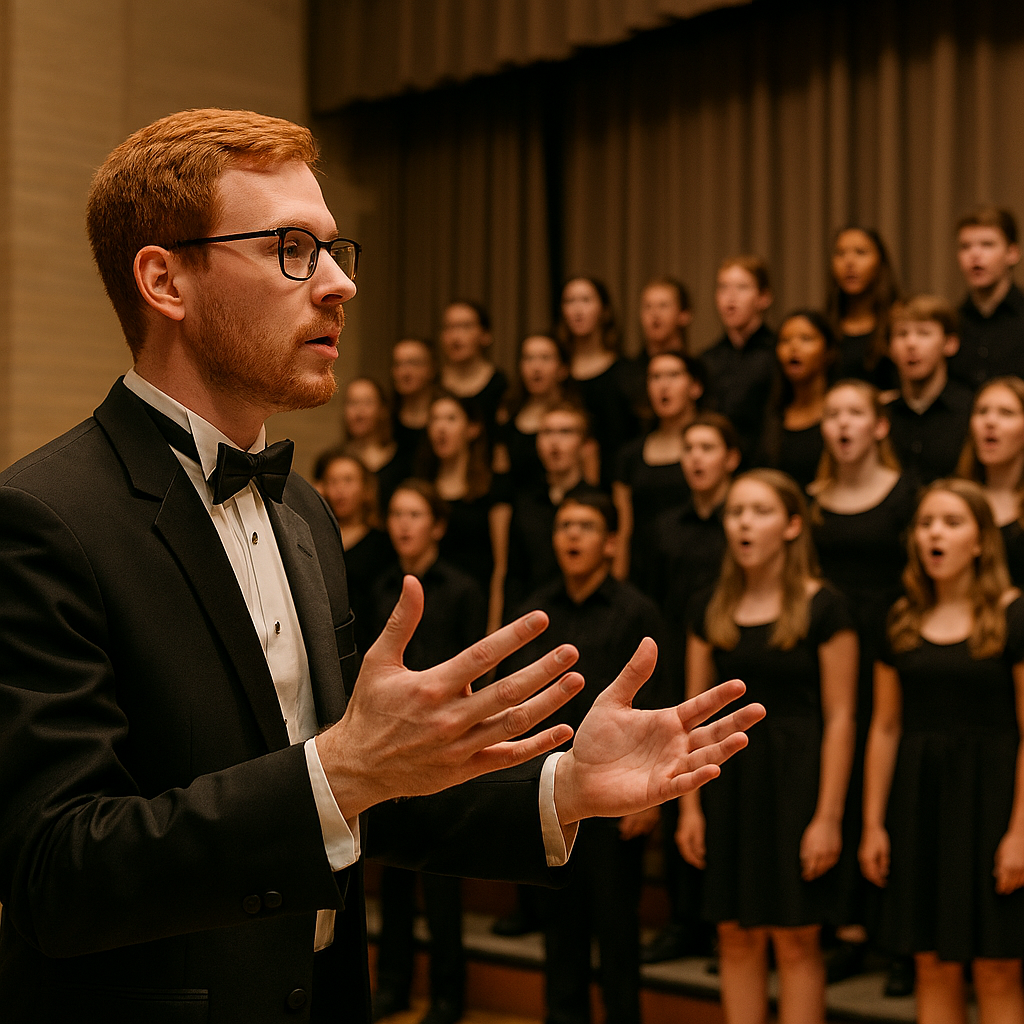
Choir director Mark Dawson leads the combined Pine City choirs in “Bridge Over Troubled Water.”
The words hung in the air, resonating with every listener. Parents thought of their children. Alumni remembered their own days in these halls. Students sang with conviction, their voices carrying both the weight of struggle and the promise of renewal.
When the final note faded, silence lingered for a heartbeat, then erupted into a standing ovation. The audience clapped, cheered, and some even shouted, “Raise the roof!”
Mark lowered his baton, his eyes shining. Danielle stood at the edge of the stage, her heart full. In six short weeks, a storm had become a movement. And on this Thursday night in May, Pine City High had found its voice.
Summer Spark: Car Wash Campaign Planning
The first Monday of summer break found Ethan Thurston unlocking the door to Room 207, not for a lesson, but for a strategy session. The air was already warm, the scent of cut grass and lilacs drifting through the open windows. He wore a Pine City High polo and khakis, his brown hair slightly tousled, a clipboard tucked under one arm.
“Okay, team,” he said as students trickled in, “we’re not just washing cars. We’re building momentum. Every dollar we raise, every conversation we spark, brings us closer to a new roof.”
The room filled quickly — student council members, cheerleaders in tank tops and ponytails, a few incoming seniors eager to help. Lily Jorgenson arrived with iced coffees for the faculty, and Marnie Thurston followed with a stack of poster board and markers.
Ethan stood at the front, gesturing to a whiteboard where he’d written:
CAR WASH DATES
• Saturday, June 14
• Saturday, July 12
• Saturday, August 9
LOCATION: Pine City Fire Station parking lot GOAL: $2,000 total + voter awareness
“We’ll need signage, social media posts, and a rotation schedule,” Ethan said. “And we’ll need to be visible. Smiles, energy, and maybe a few glittery signs wouldn’t hurt.”
A cheerleader named Tasha grinned. “We could wear our squad shirts and do a little chant while we wave signs. Something like, ‘Buckets in the halls? Help us fix the walls!’”
Laughter rippled through the room. A student council member, Jordan, added, “We should hand out flyers with the referendum info. Like, ‘Thanks for your donation — now here’s how to vote.’”
Lily nodded. “I’ll help design those. We can include a QR code that links to the district’s referendum page.”
Marnie leaned against the windowsill, her scarf fluttering slightly in the breeze. “And let’s make sure we include alumni stories on the posters. People love remembering their own time here. Nostalgia is persuasive.”
Ethan smiled. “Exactly. This is about more than soap and water. It’s about showing the community that we care — that we’re willing to work for this.”
A junior named Caleb raised his hand. “Can we do a ‘sponsor a bucket’ challenge? Like, people donate to symbolically replace one of the buckets catching leaks in the school?”
Ethan scribbled it down. “Brilliant. Let’s call it ‘Retire a Bucket.’ We’ll make a visual display at each car wash — maybe even bring a few of the actual buckets.”
The planning session stretched into the afternoon, fueled by lemonade and laughter. By the end, the students had divided into teams: promotion, logistics, signage, and voter outreach. The cheerleaders practiced chants in the hallway while the yearbook staff snapped photos for a summer campaign thread.
As the meeting wrapped up, Ethan looked around the room, pride swelling in his chest. “You’re not just raising money,” he said. “You’re raising hope. And that’s what Pine City High needs most.”
Saturday, June 14 arrived, and the sun was already high by mid‑morning, glinting off the wet pavement of the Pine City Fire Station parking lot. Buckets of soapy water lined the curb, sponges dripped suds, and the smell of car wax mingled with the scent of summer grass. A hand‑painted banner stretched across the lot: “Raise the Roof Car Wash — Donations Support Pine City High!”
Ethan Thurston stood near the entrance, clipboard in hand, brown hair damp from the humidity. He greeted each car with a smile. “Thanks for coming out today,” he said to a family in a minivan. “Every dollar helps us move closer to a new roof. And you’ll leave with the cleanest car in Pine County.”
Students bustled around him, cheerleaders waving signs at passing traffic. Tasha, her ponytail bouncing, shouted, “Buckets in the halls? Help us fix the walls!” Cars honked in response, some pulling in just to join the fun.
Jordan, a student council member, scrubbed the hood of a pickup truck and laughed. “I never thought washing cars would feel like civic duty. But hey, if soap and water get us a roof, I’m all in.”
Nearby, sophomore Jenna handed a flyer to a driver waiting in line. “Here’s info on the referendum,” she explained. “We need everyone to vote in November. Clean cars today, dry classrooms tomorrow.”
Marnie Thurston moved between groups, encouraging students with her steady presence. “Keep smiling,” she reminded them. “Every person who stops here is not just a customer — they’re a potential voter.”
Lily Jorgenson crouched beside a younger student rinsing wheels. “Make sure to get the rims,” she teased, then added more seriously, “And don’t forget to hand out flyers. People need to see the connection between what we’re doing and why.”
By noon, the line of cars stretched down the block. Alumni stopped by, reminiscing as their vehicles were scrubbed. One older man leaned out his window to say, “I graduated in ’72. The roof leaked back then too. Glad to see you kids taking charge.”
Ethan gathered the group during a lull, his voice carrying over the chatter. “Look around,” he said. “This is what community looks like. You’re not just raising money — you’re raising awareness. Every honk, every smile, every flyer handed out is one more step toward November.”
The students cheered, sponges raised like trophies. The afternoon wore on, cars gleaming as they rolled out of the lot, each driver carrying away not just a clean vehicle but a story — of students determined to save their school.
By the end of the day, the donation jar was heavy, the flyers nearly gone, and the students sunburned but exhilarated. The first car wash had been more than a fundraiser. It was proof that Pine City High’s campaign was alive and growing, one bucket of suds at a time.
By October, the air in Pine City carried the crisp bite of fallen leaves, and the urgency of the campaign matched the season’s sharpness. The car washes and concerts had raised money and awareness, but now the focus shifted: it was no longer about fundraising, it was about turnout.
Principal Danielle Savoy gathered the core team — Ethan Thurston, Lily Jorgenson, Marnie Thurston, Mark Dawson, and the student council officers — in the library one evening. The long tables were covered with stacks of flyers, voter registration forms, and maps of the district.
“We’ve done the storytelling,” Danielle said, her voice steady. “Now we need to make sure people show up at the polls. November is coming fast.”
Ethan leaned forward, brown hair falling slightly across his forehead. “The students are ready. We’ll organize canvassing teams — pairs of council members and cheerleaders — to visit neighborhoods. We’ll knock on doors, hand out flyers, and remind people what’s at stake.”
Lily added, “We should also use social media more aggressively. Daily posts, countdowns, photos of the buckets still in classrooms. People need to see the problem hasn’t gone away.”
Marnie, her scarf looped neatly around her neck, suggested another layer. “Let’s tie it to legacy. Alumni voices are powerful. If we can get graduates to write short endorsements, we’ll print them on postcards and mail them out.”
Mark Dawson smiled, his reddish hair catching the lamplight. “And the choir can help again. We’ll record a short video clip of the students singing a refrain from “Bridge Over Troubled Water.” It’ll be shared online as a reminder: this is about building a bridge to the future.”
The students listened intently, then began offering their own ideas.
Jordan, a senior council member, said, “We should set up rides to the polls. Some people won’t go unless it’s easy.”
Tasha, one of the cheerleaders, chimed in, “And we can stand outside the grocery store with signs. Not just asking for donations this time, but reminding people to vote.”
Danielle nodded, her eyes bright with determination. “Exactly. Visibility is everything. When people see your energy, they’ll remember it when they step into the voting booth.”
By mid‑October, the campaign had transformed. Students canvassed neighborhoods in pairs, their voices carrying across porches and sidewalks: “We’re raising the roof at Pine City High — please vote in November!” Alumni endorsements appeared in the local paper, and flyers with bold slogans — Protect Our Legacy. Vote Yes for the Roof. — decorated shop windows downtown.
The Legacy Wall was updated with fresh photos, showing buckets still catching water in classrooms. Tours were scheduled for community members, who walked the halls and saw firsthand the stains and drips.
As the leaves turned deeper shades of red and gold, the campaign’s rhythm matched the season: steady, relentless, and full of conviction. The students had become advocates, the teachers mentors, and the community a chorus of voices.
Election Day loomed, but Pine City High was ready.
A few days after the meeting with Mrs. Savoy, Mark Dawson posts a clip on Facebook from the Raise the Roof concert from May and “Bridge Over Troubled Water”, where he uses the clip as a campaign message:
“Last spring, our grade 7–12 choirs came together for a powerful performance of “Bridge Over Troubled Water” in the Pine City High auditorium. Under the direction of Mr. Mark Dawson, the music reminded us that even in times of challenge, we can build bridges to a stronger future.”
“Voting YES this November isn’t just about repairing a roof. It’s about building a bridge to the future — for our students, our community, and every generation that will walk these halls.Join us in raising the roof — literally and symbolically. Together, we can protect Pine City High’s legacy and ensure safe, dry classrooms for years to come.”
RaiseTheRoof #PineCityPride #BridgeToTheFuture #VoteYes
The comment thread was mostly positive and looked like this:
Sarah L. (Parent): “This gave me chills. My daughter is in the alto section — so proud of these kids. We’ll be voting YES in November!” ❤️🎶
Tom H. (Alumnus, Class of ’85): “I remember singing on that same stage. The roof leaked back then too. Time to fix it once and for all. Count me in.”
Jenna K. (Student Council Member and cheerleader): “Thanks for sharing this clip! We’ve been working hard all summer — car washes, flyers, legacy wall. Please help us finish the job by voting YES!”
Mark R. (Community Member): “Beautiful performance. The message is clear: this isn’t about luxury, it’s about safety and pride in our school.”
Tasha M. (Cheer Squad): “Buckets in the halls? Help us fix the walls! 🪣💦 Vote YES!”
Principal Danielle Savoy (official account): “Thank you to our students, staff, and community for your support. Together, we can raise the roof and protect Pine City High’s legacy.”
Caleb J. (Senior): “My dad graduated in ’94 and told me about leaks back then. We’re the generation that’s going to fix it. Let’s do this!”
Don L.: “I would like to see the district better prioritize its expenses before I vote for another tax increase. What assurances do we have that the new roof wouldn’t also fall into disrepair…or even solve the problem?”
The morning of Election Day dawned cold and clear, frost edging the lawns and the roofs of Pine City. At the high school, the buckets had been tucked away, as the forecast looked dry for the foreseeable future, but the stains on the ceiling remained, silent reminders of what was at stake.
Students arrived early, bundled in jackets, clutching coffee cups, their nerves visible in the way they paced the sidewalks. Ethan Thurston stood with a small group of student council members near the front doors, his brown hair ruffled by the wind. “This is it,” he told them quietly. “Months of work, and now it’s in the hands of the voters. All we can do is keep showing up.”
Cheerleaders waved signs at the busy intersection downtown: Raise the Roof — Vote YES! Drivers honked, some waving, others passing with unreadable expressions. Tasha shouted encouragement, her voice hoarse but determined. “Buckets in the halls? Help us fix the walls!”
Lily Jorgenson joined the cheerleaders at the intersection, her voice carrying as she handed flyers to pedestrians and encouraged neighbors. “We’re asking for your vote today,” she said warmly. “This is about protecting our legacy.”
Marnie Thurston moved among the crowd gathered near the school, her scarf wrapped tightly against the chill. She spoke softly to neighbors, reminding them of the Legacy Wall and the concert. “You saw the photos. You heard the music. This is our chance to make sure those memories don’t fade under a leaking roof.”
Mark Dawson, reddish hair bright against the gray sky, stood with Danielle Savoy at a coffee shop downtown, greeting alumni and parents away from the polling place. “Remember the Raise the Roof concert?” he asked one couple. “That spirit is what we’re carrying into today. Voting yes is building a bridge to the future.”
Principal Savoy’s calm presence steadied the students, even as nerves fluttered in their stomachs. She reminded supporters gently, “Visibility matters — but respect for the process matters too. Let’s keep our energy where it belongs: in the community.”
By afternoon, the town hummed with anticipation. At the diner, conversations turned to the referendum. At the grocery store, neighbors debated the costs and the benefits. At the fire station, where the car washes had been held, volunteers reminisced about the summer’s efforts.
As the sun dipped low, casting long shadows across Main Street, the students gathered once more at the school. They sat in Ethan’s classroom, restless, checking their phones, waiting for news. “No matter what happens,” Ethan said, his voice firm, “you’ve already made history. You turned a storm into a movement. That’s something no vote can take away.”
The night stretched ahead, heavy with suspense. Pine City waited, its future balanced on the edge of ballots cast and voices raised.
The news broke just after nine o’clock. Phones buzzed, text messages flew, and within minutes the word spread across Pine City: 58% YES, 42% NO. The referendum had passed.
In Ethan Thurston’s classroom, where students had gathered to wait out the suspense, the announcement landed like a spark. For a moment there was stunned silence, then the room erupted. Cheers, shouts, and the pounding of fists on desks filled the air.
“We did it!” Jordan shouted, leaping to his feet. “Buckets are retired!”
Tasha, still in her cheer squad hoodie, spun in a circle and laughed. “No more chanting about leaks — we actually fixed it!”
Ethan, his brown hair falling into his eyes as he tried to calm the room, couldn’t help but grin. “You turned a storm into a movement. This is your victory. Remember that.”
Down on 1st floor in her office, Principal Danielle Savoy was on the phone with a board member when the news reached her. She pressed a hand to her chest, relief flooding her voice. “Thank you. Thank you. Pine City High will finally have the roof it deserves.” When she hung up, she hurried to the commons area near the foyer, where students were already gathering.
Mark Dawson arrived in his tuxedo jacket — he had worn it again for the symbolic night — and raised his arms like a conductor. “Bridge to the future, friends. That’s what we built tonight.” His reddish hair caught the light as he laughed, swept up in the joy of his students.
Lily Jorgenson, scarf draped neatly over her shoulders, hugged one of her seniors. “You showed this town what spirit looks like. You didn’t just campaign — you taught everyone what it means to care.”
Marnie Thurston stood near the Legacy Wall, tears in her eyes as she watched students tape up a new headline: REFERENDUM PASSES — ROOF TO BE REPLACED. She whispered, “This wall was always about memory. Now it’s about renewal too.”
The cheerleaders led an impromptu chant in the commons: “Raise the Roof! Raise the Roof!” Their voices echoed through the building, bouncing off the stained ceilings soon to be repaired.
Parents and alumni trickled in, drawn by the noise and the news. One alumnus from the class of ’72 shook Ethan’s hand. “I never thought I’d see this day. You kids made it happen.”
The night stretched on with laughter, hugs, and the kind of joy that comes only when a community sees its hard work rewarded. Pine City High’s roof still leaked, but now it was only a matter of time. The buckets would be gone, the stains erased, and the legacy preserved.
For the students, staff, and town, November 4 had become more than Election Day. It was the night Pine City High raised its roof — and its spirit — together.
The next morning, the auditorium smelled faintly of fresh coffee and maple syrup from the teachers’ lounge, but the air was electric with anticipation. Students filed in, chatter bouncing off the seats, their jackets still dusted with frost from the walk to school. The banners from the “Raise the Roof” concert had been rehung, and a new sign stretched across the stage: “Thank You, Pine City — The Roof Will Rise!”
Principal Danielle Savoy stood at the podium, her smile radiant. She waited until the noise settled, then spoke with a voice that carried both relief and pride. “Last night, Pine City made history. With 58% of the vote, our community said YES. Yes to safe classrooms. Yes to protecting our legacy. Yes to raising the roof for generations to come.”
The auditorium erupted in cheers, students stomping their feet on the floor, teachers clapping until their hands stung. Ethan Thurston stepped forward next, his brown hair neatly combed, his voice steady but brimming with emotion. “You turned a storm into a movement. From car washes to flyers, from chants on street corners to conversations at kitchen tables — you showed this town what student leadership looks like. I couldn’t be prouder.”
Jordan, one of the senior council members, shouted from the front row, “Buckets are retired!” The cheerleaders picked it up instantly, chanting in rhythm: “Buckets are retired! Buckets are retired!” The auditorium shook with laughter and applause.
Mark Dawson, dressed in his familiar tuxedo jacket for symbolism, raised his hands like a conductor. “Remember the concert? “Bridge Over Troubled Water.” That wasn’t just a song — it was a promise. And today, we know the bridge is real. You built it.” His reddish hair gleamed under the stage lights as the students roared their approval.
Lily Jorgenson, scarf draped neatly over her shoulders, took the microphone next. “You proved that spirit isn’t just for pep rallies. It’s for life. You showed courage, creativity, and heart. And you reminded this town that Pine City High is worth fighting for.”
Marnie Thurston stood quietly at the edge of the stage, tears in her eyes. When Danielle beckoned her forward, she spoke softly, but the auditorium hushed to hear her. “The Legacy Wall was always about memory. Now it’s about renewal too. You’ve given us a future to match our past.”
The assembly ended with the choir, summoned by Mark, singing a reprise of “Bridge Over Troubled Water.” Their voices rose, filling the auditorium with warmth and triumph. Teachers stood arm in arm, students swayed together, and for a moment, the leaks and stains seemed already gone.
As the final note faded, Danielle raised her hand. “This is our victory. But more than that — it is our legacy. Pine City High will stand strong because of you.”
The applause was deafening, echoing through the rafters. For the first time in years, the roof above them felt less like a burden and more like a promise.
By the following summer, Pine City High School’s long‑awaited roof replacement was finally underway. On the last day of school, students and staff gathered outside the building, their cheers mingling with the rumble of machinery as the roofing contractor arrived to begin stripping away the old, weather‑worn material that had leaked and sagged beyond its service life. The timing felt symbolic — the school year closing just as renewal began — and teachers stood with their classes watching the first tar paper and membrane lifted away, knowing that when they returned in the fall, a new roof would stand as both protection and promise for generations to come.
Chapter 2: The Weight Of Guidance
The library at Ewen‑Trout Creek carried the hum of late‑summer anticipation. Faculty gathered around long tables, the scent of fresh coffee mingling with the faint polish of the floors. Superintendent Jim Erickson stood at the front, his voice steady and ceremonial. “Today marks a new chapter,” he began. “After decades of service, Principal Marlene Koski has retired. It’s my honor to introduce her successor, Tara Lindstrom, joining us from Iron Mountain.” Applause filled the room as Tara stepped forward. At forty‑one, she carried herself with brisk confidence, her dark hair pinned neatly, her smile both approachable and commanding. “I’m grateful to be here,” she said. “Ewen‑Trout Creek has a reputation for resilience and heart. I intend to honor that legacy while helping us grow.”
Allison Besonen sat among her colleagues, listening closely. Tara’s tone was firm but encouraging, and her eyes swept the room with a kind of quiet assurance. Allison felt a flicker of curiosity — what would this new leadership mean for her role, for the English department, for the school’s rhythm? The meeting moved on to schedules, curriculum updates, and the usual August logistics. But the introduction lingered in Allison’s mind. Tara Lindstrom was not Marlene Koski — she was something new, and Allison sensed she would soon be tested under her watch.
A week later, during the inservice period, Allison found herself in a smaller, more intimate meeting. The conference room was quiet, sunlight spilling across the table where Tara sat with a folder in front of her. Beside her was a young man with sharp posture and a practiced smile. Tara spoke first. “Allison, I wanted to meet with you personally. Marlene left me a strong recommendation about your mentorship last spring with Elise Lahti. She said you guided her with skill and care, and that Elise thrived under your supervision. I’d like you to take on another student teacher this fall.”
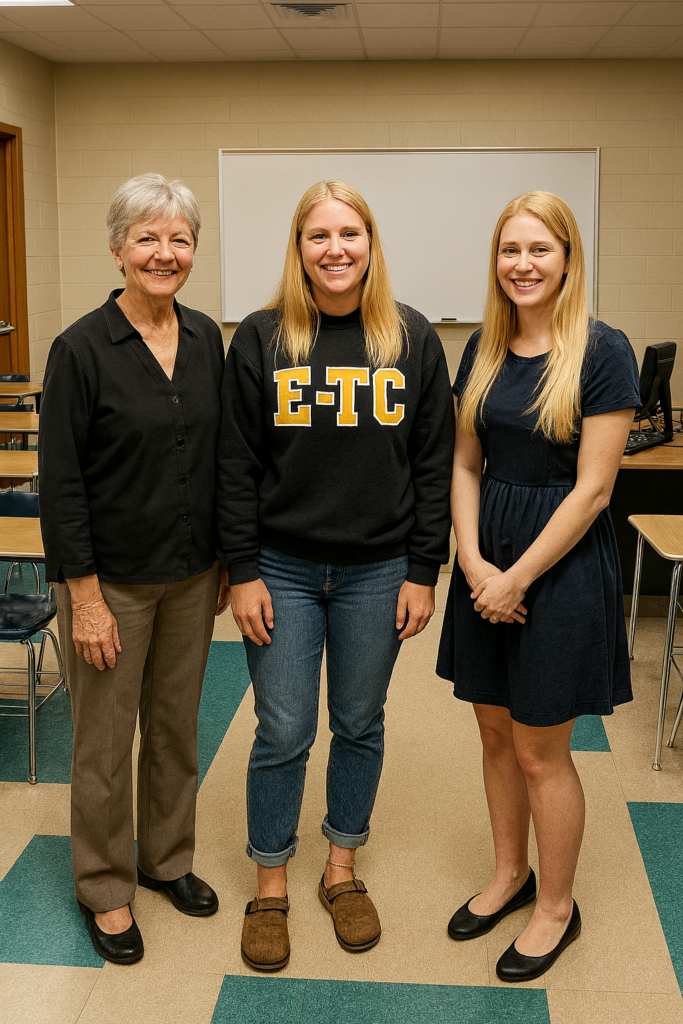
(left to right) Outgoing Ewen-Trout Creek School principal Marlene Koski, 67, english teacher Allison Besonen, 26, and student teacher Elise Lahti, 22, Northern Michigan University english education major from Crystal Falls, Michigan, together in Allison’s classroom where Allison is supervising Elise.
Allison nodded, pride and pressure mingling in her chest. Elise had been a joy — their rapport natural, their shared heritage a bridge. A few of Allison’s colleagues even joked that Elise looked like she could be Allison’s younger sister. They resembled each other and their mannerisms were so much alike. And Elise thrived under Allison. Shortly after completing her time at Ewen-Trout Creek and graduating from Northern Michigan University in Marquette, Elise landed her own full-time teaching position in Escanaba. Allison also kept in touch with Elise, having made a new friend. But for Allison, repeating that success she had with Elise felt daunting.
Tara gestured to the young man. “This is Ian Racette, a senior at Northern Michigan University. He’ll be joining us for his student teaching in English.” Ian extended a hand. “I’m excited to be here,” he said, his voice clear, almost rehearsed. His handshake was firm, his smile polite, but Allison noticed something in his manner — a slight stiffness, a laugh that landed a beat late, eyes that darted too quickly. Bright, yes. Ambitious, certainly. But not at ease. “You’ll be working closely with Allison,” Tara continued. “She’s earned a reputation for strong mentorship, and I have every confidence you’ll thrive under her guidance.”
Allison returned Ian’s smile, though inwardly she felt a flicker of unease. Mentorship was never simple, and rapport couldn’t be forced. Elise had been a gift. Ian, she suspected, would be different. The meeting ended with polite words and firm plans, but as Allison walked back down the hallway, she carried the weight of guidance once more — heavier this time, with the sense that the year ahead would test her in ways she hadn’t yet faced.
The first day of school the following week dawned with a crisp breeze and the scent of pine drifting through the open windows of Ewen-Trout Creek. Allison Besonen stood in her classroom early, arranging desk groups and checking her lesson plans. Her bulletin board displayed quotes from Finnish poets and a laminated photo of Elise Lahti, tucked discreetly in the corner — a quiet reminder of last spring’s triumph. Ian Racette arrived ten minutes before the bell, dressed neatly in khakis and a button-down shirt, his backpack slung over one shoulder. “Morning,” he said, setting his things down at the side desk Allison had designated for him.
“Morning,” Allison replied. “Ready for the first wave?”
“I’ve got my notes,” Ian said, tapping his laptop. “I figured I’d start with a short icebreaker and then jump into the syllabus.”
Allison blinked. “We’re co-teaching today. I’ll open with introductions and expectations, then you can lead the icebreaker. We’ll ease into the syllabus tomorrow.”
Ian hesitated, then nodded. “Sure. That works.” But his tone was clipped, and Allison felt the first ripple of resistance.
By Wednesday, the ripple had grown. During second period, Ian launched into a grammar mini-lesson without checking the pacing Allison had outlined. He spoke quickly, using terminology that confused the ninth graders.
“Can anyone tell me what a gerund phrase is?” he asked, scanning the room. Silence. A few students glanced at Allison.
She stepped in gently. “Let’s back up. Before we get to gerund phrases, we need to review verbals. Remember Monday’s notes?”
Ian’s jaw tightened. “I thought they were ready for the next step.”
After class, Allison pulled him aside. “Ian, I appreciate your initiative, but we need to build a foundation first. Ninth grade grammar takes time.”
Ian crossed his arms. “I just think they’ll rise to the challenge if we stop babying them.”
Allison kept her voice calm. “It’s not babying. It’s scaffolding. If they don’t understand the basics, they’ll tune out.”
He nodded, but his eyes didn’t meet hers. “I’ll adjust.”
By Friday, the tension was palpable. Ian had forgotten to submit his lesson reflection — a requirement Allison had emphasized. When she reminded him, he sighed audibly.
“I’ve been swamped,” he said. “I didn’t think it was urgent.”
“It’s part of your evaluation,” Allison replied. “I need to see how you’re processing the week.”
Ian shrugged. “I’ll get it to you eventually.”
Allison paused, choosing her words carefully. “Ian, this isn’t just about teaching content. It’s about being teachable yourself. I want to support you, but I need you to meet me halfway.”
He looked at her then, eyes guarded. “I’m trying. I just have a different style.”
She nodded slowly. “Style is fine. But growth requires reflection. Let’s talk Monday.”
As he left the room, Allison sat down at her desk, the weight of guidance pressing heavier than it had with Elise. This mentorship would not be easy. But she wasn’t ready to give up. Not yet. The conference room at Ewen-Trout Creek on Friday afternoon smelled faintly of lemon cleaner and fresh coffee. A soft rain tapped the windows, blurring the view of the pine trees beyond. Tara Lindstrom sat at the head of the table, her blouse neatly pressed, a legal pad open in front of her. Allison Besonen arrived with her laptop and a folder of notes, her expression composed but tired. Tara smiled warmly.
“Thanks for coming in, Allison. I wanted to touch base after the first week. How are things going with Ian?”
Allison settled into the chair across from her, brushing a strand of hair behind her ear. “It’s… mixed,” she said carefully. “He’s bright. He’s prepared. But he’s not very receptive to feedback.”
Tara nodded, pen poised. “Can you give me an example?”
“Wednesday,” Allison said. “He jumped ahead in the grammar sequence without checking our pacing. The students were lost. I tried to redirect gently, but afterward he told me I was ‘babying’ them.”
Tara’s eyebrows lifted slightly. “That’s a strong word.”
“I know,” Allison said. “I reminded him that scaffolding isn’t coddling. But he’s resistant. He didn’t submit his reflection on time either. When I followed up, he said he’d get to it ‘eventually.’”
Tara leaned back, thoughtful. “That’s frustrating. Especially after how well things went with Elise.”
Allison nodded. “It’s hard not to compare. Elise was collaborative from day one. Ian’s more guarded. He listens, but I can tell he’s not absorbing.”
Tara tapped her pen lightly against the pad. “It’s early,” she said gently. “Some student teachers take longer to adjust. He might be feeling pressure, or trying too hard to prove himself.”
“I’ve considered that,” Allison said. “I’m trying to be patient. But I also have a classroom to protect. I can’t let his missteps affect the students.”
“Agreed,” Tara said. “You’re the lead teacher. Your instincts matter. But let’s give it another week. Keep documenting, keep offering feedback. If things don’t improve, we’ll revisit the structure.”
Allison exhaled slowly. “Okay. I can do that.”
Tara smiled again, reassuring. “You’re not alone in this. I trust your judgment. And I know you’ll handle this with the same care you gave Elise.”
Allison nodded, grateful for the support but still carrying the weight. As she left the room, the rain outside had stopped, but the clouds lingered — a fitting metaphor for the mentorship ahead.
The hum of fluorescent lights filled Allison Besonen’s classroom as the ninth graders settled into their seats. Outside, the September sun filtered through the pine trees, casting shifting shadows across the desks. Allison had planned a guided discussion on To Kill a Mockingbird, easing students into themes of justice and empathy. Ian Racette, standing at the front with a stack of notes, seemed eager to take the lead.
“All right,” Ian began, his voice brisk. “Let’s talk about symbolism. Who can explain the significance of the mockingbird in the novel?”
A few hands went up hesitantly. Ian called on a student, who stumbled through a partial answer. Instead of building on it, Ian frowned. “No, that’s not quite right. The mockingbird isn’t about innocence. It’s about weakness. It’s prey.”
The room went still. Allison’s eyes narrowed. She could see confusion ripple across the students’ faces — they had just spent the previous day discussing the mockingbird as a symbol of innocence and goodness.
She stepped forward, her tone firm but calm. “Let’s pause here,” she said, addressing the class. “Remember what we read yesterday? Atticus tells Scout that it’s a sin to kill a mockingbird because they don’t harm anyone — they only sing. The mockingbird represents innocence, not weakness.”
Ian shifted uncomfortably, his jaw tightening. “I was trying to push them to think critically,” he said, glancing at Allison.
Allison met his gaze evenly. “Critical thinking is important, but accuracy matters too. If we misrepresent the text, students lose trust in the discussion. Let’s clarify together.”
Turning back to the class, she continued, “The mockingbird is a symbol of those who are innocent yet vulnerable — like Tom Robinson or Boo Radley. They’re harmed not because they’re weak, but because society fails to protect them.”
The students relaxed, nodding, scribbling notes. One whispered, “That makes more sense.”
Ian stood stiffly at the side, his notes clutched in his hand. Allison gave him a small, professional nod. “Why don’t you take the next question, Ian? Let’s focus on how the courtroom scene connects to this symbol.”
He cleared his throat, adjusted his papers, and moved on, though the edge in his voice lingered.
As the class ended, Allison dismissed the students with a smile, then turned to Ian. “We’ll need to talk after school,” she said quietly. “Accuracy first, then challenge. That’s the balance.”
Ian nodded curtly, avoiding her eyes. Allison sighed inwardly. The weight of guidance pressed heavier with each passing day.
The classroom was quiet after the last bell, the hum of the fluorescent lights filling the silence. Allison Besonen sat at her desk, a stack of essays beside her, waiting as Ian Racette lingered near the whiteboard, erasing half‑finished notes with sharp strokes.
“All right, Ian,” Allison began, her tone measured. “Let’s talk about today’s lesson. When you told the class the mockingbird symbolized weakness, that contradicted what we’ve been building. It confused them.”
Ian turned, marker still in hand. “I was trying to push them to think differently. Isn’t that what we’re supposed to do? Challenge them?”
“Yes,” Allison said, leaning forward slightly. “But challenge has to be grounded in accuracy. If we misrepresent the text, we lose credibility. They need to trust what’s being taught.”
Ian crossed his arms, his jaw tight. “Maybe your way is too safe. You spoon‑feed them, and they parrot back what you want. I’m trying to make them independent thinkers.”
Allison inhaled slowly, keeping her voice calm. “Independence comes after foundation. You can’t build critical thought on shaky ground. That’s why scaffolding matters.”
Ian’s voice rose. “Or maybe you just don’t like that I have a different style. Elise probably did everything your way, and you loved it. I’m not Elise.”
The words stung, but Allison kept her composure. “You’re right — you’re not Elise. And I don’t expect you to be. But I do expect professionalism. That means listening to feedback, reflecting, and adjusting.”
Ian shook his head, pacing a few steps. “I don’t need someone micromanaging me. I’ve made it this far in my program without hand‑holding.”
Allison stood now, her voice firm. “This isn’t hand‑holding. It’s mentorship. And part of being a teacher is being teachable yourself. If you resist every correction, you’re not just hurting yourself — you’re hurting the students.”
For a moment, the room was taut with silence. Ian’s face flushed, his eyes flashing. “Maybe I don’t need this placement,” he muttered. “Maybe I’d be better off somewhere else.”
Allison’s heart sank, but she steadied her tone. “That’s your choice. But if you stay here, you need to respect the process. I want you to succeed, Ian. I really do. But success requires humility.”
Ian grabbed his backpack, slinging it over his shoulder. “We’ll see,” he said flatly, and walked out, the door closing with a sharp click.
Allison sat back down, staring at the essays on her desk. The weight of guidance pressed heavier than ever. Elise had been a triumph. Ian was becoming a trial. And the year had only just begun.
The office smelled faintly of brewed coffee and pine cleaner, the kind of scent that clung to Ewen‑Trout Creek’s hallways in September. Tara Lindstrom sat behind her desk, her posture composed, a pen resting lightly between her fingers. Allison Besonen entered quietly, closing the door behind her. She looked tired, her shoulders heavy with the week’s strain.
Tara gestured to the chair across from her. “Sit, Allison. Tell me what’s going on.”
Allison lowered herself into the seat, exhaling. “It’s Ian. We had another clash today. He contradicted the symbolism lesson in front of the class, and when I corrected him, he accused me of spoon‑feeding the students. After school, I tried to offer constructive feedback, but he escalated. He said maybe he doesn’t need this placement.”
Tara’s brows knit together, though her voice remained calm. “That’s serious. Did he walk out?”
“He left abruptly,” Allison admitted. “But he hasn’t said he’s quitting outright. Still, I’m worried. He resists feedback, and the students are starting to notice the tension.”
Tara leaned back, tapping the pen against her notepad. “It’s early, but this isn’t the kind of resistance we can ignore. You’re doing your job — offering guidance, protecting the classroom. If he refuses to engage, we may need to involve his supervising professor at Northern Michigan.”
Allison nodded slowly. “I wondered if it was time. Elise thrived because she welcomed mentorship. Ian… he pushes back at every turn. I don’t want to fail him, but I can’t let the students suffer.”
Tara’s gaze softened. “You’re not failing him. Mentorship isn’t about guaranteeing success — it’s about offering the opportunity. If he rejects it, that’s his choice. But we’ll document everything, and if necessary, I’ll call his professor. Sometimes an outside voice helps reset expectations.”
Allison folded her hands in her lap. “I want him to succeed. I really do. But I can’t carry this alone.”
“You won’t,” Tara said firmly. “I trust your judgment, Allison. Keep notes, keep trying. And if he continues to resist, we’ll escalate. You’re not just protecting your classroom — you’re modeling professionalism. That matters.”
Allison felt a flicker of relief, though the weight remained. “Thank you, Tara. I’ll keep at it.”
As she left the office, the hallway lights flickered on, casting long shadows across the lockers. Allison knew the path ahead would be difficult, but at least she wasn’t walking it alone. Tara’s support — and perhaps the involvement of Northern Michigan — would be the next step in carrying the weight of guidance.
Morning light filtered through the tall windows of Ewen‑Trout Creek, painting the classroom in pale gold. Allison Besonen arrived early, her lesson plans spread neatly across her desk. She had slept poorly, replaying Ian’s words from the day before — “Maybe I don’t need this placement.” The uncertainty gnawed at her. Would he even show up?
At 8:05, the door opened. Ian Racette stepped inside, his backpack slung over one shoulder, his expression guarded but composed. “Morning,” he said, voice clipped.
Allison looked up, steady but neutral. “Morning, Ian. Glad you’re here.”
He set his things down at the side desk, avoiding her eyes. The silence stretched until Allison broke it. “Today, I’ll lead the main discussion. You can observe and take notes. We’ll talk afterward.”
Ian frowned slightly. “I thought I was supposed to teach part of the lesson.”
“You will,” Allison replied evenly. “But after yesterday, I need to reset the pace. The students need clarity, and I need to see how you process before you step back in.”
The bell rang, and the ninth graders shuffled in, chatter filling the room. Allison greeted them warmly, launching into a guided reading of To Kill a Mockingbird. She asked questions, drew connections, and invited students to share. The atmosphere was calm, steady — the kind of rhythm she knew they needed.
Ian sat at the side desk, scribbling notes, his jaw tight. A few times he shifted as if to interject, but Allison’s presence at the front was firm. She didn’t leave space for him to derail.
When class ended, students filed out, some pausing to thank Allison for clarifying yesterday’s confusion. Ian lingered, his notebook closed.
“Allison,” he said finally, “I felt sidelined.”
She met his gaze. “You weren’t sidelined. You were given space to observe. Teaching isn’t just about speaking — it’s about listening, reflecting, and adjusting. Tomorrow, if your notes show thoughtful reflection, I’ll let you take a portion again.”
Ian exhaled sharply, but nodded. “Fine.”
As he left, Allison sat back at her desk, the weight of guidance pressing but steady. He had returned. He hadn’t quit. But the path forward would require boundaries — and patience.
Friday afternoon settled heavy over Ewen‑Trout Creek, the hallways quiet after the last bus had pulled away. Allison Besonen sat at her desk, her planner open, waiting for Ian Racette to arrive. She had asked him to bring his observation notes — the reflections she had insisted on after sidelining him earlier in the week.
The door creaked open. Ian stepped in, his backpack slung low, a notebook in his hand. He looked tired but composed. “I’ve got them,” he said, setting the notebook on her desk.
Allison flipped it open, scanning the pages. To her surprise, there were entries for each day: bullet points on pacing, notes about student reactions, even a few self‑critiques. One line caught her eye: I jumped ahead too fast on grammar. Students weren’t ready. Need to slow down.
She looked up. “You did the reflections. And you were honest.”
Ian shifted in his chair. “I figured you’d want detail. I still think I was trying to challenge them, but… yeah, I saw their faces. They were lost.”
Allison nodded. “That’s growth, Ian. Recognizing when something doesn’t land is the first step. You don’t have to agree with me on everything, but you do need to reflect. That’s how you improve.”
He leaned back, arms crossed loosely this time. “I don’t like feeling micromanaged. But… I get that you’re trying to help. I’ll keep doing the notes.”
Allison softened her tone. “I’m not here to micromanage. I’m here to mentor. Elise thrived because she leaned into feedback. You don’t have to be Elise, but you do have to be teachable. That’s the difference between surviving student teaching and succeeding at it.”
Ian gave a small nod, his expression less defensive than before. “Fair enough. I’ll try.”
Allison closed the notebook and handed it back. “Good. Next week, I’ll let you take part of the lesson again. But remember — accuracy first, then challenge. Build the foundation before you push them.”
As Ian left the room, Allison sat back, exhaling. The week had been heavy, but perhaps the weight was shifting. He hadn’t quit. He had reflected. And maybe, just maybe, he was beginning to listen.
The principal’s office was quiet in the late afternoon, sunlight slanting across the bookshelves and catching the edges of framed certificates. Tara Lindstrom sat behind her desk, her expression calm but attentive, as Allison Besonen settled into the chair opposite her. Allison carried her usual folder of notes, though today her posture was less tense — she had regained some confidence after keeping the classroom steady despite Ian’s resistance.
Tara smiled. “I wanted to check in. I heard how you handled the lesson yesterday. You set boundaries, kept control, and turned it into a teachable moment for Ian. That’s exactly what strong classroom leadership looks like. It was an extremely valuable experience for him.”
Allison exhaled, a small smile tugging at her lips. “Thank you. It felt good to reassert control. The students needed clarity, and Ian needed to see that I wasn’t going to let things slide.”
Tara nodded, then leaned forward slightly. “That said, I do have one piece of feedback. I’ve noticed you’ve mentioned Elise a few times around Ian — how well she did, how she thrived under your mentorship. Ian hears that, and I think he feels like Elise is on a pedestal he’s expected to climb onto. He sees it as unfair, because his style is different.”
Allison frowned, thoughtful. “I didn’t mean it that way. Elise was just… such a success story. It’s hard not to think of her as the model.”
“I understand,” Tara said gently. “She was strong, and you’re right to be proud of her. But Ian isn’t Elise. He’s not going to mirror her, and comparing them only fuels his defensiveness. He has a valid point — even if his attitude isn’t always great. He deserves the chance to be evaluated on his own terms.”
Allison nodded slowly, her hands folded in her lap. “You’re right. I’ve stayed friends with Elise since she graduated, and I think I’ve let that closeness color how I see Ian. It’s not fair to him.”
“Exactly,” Tara said. “Celebrate Elise privately, but with Ian, focus on his progress, his reflections, his growth. Even small steps matter. If he feels you’re measuring him against someone else, he’ll resist harder.”
Allison sighed, then smiled faintly. “That makes sense. I’ll stop referring to Elise around him. He needs to know I see him as his own teacher, not as someone living in her shadow.”
Tara’s smile widened. “Good. That’s the adjustment that will help both of you. Keep setting boundaries, keep documenting, but let him know you’re judging him on his own merits. That balance will make the mentorship stronger.”
As Allison left the office, the hallway lights flickered on, casting long shadows across the lockers. She carried Tara’s words with her — a reminder that guidance wasn’t just about correcting mistakes, but about seeing each mentee as their own story. Elise had been a triumph. Ian was a trial. But he deserved the chance to be measured by his own path.
The September air carried a crispness that hinted at autumn, and Allison Besonen felt steadier as she arranged her classroom for the day. Tara’s words echoed in her mind: Stop comparing him to Elise. See him on his own terms. Allison had taken the advice to heart. Today, she would give Ian space to teach without the shadow of anyone else’s success hanging over him.
When the bell rang, Ian Racette stood at the front of the room, his tie slightly askew but his notes organized. He cleared his throat. “Okay, everyone. Today we’re going to look at character motivation in To Kill a Mockingbird. Specifically, why Atticus chooses to defend Tom Robinson.”
The students leaned in, curious. Ian’s voice was confident, though a little rushed. “Atticus knows he’ll lose. He knows the town will criticize him. But he does it anyway. Why?”
A hand shot up. “Because he believes in fairness,” a student offered.
Ian nodded. “Yes, fairness. But also integrity. He says he couldn’t hold his head up if he didn’t. That’s motivation — doing the right thing even when it costs you.”
Allison watched from the side, noting the improvement. His pacing was better, his explanation clearer. Still, he stumbled when a student asked about the town’s reaction. Ian hesitated, then gave a vague answer that left the class unsatisfied.
Allison stepped in gently. “Let’s add to that. The town’s reaction shows the pressure of conformity — how hard it is to stand against the majority. Atticus models courage, even when others don’t.”
Ian nodded quickly, picking up the thread. “Right. So motivation isn’t just about personal belief. It’s about how you act when everyone else disagrees.”
The students scribbled notes, the discussion flowing again.
After class, Allison approached him. “You did better today,” she said, her tone warm but professional. “Your pacing was stronger, and you connected with the students. You still need to prepare for follow‑up questions — that’s where you lost them. But you recovered well.”
Ian looked down at his notes, then back at her. “I guess I did okay. I still feel like you’re watching for every mistake.”
“I’m watching for growth,” Allison corrected gently. “And I saw it today. You’re moving forward. Keep building on that.”
For the first time, Ian’s expression softened. “Thanks. I’ll work on anticipating questions.”
Allison smiled faintly. “Good. That’s progress.”
As he left the room, Allison felt the weight of guidance shift slightly. It was still heavy, but now it carried a glimmer of hope. Ian wasn’t Elise — and that was fine. He was beginning to find his own footing, and Allison was learning to see him as his own story.
The hum of anticipation filled Allison Besonen’s classroom as the ninth graders shuffled into their seats. Today was different — Principal Tara Lindstrom sat quietly at the back, her legal pad balanced on her lap, observing with a calm, attentive gaze. Allison felt the weight of her presence but kept her expression neutral, determined to let Ian Racette take the lead.
Ian stood at the front, his tie neatly knotted, his notes spread across the podium. He cleared his throat. “All right, everyone. Today we’re going to talk about courage in To Kill a Mockingbird. Not just Atticus, but Scout and Jem too.”
The students leaned forward, curious. Ian’s voice was steady, though a little fast. “Courage isn’t just about fighting. It’s about standing up when you’re scared. Like when Scout diffuses the mob outside the jail. She doesn’t fight them — she talks to them.”
A hand shot up. “But wasn’t that kind of an accident? She didn’t know what she was doing.”
Ian hesitated, fumbling. “Well… maybe. But it still counts as courage.” His answer hung awkwardly, and a few students exchanged uncertain glances.
Allison stepped in gently. “Let’s build on that. Scout’s innocence reminds the mob of their humanity. She doesn’t plan it, but her honesty shifts the moment. That’s courage too — the kind that comes from being true to yourself.”
Ian nodded quickly, picking up the thread. “Right. So courage isn’t always planned. Sometimes it’s instinct. That’s what makes it powerful.”
The discussion regained momentum, students scribbling notes and offering examples. Tara watched silently, her pen moving across the page.
When the bell rang and the students filed out, Tara rose from her chair. “Thank you both,” she said, her voice warm but measured. “Ian, you brought good energy to the lesson. You connected courage to multiple characters, which gave students a broader view. That’s progress.”
Ian straightened, a flicker of pride in his eyes. “Thanks. I thought it went better.”
Tara nodded, then added, “But you need to slow down. When students ask questions, don’t rush past them. Sit with their uncertainty. That’s where deeper learning happens.”
Ian’s smile faltered slightly, but he nodded. “I’ll work on that.”
Tara turned to Allison. “And Allison, you did well stepping in without overshadowing. You clarified, then handed the thread back to Ian. That balance is exactly what mentorship should look like.”
Allison felt a small swell of relief. “Thank you. I’ve been trying to let him find his footing.”
Tara’s gaze softened. “Good. Keep doing that. Ian is making progress, even if it’s uneven. He doesn’t need to be Elise — he needs to be himself. And you’re helping him get there.”
Ian glanced at Allison, his expression less defensive than before. “I guess I do need to slow down,” he admitted quietly.
Allison smiled faintly. “That’s growth, Ian. Keep building on it.”
As Tara left the room, the air felt lighter. The weight of guidance was still there, but now it was shared — a triangle of teacher, student teacher, and principal, each shaping the path forward.
The hum of the school’s heating system filled Tara Lindstrom’s office as the late‑afternoon light slanted across the blinds. Allison Besonen sat opposite Tara, her folder of notes resting on her lap, her posture attentive but weary. Tara set her pen down and leaned forward, her expression warm but serious.
“Allison,” Tara began, “I want to thank you for how you handled Ian’s lesson today. You gave him space to lead, but you stepped in when the students needed clarity. That balance is hard to strike, and you did it well.”
Allison nodded, though her brow furrowed. “He’s improving, but it’s uneven. He still rushes, and sometimes his answers feel shallow. I worry the students notice.”
“They do,” Tara said gently. “But they also notice how you redirect without undermining him. That’s part of your strength as a mentor — you protect the classroom while still giving him dignity. That’s not easy.”
Allison exhaled, a faint smile tugging at her lips. “I’ve been trying to let him find his footing. It’s hard not to step in too much.”
Tara tapped her fingers lightly against the desk. “That’s the balance I want you to keep refining. You’re very good at scaffolding — not just for students, but for Ian. You anticipate where he’ll stumble and prepare to catch him. That’s a gift. But sometimes, you over‑prepare. You carry the weight for him instead of letting him feel it himself.”
Allison tilted her head, thoughtful. “So I need to let him struggle more?”
“Exactly,” Tara said. “Struggle is part of growth. You’ve already set boundaries, and that’s excellent. Now, let him wrestle with the discomfort of teaching. Step in when the class truly needs it, but otherwise, let him sit with the silence, the uncertainty. That’s how he’ll learn resilience.”
Allison folded her hands, considering. “I see that. I’ve been so focused on protecting the students that I forget he needs to experience the challenge too.”
Tara smiled. “And that’s why you’re a strong mentor. You care deeply about your students, but you also care about the teachers you guide. Ian is making progress — not at Elise’s pace, not with her style, but in his own way. And you’re learning to mentor different personalities. That’s growth for you, too.”
Allison’s shoulders eased, a quiet relief settling in. “Thank you, Tara. I’ll keep working on that balance.”
“Good,” Tara said, her voice firm but encouraging. “You’re not just teaching students — you’re shaping future teachers. And that requires patience, boundaries, and trust in the process. You’re doing well, Allison. Keep leaning into your strengths, but don’t be afraid to let Ian carry more of the weight himself.”
Allison’s Journal — Weekend, Late September
Saturday evening, September 27
The house is quiet tonight, and I finally have a moment to breathe. Four weeks into the school year, and already it feels heavier than the last. Elise’s mentorship last spring was such a joy — effortless, affirming, almost like watching a younger version of myself bloom. With Ian, everything feels harder. He resists, he bristles, he pushes back against feedback as though it’s a threat instead of a gift.
And yet, this week gave me a glimpse of progress. His lesson on courage wasn’t perfect — he rushed, he stumbled, he gave shallow answers — but he also connected with the students in a way I hadn’t seen before. He’s beginning to see that teaching isn’t about performance, it’s about listening. Tara reminded me not to compare him to Elise, and she’s right. I’ve been guilty of holding him against her shadow, and that isn’t fair. Ian deserves to be measured by his own growth, not someone else’s success.
I’m grateful for Tara. Her leadership feels steady, confident, and kind. She doesn’t hover, but she notices. She trusts me, and she challenges me too — reminding me that mentorship isn’t just about protecting students, but about letting the student teacher struggle enough to grow. That’s hard for me. I want to shield everyone from discomfort. But Tara’s words stay with me: Struggle is part of growth.
So I’ll keep trying. I’ll keep setting boundaries, but I’ll also let Ian carry more of the weight himself. Maybe he’ll stumble. Maybe he’ll resist again. But maybe, just maybe, he’ll learn. And maybe I’ll learn too — that guidance isn’t about perfection, but about patience, resilience, and trust.
For now, I’ll close my notebook and let the quiet of the evening settle in. Monday will come soon enough.
The September sun slanted through the tall windows, casting long rectangles of light across the desks. Allison Besonen stood at the side of the classroom, her lesson plan tucked neatly into her folder. Today, she had resolved to follow Tara’s advice: let Ian struggle, let him feel the weight himself.
Ian Racette stood at the front, his tie slightly loose, his notes spread across the podium. “Okay,” he began, his voice steady but quick. “We’re going to talk about point of view in To Kill a Mockingbird. Why does Harper Lee choose Scout as the narrator?”
A hand shot up. “Because she’s a kid,” a student said. “She sees things differently.”
Ian nodded. “Right. She’s a child, so her perspective is limited. But… uh…” He paused, flipping through his notes. “She… um… she doesn’t understand everything, so it makes the story more… complicated?”
The students shifted, waiting. One frowned. “But isn’t that confusing? Like, how do we know what’s really happening if she doesn’t understand?”
Ian froze, his eyes darting to Allison. She stayed silent, her expression calm but expectant. She had promised herself she wouldn’t rescue him too quickly.
He cleared his throat. “Well… that’s the point. It’s confusing because… life is confusing. And Scout’s innocence makes us question things. Like, when she sees the trial, she doesn’t get all the details, but we do. That’s… dramatic irony.”
The answer was clumsy, but it landed. A few students nodded, scribbling notes. Another raised a hand. “So it’s like we’re smarter than Scout, but we still learn from her?”
Ian’s face brightened. “Exactly. You said it better than I did. We learn through her eyes, even when she doesn’t understand.”
Allison watched, her heart tight but steady. He had stumbled, he had flailed, but he had recovered. And the students had helped him find the thread.
When the bell rang and the class emptied, Ian lingered at the podium, his notes scattered. “That was rough,” he admitted, his voice low. “I felt like I was drowning.”
Allison stepped forward, her tone gentle but firm. “You struggled. And that’s okay. You didn’t give up. You found your way back, and the students helped you. That’s part of teaching — letting them carry the discussion when you lose your footing.”
Ian exhaled, a faint smile tugging at his lips. “I guess it wasn’t a total disaster.”
“No,” Allison said. “It was progress. Not polished, but real. And that matters.”
As he gathered his papers, Allison felt the weight of guidance shift again. She had let him struggle, and he had survived it. The lesson wasn’t perfect, but it was honest — and in that honesty, both teacher and student teacher had grown.
The classroom was quiet in the late afternoon, the hum of the heating system filling the silence. Allison Besonen sat at her desk, her planner open, waiting as Ian Racette dropped into the chair across from her. His tie was loosened, his notebook tucked under his arm. He looked tired, but not defeated.
Allison smiled faintly. “Ian, I wanted to talk about this week. You’ve made progress.”
Ian raised his eyebrows, surprised. “Progress?”
“Yes,” Allison said firmly. “Your lesson on point of view wasn’t perfect, but you stayed with it. You didn’t shut down when you struggled. You let the students help you find the thread, and you recovered. That’s growth.”
Ian leaned back, a small grin tugging at his lips. “I guess I did manage to pull it back.”
“You did,” Allison affirmed. “And that matters. Teaching isn’t about flawless delivery — it’s about resilience. You showed resilience.”
She paused, then leaned forward. “But here’s where you need to push yourself. When students ask questions, you can’t just improvise. You need to anticipate them. Think about what they might ask, and prepare deeper answers. That’s where your teaching will move from surface to substance.”
Ian frowned slightly. “I thought I was supposed to keep it natural. Isn’t improvising part of teaching?”
“It is,” Allison said gently. “But improvisation works best when it’s built on preparation. If you know the text deeply, if you’ve thought through possible questions, then your improvisation has weight. Right now, you’re skating too close to shallow answers. The students notice.”
Ian nodded slowly, tapping his notebook. “So I need to study the text more, not just skim my notes.”
“Exactly,” Allison said. “Dig deeper. Anticipate. Write out possible questions and practice your responses. That way, when the students push you, you’ll be ready.”
Ian exhaled, then gave a small, reluctant smile. “All right. I’ll try. I don’t want to look lost up there again.”
Allison’s tone softened. “You’re not failing, Ian. You’re learning. And I see the progress. Keep building on it.”
As he gathered his things, Allison felt the weight of guidance shift once more. It was still heavy, but now it carried a spark of hope — the kind that came when a student teacher began to see the path forward, even through the struggle.
By the seventh week of the semester, the rhythm of Ewen‑Trout Creek had settled into autumn steadiness. The pine trees outside Allison Besonen’s classroom glowed with hints of gold, and inside, the ninth graders were beginning to lean into their routines. Allison stood at the side of the room, her arms folded loosely, watching as Ian Racette prepared to lead the day’s discussion.
Ian’s notes were more organized now, his posture more confident. “All right,” he began, his voice clear. “Today we’re going to talk about empathy in To Kill a Mockingbird. Why does Atticus tell Scout to climb into someone else’s skin and walk around in it?”
A hand shot up. “Because he wants her to understand Boo Radley,” a student said.
Ian nodded. “Yes, Boo Radley is one example. But it’s bigger than that. It’s about seeing the world through someone else’s eyes. That’s empathy.”
Another student raised a hand. “But isn’t that impossible? You can’t really know what someone else feels.”
Ian paused, then smiled faintly. “Good question. You’re right — we can’t fully know. But we can imagine. And that imagination changes how we treat people. Even if we don’t understand completely, trying makes us kinder.”
The students nodded, scribbling notes. The rhythm of the discussion flowed more smoothly than in weeks past. Ian handled the impromptu question with ease, his answer thoughtful and measured. Allison felt a flicker of relief — he was learning to anticipate, to respond without flailing.
Still, there were rough edges. He spoke too quickly at times, rushing past moments when silence might have deepened the discussion. And when one student asked about Mayella Ewell’s role in the trial, Ian gave a surface‑level answer, glossing over the complexity of her situation. Allison stepped in gently.
“Let’s add to that,” she said. “Mayella is trapped — by poverty, by her father, by the town’s expectations. Empathy means seeing her pain, even when her choices cause harm. That’s harder, but it’s part of the lesson.”
Ian nodded quickly, picking up the thread. “Right. Empathy isn’t just for the innocent. It’s for the complicated, too.”
The bell rang, and the students filed out, their chatter carrying down the hallway. Ian gathered his notes, turning to Allison. “That felt better,” he admitted. “I didn’t freeze this time.”
Allison smiled, her tone warm but steady. “It was better. You handled questions with more ease, and the rhythm was smoother. You still need to slow down, and dig deeper when the questions get complicated. But you’re moving forward.”
Ian exhaled, a small grin tugging at his lips. “I’ll work on slowing down. At least I didn’t drown this time.”
Allison nodded. “You stayed afloat. And that’s progress.”
As she watched him leave, Allison felt the weight of guidance shift again. It was still heavy, but now it carried momentum — the kind that came when a struggling student teacher began to find his rhythm, even with lingering rough edges.
The light through the blinds cast soft stripes across Tara Lindstrom’s desk. Allison Besonen sat opposite her, a folder of notes in her lap, her posture more relaxed than it had been in weeks past.
Tara smiled as she set down her pen. “So, how are things going with Ian? I’ve been curious after what I saw last week.”
Allison exhaled, a small smile tugging at her lips. “Honestly? It’s a vast improvement. Back in week two, I wasn’t sure he’d even finish the semester. He resisted feedback, he bristled at everything. But now… he’s more prepared. He’s handling questions with more ease. The rhythm of his lessons is smoother, even if there are still rough edges.”
Tara nodded, her expression thoughtful. “That’s encouraging. It shows he’s listening, even if slowly. And it shows you’ve been steady in your mentorship. You set boundaries early, and that gave him structure. He’s learning to trust the process.”
Allison tilted her head. “I still see the rough spots. He rushes, and sometimes his answers skim the surface. I step in when I have to, but I’m trying not to rescue him too quickly.”
“That’s exactly the balance,” Tara said. “Praise the progress — he’s come a long way from those first weeks. But don’t ignore the challenges. Frame them as the next steps, not failures. He needs to hear that he’s improving, but also that growth isn’t finished.”
Allison nodded slowly. “So I should tell him: you’re doing better, but here’s where you can go deeper.”
“Exactly,” Tara affirmed. “Affirm his resilience. He’s showing he can recover when he stumbles. That’s huge. But keep pushing him to slow down, to prepare for complexity, to dig beneath the surface. That’s where he’ll move from surviving to thriving.”
Allison smiled faintly, relief softening her features. “It feels good to say he’s improving. I wasn’t sure we’d get here.”
Tara leaned back, her tone warm but firm. “And that’s a testament to you, Allison. You’ve guided him through resistance without giving up. That’s mentorship at its best. Keep celebrating the progress, keep naming the challenges, and trust that both matter.”
Allison carried Tara’s words with her — a reminder that guidance was not just about correction, but about balance: praise for progress, clarity about challenges, and trust in the slow work of growth.
On Monday morning, Allison Besonen sat at her desk, her planner open, waiting as Ian Racette arrived with his notebook. He looked more composed than he had in the early weeks, though a trace of tension lingered in his shoulders.
“All right, Ian,” Allison began, her tone warm but steady. “Let’s talk about last week. I want to start with the positives. You were more prepared. You handled impromptu questions with more ease, and the rhythm of your lessons was smoother. That’s a vast improvement from where we started.”
Ian raised his eyebrows, a flicker of pride in his expression. “So you think I’m finally getting the hang of it?”
“You’re making progress,” Allison affirmed. “Back in week two, I wasn’t sure you’d finish the semester. Now, you’re showing resilience. You recover when you stumble, and you’re connecting with the students more naturally. That’s important.”
Ian leaned back, his grin tentative. “I guess I do feel more confident. I don’t freeze like I used to.”
Allison nodded, then leaned forward slightly. “That’s good. But here’s where I need to push you. When students ask deeper questions — about Mayella, about the town’s prejudice, about the complexity of empathy — your answers skim the surface. You need to prepare more deeply. Anticipate those questions. Think through the harder angles before you step into the classroom.”
Ian frowned, tapping his notebook. “I thought I was supposed to keep it conversational. If I script too much, won’t it sound fake?”
“Not script,” Allison clarified. “Prepare. There’s a difference. If you know the text deeply, if you’ve thought through the tough questions, then your answers will have weight. You’ll still sound natural, but you’ll be grounded. Right now, you’re improvising without enough foundation.”
Ian exhaled, his expression thoughtful. “So I need to dig deeper. Not just skim my notes.”
“Exactly,” Allison said. “You’re moving forward, Ian. I see the progress. But growth isn’t finished. Keep building. Slow down, anticipate, and prepare for complexity. That’s how you’ll move from surviving to thriving.”
Ian gave a small nod, his voice quieter now. “All right. I’ll work on that. I don’t want to just scrape by.”
Allison smiled faintly. “Good. You’re not scraping by anymore. You’re learning. And that matters.”
As Ian gathered his things, Allison felt the momentum shift — the kind that came when a struggling student teacher began to believe he could grow.
By the end of October, the air outside Ewen‑Trout Creek carried the crisp bite of autumn. Inside, Allison Besonen’s classroom felt steady, the rhythm of the school year settling into place. Allison stood at the side of the room, her arms folded loosely, watching as Ian Racette prepared to lead the day’s discussion.
His notes were thicker now, pages filled with scribbles and highlighted passages. He had clearly spent time anticipating questions. When the bell rang, Ian stepped forward with a confidence that hadn’t been there in the early weeks.
“Today,” he began, his voice measured, “we’re going to talk about moral courage in To Kill a Mockingbird. Not just Atticus, but how smaller acts of courage ripple through the story.”
A student raised a hand. “Like when Mrs. Dubose fights her addiction?”
Ian nodded, smiling. “Exactly. Atticus calls her the bravest person he knew. She wasn’t perfect, but her struggle showed courage in a different way. That’s important — courage isn’t always clean or heroic.”
Another hand shot up. “But why does Harper Lee include her? She’s kind of a minor character.”
Ian paused, then flipped to a note he had prepared. “Good question. She’s there to show that courage isn’t just in the courtroom. It’s in everyday battles too. Her fight parallels Atticus’s — both are standing against something bigger than themselves.”
The students leaned in, scribbling notes. The rhythm of the discussion was smoother, his pacing steadier. He slowed down when questions came, letting silence stretch before answering.
Still, there were rough edges. At one point, when asked about Jem’s reaction to Mrs. Dubose’s death, Ian gave a slightly rushed answer, glossing over the complexity of Jem’s anger and grief. Allison stepped in gently.
“Let’s add to that,” she said. “Jem’s anger shows how hard it is to admire someone who hurt you. That tension is part of moral courage too — seeing beyond pain to recognize strength.”
Ian nodded quickly, picking up the thread. “Right. Courage isn’t simple. It’s messy. And that’s why it matters.”
When the bell rang, the students filed out, their chatter carrying down the hallway. Ian gathered his notes, turning to Allison. “That felt better,” he admitted. “I was ready for their questions this time.”
Allison smiled, her tone warm but professional. “It was better. You slowed down, you anticipated, and you gave them more depth. There are still places to dig deeper, but you’re moving forward. That’s real progress.”
Ian exhaled, a grin tugging at his lips. “I guess preparation really does make a difference.”
Allison nodded. “It does. And you’re proving it.”
As she watched him leave, Allison felt the weight of guidance shift once more. It was still heavy, but now it carried hope — the kind that came when a struggling student teacher began to find not just rhythm, but depth.
Week Ten Check-In
The office was quiet in the late afternoon, the hum of the heating system steady against the early November chill. Tara Lindstrom sat behind her desk, her legal pad open, while Allison Besonen settled into the chair opposite her. Allison’s notes were fewer now, but her expression carried a mix of relief and determination.
Tara leaned forward, smiling. “So, Allison. We’re two‑thirds of the way through the semester. How are things with Ian these last couple of weeks?”
Allison exhaled, her tone lighter than it had been earlier in the fall. “He’s showing real progress. He’s preparing more deeply, he’s slowing down, and he’s handling questions with more confidence. The students are responding better — they trust him more now. It’s a big shift from where we started.”
Tara nodded, jotting a note. “That’s good to hear. It sounds like he’s finding his rhythm. And you’ve guided him through some rough waters to get here.”
Allison smiled faintly. “It feels different now. Now, I can see him making it through. He still has rough edges, but the foundation is stronger.”
Tara’s expression grew thoughtful. “That’s exactly what I wanted to talk about. We’re in the home stretch. The last few weeks are critical — not just for him, but for you as a mentor. This is where you shift from stabilizing to stretching.”
Allison tilted her head. “Stretching?”
“Yes,” Tara said. “He’s proven he can prepare and recover. Now, give him more responsibility. Let him carry entire lessons without you stepping in unless absolutely necessary. Push him to plan units, not just single discussions. And encourage him to reflect on how he’ll carry these skills into his own classroom after graduation.”
Allison nodded slowly, considering. “So I need to step back more, even if it’s uncomfortable.”
“Exactly,” Tara affirmed. “You’ve protected the students and guided him through resistance. Now, let him feel the full weight of teaching. If he stumbles, that’s part of the learning. But he needs to leave here knowing he can stand on his own.”
Allison’s expression softened, a mix of pride and resolve. “I can do that. He’s earned the chance to carry more.”
Tara smiled warmly. “And you’ve earned the chance to see him succeed. These last weeks will define his confidence — and your mentorship. Keep praising the progress, keep naming the challenges, but let him lead. That’s how you’ll both finish strong.”
As Allison left the office, the hallway lights flickered on, casting long shadows across the lockers. She carried Tara’s words with her — a reminder that the home stretch wasn’t about survival anymore. It was about trust, responsibility, and preparing Ian to step into his own classroom with courage.
The first snow dusted the pines outside Ewen‑Trout Creek, and the classroom carried the hush of winter settling in. Allison Besonen stood near the back wall, her arms folded loosely, her presence quiet but intentional. Today, she had resolved to let Ian Racette carry the entire lesson. No rescues, no interruptions — just him, the students, and the text.
Ian stood at the front, his notes spread neatly across the podium. His posture was straighter now, his voice steadier. “All right, everyone,” he began, “today we’re going to talk about justice in To Kill a Mockingbird. Not just the trial, but how justice — or injustice — shows up in everyday life.”
The students leaned in, curious. Ian paced the discussion carefully, his tone measured. “Atticus defends Tom Robinson knowing the verdict is already decided. That’s injustice. But think about how Scout learns to see fairness in smaller ways — like when she realizes Boo Radley protected her and Jem. Justice isn’t always in the courtroom. Sometimes it’s in the quiet acts.”
A hand shot up. “But isn’t that unfair too? Boo never gets recognized for what he did.”
Ian paused, letting the silence stretch. He had prepared for this. “You’re right. Boo doesn’t get recognition. But Harper Lee shows us that justice isn’t always about public acknowledgment. Sometimes it’s about safety, about kindness, about doing the right thing even if no one notices.”
The students scribbled notes, nodding. Another hand rose. “So is Harper Lee saying justice doesn’t exist in the legal system?”
Ian smiled faintly. “She’s saying the legal system can fail. But she’s also saying justice can survive in human choices. Atticus loses the trial, but he wins in showing his children what integrity looks like. That’s a different kind of justice.”
The rhythm flowed smoothly. Ian slowed down when questions came, letting students wrestle with the ideas before he answered. His pacing was steadier, his answers deeper. Allison watched from the back, her heart tight but proud. He wasn’t perfect — he still rushed past nuance at times, and his delivery lacked polish — but he was carrying the class.
When the bell rang, the students filed out, their chatter lively. Ian gathered his notes, turning to Allison. “I did it,” he said, his voice low but triumphant. “I carried the whole lesson.”
Allison smiled, her tone warm but restrained. “You did. You prepared, you slowed down, and you stayed with the students. There are still places to dig deeper, but today you stood on your own. That’s what matters.”
Ian exhaled, a grin spreading across his face. “It felt good. Hard, but good.”
As Allison watched him leave, she felt the weight of guidance shift once more. It was still heavy, but now it carried pride — the kind that came when a student teacher finally stood alone, imperfect but resilient, ready to step into the home stretch with courage.
Week Fifteen, Final Day
Snowflakes drifted lazily past the tall windows of Ewen‑Trout Creek, frosting the pines outside. Inside, the ninth‑grade classroom buzzed with anticipation. A frosted cake, from the Super One bakery in Ironwood that one of the students’ parents had arranged for, sat on the counter, its bright lettering reading “Congratulations, Mr. Racette!” The students had insisted on bringing it, their way of marking the end of Ian’s semester.
Ian Racette stood at the front of the room, his notes in hand. “All right, everyone,” he said, his voice steady but warm. “Since it’s my last day, we’ll keep this lesson short. Let’s talk about one final theme in To Kill a Mockingbird: what it means to grow up.”
The students leaned in, smiling. Ian continued, pacing himself with ease. “Scout and Jem start the story innocent. By the end, they’ve seen injustice, courage, and kindness. Growing up isn’t just about age — it’s about how you see the world differently.”
A hand shot up. “So does that mean we’re growing up too, just by reading it?”
Ian paused, then smiled. “Yes. Every time you wrestle with hard questions, you grow. Literature helps us do that. And you’ve all done it this semester.”
The discussion flowed smoothly, brief but meaningful. Ian slowed down, letting students share their thoughts, weaving their answers into the lesson. Allison Besonen watched from the side, her heart full. He had carried the class with confidence, no longer the defensive, uncertain student teacher of September.
When the abbreviated lesson ended, Allison stepped forward. “Ian, that was excellent. You’ve grown so much. You prepared deeply, you slowed down, and you connected with the students. I’m proud of the teacher you’ve become.”
The students clapped, some grinning, some shy. One spoke up: “Thanks for listening to us, Mr. Racette. You made class fun.” Another added, “You helped me see the book differently. I’ll remember that.”
Ian flushed, smiling awkwardly. “Thank you. That means a lot.”
Tara Lindstrom entered quietly, joining the celebration. She carried her familiar legal pad but set it aside. “Ian,” she said warmly, “you’ve come a long way. At the start, it was uncertain whether you’d finish. But you did more than finish — you grew. You showed resilience, and you learned to stand on your own. That’s what teaching is about.”
The cake was cut, plates passed around, laughter filling the room. Students offered small quotes and well‑wishes:
• “Good luck in your own classroom someday.”
• “Don’t forget us when you’re famous.”
• “You taught us courage, even when you were nervous.”
Allison raised her fork, smiling. “Here’s to Ian — for finishing strong, for growing, and for showing us that struggle can lead to success.”
Tara added, “And here’s to the students, for helping him grow. Teaching is never a solo journey.”
Ian looked around the room, his eyes bright. “Thank you all. This has been hard, but it’s been worth it. I’ll carry this with me.”
The snow continued to fall outside, but inside the classroom, warmth and celebration filled the air. Ian’s time at Ewen‑Trout Creek had ended not with uncertainty, but with success — marked by cake, laughter, and the shared recognition of growth.
Allison’s Journal — Weekend, December 6
The house is quiet tonight, snow drifting steadily outside, muffling the world in white. I finally have space to sit with my thoughts after Ian’s last day at Ewen‑Trout Creek.
Fifteen weeks. At the start, I wasn’t sure he’d make it through. His resistance, his defensiveness, the way he bristled at feedback — it all felt like a wall I couldn’t break through. But slowly, week by week, he began to listen. He prepared more deeply, slowed down, and let the students carry the discussion when he faltered. By the end, he wasn’t just surviving in front of the class — he was teaching.
Friday was proof of that. His abbreviated lesson on growing up in To Kill a Mockingbird was thoughtful, steady, and connected. The students responded with warmth, and then — the cake. I’ll never forget the look on his face when he saw it, the frosting bright with “Congratulations, Mr. Racette!” He had earned it. Their clapping, their words of thanks, their laughter over shared slices — it was the kind of send‑off that shows a teacher has truly left a mark.
I felt proud, not just of Ian, but of myself. Mentorship is harder than I imagined. It’s not just about protecting students; it’s about letting the student teacher carry the weight, even when it’s uncomfortable. Tara reminded me of that again and again. She was steady, encouraging, and clear — guiding me as I guided Ian. I’m grateful for her leadership.
Now, as the semester closes, I see growth in both of us. Ian leaves stronger, more confident, ready to step into his own classroom. And I leave with a deeper understanding of mentorship: that it is equal parts praise and challenge, patience and trust.
The snow keeps falling outside, and I feel a quiet peace. This semester was heavy, but it was worth it. Ian’s journey reminded me that teaching is never just about the lesson plan — it’s about resilience, trust, and the courage to grow.
Note from Tara to Allison
December 6, 2025
Dear Allison,
I want to take a moment to recognize the work you’ve done this semester. Guiding Ian through his student teaching was no small task. At the start, there were real questions about whether he would finish — but under your mentorship, he not only completed the semester, he grew into a teacher who could stand on his own.
That growth is a direct reflection of your steady leadership. You set boundaries when they were needed, you offered clarity without overshadowing, and you gave him space to struggle so he could learn resilience. You balanced praise with challenge, and you modeled what mentorship should look like: patient, firm, and deeply invested in both the students and the teacher in training.
The celebration in your classroom yesterday — the cake, the laughter, the words of gratitude from your students — was not just for Ian. It was also a testament to you. You created the environment where his growth could happen, and you showed your students what it means to guide someone with care and conviction.
As we move forward, I hope you carry this with you: you are not only shaping ninth graders, you are shaping future teachers. That legacy is powerful. And I am proud to have you on our team.
With gratitude,
Tara Lindstrom Principal, Ewen‑Trout Creek
And what became of Ian?
He had one more semester of classes to finish back in Marquette at Northern Michigan University before graduating with his teaching degree. During that final semester, he took some time to reconsider his plans after graduation, and Ian decided not to pursue a teaching position at that time, at least not in a public school setting. Ian decided to look into some other options, eventually landing a position that September with the UP Health System in Marquette, first in the billing department, and after about a year, advancing to a position split between the human resources area and as an onboarding specialist where he would assist new hires with the onboarding process, which included training in certain functions. The hospital felt his teaching background and the growth he talked about at Ewen-Trout Creek in his interview for the HR onboarding role made him stand out over the other applicants. Not long after, Ian met Kelsey Angotti, a young nurse recently hired at the hospital in Marquette after moving there from Kingsford, Michigan, and the two started dating. They quickly became smitten and were married about 9 months later, making their home in Marquette.
Chapter 3: Room 210 and Quiet Sparks
Pine City High School, Room 210, October 22, 1962
The air in Room 210 carried a tension beyond the walls of Pine City High. Radios across town tuned to WCCO, 830 AM from Minneapolis, buzzed with grim updates about missiles in Cuba, and even the students felt the weight of uncertainty. Yet inside the classroom, Mrs. Virginia E. Nelson — 57 years old, her gray hair pinned neatly, her voice steady and commanding — pressed forward with her lesson on Romeo and Juliet. “Love,” she said, chalk tapping against the board, “is not only passion, but courage. Shakespeare reminds us that even in times of fear, love can be defiant.”
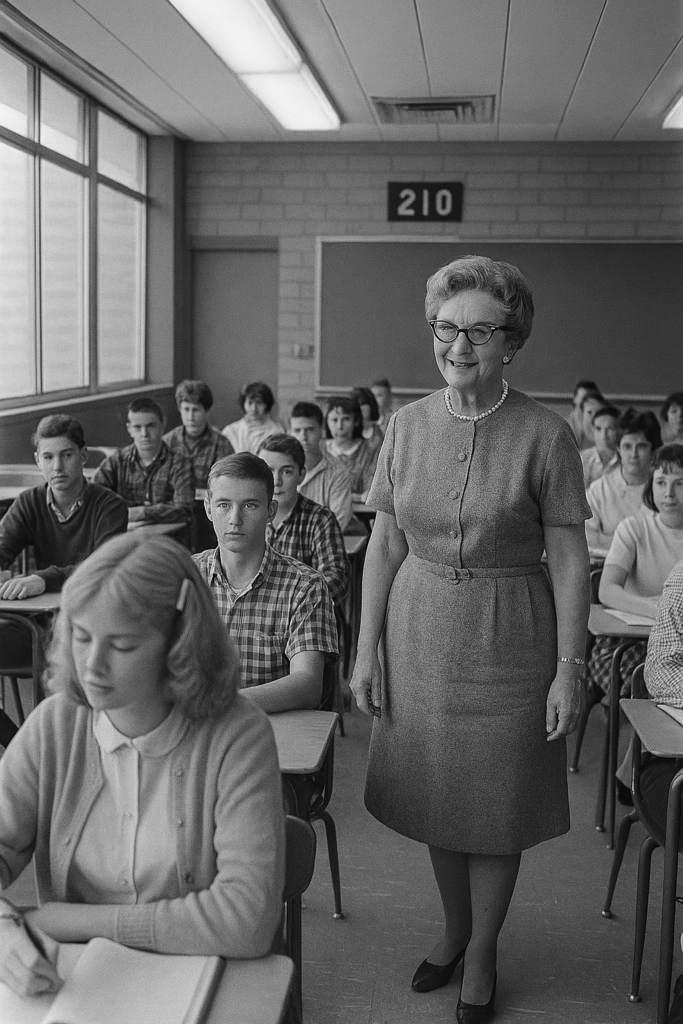
From the 1963 Pine City yearbook, Mrs. Virginia E. Nelson teaches Shakespeare to her 10th grade English class in Room 210, with Patricia (Lundgren) Lindquist in the front row. Robert Lindquist sits two rows back.
Robert Lindquist, a lanky sophomore with a nervous energy, sat two rows back. He glanced sideways at Patricia Lundgren, who had just transferred into the class that fall. Patricia’s blonde hair caught the light from the tall windows, her notebook open, her pen poised. She smiled faintly at Mrs. Nelson’s words, then at Robert when their eyes met. The world outside seemed to pause. The threat of war, the whispers of fallout shelters, the headlines about Kennedy and Khrushchev — all faded in that moment. What remained was the spark between two teenagers, drawn together by Shakespeare’s lines and Mrs. Nelson’s insistence that love mattered even when the world trembled.
Mrs. Nelson read aloud: “My bounty is as boundless as the sea, my love as deep…” Her voice carried across the room, and Robert felt the words land differently now. Patricia’s gaze lingered, steady and warm. By the end of class, Robert had worked up the courage to ask Patricia if she wanted to walk home together. She agreed, her smile soft but certain. Outside, the October air was crisp, the specter of the Cuban Missile Crisis heavy in the headlines — but for them, the walk was filled with laughter, shy glances, and the first threads of a love that would endure. That moment in Room 210 became their origin story: two teenagers discovering love in the shadow of global fear, guided by Mrs. Nelson’s lesson on Shakespeare. Decades later, their return in 2025 would carry the weight of that memory — proof that even in uncertain times, love can take root and endure.
Pine City High School Office, June 2025
The school hallways were quiet, the echoes of lockers and laughter replaced by summer stillness. In her office, near the end of a side corridor off the main office, Principal Danielle Savoy sat at her desk, catching up on paperwork in the lull after graduation.
The door opened gently, and in stepped Robert and Patricia Lindquist, both 78, hand in hand. Their faces carried the warmth of long years together, their eyes bright with anticipation.
“Good morning,” Patricia said softly, her voice tinged with nostalgia. “We’re sorry to intrude. We’re Robert and Patricia Lindquist. We graduated from Pine City in 1965.”
Danielle looked up, smiling, but a little surprised to see an elderly couple, let alone anyone, in her office. “Welcome back. What brings you here today?”
Robert cleared his throat, his voice steady but emotional. “We’re celebrating our 60th wedding anniversary. We met right here, in Room 210, during Mrs. Nelson’s sophomore English class. We were hoping… if it’s possible… to see that classroom again. And maybe walk through the school one more time.”
Danielle paused, touched by the request. She set aside her papers, her expression softening. “That’s a beautiful story. Of course — I’d be honored to show you around.”
As they walked the halls together, Robert and Patricia pointed out familiar corners: the trophy case where they once lingered, the stairwell where they hurried between classes, the cafeteria that smelled of pizza and milk cartons. Finally, Danielle unlocked Room 210.
The door creaked open, and Robert and Patricia stepped inside. The desks were newer, the walls freshly painted, but the air carried echoes of October 1962 — Mrs. Nelson’s voice reading Romeo and Juliet, the nervous glance Robert gave Patricia, the spark that began their lifelong love. Patricia squeezed Robert’s hand. “This is where it all started.”
Danielle stood quietly at the door, moved by the weight of the moment. “It’s incredible to think of the history these rooms hold. Thank you for sharing this with me.”
Robert smiled, his eyes misty. “We wanted to come back to where it began. Sixty years later, it still feels like yesterday.”
The three of them lingered in the classroom, the silence filled not with absence but with memory — a testament to love that had endured across decades, rooted in the heart of Pine City High.
Later that evening, after a flight back to Arizona from Minnesota, the Lindquists arrived home in Tempe, Arizona. The Arizona twilight settled warm and golden across the patio, the desert air carrying the scent of mesquite. Robert and Patricia Lindquist sat side by side, glasses of wine in hand, their anniversary dinner plates cleared away.
Patricia leaned back, her eyes misty but smiling. “I still can’t believe Danielle Savoy let us walk through the school today. Room 210 looked so different — new desks, fresh paint — but it was still our room.”
Robert nodded, his voice low and thoughtful. “When I stepped inside, I swear I could hear Mrs. Nelson reading Romeo and Juliet. And I saw you, sitting there with your notebook, looking at me for the first time. Sixty years later, it all came rushing back.”
Patricia reached for his hand, squeezing gently. “That’s where it began. In the middle of the Cuban Missile Crisis, when the world felt so uncertain… we found each other. And today, standing in that same room, I realized how much we’ve carried from that moment.”
Robert’s eyes glistened. “We’ve built a whole life from that spark. Children, grandchildren, memories that stretch across decades. Visiting Room 210 made this anniversary complete. It reminded me that love isn’t just about the years — it’s about the place where it first took root.”
Patricia smiled, resting her head against his shoulder. “And now we’ve come full circle. We walked back into the room where we began, and tonight we’re still here, together. That’s the greatest gift of all.”
The desert night deepened, stars pricking the sky. They sat in silence for a while, hand in hand, hearts full. The visit to Room 210 had been more than nostalgia — it was a reminder that their love story, born in a classroom under the shadow of history, had endured and flourished for sixty years.
It was not the last time that love would walk into Room 210.
Pine City High School, Room 210, April 1987
The air outside smelled like summer, though the calendar still read April. East central Minnesota had shrugged off what little winter it had that year early, and the trees already wore their green. Students spilled into Room 210 for 5th period American Literature, the windows cracked open to let in the warm breeze. It was Friday, April 17, and it was a pleasant 86 degrees outside.
Mr. Bush, tall and deliberate, adjusted his glasses and began his lecture on The Great Gatsby. His voice carried steady authority, but the hum of spring energy made the room restless. Dan Miller slouched in his desk, leather bomber jacket draped over the back of his chair. He had the look of someone who carried quiet confidence — not loud, but noticeable. Across the aisle sat Heather Anderson, her cheerleader’s poise unmistakable. Her mall bangs, teased high and held firm with hairspray, framed her face like a crown of the era. Their eyes met. At first, just a glance — Heather catching Dan’s smirk as Mr. Bush quoted Fitzgerald: “So we beat on, boats against the current…” Then another glance, longer this time, lingering. The warmth outside seemed to seep into the classroom, into the space between them.
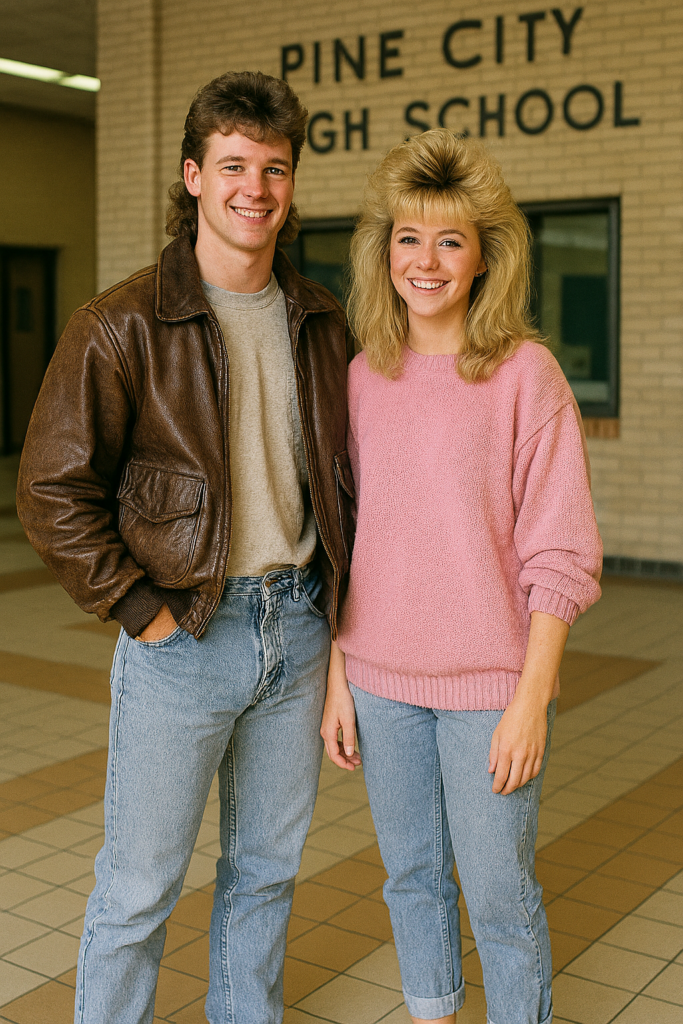
From the 1988 Pine City yearbook, Dan Miller and Heather Anderson, both Pine City Class of 1988, pose in the school commons area in the spring of 1988. They met in American Literature class their junior year in Room 210 and eventually married, living in Andover, Minnesota.
Heather twirled her pen, pretending to take notes, but her mind was elsewhere. Dan leaned back, tapping his pencil against the desk, his bomber jacket catching the light. He wasn’t the loudest guy in the room, but something about his steady presence drew her in. By the end of class, Mr. Bush assigned a paper on the American Dream. Students groaned, but Heather smiled faintly, already imagining asking Dan if he wanted to study together. Dan, catching her look, felt the spark of possibility.
Outside, the football field shimmered in the unseasonable heat, and the cheer squad’s practice echoed faintly across the campus. Heather adjusted her bangs in the reflection of the window, Dan shrugged into his jacket, and as they walked out of Room 210, their paths crossed — the beginning of a romance that would carry the same energy as that record-breaking spring. Dan and Heather graduated in June of 1988, went on to college at St. Cloud State University, and got married in 1993, shortly after they both graduated from SCSU, Dan with a degree in business, and Heather with a degree as a social studies teacher. They moved to Andover, Minnesota where they raised a family and lead successful careers – and remain very much in love.
Pine City High School, Room 210, many years later
The final bell had rung nearly half an hour ago, and the hallways had emptied into silence. Room 210 still carried the faint hum of the day — the smell of pencil shavings, the whisper of paper, the muted echo of voices that had filled it only moments before.
Lily sat at her desk, red pen in hand, her brow furrowed as she worked through a stack of essays. A burgundy infinity scarf draped loosely around her neck, soft against the cream sweater she wore. The scarf’s color matched the faint flush in her cheeks, and when she leaned forward, the silver stud in her nose caught the light from the window.
Mark Dawson lingered in the doorway, one hand resting against the frame. He had told himself he was here for the books — Lily’s small classroom library tucked neatly against the wall, a mix of classics and paperbacks with worn spines. But as he stepped inside, his eyes found her first.
“Room 210 still has its charm,” he said lightly, his voice breaking the quiet.
Lily looked up, startled, then smiled. “Even with the stained ceiling tiles?”
Mark chuckled, moving toward the bookshelf. “Even with those. Though I have to admit, the new roof makes me feel a little less guilty walking under them.” He ran his fingers along the spines, pulling out a copy of The Great Gatsby. He didn’t need it — he’d read it a dozen times — but it gave him reason to linger.
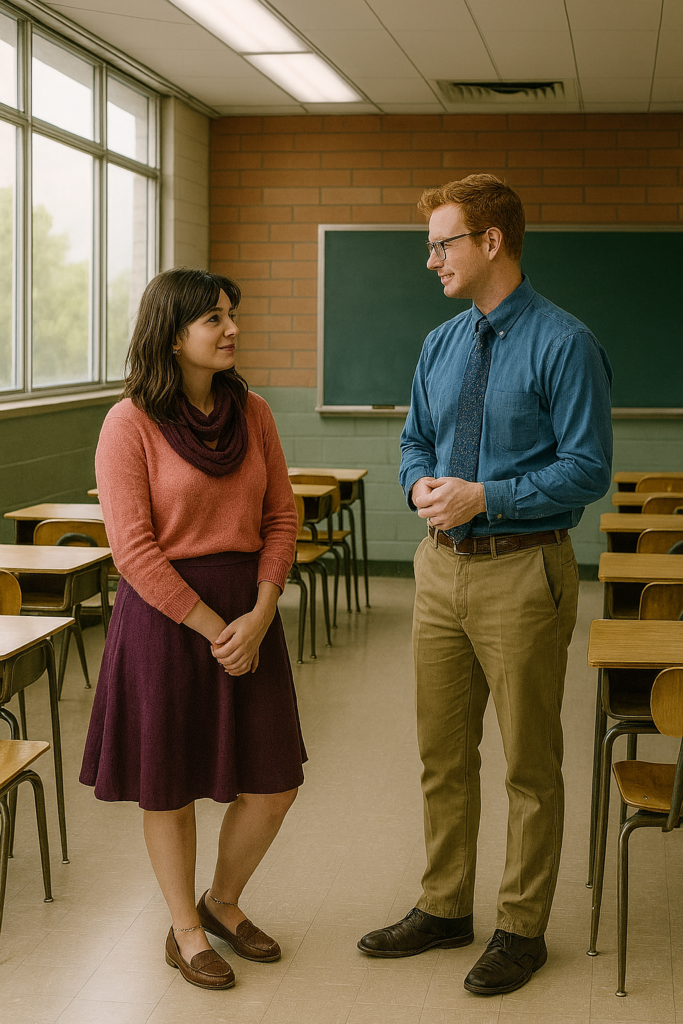
English teacher Lily Jorgenson and choir director Mark Dawson in Room 210, Lily’s classroom – both when she was Marnie’s student in high school and now as a teacher at Pine City.
“What’s the rotation this year?” he asked, glancing back at her.
Lily set down her pen, leaning back in her chair. “A few new titles. Some poetry, some contemporary fiction. I try to keep it fresh.”
Mark nodded, but his gaze lingered on her scarf, the way it framed her face, the faint scent of her perfume drifting across the room — something floral, understated, but unmistakably hers. His eyes dropped briefly to the anklet glinting against her ankle as she shifted in her chair, a small detail that felt like a secret only he was allowed to notice.
“You always have good taste,” he said, holding up the book. “In literature, and otherwise.”
Lily tilted her head, amused. “Otherwise?”
Mark smiled, a little sheepishly. “Scarves. Perfume. Anklets. You make the ordinary… not ordinary.”
Her laugh was soft, genuine, and it filled the room in a way that made the stained ceiling tiles seem irrelevant.
For a moment, neither spoke. The silence wasn’t awkward — it was charged, alive, the kind of quiet that carried possibility. Mark slid the book back onto the shelf, then leaned against it, watching her return to her papers.
He wasn’t here for Gatsby. He was here for Lily. And in the fading light of Room 210, he realized she knew it too.
Pine City High School, Room 210, Late September Afternoon, about a week later
The day’s rhythm had slowed to a hush. Lockers stood silent, and the last bus had pulled away. Lily sat at her desk, pen moving steadily across a stack of essays, her scarf today a deep forest green that matched the quiet calm of the room. The door creaked open, and Mark Dawson stepped inside, a book in hand. The Great Gatsby. He held it almost ceremoniously, as if returning it were an excuse rather than a necessity.
“Thought I’d bring this back before it started collecting dust on my shelf,” he said, his voice carrying a casual ease that didn’t quite mask the anticipation behind it.
Lily looked up, her eyes bright, the silver stud in her nose catching the light. “You didn’t have to rush. I’m glad you enjoyed it.”
Mark crossed the room, setting the book gently on the corner of her desk. His gaze lingered a moment longer than necessary — on the way her scarf draped over her shoulder, the faint scent of her perfume rising as she shifted, the anklet glinting when she crossed her legs beneath the desk.
“I always enjoy Gatsby,” he said, leaning against the bookshelf. “But I think I enjoyed borrowing it from you more.”
Lily raised an eyebrow, amused. “Is that your way of saying you’re here for another one?”
Mark smiled, scanning the spines. “Maybe. Or maybe I’m here to see what color scarf you’d surprise me with this week.”
Her laugh was soft, filling the quiet room. “You’re observant.”
“Choir director’s curse,” he said lightly. “We notice details. Notes, rhythms… scarves, anklets.”
He pulled a slim volume from the shelf — a collection of poetry — and turned it over in his hands. “This one looks promising.”
Lily leaned back, setting her pen aside. “It’s one of my favorites. You’ll have to tell me what you think.”
Mark nodded, but his eyes were on her, not the book. The silence stretched, not awkward but charged, the kind that made the stained ceiling tiles seem irrelevant.
Finally, he tucked the book under his arm. “Thanks, Lily. For the recommendation… and for the company.”
She smiled, returning to her papers, though her cheeks carried a faint warmth. “Anytime, Mark.”
As he left, the door closing softly behind him, Lily exhaled, the quiet of Room 210 settling again. But the air felt different now — alive with the quiet sparks that lingered long after he was gone.
Pine City High School, Room 210, Early October
Lily was gathering papers into neat stacks when Mark appeared in the doorway, a slim poetry book in his hand.
“I thought I’d return this before I wore out the pages,” he said, stepping inside.
Lily looked up, her scarf today a soft plum color, her nose stud catching the light. “Already finished?”
Mark nodded, setting the book gently on her desk. “I couldn’t put it down. But I think what I really enjoyed was knowing it came from you.” Her cheeks warmed, and she busied herself with the papers. “Glad it spoke to you.”
Mark hesitated, then glanced toward the window where the maple trees outside blazed in red and orange. “You know… with the leaves like this, it feels like the perfect time for coffee. Would you… want to go with me? After school?”
Lily blinked, surprised. Her pen stilled in her hand. “Coffee?”
He smiled, a little sheepish. “Yes. Just coffee. Conversation. Nothing complicated.”
She laughed softly, bashful but flattered. “You caught me off guard. But… yes. I’d like that.”
The local coffee shop smelled of espresso and cinnamon, its windows framing the brilliant foliage outside. Lily and Mark sat across from each other, mugs steaming between them.
They talked easily — about books, music, the referendum campaign, the quirks of their students. Mark listened intently, leaning forward, his eyes catching hers whenever she laughed. Lily found herself relaxing, her scarf slipping loose, her anklet glinting as she crossed her legs beneath the table.
Time passed unnoticed, the conversation flowing like a melody.
Pine City High School Parking Lot, Dusk
The sky was streaked with pink and gold as they walked back across the lot. The air was cool, leaves crunching underfoot. Lily’s car waited near the edge, its windshield reflecting the fading light.
Mark slowed as they reached it. “Thank you, Lily. For saying yes. For tonight.”
She smiled, tucking a strand of hair behind her ear. “I’m glad you asked.”
For a moment, they stood in the quiet, the world narrowing to just them. Then, gently, Mark leaned in. Lily’s breath caught, but she didn’t pull away. His lips brushed hers — soft, tentative, a promise wrapped in autumn air.
When they parted, Lily’s cheeks were flushed, her smile shy but certain.
“See you tomorrow,” she whispered.
Mark nodded, stepping back as she opened her car door. “Tomorrow.”
As she drove away, the leaves swirled across the lot, carrying with them the quiet sparks of something new.
The October air carried a crispness that made scarves and warm drinks feel essential. Lily and Mark found themselves once again at the corner table of the local coffee shop, mugs steaming between them.
Mark leaned back, smiling as Lily described her students’ latest essays, her green infinity scarf slipping loose as she gestured animatedly. He noticed the glint of her anklet when she crossed her legs, the sparkle of her nose stud catching the light.
“You make grading sound almost fun,” he teased.
Lily laughed, shaking her head. “Don’t push it. Coffee helps, though.”
They lingered longer than planned, conversation flowing easily, the quiet rhythm of their companionship settling into something familiar and comforting.
Saturday Day Trip to Duluth
The following weekend, Mark invited Lily to join him for a youth choir concert in Duluth. They drove north together, Interstate 35 lined with brilliant foliage — reds, oranges, and golds blazing against the sky.
At the concert, Mark’s eyes lit up as the young voices filled the hall. Lily watched him more than the stage, admiring the way music animated him.
Afterward, they walked the Lakewalk, the breeze off Lake Superior cool against their faces. Lily’s scarf fluttered, her laughter mingling with the sound of waves. Mark slowed his pace, savoring the quiet moments between them.
Dinner followed at a cozy restaurant near Canal Park. Candlelight flickered across their table, and Lily found herself leaning in, her cheeks warm, her smile lingering longer than usual.
Lily’s Apartment, Pine City
A week later, Lily extended an invitation. “Why don’t you come over? I’ll cook dinner.”
Mark arrived to find her apartment softly lit, the scent of garlic and herbs filling the air. Lily moved easily in the kitchen, barefoot, her anklet catching the glow of the overhead light.
They cooked together — chopping vegetables, stirring sauces, laughing when Mark spilled a little pasta water. The meal was simple but delicious, made richer by the shared effort.
After dinner, they sat on the couch, mugs of tea in hand, conversation drifting from books to music to dreams for the future.
Mark watched her, the way she tucked her hair behind her ear, the quiet confidence she carried. Lily felt his gaze and smiled, knowing this rhythm — coffee, concerts, walks, dinners — was becoming something steady, something real.
Pine City High School, Teacher’s Lounge, early November
The hum of the pop machine and the faint aroma of coffee lingered in the teacher’s lounge. The day’s chatter had faded; most staff had already gone home. Only Lily, Mark, and Principal Danielle Savoy remained, the quiet settling around them like a curtain.
Lily sat at the end of the table, papers stacked neatly beside her, her scarf a soft gray today. Mark leaned back in his chair, a book tucked under his arm, his gaze drifting toward her more often than he realized. Danielle, standing by the counter, watched them both with a knowing smile before joining them at the table.
“I’ve noticed,” Danielle began gently, folding her hands, “that the two of you seem to enjoy each other’s company quite a bit.”
Lily’s cheeks flushed, her pen stilled. Mark straightened, clearing his throat.
Danielle’s smile widened, warm but measured. “That’s not a criticism. In fact, I think it’s wonderful. You worked so well together during the referendum campaign, and it’s clear you’ve built a connection.” She paused, letting the words settle. “Congratulations. Truly.” Lily glanced at Mark, then back at Danielle, her voice quiet but steady. “Thank you. We’ve… kept things private. We don’t want it to affect our students.”
“I know,” Danielle said, nodding. “And I appreciate that. You’ve been professional, and I haven’t seen anything inappropriate. But I do want to remind you — as principal, it’s my job to set expectations. Students notice things. Even subtle looks, even patterns. And while you’re entitled to your relationship, it’s important to keep boundaries clear.”
Mark leaned forward, his tone respectful. “We understand. We’ve been careful. We don’t want to be the Thurstons — no secrets, no boundaries. That’s not us.”
Danielle chuckled softly. “Exactly. Ethan and Marnie are…let’s just say open in ways that make my job harder. I don’t want that for you. I trust you both to handle this with discretion.”
Lily nodded, her scarf slipping slightly as she shifted. “We will. We care about our students, and we care about each other. We’ll keep it appropriate.”
Danielle’s expression softened, her voice warm. “That’s all I ask. I’m glad you’ve found something meaningful. Just remember — your classrooms come first.”
The silence that followed wasn’t heavy. It was thoughtful, respectful. Danielle rose, gathering her mug. “I’ll let you get back to your papers. Thank you for hearing me out.”
As she left, Lily and Mark exchanged a glance — a quiet acknowledgment of both the joy they’d found and the responsibility they carried.
Mark smiled faintly. “Guess we’re official now. The principal noticed.”
Lily laughed, her cheeks still pink. “Official… and reminded.”
They returned to their work, the quiet sparks between them tempered now by the steady rhythm of professionalism — and the promise of something worth protecting.
Superior, Wisconsin, Saturday Afternoon
The café on Tower Avenue buzzed with weekend energy, the scent of espresso and baked goods mingling with the crisp autumn air drifting in through the open door. At a corner table, the Sparkle Squad had already gathered — Allison, Maya, Sophie, and Rachel — their laughter spilling into the room like music.
They had been inseparable since freshman year at UW-Superior, bonded forever by the day they marched together to the piercing studio, each leaving with a nose stud that became their shared symbol of courage and individuality. Over the years, they had celebrated milestones, supported each other through heartbreaks, and kept their tradition of meeting regularly alive.
Today, Lily arrived with someone new.
Mark Dawson followed her into the café, his easy smile tempered by a hint of nervousness. He carried himself with the quiet confidence of a choir director, but Lily could see the way his eyes flicked toward her friends, gauging their reactions.
“All right, everyone,” Lily said, tugging at her infinity scarf with a bashful grin. “This is Mark. He’s… well, he’s been keeping me company lately.”
The table erupted in warmth.
Allison leaned forward, her eyes sparkling. “So this is the famous choir director. Lily’s mentioned you.”
Maya grinned. “We were starting to wonder when we’d get to meet you. Lily doesn’t usually keep secrets from us.”
Sophie tilted her head, studying him with curiosity. “You like books, right? Lily said you’ve been borrowing from her classroom library.”
Rachel laughed, nudging Lily. “And scarves. Don’t forget scarves. She said you notice those too.”
Mark chuckled, his shoulders relaxing. “Guilty on all counts. Books, scarves, and… well, Lily herself.”
The friends exchanged knowing looks, their approval evident.
As the afternoon unfolded, conversation flowed easily. They reminisced about their college days — the nose piercing adventure, late-night study sessions, and the way Room 210 had become part of Lily’s new story. Mark listened intently, laughing at their stories, adding his own anecdotes from choir tours and school concerts.
At one point, Allison raised her mug. “We’ve always said the Sparkle Squad is about courage and belonging. Lily’s sparkle has always been part of us. Seeing her with you, Mark… it feels right.”
Lily’s cheeks flushed, her anklet glinting as she shifted in her chair. She glanced at Mark, who met her gaze with quiet admiration.
By the time they left the café, the spring sun was dipping low, painting Superior in gold. Lily felt lighter, her heart full. Mark had met the Sparkle Squad — and they had welcomed him not just as Lily’s companion, but as someone worthy of sharing in their legacy of sparkle.
Barker’s Island, Superior, Wisconsin, May Evening
The sun lingered in the sky, casting a golden shimmer across the bay as Lily and Mark drove out to Barker’s Island. The air was soft with spring warmth, the kind that carried the scent of budding trees and fresh grass.
The mini golf course was quiet, only a few families scattered across the greens. They played through the course, teasing each other over missed shots, celebrating the rare hole-in-one. Lily’s laughter rang out across the evening air, and Mark found himself watching her more than the ball, admiring the way she carried joy so effortlessly.
By the ninth hole, the sky had deepened into shades of pink and lavender. They paused, leaning on their putters, watching the water ripple against the shoreline.
“So,” Lily said softly, “what did you think of the Sparkle Squad?”
Mark smiled, recalling the warmth of Allison, Maya, Sophie, and Rachel. “They’re incredible. I can see why you’re so close. The way they welcomed me… it felt like being invited into something sacred.”
Lily’s eyes softened. “They’ve been with me through everything. College, growing up, finding courage. The nose rings were just the start. They’re family.”
Mark nodded, his voice quiet. “And they love you. That was obvious. Seeing you with them today… it made me realize how lucky I am to be here.” She looked at him, a little bashful, her cheeks flushed in the fading light. “I was nervous, bringing you. But you fit. You really did.”
They finished the course as the last streaks of daylight slipped away, then walked slowly back toward the parking lot, the island quiet around them.
At her car, Lily leaned against the door, smiling. “Thank you for today. For meeting them. For… everything.”
Mark stepped closer, brushing a strand of hair from her face. “Thank you for letting me in.”
The evening ended with a kiss — soft, unhurried, framed by the glow of spring twilight and the gentle lapping of the bay.
Pine City & Duluth, Summer
The summer unfolded like a melody, each note carrying Lily and Mark deeper into their rhythm.
Picnics in Pine City: On warm afternoons, they spread a blanket beneath the oaks at Voyageur Park, baskets filled with sandwiches, fruit, and Lily’s favorite sparkling water. She would slip off her sandals, her anklet catching the sunlight as she stretched out on the grass. Mark strummed his guitar softly, humming tunes while Lily leaned against him, her scarf tucked loosely around her shoulders despite the heat. They talked about books, music, and the quirks of their students, laughter mingling with the rustle of leaves.
Concerts in Duluth: On weekends, they drove north, the highway lined with green and the lake shimmering in the distance. At Bayfront Park, they sat on the grass among the crowd, the stage lights flickering against the evening sky, taking in local favorite traditions like Hairball or Trampled By Turtles. Lily’s nose stud sparkled as she tilted her head back, eyes closed, letting the music wash over her. Mark watched her more than the performers, captivated by the way joy seemed to radiate from her.
At Glensheen Mansion, they wandered the grounds before the show, the gardens alive with color. Lily teased him about his habit of humming along to every tune, while Mark admired how she carried herself with effortless grace. At Chester Bowl, they joined locals for a smaller concert, the intimacy of the setting making their laughter and whispered comments feel like part of the performance itself.
Quiet Drives Around Pine City: Evenings often ended with drives through the countryside, windows down, the scent of summer fields drifting in. Lily curled her legs beneath her, scarf trailing in the breeze, while Mark pointed out old barns and winding roads he remembered from his own youth. Sometimes they spoke in long, winding conversations; other times, silence filled the car, comfortable and complete.
The Rhythm of Love: By July, their days had settled into a pattern — picnics, concerts, drives, and quiet evenings cooking together in Lily’s apartment. Each moment carried a spark, not loud or dramatic, but steady and real.
Mark admired her individuality — the scarves, the anklets, the sparkle of her nose ring — but more than that, he admired the way she lived with intention. Lily, in turn, found comfort in his steadiness, his music, and the way he listened as if every word mattered.
The summer became their season of love, a tapestry of small joys stitched together by laughter, music, and the quiet certainty that, for now, they belonged to each other.
Pine City High School, Early September
The first week of school carried its usual rhythm: lockers slamming, voices echoing down the hallways, the scent of sharpened pencils and fresh notebooks filling the air. Room 210 was alive again, Lily’s bulletin board bright with new quotes and her small classroom library freshly stocked. She wore a soft teal infinity scarf, her nose stud catching the morning light as she greeted students with her warm smile.
At the other end of the school in the music wing, Mark was already in motion, his choir room buzzing with energy. Sheet music rustled, voices rose in tentative harmony, and his steady presence anchored the chaos.
At lunch, they found each other in the teacher’s lounge, slipping into their familiar seats side by side. Danielle Savoy passed through with a nod, her eyes flicking toward them with quiet approval. “Feels good to be back,” Mark said, unwrapping his sandwich. Lily smiled, brushing a strand of hair from her face. “It does. Though I miss the freedom of summer. The drives, the concerts…”
Mark chuckled. “We’ll make time. Even if it’s not Bayfront Park, we can still catch a show in Duluth now and then.”
But as the weeks unfolded, subtle differences began to surface. Lily thrived on variety — her scarves changed daily, her perfume shifted with the seasons, her classroom library grew with new titles she couldn’t resist. She loved spontaneity: an impromptu coffee outing, a late-night grading session turned into laughter and conversation. Mark, steady and rooted, preferred routine. His choir rehearsals followed the same structure, his evenings often dedicated to careful planning. He admired Lily’s spark but sometimes found it unsettling, her spontaneity pulling him out of his comfort zone. One afternoon, after seventh period, Mark wandered into Room 210 as he often did. Lily was rearranging her bookshelf, barefoot, her anklet glinting as she balanced on tiptoe.
“You’re always changing things,” he said, half amused, half weary.
She turned, smiling. “It keeps the room alive. Don’t you ever want to shake things up?”
Mark hesitated, then shrugged. “I like consistency. It’s how I keep the choir grounded.”
The silence that followed wasn’t heavy, but it carried a new awareness. They were different — not in ways that clashed, but in ways that hinted at diverging rhythms.
Still, when Lily crossed the room and touched his arm, her smile soft, Mark felt the spark that had carried them through summer. The differences were there, yes, but so was the affection.
For now, Room 210 still held its quiet sparks.
Pine City High School, Late October Evening
The sun had already dipped below the horizon, leaving the sky streaked with violet and gray. Room 210 glowed softly under fluorescent lights. Lily sat cross-legged on her desk chair, scarf a deep rust color, papers spread around her like a mosaic.
Mark appeared in the doorway, his tie loosened after a long day of choir rehearsals. He leaned against the frame, watching her for a moment before stepping inside.
“You’re still here,” he said.
Lily smiled, tucking a strand of hair behind her ear. “I was thinking… we should drive up to Duluth this weekend. Catch that folk concert at St. Scholastica. Maybe grab dinner after. It’ll be fun.”
Mark hesitated, setting his folder down on the edge of her desk. “I don’t know. I was planning to use Saturday to prep for the winter concert. I’ve got arrangements to finalize, and the kids need structure.”
Her smile faltered, though she tried to keep it light. “We could still go. Just for the evening. It doesn’t have to be all day.”
Mark shook his head gently. “I like having a plan, Lily. I need predictability. If I start throwing in last-minute trips, everything else gets off balance.”
She leaned back, crossing her arms, her anklet glinting as she shifted. “But that’s the point. Sometimes you need to shake things up. Life isn’t just schedules and rehearsals. It’s… moments. Spontaneous ones.”
The silence stretched, filled only by the hum of the heater. Mark rubbed the back of his neck, his voice softer now. “I admire that about you. Really. You bring color into things. But I’m wired differently. I need routine to feel grounded.”
Lily’s eyes softened, though a trace of frustration lingered. “And I need spontaneity to feel alive.”
They sat in the quiet, the difference between them laid bare. Not a fight, not a fracture — but a recognition.
Finally, Lily reached across the desk, her fingers brushing his hand. “We’ll figure it out. For now, let’s just… keep trying.”
Mark squeezed her hand, his smile faint but sincere. “For now.”
The heater hummed on, the stained ceiling tiles above them unchanged, as Room 210 held the quiet spark of two people learning how different rhythms can both carry music — even if not always in perfect harmony.
Pine City High School, Mid-December
Snow dusted the edges of the parking lot, the air sharp with winter. Inside, the school pulsed with holiday energy — students humming carols, teachers juggling exams and decorations. Room 210 glowed with strands of white lights Lily had draped across her bulletin board, her scarf a deep crimson, her nose stud catching the sparkle.
Mark appeared in the doorway, his arms full of sheet music, his expression tired but determined.
“Another rehearsal tonight,” he said, dropping the stack onto her desk. “The madrigal singers are close, but they need polish. We’ve got three performances this week.”
Lily set down her pen, her eyes soft but weary. “I know. You’ve been working so hard. But… I miss you. Outside of school.”
Mark leaned against the desk, rubbing his temples. “I miss you too. But this season is always like this. The concerts, the rehearsals — it’s what I do.”
She rose, crossing the room, her scarf brushing against her sweater. “I understand. I just… wish we could carve out time. Even one evening. A drive, a dinner, something that’s just us.”
Mark’s gaze softened, but his voice carried the weight of responsibility. “I want that. But right now, the choir needs me. The madrigals are the centerpiece of the season. If I don’t give them everything, it shows.”
Lily sighed, her anklet glinting as she shifted. “And if you don’t give us something, it shows too.”
The silence hung heavy, filled only by the muffled sound of carols drifting from the choir room down the hall.
Mark reached for her hand, squeezing it gently. “After the concerts. I promise. We’ll have time then.”
She nodded, though her smile was faint. “I’ll hold you to that.”
Pine City Auditorium, Concert Night
The stage shimmered with garlands and poinsettias, the madrigal singers in velvet gowns and crisp tunics. Mark conducted with precision, his movements sharp, his focus absolute. The music soared, filling the auditorium with warmth and tradition.
From her seat near the back, Lily watched him, admiration mingling with longing. He was brilliant here, alive in the music, commanding the stage. But she felt the distance too — the way his world seemed consumed by rehearsals, performances, and perfection.
When the final notes faded and applause thundered, Mark bowed with his singers, his smile wide. Lily clapped, proud, but her heart whispered for something quieter — a drive through snowy streets, a cup of cocoa, a moment that belonged only to them.
After the Concert backstage, Mark found her, his face flushed with triumph. “They were incredible, weren’t they?”
“They were,” Lily said softly, her scarf pulled close against the chill. “And so were you.”
He leaned in, pressing a quick kiss to her cheek, already turning back to congratulate his students.
Lily stood there, smiling faintly, knowing she loved his passion but wishing it didn’t leave her waiting in the wings.
Pine City, Mid-December Evening
The applause had faded, the poinsettias boxed away, and the madrigal costumes hung neatly in the choir room closet. Pine City High stood hushed under a blanket of snow, its windows glowing faintly against the winter night.
Mark found Lily waiting near the front doors, her scarf a deep plum, her cheeks flushed from the cold. He carried no sheet music, no folders — only his car keys and a tired but genuine smile.
“Ready?” he asked softly.
She nodded, relief and affection mingling in her eyes. “More than ready.”
They drove slowly through town, the streets lined with twinkling lights strung across storefronts and lampposts. Snowflakes drifted lazily in the headlights, the world outside hushed and shimmering. Lily leaned against the window, watching the glow of Christmas decorations blur past.
“It’s beautiful,” she murmured.
Mark glanced at her, his voice warm. “Not as beautiful as you’ve been waiting for me all season.”
She smiled, bashful, but her hand found his on the console, fingers curling gently. They pulled into Voyageur Park, the lot nearly empty, the river frozen and gleaming under the moonlight. Mark shut off the engine, and for a moment, the silence was complete — only the crunch of snow beneath their boots as they stepped out.
Lily tugged her scarf tighter, her breath visible in the cold. “This is what I wanted. Just us. No rehearsals, no schedules.”
Mark slipped an arm around her shoulders, drawing her close. “I should have given you this sooner.”
She leaned into him, her anklet hidden beneath winter boots but her sparkle still present in the glint of her nose stud. “You gave me tonight. That’s enough.”
Back at her car, the night wrapped around them in quiet stillness. Mark brushed a strand of hair from her face, his eyes soft.
“Thank you for waiting,” he whispered.
Lily smiled, her cheeks flushed from more than the cold. “Thank you for keeping your promise.”
Their kiss was gentle, unhurried, framed by the hush of snow and the glow of Christmas lights in the distance.
When they parted, Lily’s smile lingered. “See you tomorrow.”
Mark nodded, his breath visible in the frosty air. “Tomorrow.”
As she drove away, the quiet evening held its own music — not madrigals or carols, but the steady rhythm of two hearts finding time for each other at last.
Pine City, Valentine’s Day Evening
Snow still clung to the edges of the sidewalks, though the air carried a hint of spring’s promise. Lily’s apartment glowed with soft lamplight, candles flickering on the table where she had set out dinner. A bouquet of tulips stood in a vase, their petals bright against the quiet room. Lily wore a deep red infinity scarf, her nose stud catching the candlelight, her anklet glinting faintly as she moved barefoot across the floor. Mark watched her with a smile, his tie loosened, his posture relaxed after a long day of classes and rehearsals. Dinner was warm and easy — laughter over pasta, teasing about choir mishaps and student essays. But as the plates cleared and the candles burned lower, the conversation shifted.
Now, with plates cleared and mugs of tea in hand, Lily curled her legs beneath her on the couch, her scarf a deep red, her nose stud catching the flicker of the candles. Mark sat beside her, his arm resting along the back of the couch, his expression thoughtful.
“Lily,” he began gently, “have you ever thought about… marriage? About starting a family someday?”
She blinked, surprised by the shift in tone. “I’ve thought about it, yes. But I don’t know if it’s something I want. At least not in the traditional sense.”
Mark’s brow furrowed slightly. “Not in the traditional sense?”
She tucked a strand of hair behind her ear, her anklet glinting as she shifted. “I love my life here. Teaching, my friends, the Sparkle Squad, the community. I don’t feel like I need marriage to make it complete. And kids… I’m not sure. I’ve never felt that pull the way some people do.”
Mark leaned forward, his voice steady but earnest. “For me, it’s different. I’ve always imagined settling down, having a family. It feels like the natural next step.”
The silence stretched, filled only by the faint hum of the heater. Lily’s eyes softened, though her voice carried a quiet firmness. “I don’t want to rule anything out. But I don’t want to promise something I’m not sure I believe in, either.”
Mark reached for her hand, squeezing it gently. “I respect that. I just… need you to know it matters to me.”
She nodded, her smile faint but sincere. “And I need you to know I’m happy with us, right now, as we are.”
They sat together in the glow of candlelight, tulips bright between them, affection undeniable but differences quietly revealed. The love was real, the spark alive — yet beneath it lay the first whispers of divergence, not in place or profession, but in the vision of what “forever” might mean.
The candles flickered low on Lily’s coffee table, tulips bright in their vase, the quiet hum of winter pressing against the windows. Dinner had been warm, laughter easy, but now the conversation had shifted into deeper waters.
Mark sat beside her on the couch, his hand resting lightly on hers. “Lily,” he said softly, “I’ve been thinking about us. About the future. I want marriage someday. A family. That’s always been my goal.”
Lily’s smile faltered, though her eyes stayed gentle. She tucked her legs beneath her, scarf slipping loose, her anklet glinting faintly. “I know. And I respect that. But for me… marriage isn’t necessary. I’m happy living together, building a life side by side, without the paperwork or the ceremony. And children… I don’t know if that’s something I want.”
Mark’s brow furrowed, his voice steady but tinged with concern. “But isn’t that what relationships are supposed to lead to? Marriage, family, the whole picture?” She shook her head, her nose stud catching the candlelight. “Not for everyone. For me, love is enough. Commitment is enough. I don’t need a wedding to prove it, and I don’t feel incomplete without children. I want us — just us — to be enough.”
The silence stretched, filled only by the faint ticking of the clock. Mark squeezed her hand, his voice quieter now. “I don’t doubt us. I don’t doubt how much I care for you. But I don’t know if I can let go of that dream.”
Lily leaned against him, her voice tender but firm. “And I don’t want to promise something I can’t give. I’d rather be honest now than pretend.”
They sat together in the glow of candlelight, affection undeniable, but the difference laid bare. The love was real, the spark alive — yet beneath it, the quiet recognition that their visions of “forever” might not align.
Pine City High School, Late February
The snowbanks outside the school were high, the air sharp with winter. Inside Room 210, Lily graded essays while Mark leaned against the bookshelf, a familiar rhythm between them. Yet the conversation carried a new weight.
“I’ve been thinking,” Mark said quietly, his voice steady but hesitant. “About what we talked about on Valentine’s Day. Marriage. Family.” Lily set down her pen, her scarf a soft gray today. “I know.”
Mark’s eyes softened. “I care about you, Lily. More than I can say. But I don’t think we’re looking for the same future.”
She nodded, her smile faint but sincere. “I’ve felt it too. I love what we have, but I don’t want to promise something I can’t give. And you shouldn’t have to compromise what you’ve always wanted.”
The silence wasn’t heavy — it was honest. They both knew.
March, Teacher’s Lounge
The teacher’s lounge buzzed with chatter, but Lily and Mark sat side by side, their conversation easy. Danielle Savoy passed through, offering a smile that carried no concern. They laughed about students, shared stories of rehearsals and grading, but the undertone had shifted. The spark was still there, but now it was framed by friendship rather than romance.
Mark leaned back, sipping his coffee. “I’m glad we can still do this. Be here. Together.”
Lily smiled, her nose stud catching the light. “Me too. You’re important to me, Mark. That doesn’t change.”
Early May, Pine City Auditorium
The spring concert filled the auditorium with music. Mark conducted with his usual precision, his choir voices rising in harmony. Lily sat near the back, clapping proudly, admiration still in her eyes.
Afterward, backstage, Mark found her. “Thanks for coming.”
“Wouldn’t miss it,” she said warmly.
They hugged — brief, respectful, but full of affection. It wasn’t romantic anymore, but it was real.
May, Room 210
The school year wound down, the air warm with spring. Lily packed away books, her scarf light and floral, her anklet glinting as she moved across the room. Mark stepped in, leaning against the doorframe.
“Summer’s coming,” he said.
She smiled. “It’ll be good. For both of us.”
He nodded, his voice quiet but certain. “We weren’t the long-term fit. But I’ll always be glad we had this.”
Lily crossed the room, touching his arm gently. “Me too. And I’ll always be glad you’re my colleague. My friend.”
The moment lingered, warm and steady. Their romance had unwound, but their bond remained — rooted in respect, shared history, and the quiet certainty that they would carry forward together, even if on different paths.
Cozy Coffee Shop, Downtown Duluth, Late November
The windows fogged gently from the warmth inside, the scent of espresso and cinnamon drifting through the air. Lily Jorgenson sat across from Marnie Thurston, their mugs steaming between them. Best friends. Colleagues. English teachers together. And now, confidants. Outside, Lake Superior shimmered under a gray sky, the last leaves clinging to the trees. The fabled gales of November were very much living up to their name, a cool, windy day in the mid-30s. But it was a good day for a girls’ day trip to the Twin Ports and, for Lily, some soul searching.
Marnie stirred her drink slowly, watching Lily’s expression. “You’ve been quiet lately,” she said gently. “Want to talk about it?”
Lily nodded, her fingers wrapped around her mug. “It’s about Mark. We broke up. Actually it was the end of last school year.”
Marnie’s eyes softened. “Oh, Lily…”
“It wasn’t dramatic,” Lily said quickly. “No fighting, no betrayal. Just… clarity.” She paused. “Mark wants the whole thing — marriage, kids, the house with the swing set. And I realized I don’t. I love him. I did. But I’m content with just being together, living life side by side. Marriage isn’t necessary for me. And kids… I’ve never felt that pull.”
Marnie nodded, listening intently.
“We talked about it,” Lily continued. “Really talked. And we both knew — if we stayed together, one of us would be compromising something big. So we let go. Not out of anger, but out of respect.”
Marnie reached across the table, resting her hand on Lily’s. “That’s brave. And honest. And so you.”
Lily smiled faintly. “We’re still friends. Still colleagues. He’s our choir director, I’m teaching English. We pass in the halls, we share coffee in the lounge. It’s not awkward. Just… different.”
Marnie leaned back, her eyes thoughtful. “You modeled something powerful, you know. That love doesn’t have to end in bitterness. That choosing different paths doesn’t mean failure.”
Lily blinked, her eyes damp. “I hope so. I just want to live authentically. And I want him to have the life he dreams of — even if I’m not in it that way.”
They sat in silence for a moment, the hum of the coffee shop around them. Then Marnie raised her mug. “To love. In all its forms.”
Lily clinked hers gently. “To choosing truth. Even when it hurts.”
Lily sighed, tracing the rim of her mug. “I just keep wondering if I’ll ever find someone who loves me but doesn’t expect me to change my rhythm of life. Mark wanted marriage, kids, the whole traditional path. And I… I don’t.”
Marnie leaned forward, her eyes warm and steady. “Lily, listen to me. The right one for you is out there. Someone who not only loves you, but also fits into your rhythm — your way of living, your pace, your vision of love. You don’t have to bend yourself into someone else’s mold.”
Lily’s eyes softened, though doubt lingered. “But what if that’s too much to ask?”
Marnie shook her head firmly, her nose stud catching the light. “It’s not too much. It’s exactly what you deserve. Love isn’t about compromise that erases who you are — it’s about finding someone whose heartbeat matches yours. You’ve got so much to give, Lily. And when the right person comes along, they’ll see that and want to walk beside you, not ahead of you or behind you.”
Lily blinked back tears, a smile tugging at her lips. “You really think so?”
“I know so,” Marnie said, squeezing her hand. “You’re brave enough to be honest about what you want. That honesty will draw the right person to you. Until then, you’ve got friends who love you exactly as you are.”
The hum of the coffee shop wrapped around them, but in that moment, Lily felt lighter. Marnie’s words weren’t just comfort — they were a promise that her path, however unconventional, was still worthy of love.
From Lily’s journal that evening…
“Marnie said the right one for me is out there — someone who loves me and fits into my rhythm of life. Not someone who wants me to change, but someone who walks beside me. I needed to hear that. I needed to believe that.”
Her pen paused, and she pressed her hand lightly against the page, as if sealing the words into her heart.
“It hurts to let go of Mark, but it doesn’t mean I failed. It means I was honest. And honesty will lead me to the love that matches me. Until then, I have friends who see me, who remind me I’m enough.”
She closed her eyes, breathing deeply, and for a moment it felt like Marnie’s encouragement wrapped around her like a hug. The ache was still there, but softer now, cushioned by hope.
Lily tucked the journal beside her pillow, whispering aloud: “To truth. To love. To me.”
The night settled gently, and Lily drifted toward sleep with the quiet assurance that her story wasn’t ending — it was unfolding, one honest step at a time.
Sparkle Squad Gathering, Lily’s Apartment, Early Winter Evening
The five friends crowded around Lily’s dining table, mugs of cocoa steaming, the faint scent of cinnamon rolls drifting from the oven. The ritual was familiar — laughter, warmth, and the comfort of being together.
Lily cleared her throat, her hands folded in her lap. “I wanted to tell you all… Mark and I broke up.”
The room quieted. Allison leaned forward, her eyes wide with concern. “Oh, Lily…”
Rachel reached across the table, squeezing Lily’s hand. “Are you okay?”
Lily nodded, her voice steady but soft. “I am. It wasn’t ugly. We just realized we wanted different things. He wants marriage, kids, the whole traditional path. I don’t. I’m content with love, with living together, with marriage optional. We respected each other enough to let go.”
Sophie’s eyes shimmered, her voice gentle. “That’s hard, but it sounds… honest. And brave.”
Maya, ever quick with humor, smirked. “Well, at least you didn’t waste years figuring it out. Some people drag it out forever.”
The words landed heavier than Maya intended. Lily’s smile faltered, and Allison shot Maya a look. Rachel shifted uncomfortably, and Sophie glanced down at her mug.
Maya blinked, realizing too late that her teasing tone had cut deeper than she meant. “I didn’t mean it like that,” she added quickly, her voice softer now. “I just… joke too much sometimes.”
Lily exhaled, managing a small smile. “I know, Maya. It’s okay.”
The moment passed, but a faint ripple lingered in the air — the kind that hinted at cracks beneath the surface of even the closest friendships.
Allison raised her mug, breaking the tension. “To Lily. To honesty. And to us — the Sparkle Squad.”
The others clinked their mugs, the warmth returning, though Maya’s eyes lingered on Lily with a flicker of guilt.
Chapter 4: Shining After Shadows
Barkers Island Inn, Superior, Wisconsin
The December wind off Lake Superior rattled the windows of Barkers Island Inn, but inside Room 214 the Sparkle Squad was warm, sprawled across beds and armchairs with mugs of cocoa and half-empty plates of cheesecake from the restaurant downstairs. Their laughter had carried them through the day — wandering Canal Park, browsing the shops, dinner at a favorite spot — and now, as always, they settled into the tradition of talking late into the night.
Lily tucked her legs beneath her, her nose ring catching the lamplight as she spoke. “It’s strange, you know. Seven months since Mark and I ended things, and I still feel… lighter. Sad sometimes, yes, but mostly relieved. I don’t regret it. We’re still friends though.”
Allison leaned forward, her voice steady and protective. “You were honest with him, Lily. That’s what matters. You didn’t compromise yourself.” Sophie smiled softly, brushing her hair back. “And you’ve got us. Ten years strong. That’s something most people don’t have.”
Rachel, perched cross-legged on the bed, nodded. “Exactly. We’re proof that love doesn’t only come in one form.”
Maya, lounging in the armchair with her legs stretched out, grinned. “Well, sure. But Lily, you’ve got to admit — you’re twenty-eight. If you keep waiting for someone who doesn’t want marriage or kids, you might be waiting forever.”
The words hung in the air, heavier than Maya intended. Lily’s smile faltered, her eyes dropping to her mug.
Allison’s head snapped up. “Maya. That’s not fair.” Maya blinked, caught off guard. “I didn’t mean it like that. I was just—”
“You were just being blunt,” Allison cut in, her tone sharper than usual. “But sometimes blunt hurts. Lily doesn’t need you reminding her of timelines or expectations. She’s living her truth.”
The tension thickened. Sophie shifted, her voice gentle but strained. “Hey, hey… let’s not turn this into a fight. We all love each other. Maya, I know you didn’t mean harm. Allison, I know you’re protecting Lily. Let’s breathe.”
But Rachel, usually the one to crack a joke or lighten the mood, stayed quiet. She pulled her blanket tighter, her gaze fixed on the floor. The silence from her corner was louder than any words.
Lily finally spoke, her voice low. “It’s okay. I know Maya didn’t mean to hurt me. But… it did.”
Maya’s grin faded, replaced by a flicker of guilt. She opened her mouth, then closed it again, realizing no quick joke could fix this.
The five sat in uneasy quiet, the sparkle of their bond dimmed for the first time in years. Outside, the wind howled across the frozen bay, as if echoing the shadow that had crept into the room. The laughter that had filled Room 214 earlier in the night was gone, replaced by a silence so heavy it seemed to press against the walls. One by one, the Sparkle Squad drifted back to their separate rooms, the ritual of conversation broken. Lily lingered longest, folding her blanket carefully before slipping out. Her chest felt tight, the sting of Maya’s words replaying in her mind. She knew Maya hadn’t meant to wound her, but the reminder of timelines and expectations cut deep. Alone in her room, she sat on the edge of the bed, staring at her nose ring in the mirror — the symbol of belonging that tonight felt fragile.
Allison paced her room, restless. Protective by nature, she couldn’t shake the image of Lily’s hurt expression. “Maya should know better,” she muttered under her breath. Ten years of friendship didn’t excuse carelessness. Allison’s loyalty burned hot, and she resolved to stand firm, even if it meant confrontation.
Sophie curled up with her journal, torn between her love for all of them. She scribbled furiously: I hate conflict. I hate seeing them hurt each other. Maya didn’t mean it, but Allison’s right — words matter. How do I keep us together when we’re pulling apart? Her pen hovered, her heart aching with the weight of being the peacemaker. Rachel, usually the spark of joy in any gathering, lay quietly in bed, staring at the ceiling. Withdrawal was unlike her, but tonight she felt drained. The balance of the group had shifted, and she didn’t know how to restore it. For the first time, she wondered if their bond could break.
And Maya — alone in her room, the hum of the heater filling the silence — sat with her head in her hands. She replayed the moment over and over, her own voice echoing back at her. “You’re twenty-eight… you might be waiting forever.” She had meant it as a joke, a nudge, but it had landed like a blow. Guilt gnawed at her. She loved these women — her sisters in everything but blood — and the thought of losing them made her stomach twist.
Across the hall, five women lay awake, each carrying their own version of the evening’s shadow. The sparkle that had defined them for a decade flickered uncertainly, as if the bond forged by their nose rings could dim.
Outside, the wind swept across the frozen bay, rattling the windows. Inside, the Sparkle Squad faced the quiet truth: even ten years of friendship could be shaken. And yet, beneath the hurt, the love remained — waiting for someone to reach across the silence and begin the work of repair.
Sunday Morning, Barkers Island Inn Restaurant
The restaurant at Barkers Island Inn was bright with winter sunlight, the bay outside glazed with ice. Inside, the Sparkle Squad sat around a corner table, plates of pancakes and omelets steaming in front of them. Normally, breakfast together meant chatter and laughter spilling over coffee refills. This morning, though, the air felt heavy, as if the shadow from last night had followed them down the hall.
Lily stirred her coffee slowly, her eyes fixed on the swirling cream. She hadn’t slept well, replaying Maya’s words in her mind. She wanted to move past it, but the sting lingered. Allison sat beside her, posture straight, protective energy radiating even in silence. She buttered her toast with deliberate care, her jaw tight. Every so often she glanced at Maya, as if daring her to say something careless again. Sophie tried to fill the quiet, her voice soft. “The lake looks beautiful this morning. Almost like glass.” She smiled, but it didn’t quite reach her eyes. She hated the tension, hated the way it pulled at the threads of their bond.
Rachel, usually the one to brighten any room, picked at her fruit cup without saying much. Her silence was uncharacteristic, and the others noticed. She felt drained, unsure how to restore the balance, so she withdrew instead of forcing cheer.
Maya sat across from Lily, her fork idle on her plate. She wanted to speak, to crack a joke, to break the silence — but guilt pressed down on her. Every attempt at words felt wrong. So she stayed quiet, her usual spark dimmed.
The waitress came by with a pot of coffee, refilling mugs. “Anything else for you ladies?” she asked brightly.
“No, thank you,” Lily murmured, her voice barely above a whisper.
The waitress moved on, leaving the five of them in their uneasy quiet. Ten years of friendship had carried them through college, careers, and countless nights of laughter. But this morning, even the sparkle of their nose rings seemed muted, as if reflecting the strain between them.
They ate slowly, conversation sparse, each woman lost in her own thoughts. The bond was still there — strong, enduring — but for the first time, it felt fragile.
Outside, the sunlight glinted off the frozen bay, promising warmth beyond the shadows. Inside, the Sparkle Squad sat together, silent but still side by side, the first step toward healing yet to be taken.
US-2, Superior to Ashland
The highway stretched eastward, a ribbon of blacktop bordered by snowy pines. Light lake-effect snow drifted across the windshield of Allison’s SUV, the wipers brushing it away in steady rhythm. Sophie sat in the passenger seat, her boots tucked neatly beneath her, watching the flakes swirl in the headlights.
For a while, they drove in silence, the hum of the tires and the faint crackle of the radio filling the space. Finally, Sophie spoke. “Last night… it was hard to watch. We’ve never had a moment like that before.”
Allison tightened her grip on the steering wheel. “Maya crossed a line. I know she didn’t mean to, but Lily doesn’t deserve to be reminded of clocks and expectations. She’s already carrying enough.”
Sophie nodded, her voice gentle. “I know. Maya’s humor is part of what makes her, well, Maya. But sometimes it cuts deeper than she realizes. I don’t think she meant harm.”
Allison exhaled, her breath fogging faintly in the cool air. “Intent doesn’t erase impact. Lily was hurt. And I won’t just sit by when someone hurts her — even if it’s Maya.”
Sophie glanced out at the snow, then back at Allison. “You’re protective. That’s one of the things I love about you. But if we’re going to get through this, we’ll need more than defense. We’ll need understanding, too.”
Allison’s jaw softened. “You’re right. I know Maya loves us. I just… I don’t want Lily to feel like she’s less than, or like she’s failing because she doesn’t want the same things Mark did.”
Sophie smiled faintly. “That’s why we’re here. To remind each other that our paths don’t have to look the same. Ten years of friendship doesn’t vanish because of one misstep. It just means we’ve got to work harder to keep the bond strong.”
The SUV rolled past the dark outline of the lake, snowflakes catching in the beams of the headlights. Allison’s shoulders eased, the tension of the night before slowly unwinding.
“Thanks for saying that,” she murmured. “I needed to hear it.”
Sophie reached over, resting her hand lightly on Allison’s arm. “We’ll be okay. All five of us. Even Maya. She’ll figure it out. And when she does, we’ll be stronger for it.”
The snow thickened slightly, but inside the SUV the air felt lighter. Two friends, side by side, carrying the weight of the Squad together — and believing, even in the shadow, that the sparkle would return.
Maya’s Drive, Superior to Minneapolis
Interstate 35 stretched endlessly before her, headlights carving tunnels of light through the drifting snow. Maya gripped the steering wheel, her knuckles pale, the hum of the tires on the pavement the only sound in the cabin. Normally, she loved these drives — music loud, windows cracked for fresh air, her thoughts free to wander. Tonight, the silence pressed down like a weight.
She replayed the moment again and again. You’re twenty‑eight… you might be waiting forever. The words had slipped out so easily, meant as a joke, a nudge. But Lily’s face — the way her smile faltered, the way her eyes dropped — haunted her.
“Why did I say that?” she whispered into the empty car. Her voice sounded small, swallowed by the heater’s hum.
The miles ticked by, each one heavy with regret. She thought of Allison’s sharp defense, Sophie’s strained attempt to mediate, Rachel’s uncharacteristic silence. Ten years of friendship, and with one careless remark she had shaken their balance.
Maya’s chest ached. These women weren’t just friends — they were her sisters, her family. The ones who had welcomed her when she was the odd fifth roommate, the one with the solo dorm room. The ones who had laughed with her, cried with her, carried her through the chaos of teaching and life. And now, she feared, the ones she might lose.
Snowflakes swirled in the headlights, blurring the road ahead. She turned the radio on, then off again, unable to bear the noise. Her thoughts were louder than any song. “I’d take it back if I could,” she murmured. “I’d swallow the words, keep them locked inside. Anything to erase that look on Lily’s face. Anything to take away the hurt.” The highway signs counted down the miles to Minneapolis:
123… 87… 66.
Each marker brought her closer to Minneapolis, but farther from the warmth of the Squad.
By the time she reached the city lights, her heart felt heavier than when she left Superior. She parked outside her apartment, engine ticking as it cooled. For a long moment she sat in the dark, forehead against the steering wheel. One remark. One shadow. And now, the long road ahead to make amends.
Lily’s Drive, Superior to Pine City
The taillights ahead were faint, swallowed by the drifting snow. Lily knew Maya’s car was somewhere up there on Interstate 35, ten minutes ahead, but the distance felt wider than miles. She gripped the steering wheel, her breath fogging faintly in the cool air, the heater humming against the December chill. Normally, these drives home left her content — tired but happy, heart full from a weekend with her closest friends. Tonight, the silence pressed heavy. The laughter and warmth of the Sparkle Squad had unraveled so quickly, one remark turning joy into hurt. She replayed Maya’s words, the blunt reminder of age and expectations. “You’re twenty‑eight… you might be waiting forever.” Lily knew Maya hadn’t meant cruelty. But the sting was real, cutting into the tender place left by her breakup with Mark. Her eyes flicked to the nose ring glinting faintly in the rearview mirror. It had always been their symbol — five sparks of courage, five reminders of belonging. Tonight, though, she wondered if even that bond could dim.
“Ten years,” she whispered to herself. “Ten years of friendship. We can’t lose it now.”
She thought of Allison’s fierce defense, Sophie’s gentle attempts to mediate, Rachel’s uncharacteristic silence. Each reaction had shown how deeply they all cared — but also how fragile even the strongest bonds could feel when tested. The highway signs ticked past: Duluth fading behind her, Cloquet, Moose Lake. Snowflakes swirled in the headlights, blurring the road ahead. Lily’s chest ached with worry. What if this shadow lingered? What if Maya pulled away, or Allison’s anger hardened, or Rachel’s withdrawal deepened? She tightened her grip on the wheel. No. We’ve come too far together. We’ve built too much. We’ll find our way back. The miles rolled on, Pine City drawing closer. Lily’s heart was heavy, but beneath the sadness was a quiet resolve. The Sparkle Squad had weathered ten years of life, love, and change. They could weather this too. Outside, the snow fell steady, blanketing the highway in white. Inside, Lily drove on, carrying both the hurt of the weekend and the hope that, somehow, the sparkle would shine again.
Rachel’s Drive, Superior to Green Bay
The highway unfurled beneath Rachel’s tires, first south along US‑53, then eastward on Highway 29. The freeways made the miles pass quickly — smooth pavement, steady speed, the familiar rhythm of long-distance driving. But the distance did nothing to ease the heaviness in her chest. Normally, Rachel loved these drives. She’d sing along to playlists, call a friend, or let her thoughts wander to lesson plans and new ideas for her students. Today, though, the silence pressed in. Even the music felt wrong, so she left the radio off, the hum of the engine her only companion.
She replayed the weekend in her mind: Lily’s brave honesty, Allison’s fierce defense, Sophie’s gentle attempts to mediate, Maya’s words that landed too hard. And her own silence — the part that unsettled her most. She was the cheerful one, the steady one, the one who always found a way to lighten the mood. But last night, she had withdrawn. She hadn’t known what to say, and so she said nothing. The absence of her usual spark gnawed at her. Did they notice? Did they wonder why I didn’t step in? She gripped the wheel tighter, the snow swirling in her headlights. Rachel loved them all — her four sisters in everything but blood. Ten years of friendship had carried them through college, careers, heartbreaks, and triumphs. But for the first time, she felt the bond wobble, as if the sparkle they had always shared could dim. She whispered into the quiet car, “We’ll be okay. We have to be.”
The freeway signs ticked past: Eau Claire, Wausau, Shawano. Each marker brought her closer to Green Bay, but the ache remained. She thought of Maya, alone on her own drive, and Lily, hurt but hopeful. She thought of Allison’s loyalty and Sophie’s gentle wisdom. And she thought of herself — the one who had always been steady, now shaken. By the time the lights of Green Bay appeared on the horizon, Rachel’s resolve had begun to form. She couldn’t stay withdrawn. When the time came, she would speak. She would help restore the balance, remind them all of the joy they had built together. The freeway carried her swiftly home, but the healing of the Sparkle Squad would take longer. For now, Rachel drove on, the shadow of the weekend still heavy, but with a quiet determination that the sparkle would shine again.
Allison’s Drive, Ashland to Ewen
The SUV felt emptier after Sophie stepped out in Ashland, waving goodbye with her usual gentle smile. Allison watched her friend disappear into the snowy evening, then turned east again, the tires humming steadily along US‑2. For a while, the road was busy enough — headlights and taillights flickering past, the comfort of company even in strangers. But once she crossed into Michigan and turned onto M‑28 at Wakefield, the highway grew quiet. The traffic thinned, the towns spaced farther apart, until it was just Allison, the dark pines, and the occasional swirl of lake‑effect snow drifting across the road. The loneliness pressed in, sharper now that the weekend had ended in shadows.
She thought of Lily first. Always Lily. Their bond had been forged in those early college days as roommates, and it had only deepened through years of teaching, laughter, and shared confidences. Whatever happened with the Sparkle Squad, Allison knew Lily would always be her sister in spirit. That certainty steadied her, a light against the dark stretch of highway. Her thoughts turned to Sophie next. The drive they had shared eased some of the tension, Sophie’s calm voice reminding her that understanding mattered as much as loyalty. Allison felt a quiet optimism that their friendship would endure, even strengthen, after this. Sophie had a way of smoothing jagged edges, and Allison trusted that. But the larger picture weighed heavy. Ten years of friendship, now shaken by one remark. Maya’s bluntness had cut too deep, and Allison’s protective instincts had flared. She didn’t regret defending Lily, but she wondered if her sharpness had widened the rift. And Rachel’s silence — so unlike her — lingered in Allison’s mind as another sign of imbalance.
The SUV rolled through the dark, headlights carving tunnels of light into the snow. Allison tightened her grip on the wheel, whispering to herself, “We’ll be okay. We have to be.” The road stretched on, lonely and quiet, but Allison carried with her the certainty of Lily’s friendship and the hope that Sophie’s wisdom would help guide them all back. The sparkle might have dimmed, but she believed it wasn’t gone. Not yet. Allison passed by her school – Ewen-Trout Creek – and its sign declaring it “Home of the Panthers” at the side of M-28 on the west end of Ewen. She’d be home in less than five minutes. By the time she turned onto Hall Road outside Ewen, the house lights ahead felt like a beacon. Home. Lonely tonight, yes — but not without hope. And “sisu.”
Maya’s Apartment, north Minneapolis
The key turned in the lock with a soft click, and Maya pushed the door open. Usually, the building carried its own soundtrack — footsteps in the hall, a neighbor’s television muffled through the walls, the hum of traffic drifting up from the street below. Tonight, though, the air was still. Eerily quiet. She set her bag down by the door, the sound of it thudding against the hardwood louder than it should have been. The silence pressed in, amplifying everything she carried from the weekend. Her apartment felt cold, though the heat was on. The familiar clutter — books stacked on the coffee table, a half-finished lesson plan on the desk — offered no comfort. She stood in the middle of the room, staring at nothing, replaying the moment again and again.
“You’re twenty‑eight… you might be waiting forever.”
The words echoed in her mind, sharper now than when she had said them. She saw Lily’s face, the way her smile had faltered, the way Allison’s eyes had flashed with anger. Ten years of friendship, shaken by one careless remark. Maya sank onto the couch, her hands trembling as she pressed them to her face. The silence of the apartment made her thoughts louder, her guilt heavier. She tried to swallow it down, but the ache rose anyway. And then, the tears came. Quiet at first, then harder, until she was sobbing into her hands. She loved them — Lily, Allison, Sophie, Rachel — loved them like sisters. The thought of losing them, of being the one who fractured their bond, was unbearable.

Maya, crying uncontrollably in her Minneapolis apartment, worried that her words may have caused permanent damage to the Sparkle Squad friendships.
Her shoulders shook, the sound of her crying filling the apartment that had seemed so empty moments before. She whispered through the tears, “I’m sorry. I’m so sorry.” The night stretched on, the city outside muffled and distant. The lights of downtown Minneapolis and its skyline were visible in the distance. Inside, Maya sat alone in her quiet apartment, regret heavy in her chest, knowing that the road to forgiveness would be long — but hoping, somehow, that her sisters would let her walk it.
Lily’s Apartment, Pine City
The drive had been long, the snow steady but manageable, and by the time Lily pulled into Pine City the streets were hushed beneath their winter blanket. She parked, gathered her overnight bag, and climbed the stairs to her apartment.
Inside, the familiar warmth greeted her — the soft glow of the lamp she’d left on, the faint scent of vanilla from the candle she’d burned earlier in the week. It should have felt comforting, but tonight the quiet pressed in, echoing the silence that had settled over the Sparkle Squad’s breakfast table. She set her bag down, slipped off her boots, and padded barefoot across the living room. The apartment was still, almost too still, and the weight of the weekend lingered. Maya’s words replayed in her mind, sharper now in solitude. “You’re twenty‑eight… you might be waiting forever.”
Lily sighed, sinking onto the couch. She traced the edge of her nose ring with her fingertip, the small silver hoop catching the lamplight. It had always been their symbol — five sparks of courage, five reminders of belonging. Tonight, it felt like a promise she refused to let go of. Yes, she was hurt. Yes, the weekend had gone off course. But beneath the sadness was something stronger: resolve. Ten years of friendship didn’t vanish because of one misstep. She loved them all — Allison’s fierce loyalty, Sophie’s gentle wisdom, Rachel’s steady joy, Maya’s humor and heart. Even now, even in the shadow, she believed in them. She whispered into the quiet room, “We’ll be okay. We have to be.” The words steadied her. She knew healing wouldn’t come overnight, but she trusted that the sparkle would return. The bond they had built was too deep, too enduring, to break. Outside, snowflakes drifted softly past the window. Inside, Lily sat in the quiet, sad but hopeful, determined to carry the light until her sisters were ready to shine again.
Shadows Stretch: Lily, Sophie, and Allison in Ewen
The snow was deep along Hall Road, the Besonen house tucked into its quiet corner east of town. Lily arrived late Friday evening, her car crunching into the driveway, headlights sweeping across Allison’s porch. Sophie had come earlier, her laughter already warming the kitchen. Inside, the three women settled into a rhythm that felt familiar and safe. Allison brewed coffee, Lily curled up on the couch, Sophie spread out her notes for the biology course she was teaching. They talked about work, about students, about the small joys of daily life. But beneath the chatter was an unspoken truth: the Sparkle Squad wasn’t whole. The absence of Maya and Rachel hung in the air, a shadow they didn’t name. Still, the weekend gave them comfort. Lily leaned on Allison’s loyalty, Sophie’s gentle wisdom steadied them both, and for a few days, the bond between the three felt like a refuge.
Sophie and Rachel in Green Bay
Weeks later, Sophie drove east to Green Bay, the city lights welcoming her into Rachel’s world. Rachel greeted her with her usual warmth, though it was quieter than before. They spent the weekend wandering the downtown shops, cooking dinner together, and talking late into the night. Rachel admitted what she hadn’t said at Barkers Island Inn: “I didn’t know how to react. I wanted to defend Lily, but Allison already had. I wanted to lighten the mood, but it didn’t feel right. So I froze.”
Sophie reached for her hand. “You don’t have to carry guilt for that. We all stumbled. What matters is that we still care.”
Rachel nodded, her smile faint but genuine. “I just want us back. All five of us.”
Their weekend together rekindled some of Rachel’s spark, reminding her that even in the shadow, friendship could be tended.
Maya and Rashida in Minneapolis
At Minneapolis North High School, Maya lingered in the staff lounge one afternoon, her coffee untouched. Rashida Shahin, the school’s social worker, noticed her quiet and sat down beside her.
“You look heavy today,” Rashida said gently.
Maya sighed. “It’s my friends. The Sparkle Squad. We’ve been together for ten years, and I… I messed it up. One remark, one stupid comment, and now everything feels broken. They’re still talking to each other, but not to me. I feel like I’m on the outside.”
Rashida listened, her expression calm. “You love them deeply. That’s clear. But love means owning our mistakes. Have you told them how much they mean to you? Not just in words, but in action?”
Maya shook her head. “I don’t know how. I don’t want to make it worse.”
“Start with honesty,” Rashida advised. “Reach out individually. Tell them you regret what you said. Don’t defend it, don’t explain it away — just acknowledge the hurt. And then show them you’re willing to listen. Sometimes repair begins with silence, with letting others speak.”
Maya’s eyes filled with tears. “I just want them back. They’re my sisters.”
Rashida placed a hand on her shoulder. “Then fight for them. Not with words that wound, but with words that heal. And remember — forgiveness takes time. Be patient, but be persistent. If they know your heart, they’ll find their way back to you.”
Maya nodded slowly, the weight in her chest shifting. For the first time in nearly three months, she felt a glimmer of hope.
Across the Midwest, the Sparkle Squad lived in fragments when they could meet — Lily, Allison, and Sophie in Ewen; Sophie and Rachel in Green Bay; Maya alone in Minneapolis, seeking counsel. The text threads had grown quiet, the sparkle dimmed. But beneath the silence, love remained. And with Rashida’s advice echoing in her heart, Maya began to imagine the first steps toward repair. Maya sat at her desk late on a Thursday evening, the glow of her laptop casting shadows across the quiet apartment. Rashida’s words echoed in her mind: Start with honesty. Don’t defend. Don’t explain away. Just acknowledge the hurt.
Her fingers hovered over the keyboard, trembling. She had drafted and deleted half a dozen messages already — too long, too short, too defensive, too vague. But tonight, she knew she had to send something real.
She opened the group chat, stared at the five names lined up together, and then closed it again. No. Not yet. Rashida had told her to start individually, to show each friend that she saw them, that she valued them. So she opened a new message to Lily. Her heart pounded as she typed:
Maya: Lily, I’ve been carrying guilt for months over what I said at Barkers Island. I hurt you, and I can’t take it back, but I need you to know how deeply sorry I am. You mean the world to me — you always have. I love you, and I never want you to feel less than or judged by me. You’re my sister, and I hope someday you can forgive me.
She stared at the words, tears blurring her vision. For once, she didn’t try to soften them with humor. She hit send before she could second-guess herself.
The silence afterward was unbearable. She sat back, clutching her phone, waiting. Minutes passed. Then, finally, the screen lit up.
Lily: Thank you for saying that, Maya. It hurt, yes. But I know you didn’t mean to wound me. I’ve missed you. We all have.
Maya’s breath caught. Relief washed over her, fragile but real.
She opened another message, this time to Allison.
Maya: Allison, I know I upset you too. You were right to defend Lily. I crossed a line, and I regret it. I love how fiercely you protect us — it’s part of what makes you the heart of this group. I hope I can earn back your trust.
The reply came slower, but it came.
Allison: I was angry. Still am, a little. But I know you love us. That matters. Let’s talk soon.
Maya wiped her eyes, her chest aching with both guilt and hope. She sent similar messages to Sophie and Rachel — each one tailored, each one honest.
Sophie responded quickly, her warmth steady: We’ll find our way back, Maya. I believe that. Rachel’s reply was shorter, but meaningful: I’ve missed your spark. Let’s not give up.
For the first time in months, Maya felt the shadow lift just slightly. The road ahead was long, but she had taken the first step.
She whispered into the quiet apartment, “I need my sisters. And I’ll fight for them.”
Outside, the city lights glowed against the winter night. Inside, Maya sat with her phone pressed to her chest, the beginnings of repair flickering like the sparkle of five nose rings — dimmed, but not extinguished.
The Proposal
Maya sat at her kitchen table on a quiet Sunday evening, her phone glowing in her hand. She had already sent her apologies, already opened the door to healing. But she knew words alone weren’t enough. What the Sparkle Squad needed was each other — in person, together, the way they had always been.
Her fingers trembled as she opened the group chat. For months, it had been quieter than ever, the sparkle dimmed. Tonight, she typed slowly, carefully, her heart in every word:
Maya: Sisters… I miss you. More than I can say. I don’t want us to stay apart. I’d love for us to plan a reunion — wherever you choose, I’ll be there. I’ll drive, I’ll fly, I’ll do whatever it takes. I just want to see you, to laugh with you, to remind ourselves why we’ve always been stronger together.
She paused, staring at the message. Vulnerability pressed heavy in her chest, but she hit send.
The silence afterward felt endless. Then, one by one, the replies came.
Lily: I miss you too, Maya. We all do. I’d love to meet again.
Allison: I’m in. It’s time. We’ve been through too much together to let this slip away.
Sophie: Yes. Let’s do it. Anywhere, anytime. I’ll bring the cheesecake.
Rachel: Count me in. I want us whole again.
Maya’s eyes blurred with tears. For the first time in months, the group chat lit up with warmth, sincerity, and hope.
She typed one more message, her heart steady now:
Maya: Thank you. You’re my sisters. Our nose rings, our memories, our love — they’re forever. Let’s choose a place, and let’s shine again.
The five sat in their separate homes, miles apart, but united in spirit. The rift had left shadows, yes. But the desire to heal, to preserve the bond forged ten years ago, was stronger.
And so, the Sparkle Squad began to plan their reunion — not just another gathering, but a deliberate act of love, a promise that their sparkle would live on forever.
Maya: Sisters… thank you for hearing me out. I’d love for us to plan a reunion. Please choose where — I’ll go wherever. I just want us together again.
Lily: I think Superior makes sense. It’s where we started, where we’ve had so many memories.
Allison: Superior feels right. Barkers Island Inn again? Or maybe somewhere new, but still in town?
Sophie: I like Superior too. It’s central enough, and it feels like home base for us.
Rachel: Agreed. Superior is perfect. It’s where we became the Sparkle Squad.
Maya: Superior it is, then. Thank you. I’ll be there, no matter what. I just want to see you all, laugh with you, and remind ourselves why we shine.
Lily: Then it’s settled. Superior. Barkers Island Inn, one more time.
Allison: Yes. Let’s make it special.
Sophie: Our sparkle deserves it.
Rachel: Forever sisters. Nose rings and all.
Maya: 💖 Thank you. I can’t wait.
Shining After Shadows
The familiar walls of Barkers Island Inn seemed to glow brighter that Saturday evening, as if they knew the Sparkle Squad had returned whole. The five women gathered in Room 214 once more, barefoot on the carpet, mugs of cocoa in hand. The air was tentative at first, but warm — the kind of warmth that comes from love waiting to be spoken aloud.
Maya sat forward, her hands trembling around her mug. Her eyes brimmed with tears as she looked at each of her sisters. “I need to say this,” she whispered. “I am so sorry. For what I said to you, Lily… and for what I did to all of us. I let my bluntness hurt you, and I let it shake what we’ve built. You mean everything to me. All of you. I love you, and I never want to lose us.”
Her voice broke, and the tears spilled freely.
Lily reached across the table, her own eyes shining. “Maya, I forgive you. I know you didn’t mean to wound me. And I’ve missed you more than I can say.”
Allison leaned in, her protective edge softened. “You hurt Lily, yes. But you owned it. That matters. I forgive you too.”
Sophie smiled through tears, her voice steady. “We’re stronger for this. Forgiveness is part of love. And I love you, Maya.”
Rachel, usually the spark of joy, finally let her light shine again. “I forgive you. I’ve missed your spark. Let’s never let silence steal it again.”
The five women embraced, arms tangled, laughter breaking through tears. For the first time in months, the sparkle returned — bright, unshaken, alive.
As the evening wore on, Lily leaned back against the bed, her smile bright. “We should mark this. Something to remind us that we came through the shadows together.”
Allison tilted her head. “Another symbol? We already have our hoops.”
“Not another piercing,” Lily clarified quickly, grinning. “Just something new for our collection. A stud we can swap in when we want to carry this moment with us.”
Rachel’s eyes lit up. “A heart. Small, simple, but perfect. For love.”
Sophie clapped her hands. “Yes! A heart-shaped stud. That’s exactly it.”
Maya wiped her eyes, her voice trembling but hopeful. “I’d love that. More than anything.”
The next afternoon, bundled in scarves and coats, the Sparkle Squad headed to downtown Superior and Tower Avenue. The familiar piercing studio welcomed them back, the piercer smiling as he recognized the group who had once come together for their original nose studs. This time, no new piercings were needed. Instead, they each chose a delicate heart-shaped nose stud — silver, understated, but radiant. One by one, they held the tiny pieces in their palms, laughing as they compared them, imagining when they’d wear them.
“These hearts,” Lily said softly, “are for us. For love, for forgiveness, for forever.”
Maya nodded, her smile breaking through tears. “Shining after shadows.”
The five hugged again, their laughter echoing into the Superior streets. Their bond, tested but unbroken, now carried a new symbol — five tiny hearts, ready to sparkle whenever they chose, a reminder of love that would never fade.
Back in Room 214 at Barkers Island Inn, the five women sprawled across the beds and carpet, cocoa mugs and cheesecake plates scattered around them. The lamplight glowed soft and golden, catching the shimmer of their nose hoops — and, tucked safely in little velvet cases on the nightstand, the new heart-shaped studs they had chosen together.
The five each swapped out their hoops and put in the new dainty little heart studs. Allison snapped a quick selfie of the group with beaming smiles. The Sparkle Squad was aglow again!
Allison’s Caption: ✨ Ten years, one bond, five hearts. Sparkle Squad forever — shining after shadows, sparkling into tomorrow. 💖👭
Comments:
• Lily: “Hearts and hoops, memories and love. Couldn’t ask for better sisters 💕”
• Sophie: “Biggest hoops, brightest hearts — we sparkle in every chapter ✨”
• Rachel: “From day one to forever. This photo is going in my favorites 📸💙”
• Maya: “Grateful beyond words. Thank you for loving me back into the light ❤️”
The room rang with laughter, the kind that came easily again, bubbling up after months of silence. Hug after hug, joke after joke, the Sparkle Squad felt like themselves once more — whole, unshaken, alive.
Lily leaned against Allison, smiling as Sophie teased Rachel about her fruit obsession. Maya laughed too, her tears finally replaced by joy. She looked around at her sisters, her voice quiet but certain: “We’re forever. Hearts and hoops, memories and love. Always.”
The others nodded, their smiles radiant. Ten years of friendship had weathered shadows, but tonight the sparkle shone brighter than ever — five women, five nose rings, five hearts bound together.
Outside, the winter wind swept across Lake Superior. Inside, the Sparkle Squad glowed, their bond renewed, their laughter echoing into the night.
Chapter 5: Scraps in the Storm
The hum of fluorescent lights blended with the shuffle of notebooks and the faint scent of coffee drifting in from the hallway. Sophie Kowalski leaned against the edge of her desk, her long braid falling over one shoulder, as she scanned the faces in her biology class early in spring semester. She loved this room — not for its cinderblock walls or worn lab tables, but for the people who filled it.
Her students weren’t the typical eighteen-year-olds fresh out of high school. They were older, seasoned, sometimes scarred by life, but always resilient. Sophie thrived here, teaching those who had taken winding paths back to education.
“Alright,” she said with her easy smile, “today we’re talking ecosystems — but I want you to think about the ones you live in, not just the ones in the textbook.”
Don Walkowiak raised his hand, his posture still carrying the discipline of twelve years in the Marines. At forty-eight, he was broad-shouldered, with calloused hands from years in the wood products industry. Now, enrolled in the farm operation program, he spoke with a voice that carried weight.
“Out by my place, the soil’s been changing. You can tell when you’ve lived here long enough. Sophie, you get it — you’re from Ashland. You know what matters to this area.”
Sophie nodded, her eyes warm. “Exactly, Don. That’s why your perspective is so valuable. You’ve seen the land shift, and that’s data we can’t find in a textbook.”
Rachel Smith sat a few rows back, her long, dark hair pulled into a practical pony tail. At forty-two, she balanced coursework in the nursing program with raising her two teenagers on the Bad River Reservation. She had walked into Sophie’s class wary, expecting judgment for her past choices, her appearance, her struggles. But Sophie had met her with respect. Rachel spoke softly now, but with conviction. “I appreciate how you’ve come out to the Reservation. You don’t just teach biology — you listen. That makes it easier for me to believe I belong here.”
Sophie’s smile widened. “Rachel, you absolutely belong here. Science is about curiosity, not perfection. And your kids are going to see you thriving — that’s powerful.”
Faith Engstrom lounged in her chair, her nose ring catching the light as she twirled a pen between her fingers. At twenty-four, she had spent six years drifting through part-time jobs after graduating from Washburn High School, convinced school wasn’t for her. None of the part-time jobs were that interesting, and her lack of commitment to them showed to her former employers – two of whom fired her. But now, undecided on a major, she was back — and Sophie had become her anchor. “Honestly,” Faith said with a grin, “I hated high school. Couldn’t wait to get out. But you’re the coolest teacher I’ve ever had. And, okay, the nose ring helps. It makes you instantly relatable to me.” The class laughed, and Sophie chuckled with them, touching her own hoop absentmindedly. “Well, Faith, I’ll take that as a compliment. But more importantly, you’re here now, and you’re thriving. That’s what matters.”
The room settled into a rhythm, students scribbling notes, exchanging ideas, and leaning into Sophie’s approachable style. She moved easily among them, answering questions, encouraging connections, and reminding them that science wasn’t just about cells and ecosystems — it was about people, places, and the courage to keep learning. For Sophie, this was more than a job. It was a calling. And for Don, Rachel, Faith, and the others, her classroom wasn’t just a place to study biology. It was a place to rediscover themselves.

Faith Engstrom, 24, of Washburn, Wisconsin, a non-traditional student in Sophie Kowalski’s biology class at Northwood Technical College’s Ashland campus.
The Workshop in Odanah
The drive east along US-2 was short, just nine miles, but Sophie Kowalski always felt the shift when she crossed into Odanah. The land seemed to breathe differently here — the Bad River winding its way toward Lake Superior, the forests pressing close, the air carrying a quiet reverence.
She parked outside the community center, where folding chairs had been set up in neat rows and a projector hummed softly against the wall. Tribal elders, parents, and students filtered in, their conversations low but purposeful. Water quality was not an abstract concept here; it was life.
Sophie adjusted her braid and smiled as she greeted Rachel Smith, her nursing student, who had come with her teenage daughter, Winona, dressed in an Ojibwe floral ribbon skirt that she had made. “Glad you’re here,” Sophie said warmly. “Tonight’s about listening as much as teaching.”
Rachel nodded. “We’ve been fighting for this river for generations. It means a lot that you’re standing with us.”
The workshop began with Sophie at the front, her slides showing maps of the watershed, charts of rainfall patterns, and photos of the river’s bends. She spoke with clarity but without jargon, weaving science into stories. “When we talk about water quality,” she said, “we’re talking about the health of families, the strength of traditions, and the future of this land. Every test tube, every sample, is connected to the lives we live here.”
Hands went up. A fisherman asked about mercury levels. A mother worried about runoff from nearby roads. Sophie answered each question patiently, drawing connections between biology and lived experience.
Midway through, a camera crew slipped in quietly. The logo on their microphone read Northern News Now. A reporter whispered to an elder before turning her lens toward Sophie. The red light blinked on.
Sophie didn’t falter. She welcomed the attention, knowing the story mattered beyond these walls. “We’re not just collecting data,” she said, her voice steady. “We’re protecting a legacy. The Bad River flows into Lake Superior, and what happens here ripples outward to all of us.”
The reporter leaned toward the camera, narrating softly: “Tonight in Odanah, community members and educators gather to discuss water quality. Biology instructor Sophie Kowalski of Northwood Technical College is working alongside the Bad River community to ensure their land and waters remain protected for generations to come.”
Applause followed Sophie’s closing remarks. She stepped down from the front, joining the circle of chairs as elders shared stories of fishing trips, harvests, and the river’s changing moods. The camera caught her listening intently, nodding, her hoop nose ring glinting under the fluorescent lights — a small sparkle in a room filled with determination.

Northwood Technical College biology instructor Sophie Kowalski speaks on protecting Lake Superior water quality at a conference hosted by the Bad River Indian Reservation in Odanah, Wis.
Later, as she packed up her laptop, Winona tugged at Sophie’s sleeve. “You make science feel like it belongs to us,” she said shyly.
Sophie crouched to meet her eyes. “That’s because it does. This river, this land — it’s your classroom too.”
Outside, the night air was heavy with the scent of rain-soaked earth. Sophie glanced back at the community center, its windows glowing, voices still rising within. She knew the workshop was only one step, but it was a step toward resilience, toward belonging, toward a shared fight for the water that sustained them all.
A Weekend in Ewen
The first weekend of June dawned clear and bright, the kind of day that promised adventure. Lily Jorgenson’s car pulled up in front of Sophie Kowalski’s Ashland home, the trunk already packed with hiking boots, fishing poles, and a cooler of snacks. Sophie stepped out with her braid swinging, waving as she slid into the passenger seat.
“Road trip!” Lily grinned, adjusting her sunglasses. “Next stop: Ewen.”
The drive east was filled with laughter, playlists of old Squad favorites, and stories of Sophie’s students and Lily’s work back in Pine City. By late afternoon, they rolled into Allison Besonen’s driveway on Hall Road, greeted by Allison’s wide smile and the smell of something baking in her kitchen.
“You made it!” Allison hugged them both. “I’ve got the weekend planned — hope you’re ready.”
The next morning, Allison led them to Bond Falls State Park, just fifteen miles away. The roar of cascading water filled the air as they followed the boardwalk, mist cooling their faces. Sophie paused, taking in the sight of the falls tumbling over ancient rock.
“Pictures don’t do this justice,” she said, snapping a photo anyway.
Lily leaned against the railing, her hoop nose ring catching the sunlight. “It feels like the kind of place you could just sit and breathe for hours.”
Allison laughed. “That’s why I bring everyone here. It’s my reset button.”
Allison also took them to her family’s deer camp just a few minutes away off Calderwood Road, which has been in her family since the 1950s. Allison has been joining her dad Art, her uncle Jerry, and her two cousins, Jerry’s sons Mike and Josh, for at least one weekend of deer camp since high school. Allison has shot two deer, one her first year teaching at Ewen-Trout Creek, and the other two years ago.
On Sunday, they drove west to the Porcupine Mountains, packs slung over their shoulders. The trails wound through towering pines and opened onto ridges with sweeping views of Lake Superior. Sophie stopped to tie her boot, looking out at the endless blue.
“Hard to believe this is all in our backyard,” she said.
Lily pulled out her phone for a group selfie, the three of them sweaty but smiling, framed by the expanse of forest and lake. “Sparkle Squad adventure edition,” she joked.
Allison shook her head, laughing. “We’re going to need a whole scrapbook just for this weekend.”
Their final outing took them to Lake Gogebic in Bergland, poles in hand, the water shimmering under the late afternoon sun. Sophie sat at the edge of the dock, her braid brushing her shoulder as she cast her line.
“I haven’t done this since I was a kid,” she admitted.
Allison, ever the guide, showed her how to adjust the reel. “It’s like riding a bike. You’ll get the feel back.”
Lily, perched nearby, pulled in a small perch and held it up triumphantly. “First catch of the day!”
The three laughed, the sound carrying across the lake. As the sun dipped lower, painting the sky in shades of gold and pink, Sophie felt a deep contentment. The storms of life, the challenges of teaching, even the looming summer uncertainties — all of it seemed lighter here, surrounded by friends, water, and the steady rhythm of belonging.
Evening at Allison’s house, Hall Road, McMillan Township, near Ewen, Michigan
The kitchen smelled faintly of lake water and frying oil, the day’s catch sizzling in the pan. Allison set the platter of golden fillets on the table, alongside bowls of potato chips and bottles of pop that clinked as Lily carried them in. Sophie laughed as she slid into her chair, braid damp from her shower after the long hike.
“Not bad for a day’s work,” Allison said, serving up the fish. “Fresh from Lake Gogebic to our plates.”
Lily raised her bottle in a mock toast. “To the Sparkle Squad — conquering waterfalls, mountains, and fish.”
They clinked bottles, the fizz rising as they dug in. The chips crunched, the fish flaked perfectly, and the conversation flowed as easily as the river they’d stood beside at Bond Falls.
Sophie leaned back, smiling. “You know, this weekend felt like more than just an adventure. It’s like… every time we do something together, it adds another layer to who we are.”
Allison nodded, her hoop nose ring catching the light. “Exactly. Bond Falls, the Porkies, Lake Gogebic — they’re not just places. They’re chapters. Just like our piercings, our scrapbooks, our stories. We’re building a timeline.”
Lily brushed a strand of hair from her face, her heart stud glinting. “And the best part is, it’s not about proving anything. It’s just us — showing up, laughing, making memories.”
The room grew quiet for a moment, the kind of silence that felt full rather than empty. Sophie broke it with a soft chuckle. “I’ll admit, Faith was right. I might be the ‘cool teacher,’ but you two are the coolest friends. This weekend reminded me why the Squad matters so much.”
Allison reached across the table, squeezing Sophie’s hand. “Because we sparkle brighter together.”
Outside, the June evening stretched long, the sky still painted in pale pinks and blues. From down Hall Road came the distant hum of a side‑by‑side ATV, its engine buzzing faintly against the quiet countryside — a sound as common to summer evenings here as laughter around the dinner table. Inside, three women sat around a simple meal of fish, chips, and pop — their reflections weaving another thread into the enduring bond of the Sparkle Squad.
The Storms Arrive – June 18
The shrill tone of Sophie Kowalski’s weather radio pierced the quiet of her living room, a sound she had learned never to ignore. She set down her mug of tea and hurried over, braid brushing her shoulder as the automated voice filled the air:
“The National Weather Service in Duluth, Minnesota has issued a Severe Thunderstorm Warning and Flash Flood Warning for Ashland County in northwestern Wisconsin. Up to six inches of rain expected in the next four hours from thunderstorms that will be training across the same areas. Additional rainfall possible. Residents are advised to seek higher ground and avoid flooded areas.”
BZZT! BZZT! BZZT!
Sophie glanced toward the window. The sky had already darkened to an ominous slate, thunder rumbling in the distance. She knew the pattern well — the “Ring of Fire” setup that often turned June into a gauntlet of storms. Tonight, the radar showed line after line of cells, training over the same ground, relentless: Spooner…Drummond…near Iron River…and now approaching Ashland.
Within an hour, rain hammered her roof, sheets of water cascading down the street. Lightning split the sky, followed by the crack of thunder that rattled her windows. Sophie moved to the basement, checking the sump pump, her heart sinking as water began to seep through the foundation.
By midnight, the pump was overwhelmed. Water pooled across the floor, inching higher, soaking boxes stacked neatly against the wall. Sophie waded in, her breath catching as she saw the shelves where her scrapbooks were stored. The carefully curated albums — photos, ticket stubs, handwritten captions, mementos of Sparkle Squad adventures — were already warping, ink bleeding into blurred colors.
“No…” she whispered, pulling one from the shelf. The pages clung together, the sparkle stickers dissolving into mush. Years of memories, painstakingly preserved, were dissolving before her eyes.
Upstairs, the TV, tuned to WDIO, Channel 10 in Duluth, blared another update, the familiar voice of long-time weather man Justin Liles:
“The National Weather Service in Duluth, Minnesota has extended the Flash Flood Warning for Ashland County until 6:00 a.m. Flash flooding has been reported in Odanah. Portions of the Bad River Reservation under water. The bridge over the Bad River on US-2 has been closed, with Wisconsin Highways 13 and 169 designated as the detour route. Residents are urged to evacuate.”
Sophie closed her eyes, the weight of the words pressing down. She thought of Rachel Smith and her daughter Winona, of the families she had met at the community workshop just weeks earlier. The Bad River was living up to its name, surging beyond its banks, swallowing homes and roads.
Outside, sirens wailed faintly in the distance. Sophie sat on the basement steps, soaked scrapbook in her lap, tears mixing with the damp air. The storm was more than rain — it was loss, both personal and communal.
She whispered to herself, as if to the Squad: “We’ll rebuild. Somehow, we’ll rebuild.”
The rain kept falling, hour after hour, as Ashland County drowned beneath the training storms.
Aftermath
By 9:30 a.m. on June 19, the rain had finally stopped in Ashland. The air was heavy, damp, and strangely quiet, as though the town itself was holding its breath. Sophie Kowalski stood in her backyard, staring at the numbers on her rain gauge: 11.18 inches since 6:30 p.m. the night before. It was almost an inch an hour, relentless. She shook her head, braid sticking to her damp shoulder. Juneteenth — a day meant to celebrate freedom — had instead become a day of reckoning. For some, it meant evacuation from long‑held lands. For her, it meant loss.
Down in the basement, the water had drained, leaving behind a soggy carpet and the sour smell of mildew. Sophie knelt by the ruined shelves, pulling out warped scrapbooks, their pages fused together, stickers peeling, ink blurred into illegible smudges. She tossed them into a growing pile of garbage bags, each thud echoing like a small heartbreak. A few tears from Sophie’s eyes add to the moisture on the floor.
The radio on the counter from WNXR, 107.3 FM in Ashland, carried updates: flash flooding in Odanah, parts of the Bad River Reservation under water. Rachel Smith’s trailer had stayed dry, but others had not been so fortunate. Sophie thought of Winona, Rachel’s daughter, and the families she had met at the workshop. The Bad River was living up to its name, swallowing homes and memories alike.
By noon, the crunch of tires on wet gravel announced Lily Jorgenson’s arrival. She stepped out of her car, determination in her eyes. “I came as soon as I heard,” she said, hugging Sophie tightly. “Let’s get to work.”
Together, they hauled ruined boxes up the stairs, the smell of damp paper clinging to their clothes. Lily cracked jokes to lighten the mood, but her eyes softened each time Sophie pulled another scrapbook from the wreckage.
Just before one o’clock, Allison Besonen’s Ford Bronco pulled in, mud streaked along its sides from the detour around the closed stretch of US‑2 west of Odanah. Water mixed with mud had washed over part of Highway 13 south of Ashland, but the highway remained open. She climbed out, wiping sweat from her forehead. “Roads are a mess, but I wasn’t going to let you face this alone.”
The three women moved in rhythm, hauling, scrubbing, and sorting. Allison ripped up sections of carpet, Lily carried out waterlogged furniture, and Sophie, though exhausted, found strength in their presence.
By late afternoon, the basement was stripped bare, the worst of the damage contained. They sat on the porch steps, sipping bottles of water, their jeans stained and hands raw. The sky above was still gray, but a hint of clearing glowed faintly to the north, promising cooler air overnight.
Sophie looked at her friends, her voice quiet but steady. “I lost the scrapbooks. But I didn’t lose the memories. And I didn’t lose you.”
Lily nudged her shoulder. “We’ll help you rebuild. Maybe even start a new kind of scrapbook — one that can’t be ruined by water.”
Allison smiled, her hoop nose ring catching the muted light. “Because the Sparkle Squad isn’t just on paper. It’s here, in us.”
The three sat together, damp and weary, but bound by something stronger than the storm.
Reaching Out
Two days after the storms, Sophie sat at her kitchen table, laptop open, a slight musty smell still lingering from the basement. She dialed a familiar number — one of her contacts on the Bad River tribal council.
“Boozhoo, Sophie,” came the voice on the other end, that of council member Tim St. Clair, warm but weary. “We’re grateful you called. The river has left us with more than damaged homes. We’re worried about water quality — wells, runoff, contamination. We need hands, people who can test, clean, and reassure families.”
Sophie nodded, jotting notes. “I can help. My summer class is small, but I think some of my students – now and from the past – would volunteer. Don Walkowiak, Rachel Smith, Faith Engstrom — they’d step up. If I can organize them, what’s the best way we can serve?”
Tim paused. “We need water testing teams, supply distribution, and people to help elders who can’t clear debris themselves. If you can bring volunteers, we’ll put them to work.”
Sophie’s voice steadied. “Consider it done.”
Two days later, Sophie’s biology class gathered in the parking lot of Northwood Tech. Don stood tall, his Marine discipline evident as he loaded bottled water and testing kits into the back of his truck. Faith adjusted her nose ring, pulling her hair into a messy bun, while Rachel Smith arrived with her daughter Winona, determined to help her own community.
Sophie addressed them with quiet conviction. “We’re not just here as students. We’re here as neighbors. The Bad River needs us, and we’re going to listen, learn, and lend our hands.”
The drive east to Odanah was solemn, the landscape still scarred by floodwaters. When they arrived, tribal leaders directed them to different tasks.
• Don joined a team clearing debris from a flooded yard, his strength and steady presence reassuring the elder who lived there.
• Rachel and Winona helped distribute bottled water and hygiene supplies at the community center, Rachel translating medical concerns into practical advice for families worried about contamination. The families who came were reassured, especially recognizing Rachel and Winona from their own community who were there to help and that they knew of Sophie’s expertise.
• Faith shadowed Sophie, assisting with water testing along the riverbanks. She held the vials carefully, watching Sophie explain the process to tribal youth who had gathered to learn. “It’s science,” Sophie told them, “but it’s also stewardship. This river is part of who you are.”
By late afternoon, the group reconvened, tired but uplifted. Sophie looked at her students — no longer just learners, but contributors to something larger.
“This,” she said softly, “is what education is meant to be. Not just in classrooms, but in communities. You’ve all made a difference today.”
The tribal council thanked them, promising to continue the partnership. As the sun dipped low over the reservation, Sophie felt the weight of loss begin to shift into something else: resilience, shared responsibility, and the enduring bond between her classroom and the land she loved.
Sophie’s Journal — June 22
The basement still smells faintly of mildew, even after hours of scrubbing and hauling. I can’t walk down the stairs without seeing the empty shelves where my scrapbooks used to sit. It feels like a part of me was washed away with the floodwaters.
I keep thinking about the pages — the ticket stubs from our first Squad concert, the photos from Bond Falls a few weeks ago, the notes Lily scribbled in the margins, Allison’s pressed wildflowers, Maya’s doodles. They’re gone in paper form, but I realize tonight that they aren’t gone in truth. The memories live in us, in laughter that resurfaces when we retell the stories, in the sparkle of a nose stud catching the light, in the bond that keeps us showing up for each other.
I miss the scrapbooks, yes. They were my way of holding on, of preserving the timeline. But maybe this loss is a reminder: memories aren’t meant to be locked away. They’re meant to be lived, shared, and carried forward.
Already, new memories are being created. Lily and Allison hauling soggy carpet out of my basement, my student Rachel and her daughter Winona handing out bottled water at the community center, Faith, another of my students, carefully holding vials as we tested the river, and Don – another former student, a Marine, cleaning up a yard, in command like he was on a battlefield. These moments are just as precious, maybe even more so, because they’re born from resilience.
The flood took my scrapbooks, but it didn’t take the Sparkle Squad. It didn’t take the friendships, the laughter, or the courage. And tonight, as I write in this journal — the one book that survived — I feel grateful. Grateful that the story continues, even without the pages.
The State Fair and Grandstand
The Minnesota State Fairgrounds pulsed with life — the smell of fried food, the chatter of crowds, the neon glow of midway rides. Maya Patel beamed as she handed out tickets, her bracelets jingling. “My treat,” she said. “Fair first, Grandstand concert after. We’re making memories tonight.” The Sparkle Squad get-together takes in the “Great Minnesota Get-Together!”
Lily Jorgenson laughed as she balanced a bucket of Sweet Martha’s cookies, while Allison Besonen marveled at the endless rows of exhibits. Sophie Kowalski trailed behind, braid swinging, her easy smile returning after a summer of recovery. Rachel Schneider joined them from Green Bay, her laughter carrying above the crowd, which topped 114,000 for opening day.
By the time the Grandstand lights dimmed and the music roared to life, the Squad was dancing, singing, and cheering together, their jewelry catching the stage lights like sparks. For a few hours, the flood and its aftermath felt far away. After the concert, the group headed back to the Transit Center to catch their Park-and-Ride bus back to Maya’s car in a parking area just off Highway 36 in Roseville.
Back in Maya’s north Minneapolis apartment, the Squad sprawled across couches and floor cushions, shoes kicked off, snacks scattered. The city hummed outside, but inside it was just them — late‑night conversation, laughter, and the comfort of belonging.
Sophie pulled her journal from her bag, its cover worn but intact. She hesitated, then opened it. “I want to share something,” she said softly. “This survived the flood. My scrapbooks didn’t. But I wrote about it.”
The room quieted. Sophie read aloud, her voice steady but tinged with emotion:
“I miss the scrapbooks. They were my way of holding on. But maybe this loss is a reminder: memories aren’t meant to be locked away. They’re meant to be lived, shared, and carried forward. Already, new memories are being created — Lily and Allison hauling soggy carpet, Rachel and Winona handing out water, Faith testing the river. The flood took my scrapbooks, but it didn’t take the Sparkle Squad. It didn’t take the friendships, the laughter, or the courage. And tonight, I feel grateful. Grateful that the story continues, even without the pages.”
Silence lingered for a moment, then Maya leaned forward, her eyes shining. “Sophie, none of this was your fault. Storms happen. What matters is how we carry each other through them.”
Allison nodded firmly. “The scrapbooks were beautiful, but they were never the whole story. We are.”
Lily reached over, squeezing Sophie’s hand. “And we’ll rebuild. Maybe electronically this time — shared albums, digital scrapbooks. That way, nothing can wash them away.”
Rachel smiled, her hoop glinting in the lamplight. “The memories are safe. They live in us, and now in your journal too.”
Sophie closed the book, tears brimming but her smile wide. “Thank you. I needed to hear that.”
The Squad leaned back into the cushions, laughter bubbling again as the night stretched on. Outside, the city lights shimmered, but inside Maya’s apartment, the Sparkle Squad glowed brighter — a circle of resilience, friendship, and sparkle that no flood could ever erase.
The Digital Scrapbook
Maya’s apartment buzzed with the afterglow of the State Fair. Phones lay scattered across the coffee table, each one brimming with photos from the day. Sophie opened her laptop, pulling up a shared folder. “Alright,” she said, smiling, “this is the start of our new scrapbook. Digital this time. Nothing can wash these memories away.”
Lily leaned over, sliding a photo into the folder: the five of them crowded around a bucket of Sweet Martha’s cookies, chocolate smudges on their fingers, laughter frozen in the frame. “This has to be the cover shot,” she declared.
Allison uploaded a picture of them grinning beside Princess Kay of the Milky Way, her butter sculpture half‑finished in the chilled booth. “Only at the Great Minnesota Get‑Together,” she said, shaking her head.
Rachel added shots from the agricultural exhibits — the giant pumpkins, prize‑winning cattle, and rows of colorful produce. “Proof we didn’t just eat our way through the fair,” she teased.
Maya, ever the adventurer, contributed a video clip of them shrieking down the tall slide, their jewelry flashing as they raced to the bottom. “That one’s going in the highlight reel,” she laughed.
Sophie uploaded her favorite: a panoramic shot from the suspended gondola cars, the fairgrounds sprawling below in a sea of lights and color. “This one feels like the whole day in a single frame,” she said softly.
Finally, they added the concert photos — the five of them dancing under the Grandstand lights, their nose rings sparkling from the flash of their phones, joy radiating from every angle.
When the folder was complete, Sophie typed the title:
“The Sparkle Squad at the Great Minnesota Get‑Together.”
She leaned back, eyes shining. “First entry in the new scrapbook. And it’s perfect.”
The Squad gathered around, arms linked, their reflections glowing on the laptop screen. The flood had taken paper memories, but tonight they had created something stronger — a living archive, built together, resilient and radiant.
The Pow Wow
The crisp air of early autumn carried the scent of woodsmoke and frybread as Sophie and her guests arrived at the pow wow grounds in Odanah for the Bad River Manoomin Celebration and Pow Wow. The drumbeat echoed across the circle, steady and strong, a heartbeat of the community.
Sophie walked with the Sparkle Squad — Lily, Allison, Maya, and Rachel Schneider— each wearing a newly crafted Ojibwe floral banded skirt along with moccasins. The vibrant ribbons shimmered in the sunlight, their colors dancing with every step. Faith, nervous but radiant, wore her own skirt and moccasins with pride, while Don stood nearby in his outdoorsman attire, respectful and attentive.
The arena filled with dancers in regalia, eagle feathers swaying, jingles ringing, and beadwork gleaming. Tribal elders and council members sat in a place of honor, their voices carrying warmth and authority.
When the Grand Entry began, Sophie and her group joined the line, moving to the drum’s rhythm. The skirts flowed in harmony, a visible symbol of welcome and inclusion. Rachel Smith’s daughter, Winona, already familiar with pow wow traditions, smiled as she walked beside her mother, proud to see her family and friends embraced.
After the songs, the Bad River Tribal Council rose. The chairperson spoke:
“Tonight, we honor Sophie Kowalski. In the storms, she stood with us. In the floods, she worked beside us. And in the classroom, she has nurtured our young people. Her friendship is a gift, and her presence here is a blessing.”
Applause rippled through the crowd. Sophie’s eyes brimmed with tears as she stepped forward, the council presenting her with a star quilt — a symbol of gratitude and protection. She held it close, overwhelmed by the honor.
The Sparkle Squad gathered around her, their skirts bright against the firelight. Faith whispered, “I want to carry this forward, Sophie. You’ve shown me what it means to belong.” Don nodded, adding, “And to build something lasting.”
The drum resumed, and the circle widened. Sophie, her friends, and her students joined hands with tribal members, moving together in the round dance. Mist from the nearby river drifted in the cool night air, mingling with laughter and song.
In that moment, Sophie realized the flood had not washed away her story — it had carried her here, into a circle of resilience, gratitude, and legacy.
After Sophie’s recognition by the Tribal Council, the Sparkle Squad drifted toward the food stands, drawn by the irresistible aroma of fry bread sizzling in cast‑iron pans. The line was long but cheerful, families laughing and children darting between legs.
When their turn came, each woman carried a paper plate piled high with golden fry bread, crisp at the edges and soft in the center. Lily tore hers in half, steam rising, and passed a piece to Allison. “This is better than any fair food,” she said, grinning.
Rachel drizzled honey over hers, while Maya sprinkled sugar, the grains catching in the firelight. Faith, still adjusting to her ribbon skirt, took a bite and closed her eyes. “It tastes like belonging,” she whispered.
Sophie looked around at her friends, their skirts bright against the night, their laughter mingling with the drumbeat. She held her own piece of fry bread, savoring the warmth in her hands. “This,” she said softly, “is what it means to be welcomed.”
The circle of friendship widened once more — not just through ceremony, but through the simple joy of sharing food, a tradition as enduring as the drum itself.
The summer storms had long passed, but their echoes remained in the lives Sophie touched. What became of Sophie’s students in the years to come?
Don Walkowiak stood proudly at the edge of his new farm, rows of pumpkins glowing orange in the autumn sun. His certificate from the farm program hung in the office of the renovated barn, now a bustling event center. Weddings filled the summer calendar, and each October he hosted a harvest festival, laughter and music spilling across the fields. What began as coursework had become a livelihood, rooted in the land he loved.
Rachel Smith walked the halls of Ashland’s hospital in her new nursing scrubs, her badge clipped neatly to her pocket. Graduation had been hard‑won, but now she cared for patients with the same compassion she had shown her community during the flood. Her steady presence reassured families in crisis, and she carried the pride of knowing she had built a new life for herself and her children. Rachel’s patients found her relatable, loving, and compassionate, and in a short time has received many compliments from surveys sent out to patients after their stays at the hospital.
Winona Smith, inspired by her mother’s resilience, graduated high school with determination in her eyes. She spoke often of the flood — how helping neighbors had shown her the joy of service even in the darkest moments. She enrolled in nursing courses at Northwood Tech, eager to follow Rachel’s path, her ambition fueled by the example of strength she had grown up watching.
Faith Engstrom packed her bags for Madison, her associate’s degree complete. She had once hated school, but Sophie Kowalski had changed that. Now, Faith pursued biology at UW‑Madison, a city and campus whose progressive vibe she fell in love with immediately, dreaming of teaching at a community college, or perhaps joining research or environmental activism. Her nose ring sparkled as she told friends, “I want to be like Sophie — someone who makes science feel like it belongs to everyone.”
And through them all, Sophie’s influence lingered — not in scrapbooks, but in living legacies. Her students carried forward the lessons of resilience, curiosity, and belonging. The flood had washed away paper memories, but it had also carved new paths, each one flowing outward like the Bad River itself, into futures bright with possibility.
Chapter 6: Romantic Ripple
Wessman Arena, Superior — A Flash of Sparkle
The cold air inside Wessman Arena carried that familiar mix of popcorn, ice shavings, and winter jackets thawing in the stands. Sophie and Rachel slipped into their seats halfway through the first period, the UW–Superior Yellowjackets already buzzing around the rink with the kind of energy only a rivalry game could summon.
Rachel tugged her gray beanie down over her ears and exhaled. “I forgot how loud college hockey is,” she said, raising her voice over the drumline pounding from the student section.
Sophie grinned. “You teach high school. This is practically a spa.”
They both laughed, settling in as the cheer squad filed into the aisle beside them, pom-poms flashing gold and black. The squad moved with practiced precision, calling out chants that rolled through the arena like waves.
Then Rachel froze mid‑sip of her hot chocolate.
“Wait—Sophie. Look.”
Sophie followed her gaze. One of the cheerleaders—maybe nineteen, maybe twenty—had her hair pulled into a high ponytail, a ribbon streaming down her back. But it wasn’t the ribbon that caught their attention. It was the glint.
A tiny silver hoop in her left nostril, catching the arena lights every time she turned.
Sophie nudged Rachel with her elbow. “Well, would you look at that.”
Rachel’s smile spread slowly, the kind that warmed her whole face. “She reminds me of us. Back when we were the ones trying to figure out who we were.”
The cheerleader shouted a chant, voice bright and confident, the hoop flashing again as she moved. She couldn’t have known she had an audience—two women nearly a decade older, watching with a kind of quiet pride.
Sophie leaned back in her seat. “It’s wild, isn’t it? We thought we were being so bold with our nose rings. And now here she is, rocking hers like it’s the most natural thing in the world.”
“It is the most natural thing in the world,” Rachel said softly. “For her. For us. For the girls who’ll come after her.”
A goal horn blared, the crowd erupting, but the moment between them stayed suspended—something small and shining, like the hoop itself.
Rachel watched the cheerleader a moment longer, thoughtful. “It’s like… a timeline,” she said. “A living one. Sparkle to sparkle. Courage to courage.”
Sophie nodded. “And she doesn’t even know she’s part of it.”
“Neither did we,” Rachel said, her voice warm with memory. “Not at first.”
The cheer squad launched into another routine, pom-poms flashing, the silver hoop catching the light again. Sophie and Rachel exchanged a look—one of recognition, of continuity, of the quiet pride that comes from seeing a younger woman step into a world you helped make a little brighter.
The game roared on, but for a moment, the arena felt like a bridge between generations—one tiny nose ring at a time.
After the Game — A New Kind of Spark
The Yellowjackets won in overtime, and Wessman Arena emptied in a rush of stomping boots and echoing cheers. Sophie and Rachel lingered in their seats, letting the crowd thin before they made their way out.
“That cheerleader,” Rachel said as she pulled on her coat. “I can’t stop thinking about her. She just… shined.”
Sophie smiled knowingly. “You saw yourself in her.”
Rachel didn’t deny it. “Maybe. Or maybe I saw who I wanted to be at her age.”
They stepped into the cold Superior night, their breath rising in pale clouds. The parking lot lights cast long shadows across the snowbanks, and the air hummed with the afterglow of the game.
As they walked, Rachel tucked her hands into her pockets. “It’s funny,” she said. “Seeing her made me realize how much has changed. I’m not twenty anymore. I’m not trying to figure out who I am. I know who I am now.”
Sophie nudged her shoulder. “And who is that?”
Rachel laughed softly. “Someone who’s ready for… something. I don’t know what yet. But something.”
They reached the car, the engine clicking as it warmed. Sophie glanced over at her friend, studying the thoughtful set of her mouth, the way her eyes drifted toward the horizon as if searching for a sign.
“You know,” Sophie said gently, “sometimes the universe sends a spark before it sends the person.”
Rachel raised an eyebrow. “A spark?”
“Yeah. Something small that wakes you up a little. Makes you pay attention.”
Rachel considered that as she buckled her seatbelt. “Maybe tonight was that.”
“Maybe,” Sophie echoed, starting the car.
As they pulled out of the lot, Rachel watched the arena recede in the rearview mirror — the bright lights, the echo of the drumline, the flash of a silver hoop on a young woman’s face. A reminder that courage evolves, that identity deepens, and that sometimes the next chapter begins with noticing something — or someone — you weren’t expecting. Rachel didn’t know it yet, but the spark she felt tonight wasn’t just nostalgia. It was the first quiet shift toward a connection waiting for her back in Green Bay — one that would surprise her, challenge her, and meet her exactly where she was at twenty‑eight.
The First Meeting — Resch Center, Green Bay Gamblers Game
Rachel Schneider hadn’t planned on hockey tonight. She hadn’t planned on anything, really.
Her friends’ dinner plans had fallen through at the last minute, leaving her with a quiet apartment, a half‑graded stack of essays, and a restless energy she couldn’t shake. So she grabbed her coat, her blue‑framed glasses, and her Gamblers beanie, and drove to the Resch Center on a whim.
A last‑minute ticket. A seat she didn’t overthink. A night she expected to be simple.
It wasn’t.
The arena buzzed with Friday‑night electricity — the kind that made even casual fans lean forward in anticipation. Rachel found her seat a few rows below the scorekeeper’s booth, close enough to feel the cold radiating off the ice. She settled in, tugged her beanie down, and let the noise wash over her.
The puck dropped. The Gamblers surged. And Rachel — spontaneous, loud, unfiltered Rachel — cheered like she’d been waiting all week for this.
Up in the booth, Soren Berglund noticed.
He was supposed to be tracking shots on goal, faceoff percentages, and time on ice. He was supposed to be updating the stat sheet with the precision of a surgeon. He was supposed to be focused.
But there she was.
A brunette with a braid tucked into her coat collar, blue glasses catching the arena lights, a silver hoop glinting in her right nostril. She jumped to her feet after a breakaway, clapped hard enough to sting her palms, and shouted encouragement with a voice that carried.
Soren blinked. Then blinked again.
He’d worked this booth for eight years, not long after moving to Green Bay from his home town of Edina, Minnesota after graduating from college. He picked up this gig to go along with his full-time job as a customer service supervisor in the call center for Ameriprise Auto & Home Insurance, now part of the well-known American Family Insurance. The insurance company job was reliable but Soren’s true passion was hockey. He’d seen thousands of games, either on TV or in person. He’d seen thousands of fans in this very arena. But something about the girl he saw in the stands tonight — the joy, the spark, the way she didn’t care who heard her — tugged at him.
He found himself tracking her reactions between plays. Not in a creepy way — just… curious. Drawn.
When the horn sounded for intermission, he finished entering the last stat, saved the file, and stepped out of the booth to stretch. He didn’t expect to see her again.
But fate, or maybe just the layout of the Resch Center, had other plans.
Rachel joined the concession line, debating whether she wanted nachos or a pretzel. She was halfway through convincing herself she didn’t need either when someone stepped into line behind her.
She glanced back.
It was him — the guy from the booth. Headset now around his neck, stat sheets tucked under his arm, blond hair slightly mussed from the headphones. He looked… approachable. Warm. A little shy.
He noticed her noticing him and offered a small, tentative smile.
“Hey,” he said, voice soft but steady. “You were sitting in Section 112, right?”
Rachel raised an eyebrow. “You recognized me?”
He chuckled, rubbing the back of his neck. “Hard not to. You were the loudest person in your row.”
She laughed, a bright, unguarded sound. “I take that as a compliment.”
“It was meant as one,” he said, and his cheeks flushed just slightly.
They shuffled forward in line.
“So,” she said, tilting her head, “you’re the guy in the booth with all the screens and numbers?”
“Guilty,” he said. “I’m Soren. I keep the official stats for the Gamblers.”
“Rachel,” she replied. “I teach English at West High. My stats are more like… how many essays I can grade before I lose my mind.”
He smiled — a real one this time, warm and a little crooked. “I’d take hockey stats over essays any day.”
“Yeah, well,” she said, nudging him lightly with her elbow, “I’d take a power play over comma splices.”
They both laughed.
The line moved. They didn’t notice.
When they finally reached the counter, Rachel ordered a pretzel. Soren ordered the same without thinking. They exchanged a look — amused, surprised, something else neither of them named.
As they walked back toward their sections, the crowd noise swelling again, Rachel slowed.
“So,” she said, “do you always talk to strangers in concession lines?”
“Only the ones who cheer loud enough to shake the booth,” he said.
She grinned. “Good answer.”
They reached the point where their paths split — her stairs down, his stairs up. Neither moved.
The arena lights dimmed for the start of the second period. Still, they didn’t move.
Finally, Soren cleared his throat. “Maybe… after the game… if you’re not rushing off… we could talk again?”
Rachel felt a flutter she hadn’t expected. “Yeah,” she said softly. “I’d like that.”
They hesitated a moment longer — a breath, a spark, a beginning — before parting ways.
Soren climbed back to his booth, heart beating faster than it should. Rachel returned to her seat, pretzel forgotten in her lap, smiling at nothing in particular.

Soren Berglund, 30, official team statistician for the Green Bay Gamblers, at the Resch Center in Green Bay, Wis.
Neither of them watched the opening faceoff. They were both thinking about the same thing.
This might be something.
The Gamblers won 4–2, but Rachel barely remembered the third period.
She cheered, she clapped, she stood for the final horn — but her mind kept drifting upward, toward the booth where Soren sat tapping numbers into his laptop. Every so often, she caught a glimpse of him glancing down, and each time, her heart did a little flip she refused to analyze.
When the crowd began to spill toward the exits, Rachel lingered in her seat, pretending to scroll her phone. She wasn’t waiting for him. Not intentionally. Not consciously.
But she didn’t leave.
Up in the booth, Soren finished his post‑game entries, saved the file, and took a breath. He wasn’t the type to chase moments. He wasn’t impulsive. He wasn’t bold.
But tonight… tonight felt different.
He stepped out of the booth, descended the narrow staircase, and joined the flow of fans heading toward the doors. He didn’t expect to see her again.
But there she was — standing near the exit, adjusting her scarf, her breath fogging in the cold air drifting in from outside.
Their eyes met. Both froze. Both smiled.
“Hey,” he said, a little breathless from the stairs.
“Hey,” she echoed, tucking a strand of hair behind her ear.
They walked out together into the crisp night, the parking lot glowing under tall lamps. Snowbanks lined the edges, glittering faintly. Cars hummed to life around them, but the space between them felt strangely quiet.
“So,” Rachel said, stuffing her hands into her coat pockets, “do you always work games?”
“Most of them,” Soren replied. “Home games, at least. I’ve been doing stats for the Gamblers for… wow, almost eight years now.”
“That long?” she said, impressed.
He shrugged, smiling shyly. “I like patterns. Numbers. The way the game tells a story if you know how to read it.”
Rachel laughed softly. “I teach English. I like stories too. Just… different ones.”
“Maybe not that different,” he said, surprising himself. “Hockey’s full of metaphors.”
She tilted her head. “Oh yeah? Give me one.”
He hesitated, then said, “Sometimes the best plays happen when you stop overthinking and just… move.”
Rachel felt that land somewhere deeper than she expected.
They reached the row where their cars were parked — hers a few spaces down from his. They both slowed. Neither turned toward their door.
The cold nipped at their cheeks, but neither seemed to notice.
“This was nice,” Rachel said quietly.
“It was,” Soren agreed, his voice warm in the winter air.
They stood there, the silence stretching — not awkward, not uncertain, just… full. Charged. Like the moment before a puck drop, when anything could happen.
Soren shifted his weight, opened his mouth, closed it again. “I, um… I’m not great at this,” he admitted.
Rachel smiled. “At what?”
He gestured vaguely between them. “This. Talking to someone I… want to talk to.”
Her breath caught — just a little. “You’re doing fine.”
He exhaled, relieved. “Good. Because I’d like to talk to you again. If you’d want that.”
Rachel felt warmth bloom in her chest, cutting through the cold. “Yeah,” she said softly. “I’d want that.”
They lingered another beat — long enough for their breath to mingle in the air, long enough for both of them to feel the shift neither dared name.
Finally, reluctantly, they stepped back.
“Goodnight, Rachel,” Soren said, his voice gentle.
“Goodnight, Soren.”
They walked to their cars, each glancing back once — just once — before driving away into the winter night, hearts a little lighter, a little faster, and full of something new.
Something that felt like possibility.
The Second Meeting — One Week Later at the Resch Center
Rachel hadn’t planned on going to another Gamblers game so soon.
But all week, between grading essays and navigating the usual chaos of high school life, she kept replaying that moment in the parking lot — the way Soren’s breath had fogged in the cold air, the shy curve of his smile, the warmth in his voice when he said her name.
She told herself she was going because she liked hockey. She told herself she needed a break. She told herself it was just something to do on a Friday night.
But when she bought her ticket, she didn’t even pretend she wasn’t hoping to see him again.
Her seat was in the same section — a few rows below the scorekeeper’s booth. She arrived early, the arena still filling, and settled in with a flutter of nerves she refused to name.
Up in the booth, Soren was adjusting his headset when he glanced down at the stands out of habit.
And there she was.
His breath caught — just a little. Her blue‑framed glasses. Her braid tucked into her coat. Her nose ring catching the arena lights.
She was here.
He tried to focus on his pre‑game checklist, but his eyes kept drifting back to her. She was scanning the crowd, taking in the energy, completely unaware of the way his pulse had picked up.
Then she looked up.
Their eyes met.
Rachel’s smile bloomed instantly — bright, warm, unmistakably happy to see him.
Soren felt something in his chest loosen.
He lifted a hand in a small wave. She waved back, a little more enthusiastically than she meant to.
The game began, and Rachel cheered with the same unfiltered joy as before. Soren tried to stay focused, but every time she jumped to her feet, he felt his own grin tugging at the corners of his mouth.
By the first intermission, he’d made up his mind.
He stepped out of the booth, took a steadying breath, and headed down the stairs.
Rachel was already on her way to the concourse, weaving through the crowd. When she spotted him, her face lit up.
“Well hey there, Mr. Stats,” she said, teasing warmth in her voice.
He laughed softly. “I was hoping I’d see you again.”
“Funny,” she said, “I was hoping the same thing.”
They fell into step together, the noise of the arena fading into a comfortable hum around them.
“Did you come alone again?” he asked.
“Yeah,” she said. “I like the freedom. And the nachos.”
He smiled. “Good priorities.”
They reached the concession line — the same one as last time — and Rachel shook her head with a laugh. “Déjà vu.”
“Maybe it’s a sign,” Soren said before he could stop himself.
Rachel’s eyebrows lifted, amused and intrigued. “A sign of what?”
He swallowed. “That I should… maybe… ask if you’d want to get coffee sometime. Outside of the arena. When I’m not tracking faceoff percentages.”
Rachel felt her heart skip. She hadn’t expected him to be this forward — not shy, careful Soren — but the confidence suited him.
“I’d like that,” she said, her voice soft but certain.
His shoulders relaxed, relief washing over him. “Yeah?”
“Yeah,” she said, smiling. “I really would.”
They ordered their snacks — pretzels again, because apparently that was their thing now — and lingered in the concourse long after the second period started.
When they finally walked back toward their sections, Rachel touched his arm lightly. “I’m glad you came down to say hi.”
Soren met her eyes, steady and warm. “I’m glad you came back.”
They parted ways at the stairs, but this time, there was no hesitation, no uncertainty.
This time, they both knew.
This was something.
The second intermission lights dimmed as fans drifted back toward their seats, but Rachel and Soren lingered in the concourse, pretzels in hand, neither quite ready to break the spell of easy conversation.
Rachel nudged him lightly with her shoulder. “You know, if we keep meeting at this concession stand, people are going to think we planned it.”
Soren smiled, a soft, crooked grin that made his eyes warm. “I wouldn’t mind if we did.”
She felt that — a little flutter low in her chest — and tucked a loose strand of hair behind her ear. “So… about that coffee.”
He straightened slightly, as if gathering courage. “Yeah. I’d really like to take you out. Somewhere not surrounded by nacho cheese and goal horns.”
Rachel laughed. “I mean, that’s a high bar, but I’m willing to try.”
Soren hesitated, then reached into his coat pocket and pulled out his phone. “Can I… give you my number? Or—actually—can I get yours? That might be easier.”
Rachel’s smile softened. “Yeah. Here.”
She handed him her phone. Their fingers brushed — just a light touch, but enough to make both of them pause for half a heartbeat. Soren typed carefully, as if afraid of making a mistake, then handed it back.
A moment later, her phone buzzed in her hand.
Soren Berglund: Hi. Just making sure this is really you and not a random pretzel vendor.
Rachel snorted, covering her mouth. “Wow. Bold move.”
He shrugged, cheeks pink. “I panicked.”
She typed back quickly.
Rachel Schneider: It’s me. And for the record, I’m a much better conversationalist than a pretzel vendor.
Soren laughed — a quiet, genuine sound that made Rachel’s heart warm.
“So,” he said, shifting his weight, “there’s a place I like on Broadway. Cozy, quiet, good coffee. Not too far from here.”
“Name?” she asked.
“Harbor House Café.”
Rachel nodded. “I know it. I’ve graded many essays there.”
“Then it’s perfect,” he said. “Saturday morning? Maybe ten?”
She pretended to think it over, tapping her chin. “Hmm. Coffee with the Gamblers’ stat guy. I don’t know… sounds risky.”
He played along. “I promise not to bring spreadsheets.”
“No promises on my end,” she said. “I might bring a stack of comma splices.”
He grinned. “I’ll take my chances.”
They stood there a moment longer, the crowd noise fading into the background, the air between them warm despite the cold drifting in from the arena doors.
“Saturday at ten,” Rachel said, her voice softening. “I’ll be there.”
“I will too,” Soren replied, and there was something steady in his tone — something that made her chest tighten in the best way.
They walked back toward their sections, parting at the same spot as before. But this time, there was no hesitation, no uncertainty.
This time, they both knew exactly where things were heading.
And it felt right.
Rachel Tells Sophie — Saturday Afternoon, Video Chat
Rachel flopped onto her couch, still in her soft Packers hoodie and leggings, hair in a messy braid. She’d spent the morning at Harbor House Café with Soren — two hours that felt like twenty minutes — and she’d been floating ever since.
Her phone buzzed with a FaceTime request.
Sophie.
Rachel grinned and answered. “Hey, Soph.”
Sophie’s face filled the screen, framed by her kitchen cabinets and a mug of tea. “Okay,” she said immediately, narrowing her eyes. “What’s going on with you?”
Rachel blinked. “What do you mean?”
“You’re glowing,” Sophie said, pointing at the screen. “Like, post‑good‑news glowing. Like I met someone glowing.”
Rachel felt her cheeks warm. “I am not glowing.”
“You so are,” Sophie insisted. “Spill.”
Rachel tried to play it cool, but the smile tugging at her mouth betrayed her. “Fine. I… might have met someone.”
Sophie gasped dramatically. “I knew it! Who? Where? When? Why didn’t you text me immediately?”
Rachel laughed. “Because I wanted to actually process it before you started squealing.”
“I’m squealing internally,” Sophie said. “Now talk.”
Rachel tucked her legs under her. “Okay. So remember that Gamblers game I went to last week? The one I went to alone because my plans fell through?”
“Yeah, the spontaneous Rachel night.”
“Right. Well… I met the scorekeeper.”
Sophie blinked. “The what now?”
“The scorekeeper,” Rachel repeated, trying not to smile too hard. “He works in the booth. Tracks all the stats.”
Sophie leaned closer to the camera. “Rachel. You met a hockey stats guy. That is the most you thing I’ve ever heard.”
Rachel laughed. “I know. His name is Soren. Soren Berglund. He’s from Edina, Minnesota originally. And he’s… really sweet. And smart. And kind of nerdy in the best way.”
Sophie’s eyebrows shot up. “Nerdy how?”
“He talks about shot differentials like they’re poetry.”
Sophie clapped a hand over her mouth. “Oh my gosh, you’re smitten.”
“I am not smitten,” Rachel protested — too quickly.
Sophie grinned. “You totally are. Keep going.”
Rachel sighed, but it was a happy sigh. “We talked during intermission last week. Then again after the game. And then… I went back this week.”
“You went back,” Sophie repeated slowly. “For hockey… or for him?”
Rachel hesitated. “Both?”
Sophie squealed out loud this time. “I love this for you.”
Rachel rolled her eyes, but she couldn’t stop smiling. “We exchanged numbers. And we got coffee this morning.”
Sophie froze. “Rachel. You went on a date and you’re telling me now?”
“It wasn’t a date,” Rachel said — then paused. “Okay, it was kind of a date.”
“What happened?”
Rachel’s voice softened. “We talked. For hours. About everything. Teaching. Hockey. Books. Minnesota winters. He’s easy to talk to. And he listens. Really listens.”
Sophie’s expression melted. “Rach… that sounds wonderful.”
“It was,” Rachel admitted. “And when we left, he said he’d like to see me again.”
“And you said…?”
“I said yes.”
Sophie beamed. “Of course you did.”
Rachel leaned back, letting the moment settle. “It’s early. Really early. But… it feels good. It feels… possible.”
Sophie nodded, her voice gentle. “You deserve possible. You deserve someone who sees you — all of you.”
Rachel swallowed, touched. “Thanks, Soph.”
“And,” Sophie added, “I cannot wait to tell the rest of the Squad that Rachel Schneider is dating a hockey statistician.”
Rachel groaned. “Please don’t make it sound like I’m dating a spreadsheet.”
Sophie laughed. “Honey, you’re dating a man who is a spreadsheet.”
Rachel threw a pillow at the phone, teasingly. “Goodbye.”
“Love you too!” Sophie called as the screen went dark.
Rachel set her phone down, still smiling.
Yeah. This felt like something.
Something real.
Fox River Trail — A Walk Toward Something New
The late‑morning sun hung low over the Fox River, casting a soft shimmer across the water. The air was crisp but not biting, the kind of early‑spring chill that hinted at warmer days ahead. Rachel pulled her scarf a little tighter as she waited near the trailhead, watching joggers and dog‑walkers drift past.
She spotted Soren before he saw her — hands in his jacket pockets, blond hair tousled by the breeze, expression thoughtful in that way she was already learning to recognize. When his eyes found hers, his whole face brightened.
“Hey,” he said, a little breathless, as if he’d hurried the last few steps.
“Hey yourself,” Rachel replied, smiling. “Ready for some fresh air?”
“Definitely,” he said. “I’ve been staring at spreadsheets all morning.”
“Ah yes,” she teased. “The glamorous life of a hockey statistician.”
He chuckled. “Don’t be jealous.”
They fell into step easily, the trail winding along the riverbank. The water moved steadily beside them, ducks cutting small wakes across the surface. For a few minutes, they walked in comfortable silence, letting the rhythm settle.
“So,” Rachel said eventually, “you grew up in Edina, right?”
“Yeah,” Soren said. “Classic Twin Cities suburb. Hockey rinks everywhere. I think I learned to skate before I learned to walk.”
Rachel laughed. “That tracks.”
“What about you?” he asked. “Where’d you grow up?”
“Green Bay,” she said. “Born and raised. My parents still live on the west side. My mom teaches second grade, and my dad works for a construction company.”
“Teachers in the family,” Soren said. “That explains a lot.”
“Oh yeah?” she asked, raising an eyebrow.
He nodded. “You have that… I don’t know. That mix of patience and fire. Like you care a lot, but you don’t let people walk all over you.”
Rachel blinked, surprised by the accuracy. “Wow. That’s… actually spot‑on.”
He shrugged, a little shy. “I pay attention.”
They walked a few more steps before Rachel asked, “What about your family?”
Soren hesitated — not out of discomfort, but out of choosing his words carefully. “My parents still live in Edina. My mom’s a nurse. My dad’s an accountant. Very Scandinavian household. Quiet. Practical. Lots of lefse.”
Rachel grinned. “I love lefse.”
“Good,” he said. “That’s a requirement.”
She nudged him with her shoulder. “Oh, so we’re doing requirements now?”
“Only the important ones,” he said, smiling.
They reached a bend in the trail where the river widened, sunlight dancing across the surface. Rachel slowed, taking it in. “I used to come here a lot in high school,” she said. “Whenever I needed to think.”
“Do you still?” he asked.
“Sometimes,” she said. “Teaching can get overwhelming. I love it, but… it’s a lot. The kids, the grading, the emotional load. I come here when I need to breathe.”
Soren nodded, his expression softening. “I get that. Hockey’s always been that for me. Even when I wasn’t playing anymore. The rink is… I don’t know. A place where everything makes sense.”
Rachel glanced at him. “Why’d you stop playing?”
He exhaled slowly. “Shoulder injury in high school. Nothing dramatic. Just enough to make competitive hockey unrealistic. Stats were my way of staying connected.”
“That must’ve been hard,” she said gently.
“It was,” he admitted. “But it led me here. And… I’m not unhappy with how things turned out.”
Rachel felt warmth bloom in her chest. “I’m glad you’re here.”
He looked at her then — really looked — and the moment stretched, quiet and full.
“I’m glad you’re here too,” he said softly.
They continued walking, the conversation drifting to hopes and futures. Rachel talked about wanting to eventually teach AP Literature, maybe even write a book someday. Soren shared his dream of working analytics for a bigger team — maybe the Wild, maybe a college program — but only if it didn’t pull him away from the life he was building in Green Bay.
Their goals weren’t identical, but they aligned in all the ways that mattered: stability, community, growth, partnership.
At one point, Rachel laughed and said, “You know, this is weird.”
“What is?” Soren asked.
“How easy this is,” she said. “How… natural.”
Soren’s smile was small but certain. “Yeah. I feel that too.”
They reached the end of the trail loop, the river stretching behind them like a quiet witness. Neither made a move to leave.
“So,” Rachel said, tucking her hands into her pockets, “I’d like to do this again.”
Soren’s eyes warmed. “Me too.”
“Good,” she said, her voice softening. “Because I think we’re onto something.”
He nodded, the breeze lifting his hair. “Yeah. I think we are.”
They walked back toward the parking lot, side by side, steps in sync — two people who hadn’t planned on finding anything, but somehow found exactly what they needed.
Their First Long Phone Call — Two Nights Later
Rachel had just settled onto her couch with a cup of chamomile tea when her phone buzzed. Soren Berglund lit up the screen.
Her heart did that little flutter she was starting to recognize.
She answered with a smile in her voice. “Hey, Soren.”
“Hey,” he said, sounding a little shy, a little hopeful. “I, uh… hope I’m not calling too late.”
“It’s not late,” she said. “I was just sitting here doing nothing. Perfect timing.”
He exhaled, relieved. “Good. I wasn’t sure if calling was too forward.”
“Not too forward,” she said softly. “I’m glad you did.”
There was a small pause — not awkward, just warm — before he said, “So… how was your day?”
Rachel curled her legs under her. “Pretty good. My sophomores turned in their essays on The Outsiders, so I spent most of the day trying to decipher handwriting and gently correcting comma splices.”
Soren laughed. “I don’t envy you.”
“You shouldn’t,” she said. “What about you? How’s the glamorous world of insurance call centers?”
He groaned dramatically. “Oh, you know. Living the dream. Supervising people who hate being supervised.”
Rachel laughed, and he added, “But it wasn’t bad. I kept thinking about our walk.”
Her breath caught — just a little. “Me too.”
Another quiet beat. Then Soren said, “Can I tell you something? Something a little personal?”
Rachel sat up straighter. “Of course.”
He hesitated, then began. “You asked me the other day why hockey matters to me. And I told you part of it — the injury, the stats, staying connected. But there’s more.”
Rachel’s voice softened. “I figured there might be.”
Soren took a breath. “My dad and I… we weren’t always great at talking. Not about feelings, anyway. Very Scandinavian household. Lots of quiet. Lots of practicality. But hockey… that was our language.”
Rachel listened, heart open.
“When I was little,” he continued, “he’d take me to early‑morning practices. Like, five‑a.m. practices. I’d be half-asleep in the backseat, and he’d hand me a hot chocolate and say, ‘Let’s go make some memories.’”
Rachel smiled. “That’s really sweet.”
“Yeah,” Soren said, his voice warm with nostalgia. “And after games, we’d stop at this little diner in Edina. I’d get pancakes. He’d get black coffee. We’d talk about the game — what I did well, what I could work on. It was… our thing.”
Rachel could almost picture it — a small boy in oversized gear, a quiet dad trying to show love the way he knew how.
“And when I got hurt,” Soren said, “I thought I’d lose that connection. But we just… shifted. We started watching Wild games together. Every week. Sometimes in person, sometimes on TV. We’d text during games when I was in college. It was the one constant.”
Rachel’s voice was gentle. “It sounds like hockey wasn’t just a sport for you. It was… home.”
Soren let out a breath that sounded almost like relief. “Yeah. Exactly.”
She let the silence sit for a moment — not heavy, but meaningful.
“I’m really glad you told me that,” she said. “It helps me understand you better.”
“I want you to understand me,” he said quietly.
Rachel felt warmth bloom in her chest. “You’re doing a good job of that.”
He laughed softly, and the tension eased.
They drifted into lighter topics — favorite movies, embarrassing childhood stories, the time Rachel accidentally called a student’s parent “Mom” during conferences, the time Soren fell on his face during a middle‑school choir concert.
They laughed until their sides hurt. They talked until Rachel’s tea went cold. They forgot to check the time.
Eventually, Soren said, “I should probably let you sleep.”
Rachel glanced at the clock and blinked. “Soren… it’s after midnight.”
“Oh wow,” he said. “I didn’t mean to keep you up.”
“You didn’t keep me up,” she said. “I stayed up.”
He was quiet for a moment. “I really like talking to you, Rachel.”
She smiled into the phone. “I really like talking to you too.”
Another soft pause — the kind that feels like a held breath.
“Goodnight, Rachel,” he said, voice warm and low.
“Goodnight, Soren.”
She hung up, set her phone on her chest, and stared at the ceiling with a smile she couldn’t fight.
Yeah. This was definitely something.
Door County — The First Kiss
The drive up Highway 57 felt like something out of a postcard.
Spring had finally settled over Wisconsin, softening the edges of winter. The fields were turning green again, the sky a clear, endless blue, and the cherry orchards along the roadside were just beginning to bud. Rachel rolled down the passenger‑side window, letting the cool breeze sweep through her hair.
“This was a great idea,” she said, glancing over at Soren.
He kept one hand on the wheel, the other resting loosely on his thigh. “I’m glad you wanted to come. I haven’t done a Door County drive in years.”
Rachel smiled. “I haven’t done one in forever. I forgot how pretty it is.”
Soren stole a quick look at her — the wind tugging at her braid, the sunlight catching the silver hoop in her nose, the easy smile that had become his favorite sight. “Yeah,” he said softly. “It really is.”
They stopped in Sturgeon Bay for lunch, wandered through a few shops, then continued north until they reached a quiet overlook near Egg Harbor. The water stretched out before them, shimmering under the afternoon sun. A few gulls drifted overhead, their calls echoing faintly.
Rachel stepped out of the car and walked toward the edge of the overlook, hands tucked into her jacket pockets. “I used to come here in college when I was home from Superior on summer vacation,” she said. “Whenever I needed to clear my head.”
Soren joined her, standing close enough that their shoulders brushed. “It’s peaceful,” he said. “Feels like the kind of place where big thoughts happen.”
She laughed softly. “Yeah. Or where you realize you’ve been overthinking everything.”
He smiled. “I do that too.”
They stood there for a moment, the breeze carrying the scent of pine and lake water. Rachel glanced sideways at him, her expression softening.
“You know,” she said, “I’m really glad we met.”
Soren’s breath caught — just a little. “Me too.”
“I wasn’t expecting any of this,” she admitted. “Not the hockey game, not the concession‑stand conversation, not… you.”
He turned toward her fully now, his eyes warm and steady. “I wasn’t expecting you either.”
The air between them shifted — subtle, but unmistakable. Rachel felt her heart pick up, not in a nervous way, but in a this is right way.
Soren hesitated, searching her face. “Rachel… can I—?”
She didn’t let him finish.
She stepped closer, closing the small space between them, and lifted her chin just slightly. “Yeah,” she whispered. “You can.”
Soren cupped her cheek gently, his thumb brushing her skin with a tenderness that made her breath catch. He leaned in slowly — giving her every chance to pull away — but she didn’t. She leaned in too.
Their lips met softly at first, a warm, tentative brush that sent a quiet thrill through both of them. Then Rachel’s hand slid up to the front of his jacket, and Soren deepened the kiss just enough to let her know he felt it too — the spark, the promise, the beginning.
When they finally pulled back, Rachel rested her forehead against his, eyes closed, smiling.
“Well,” she murmured, “that was… something.”
Soren laughed under his breath, his voice low and full. “Yeah. Definitely something.”
She opened her eyes, meeting his. “Worth the drive?”
He brushed a strand of hair from her face. “Worth everything.”
Rachel felt her heart swell — not with surprise, but with certainty.
This wasn’t just a spark anymore. This was the start of something real.
The Drive Back — Door County to Green Bay
The sun had dipped low over the bay by the time Rachel and Soren got back into his car, painting the sky in streaks of pink and gold. The air still held the coolness of early spring, but inside the car, everything felt warm.
Rachel buckled her seatbelt, still feeling the ghost of his lips on hers. She glanced over at him — the way he exhaled softly before starting the engine, the faint smile tugging at the corner of his mouth, the way he kept stealing glances at her like he couldn’t quite believe what had happened.
She couldn’t either.
They pulled onto the winding road that led back toward Sturgeon Bay, the lake shimmering behind them. For a few minutes, neither spoke. It wasn’t silence — it was something gentler, something full.
Finally, Soren said quietly, “So… that happened.”
Rachel laughed, her cheeks warming. “Yeah. It did.”
He kept his eyes on the road, but she could hear the smile in his voice. “I’ve been wanting to do that for a while.”
“Me too,” she admitted. “I just… didn’t want to rush anything.”
“You didn’t,” he said. “It felt right.”
Rachel rested her head against the seat, watching the trees blur past. “It did.”
They drove a little farther, the road curving through orchards and quiet stretches of farmland. The sky deepened to lavender, then to a soft blue-gray.
Soren cleared his throat. “Can I tell you something?”
Rachel turned toward him. “Of course.”
“I was nervous today,” he said. “Not because of the drive. Or Door County. But because… I really like you. And I didn’t want to mess anything up.”
Her heart softened. “Soren… you didn’t mess anything up.”
He let out a breath that sounded like relief. “Good. Because I want to do this right. I want to take my time. I want to… I don’t know. Build something.”
Rachel felt that land deep in her chest. “I want that too.”
He glanced at her then — a quick look, but full of meaning. “Yeah?”
“Yeah,” she said softly. “I really do.”
They passed through Sturgeon Bay, the lights of the town glowing warmly against the dusk. Rachel reached out, resting her hand on the center console. Soren hesitated only a second before sliding his hand into hers.
His palm was warm. Steady. Familiar already.
They drove like that for miles — fingers intertwined, the hum of the engine beneath them, the quiet comfort of two people who had finally stepped into something they’d both been circling around.
As they neared Green Bay, the city lights appearing on the horizon, Rachel said, “Today was perfect.”
Soren squeezed her hand gently. “It was. Because you were there.”
She smiled, leaning her head slightly toward him. “You’re kind of a romantic, you know.”
He laughed softly. “Don’t tell anyone. It’ll ruin my stats‑guy reputation.”
Rachel grinned. “Your secret’s safe with me.”
They pulled into her apartment parking lot, neither eager for the night to end. Soren put the car in park but didn’t turn off the engine yet. He looked at her — really looked — and she felt that same warm certainty she’d felt on the overlook.
“Can I see you again soon?” he asked.
Rachel’s answer was immediate. “Yes. Absolutely.”
He smiled — that soft, earnest smile she was already falling for. “Good.”
She leaned over and kissed him again — a gentle, lingering kiss that said everything words didn’t need to.
When she finally stepped out of the car, she looked back at him, her heart full.
“Goodnight, Soren.”
“Goodnight, Rachel.”
She walked toward her building, and he watched her go, the glow of the dashboard lights reflecting in his eyes.
Yeah. This was real. And it was only just beginning.
Sparkle Squad FaceTime — Rachel’s Big Reveal
Rachel settled onto her couch, propping her phone against a pillow. Her heart was still warm from the Door County drive, the kiss, the drive back — all of it. She’d told Sophie already, of course. But now it was time to tell everyone.
She hit Start Call on the Sparkle Squad group chat.
One by one, the screens popped to life.
Sophie appeared first, hair in a loose ponytail, wearing her “I Teach, What’s Your Superpower?” sweatshirt — and grinning like she’d been waiting for this moment all day.
Lily joined next, curled up in her reading chair, a soft blanket around her shoulders.
Allison popped in from her kitchen, still in her Ewen-Trout Creek hoodie, a mug of tea in hand.
Maya appeared last, breathless, like she’d sprinted to catch the call. “Okay, I’m here! What did I miss?”
“Nothing yet,” Sophie said, eyes sparkling. “But we’re about to.”
Rachel groaned. “Oh no.”
“Oh YES,” Lily said, leaning forward. “You’ve been suspiciously quiet today.”
“And Sophie has been smirking,” Allison added. “Which means something happened.”
Maya pointed dramatically at the screen. “SPILL. NOW.”
Rachel held up her hands. “Okay, okay! I have news.”
The Squad collectively leaned in.
“Is it about the hockey guy?” Lily asked.
“THE SCOREKEEPER,” Maya corrected, wiggling her eyebrows.
Rachel laughed. “Yes. Soren.”
Sophie beamed. “I told them nothing. But I may have hinted.”
“You hinted loudly,” Allison said.
“LOUDLY,” Lily echoed.
Rachel shook her head, cheeks warming. “Fine. Yes. I’ve been seeing him. We’ve gone on a few dates.”
“How many?” Maya demanded.
Rachel hesitated. “Three.”
The Squad erupted.
“THREE?” “RACHEL.” “YOU DIDN’T TELL US?” “WE COULD HAVE BEEN PREPARING.”
Rachel laughed so hard she nearly dropped her phone. “You guys are ridiculous.”
“Correct,” Sophie said. “Now continue.”
Rachel took a breath. “Okay. So… the third date was a drive up to Door County.”
Allison’s eyes widened. “Door County is serious.”
“That’s a relationship date,” Lily said.
“That’s a ‘we like each other’ date,” Maya added.
Sophie smirked. “And…?”
Rachel bit her lip. “We kissed.”
The Squad exploded again.
“YES!” Maya squealed.
“FINALLY,” Lily said.
“That’s so sweet,” Allison murmured.
Sophie pumped her fist. “I knew it.”
Rachel covered her face. “Oh my gosh, stop.”
“No,” Lily said. “We need details.”
“Where?” Maya asked. “Was it romantic? Was it awkward? Did he trip?”
Rachel laughed. “It was on an overlook by the water. And no, he didn’t trip.”
Allison sighed happily. “That sounds beautiful.”
“It was,” Rachel admitted. “And the drive back was even better. We talked about everything. He wants to take things slow. Build something real.”
The Squad softened instantly.
“That’s a green flag,” Lily said. “A huge one,” Allison agreed. “Like… Packers‑green,” Maya added.
Rachel rolled her eyes, but she couldn’t stop smiling. “You’re all impossible.”
“But we’re happy for you,” Sophie said gently. “Really happy.”
Rachel’s smile softened. “Thanks. I wasn’t expecting any of this. But… it feels good. It feels like something that could matter.”
Lily nodded. “You deserve that.”
Allison added, “And we’re here for every step.”
Maya grinned. “And for every kiss.”
Rachel threw a pillow at her phone, teasingly. “Goodbye.”
“LOVE YOU TOO!” the Squad chorused as the call ended.
Rachel set her phone down, heart full.
Her friends were with her. Her spark was growing. And this new chapter felt brighter than she’d imagined.
Meeting the Berglunds — Edina, Minnesota
Robert and Mary Berglund’s home sat on a quiet, tree‑lined street in Edina, the kind of neighborhood where every yard looked like it had been trimmed with a ruler. The house itself was warm and tidy, with a front porch decorated in understated Scandinavian style — clean lines, soft colors, a potted fern that looked like it had never once been neglected.
Rachel smoothed her sweater as she and Soren walked up the front steps.
“You okay?” Soren asked softly.
She smiled. “A little nervous. But in a good way.”
He squeezed her hand. “They’re going to love you.”
The door opened before they could knock.
Mary Berglund stood there, petite and bright‑eyed, her blond hair pulled back neatly. “Soren! And you must be Rachel.”
Rachel barely had time to respond before Mary pulled her into a warm hug. “We’ve heard such lovely things.”
Rachel laughed, surprised but touched. “I’m really happy to meet you.”
Robert appeared behind his wife — tall, quiet, with the same thoughtful eyes as Soren. He offered Rachel a handshake that turned into a gentle two‑handed clasp. “Welcome. We’re glad you’re here.”
Inside, the house smelled faintly of cardamom and fresh coffee. Family photos lined the hallway — Soren in youth hockey gear, Soren at high school graduation, Soren with his parents at a Wild game.
Rachel paused at one of them — a picture of Soren at maybe age ten, missing a front tooth, holding a hockey stick almost as tall as he was.
Mary noticed. “He was so proud of that stick. Slept with it for a week.”
Soren groaned. “Mom…”
Rachel grinned. “I love this.”
They settled in the living room, where Mary had laid out a spread of lefse, fruit, and coffee. Conversation flowed easily — surprisingly so. Mary asked about Rachel’s teaching, genuinely curious. Robert asked about her family in Green Bay. They both listened with the same quiet attentiveness Soren had.
At one point, Mary leaned forward. “Soren tells us you’re a big reader.”
Rachel nodded. “English teacher. It comes with the territory.”
Robert smiled. “He used to read hockey almanacs for fun.”
“Dad,” Soren muttered.
Rachel laughed. “Honestly? That tracks.”
As the afternoon went on, Rachel found herself relaxing completely. The Berglunds were gentle, thoughtful, and clearly proud of their son. And they watched the way he looked at Rachel — the soft glances, the small smiles — with a warmth that made her chest tighten.
When it was time to leave, Mary hugged Rachel again. “We hope to see you again soon.”
“I’d like that,” Rachel said sincerely.
As they walked back to the car, Soren let out a breath. “So… how was that?”
Rachel slipped her hand into his. “They’re wonderful. And I can see exactly where you get your heart from.”
Soren’s cheeks flushed, and he kissed her temple. “I’m really glad you came.”
Maya’s apartment, Minneapolis
Maya’s apartment smelled incredible the moment Rachel and Soren stepped inside — warm spices, toasted rice, and something bright and citrusy drifting through the air. Maya popped her head out from the kitchen, her curls pulled back and her apron already dusted with flour.
“You two made perfect timing,” she said, waving them in. “Dinner’s almost ready. I wanted to make something special for your first overnight here.”
Rachel smiled, slipping off her shoes. “It smells amazing.”
“It’s my fusion curry,” Maya said proudly. ““A little Indian, and a little Midwestern comfort. You’re getting the full Maya experience tonight.”
Soren laughed softly. “We’re honored.”
Maya ushered them to the small dining table she’d set with mismatched but cheerful plates. A pot simmered on the stove, steam rising in gentle curls. She lifted the lid and stirred.
“Wild rice base,” she explained. “Chicken simmered with ginger, garlic, turmeric, and a little maple syrup. And naan from scratch — don’t look too closely at the shapes.”
Rachel peeked. “They look perfect.”
“They look like Minnesota,” Maya said. “A little uneven, but full of heart.”
She plated the food with care, adding a bright cucumber‑mint salad on the side. When she finally sat down, she exhaled with satisfaction. “Okay. Eat. Please. I’ve been cooking since noon.”
Rachel took her first bite and closed her eyes. “Maya… this is incredible.”
Soren nodded, already reaching for another piece of naan. “This is one of the best meals I’ve had in a long time.”
Maya beamed. “Good. I wanted tonight to feel like home for you two.”
They ate slowly, talking about the day — meeting Robert and Mary, the drive through Edina, the little bakery they’d stopped at. Maya listened intently, her eyes warm and bright.
“I’m really glad you came,” she said. “Hosting friends is one of my favorite things. And hosting you…” She gestured between them. “It just feels right.”
After dinner, Maya cleared the plates while Rachel and Soren insisted on helping. Maya waved them off.
“Nope. Guests don’t do dishes. You two go sit on the couch. I’ll join you in a minute.”
Rachel and Soren settled into Maya’s cozy living room — soft lighting, colorful throw blankets, and a bookshelf full of novels and teaching materials. When Maya joined them, she curled up in her favorite chair with a mug of tea.
“So,” she said, tucking her feet under her, “tell me everything. How are you two really doing?”
Rachel glanced at Soren, then back at Maya. “Good,” she said softly. “Really good.”
Soren nodded. “It’s been a steady, comfortable kind of good.”
Maya smiled — the kind of smile that said she’d been hoping to hear exactly that. “Then tonight is perfect. Good food, good company, and no rush to be anywhere.”
They talked for hours — about teaching, about Green Bay, about Maya’s upcoming plans, about Rachel’s students, about Soren’s work. The conversation flowed easily, warm and unhurried, the kind of evening that deepened friendships without needing anything dramatic.
By the time they finally stood to get ready for bed, Maya stretched and said, “I’m really glad you’re here. This feels like the right place for you tonight.”
Rachel hugged her. “It does.”
Soren added, “Thank you for everything.”
Maya squeezed his arm. “Anytime. You’re family.”
The next morning, the sun was already bright when Maya, Rachel, and Soren stepped out of Maya’s apartment building. The air had that soft, early‑summer warmth that made everything feel unhurried. Maya locked her door, slung her bag over her shoulder, and said, “Lily texted. She’s already in White Bear Lake. She got there early because she wanted to grab a good parking spot.”
Rachel laughed. “Classic Lily.”
Soren smiled. “She’s excited to see us.”
They drove east toward White Bear Lake, the morning light flickering through the trees along I‑694. Rachel sat in the passenger seat, relaxed, her hand resting lightly on Soren’s arm. Maya hummed along to the radio, cheerful and content after hosting them overnight.
When they pulled into the restaurant parking lot — a cozy brunch spot with big windows and hanging flower baskets — Lily was already outside, waving both arms like she was greeting long‑lost family.
“There you are!” she called, jogging over. She hugged Rachel first, then Maya, then Soren. “I’ve been looking forward to this all week.”
Rachel hugged her back. “We have too.”
They headed inside, where the host seated them at a sunny corner table. Lily slid into the booth next to Rachel, already chatting about her drive down from Pine City.
“I left early,” she said, brushing a curl behind her ear. “I figured you three would be hungry after your big day yesterday.”
Maya grinned. “We were well fed last night, thank you very much.”
Soren nodded. “Maya made an incredible dinner.”
Lily’s eyes widened. “Oh, I want details.”
Maya laughed. “Later. Let’s order first.”
Menus opened. Coffee arrived. The table settled into easy conversation — the kind that comes naturally when everyone already feels comfortable.
Rachel leaned back, taking in the moment. Lily’s bright energy. Maya’s warm steadiness. Soren’s quiet contentment beside her. It felt like the perfect continuation of the weekend.
When the food arrived — omelets, berry‑topped waffles, and Maya’s choice of a savory wild‑rice hash — Lily clasped her hands dramatically. “Okay. Now tell me everything. How was meeting Soren’s parents?”
Rachel smiled, a little shy but happy. “It went really well. They were kind. Warm. Easy to talk to.”
Soren added, “Mom loved her.”
Lily beamed. “Of course she did.”
They ate and talked, laughter rising easily between them. Maya told a story about one of her students. Lily shared a funny moment from one of her English classes. Rachel added small details, her voice soft but confident.
It was the kind of brunch that felt like a bridge — connecting the weekend’s emotions to the friendships that supported them.
When they finally stepped back outside, the sun was higher, the air warmer. Lily hugged Rachel again, then squeezed Soren’s arm.
“I’m really happy for you two,” she said. “And I’m glad we got to do this.”
Maya nodded. “This was perfect.”
Rachel felt it too — the right ending to a good weekend, surrounded by people who cared about them. Soren opened the car door for her, and as she climbed in, she glanced back at Lily and Maya standing together in the parking lot, chatting and laughing. It struck her how natural it all felt — how seamlessly her life with Soren was beginning to blend with the Sparkle Squad’s world. Rachel and Soren had plenty to talk about on their drive back to Green Bay.
A Quiet Evening in Green Bay — The Next Date
The following Friday evening, Green Bay was wrapped in that early‑spring stillness — cool air, soft light, and the faint smell of thawing earth. Rachel had just finished straightening her living room when she heard a knock at the door.
She opened it to find Soren standing there with a shy smile and a small bouquet of tulips — pale pink and white.
“For you,” he said, suddenly looking a little self‑conscious. “I, uh… remembered you said tulips were your favorite spring flower.”
Rachel’s heart warmed. “They are. Thank you.”
He stepped inside, and the moment the door closed behind him, something shifted — not dramatic, not overwhelming, just a soft awareness. They’d seen each other since the trip, of course — texts, calls, a quick lunch midweek — but this was their first real date back home.
And they both felt the difference.
“Dinner’s almost ready,” Rachel said, leading him toward the kitchen. “I made chicken piccata. And roasted potatoes. And a salad that I’m pretending is fancy.”
Soren laughed. “Everything you make is fancy to me. I lived on frozen pizza in college.”
Rachel rolled her eyes affectionately. “You’re impossible.”
They ate at her small kitchen table, candles flickering between them. Conversation flowed easily — stories from work, a funny moment with one of Rachel’s students, a wild insurance‑call‑center mishap Soren had handled that afternoon. But beneath the laughter, there was a softness, a closeness, a shared memory of a lakeside inn and a night that had changed everything.
After dinner, they moved to the couch with mugs of tea. Rachel tucked her legs under her, and Soren sat close enough that their knees brushed.
For a while, they just talked — about books, about the Wild’s Stanley Cup chances, about the drive home from the Cities. Then the conversation drifted into quieter territory.
Soren set his mug down and turned slightly toward her. “I’ve been thinking about last weekend.”
Rachel’s breath caught — not in fear, but in anticipation. “Me too.”
He reached for her hand, threading his fingers through hers. “It felt… important. Not just the trip. Or meeting people. But… us.”
Rachel nodded, her voice soft. “It did. It felt like something shifted.”
Soren exhaled, relieved she felt it too. “I don’t want to rush anything. But I also don’t want to pretend I don’t know where this is going.”
Rachel looked at him — really looked — and saw the steadiness she’d fallen for. “I don’t want to pretend either.”
He brushed his thumb over her knuckles. “I care about you. A lot. And I’m not going anywhere.”
Rachel felt her chest tighten in the best way. “I care about you too. More than I expected to this early. But it feels right.”
He smiled — that soft, earnest smile that always made her feel seen. “Yeah. It does.”
They sat there for a moment, the quiet settling around them like a warm blanket. Then Rachel leaned her head against his shoulder, and he wrapped an arm around her, pulling her close.
The room was dim, the only light coming from the lamp beside the couch. Outside, the wind rustled the early buds on the trees. Inside, everything felt still and safe.
After a long stretch of comfortable silence, Rachel spoke again, her voice barely above a whisper. “I think… I’m falling in love with you.”
Soren’s breath hitched — not in surprise, but in recognition. He turned his head slightly, resting his cheek against her hair. “Rachel,” he murmured, “I’m already there.”
She closed her eyes, letting the words settle deep. “Yeah. I think I knew.”
He held her a little tighter. “I want to build something with you. Something real. Something steady.”
Rachel smiled into his shoulder. “We already are.”
They stayed like that for a long time — no rush, no pressure, just two people who had found something rare and were letting themselves believe in it.
Later, when Soren kissed her goodnight at the door — slow, warm, lingering — it wasn’t the spark of something new.
It was the glow of something growing.
Something steady. Something chosen. Something that felt like the beginning of a life they could build together.
A Future-Shaped Conversation — The Next Weekend
Saturday evening settled softly over Green Bay, the kind of early‑spring night where the air still held a chill but the promise of warmth lingered. Rachel and Soren had spent the afternoon wandering through the Botanical Garden, hand in hand, talking about everything and nothing. Now they were back at Rachel’s apartment, curled up on the couch with a bowl of popcorn between them and a movie paused on the screen.
But neither of them was watching it.
Rachel leaned her head against Soren’s shoulder, feeling the steady rise and fall of his breathing. His arm was draped around her, fingers tracing slow, absent‑minded circles on her upper arm — a gesture that had become second nature since White Bear Lake.
She shifted slightly, looking up at him. “You’re quiet tonight.”
Soren smiled softly. “Just thinking.”
“About what?”
He hesitated, not out of fear, but out of wanting to choose the right words. “About… us. About how good this feels.”
Rachel’s heart warmed. “It does feel good.”
He turned toward her a little more, his expression open and earnest. “I keep thinking about the future lately. Not in a scary way. Just… in a way that feels natural.”
Rachel’s breath caught — not in surprise, but in recognition. She’d been thinking the same thing.
She tucked her legs under her, facing him fully now. “What kind of future?”
Soren’s thumb brushed her hand. “The kind where… I’m not making plans alone anymore.”
Rachel felt something settle deep inside her — a quiet, steady yes.
She kept her voice gentle. “I’ve been thinking about that too.”
He exhaled, relieved. “Yeah?”
“Yeah,” she said. “Like… when I picture where I want to be in a few years, I don’t picture myself by myself. I picture… us. Together.”
Soren’s eyes softened, and he reached up to tuck a strand of hair behind her ear. “I do too.”
They sat in that truth for a moment — not rushing it, not overanalyzing it, just letting it breathe.
Rachel spoke first, her voice quiet but sure. “I know we’re not talking timelines or anything. But… I want a life with someone who’s steady. Kind. Someone who listens. Someone who makes me feel safe and seen. And that’s you.”
Soren swallowed, emotion flickering across his face. “Rachel… I want that too. With you. I want… a home. A family someday. Someone to come home to. Someone to build things with. And when I think about that… it’s you.”
Rachel felt her eyes sting, but in the best way. “I’m glad.”
He took her hands in his, holding them gently. “I’m not saying we need to rush anything. But I want you to know… I’m serious about us. I’m not dating just to date. I’m dating because I’m looking for my person.”
Rachel squeezed his hands. “And I think I’ve found mine.”
Soren’s breath hitched — a soft, quiet sound of joy. “Yeah. Me too.”
They leaned into each other then, foreheads touching, the room warm and still around them. It wasn’t a proposal. It wasn’t a plan. It was a promise — unspoken but understood.
A few minutes later, Rachel curled back into his side, her head on his chest, his arm wrapped around her.
“Hey, Soren?” she murmured.
“Yeah?”
“When you think about the future… do you picture it here? In Wisconsin? Or Minnesota?”
He chuckled softly. “Honestly? Wherever you are.”
Rachel smiled into his shirt. “Good answer.”
He kissed the top of her head. “It’s the truth.”
They stayed like that for a long time — the movie still paused, the popcorn forgotten, the world outside quiet — two people who had found something rare and were gently, naturally, beginning to imagine a life built together.
Not someday. Not maybe. But eventually — and with certainty.
The Conversation Deepens — Practical Futures
Rachel shifted closer on the couch, her legs tucked under her, her hand still resting in Soren’s. The room felt warm and safe, the kind of space where honesty came easily.
Soren took a slow breath. “Can I tell you something I’ve been thinking about? Something… bigger picture?”
Rachel nodded. “Of course.”
He hesitated, choosing his words carefully. “I love my job. I really do. But I’ve always had this dream — not a fantasy, but a real goal — of working for an NHL franchise someday. Maybe in analytics. Maybe in operations. Something behind the scenes.”
Rachel’s eyes softened. “That makes so much sense. You light up when you talk about hockey.”
He smiled, a little shy. “Yeah. It’s been part of my life forever. And I don’t know if it’ll ever happen, but… I don’t want to close the door on it.”
Rachel squeezed his hand. “I wouldn’t want you to.”
Soren looked at her, searching her face. “But it might mean moving someday. If the right opportunity came up. And I don’t want to even think about that unless… unless it’s something we’d talk about together.”
Rachel felt her heart swell — not with fear, but with clarity. “Soren… if you got an opportunity like that, we’d talk about it. Together. I’m not tied to Green Bay forever. I love my job, and I’ve loved Green Bay, but teaching is portable. And honestly? I want to build a life with you more than I want to stay in one place.”
Soren’s breath caught. “Really?”
“Really,” she said softly. “If your dream takes you to Minnesota, or Chicago, or wherever… we’d figure it out.”
He leaned his forehead against hers, relief and gratitude washing over his face. “Thank you. I didn’t want to assume.”
“You didn’t assume,” Rachel said. “You asked. That’s what matters.”
They sat like that for a moment, the weight of the conversation settling in — not heavy, but real.
Then Rachel spoke again, her voice thoughtful. “What about holidays? I know your family does Christmas Eve big. Mine does Christmas Day. And Thanksgiving is… well, chaotic.”
Soren laughed. “Mine too. But honestly? I’d love to split holidays. Or alternate. Or host someday.”
Rachel smiled. “Host? You?”
He shrugged, grinning. “I can make a mean Swedish meatball.”
Rachel laughed, leaning into him. “Okay, that’s fair.”
Soren’s expression softened again. “What about your career? Your goals? I want to support whatever you want too.”
Rachel thought for a moment. “I love teaching. And I want to keep doing it. Maybe get my master’s eventually. Maybe move into curriculum work someday. But I don’t need to stay in one district forever. I’m open to… wherever life takes us.”
Soren’s eyes warmed at the word us.
Rachel continued, “I want a partner who dreams with me. Who plans with me. Who builds something steady. And that’s you.”
Soren swallowed, emotion flickering across his face. “I want all of that too. With you.”
He pulled her gently into his arms, and she settled against him, her head on his chest, his hand resting over her heart.
After a long, quiet moment, Soren spoke again, his voice low. “I don’t know when or how or where… but I can see a future with you. A real one. A home. Holidays. Careers that support each other. Maybe even—”
He stopped himself, not wanting to rush.
Rachel lifted her head, meeting his eyes. “I can see it too.”
He exhaled, a soft, relieved laugh. “Good.”
Rachel smiled. “We don’t have to figure everything out tonight. But it feels good to know we’re dreaming in the same direction.”
Soren kissed her forehead. “Yeah. It really does.”
They curled into each other again, the movie still paused, the popcorn still forgotten — two people quietly, naturally beginning to imagine a life built together.
Not someday. Not maybe. But eventually — and with certainty.
Rachel & Sophie FaceTime — The Future Talk Debrief
Rachel had just finished brushing her teeth when her phone buzzed with a FaceTime request.
Sophie 💛 Incoming call…
Rachel sighed, smiling. She knew exactly why Sophie was calling. She accepted.
Sophie’s face appeared instantly — hair in a messy bun, wearing her UW‑Superior hoodie, eyes bright with mischief.
“Okay,” Sophie said, skipping any greeting. “You had another date with Soren tonight. And you look like someone who has been thinking Very Big Thoughts. Start talking.”
Rachel blinked. “I literally just answered the phone.”
“Exactly,” Sophie said. “And I can already tell something happened. Spill.”
Rachel groaned, flopping onto her bed. “You’re impossible.”
“And you’re glowing,” Sophie said, pointing at the screen. “Again. So. What did he say? What did you say? Did you talk about the future? Did you talk about moving? Did you talk about holidays? Did you talk about—”
“Sophie,” Rachel said, laughing. “Breathe.”
Sophie inhaled dramatically. “Okay. Breathing. Now talk.”
Rachel tucked a strand of hair behind her ear. “We… did talk about the future.”
Sophie’s eyes widened. “OH MY GOSH.”
Rachel held up a hand. “Not like that. Not proposals or anything. Just… real stuff. Practical stuff.”
Sophie leaned closer. “Define practical.”
Rachel took a breath. “Careers. Where we might live someday. Holidays. What we want long‑term.”
Sophie froze. “Rachel. That’s not practical. That’s… that’s future future.”
Rachel felt her cheeks warm. “Yeah. I guess it is.”
Sophie’s voice softened, but her eyes sparkled. “Okay. What did he say?”
Rachel smiled, remembering. “He told me he has this dream of working for an NHL franchise someday. Maybe in analytics. And he said he didn’t want to think about that unless… unless it was something we’d talk about together.”
Sophie melted. “Oh my gosh. That’s so sweet I might pass out.”
Rachel laughed. “Sophie!”
“No, seriously,” Sophie said. “That’s a man thinking long‑term. That’s a man picturing you in his future.”
Rachel’s voice softened. “He said he doesn’t want to make plans alone anymore.”
Sophie clutched her chest. “I’m deceased.”
Rachel rolled her eyes affectionately. “And I told him I’m not tied to Green Bay forever. That teaching is portable. And that… I want to build a life with someone who dreams with me.”
Sophie’s jaw dropped. “YOU SAID THAT?”
Rachel nodded. “Yeah. And he said he wants a home. A family someday. Someone to come home to. And when he pictures that… it’s me.”
Sophie squealed so loudly Rachel had to lower the volume. “RACHEL SCHNEIDER. YOU TWO ARE BASICALLY MARRIED.”
Rachel laughed. “We are not.”
“You are emotionally married,” Sophie insisted. “You are spiritually married. You are future‑planning married.”
Rachel shook her head, but her smile was soft and full. “It just felt… natural. Like we weren’t forcing anything. Like we were just saying out loud what we already knew.”
Sophie’s voice gentled. “That’s how it’s supposed to feel.”
Rachel swallowed, emotion rising. “Yeah. I think so.”
Sophie leaned back, satisfied. “Okay. So let me summarize: you love him, he loves you, you’re talking about future careers, future holidays, future homes, and you’re both open to moving for each other. Did I miss anything?”
Rachel laughed. “No. That’s… pretty much it.”
Sophie grinned. “I’m so happy for you I could scream.”
“You already did,” Rachel said.
“Then I’ll scream again,” Sophie said, and did.
Rachel shook her head, but her heart felt warm and steady. “Thanks, Soph. For being excited with me. And for… knowing me.”
Sophie’s voice softened. “Always. You’re my girl. And this? This is the real thing. I can feel it.”
Rachel smiled, her eyes shining. “Yeah. Me too.”
They talked for another half hour — about the future, about possibilities, about how wild it felt to be dreaming in the same direction as someone else — until Sophie finally yawned and Rachel told her to get some sleep.
“Fine,” Sophie said. “But tomorrow? I want updates.”
“You’ll get them,” Rachel promised.
“Good,” Sophie said. “Because this is my favorite season of your life so far.”
Rachel laughed. “Mine too.”
They hung up, and Rachel lay back against her pillows, heart full and steady.
Yeah.
This was love. And it was leading somewhere real.
The Proposal — Resch Center, First Intermission
Rachel had been to plenty of Gamblers games before, but tonight felt different. Maybe it was the way Soren kept glancing at her with that soft, secretive smile. Maybe it was the way he’d insisted she come up to the scorekeeper’s booth with him “just for fun.” Or maybe it was just the electric buzz of a packed arena — nearly ten thousand fans filling the Resch Center, the air thick with popcorn, cold air, and anticipation.
Soren held the door open to the booth, letting her step inside first. “You okay up here?” he asked, his voice casual but warm.
Rachel grinned. “I love it up here. Best view in the house.”
He smiled — that same soft, knowing smile he’d been wearing all night. “Good.”
The first period flew by. Rachel leaned over the monitors, watching Soren work — fingers flying over the keyboard, eyes sharp, headset crackling with communication from the officials. He looked so at home here, so confident, so him.
When the horn sounded to end the period, the crowd roared. The lights dimmed slightly as the ice crew prepared to come out.
Soren checked the clock, then glanced at her again. “Hey,” he said softly, “come stand over here with me for a second.”
Rachel raised an eyebrow. “Why? Are we getting a better view of the Zamboni?”
He laughed nervously. “Something like that.”
She stepped beside him, leaning her elbows on the counter. “You’re acting weird.”
“I’m not acting weird,” he said, absolutely acting weird.
Rachel opened her mouth to tease him again — but then the arena lights shifted. The videoboard flickered. The usual intermission graphics didn’t appear.
Instead, a single image filled the screen.

A photo of her and Soren — taken by Maya in White Bear Lake, Rachel’s hair in a braid, her signature sweater and leggings outfit, as she’s snuggled into Soren’s side with a beaming smile.
And beneath it, in huge bold letters:
RACHEL SCHNEIDER,
WILL YOU MARRY ME?
LOVE, SOREN
Rachel froze.
The crowd didn’t.
A wave of sound rolled through the arena — gasps, cheers, whistles, applause. People stood. People pointed. People shouted her name even though they didn’t know her.
Rachel’s hand flew to her mouth. “Oh my gosh.”
Soren stepped behind her, gently turning her toward him. His hands were shaking — just a little — but his eyes were steady, full of love and certainty.
“Rachel,” he said, voice soft but carrying over the roar of the crowd, “I love you. I’ve loved you for a while now. And I want to spend my life with you. You’re my best friend. My partner. My heart. Will you marry me?”
He dropped to one knee — right there in the scorekeeper’s booth, headset still around his neck, the entire arena watching.
Rachel’s breath caught. Tears blurred her vision. She laughed — a bright, joyful sound — and covered her face with both hands.
“Soren,” she whispered, voice trembling. “Yes. Yes, of course I will.”
The booth erupted — the videoboard operator cheering, the PA announcer shouting, “SHE SAID YES!” into a hot mic, the crowd exploding into a standing ovation that shook the rafters.
Soren stood, slipping the ring onto her finger — a simple, elegant solitaire that sparkled under the arena lights. Rachel threw her arms around him, kissing him as the crowd roared even louder.
Down on the ice, the Zamboni driver honked the horn in celebration, along with the goal horn that sounds in the arena whenever the Gamblers score.
The Kiss Cam operator, not to be outdone, zoomed in on the booth and plastered their kiss across the giant screen. The arena went wild.
Rachel pulled back, laughing breathlessly. “You planned this? All of this?”
Soren shrugged, cheeks flushed. “I wanted to propose in a place that mattered to both of us. And… well… you’re not exactly a private‑proposal kind of person.”
Rachel laughed again, wiping tears from her cheeks. “You’re right. This is perfect. Absolutely perfect.”
He kissed her forehead. “I love you.”
“I love you too,” she whispered.
The crowd kept cheering. The announcer kept talking. The videoboard kept showing their picture.
But in the booth — in that tiny, crowded space above the ice — it felt like the world had narrowed to just the two of them.
Rachel looked down at the ring, then back at Soren, her heart full and steady.
This was real. This was forever. And she couldn’t wait for everything that came next.
The Berglund Call — Edina, Minnesota (Post‑Game)
Soren and Rachel slipped into his car in the Resch Center parking lot, the ring still sparkling on her hand, the roar of the crowd still echoing in their ears. As soon as the doors closed, Soren exhaled a shaky laugh.
“Okay,” he said, pulling out his phone. “We should call my parents before they see it on social media.”
Rachel grinned. “Good idea.”
He hit FaceTime: Mom & Dad.
Mary answered on the first ring, Robert leaning in behind her. “Soren! We just saw—”
Mary gasped mid‑sentence, her hands flying to her mouth. “RACHEL! THE RING!”
Robert broke into the widest smile Rachel had ever seen. “Congratulations, you two.”
Rachel felt her eyes sting. “Thank you. It was… incredible.”
Mary wiped at her eyes. “We are so happy for you. And that proposal! In the arena! With the picture! Oh my goodness, Soren, you romantic thing.”
Soren blushed. “I wanted it to be special.”
Robert chuckled. “Son, you shut down the entire Resch Center. That qualifies.”
Mary leaned closer to the camera. “Rachel, welcome to the family. Truly.”
Rachel swallowed, touched. “Thank you. That means so much.”
They talked for ten more minutes — about the game, the crowd’s reaction, the ring, the timing — until Mary insisted they come to Edina soon so she could “hug both of you until you can’t breathe.”
When the call ended, Rachel leaned her head on Soren’s shoulder. “They’re wonderful.”
Soren kissed her hair. “They already adore you.”
The Schneider Call — Green Bay, Wisconsin (Later That Night)
Rachel’s parents lived only fifteen minutes away, but tonight was too big for a text or a casual drop‑in. She hit FaceTime: Mom & Dad.
Her mother answered immediately. “Rachel? Honey, are you okay? We saw something online about—”
Then she saw the ring.
Her mother screamed. Her father jumped. The dog barked.
“OH MY GOODNESS, RACHEL!” her mom cried. “IS THAT— DID HE— ARE YOU—”
Rachel laughed, holding up her hand. “Yes, Mom. He proposed.”
Her father leaned in, squinting at the screen. “Well I’ll be. That’s a nice ring, kiddo.”
Her mom swatted him. “Tom! Congratulate them properly!”
He cleared his throat, smiling warmly. “Congratulations, sweetheart. And you too, Soren. Welcome to the family.”
Soren smiled. “Thank you, Mr. Schneider.”
Rachel’s mom wiped her eyes. “And in the arena! With the big screen! Oh, Rachel, that’s so you.”
Rachel laughed. “I know. It was perfect.”
Her mom sniffled. “We need to celebrate. Tomorrow. Dinner. No arguments.”
“Wouldn’t dream of it,” Rachel said.
They talked for a while longer — about the proposal, about the game, about how her mom had already texted half the extended family — until Rachel finally promised they’d come by the next day.
When the call ended, Rachel leaned back against the headrest, her heart full. “Okay. That went well.”
Soren grinned. “Your mom is adorable.”
“She’s going to be insufferable for weeks,” Rachel said fondly.
The Sparkle Squad FaceTime — Sunday Morning
Rachel and Soren were sitting at her kitchen table the next morning, still in pajamas, still glowing, when her phone buzzed.
Incoming Group FaceTime: Sparkle Squad 💖✨
Rachel groaned. “Oh no.”
Soren laughed. “You knew this was coming.”
She accepted the call.
Immediately, the screen exploded into chaos.
Sophie screamed first.
Maya screamed second.
Lily clapped her hands over her mouth.
Allison burst into happy tears.
“SHOW US THE RING!” Maya demanded.
Rachel held up her hand. The Squad collectively lost their minds.
“Oh my gosh, it’s gorgeous,” Lily said.
“Soren, you absolute legend,” Sophie declared.
“YOU PROPOSED IN THE ARENA?” Maya shouted.
Allison sniffled. “I’m so happy for you two.”
Rachel laughed, overwhelmed. “Yes, he proposed in the arena. On the videoboard. During intermission.”
Sophie pointed at the screen. “I KNEW you were going to marry a hockey guy.”
Rachel rolled her eyes. “You did not.”
“I absolutely did,” Sophie said. “I just didn’t know he’d propose in front of ten thousand people.”
Maya leaned in. “Soren, you have set the bar so high that no one else’s boyfriend will ever recover.”
Soren blushed. “I just wanted it to be special.”
“It was EPIC,” Maya said. “I screamed when I saw the video.”
“You saw a video?” Rachel asked.
“Oh yeah,” Lily said. “It’s everywhere. TikTok. Instagram. ESPN SportsCenter. You’re famous.”
Rachel groaned. “Oh no.”
“Oh YES,” Sophie said. “You’re the main character today.”
Allison wiped her eyes again. “I’m just so happy for you both. You’re perfect together.”
Rachel reached for Soren’s hand under the table. “Thanks, Al. That means a lot.”
Soren smiled at the screen. “Thank you all. You’ve been such a big part of Rachel’s life. I’m really grateful for you.”
The Squad melted.
“HE’S SO SWEET,” Maya wailed. “KEEP HIM FOREVER,” Sophie commanded. “Please do,” Lily added warmly. Allison nodded. “He’s a good one.”
Rachel laughed, leaning into Soren. “I plan to.”
The call lasted nearly an hour — full of teasing, screaming, planning, and love — until Sophie finally declared, “Okay, we need a wedding group chat. Immediately.”
Rachel groaned. “Oh no.”
“Oh YES,” the Squad said in unison.
When the call ended, Rachel set her phone down and leaned into Soren’s shoulder.
“Well,” she said, “that was… a lot.”
Soren laughed softly. “They love you. And they love us.”
Rachel smiled, her heart full. “Yeah. They really do.”
And as the morning sunlight streamed through the kitchen window, catching the sparkle of her ring, Rachel felt it settle deep inside her:
This was real. This was right. This was the beginning of forever.
Wedding Day — Green Bay Botanical Garden
Third Saturday in June, 4:00 p.m.
The Green Bay Botanical Garden had never looked more alive.
Early‑summer sunlight filtered through the canopy of maples and birches, scattering gold across the pathways. Peonies and roses were in full bloom, filling the air with a soft sweetness. Guests drifted toward the Mabel Thome Patio, their voices low with anticipation, the colors of sage, ivory, navy, and gold blending beautifully with the garden’s greens.
At the center of it all, Rachel stood with Sophie, Lily, Allison, and Maya in the bridal suite — a bright room overlooking the gardens. Her dress was simple and elegant: ivory satin, a fitted bodice, and a flowing skirt that moved like water when she breathed. Her hair was pinned loosely, a few curls framing her face.
Sophie adjusted Rachel’s veil with the precision of someone who had been preparing for this moment since college. “Okay,” she said, stepping back, “you look like the main character.”
Rachel laughed softly. “I feel like one.”
Maya fanned herself dramatically. “I’m going to cry. I’m warning everyone now.”
Allison dabbed her eyes. “Too late.”
Lily squeezed Rachel’s hand. “He’s going to lose it when he sees you.”
Rachel’s heart fluttered — not with nerves, but with certainty. “I hope so.”
Across the garden, in a shaded grove near the ceremony site, Soren stood with Nick, his best man, a long time childhood friend from Edina, and groomsmen Tom and Kevin, coworkers from the insurance company, and Tony from the Gamblers front office. His navy suit fit perfectly, the gold tie a subtle nod to the Gamblers. Nick clapped him on the shoulder.
“You ready, man?”
Soren exhaled, smiling. “More than ready.”
Tony grinned. “The whole Gamblers office is buzzing. You’re officially the most romantic guy in the organization.”
Tom added, “And the bravest. Proposing in front of ten thousand people? Legendary.”
Soren shook his head, but his smile was soft. “It was worth it.”
Nick straightened Soren’s boutonniere — a white rose with a tiny navy ribbon. “She’s going to be beautiful.”
Soren’s voice gentled. “She always is.”
The Ceremony
Guests settled into their seats as the string quartet began to play. The aisle was lined with greenery and soft white blooms, the late‑afternoon sun casting a warm glow across the patio.
Soren took his place at the front, hands clasped, heart pounding in the best way.
The music shifted.
The bridesmaids walked in one by one — Lily, Allison, Maya — each carrying a bouquet of sage and ivory. Then Sophie, radiant and proud, giving Soren a tiny wink as she passed. Sunlight glistened off each of their nose rings. Each chose a matching diamond nose stud for the wedding – like four little stars, a miniature constellation, lights guiding them since the day they all chose the piercing needle early in their freshman year at UW-Superior.
Then the music changed again — a soft, sweeping melody Rachel loved.
Everyone rose.
Rachel stepped into view.
Soren’s breath caught. His eyes softened, then shone. He looked like a man seeing his future walk toward him.
Rachel felt her heart swell as she met his gaze. Every step felt like a promise.
When she reached him, her own diamond nose stud sparkling, he whispered, “You’re stunning.”
She whispered back, “You’re not so bad yourself.”
The officiant welcomed everyone, then introduced the readings.
First Reading — “Little Women”
Sophie read a short excerpt about love that grows steadily, rooted in friendship and mutual respect. Rachel squeezed Soren’s hand.
Second Reading — Herb Brooks (“This Is Your Time”)
Nick read the adapted excerpt with a steady voice, the words echoing across the garden like a blessing of courage, partnership, and choosing each other every day.
Soren’s eyes glistened. Rachel’s did too.
Vows
They had written their own.
Soren went first.
“Rachel… you are my teammate, my partner, my best friend. You’ve brought joy and steadiness into my life in ways I didn’t know I needed. I promise to love you with the same devotion I bring to every game, every season — choosing you, supporting you, and building a life with you, one day at a time.”
Rachel blinked back tears.
Then she spoke.
“Soren… you are the chapter I didn’t know my story was missing. You’ve shown me what it means to be loved with gentleness and strength. I promise to grow with you, to dream with you, and to build a life full of stories worth telling — together.”
There wasn’t a dry eye in the garden.
The Kiss
When the officiant said, “I now pronounce you husband and wife,” Soren pulled Rachel close and kissed her — soft, joyful, full of promise.
The guests erupted into applause.
The garden seemed to glow.
Reception — Stories & Seasons
The reception hall was a perfect blend of their worlds. Each table was named after an American author:
• Louisa May Alcott
• Toni Morrison
• John Steinbeck
• Maya Angelou
• F. Scott Fitzgerald
• Mark Twain
Centerpieces combined stacks of vintage books, small floral arrangements, and hockey pucks engraved with “R & S” and the wedding date.
The wedding party entered to upbeat music. Then the groomsmen formed a tunnel of raised hockey sticks.
Rachel and Soren ran through it, laughing, hand in hand. Bookmarks with their wedding date and a quote chosen by Rachel: “Whatever our souls are made of, his and mine are the same.”
First Dance
Under twinkling lights, surrounded by flowers and friends, Rachel and Soren swayed together, foreheads touching.
“This is perfect,” Rachel whispered.
Soren kissed her temple. “You’re perfect.”
They held each other close, the world narrowing to just the two of them — husband and wife.
Closing Moment
As the sun set over the gardens, Rachel and Soren slipped away for a quiet moment under the birch trees.
Rachel looked at her ring, then at him. “We did it.”
Soren smiled, brushing a curl from her cheek. “Yeah. And this is just the beginning.”
They kissed again — soft, certain, full of forever.
And in that moment, surrounded by the beauty of the garden and the warmth of everyone who loved them, Rachel and Soren Berglund stepped into the first chapter of their new life together.
Chapter 7: Constellations
The first dusting of snow had settled over Pine City overnight, soft and tentative, as if winter were testing its footing before committing to anything. Marnie Thurston stood in the quiet of her kitchen, hands wrapped around a mug of peppermint tea she hadn’t meant to make. She’d reached for the coffee canister out of habit, then stopped halfway, her stomach tightening in a way that felt… familiar. Or maybe imagined. She wasn’t sure anymore.
The old farmhouse creaked gently around her — the kind of sound she’d grown used to since she and Ethan moved in that summer, a mix of settling wood and the sighs of a house that had seen many winters. They had sold their starter home, a small rambler in Pine City, wanting more room and to be out in the country instead of in town. Upstairs, Ethan was still asleep, worn out from a late night of grading essays at the dining room table, red pen tucked behind his ear like always. Marnie had kissed the top of his head before heading to bed, feeling a warmth in her chest she couldn’t quite name.
Now, in the stillness of early morning, that warmth had shifted into something fluttery. Something nervous.
She set the mug down and pressed her palms against the counter.
It’s probably nothing. You’re just tired. It’s November. Everyone’s tired.
But her cycle was never late. Not by more than a day. And this was… three.
She exhaled slowly, the kind of breath that felt like stepping off a ledge.
The test was already in the bathroom drawer — not because she’d been expecting this, but because she was a planner, and planners kept things on hand “just in case.” She padded down the hallway, the floor cool beneath her feet, and closed the bathroom door behind her. The test felt absurdly light in her hands.
She read the instructions even though she didn’t need to. She waited the required seconds. She set it on the counter and forced herself to look away, focusing instead on the frost feathering the small bathroom window overlooking their backyard — the maple tree bare now, the garden beds tucked under a thin veil of snow.
Her heart thudded in her ears. When she finally turned back, the result was already there.
Two lines. Clear. Unmistakable. Immediate.
Marnie’s breath caught, a soft sound that was half‑laugh, half‑sob. She pressed a hand to her mouth, eyes stinging as the reality washed over her in a warm, dizzying wave.
I’m pregnant. We’re having a baby. Ethan’s going to be a dad.
She sat down on the edge of the tub, the test still in her hand, and let the tears come — not from fear, not from shock, but from the overwhelming, impossible tenderness of it all.
A soft creak sounded in the hallway. Ethan’s footsteps. His sleepy voice.
“Marn? You okay?”
She looked up, tears on her cheeks, joy blooming so fiercely it almost hurt.
“Ethan,” she whispered, holding out the test with trembling fingers. “We’re… we’re going to have a baby.”
His eyes widened, sleep falling away in an instant. And then he was kneeling in front of her, hands on her knees, face breaking into the kind of smile she knew she’d remember for the rest of her life.
“Really?” he breathed.
She nodded, laughing through her tears. “Really.”
He pulled her into his arms, holding her as if she were the most precious thing in the world — and in that moment, with the first snow still clinging to the windowsill and the future unfolding quietly around them, she believed it.
Marnie’s First Appointment with Dr. Klein
The waiting room at Pine City Women’s Health smelled faintly of lavender and printer paper — a strangely comforting mix that made the space feel both clinical and lived‑in. Marnie sat with her hands folded over her purse, trying not to fidget. She’d told Ethan she didn’t need him to take the morning off and call in a sub, and she meant it… mostly. But now, sitting here alone with her nerves and her excitement tangled together, she wished he were beside her.
The nurse called her name, and Marnie followed her back through the hallway lined with framed photos of babies born under Dr. Klein’s care — smiling parents, swaddled newborns, tiny hats in every color. She wondered, with a flutter in her chest, if her own daughter’s picture would be up there someday.
The exam room was warm, softly lit, and painted a calming sage green. A few minutes later, the door opened and Dr. Jessica Klein stepped inside, her smile bright and genuine.
“Marnie Thurston,” she said warmly, extending a hand. “It’s good to see you. I hear congratulations are in order.”
Marnie felt her cheeks warm. “Thank you. It still doesn’t feel real.”
“That’s completely normal,” Dr. Klein said, settling onto her stool and opening the chart. “Let’s take this one step at a time. How are you feeling so far?”
“Mostly tired,” Marnie admitted. “And a little queasy in the mornings. But nothing terrible.”
“That all sounds very typical for early pregnancy.” Dr. Klein clicked her pen. “Any cramping? Spotting? Anything that’s worried you?”
“No,” Marnie said. “Just… nerves, I guess.”
Dr. Klein’s smile softened. “That’s normal too. First pregnancies come with a lot of emotions — excitement, fear, joy, uncertainty. You’re allowed to feel all of it.”
Marnie exhaled, relieved by the reassurance.
“Alright,” Dr. Klein continued, “let’s get some vitals, and then we’ll talk dates.”
After the blood pressure check, weight, and a few routine questions, Dr. Klein tapped her pen against the chart.
“Based on your last menstrual period,” she said, “you’re measuring right on track. That puts your estimated due date at…” She paused, calculating. “July 18th.”
Marnie blinked. “July?”
“Mid‑July,” Dr. Klein confirmed. “A lovely time to have a baby — and it gives you plenty of time before the school year starts again.”
A laugh bubbled out of Marnie, half relief, half disbelief. “That’s… perfect. Really perfect.”
“I thought you might like that,” Dr. Klein said with a knowing smile. “Everything looks healthy so far. Your labs will confirm, but I don’t see anything concerning.”
Marnie felt her eyes sting unexpectedly. “I’m sorry,” she said, brushing at them. “I didn’t think I’d get emotional.”
“Oh, trust me,” Dr. Klein said gently, “you’re in good company. I’ve seen everything from laughter to full‑on sobbing in this room. You’re doing beautifully.”
Marnie let out a shaky breath. “Ethan’s going to be so excited when I tell him the date.”
“First baby?” Dr. Klein asked.
“Yes.”
“Then enjoy this part,” she said. “The early wonder. The planning. The dreaming. It’s a special time.”
Marnie nodded, her hand drifting unconsciously to her stomach. “It already feels special.”
Dr. Klein stood. “We’ll schedule your next appointment for four weeks from now. And if you have any concerns before then — anything at all — you call us. That’s what we’re here for.”
“Thank you,” Marnie said, meaning it.
As she stepped back into the hallway, past the photos of smiling families and tiny newborns, she felt something settle inside her — a quiet certainty, warm and steady.
July 18th. A summer baby. Their baby.
And for the first time, it felt real.
Lily Jorgenson balanced her phone against a stack of graded essays on her kitchen table, angling it just right so the overhead light didn’t glare across the screen. The FaceTime ringtone chimed once, twice—
Maya answered first, her face filling the screen at an unflattering angle. “Why do I always look like a cryptid when these calls start?”
“Because you hold your phone like a dad,” Sophie said as she joined, her braid swinging into view before her face did.
A second later, Allison’s square popped up — sitting in her living room in Ewen, flannel shirt, hair pulled back, expression already suspicious. “This better not be about another group tattoo idea.”
“It’s not,” Lily laughed. “No tattoos for us! We’ll stick with pierced noses.”
Rachel joined last, breathless, earbuds askew. “Sorry! Soren and I were reorganizing the pantry and it turned into a whole thing.”
Maya smirked. “Translation: they were making out next to the cereal.”
Rachel flushed. “We were not—okay, maybe a little.”
Lily clapped her hands. “Focus, people! I have news.”
Four faces leaned in.
“It’s about Marnie.”
That got their attention. Even Allison’s eyebrows lifted.
“How is she?” Sophie asked softly. “It’s been forever.”
“She’s good,” Lily said, her smile widening. “Really good. And she wanted me to tell you all because… well… you were there for her when she needed it most.”
The Squad quieted. They all remembered sophomore year — the accident, the hospital visits, the way Marnie had become “the honorary big sister” of the group.
Lily took a breath, unable to contain her grin any longer.
“She’s pregnant.”
The reaction was instantaneous.
Maya shrieked. “WHAT?!”
Rachel gasped, hands flying to her mouth. “Oh my gosh, oh my gosh—”
Sophie’s eyes filled instantly. “Lily… that’s wonderful.”
Allison blinked hard, a rare smile tugging at her mouth. “Well, I’ll be. Good for her.”
Lily laughed, overwhelmed by their joy. “She found out a couple weeks ago. She told Ethan first, obviously, and then her parents and sisters… and then me.”
“You were the first friend she told,” Rachel said, her voice warm. “That’s huge.”
“It meant a lot,” Lily admitted. “She said she wanted the Squad to know next.”
Maya leaned closer to the camera. “How far along is she? Is she feeling okay? Does she need anything? Should we send a care package? Should we—”
“Maya,” Allison cut in, “let the woman breathe.”
Lily grinned. “She’s about eight weeks. Due July 18th.”
Rachel let out a soft, emotional laugh. “A summer baby. That’s perfect for her.”
“And for Ethan,” Sophie added. “He’s going to be such a good dad.”
“Oh, he’s already fussing,” Lily said. “He’s been reading every book he can find. He’s adorable.”
Maya wiped at her eyes dramatically. “Our little Marnie is having a baby. I feel like I need to sit down.”
“You are sitting,” Allison deadpanned.
“Then I need to sit more.”
Lily laughed. “She wants to see all of you soon. Maybe over winter break? She said she misses you.”
Rachel’s expression softened. “We miss her too.”
Sophie nodded. “Tell her we’re here for anything she needs.”
“I will,” Lily said. “And she’ll be so happy to hear it.”
There was a moment — a warm, glowing pause — where the five of them simply smiled at each other, connected across miles and years and memories.
Then Maya broke it.
“So… baby shower planning starts when?”
Allison groaned. “God help us.”
Rachel laughed. “We’re doing it. You know we are.”
Sophie nodded. “Of course we are.”
Lily beamed. “I knew you’d say that.”
And just like that, the constellation tightened — one more star added to the sky.
Lily ended the FaceTime call with a final wave, the screen going dark as the laughter of the Squad faded into the quiet of her apartment. She leaned back in her chair, still smiling, heart full from the chaos and joy of the last ten minutes.
She didn’t even bother to get up. She tapped Marnie’s name in her favorites list.
The phone rang once.
“Marn?” Lily said as soon as the call connected. “They absolutely lost it.”
Marnie’s laugh came through warm and breathless. “Good lost it or bad lost it?”
“The best kind,” Lily said, kicking her feet up on the ottoman. “Maya screamed so loud I think my neighbor thought I was being murdered. Sophie cried. Rachel almost dropped her phone. And Allison smiled — like, a real, actual smile.”
“Oh my gosh,” Marnie whispered, overwhelmed. “Really?”
“Really,” Lily said. “They’re so happy for you. All of them. They kept saying how perfect this is, how excited they are to see you, how much they’ve missed you.”
There was a soft inhale on the other end of the line. “I didn’t expect them to react like that.”
“Marnie,” Lily said gently, “you’re part of their story. You always have been. They haven’t forgotten that.”
Marnie was quiet for a moment, and Lily could picture her — standing in that old farmhouse kitchen, hand wrapped around a mug of ginger tea, eyes shining.
“Ethan’s right here,” Marnie said. “He’s pretending not to listen.”
A muffled voice in the background: “I’m not pretending.”
Lily laughed. “Hi, Ethan.”
“Hi, Lily,” he called back. “Thank you for telling them.”
“Of course,” she said. “They love you two. And they can’t wait to see you over winter break.”
Marnie exhaled, the sound soft and full. “I miss them. It’s been so long.”
“They miss you too,” Lily said. “But distance doesn’t matter with them. You know that.”
“I do,” Marnie said quietly. “I really do.”
Lily hesitated, then added, “Maya’s already planning a baby shower, by the way.”
A groan from Ethan. “Should I be scared?”
“Yes,” Lily and Marnie said at the same time, then burst into laughter.
Lily’s voice softened. “They’re excited for you, Marn. Truly.”
“I’m excited too,” Marnie said, her voice thick with emotion. “It’s all starting to feel real.”
“It is real,” Lily said. “And it’s going to be beautiful.”
They talked for a few more minutes — about due dates, winter break plans, and the way the first snow had settled over Pine County — before Lily finally let them go.
When the call ended, she sat back, heart warm.
A baby. A summer birth. A new star in their constellation.
And the Squad already shining a little brighter because of it.
Twilly’s Sports Bar & Grill, US-45, Bruce Crossing, Michigan
Twilly’s Sports Bar & Grill was already buzzing when Allison pushed open the door, the blast of warm air and fryer grease hitting her like a familiar hug. It was the first Friday of deer season, which meant every table was full of blaze orange, flannel, and stories that grew more dramatic with each retelling.
She brushed a few snowflakes from her hair, cheeks still pink from the cold. After a long day at deer camp with her dad, Uncle Jerry, and her cousins — trudging through the Big Valley woods, checking blinds, laughing at old stories — she was tired, hungry, and not quite ready to go home to her quiet little house on Hall Road.
Twilly’s was the perfect stop.
She slid into a small high‑top near the end of the bar, nodding to a couple of locals she recognized. The waitress, a woman in her fifties with a ponytail and a no‑nonsense stride, dropped off a menu without needing to ask.
“Back from camp?” she said.
“Yup,” Allison replied. “Just need something hot before I head home.”
“Fish sandwich special’s good tonight.”
“Sold.”
The waitress grinned and disappeared.
Allison leaned back, letting the noise wash over her — the clatter of pool balls, the hum of conversation, the occasional burst of laughter from the table of guys who’d clearly been celebrating since noon. It felt like home in the way only U.P. bars could.
The door opened again, letting in a gust of cold air and a man in a dark green DNR jacket dusted with snow. He stepped inside, stamping his boots, scanning the room with the practiced awareness of someone who never fully turned off the job.
Allison noticed him without meaning to.
Tall. Broad‑shouldered. A little tired around the eyes. The kind of man who looked like he’d spent the whole day in the woods and didn’t mind it one bit.
He took off his hat, revealing short, sandy‑brown hair and a face that was handsome in a quiet, unassuming way — the kind of handsome that sneaks up on you.
He nodded to a couple of older guys at the bar who greeted him with familiarity.
“Evenin’, Officer Heikkila.”
“Evening,” he said, voice low and warm. “How’s the crowd tonight?”
“Behavin’ so far,” one of them chuckled.
Heikkila smiled — a small, tired curve of his mouth — and took a seat at the bar, two stools down from Allison. He didn’t look her way, not yet. He was focused on the menu, on thawing out, on the simple comfort of a place where people knew him but didn’t demand anything from him.
The bartender approached. “Long day?”
“Long week,” he said. “I’ll take the fish sandwich. And a Coke.”
Allison’s ears perked up.
Fish sandwich. Same as me.
She didn’t know why that detail stuck, but it did.
A few minutes passed. The bar hummed. The kitchen clattered. Snow tapped softly against the windows.
Then — purely by chance — their eyes met.
Just a flicker. A moment.
But enough.
He gave her a polite nod, the kind strangers give in small towns.

Erik Heikkila, 35, at Twilly’s Sports Bar & Grill in Bruce Crossing, Michigan
She nodded back.
And something in her chest shifted — not dramatically, not in a way she could name, but in a way she felt.
He looked away first, back to the bar, back to his thoughts.
But Allison kept her gaze on him for a heartbeat longer, curiosity blooming quietly.
Officer Heikkila, she thought. I’ve heard that name before.
She didn’t know yet that this was the beginning of something. Neither did he.
But Twilly’s had a way of bringing the right people together at the right time — especially on cold November nights when the woods were full of hunters and the roads were full of snow.
And tonight, without either of them realizing it, a new constellation had just begun to form.
Allison’s fish sandwich arrived first — golden, crispy, steam curling up from the bun. She’d just taken her first bite when she heard the bartender set a plate down two stools away.
“Fish sandwich for you, Officer Heikkila.”
“Thanks,” he said, voice low and warm.
Allison tried not to glance over, but she did anyway — just a quick look. He’d shrugged off his DNR jacket, revealing a dark green thermal shirt stretched across broad shoulders. His hands were rough, the kind of rough that came from real work, not gym hours. He took a sip of his Coke, exhaled, and for a moment looked like a man finally letting the day fall off him.
Then the bartender said something that made him huff a quiet laugh.
“Busy out there?” she asked.
“Opening week of deer season,” he replied. “So… yes.”
Allison smiled into her sandwich. Understatement of the year.
He must’ve caught the movement, because when she lifted her head, he was looking at her — not in a bold way, but in a curious, polite, small-town way.
“You out hunting today?” he asked.
His voice surprised her — deeper than she expected, steady, with that faint U.P. cadence she knew by heart.
“Yeah,” she said, brushing a crumb from her lip. “With my dad and uncle. Out toward Bond Falls.”
He nodded, recognition flickering. “Good country out there.”
“It is,” she agreed. “Cold today, though.”
He gave a small smile. “Cold’s better than warm. Warm means tracking gets messy.”
She laughed softly. “Spoken like a DNR officer.”
“Guilty,” he said, lifting his Coke in a half‑toast.
She lifted hers back.
For a moment, neither of them spoke. The bar hummed around them — pool balls cracking, someone telling a story too loudly, the fryer hissing in the kitchen. Snow tapped against the windows like it wanted in.
Then he cleared his throat lightly. “I’m Erik, by the way. Erik Heikkila.”
She already knew the last name — everyone in the western U.P. knew a Heikkila or two — but hearing him say it made it feel different. More personal.
“Allison,” she said, offering a small smile. “Allison Besonen.”
His eyebrows lifted just a fraction. “Besonen… from Negaunee?”
“Originally,” she said. “I’ve been in Ewen the last seven years — teaching at Ewen‑Trout Creek. But my family’s had a deer camp near Bond Falls forever, and my aunt lives right here in Bruce’s. So I’ve been around this area my whole life.”
Recognition flickered in his expression — not just of her name, but of the kind of person she was. Someone with deep roots. Someone who belonged here.
“Got it,” he said, nodding. “That makes sense.”
Erik finished answering a hunter’s question, jotting something on a napkin — a regulation number, maybe — before giving the man a polite nod. When he turned back toward the bar, Allison had already finished her sandwich and was slipping on her jacket.
He hesitated for half a second, then stepped toward her.
“Heading out?” he asked.
“Yeah,” she said, looping her scarf around her neck. “Long day at camp. I’m ready for my couch.”
He smiled — small, but warm. “Can’t blame you.”
She adjusted her hat, then added, “Good luck with the rest of deer season.”
“Thanks,” he said. “And… if you’re out near Bond Falls again, keep an eye out. I’m usually patrolling that area this time of year.”
It wasn’t a flirt. It wasn’t even an invitation. But it was something.
“I’ll do that,” she said, meeting his eyes.
For a moment, neither of them moved. The bar noise faded into a soft hum around them — the clatter of pool balls, the low murmur of hunters swapping stories, the fryer hissing in the kitchen.
Then Allison pushed open the door, letting in a gust of cold air and a swirl of snowflakes.
“Goodnight, Erik.”
“Night, Allison.”
He watched her step out into the snowy parking lot, her taillights glowing red as she pulled onto US-45, then turned west at the blinker light onto M-28 and disappeared into the dark.
He didn’t know why he kept watching. She didn’t know why her heart felt a little lighter on the drive home.
But something had shifted. And Twilly’s had a way of starting things.
Allison kicked off her boots in the entryway of her little house on Hall Road, the warmth of the woodstove greeting her like a familiar friend. She hung her coat, shook the snow from her hair, and before she even thought about changing into pajamas, she grabbed her phone.
Lily answered on the second ring.
“Hey! You home already?” Lily asked, voice bright.
“Just walked in,” Allison said, sinking onto the couch. “And I have… a story.”
Lily gasped dramatically. “Please tell me someone at Twilly’s tried to sell you a ‘lucky’ deer charm again.”
“No,” Allison said, laughing. “Better.”
“Oh this is going to be good,” Lily said, settling in. “Okay. Hit me.”
Allison took a breath. “I met someone.”
There was a beat of silence — then Lily squealed so loudly Allison had to pull the phone away from her ear.
“WHAT? Who? When? HOW?”
“Lily,” Allison said, trying not to laugh. “Calm down.”
“No. Absolutely not. Tell me everything.”
Allison tucked her legs under her, feeling suddenly shy. “He’s a DNR conservation officer. Erik Heikkila.”
Lily froze. “Heikkila?”
“Yeah,” Allison said. “He just transferred up here. Lives somewhere between Bruce Crossing and Trout Creek.”
“Oh my gosh,” Lily breathed. “Is he cute?”
Allison hesitated — not because she didn’t know, but because she knew too well.
“He’s… handsome,” she admitted. “In a quiet way. And he was nice. Really nice.”
Lily’s grin was audible. “Allison Besonen. You have a crush.”
“I do not,” Allison protested, though her cheeks warmed. “I just… noticed him.”
“And he noticed you,” Lily said confidently. “I can hear it in your voice.”
Allison rolled her eyes, but she couldn’t stop smiling. “We just talked for a minute. That’s all.”
“Uh‑huh,” Lily said. “And when are you seeing him again?”
“I don’t know,” Allison said honestly. “He said he patrols around here a lot. So… maybe.”
Lily squealed again. “This is happening. I can feel it.”
Allison laughed, leaning back into the couch cushions. “It’s nothing. Really.”
“Sure,” Lily said. “And Marnie’s pregnancy is ‘just a little news.’”
Allison groaned. “Goodnight, Lily.”
“Goodnight, future Mrs. Heikkila.”
“LILY.”
But she was laughing — and when she hung up, she sat for a long moment in the quiet of her living room, replaying the way Erik had said her name.
Maybe it was nothing.
Maybe it was something.
Either way, she wasn’t ready to stop thinking about it.
The snow had picked up by the time Erik pulled out of the Twilly’s parking lot, the flakes drifting sideways in the glow of his headlights. He turned east onto M‑28, the familiar stretch of highway winding through dark pines and open fields, the kind of road he could drive half-asleep and still never miss a turn.
But tonight, he was wide awake.
He loosened his grip on the steering wheel, exhaling slowly. It had been a long week — early patrols, late reports, a handful of hunters who needed reminders about tagging rules, and one guy who’d tried to convince him that “technically” shooting from the tailgate wasn’t shooting from a vehicle.
He should’ve been thinking about all that.
Instead, he kept seeing her.
Allison Besonen.
He said her name in his mind, testing the sound of it. It fit her — steady, grounded, no-nonsense. The kind of name you heard in the U.P. and immediately pictured someone who could handle a chainsaw, a classroom full of teenagers, and a snowstorm without blinking.
He hadn’t expected to talk to anyone tonight. He’d just wanted a hot meal and a quiet corner. But then she’d looked up at him with those clear, steady eyes, and something in his chest had shifted — not dramatically, not in a way he could name, but enough that he noticed.
He passed the roadside park for Agate Falls, the roar of the water muffled by distance and snow. The woods pressed close on either side of the road, dark and familiar. He’d grown up in country like this. Sagola wasn’t far as the crow flies, especially by U.P. standards, but it felt different being back as an adult. As a conservation officer. As someone who’d seen a lot of the world and realized he preferred the quiet parts of it, especially the Upper Peninsula.
He glanced at the empty passenger seat.
He wasn’t lonely. He’d never been the type to rush into things. The Marines had taught him patience, discipline, the value of keeping his head down and doing the job. His years in Kalkaska had been good, steady, predictable.
But tonight… he felt something he hadn’t felt in a long time.
Curiosity.
He replayed their conversation — the way she’d said she was originally from Negaunee, the way her face softened when she talked about her family’s deer camp, the way she’d smiled when he mentioned Bond Falls.
She belonged here. You could tell.
And she’d looked at him like she saw something familiar too.
He shook his head lightly, a small smile tugging at the corner of his mouth. He wasn’t reading into it. He wasn’t that guy. But still… it had been a long time since a simple conversation stuck with him like this.
The snow thickened as he turned onto the smaller county road that led toward his rental. The trees arched overhead, branches heavy with white, the world narrowing into a tunnel of quiet.
He liked this stretch — the solitude, the stillness, the way the stars sometimes broke through the clouds and lit up the whole sky. Tonight, the clouds held firm, but he could feel the stars anyway.
He pulled into the driveway of the small house he was renting — a modest place with a metal roof and a woodpile stacked neatly against the side. The porch light flicked on automatically, casting a warm glow across the snow.
He sat for a moment before getting out, hands resting on the steering wheel.
He hadn’t expected anything tonight.
But he found himself hoping — quietly, cautiously — that he might run into Allison Besonen again.
Maybe at Twilly’s. Maybe out on patrol. Maybe somewhere he didn’t expect.
The U.P. was big, but not that big.
And sometimes, the right people crossed paths more than once.
He stepped out into the cold, the snow crunching under his boots, and for the first time in a long while, he felt something like anticipation settle in his chest.
University of Minnesota – Twin Cities campus, downtown Minneapolis
Maya Patel – part Caucasian, part African-American, adopted almost from birth by immigrants from India – is there because she was invited — not as a token, not as a checkbox, but because she’s earned a reputation as a teacher who “gets it.” Someone who understands kids, culture, and community with a depth that can’t be taught.
Adrian Nadeau – part Ojibwe, part African-American – is there representing a youth leadership program connected to his tribal community — someone who works at the intersection of culture, mentorship, and identity.
They don’t know each other yet. But they’re about to.
The campus center buzzed with the kind of energy Maya loved — a mix of educators, youth workers, community leaders, and students, all bundled in winter coats and carrying notebooks, coffee cups, and the weight of caring deeply about the world.
She slipped into a seat near the front, scanning the room. Panels like this always drew a certain crowd: the passionate, the curious, the chronically overworked, and the ones who showed up because they believed showing up mattered. Maya belonged to all four categories.
The moderator introduced the panelists — a professor from the U, a youth counselor from St. Paul, a community organizer from Little Earth, and a representative from an Ojibwe youth leadership program.
That last one caught her attention.
He was tall, with warm brown skin and long, dark hair pulled back neatly. His posture was relaxed but attentive, his expression thoughtful. When he nodded to the audience, his eyes swept the room with quiet awareness.
Interesting, Maya thought.
But she didn’t dwell on it. She was here to listen, to learn, to contribute if needed.
The panel began with broad questions about identity, belonging, and the challenges young people face navigating multiple cultural worlds. Maya listened, nodding at points, frowning at others, mentally filing away ideas for her classroom.
Then came the Q&A.
A woman in the back raised her hand. “How do we help kids who are… confused about their identity? You know, mixed‑race kids, adopted kids, kids who don’t really know where they fit?”
Maya felt her spine straighten.
The panelists answered kindly, but the responses skimmed the surface — well‑meaning, but missing the heart of it.
Before she realized she’d made a decision, Maya raised her hand.
The moderator nodded. “Yes — you, in the front.”
Maya stood, smoothing her sweater, and spoke with the calm confidence of someone who had lived the question.
“I think we need to stop assuming identity is a problem to fix,” she said. “For a lot of kids — and adults — identity is a constellation. Not a single point. Not a straight line. A constellation.”
The room quieted.
She continued, her voice steady.
“Kids who hold multiple identities aren’t confused. They’re fluent. They’re navigating different cultural spaces with a skill set most adults don’t have. The challenge isn’t who they are — it’s whether the adults around them know how to honor all the parts of them.”
A few heads nodded. Someone murmured, “That’s good.”
Maya went on.
“When we treat identity like a burden, kids feel like a burden. When we treat it like a richness, they feel rich. And they rise to that.”
She sat down, heart steady, breath even. She hadn’t planned to speak — but it felt good. Right. True.
Across the room, the representative from the Ojibwe youth program lifted his hand.
The moderator gestured to him. “Go ahead.”
He leaned forward slightly, voice warm and measured.
“I want to build on what she said,” he began, nodding toward Maya. “Because she’s exactly right.”
Maya blinked. Oh.
He continued.
“In my community, identity isn’t something you choose once. It’s something you grow into, something you carry, something you share. Our kids aren’t confused — they’re carrying stories from multiple directions. And that’s strength.”
His eyes flicked to Maya — not in challenge, but in recognition.
“And when adults honor that,” he added, “kids stop trying to shrink themselves to fit. They start expanding.”
The room hummed with agreement.
Maya felt something warm settle in her chest.
He gets it, she thought. He really gets it.
The panel wrapped up soon after, and people gathered around Maya — teachers asking for her phrasing, students thanking her, community members wanting to talk more. She answered questions, smiled, listened, but her mind kept drifting back to the man on the panel.
When the crowd finally thinned, she turned — and there he was, waiting a respectful distance away, hands in his pockets, expression open and warm.
“Hi,” he said, stepping forward. “I’m Adrian. Adrian Nadeau.”
His voice was deep, steady, with a hint of a smile woven through it.
“Maya Patel,” she replied, shaking his hand.
“I know,” he said softly. “Your point about belonging… that was something special.”
She felt her cheeks warm — not with embarrassment, but with the rare feeling of being truly seen.
“And your addition about community responsibility?” she said. “That was exactly what I wanted to say but didn’t have the words for.”

Adrian Nadeau, 30, Ojibwe youth program representative and also part African-American, speaks at a forum on multicultural inner city youth held at the University of Minnesota – Twin Cities in Minneapolis where Maya was attending.
He smiled — a real one, slow and genuine.
“Sounds like we’re thinking in the same direction.”
“Looks like it,” she said.
A beat passed — not awkward, not rushed. Just a moment suspended between two people who didn’t miss much.
Adrian tilted his head slightly. “I’d like to hear more of your thoughts sometime. Maybe over coffee?”
Maya’s heart did a quiet, unexpected flip.
“I’d like that,” she said.
And as they exchanged numbers, the room around them faded into a soft blur — not because this was a dramatic moment, but because it was a true one.
A beginning that felt less like chance and more like alignment.
A constellation forming.
The café on Nicollet had that cozy‑but‑not‑trying‑too‑hard vibe Maya loved — exposed brick, mismatched mugs, a chalkboard menu with too many tea options, and a steady hum of conversation that made it easy to talk without feeling overheard.
She arrived two minutes early. He arrived one minute early. They both noticed.
Adrian held the door for her, snow dusting his shoulders. “Maya.”
“Adrian,” she said, smiling. “You made it.”
“I wasn’t going to miss this,” he replied, and it wasn’t flirtation — just honesty.
They ordered drinks — Maya a chai latte, Adrian a black coffee with a splash of oat milk — and found a small table near the window. Outside, the city moved in slow winter rhythm; inside, the air smelled like cinnamon and espresso.
For a moment, they just sat, letting the quiet settle.
Then Maya leaned forward, elbows on the table. “So. I’ve been thinking about what you said at the panel. About identity being something you grow into.”
Adrian nodded. “It’s how I was raised. My mom always said identity isn’t a box — it’s a story. And stories change as you live them.”
Maya’s eyes lit. “Yes. Exactly. That’s what I try to teach my students. That they’re not unfinished or confused — they’re evolving.”
He smiled. “You said that beautifully.”
She shrugged, but her cheeks warmed. “It’s just… true.”
Adrian took a sip of his coffee, studying her with quiet curiosity. “Can I ask you something?”
“Sure.”
“When you spoke at the panel… you weren’t just talking as a teacher. You were talking from experience.”
Maya didn’t flinch. “I was.”
He waited — not pushing, just giving space.
“My birth parents were Black and white,” she said. “They placed me for adoption when I was a baby. My parents — the ones who raised me — immigrated from India. So I grew up with… a lot of threads. And I love all of them.”
Adrian’s expression softened. “That’s a powerful mix.”
“It is,” she said. “But it took me a while to see it that way. For a long time, people tried to tell me what I was. Or wasn’t.”
He nodded slowly. “I get that.”
She tilted her head. “Your turn.”
He chuckled. “Fair.”
“My dad’s African-American. My mom’s Ojibwe. I grew up in two communities that don’t always intersect, but both shaped me. I learned early that identity isn’t a single lane — it’s a whole map.”
Maya’s smile widened. “I like that.”
“Yeah?”
“Yeah. A map. That’s exactly how it feels.”
They paused as the barista dropped off their drinks. Maya wrapped her hands around her mug, letting the warmth seep in.
“So,” she said, “what made you want to work with youth?”
Adrian leaned back, thoughtful. “Honestly? I had mentors who saw things in me before I saw them in myself. I wanted to be that for someone else.”
“That’s beautiful,” Maya said softly.
He shrugged, a little shy. “It’s just true.”
She laughed — a warm, bright sound that made his eyes flick up in surprise.
“What?” he asked.
“You said that exactly the way I did earlier.”
He grinned. “Maybe we’re both just honest people.”
“Dangerous combination,” she teased.
“Or a good one.”
Their eyes held for a moment — not romantic, not yet, but aware.
Maya broke the gaze first, clearing her throat lightly. “So tell me about your program. The youth leadership one.”
Adrian lit up — not dramatically, but with the quiet passion of someone who loves what he does.
He talked about:
• cultural mentorship
• language revitalization
• community service projects
• teaching kids to navigate identity with pride
• building bridges between Indigenous and urban communities
Maya listened, rapt.
“You’re doing incredible work,” she said when he finished.
“So are you,” he replied. “I could tell from the way you talked about your students. You see them.”
“I try,” she said. “They deserve that.”
He nodded. “They do.”
Another pause — comfortable this time.
Maya took a sip of her chai. “You know… I wasn’t expecting to meet someone at that panel who actually understood what I meant.”
Adrian’s voice was quiet. “I wasn’t expecting to meet someone who said what I’ve been thinking for years.”
She looked up, surprised by the sincerity in his tone.
He held her gaze. “It’s rare.”
Maya swallowed. “Yeah. It is.”
The moment stretched — warm, steady, full of possibility.
Then Adrian smiled, easing the intensity just enough. “So… should we do this again sometime?”
Maya didn’t hesitate. “Yes. We should.”
And as they stood to leave, brushing snow from their coats, both of them felt it — that subtle, unmistakable shift.
Not a spark. Not a fire. Something steadier. Something real.
A beginning.
Sparkle Squad FaceTime — Double Confessions Weekend
Maya was the first to join the call — unsurprising, given the way she’d been pacing her apartment for the last twenty minutes. She angled her phone so the lighting was good but not trying to be good, fluffed her curls, and took a steadying breath.
Okay. Don’t oversell it. Don’t undersell it. Just… be normal.
The screen blinked, and Sophie appeared next, wrapped in a blanket and holding a mug the size of her head.
“Hey!” Sophie chirped. “You look suspiciously glowy for a Sunday night.”
“I do not,” Maya said, even though she absolutely did.
“Uh‑huh.”
Then Lily joined — hair in a messy bun, cat walking across her keyboard.
“Okay, who’s pregnant?” Lily demanded. “Because that’s the only reason Maya looks like she’s about to burst.”
“I’m not pregnant,” Maya said, exasperated. “Why is that always your first guess?”
“Because you all have chaotic lives,” Lily replied. “I’m just playing the odds.”
Before Maya could respond, Allison’s square popped up — cheeks pink, hair damp from a shower, wearing a faded Ewen‑Trout Creek hoodie.
“Hey guys,” she said, settling onto her couch.
Sophie squinted. “Okay, what is happening tonight? You look glowy too.”
Allison blinked. “I do?”
“Oh my god,” Lily whispered. “There are TWO of you.”
Maya and Allison exchanged a look — the kind that said you go first / no, YOU go first.
Sophie leaned forward. “Okay. Someone talk. I can feel the secrets radiating through the screen.”
Maya inhaled. “Fine. I’ll go.”
Allison nodded quickly. “Yes. You go.”
Maya shot her a suspicious look but continued. “So… I met someone.”
Lily shrieked. “I KNEW IT.”
Sophie clapped like a delighted seal. “Tell us everything.”
Maya tried to look casual and failed spectacularly. “His name is Adrian Nadeau. We met at a community forum yesterday.”
“Ooh, a civic‑minded hottie,” Lily said. “Continue.”
“He’s Ojibwe and African‑American,” Maya said, “and he works with a youth leadership program. And he’s… smart. Like, really smart. And thoughtful. And—”
“And Maya is smitten,” Sophie sang.
“I am not smitten,” Maya protested. “I’m… intrigued.”
Lily snorted. “That’s Maya for ‘I’m already planning our wedding playlist.’”
Maya threw a pillow at her screen. “Shut up.”
Sophie leaned in. “Okay, but how did it happen?”
Maya’s face softened. “We talked. Really talked. And he understood things about identity and belonging that I’ve never had to explain to someone before. It was… easy. And rare.”
The Squad collectively melted.
“That’s huge,” Sophie said gently.
“It is,” Maya admitted, voice quiet.
Lily pointed dramatically at Allison. “Okay, your turn. Because you’ve been sitting there looking like you swallowed a firefly.”
Allison’s eyes widened. “What? No. I—”
“Allison,” Maya said, narrowing her eyes. “You have the same face I had five minutes ago.”
Allison groaned, burying her face in her hands. “Fine. I met someone too.”
Sophie gasped. “WHAT.”
Lily slapped her desk. “DOUBLE FEATURE.”
Maya grinned. “Okay, spill.”
Allison peeked out from behind her hands. “His name is Erik Heikkila. He’s a DNR conservation officer.”
Lily’s jaw dropped. “You met a hot forest ranger?”
“He’s not a forest ranger,” Allison said automatically. “He’s—”
“Hot,” Lily finished. “Continue.”
Allison rolled her eyes but couldn’t hide her smile. “We met at Twilly’s. He was answering a hunter’s question, and we just… talked. It wasn’t long. But he was kind. And grounded. And he remembered my name.”
Sophie tilted her head. “You like him.”
“I don’t know,” Allison said softly. “Maybe. It felt… easy. And rare.”
Maya blinked. “Did we just have the same weekend?”
Allison laughed. “Apparently.”
Lily pointed between them. “Okay, so Maya met a brilliant youth‑program guy who understands identity on a cosmic level, and Allison met a rugged conservation officer with a jawline carved by Lake Superior. I love this for both of you.”
Sophie wiped a fake tear. “My girls are thriving.”
Maya leaned back, smiling. “It’s weird, right? That it happened at the same time?”
Allison nodded. “Yeah. But… good weird.”
“Very good weird,” Sophie agreed.
Lily raised her mug. “To new beginnings.”
The others lifted their drinks — chai, tea, water, whatever was nearby.
“To new beginnings,” they echoed.
And as the call dissolved into laughter, teasing, and the kind of warmth only the Squad could generate, Maya and Allison both felt it:
Something was shifting. Something was starting. And they weren’t doing it alone.
Pine City — The Sparkle Squad Winter Gathering
Snow drifted lazily across the Pine City sky as Maya’s car pulled into Lily’s driveway, tires crunching over the packed white. The house glowed with warm light, and through the front window she could see silhouettes moving — Sophie setting out mugs, Rachel laughing at something, Lily chasing Frodo – her 9 month old domestic shorthair cat – away from the cheese plate.
Maya grinned. Home base.
She knocked once before letting herself in.
“MAYA!” Lily shouted, barreling toward her with a hug that nearly knocked her hat off.
“Hi!” Maya laughed. “I brought samosas.”
“You’re a hero,” Sophie said from the kitchen doorway.
Frodo trotted over, tail high, sniffed Maya’s boots, and immediately tried to climb her leg.
“Frodo,” Lily scolded, scooping him up. “Boundaries.”
“He has none,” Rachel said, appearing with a tray of hot cocoa. “Absolutely none.”
The door opened again, letting in a gust of cold air — and Allison, cheeks pink, scarf dusted with snow.
“Hey!” she said, stomping off her boots. “Sorry I’m late. My dad insisted on loading me up with venison.”
“Classic Art,” Maya said.
“Classic U.P.,” Sophie added.
A moment later, another knock — and Marnie and Ethan stepped inside, brushing snow from their coats. Marnie looked radiant, cheeks flushed, eyes bright, one hand instinctively resting on her stomach.
The Squad swarmed her immediately.
“Marnie!” “How are you feeling?” “You look amazing!” “Is the nausea better?” “Do you need to sit?” “Do you need water?” “Do you need a blanket?”
Marnie laughed, overwhelmed but delighted. “I’m fine! Really. End of the first trimester is treating me well.”
Ethan slipped an arm around her shoulders, smiling. “She’s been a champ.”
“Ethan,” Lily said, pointing at him, “you’re glowing too.”
He chuckled. “I’m just trying to keep up.”
They all settled into the living room — blankets, cocoa, snacks, Frodo weaving between legs like he owned the place. The room buzzed with warmth and familiarity.
Rachel curled up next to Sophie on the couch. “Okay. Updates. Who’s starting?”
Marnie raised her hand shyly. “I guess we can.”
The room quieted, soft and expectant.
“So,” Marnie began, “we had our twelve‑week appointment. Baby’s doing great. Strong heartbeat. Due July 18th.”
The Squad collectively melted.
“That’s perfect,” Sophie whispered. “A summer baby,” Maya said. “I love it.” “Right after school gets out,” Lily added. “Ideal teacher timing.”
Marnie laughed. “That was the hope.”
Ethan squeezed her hand. “We’re excited. Nervous. But mostly excited.”
Rachel wiped a tear. “You two are going to be incredible parents.”
Frodo meowed loudly, as if agreeing.
“Okay,” Maya said, clapping her hands. “Next update. Allison. You have news.”
Allison groaned. “Do I have to?”
“Yes,” the Squad said in unison.
She sighed dramatically. “Fine. I ran into Erik again.”
“Twilly’s guy?” Sophie asked.
“DNR guy?” Lily added.
“Handsome quiet one?” Maya teased.
Allison glared at all of them. “Yes. Him.”
“And?” Rachel prompted.
“And… we exchanged numbers,” Allison said, cheeks warming. “We’ve been texting. He’s off next weekend, so we’re going on a date.”
The room erupted.
“ALLISON!” “Oh my gosh!” “That’s amazing!” “Where?” “What are you wearing?” “Do you need help picking an outfit?”
Allison held up her hands. “It’s just a date. Calm down.”
Maya smirked. “You like him.”
“I don’t know him well enough to like him,” Allison said primly.
“Your face says otherwise,” Lily said.
Allison threw a pillow at her.
“Okay,” Rachel said, wiping tears of laughter. “Maya. Your turn.”
Maya took a breath — not nervous, but aware. “I met someone too.”
Sophie gasped. “This weekend was wild.”
“His name is Adrian Nadeau,” Maya continued. “We met at a community forum. He works with youth leadership programs. He’s… incredible. Smart. Kind. Thoughtful. And he actually understood what I was saying.”
The Squad softened — not teasing now, but listening.
“That’s big,” Rachel said gently.
“It is,” Maya admitted. “We’ve gone for coffee. We’re taking it slow. But it feels… good.”
“Good is good,” Sophie said.
“Good is great,” Lily added.
“Good is how it starts,” Allison said quietly, smiling.
Maya smiled back.
“Okay,” Lily said, turning to Rachel. “Your turn. How are the Berglunds?”
Rachel laughed. “We’re good. Married life is great. Soren reorganized the spice cabinet yesterday and it turned into a whole debate about cumin.”
“That sounds like Soren,” Maya said.
“He also bought a new hockey stick he absolutely didn’t need,” Rachel added.
“Classic Soren,” Sophie said.
“But we’re happy,” Rachel finished, leaning into Sophie. “Really happy.”
The room warmed even more — the kind of warmth that comes from shared history, shared growth, shared love.
Frodo jumped onto the coffee table, knocking over a napkin holder.
“Frodo!” Lily yelped.
Maya laughed. “He’s the real main character.”
“He knows,” Lily said, scooping him up.
The group settled deeper into blankets and conversation, the snow falling softly outside, the house glowing with light and laughter.
For a moment — a long, perfect moment — everything felt exactly right.
A constellation of people, gathered in one place, shining a little brighter together.
This Is Your Time – The Berglund home, Green Bay
It was a Tuesday afternoon in late December, the kind of gray Wisconsin day where the sky felt like a heavy wool blanket. Soren had just finished a shift at the customer service desk, his name badge still clipped to his shirt, when his phone buzzed with a number he didn’t recognize.
He almost let it go to voicemail. Almost.
“Hello, this is Soren.”
A warm, professional voice answered. “Hi Soren, this is Mark Ellison with the Detroit Red Wings. Do you have a moment?”
Soren froze. The Detroit Red Wings.
He swallowed. “Uh—yes. Yes, I do.”
“Great,” Mark continued. “I’ll get right to it. Your name came up in a conversation last week with a few of our scouting staff. They spoke very highly of your work with the Gamblers — your analytics, your eye for player development, your consistency. We’re looking to expand our amateur scouting team, and we wanted to gauge your interest.”
Soren sat down on the edge of the bed, heart thudding.
Interest? Interest?
He’d dreamed of something like this since he was a kid taping posters of Steve Yzerman and Nicklas Lidström to his bedroom wall. He’d thought that dream died with the injury that ended his playing career. But here it was — resurrected, unexpected, impossible.
“I… I’m honored,” he managed. “Truly.”
“We’d love to talk more,” Mark said. “This would be a regional scouting role — covering Wisconsin, Minnesota, and parts of Michigan. You’d be based wherever you choose, though Detroit would be ideal. If you’re open to it, we’d like to set up a formal interview after the holidays.”
Soren exhaled slowly, trying to keep his voice steady. “Yes. I’m definitely open to it.”
“Excellent. I’ll send you some information. Enjoy your holidays, Soren — and congratulations. You’ve clearly made an impression.”
When the call ended, Soren stared at his phone for a long moment, the room suddenly too quiet.
He wasn’t imagining it. He wasn’t dreaming. The Detroit Red Wings had called him.
He ran a hand through his hair, breath shaky.
“Rachel,” he whispered to the empty room, “you’re not going to believe this.”
The next day, Soren was in the kitchen making coffee when his phone buzzed again — another unfamiliar number. His stomach flipped.
He answered quickly. “Hello, this is Soren.”
“Hi Soren, this is Jenna Larson with the Minnesota Wild. Do you have a moment?”
He nearly dropped the mug.
The Wild. His team. His childhood team. The team he’d watched with his dad, the team he’d yelled at the TV for, the team whose jersey he wore until it was threadbare.
“Yes,” he said, voice tight. “I have a moment.”
“Wonderful,” Jenna said. “I’ll get right to it. We’ve been reviewing candidates for a front office operations role — someone with analytics experience, strong organizational skills, and a background in hockey development. Your name came up more than once.”
Soren blinked hard, gripping the counter.
“We were impressed by your work with the Gamblers,” she continued. “And your leadership experience outside of hockey is a big plus. We’d like to know if you’d be interested in discussing the position.”
He closed his eyes.
Detroit was an honor. Detroit was history. Detroit was prestige.
But Minnesota… Minnesota was home.
“I’m definitely interested,” he said quietly.
“Great,” Jenna replied. “This role would be based in St. Paul. We’re flexible on timing, but we’d love to set up a conversation after the holidays.”
Soren nodded, even though she couldn’t see him. “Yes. Absolutely.”
“Perfect. I’ll send details your way. Enjoy your holiday season, Soren — and congratulations. You’ve clearly built a strong reputation.”
When the call ended, Soren set the phone down and braced both hands on the counter, breathing deeply.
Two calls. Two opportunities. Two dreams.
And both in forty‑eight hours.
He heard the front door open — Rachel returning from a grocery run — and he turned toward the sound, heart pounding.
She stepped into the kitchen, cheeks pink from the cold. “Hey, love. You okay? You look like you saw a ghost.”
Soren swallowed hard.
“Rach,” he said, voice thick, “we need to talk.”
She set the bags down slowly. “What happened?”
He took her hands.
“I got another call,” he said. “This time… from the Minnesota Wild.”
Rachel’s eyes widened, breath catching.
“Oh,” she whispered. “Oh, Soren.”
He nodded, overwhelmed.
“This is your time,” she said softly, echoing Herb Brooks without even realizing it.
And for the first time, Soren let himself believe it.
Late Night in Green Bay — Rachel & Soren Talk About the Future
The house was quiet, the kind of quiet that only settles after midnight. Snow tapped softly against the windows, and the only light came from the lamp on the nightstand, casting a warm glow across the bedroom.
Rachel sat cross‑legged on the bed in one of Soren’s old Gamblers hoodies, her hair pulled into a loose braid. Soren paced at the foot of the bed, running a hand through his hair for what had to be the twentieth time.
He finally stopped, exhaling hard. “I still can’t believe this is happening.”
Rachel watched him, her expression soft. “I can.”
He blinked. “You can?”
She nodded. “You’ve worked for this. Even when you didn’t think you were working for it. Every late night with stats. Every game you watched with that notebook. Every conversation you had with scouts and coaches. You’ve been building toward this for years.”
Soren sat on the edge of the bed, elbows on his knees. “I just… I never thought it would be real. Not after the injury. Not after everything changed.”
Rachel reached out, resting a hand on his back. “Dreams don’t always die. Sometimes they just… reroute.”
He let out a shaky laugh. “Yeah. I guess they do.”
A long silence settled between them — not heavy, but full.
Finally, Soren spoke again, voice low. “Rach… I don’t know what to do.”
She shifted closer. “Tell me what’s in your head.”
He took a breath. “Detroit is… Detroit. Original Six. History. Legacy. It’s the kind of organization you don’t say no to. And the scouting role — it’s real hockey work. Evaluating talent. Being in rinks. Being part of the pipeline.”
Rachel nodded, listening.
“But Minnesota…” His voice softened. “That’s home. That’s the team I grew up loving. That’s the jersey I wore until it fell apart. And the front office role — it’s stable. It’s long‑term. It’s… it’s the Wild.”
Rachel smiled gently. “Your team.”
“Yeah,” he whispered. “My team.”
He rubbed his hands together, restless. “But both jobs mean moving. Leaving Green Bay. Leaving your school. Your kids. Your colleagues. Everything you’ve built.”
Rachel inhaled slowly. “Soren… my career matters. You know that. But so does yours. And we’re a team now. We make decisions together.”
He looked at her, eyes searching. “Would you really move? For me?”
She didn’t hesitate. “For us.” He swallowed hard.
Rachel continued, voice steady. “Teaching jobs exist everywhere. I love my school, but I’m not tied to one building. I can teach in Detroit. I can teach in St. Paul. I can teach anywhere kids need someone who believes in them.”
Soren’s eyes softened. “I don’t want you to give up anything.”
“I’m not giving up,” she said. “I’m adapting. Just like you are.”
He leaned back against the headboard, overwhelmed. “I’m scared.”
Rachel moved beside him, tucking herself under his arm. “Of what?”
“Of choosing wrong,” he admitted. “Of uprooting us. Of making you unhappy. Of failing.”
She rested her head on his shoulder. “Hey. Look at me.” He did.
“You’re not going to fail,” she said. “You’re going to grow. And I’m going to grow with you. That’s what marriage is.”
He closed his eyes, letting her words settle.
After a moment, Rachel asked softly, “If you take away the fear… what does your heart say?”
Soren was quiet for a long time.
Finally, he whispered, “Minnesota.”
Rachel smiled. “Yeah. I thought so.”
“But Detroit…” he said, conflicted.
“Is incredible,” she agreed. “And flattering. And a huge honor. But Minnesota is where your roots are. Where your family is. Where your love for hockey started.”
He nodded slowly. “It feels like… coming full circle.”
Rachel squeezed his hand. “Then maybe that’s your answer.”
He leaned his forehead against hers. “I don’t deserve you.”
She laughed softly. “You absolutely do.”
They sat like that for a long time — wrapped in each other, wrapped in possibility, wrapped in the quiet understanding that their life was about to change.
Not because of a job. But because of a dream finally opening its door.
And because they were brave enough to walk through it together.
Scene: Sparkle Squad FaceTime — “We Need Your Perspective”
The screen split into familiar squares as the call connected — Lily in her kitchen with Frodo perched on the counter like a furry gargoyle, Sophie wrapped in a blanket with a mug of tea, Maya leaning back on her couch, Allison in her living room with a stack of papers beside her, and Rachel and Soren together on their couch in Green Bay.
“Hey everyone,” Rachel said, waving.
“Hi!” “Hey!” “Hi Berglunds!” Frodo meowed loudly.
Soren chuckled. “Hi, Frodo.”
Lily sighed. “He thinks he’s part of the Squad.”
“He is,” Maya said. “He’s the emotional support animal we didn’t know we needed.”
Rachel smiled, but there was a quiet tension in her posture — not fear, just weight. Soren cleared his throat.
“So,” he began, “I know I don’t usually talk much on these calls, but… Rachel and I wanted to share something. And we wanted your perspective.”
The Squad straightened, sensing the seriousness.
Soren took a breath. “I got two job calls this week. From NHL teams.”
Maya’s jaw dropped. “Soren. What?!”
“Are you serious?” Sophie gasped.
“That’s incredible!” Lily said.
Allison leaned forward. “Which teams?”
Soren rubbed the back of his neck. “The Detroit Red Wings… and the Minnesota Wild.”
The reaction was immediate.
“THE WILD?!” “Soren, that’s huge!” “Both? In the same week?”
Rachel squeezed his hand, letting him continue.
“It’s… overwhelming,” he admitted. “Detroit is a massive honor. Original Six. Huge legacy. And the scouting role is real hockey work — being in rinks, evaluating players, being part of the development pipeline.”
He paused, eyes flicking to Rachel.
“But Minnesota… that’s home. That’s the team I grew up loving. And the front office role is stable, long‑term, and honestly feels like a dream I didn’t think I’d ever get close to.”
The Squad softened, listening intently.
Rachel added quietly, “We’ve been talking a lot. And we’re leaning toward Minnesota. But it’s a big decision. It affects both of us. And we wanted to reflect it with people who know us — especially people who’ve known me for a long time.”
Soren nodded. “I don’t want to uproot Rachel’s career or our life here unless it’s the right move. And I don’t want to choose something just because it feels nostalgic. I want to choose what’s right for us.”
He looked into the camera, vulnerable. “So… we’d love your thoughts.”
The Squad exchanged glances — not to decide for them, but to gather themselves.
Maya spoke first, voice warm but steady. “Soren… I’m really proud of you. This is huge. And I want to say something clearly: choosing Minnesota isn’t choosing nostalgia. It’s choosing alignment. It’s choosing a place where your heart already lives.”
Soren swallowed hard.
Sophie added, “And Rachel… you’ve always been adaptable. You’ve always been able to build community wherever you go. If you two decide Minnesota is right, I know you’ll find your place there.”
Rachel’s eyes softened. “Thank you.”
Allison leaned forward. “I’m going to say something practical — because that’s my role here. Teaching jobs exist everywhere. And Minnesota has great schools. You wouldn’t be starting from scratch. You’d be bringing experience and heart into a new community.”
Rachel nodded slowly. “That’s what I’ve been thinking too.”
Lily chimed in, Frodo now climbing onto her shoulder like a parrot. “And honestly? Being closer to your families wouldn’t be the worst thing. Especially if you’re thinking long‑term.”
Rachel and Soren exchanged a look — one that said we’ve talked about that too.
Maya added gently, “Detroit is amazing. Truly. But Minnesota feels like the place where your life fits. Where your story fits.”
Soren exhaled, shoulders loosening. “That’s… exactly what it feels like.”
Rachel squeezed his hand. “We didn’t want you to decide for us. We just wanted to hear how it sounded outside our own heads.”
Sophie smiled. “It sounds like you already know.”
Allison nodded. “And we’re behind you. Whatever you choose.”
Lily raised her mug. “To the Berglunds — making big decisions with big hearts.”
Maya lifted hers too. “And to dreams that come back around.”
Soren’s voice was quiet, full. “Thank you. All of you. This helps more than you know.”
Rachel leaned her head on his shoulder. “We’ll keep you posted.”
Frodo meowed loudly, knocking over Lily’s mug.
Maya laughed. “Frodo says choose Minnesota.”
Rachel grinned. “Well, that settles it.”
The screen filled with laughter — warm, supportive, steady — the kind that makes big decisions feel a little less heavy.
And for the first time since the calls came in, Soren felt something like clarity.
Not certainty. Not pressure. Just… peace.
It was a cold morning in mid-January, the kind of cold that made the windows frost in delicate patterns. Rachel was still in pajamas, curled on the couch with a blanket and a mug of peppermint tea. Soren was in the kitchen, pouring cereal into a bowl, humming under his breath.
His phone buzzed on the counter.
He glanced at the screen — an unfamiliar St. Paul number, area code 651.
His heart stopped.
“Rach,” he called, voice suddenly thin. “It’s… I think it’s them.”
Rachel set her mug down carefully. “Answer it.”
He swallowed hard and picked up. “Hello, this is Soren.”
A warm, professional voice came through. “Hi Soren, this is Jenna Larson with the Minnesota Wild. Do you have a moment?”
He closed his eyes. “Yes. Yes, I do.”
Rachel stood now, moving closer, her hand hovering near his back without touching — not wanting to distract him, but wanting to be there.
Jenna continued, her tone bright. “I’ll get right to it. We were very impressed with your interview, your background, and the recommendations we received. The team feels you’d be an excellent fit for our operations department.”
Soren’s breath caught.
Rachel’s eyes widened.
“We’d like to formally offer you the position,” Jenna said. “Full‑time, based in St. Paul. Competitive salary, benefits, and opportunities for advancement within the organization.”
Soren gripped the counter with his free hand, knuckles white. “I… wow. Thank you. I’m honored.”
“We’d love to have you,” Jenna said warmly. “Take a day or two to talk it over with your wife, but we’re hoping to have you start in late February or early March.”
Rachel’s hand found his back now, steady and warm.
Soren nodded, even though she couldn’t see him. “Thank you. Truly. I’ll be in touch very soon.”
“Congratulations, Soren,” Jenna said. “Welcome — hopefully — to the Minnesota Wild family.”
When the call ended, Soren lowered the phone slowly, as if afraid the moment might shatter if he moved too quickly.
Rachel watched him, breath held. “Well?”
He looked up at her, eyes shining. “They offered me the job.”
Rachel let out a soft, disbelieving laugh. “Oh my gosh. Soren.”
He set the phone down and covered his face with both hands, overwhelmed. “Rach… they offered me the job.”
She stepped forward, pulling his hands away gently. “Hey. Look at me.”
He did — eyes wet, breath shaky.
“This is real,” she whispered. “This is happening.”
He nodded, voice breaking. “I didn’t think… I never thought I’d get something like this. Not after the injury. Not after everything.”
Rachel cupped his face in her hands. “You earned this. Every bit of it.”
He leaned into her touch, eyes closing. “I’m scared.”
“I know,” she said softly. “Me too.”
He opened his eyes. “But I want this. I really want this.”
Rachel smiled — not big, not dramatic, but full of quiet certainty. “Then we’ll make it work. Together.”
He pulled her into a tight embrace, burying his face in her shoulder. She held him just as tightly, grounding him, steadying him.
After a long moment, he whispered, “We’re moving to Minnesota.”
Rachel laughed through tears. “Looks like it.”
He pulled back, wiping his eyes. “I should call my parents.”
“You should,” she agreed. “And the Squad.”
He nodded, still dazed. “Yeah. The Squad.”
Rachel took his hand. “Soren… I’m proud of you. So proud.”
He exhaled, a long, trembling breath. “Thank you. For believing in me.”
“Always,” she said.
They stood there in the quiet kitchen, snow falling softly outside, the world unchanged and yet completely different.
A dream had just opened its door.
And they were stepping through it — together.
Rachel & Soren Talk Through the Move
The dining table was covered in papers — printed job postings, maps of the Twin Cities and western Wisconsin, scribbled notes, and a half‑eaten plate of Christmas cookies they had saved in the freezer. Rachel sat cross‑legged in her chair, hair in a messy bun, a pen tucked behind her ear. Soren stood by the window, staring out at the snow‑covered street like it might offer answers.
“Okay,” Rachel said, tapping her pen against a notepad. “Let’s do this. Let’s actually talk through it.”
Soren turned, exhaling. “Yeah. We need to.”
He sat across from her, leaning forward, elbows on the table. “So… option one: I move to St. Paul in March, you stay here until June.” Rachel nodded. “That’s the one that protects my career. Leaving mid‑year would look bad. And I don’t want to do that to my kids.” “I know,” Soren said softly. “And I don’t want you to.”
She reached across the table and squeezed his hand. “We’ll get through the distance. It’s not ideal, but it’s temporary.”
He squeezed back. “Yeah. Temporary.”
They let that settle — the sadness, the practicality, the inevitability.
“Okay,” Rachel said, pulling her hand back to flip a page. “Next question: where do we live once I join you?”
Soren groaned. “This is the part that’s melting my brain.”
Rachel laughed. “Same. But let’s break it down.”
She drew a line down the center of the page.
“Left side: Minnesota suburbs. Right side: western Wisconsin.”
Soren leaned in. “Okay. Minnesota suburbs first.”
Rachel wrote as they talked.
Minnesota Suburbs
• Close to Soren’s job
• Great schools
• Familiar for Soren
• Higher rent
• Competitive housing
• Rachel needs Minnesota licensure
Soren rubbed his chin. “I mean… Woodbury is nice. Really nice. But it’s expensive.”
“And competitive,” Rachel added. “And I’d be applying for jobs at the same time as every other teacher in the metro.”
“True.”
Rachel flipped to the Wisconsin side.
Western Wisconsin
• Rachel already licensed
• Strong school districts
• More affordable
• Manageable commute for Soren
• Quiet, community‑oriented
• Still close to the Twin Cities
Soren nodded slowly. “Hudson is… honestly perfect. Close to St. Paul. Great schools. And it feels like the kind of place we’d fit.”
Rachel smiled. “I was thinking the same thing.”
“And River Falls,” he added. “A little farther, but it’s got that college‑town energy. And it’s more affordable.”
Rachel wrote it down. “And I’d have a good shot at getting hired there.”
“You’d have a good shot anywhere,” Soren said, and he meant it.
She blushed slightly. “Thank you. But realistically, Wisconsin is easier. I don’t have to wait for licensure. I can apply right away.”
Soren leaned back, thinking. “And… I don’t know. I love Minnesota. I do. But I don’t need to live in the city. I grew up in Edina — suburbs are my comfort zone.”
Rachel grinned. “I know. You get twitchy if there’s too much traffic noise.”
He pointed at her. “Exactly.”
She laughed, then grew thoughtful. “Hudson or River Falls gives us the best of both worlds. You get your Minnesota job. I get a strong teaching market. We get space. Community. And we’re still close to your family.”
“And yours,” he added. “Your parents can visit easily.”
Rachel nodded. “Yeah. They’d like that.”
They sat quietly for a moment, letting the picture form — a house in a quiet neighborhood, weekend walks along the St. Croix River, Rachel driving to a Wisconsin school she loves, Soren commuting to St. Paul for the job he’s dreamed of since he was a kid.
It felt… right.
Soren reached across the table again. “Rach?”
“Yeah?”
“I think Hudson or River Falls is our answer.”
She squeezed his hand. “I think so too.”
He exhaled, relief softening his shoulders. “Okay. Okay. That actually feels good.”
“It does,” she agreed. “It feels like us.”
He smiled — that quiet, earnest smile she loved. “We’re really doing this.”
“We are,” she said. “And we’re doing it together.”
He stood, walked around the table, and pulled her into his arms. She melted into him, the weight of the decision settling into something warm and steady.
“Hudson or River Falls,” she murmured into his chest.
“Yeah,” he said, kissing the top of her head. “Our next home.”
And for the first time since the Wild called, the future didn’t feel overwhelming. It felt possible.
Rachel Meets with Mr. Gralewski
The hallway outside the main office at Green Bay West was unusually quiet — it was after school on a late January day that had nearly emptied the building, leaving only the hum of the heating system and the faint echo of someone shoveling outside. Rachel paused at the office door, smoothing her sweater and taking a steadying breath.
Eight years. Eight years of classrooms, students, parent nights, hallway duty, laughter, tears, and growth. Eight years under one principal — a rarity in education.
She knocked lightly.
“Come in,” Mr. Gralewski called.
He sat behind his desk, glasses perched low on his nose, a stack of papers in front of him. When he looked up and saw her, he smiled warmly.
“Rachel. Good to see you. How’s your day going?”
She returned the smile, though hers carried a quiet weight. “Good. Restful. I… actually wanted to talk with you about something important.”
His expression shifted — attentive, open. “Of course. Have a seat.”
She sat across from him, folding her hands in her lap. For a moment, she wasn’t sure where to begin.
“Is everything alright?” he asked gently.
“Yes,” she said quickly. “Everything’s fine. More than fine, actually. It’s just… there’s been a big development in my family.”
He nodded, waiting.
Rachel took a breath. “My husband was offered a position with the Minnesota Wild. A full‑time front office role. It’s… it’s the opportunity of a lifetime for him.”
Mr. Gralewski’s eyebrows lifted, impressed. “That’s incredible. Congratulations to him — and to you.”
“Thank you,” she said softly. “We’re really excited. But it means we’ll be moving to Minnesota this summer.”
He leaned back, absorbing the news. “I see.”
“I wanted to tell you in person,” Rachel continued. “And I want to be very clear — I’m committed to finishing the school year. I would never leave mid‑year. My students deserve consistency, and… well, you know me.”
He smiled. “Yes. I do.”
Rachel’s voice softened. “This school has been my home for eight years. My first job. My first classroom. Everything I’ve learned about teaching — about who I am as an educator — happened here. Under your leadership. I’m grateful for that. Truly.”
Mr. Gralewski’s expression warmed, touched. “Rachel, you’ve been one of the most dependable, thoughtful, and student‑centered teachers in this building since the day you arrived. Losing you will be a blow. But I’m proud of you. And I’m proud of the way you’re handling this.”
She blinked back unexpected emotion. “Thank you. That means a lot.”
He nodded. “And you’re right — finishing the year is the right call. It protects your reputation, and it shows your character. Any district in Minnesota or Wisconsin will be lucky to have you.”
Rachel exhaled, relieved. “I hope so. I’ll start applying in the spring.”
“You’ll have strong references from me,” he said firmly. “And from anyone else you need.”
She smiled. “Thank you.”
He leaned forward, folding his hands. “How are you feeling about all this? Leaving your hometown… that’s not small.”
Rachel looked down at her hands, then back up. “It’s bittersweet. Green Bay is home. My parents are here. My memories are here. But… Soren’s dream is in Minnesota. And I want to build our life together. It feels like the right next step.”
Mr. Gralewski nodded slowly. “Then it is.”
They sat in a comfortable silence for a moment — the kind that comes from mutual respect.
“When the time comes,” he said, “we’ll give you a proper send‑off. Eight years deserves that.”
Rachel laughed softly. “I’d like that.”
She stood, and he rose with her.
“Congratulations again,” he said, offering his hand. “And thank you for everything you’ve given this school.”
Rachel shook his hand, her grip steady. “Thank you for everything you’ve given me.”
As she stepped out into the quiet hallway, she felt the weight of the moment settle — not heavy, but real. A chapter was closing, but another was opening. And for the first time, she felt ready.
Sparkle Squad FaceTime — “It’s Official”
The screen lit up one by one — Maya in her apartment with a mug of chai, Sophie wrapped in a fleece blanket, Allison sitting cross‑legged on her couch, Lily with Frodo perched on her shoulder like a pirate’s cat, and finally Rachel and Soren together on their couch in Green Bay.
“Hi everyone!” Rachel said, waving.
“Hey!” “Hi Berglunds!” “Hi Soren!” Frodo meowed loudly, tail flicking across Lily’s camera.
Soren laughed. “Hi, Frodo.”
Maya leaned forward. “Okay, you two look like you’re sitting on a secret. Spill.”
Rachel glanced at Soren, who took a breath and nodded. “Alright. It’s official. I accepted the job with the Minnesota Wild.”
The reaction was instant and explosive.
“YES!” Maya shouted. “Oh my gosh, Soren!” Sophie gasped. “That’s incredible!” Allison said. Lily clapped so hard Frodo jumped off her shoulder. “I’m so proud of you!”
Soren’s cheeks flushed, humbled. “Thank you. Really. It still doesn’t feel real.”
Rachel squeezed his hand. “It’s very real.”
Maya grinned. “So what happens now? When do you start? What’s the plan?”
Soren exhaled. “I start March 1.”
The Squad collectively froze.
“Oh,” Sophie said softly. “That’s soon,” Allison added. “Like… really soon,” Lily said.
Rachel nodded. “Yeah. It is.”
Maya’s eyes softened. “Okay. Tell us the rest.”
Rachel took over, her voice steady but warm. “We’ve talked it through, and the best decision — for my career, for my students, and for us — is for me to stay in Green Bay until the end of the school year.”
Sophie nodded slowly. “That makes sense.”
“It does,” Allison agreed. “Leaving mid‑year would be rough.”
Rachel sighed. “Exactly. I don’t want to do that to my kids. And honestly… it would hurt my chances of getting hired somewhere new.”
Soren added, “So I’ll move to St. Paul in late February. We’ll do long‑distance for about three months.”
Lily frowned sympathetically. “That’s going to be hard.”
“It will be,” Rachel admitted. “But it’s temporary. And it’s the right call.”
Maya leaned closer to her screen. “You two can handle it. You communicate better than most married couples I know.”
Rachel smiled. “Thank you.”
Soren continued, “We’ve also started looking at where we want to live. And we think Hudson or River Falls makes the most sense.”
Allison’s eyes lit. “Oh, that’s perfect. Close to St. Paul for you, and Rachel can teach in Wisconsin without dealing with licensure headaches.”
“Exactly,” Rachel said. “I can apply right away. And the districts out there are strong.”
Sophie nodded. “And it fits you two. Suburban, community‑oriented, close to nature.”
“And close to the Twin Cities,” Maya added. “But not in the Twin Cities.”
Soren laughed. “Yeah. I’m not built for downtown Minneapolis.”
“We know,” Lily said, smirking.
Rachel leaned into him. “We’re excited. Nervous. But excited.”
Maya’s voice softened. “This is huge. And you’re handling it with so much grace.”
Sophie added, “And we’re here for you. All of it. The long‑distance stretch, the move, the job search — everything.”
Allison nodded. “You’re not doing this alone.”
Lily lifted Frodo, who squirmed indignantly. “Even Frodo supports you.”
Frodo meowed loudly, as if protesting the claim.
Rachel laughed. “Thank you, Frodo.”
Soren looked at the screen, eyes warm. “We wanted to tell you all first. You’ve been such a big part of our lives. And we’re grateful.”
Maya raised her mug. “To the Berglunds — chasing dreams and building a life together.”
Sophie lifted her tea. “To new beginnings.”
Allison raised her water bottle. “To courage.”
Lily lifted Frodo’s paw. “And to Frodo, who is clearly the emotional anchor of this group.”
Frodo meowed again, louder.
Rachel and Soren laughed, leaning into each other as the screen filled with warmth, support, and the kind of love that makes big transitions feel a little less scary.
And for the first time since the offer came, the future felt not just possible — but shared.
Rachel Begins Her Job Search
The dining table was once again covered in papers — this time not maps or housing notes, but printed job postings, district websites, and a neatly organized notebook labeled “Job Search — Twin Cities”
Rachel sat with her laptop open, a mug of peppermint tea steaming beside her. Outside, the late‑January snow fell in soft, steady flakes. The house was quiet; Soren was at the Gamblers’ arena for one of his last games before the move.
She took a breath, clicked open her browser, and typed:
“Hudson School District job openings.”
The page loaded slowly, the district’s blue‑and‑white logo appearing at the top. She scrolled.
Grade 9 English — Long‑Term Sub (Spring) Not relevant.
Elementary positions Not her license.
High School English — (Anticipated) Her heart skipped.
She clicked.
The posting was brief — “anticipated” meant they weren’t certain yet, but expected a retirement or transfer. Still, it was something.
She copied the link into her notebook.
Next tab:
River Falls School District — Employment Opportunities
She scrolled.
High School English — Full‑Time,
Her breath caught.
She clicked.
This one was real — not anticipated, not tentative. A full‑time opening for next fall. Strong district. Good reputation. A place she could see herself.
She copied the link, then sat back, letting the possibility settle.
This could be it.
She opened another tab.
Somerset School District — Careers
Nothing yet.
Another tab.
New Richmond School District — Employment
English Language Arts — Grades 9–12 Her eyes widened.
Three leads. Three real possibilities.
She exhaled, a mix of relief and nerves.
“Okay,” she whispered to herself. “Let’s do this.”
She opened her résumé — updated last week — and her cover letter template. She adjusted the header, added “Relocating to the St. Croix River Valley area,” and began typing the draft of a cover letter, the first one for the Hudson opening.
Dear Hiring Committee,
I am writing to express my interest in the anticipated High School English position for the upcoming school year. With eight years of experience teaching English at Green Bay West High School, I bring a deep commitment to student-centered instruction, culturally responsive teaching, and building strong relationships with students and families…
She paused, reread, nodded.
Good.
She saved it, then opened a new document.
I am excited to apply for the High School English position in the River Falls School District…
When she finished, she sat back, rubbing her eyes. Three applications. Three districts. Three potential futures.
She clicked “Submit” on the River Falls application first — the one that felt most real.
A small confirmation box popped up:
Your application has been received.
Rachel exhaled, a soft, shaky breath.
“One down,” she murmured.
She submitted Hudson next. Then New Richmond.
When the last confirmation appeared, she closed her laptop gently, hands resting on the cover.
For the first time since the Wild offer came, she felt something shift inside her — not fear, not uncertainty.
Hope.
A quiet, steady hope.
She picked up her phone and texted Soren:
Three applications submitted. River Falls, Hudson, New Richmond. Feeling good. ❤️
His reply came almost instantly:
I’m so proud of you. We’re really doing this. ❤️
Rachel smiled, leaning back in her chair as the snow continued to fall outside.
A new chapter was beginning — not just for Soren, but for her too.
And she was ready.
Erik & Allison — Second Date in Early February
The snow had fallen in thick, soft layers overnight, blanketing Ewen in a fresh coat of white that sparkled under the pale winter sun. Allison brushed off her windshield with brisk, practiced movements, her breath forming clouds in the cold air. She wasn’t nervous — not exactly — but there was a flutter in her chest she couldn’t quite ignore.
Her phone buzzed.
Erik: Just pulled into the Settler’s Co‑Op lot. No rush. Roads are slick.
She smiled. Of course he’d think of that.
She finished clearing the car, climbed in, and drove the short distance to Bruce Crossing. The Co‑Op’s familiar sign came into view, and she spotted his truck immediately — the same dark green F‑150 she’d seen on patrol routes and in the Twilly’s parking lot.
He was leaning against it, hands in his coat pockets, snowflakes caught in his beard. When he saw her, he straightened and smiled — small, but warm.
“Allison,” he said as she stepped out of her car. “Good to see you.”
“You too,” she said, tugging her hat down over her ears. “Thanks for meeting me here.”
“Anytime,” he replied. “Figured we could grab coffee inside, then maybe take a drive out toward Bond Falls? Roads should be plowed by now.”
She raised an eyebrow. “A scenic drive?”
He shrugged, a little shy. “It’s pretty out there after fresh snow. And… I like talking to you.”
Her cheeks warmed — from the cold, she told herself. “I’d like that.”
They walked inside, brushing snow from their coats. The Co‑Op was quiet, just a few locals talking about ice fishing conditions.
They got their coffee and paid. Erik glanced out the window. “Looks like the plows hit M‑28 again. Want to head out?”
“Sure,” she said, standing and pulling on her coat.
They walked to their vehicles, and Erik gestured. “Ride with me? Easier than following each other.”
She hesitated only a moment before nodding. “Okay.”
He opened the passenger door for her — not in a showy way, just a quiet, respectful gesture that made her chest warm.
The drive toward Bond Falls was peaceful, the world softened by snow. Pines bowed under the weight of it, and the sky was a pale, wintery blue.
“It’s beautiful,” Allison murmured.
“Yeah,” Erik said. “I like it best in winter. Quiet. Honest.”
She glanced at him. “Honest?”
He nodded. “Winter doesn’t pretend to be anything it’s not. It’s cold. It’s harsh. But it’s also… steady. Reliable.”
She smiled. “That sounds like you.”
He blinked, surprised. “Me?”
“Yeah,” she said softly. “Steady. Reliable.”
He looked back at the road, but she saw the faint smile tug at the corner of his mouth.
Turning off M-28 and heading down Calderwood Road, and heading past the Besonen family deer camp, before long they reached the overlook near the falls — the water rushing beneath layers of ice, mist rising in the cold air. They stepped out, breath visible, boots crunching on the packed snow.
“It’s beautiful,” she said again, pulling her scarf tighter.
“It is,” he agreed — but he was looking at her.
She felt the warmth rise in her cheeks again.
They stood in comfortable silence for a moment, watching the water.
Then Erik cleared his throat. “I… uh… I’ve really enjoyed getting to know you. These past few weeks.”
“Me too,” she said, meeting his eyes.
He shifted slightly, gathering courage. “I’d like to keep seeing you. If you want that.”
Allison felt something settle inside her — not a spark, not a rush, but a quiet, steady yes.
“I do,” she said. “I want that.”
His smile widened — still subtle, still Erik, but unmistakably happy.
“Good,” he said softly.
They stood there a little longer, the falls roaring beneath them, the winter air crisp and clean, the moment simple and real.
And for the first time, Allison felt the beginning of something she hadn’t expected — something grounded, something steady, something honest. Something like him.
Downtown Minneapolis, Lyndale Avenue
The Minneapolis winter had settled into its familiar rhythm — gray skies, crisp air, and sidewalks lined with salt and slush. Maya pulled her scarf tighter as she stepped into the small café on Lyndale where she and Adrian had been meeting every other week.
He was already there, sitting by the window, a book open in front of him and a half‑finished cup of coffee at his elbow. When he looked up and saw her, his face lit with that warm, steady smile she’d come to recognize — the one that wasn’t flashy or performative, just genuine.
“Maya,” he said, standing to greet her. “Good to see you.”
“You too,” she said, brushing snow from her coat. “Sorry I’m late. Traffic was a mess.”
“You’re right on time,” he said, and he meant it.
She slid into the seat across from him, and for a moment they simply took each other in — comfortable, familiar, the kind of quiet that only exists when two people have stopped trying to impress and started simply being.
“How’s your week been?” he asked.
Maya let out a breathy laugh. “Busy. My juniors are in that pre‑spring slump where they forget how to function. I had three kids turn in essays with the wrong prompt.”
Adrian winced sympathetically. “Oof. That’s rough.”
“It is,” she said, smiling. “But they’re trying. And honestly? I love them. Even when they’re chaos.”
“I can tell,” he said. “You talk about them like they’re yours.”
She shrugged, a little shy. “They kind of are.”
He nodded, understanding. “My kids at the youth center are the same. They drive me up the wall sometimes, but I wouldn’t trade them.”
Maya leaned forward, chin resting on her hand. “How’s the program going?”
Adrian’s expression softened. “Good. Really good. We started a new mentorship cohort last week. A couple of the kids are dealing with some heavy identity stuff — mixed heritage, adoption, cultural expectations. It’s… a lot. But they’re opening up.”
Maya’s eyes warmed. “Because they trust you.”
He looked down, a little embarrassed. “I hope so.”
“I know so,” she said gently.
A quiet moment passed — not awkward, but full.
Adrian cleared his throat. “Actually… that’s something I wanted to talk to you about.”
Maya straightened slightly. “Oh?”
He hesitated, choosing his words with care. “I’ve been thinking a lot about… us. About how easy it is to talk to you. How you understand things I don’t have to explain.”
Her heart fluttered — not dramatically, but in that deep, steady way that meant something real.
“I feel the same,” she said softly.
He smiled, relieved. “Good. Because I’d like to keep seeing you. More intentionally. If you want that.”
Maya felt warmth spread through her chest. “I do. I really do.”
He let out a breath he’d been holding. “Okay. Good.”
She laughed gently. “You’re cute when you’re nervous.”
He groaned. “Please don’t tell the kids that.”
“Never,” she promised. “Your secret’s safe.”
They shared a smile — warm, open, full of possibility.
After a moment, Maya added, “I told the Squad about you.”
Adrian raised an eyebrow. “Should I be honored or terrified?”
“Both,” she said. “They’re excited. And nosy. And they want to meet you eventually.”
He chuckled. “I can handle that.”
“I think you can,” she said, eyes soft.
He reached across the table, not quite touching her hand, but close enough that she felt the intention.
“Maya,” he said quietly, “I’m really glad we met.”
She held his gaze, steady and sure. “Me too.”
Outside, snow began to fall again — soft, slow, unhurried.
Inside, something between them settled into place with the same quiet certainty.
Not a spark. Not a fire. Something steadier. Something real.
Pine City — Marnie’s Appointment with Dr. Klein
The Pine City Women’s Health clinic was calm that morning, the kind of winter quiet that made everything feel softer. Snow drifted lazily outside the windows, and the waiting room smelled faintly of peppermint tea and hand lotion. Marnie sat with her coat folded neatly on her lap, one hand resting over the small but unmistakable curve of her belly.
Ethan, who arranged for a substitute teacher this time so he could be with, squeezed her other hand. “You okay?”
She nodded, though her eyes were bright with nerves. “Yeah. Just… excited. And a little scared.”
He smiled. “Me too.”
Before she could overthink it, the nurse opened the door. “Marnie? Dr. Klein is ready for you.”
They followed her back to the familiar sage‑green exam room. The framed photos of babies on the wall felt different today — not abstract, not distant. Possible.
A few minutes later, Dr. Jessica Klein stepped in, her smile warm and steady. “Good morning, you two. Ready for today?”
Marnie let out a breathy laugh. “As ready as I’ll ever be.”
Dr. Klein sat on her stool, flipping open the chart. “Everything from your last appointment looked great. How have you been feeling?”
“Better,” Marnie said. “Less nausea. More energy.”
“That’s exactly what we want to hear,” Dr. Klein said. “And today we get to take a look at your little one.”
Ethan’s hand tightened around hers.
Dr. Klein dimmed the lights and prepared the ultrasound machine. “Alright, Marnie — lean back and lift your shirt just a bit.”
The gel was cold, but familiar now. Marnie inhaled sharply as the wand touched her skin.
And then — there she was.
A tiny profile. A fluttering heartbeat. A little hand curled near her face.
Marnie’s breath caught. Ethan’s did too.
“Oh,” Marnie whispered. “Hi, baby.”
Dr. Klein smiled. “She’s growing beautifully.”
Marnie blinked. “She?”
Dr. Klein nodded, angling the screen. “If you’d like to know the sex — I’m seeing a very clear indication that you’re having a girl.”
For a moment, the room went still.
A girl. A daughter.
Marnie’s eyes filled instantly, tears slipping down her cheeks before she could stop them. Ethan pressed his forehead to hers, his voice thick. “A girl, Marn.”
She laughed through the tears. “We’re having a daughter.”
Dr. Klein gave them a moment, then continued gently. “Everything looks healthy. Strong heartbeat, good measurements, no concerns at all.”
Marnie wiped her cheeks, still staring at the screen. “She’s real,” she whispered. “I mean… I knew she was real, but… this feels different.”
“It always does,” Dr. Klein said softly. “You’re doing beautifully.”
Ethan kissed Marnie’s temple. “She’s perfect.”
Marnie reached for his hand again, squeezing it tightly. “We have to tell Lily. And my mom. And the Squad. They’re going to lose their minds.”
Ethan laughed. “One thing at a time.”
Dr. Klein printed a few ultrasound photos and handed them over. “Here you go. First pictures of your little girl.”
Marnie held them like something sacred.
As they stepped back into the hallway, past the photos of smiling families and newborns in tiny hats, Marnie felt something settle inside her — a warm, steady certainty.
She wasn’t just imagining a future anymore.
She was carrying it.
Marnie Shares the News
Lily’s apartment was quiet except for the soft hum of her heater and the occasional thump of Frodo jumping on and off furniture when her phone buzzed.
Marnie: Hey… do you have a minute?
Lily smiled and hit call.
Marnie appeared on the screen, cheeks flushed, eyes bright in a way Lily hadn’t seen in years. Ethan hovered behind her, one hand resting gently on her shoulder.
“Hey you two,” Lily said warmly. “How did the family calls go?”
“Good,” Marnie said, breathless with excitement. “Really good. Everyone’s thrilled.”
Ethan nodded. “Her mom cried. Twice.”
Marnie elbowed him gently. “She’s excited.”
Lily laughed. “Of course she is. So… what’s up?”
Marnie hesitated, then took a breath. “Lily… would it be okay if I told the Squad myself? All at once?”
Lily’s expression softened instantly. “Of course. I think they’d love that.”
Marnie exhaled, relieved. “Thank you. I just… I want to tell them together. They’ve been such a big part of my life, even from a distance.”
Lily nodded. “I’ll set it up.”
The screen filled one square at a time:
• Maya with her hair in a messy bun
• Sophie wrapped in a blanket
• Allison sitting cross‑legged on her couch
• Rachel and Soren together, still glowing from their own big news
• Lily in her kitchen with Frodo perched on the counter
• And finally, Marnie and Ethan
“Hi everyone,” Marnie said, waving shyly.
“Hi Marnie!” “Hey you two!” “Hi Ethan!” Frodo meowed loudly, as if announcing himself.
Maya leaned forward. “Okay, you look like you’re about to burst. What’s going on?”
Marnie laughed nervously. “Well… we have some news.”
Ethan squeezed her hand.
Marnie took a breath. “We had our appointment with Dr. Klein today. And everything looks good. The baby’s healthy. Strong heartbeat. Good measurements.”
The Squad collectively melted.
“Oh thank goodness,” Sophie said. “That’s wonderful,” Allison added. Rachel beamed. “I’m so happy for you.”
Marnie swallowed, eyes shining. “And… we found out the sex.”
The screen went silent.
Maya leaned in. “Well? Don’t leave us hanging!”
Marnie’s smile trembled with joy. “It’s a girl.”
The reaction was immediate and explosive.
Maya shrieked. “A girl!” Sophie squealed. Lily clapped a hand over her mouth, eyes filling. Rachel gasped. “Marnie, that’s perfect.” Allison actually smiled — a real, wide one. “She’s going to be so loved.”
Frodo meowed again, as if adding his approval.
Marnie laughed through tears. “You guys…”
Lily wiped her eyes. “Marnie, that’s wonderful. A little girl. She’s going to be amazing.”
Ethan wrapped an arm around Marnie’s shoulders. “We’re pretty excited.”
Maya leaned closer to her screen. “Do you have names picked out?”
Marnie shook her head quickly. “Not sharing yet.”
Rachel grinned. “Good. Keep that one for yourselves.”
Sophie added, “But she’s going to be adorable. I already know it.”
Marnie blushed. “I hope so.”
Lily spoke softly. “She’s going to have your heart, Marnie. And Ethan’s. And ours.”
Marnie’s eyes filled again. “Thank you. I wanted to tell you all together because… you’re part of this. You’ve been part of my story for so long. And I want her to know you too.”
The Squad collectively melted again. Maya sniffed. “I’m not crying. You’re crying.”
“You’re definitely crying,” Sophie said.
Rachel leaned into Soren. “This is such a good year.”
Soren nodded. “It really is.”
Lily smiled through tears. “We love you, Marnie. And we already love her.”
Marnie pressed a hand to her heart. “I love you all too.”
The screen filled with warmth, laughter, and the kind of joy that only comes from a circle of women who have weathered storms together and now get to celebrate something beautiful.
And for the first time, Marnie felt her daughter’s future surrounded by love — not just from family, but from the constellation of friends who had held her through some of the hardest moments of her life.
A Few Weeks Later — Rachel Checks Her Email
It was a quiet Thursday evening in late February. Rachel sat at her kitchen table, a half‑graded stack of essays beside her, the house feeling a little too still with Soren already in St. Paul for onboarding meetings. She refreshed her email for the third time that hour, even though she knew better.
Districts don’t move that fast, she reminded herself.
Still, her stomach fluttered every time she saw a new message.
She took a sip of lukewarm tea, clicked “refresh” again — and froze.
Subject: River Falls School District — Application Update
Her heart thudded.
She clicked.
Dear Ms. Berglund, Thank you for your application for the High School English position. We would like to invite you to a preliminary virtual interview…
Rachel covered her mouth with her hand, eyes stinging.
River Falls. The real opening. The one she felt in her bones.
She read the email twice, then three times, then leaned back in her chair, letting the relief wash over her.
“Okay,” she whispered. “Okay. This is happening.”
She scrolled further.
Please reply with your availability for a 30‑minute interview within the next two weeks.
She exhaled shakily, already reaching for her phone.
Before she could text Soren, another notification popped up.
Subject: Hudson School District — Anticipated Opening
Her breath caught again.
She opened it.
Dear Ms. Berglund, Thank you for your interest in the anticipated High School English position. While the position is not yet officially posted, we would like to conduct an initial screening interview with you…
Rachel laughed — a soft, disbelieving sound.
Two districts. Two interviews.
She blinked back tears.
Then — as if the universe wanted to make sure she didn’t get too comfortable — her phone buzzed with a voicemail notification.
New Richmond School District — Missed Call
Her hands trembled as she hit play.
“Hello, Ms. Berglund, this is Karen Thompson from New Richmond High School. We received your application and would love to schedule an interview with you. Please give us a call back at your convenience.”
Rachel set the phone down slowly, staring at the table as the reality settled in.
Three applications. Three responses. Three interviews.
She pressed both hands to her face, overwhelmed with gratitude, relief, and something she hadn’t let herself feel fully until now:
Confidence.
She picked up her phone and called Soren.
He answered on the first ring. “Hey, love. Everything okay?”
Rachel laughed through tears. “Soren… I got three interview requests. It’s deja vu – it feels like how you got the calls from the Red Wings and the Wild so close together.”
There was a beat of stunned silence — then his voice broke into a smile she could hear.
“Rach. That’s incredible. I’m so proud of you.”
She wiped her cheeks. “I think… I think this is going to work. I think we’re going to be okay.”
“We are,” he said softly. “We really are.”
And for the first time since the Wild offer came, Rachel felt the ground beneath her steady — not just for Soren’s dream, but for her own.
Morning Virtual Interview with River Falls
Rachel set up her laptop on the dining table, adjusting the lighting so she didn’t look washed out. Her lesson plan binder sat nearby, just in case. She took a steadying breath as the Zoom waiting room spun.
Connecting…
Three faces appeared:
• Dr. Karen Ellingson, principal — calm, kind eyes, a soft Midwestern cadence
• Mr. Jeff Larkin, English department chair — glasses, a thoughtful presence
• Ms. Brianna Schultz, 10th‑grade English teacher — warm, energetic
“Good morning, Rachel,” Dr. Ellingson said. “Thank you for joining us.”
“Thank you for having me,” Rachel replied, smiling.
They began with the usual questions — teaching philosophy, classroom management, culturally responsive practices — but the tone was different from other interviews she’d had in her career. River Falls felt collaborative, not evaluative.
Mr. Larkin leaned forward. “Your application mentioned you’ve taught a wide range of learners. Can you tell us about a time you differentiated instruction for a student who was struggling?”
Rachel nodded. “Absolutely. Last year I had a student who—”
She told the story of a quiet sophomore who blossomed when she shifted from traditional essays to multimodal projects. As she spoke, she saw Ms. Schultz nodding vigorously.
“That’s exactly the kind of flexibility we value here,” Ms. Schultz said.
Dr. Ellingson asked about assessment practices, then about how Rachel builds relationships with students.
Rachel answered honestly. “I believe students learn best when they feel seen. I start every year with identity mapping and personal check‑ins. It helps me understand who they are beyond the classroom.”
The panel exchanged a look — a good one.
Near the end, Dr. Ellingson said, “We’ll be moving quickly with this process. You should hear from us within a week.”
Rachel logged off with her heart steady and hopeful.
That felt right, she thought.
Afternoon Virtual Interview — Hudson
Rachel refreshed her tea, straightened her blazer, and clicked into the Hudson interview link.
This panel was larger:
• Principal Mark Jensen — polished, efficient
• Assistant Principal Dana Wu — analytical, observant
• Two English teachers, Mr. Patel and Ms. Greene
• A curriculum coordinator, Ms. Larson
“Good afternoon, Ms. Berglund,” Principal Jensen said. “We appreciate your flexibility in meeting today.”
“Of course,” Rachel said. “Thank you for the opportunity.”
Hudson’s questions were sharper, more data‑driven.
“How do you use formative assessment to adjust instruction in real time?” “How do you support students who are above grade level?” “How do you integrate district literacy standards into daily lessons?”
Rachel answered with confidence, drawing on her eight years of experience.
She talked about exit tickets, small‑group conferencing, and using student choice to challenge advanced learners. She described her unit on The Hate U Give and how she aligned it with Wisconsin’s literacy standards.
Ms. Larson asked, “How do you handle parent communication, especially in challenging situations?”
Rachel smiled. “With transparency, empathy, and documentation. I believe parents want to feel heard, even when we disagree.”
Mr. Patel nodded approvingly.
The tone was professional — less warm than River Falls, but still positive.
At the end, Principal Jensen said, “We’re interviewing several strong candidates, but your experience is impressive. We’ll be in touch soon.”
Rachel logged off feeling proud — and tired.
Two down. One to go.
Two Days Later — In‑Person Interview in New Richmond
Rachel left Green Bay at 7:15 a.m., coffee in hand, the winter sun barely rising. The drive was long but peaceful — snow‑covered fields, quiet highways, the familiar rhythm of Wisconsin winter.
She arrived at New Richmond High School with ten minutes to spare, cheeks pink from the cold.
Inside, the front office secretary greeted her warmly. “You must be Rachel. They’re excited to meet you.”
That eased her nerves.
The interview panel was smaller:
• Principal Karen Thompson — warm, direct, motherly
• English teacher Mr. Alvarez — friendly, enthusiastic
• Counselor Ms. Reilly — soft‑spoken, observant
“Thank you for making the drive,” Principal Thompson said. “We know it’s a haul.”
Rachel smiled. “I’m happy to be here.”
New Richmond’s questions focused on relationships, community, and student well‑being.
“How do you support students who are struggling emotionally?” “What does a welcoming classroom look like to you?” “How do you build trust with families?”
Rachel spoke from the heart.
“I believe in meeting students where they are. I check in with them. I listen. I make sure they know they matter.”
Ms. Reilly’s eyes softened. “That’s exactly what our kids need.”
Mr. Alvarez asked about collaboration, and Rachel described her work with PLCs, co‑planning units, and sharing resources.
Then Principal Thompson leaned forward. “Rachel… why New Richmond? What draws you here?”
Rachel paused — then answered honestly.
“My husband just accepted a job with the Minnesota Wild. We’re moving to the St. Croix River Valley this summer. I want to teach in a community that values relationships, stability, and growth. Everything I’ve learned about New Richmond tells me this is that kind of place.”
Principal Thompson smiled. “It is.”
Afterward, she gave Rachel a brief tour — the library, the English wing, the commons. Students waved. Teachers smiled. It felt… homey.
When Rachel got back into her car, she sat for a moment, letting the day settle.
Three interviews. Three possibilities. Three futures.
And for the first time, she felt not just hopeful — but certain that one of these doors would open.
Rachel & Soren — Evening Check‑In After the New Richmond Interview
[Phone rings — Soren picks up almost immediately.]
Soren: Hey, love. How’d it go? You home?
Rachel: Just walked in. I’m exhausted, but… in a good way.
Soren: Tell me everything.
Rachel: Okay. River Falls first — that one felt the most natural. The panel was warm, collaborative. They asked good questions, but it didn’t feel like they were trying to trip me up. I could actually see myself there.
Soren: I could hear it in your voice after that one. You sounded… settled.
Rachel: Yeah. I did. Then Hudson — more formal, more polished. They’re clearly a high‑performing district. I think I did well, but it felt a little more… competitive.
Soren: Competitive isn’t bad. You’re good at that.
Rachel: True. But River Falls felt more like my people.
Soren: And New Richmond today?
Rachel: Honestly? Surprisingly lovely. Smaller panel, very community‑oriented. They were warm. The principal gave me a tour afterward — students actually waved at me. It felt… homey.
Soren: So you liked it.
Rachel: I did. I liked all three, just in different ways. River Falls felt like the best fit. Hudson felt like the biggest challenge. New Richmond felt like a place I could belong.
Soren: That’s a good problem to have.
Rachel: I know. I’m just… relieved. I was so scared nothing would come through.
Soren: Rach, you’re incredible at what you do. I never doubted you’d get interviews.
Rachel: I know. I just needed to hear it.
Soren: So… want to hear about my week?
Rachel: Absolutely. How’s the Wild treating you?
Soren: Honestly? Amazing. Overwhelming, but amazing. Everyone’s been welcoming. I shadowed two departments today — analytics and player development. I’m learning so much. And I got to sit in on a pre‑game meeting yesterday.
Rachel: You’re glowing. I can hear it.
Soren: I feel like I’m exactly where I’m supposed to be. It’s surreal.
Rachel: I’m so proud of you.
Soren: And I’m proud of you. Three interviews, Rach. Three. You’re building our future just as much as I am.
Rachel: We’re doing it together.
Soren: Together.
Rachel: I miss you.
Soren: I miss you too. But this is temporary. And soon we’ll be in Hudson or River Falls or wherever you land, and we’ll look back at this and say, “We did it.”
Rachel: Yeah. We will.
Soren: Get some rest, okay?
Rachel: You too. Goodnight, love.
Soren: Goodnight.
The Calls Come In
It was a Tuesday afternoon in early March, the kind of day where the snow had finally stopped falling but the air still held that late‑winter bite. Rachel was in her classroom after school, straightening desks and gathering stray papers, when her phone buzzed.
Unknown number — River Falls, WI
Her heart jumped.
She stepped into the hallway and answered. “Hello, this is Rachel.”
A warm voice replied. “Hi Rachel, this is Dr. Ellingson from River Falls High School. Do you have a moment?”
Rachel leaned against the wall, breath catching. “Yes. Of course.”
“We wanted to thank you again for your interview. The panel was very impressed with your experience, your philosophy, and your presence. We’d like to formally offer you the High School English position for the upcoming school year.”
Rachel closed her eyes, a wave of relief washing over her. “Thank you. Thank you so much.”
“We’d love to have you join our team,” Dr. Ellingson continued. “Take a few days to think it over. I’ll email the contract details shortly.”
Rachel hung up, hands trembling. She pressed her forehead against the cool cinderblock wall and let out a shaky laugh.
She had an offer. A real offer. From a district she loved.
She texted Soren:
River Falls offered me the job. I’m shaking.
His reply came instantly:
RACH!!! I’m so proud of you. Call me when you can. ❤️
She was still smiling when her phone buzzed again.
New Richmond School District — Karen Thompson
Rachel blinked. Two calls in one day?
She answered. “Hello?”
“Hi Rachel, it’s Karen Thompson from New Richmond. I hope I’m not catching you at a bad time.”
“Not at all,” Rachel said, heart pounding again.
“I’ll get right to it,” Principal Thompson said warmly. “We’d like to offer you the High School English position for next year. The panel felt you were an excellent fit for our community.”
Rachel’s breath caught. “Wow. Thank you. I’m honored.”
“We know you’re interviewing with other districts,” Thompson added, “but we wanted you to know we’d be thrilled to have you. I’ll send the contract details tonight.”
When the call ended, Rachel stood in the empty hallway, phone pressed to her chest, overwhelmed.
Two offers. Two good districts. Two futures.
She walked back into her classroom, sat at her desk, and let herself feel it — the relief, the pride, the validation.
She wasn’t just following Soren’s dream. She was building her own.
Rachel & Soren Talk Through the Offers
Rachel curled up on the couch in their Green Bay living room, a blanket wrapped around her legs, her laptop still open from the day’s emails. Soren was on FaceTime from his temporary apartment in St. Paul, sitting cross‑legged on the bed with a Wild hoodie on and his hair still damp from a late shower.
“Okay,” he said gently. “Tell me everything.”
Rachel exhaled, running a hand through her hair. “It’s… a lot. In a good way. But a lot.”
“Start wherever you want.”
She nodded. “River Falls called first. They offered the job. Full‑time English. The principal was so warm, Soren. And the department chair? I felt like I could collaborate with him easily. It just… felt right.”
Soren smiled softly. “I remember how you sounded after that interview. You were glowing.”
“I was,” she admitted. “I still am.”
“And New Richmond?”
Rachel leaned back, thinking. “They offered too. And honestly? They surprised me. The principal is wonderful — very community‑focused. The school felt homey. The kids were friendly. It felt like a place where I could belong.”
Soren nodded slowly. “So you liked both.”
“I did,” she said. “River Falls felt like the best professional fit. New Richmond felt like the best emotional fit.”
He considered that. “That’s a tough choice.”
Rachel laughed softly. “Yeah. I’m basically choosing between two really good futures.”
Soren shifted, leaning closer to the camera. “Okay. Let’s talk logistics too. Because where you work affects where we live.”
Rachel nodded. “Right. If I choose River Falls, we’d probably live in River Falls or maybe Hudson. If I choose New Richmond, Hudson or Somerset makes more sense.”
“And commute times?”
“River Falls is a little farther for you — maybe 35 to 40 minutes. New Richmond is closer — 25 to 30.”
Soren shrugged. “Honestly? I don’t care about the commute. I care about you being happy.”
Rachel’s eyes softened. “I know. But I want this to work for both of us.”
He smiled. “It will. Because we’re making the decision together.”
She looked down at her hands. “I keep thinking about the River Falls interview. How natural it felt. How aligned their philosophy was with mine. I felt… seen. Professionally.”
“And New Richmond?”
Rachel’s smile turned wistful. “It felt like home. Like a place where I could walk into the building every day and feel grounded.”
Soren nodded slowly. “So the question is… which matters more right now? Professional alignment or emotional fit?”
Rachel sighed. “That’s what I’m trying to figure out.”
He watched her for a moment, then said quietly, “Rach… you’ve spent eight years pouring yourself into a school that needed you. You’ve done the hard work. You’ve grown so much. Maybe this next chapter is about choosing the place that fills you back up.”
She blinked, surprised by how deeply that landed. “You think so?”
“I do,” he said. “And I think you already know which one that is.”
Rachel swallowed. “New Richmond.”
Soren smiled gently. “Yeah. That’s what I heard in your voice.”
She let out a long breath — relief, clarity, and a little disbelief. “I didn’t expect that. I thought River Falls would be the obvious choice.”
“It was the obvious choice,” he said. “But New Richmond is the right one.”
Rachel felt her chest loosen, the decision settling into place with a quiet certainty. “I think you’re right.”
“I know I am,” he said, grinning. “I’m your husband. It’s my job.”
She laughed, wiping at her eyes. “Okay. New Richmond.”
“New Richmond,” he echoed. “And Hudson or Somerset for us.”
Rachel nodded, smiling. “Yeah. That feels good.”
“It feels like us,” he said.
She leaned closer to the screen. “Thank you. For helping me see it.”
“Always,” he said softly. “We’re building this life together.”
Rachel closed her laptop slowly, her heart steady.
Two good choices. One right one. And a future that suddenly felt clearer than it had in weeks.
Rachel Accepts the New Richmond Position
It was early evening, the winter light fading into that soft blue that always made Green Bay feel a little nostalgic. Rachel sat at her dining table with her laptop open, the New Richmond contract email pulled up on the screen. She’d read it three times already — salary, benefits, start date, expectations. All solid. All fair. All… right.
Her phone buzzed with a text from Soren:
You’ve got this. I’m with you. ❤️
She smiled, took a breath, and clicked “Call” on Principal Thompson’s number.
The line rang twice.
“Hello, this is Karen Thompson.”
“Hi, Principal Thompson — this is Rachel Berglund.”
Her voice was steady. Calm. Certain.
“Oh! Rachel, it’s good to hear from you. How are you?”
“I’m well,” Rachel said, and she meant it. “I wanted to thank you again for the offer. I’ve taken some time to think it over, and… I’d like to formally accept the position.”
There was a warm, genuine smile in Thompson’s voice. “Rachel, that’s wonderful news. We’re thrilled to have you joining us.”
Relief washed through Rachel — not the frantic kind, but the deep, grounding kind that settles in your bones.
“Thank you,” she said softly. “I’m excited. Truly.”
“You’ll be a great fit here,” Thompson continued. “I’ll send the onboarding paperwork tomorrow. And when you’re ready, we can schedule a spring visit so you can meet the department.”
“I’d love that,” Rachel said.
They exchanged a few more details — start dates, orientation, curriculum materials — and then the call ended.
Rachel closed her laptop slowly, letting the moment sink in.
She wasn’t just moving for Soren’s dream. She wasn’t just following. She was stepping into her own next chapter — one she chose.
Her phone buzzed again.
Soren: Well?
Rachel called him immediately.
He answered breathlessly. “Rach?”
“I accepted,” she said, smiling so hard her cheeks hurt. “New Richmond. It’s official.”
Soren let out a joyful laugh — the kind that came from deep in his chest. “Yes! Rach, that’s amazing. I’m so proud of you.”
“I’m proud of me too,” she admitted, surprising herself.
“You should be,” he said. “We’re really doing this. We’re building our life.”
Rachel leaned back in her chair, feeling the truth of it settle around her like a warm blanket.
“Yeah,” she said softly. “We are.”
And for the first time since the Wild called, the future didn’t feel like a puzzle.
It felt like a path — one she and Soren were walking together, step by steady step.
Squad FaceTime — “Rachel’s Moving to New Richmond!”
The screen lit up one square at a time:
• Maya, curled up on her couch with a soft throw blanket
• Sophie, hair in a messy bun, sipping tea
• Allison, sitting in her Hall Road living room, Frodo‑free but cozy
• Lily, with Frodo perched on the back of her chair like a furry gargoyle
• Rachel, glowing, Soren leaning into frame behind her
“Okay,” Maya said, eyes sparkling. “Rachel said she has news. Big news. So let’s go!”
Rachel laughed. “You’re all ridiculous.”
Soren nudged her shoulder. “Tell them.”
Rachel took a breath, cheeks pink with excitement. “I accepted the job in New Richmond.”
The reaction was instant.
“YES!” Maya shouted. “ You won’t be far from me now!”
“Oh my gosh, Rachel!” Sophie squealed.
Allison grinned — a real, wide grin. “That’s perfect.”
Lily clapped her hands, startling Frodo. “I knew it! I knew it! And you won’t be far from me either”
Rachel laughed. “You all sound more excited than I am.”
“That’s impossible,” Maya said. “This is huge. You’re going to be so close!”
Lily nodded. “Seriously. You, me, and Maya — all within like 45 minutes, maybe an hour, of each other. That’s practically neighbors.”
Sophie added, “And closer to me and Allison too. We’re not that far from New Richmond.”
Allison nodded. “It’s going to make Squad gatherings so much easier.”
Rachel’s smile softened. “That’s actually one of the things I’m excited about. I’ve missed being close to you all.”
Soren wrapped an arm around her shoulders. “And we’re looking at Hudson or Somerset for housing. So we’ll be right in the middle of everything.”
Maya gasped. “You could be like… twenty minutes from me.”
Rachel laughed. “I know.”
Sophie leaned forward. “Okay, but tell us — how do you feel?”
Rachel exhaled, eyes bright. “Grounded. Like I’m choosing something that fits who I am now, not who I was eight years ago.”
The Squad collectively melted.
Updates ripple around the circle
Lily cleared her throat, smiling. “Speaking of updates… Marnie had her appointment with Dr. Klein. Baby girl is doing great. Strong heartbeat. Everything looks perfect.”
“A girl!” Maya said again, still delighted. Sophie clutched her chest. “I’m never getting over that.” Allison’s eyes softened. “I’m so happy for her.”
Lily nodded. “She’s glowing. And Ethan’s already talking about building a crib.”
Rachel laughed. “Of course he is.”
Maya shifted, suddenly shy. “Um… I have an update too.”
The Squad leaned in.
“Adrian and I… we’re officially seeing each other. Like, intentionally. Not just coffee‑and‑vibes.”
Sophie squealed. “MAYA!” Rachel clapped. “I love this for you.” Lily beamed. “He seems wonderful.” Allison nodded. “He does.”
Maya blushed. “He really is.”
Allison cleared her throat next. “Well… since we’re sharing… Erik and I went on our second date.”
The Squad froze — then erupted.
“ALLISON!” Maya shouted. “Oh my gosh!” Rachel said. Sophie leaned so far forward she nearly fell off her couch. “Tell us everything.” Lily grinned. “Bond Falls?” Allison blinked. “How did you—” Lily smirked. “I know you.”
Allison rolled her eyes, but she was smiling. “It was nice. Really nice. He’s… steady. And kind.”
Rachel’s voice softened. “You deserve that.”
Allison looked down, cheeks pink. “Yeah. I think so too.”
Maya looked around the screen, her voice warm. “You know… it feels like everything is shifting. In a good way.”
Rachel nodded. “Yeah. Like we’re all moving into the next chapter.”
Sophie added, “And somehow… closer together.”
Lily smiled, stroking Frodo’s head. “Geographically and emotionally.”
Allison chuckled. “That’s very poetic.”
“It’s true,” Rachel said. “I feel it.”
Soren leaned into frame. “I feel it too. You all are part of our life. And now we get to actually live near each other.”
Maya raised her mug. “To the next chapter.”
Sophie lifted her tea. “To new jobs, new babies, new relationships.”
Allison raised her water bottle. “To steady, good things.”
Lily lifted Frodo’s paw. “And to Frodo, who is obviously the Squad mascot.”
Frodo meowed loudly, as if confirming.
Rachel laughed, eyes shining. “To all of it.”
And as the screen filled with warmth, laughter, and overlapping voices, the Squad felt something they hadn’t felt in years:
A sense of coming home — not to a place, but to each other.
House Hunting in the St. Croix River Valley
The Saturday sun was already high when Rachel pulled into the Hudson park‑and‑ride. Soren was waiting for her, leaning against his car with two coffees in hand. When he saw her, he straightened, smiling that soft, familiar smile that made the whole week apart worth it.
“You made good time,” he said, handing her the latte.
“No traffic,” she said, stretching her back. “And I might’ve sped a little.”
He kissed her forehead. “I won’t tell.”
They climbed into his car, the realtor’s itinerary printed and clipped to the dashboard.
“Three houses today,” Soren said, tapping the list. “One in Hudson, one in Somerset, one in New Richmond.”
Rachel took a sip of coffee. “Okay. Let’s see what the universe has for us.”
House #1 — Hudson (The Cute One That’s Too Small)
The first house was a charming 1950s rambler on a quiet street lined with maple trees. The yard was tidy, the siding freshly painted, and the lilacs in full bloom.
Rachel stepped inside and inhaled. “It smells like cookies.”
Soren grinned. “That’s staging. It’s working.”
The living room was bright, the kitchen updated, the backyard perfect for summer evenings. But the bedrooms were tiny — really tiny.
Rachel stood in the doorway of the primary bedroom, arms crossed. “Our bed won’t fit.”
“It might,” Soren said, measuring with his hands.
“It won’t,” Rachel said, laughing.
They walked back to the living room, both smiling but both knowing.
“It’s adorable,” Rachel said.
“It is,” Soren agreed.
“But it’s not ours.”
“No,” he said softly. “It’s not.”
House #2 — Somerset (The One With Potential… and Problems)
The second house sat on a quiet cul‑de‑sac, newer construction, good bones. Rachel liked the neighborhood immediately — kids on bikes, a couple walking a golden retriever, a basketball hoop in a driveway.
Inside, the space was open and airy. The kitchen was huge. The basement had room for Soren’s hockey gear. The primary suite was perfect.
But the inspection notes were… less perfect.
Rachel frowned at the report. “Roof needs replacing in five years. Furnace is original. And what is this note about the deck?”
Soren squinted. “Uh… ‘structurally questionable.’ That’s not ideal.”
Rachel walked out onto the deck, which creaked ominously. “Nope. Absolutely not.”
He joined her, bouncing lightly. The whole thing shuddered.
“Yeah,” he said. “We’d die.”
Rachel laughed. “I’m not buying a house where the deck tries to murder us.”
They left with mixed feelings — liking the space, not liking the looming expenses.
House #3 — New Richmond (The One That Feels Like a Beginning)
The third house was a two‑story craftsman on a quiet street just a few minutes from the high school where Rachel would be teaching. The porch had a swing. The yard had a maple tree big enough for a hammock. The siding was a soft, welcoming blue.
Rachel’s breath caught. “Oh.”
Soren smiled. “Yeah. I had the same reaction.”
Inside, the house was warm and bright. Hardwood floors. A big kitchen with a window over the sink. A dining room that felt like it was waiting for holidays. A living room with built‑in shelves.
Rachel ran her fingers along the banister as they climbed the stairs. “This feels like a home.”
The primary bedroom was spacious, with morning light streaming through the windows. The second bedroom was perfect for guests — or someday, something more. The third bedroom had a slanted ceiling and a window seat.
Rachel sat on the window seat, looking out at the quiet street. “I can see us here.”
Soren sat beside her. “Me too.”
They walked through the backyard — fenced, with space for a garden. Soren pointed to a corner. “I could put a grill there.”
Rachel pointed to the maple tree. “I could read under that.”
They stood in the middle of the yard, the spring breeze warm on their faces.
“This feels right,” Rachel said softly.
“It does,” Soren agreed. “It feels like the beginning.”
She took his hand. “Should we…?”
He squeezed her fingers. “Let’s put in an offer.”
Rachel exhaled, a mix of excitement and disbelief. “We’re really doing this.”
“We are,” he said, pulling her close. “This is our next chapter.”
They walked back to the house, hand in hand, ready to tell the realtor.
And as they stepped onto the porch, Rachel looked back at the maple tree, the porch swing, the blue siding — and felt something settle deep inside her. Home.
The Offer — and the Call That Changes Everything
Rachel and Soren sat at the small kitchen table in his temporary St. Paul apartment, laptops open, realtor’s email pulled up, the offer paperwork ready. The late‑spring sun streamed through the blinds, catching the dust motes in the air.
“Okay,” Soren said, exhaling. “We’re really doing this.”
Rachel nodded, heart thudding. “We are.”
Their realtor, Megan, had already walked them through the comps. The house was priced fairly — maybe even a touch under market for the neighborhood. But spring meant competition. They had to be smart.
“Full asking?” Soren asked.
Rachel bit her lip. “I think so. And maybe a little over. I don’t want to lose this one.”
He reached for her hand. “Then let’s go a little over.”
They settled on a number — competitive, but not reckless. They added a personal letter, something Megan said could help in a family‑owned home like this one.
Rachel wrote it.
We’re both educators at heart — my husband with the Minnesota Wild’s development team, and I as a high school English teacher. We fell in love with your home the moment we stepped inside. It feels warm, lived‑in, and full of stories. We hope to add our own.
Soren read it and smiled. “It sounds like us.”
They signed the offer electronically, hands trembling slightly, and hit Send.
Megan texted immediately.
Offer submitted. Sellers reviewing tonight. I’ll keep you posted.
Rachel closed her laptop and leaned into Soren’s shoulder. “Now we wait.”
That night, waiting…
They tried to distract themselves with takeout Thai, a Wild game on TV, and folding laundry, but every buzz of Rachel’s phone made them jump.
By 9:30 p.m., Rachel was pacing.
“What if someone else offered way over?” she said. “What if they want a family with kids? What if—”
Soren gently caught her hands. “Rach. Breathe. If it’s meant to be ours, it will be.”
She nodded, but her stomach was in knots.
At 9:47 p.m., her phone buzzed.
Megan (Realtor): Call me.
Rachel’s breath caught. “Oh my gosh.”
Soren grabbed her hand. “Answer it.”
She did.
“Megan?” Rachel said, voice shaking.
“Hi Rachel,” Megan said, sounding… cheerful. “I have news.”
Rachel squeezed Soren’s hand so tightly he winced.
“The sellers reviewed all offers,” Megan continued. “There were three total.”
Rachel’s heart sank. “Three?”
“Yes,” Megan said. “But… they chose yours.”
Rachel froze. “They… what?”
“They accepted your offer,” Megan said, smiling through the phone. “Congratulations. You got the house.”
Rachel covered her mouth with her free hand, tears springing instantly. Soren’s eyes widened, then he pulled her into his arms.
“We got it?” he whispered.
“We got it,” she said, laughing through tears. “Soren, we got it!”
He lifted her off the ground, spinning her once before setting her down gently. “Rach… we have a home.”
She pressed her forehead to his. “Our home.”
Megan continued, “I’ll send the official acceptance and next steps tonight. But it’s yours. They loved your letter. They said they wanted the house to go to someone who would appreciate its history.”
Rachel wiped her cheeks. “We will. We really will.”
When the call ended, Rachel and Soren stood in the middle of the tiny apartment kitchen, holding each other, letting the reality settle.
A house. Their house. A porch swing. A maple tree. A window seat. A beginning.
Rachel whispered, “This is where our life starts.”
Soren kissed her forehead. “It already has.”
First Saturday in May in the U.P. — “Meeting the Besonens”
The morning sun filtered through thin clouds as Allison and Erik headed east on M‑28, the highway stretching ahead in long, familiar lines they’d both traveled countless times before. The snowbanks were finally gone, replaced by damp earth and the first hints of green pushing through the roadside brush. It was one of those early‑May days in the U.P. where the air still held a chill, but the light promised summer. It was supposed to be around 65 and mostly sunny all day.
Allison sat in the passenger seat of Erik’s truck, sweatshirt sleeves pushed up, jeans cuffed at the ankles, hair in a loose ponytail. She looked comfortable, unpretentious, and grounded. Erik liked that about her. He liked a lot about her. He glanced over, smiling. “You okay?”
She nodded, though her fingers tapped lightly against her thigh. “Yeah. Just… haven’t brought someone home in a long time.”
He reached over, brushing her hand with his. “I’m honored.”
She rolled her eyes, but her smile gave her away. “You’re such a sap.”
“Marine Corps didn’t beat it out of me,” he said, grinning.
After coming to pick her up at her house, they passed through Bruce Crossing, then Sidnaw, then the long quiet stretch toward Ishpeming with traffic noticeably busier once they reached US-41. The closer they got to Negaunee, the more Allison’s nerves hummed beneath the surface.
Erik noticed. “Your parents are going to like me.”
“They will,” she said quickly. “They’re good people. They just don’t say much.”
“Neither do I,” he said. “We’ll get along fine.”
She laughed. “My dad might adopt you.”
“I can live with that.”
The Besonen Home — Negaunee, Michigan
Art and Lorraine Besonen’s house sat on a quiet road lined with old maples, the kind of neighborhood where everyone knew who belonged. The yard was tidy, the porch swept, and the faint smell of something baked drifted out the open kitchen window.
Allison took a breath as they walked up the steps. “Okay. Here we go.”
Erik held the bouquet of simple wildflowers and daisies, nothing fancy, but chosen with care. He knocked.
Lorraine opened the door, warm smile already in place. “Allison! Oh, sweetheart, it’s so good to see you.”
She hugged her daughter, then turned to Erik. “And you must be Erik.”
“Yes, ma’am,” he said, offering the bouquet. “These are for you.”
Lorraine’s face lit up. “Well aren’t you just the sweetest thing. Come in, come in.”
Inside, the house smelled like fresh nisu bread and coffee — unmistakably Yooper, unmistakably Lorraine.
Art stood from his recliner, tall and solid, expression unreadable but not unfriendly. He extended his hand.
Erik met it with a firm, respectful shake. “Sir. It’s good to meet you.”
Art nodded once. “You too.”
That was it. But in Besonen‑speak, it was practically a sonnet.
They sat around the kitchen table, sunlight slanting across the wood. Lorraine poured coffee, set out slices of warm nisu, and asked Erik about his drive, his work, his family.
Erik answered with quiet honesty, with nothing embellished, nothing performative. Just truth.
Art listened more than he spoke, eyes steady, taking the measure of the man sitting across from him.
At one point, he asked, “You like the DNR work?”
“Yes, sir,” Erik said. “It’s good work. Honest work. Keeps me outdoors. Lets me serve the community. I’m stationed out of Baraga but patrol a large area around Baraga, Houghton, and part of Ontonagon County.”
Art nodded again, slow and approving. “Good.”
Lorraine beamed. “He’s a nice young man, Allison.”
“Mom,” Allison muttered, cheeks pink.
Erik hid a smile behind his coffee cup.

Art Besonen, 59, with his daughter Allison at Art & Lorraine Besonen’s home in Negaunee, Michigan
After lunch, Art offered — in his quiet way — to show Erik the backyard. It wasn’t really an invitation; it was a test. Allison watched from the kitchen window as the two men walked the perimeter, hands in pockets, talking in low tones.
Lorraine leaned beside her. “Your father likes him.”
Allison blinked. “He hasn’t said anything.”
“He doesn’t have to,” Lorraine said. “He’s talking.”
Allison laughed softly. “Fair point.”
When the men returned, Art clapped Erik once on the shoulder — a gesture so rare Allison nearly choked on her coffee.
“You’re welcome back anytime,” Art said simply.
Erik nodded. “Thank you, sir.”
Allison’s heart did a strange, warm flip.
The Drive Home — M‑28, Late Afternoon
They headed west again, the sun still several hours from sunset, the sky turning that soft early‑evening gold.
Allison let out a long breath. “Well. That went… surprisingly well.”
Erik smiled. “Your parents are great.”
“They liked you.”
“I liked them too.”
She turned toward him, studying his profile, noticing the calm, steady way he held the wheel, the quiet confidence in his posture.
“You handled today really well,” she said softly.
He glanced at her. “I wanted to. It mattered to you.”
She swallowed, warmth blooming in her chest. “Yeah. It did.”
He reached for her hand again, fingers intertwining easily.
“Good,” he said. “Because you matter to me.”
Allison looked out the window, smiling into the fading light. The first Saturday in May. A day trip to Negaunee. A quiet beginning to something real. And Erik Heikkila had passed the Art Besonen test with flying colors.
Monday Morning at the Baraga DNR Post
The Baraga DNR post smelled like coffee, wet wool, and the faint metallic tang of gear drying on racks. It was a typical early‑May Monday, cool with a wind off Keweenaw Bay, bright, and buzzing with the energy that always followed the opening weekend of trout season.
Bill Heinonen, 44, broad‑shouldered, mustached, and carrying the kind of Yooper humor that could be both dry and devastating, stood at the counter sorting through weekend reports. He glanced up as Erik walked in, hanging his jacket on the hook by the door.
“Morning,” Bill said. “Did you survive opening weekend?”
Erik poured himself coffee. “Barely. Half the county was out on the Sturgeon River. I swear every guy with a spinning rod and a bucket hat decided to fish the same bend.”
Bill snorted. “Sounds about right. I had a guy try to convince me he didn’t need a license because he ‘only planned to fish for ten minutes.’”
Erik shook his head. “Classic.”
Bill finished stacking the reports, then leaned against the counter, arms crossed. “So. You were off Saturday. Big plans?”
Erik tried — unsuccessfully — to keep his expression neutral. “Yeah. Drove to Negaunee.”
Bill raised an eyebrow. “Negaunee? That’s a haul for a day trip. What’s over there?”
Erik took a sip of coffee, buying himself a second. “Allison’s parents.”
Bill froze mid‑sip of his own coffee. “Oh ho. Meeting the parents already?”
Erik shrugged, but the faint pink at the tips of his ears gave him away. “She asked. It felt right.”
Bill set his mug down with a soft thud. “Alright, now you gotta tell me everything. How’d it go?”
Erik leaned against the counter beside him, the memory softening his posture. “Good. Really good, actually.”
“Art and Lorraine, right?” Bill asked. “I think I met her dad once at a township meeting. Quiet guy. Real Finnish.”
“That’s him,” Erik said with a small laugh. “He barely said ten words. But he shook my hand twice. And he showed me the backyard.”
Bill’s eyes widened. “He showed you the backyard? That’s practically a marriage proposal in Yooper‑Finnish culture.”
Erik chuckled. “That’s what Allison said.”
“And her mom?”
“Warm. Friendly. She baked nisu.”
Bill let out a low whistle. “Nisu? For you specifically?”
“I think so.”
Bill slapped the counter. “Buddy, that’s it. You’re in.”
Erik shook his head, but he couldn’t hide the quiet pride in his voice. “It just… felt good. Like I fit there.”
Bill studied him for a moment, his expression softening. “You like this girl.”
Erik didn’t hesitate. “Yeah. I do.”
Bill nodded slowly, knowingly. “And she likes you. I can tell. She’s got that look when she talks about you — like she’s trying not to smile but failing.”
Erik looked down at his coffee, a rare, shy grin tugging at his mouth. “She’s something special.”
Bill clapped him on the shoulder. “Well, good on you. It’s about time you found someone who gets the job, the hours, the lifestyle. And if her parents already like you? You’re ahead of the game.”
Erik nodded. “It meant a lot. More than I expected.”
Bill pushed off the counter. “Alright, lover boy. Enough romance. We’ve got a meeting in ten minutes about the trout opener complaints.”
Erik groaned. “Let me guess — the usual?”
“Yup,” Bill said. “Trespassing, littering, and one guy who swears the trout ‘personally insulted him.’ Oh, and we also had the State Police help us break up a large underage party in the woods near Kenton Saturday night. High school kids’ after prom party and someone had a keg.”
Erik blinked. “How does a trout insult someone?”
Bill shrugged. “You’ll hear the report.”
They headed toward the briefing room, boots echoing on the tile.
Just before they walked in, Bill nudged him. “Hey. Seriously. Good for you.”
Erik nodded once — the same quiet, meaningful nod Art Besonen had given him two days earlier.
“Thanks,” he said. “Feels like something good is starting.”
And Bill, who’d been doing this job long enough to recognize when a man was telling the truth, simply said:
“Yeah. It does.”
Allison flopped onto her couch, still in her sweatshirt and cuffed jeans from the long day. The late‑evening May sunlight slanted through the window of her little Hall Road house, turning everything gold. She tapped the FaceTime icon next to Lily Jorgenson and waited.
It rang once.
Twice.
Then Lily’s face filled the screen — bright, warm, hair in a messy bun, Frodo’s tail flicking across the bottom corner.
“Allison!” Lily beamed. “You survived!”
Allison snorted. “Barely.”
Lily gasped dramatically. “Oh no. Was it bad? Did your dad interrogate him? Did your mom ask about grandchildren? Did—”
“Lily,” Allison said, holding up a hand. “Breathe.”
Lily pressed her lips together, eyes wide. “Okay. I’m breathing. Tell me everything.”
Allison leaned back, letting her head rest against the cushion. “It actually… went really well.”
Lily’s whole face lit up. “Really?”
“Yeah.” Allison smiled, small but real. “My mom loved him. She made nisu.”
Lily clapped a hand over her mouth. “She made nisu? For him?”
“Yep.”
“That’s basically a Finnish knighthood.”
Allison laughed. “Pretty much.”
“And your dad?” Lily asked, softer now. “How did Art do?”
Allison hesitated, not because it was bad, but because it mattered. “He shook Erik’s hand. Twice.”
Lily’s eyes widened. “Twice? Art Besonen shook a man’s hand twice? Allison, that’s—”
“I know,” Allison said, cheeks warming. “And he showed Erik the backyard.”
Lily let out a squeal so high‑pitched Frodo jumped. “THE BACKYARD? Allison, that’s like… that’s like… Art adopting him on the spot!”
Allison rolled her eyes, but she was smiling. “It was good. Really good. Erik was respectful, calm, honest. He didn’t try too hard. He didn’t get weird. He just… fit.”
Lily’s expression softened into something tender. “You really like him.”
Allison looked down at her hands, picking at a loose thread on her sweatshirt. “Yeah. I do.”
“And he likes you,” Lily said gently. “You can see it.”
Allison shrugged, but her eyes were warm. “He said it mattered to him. Meeting them. Getting it right.”
Lily pressed a hand to her heart. “That’s… Allison, that’s huge.”
“I know.”
A quiet moment settled between them — comfortable, full of meaning.
Then Lily brightened again. “Okay, but what did your mom say after he left? Because Lorraine always has opinions.”
Allison smirked. “She said, and I quote, ‘He’s a nice young man, Allison. Don’t screw this up.’”
Lily burst out laughing. “That is PEAK Lorraine.”
“Yeah,” Allison said, laughing too. “It is.”
Lily leaned closer to the camera, eyes shining. “I’m really happy for you.”
Allison’s smile softened. “Thanks, Lil.”
“You deserve someone good,” Lily said. “Someone steady. Someone who sees you.”
Allison swallowed, touched in a way she didn’t quite know how to express. “Yeah. I think… I think he might be that.”
Lily nodded, proud and emotional. “I’m so glad it went well.”
“Me too.”
Frodo suddenly climbed into Lily’s lap, blocking half the screen with his tail.
Allison snorted. “Tell your cat to stop flirting with me.”
“He can’t help it,” Lily said, scratching his ears. “He has excellent taste.”
Allison rolled her eyes again, but her smile lingered long after they hung up.
The Berglund’s Closing Day — “Sign Here… and Here… and Here…”
Friday of Memorial Day Weekend
The conference room at the title company smelled faintly of coffee and printer toner. A stack of documents sat neatly in the center of the table — thick enough to be intimidating, thin enough to be doable. Rachel and Soren sat side by side, pens in hand, both buzzing with a mix of nerves and giddy disbelief.
Their realtor, Megan, smiled from across the table. “Alright, you two. Ready to sign your lives away?”
Soren grinned. “We’ve been ready for weeks.”
Rachel elbowed him gently. “Speak for yourself. I’m still recovering from the inspection report.”
Megan laughed. “Don’t worry. This house is solid. And today is the easy part. Just… a lot of signatures.”
The closing agent, a cheerful woman named Denise, slid the first document forward. “Okay, this is your settlement statement. It outlines all the costs and credits. Sign at the bottom.”
Rachel leaned in, reading carefully. “Looks right.”
Soren nodded. “Yep.”
They signed.
Denise slid another page. “This is your mortgage note. Sign here… and initial here.”
They signed.
Another page. “This is your deed of trust. Sign here.”
They signed.
Another. “This is your occupancy affidavit.”
They signed.
Another. “This is your—”
Soren groaned dramatically. “Denise, how many pages are there?”
She smiled sympathetically. “About forty‑five.”
Rachel laughed, shaking out her hand. “I’m going to need physical therapy after this.”
Soren flexed his fingers. “Writer’s cramp is real.”
Megan leaned in. “Just think — every signature gets you closer to that porch swing.”
Rachel brightened. “Okay, that helps.”
They kept signing — page after page, initial after initial. At one point, Soren accidentally signed on the wrong line and muttered, “I swear I’m literate,” which made Rachel snort so loudly she startled Denise.
Finally — finally — Denise set down her pen and said, “Alright. That’s everything on your end.”
Rachel blinked. “That’s it?”
“That’s it,” Denise said, smiling. “Let me go make copies, and then I’ll bring you your keys.”
As she left the room, Rachel leaned back in her chair, rubbing her cramped hand. “We did it.”
Soren reached for her other hand. “We really did.”
Megan beamed. “Congratulations, homeowners.”
Rachel felt her throat tighten. “Homeowners,” she repeated softly. “That feels… huge.”
Soren squeezed her hand. “It is.”
Denise returned a moment later with a small envelope and a key ring with two shiny brass keys.
“Here you go,” she said, placing them on the table. “Soren and Rachel, here are the keys to your new home!”
Rachel stared at the keys for a long moment before picking them up, the metal cool against her palm. She looked at Soren, eyes bright.
“Want to go see our house?” she whispered.
He grinned. “Race you there.”
Rachel & Soren’s First Night in the New House
The sun had already dipped below the horizon by the time Rachel and Soren carried the last of the essentials into the house — a couple of overnight bags, a box labeled Kitchen — Immediate, and a stack of blankets. The rest of their belongings wouldn’t arrive for days, but tonight wasn’t about furniture.
It was about being here. Together.
Rachel stood in the middle of the empty living room, hands on her hips, turning slowly in a circle. “It feels bigger without furniture.”
Soren set down a bag and stretched his back. “It feels like an echo chamber.”
She clapped once, and the sound bounced off the walls. “Yep. Echo chamber.”
He laughed, walking over to wrap his arms around her from behind. “Still feels like home.”
Rachel leaned into him, letting her head rest against his shoulder. “It really does.”
They wandered through the house again — not because they needed to, but because they couldn’t help it. The kitchen felt even warmer at night, the soft under‑cabinet lights casting a golden glow. The dining room looked like it was waiting for holidays. The window seat upstairs was a perfect little moonlit nook.
Rachel sat in it, tucking her knees up. “I’m going to read here all the time.”
Soren sat beside her, shoulder to shoulder. “I’m going to fall asleep here all the time.”
She nudged him. “You can’t claim my reading spot.”
“Too late,” he said, grinning.
They stayed there for a while, just listening to the quiet. No traffic. No neighbors stomping. No apartment hum. Just the soft creaks of an old house settling around them like a welcome.
Eventually, they made their way downstairs and unrolled a pile of blankets in the middle of the living room — their makeshift bed for the night.
Rachel flopped onto the blankets dramatically. “This is either romantic or a terrible idea.”
“Both,” Soren said, lying down beside her. “But mostly romantic.”
They ate takeout pizza straight from the box, sitting cross‑legged on the floor. Rachel kept glancing at the front windows, still half‑expecting someone to knock and say there’d been a mistake.
Soren noticed. “You okay?”
She nodded slowly. “Yeah. I just… can’t believe this is ours.”
He reached for her hand. “We worked for this. Both of us. It’s real.”
She squeezed his fingers. “I know. I’m just letting it sink in.”
After dinner, they lay on their backs, staring up at the ceiling.
“What do you think the first thing we should buy is?” Soren asked.
“A couch,” Rachel said immediately. “I’m too old to sit on the floor.”
He laughed. “Fair.”
“And curtains,” she added. “Before the neighbors get a free show.”
“Also fair.”
“And maybe a rug. And—”
“Okay, okay,” he said, rolling toward her. “One thing at a time.”
She smiled. “I’m just excited.”
“I know,” he said softly. “Me too.”
They turned off the lights, letting the moonlight spill through the bare windows. The house felt different in the dark — quieter, more intimate, like it was holding its breath with them.
Rachel curled into Soren’s chest. “This is the first night of the rest of our life, isn’t it?”
He kissed the top of her head. “Yeah. It is.”
She closed her eyes, listening to the steady rhythm of his breathing, the faint hum of the refrigerator, the soft creak of the old floorboards.
And for the first time in months — through job searches, interviews, long‑distance weeks, and endless decisions — she felt completely, deeply settled.
Home.
Marnie’s Baby Shower — Pine City High School, 2nd Saturday in June
The Pine City High School cafeteria had never looked like this before.
Paper lanterns in soft pastels hung from the ceiling. A banner stretched across the far wall:
“Welcome Baby Thurston — We Love You Already!”
Tables were arranged in a wide semicircle, covered in mint‑green and lavender tablecloths. Each one had a small vase of wildflowers, a handwritten card, and a tiny rubber duck wearing a sparkly bow.
Lily stood in the center of it all, clipboard in hand. She’d been there since 7 a.m., directing traffic with the gentle authority of someone who cared deeply about getting this right. By late morning, the cafeteria buzzed with voices and laughter. Pine City’s female staff arrived in waves:
• Principal Danielle Savoy, stylish as ever, carrying a gift bag with tissue paper exploding out the top.
• Teachers from every department — English, math, science, art — all smiling, hugging, and cooing over the decorations.
• The lunch ladies, who brought a tray of homemade bars “just in case the catered stuff wasn’t enough.”
Then came Marnie’s family:
• Lori, her mom, warm and glowing with pride.
• Amber and Kellie, her younger sisters, both sporting nose rings that sparkled under the cafeteria lights, a quiet tribute to the sister they adored.
And then, the Sparkle Squad swept in like a burst of color and energy. Rachel, Maya, Sophie, and Allison entered together, each carrying gifts, each immediately drawn into Lily’s orbit.
The Guest of Honor Arrives
As the hands of the Simplex clock on the cafeteria wall pointed to 12:00, the room quieted as the doors opened again.
Marnie stepped in, very pregnant, very radiant, and very emotional. Ethan walked beside her, carrying a diaper bag someone had already gifted them, looking both proud and slightly overwhelmed.
The room erupted in cheers.
“Marnie!” “You look beautiful!” “Almost there, mama!” “Let us see that bump!”
Marnie laughed, covering her face with her hands. “You guys…”
Lily hurried over, hugging her carefully. “Welcome to your shower.”
Marnie’s eyes filled instantly. “Lily… this is incredible.”
“You deserve it,” Lily said softly.
Ethan shook his head in awe. “This is… wow.”
Games, Gifts, and Giggles
The shower unfolded in a joyful blur:
• Guess the Baby Food had Rachel gagging dramatically while Sophie cackled.
• Baby Bingo got surprisingly competitive — Maya won by a landslide.
• Decorate a Onesie turned into a fun art competition between Allison and Danielle Savoy.
Allison Besonen and Pine City principal Danielle Savoy enjoy “Decorate a Onesie” at the baby shower for Marnie Thurston in the Pine City High School cafeteria.
Advice for the new parents produced gems like “sleep when the baby sleeps,” from Denise, one of the school lunch ladies, with 7 kids of her own; “take pictures of everything,” from Pine City High School art teacher Ann Nylund; and “Don’t let Ethan teach her to drive until she’s 30” from Jill, Marnie’s friend from high school.
The Emotional Centerpiece
When it was time for gifts, Marnie sat in a decorated chair while everyone gathered around.
She opened:
• A handmade quilt from Allison’s mom.
• A stack of children’s books from Sophie.
• A diaper bag stocked with everything imaginable from Maya.
• A framed poem — “Hope is the thing with feathers” — from Lily.
Marnie held the frame to her chest, tears spilling freely. “Lily… this is perfect.”
Lily wiped her own eyes. “I wanted her to grow up with Emily Dickinson in her life.”
Marnie’s breath caught — the name not yet revealed, but already echoing in her heart.
Later, after the games and gifts and laughter, Marnie stepped aside to catch her breath. Lily joined her, handing her a cup of water.
“You okay?” Lily asked.
Marnie nodded, eyes shining. “I’m overwhelmed. In the best way.”
Lily smiled. “You’re loved. So is she.”
Marnie placed a hand on her belly. “She’s kicking. I think she likes the party.”
“She’s a Squad baby,” Lily said. “Of course she does.”
Marnie laughed softly. “Thank you, Lily. For everything. You made today perfect.”
Lily’s voice softened. “I just wanted you to feel supported. And celebrated. And… seen.”
“I do,” Marnie said. “More than you know.”
They hugged — carefully, gently — and the room around them buzzed with joy, friendship, and the unmistakable sense that something beautiful was about to begin.
A Warm July Morning — “Ethan… I Think It’s Time.”
July 16. The sun was already bright over Pine City by the time Marnie eased herself out of bed. Mid‑July warmth drifted through the open windows, carrying the scent of cut grass. Ethan was in the kitchen humming softly, flipping pancakes — his Saturday ritual — while the radio played low in the background.
Marnie waddled in, one hand on her lower back, the other bracing against the counter.
Ethan turned, spatula in hand. “Morning, beautiful. How’d you sleep?”
She gave him a look. “Like a woman who is nine months pregnant.”
He laughed, crossing the room to kiss her forehead. “Fair.”
She inhaled deeply. “Those pancakes smell amazing.”
“They’re blueberry,” he said proudly. “Your favorite.”
She reached for a plate — and froze.
A strange, warm sensation bloomed low in her belly. Not a contraction. Not a kick. Something else.
“Marnie?” Ethan asked, noticing her stillness. “You okay?”
She looked down.
A small, unmistakable puddle was forming at her feet.
Her eyes widened. “Oh.”
Ethan blinked. “Oh?”
She met his gaze, breath catching. “Ethan… I think my water just broke.”
For a moment, the world went perfectly still.
Then Ethan’s eyes went huge. “Oh! Oh! Okay! Okay. Right. This is happening.”
He set the spatula down — in the sink, missing completely — and hurried to her side.
“Are you sure?” he asked, voice an octave higher than usual.
Marnie gave him a look that was equal parts amused and exasperated. “Ethan. I’m standing in a puddle.”
“Right. Yes. Good point.”
He grabbed a towel, then another, then panicked and grabbed a third.
Marnie laughed, even as another wave of pressure tightened across her abdomen. “Honey, it’s fine. We’re fine.”
He nodded rapidly. “Hospital bag. We need the hospital bag.”
“It’s by the door,” she reminded him gently.
He sprinted to the entryway, grabbed the bag, then came back with both the bag and her sandals, and his wallet, and the car keys, and a random throw pillow.
She raised an eyebrow. “Why the pillow?”
“I panicked,” he admitted.
She smiled, reaching for his hand. “Ethan. Breathe.”
He took a deep breath. “Okay. Breathing. I’m breathing.”
Another contraction rolled through her — stronger this time. She gripped his arm, closing her eyes.
Ethan’s voice softened instantly. “Hey. I’ve got you. I’m right here.”
When it passed, she opened her eyes, tears gathering — not from pain, but from the enormity of it.
“We’re going to meet her today,” she whispered.
Ethan’s face crumpled with emotion. “Yeah. We are.”
He kissed her forehead again, steadier now. “Let’s get you to the hospital.”
She nodded. “Let’s go have our baby.”
He helped her to the car, one hand on her back, the other holding the hospital bag. The July sun was warm on their shoulders, the sky impossibly blue. It was the kind of morning that felt like a blessing.
As he buckled her in, Marnie placed a hand on her belly.
“Okay, little one,” she murmured. “We’re ready for you.”
Ethan climbed into the driver’s seat, started the car, and reached for her hand.
“Here we go,” he said softly.
And with that, they pulled out of the driveway — toward the hospital, toward parenthood, toward the moment their world would change forever.
The Drive to Sandstone — “Ethan, Eyes on the Road.”
As they pulled out of the driveway, Ethan immediately turned on the hazard lights.
Marnie blinked. “Ethan… why?”
“In case we need to go fast,” he said, gripping the wheel like it might fly away.
She gave him a look. “We’re not in a movie.”
He flicked the hazards off. “Right. Sorry.”
They turned onto the county road, then merged onto I‑35, the familiar stretch of highway that curved gently through pines and farmland toward Sandstone.
Marnie breathed slowly, one hand resting on her belly. “She’s moving a lot.”
Ethan’s eyes darted from the road to her. “Is that good? Is that bad? Should I call Dr. Klein?”
“Ethan,” she said gently, “it’s good. She’s just excited.”
He exhaled, nodding. “Okay. Good. Excited is good.”
A beat.
“Are you excited?” he asked.
She smiled. “I’m very excited.”
Another contraction tightened across her abdomen — not painful yet, just insistent. She breathed through it, calm and steady.
Ethan noticed immediately. “Is that another one? How far apart are they? Should I time them? I can time them.”
He fumbled for his phone.
Marnie put a hand on his arm. “Eyes on the road, honey.”
He snapped his gaze forward. “Right. Road. Yes.”
They passed the Hinckley exit. A semi rumbled by. The radio played softly, some old country song Ethan didn’t even register.
Marnie looked out the window at the blur of trees. “It’s a beautiful day for a birthday.”
Ethan’s throat tightened. “Yeah. It is.”
She glanced at him, amused. “You’re more nervous than I am.”
“I’m not nervous,” he said, voice cracking. “I’m… alert.”
She laughed softly. “You’re adorable.”
“I’m terrified,” he admitted.
“I know,” she said warmly. “But we’re okay.”
He reached over, threading his fingers through hers. “I just want everything to go perfectly.”
“It will,” she said. “And even if it doesn’t, we’ll handle it. Together.”
He squeezed her hand. “Together.”
They drove in silence for a moment, the hum of the tires steady beneath them.
Then Ethan said, “Should I call our parents? Or Lily? Or—”
“Not yet,” Marnie said. “Let’s get checked in first.”
“Okay. Yes. Good plan.”
Another mile passed.
“Do you want music?” he asked.
“Sure.”
He turned on the radio. Static. He switched stations. More static. He switched again.
Finally, a clear signal: “Take It Easy” by the Eagles.
Marnie burst out laughing. “Perfect.”
Ethan groaned. “The universe is mocking me.”
She squeezed his hand. “Or reminding you.”
“Of what?”
“To take it easy.”
He shot her a look. “You’re hilarious.”
She grinned. “I know.”
The green highway sign appeared ahead:
EXIT 191 – MINNESOTA HIGHWAY 23 – SANDSTONE – 1 MILE
Ethan’s breath hitched. “We’re almost there.”
Marnie nodded, calm and steady. “We are.”
He took the exit, turned toward the hospital, and pulled into the parking lot, heart pounding. As he parked, he looked at Marnie and felt everything hit him at once: love, fear, awe, and joy.
“Marnie,” he whispered, voice thick, “we’re going to meet our daughter today.”
She reached for his face, brushing her thumb along his cheek. “Yes, we are.”
And with that, they stepped out of the car into the warm July morning, into the hospital, into parenthood.
The Birth of Baby Thurston
The labor and delivery room at Essentia Health – Sandstone was bright and calm, sunlight streaming through the blinds in soft stripes. The July heat pressed gently against the windows, but inside, the air was cool and steady.
Marnie lay propped up in the hospital bed, her hair pulled back, her face flushed but focused. Ethan sat at her side, holding her hand with both of his, thumb brushing her knuckles in a rhythm that matched his own racing heartbeat.
Nurse Stacy Hendrickson, age 28, cheerful and steady, checked the monitors with practiced ease. “You’re doing beautifully, Marnie. Baby’s heart rate looks perfect.”
Marnie exhaled slowly. “Good. That’s good.”
Ethan kissed her forehead. “You’re amazing.”
She gave him a tired smile. “You keep saying that.”
“Because it’s true.”
The door opened, and Dr. Jessica Klein stepped in, her presence instantly grounding. “Alright, Marnie. Let’s see how we’re doing.” She checked gently, then looked up with a warm smile. “You’re ready. It’s time to meet your daughter.”
Ethan’s breath caught. “Oh.”
Marnie squeezed his hand. “We’re really doing this.”
Dr. Klein nodded. “We are. And you’re in great shape. Stacy and I will guide you every step of the way.” Stacy moved to Marnie’s other side, her voice calm and encouraging. “Okay, Marnie. When you feel the next contraction, I want you to take a deep breath and push just like we practiced.” Marnie nodded, jaw set with determination. The contraction built — slow at first, then cresting like a wave. “Okay,” Marnie whispered. “Okay… here it comes.”
“You’ve got this,” Ethan said, voice thick with emotion.
She pushed, gripping his hand, her breath steady, her strength unmistakable. “That’s perfect,” Dr. Klein said. “Great job, Marnie. She’s moving down beautifully.” Stacy smiled. “You’re a natural.” Marnie let out a shaky breath as the contraction eased. “That… was something.”
Ethan brushed her hair back gently. “You’re incredible.”
She looked at him, eyes shining. “Don’t you dare cry before I do.”
He laughed, wiping at his eyes anyway. “Too late.”
Another contraction came. Another push. Then another. Time blurred — not rushed, not slow, just suspended in the strange, sacred rhythm of birth. Finally, Dr. Klein’s voice softened. “Alright, Marnie. One more good push. She’s right there.” Marnie nodded, gathering everything she had left. “Okay… okay…” She pushed strong and fierce.
And then at 12:42 p.m. on July 16, a tiny cry filled the room. Ethan’s breath broke into a sob. Dr. Klein lifted the baby gently, her voice warm. “She’s here.” Stacy quickly wrapped the newborn in a soft blanket, her movements efficient but tender. “She’s beautiful, Marnie.” Marnie’s face crumpled with joy and disbelief. “Let me see her.”
Stacy placed the baby on Marnie’s chest, skin‑to‑skin, tiny fingers curling instinctively. Marnie gasped, tears spilling freely. “Hi, sweetheart… hi…” Ethan leaned over them, one hand on Marnie’s shoulder, the other trembling as he touched his daughter’s tiny back. “She’s perfect. She’s absolutely perfect.” The baby let out another soft cry, then settled, her cheek pressed against her mother’s skin.
Dr. Klein smiled. “Congratulations, you two. She’s healthy, strong, and very vocal.”
Marnie laughed through tears. “Just like her dad.”
Ethan sniffed. “I’m not vocal.”
Stacy grinned. “You’ve cried more than the baby.” Ethan laughed, wiping his face. “Fair.”
Marnie looked up at him, eyes full of love. “Ethan… we’re parents.”
He kissed her forehead, then their daughter’s. “Yeah. We are.”
The room felt impossibly full of light, of warmth, of the quiet miracle of a new life. And in that moment, the world outside faded away, leaving only the three of them. A family.
“Her Name Is…” — The Name Reveal
The room had settled into that warm, hushed stillness that follows the first flurry of birth. The monitors beeped softly. The July sunlight filtered through the blinds in gentle stripes. Marnie lay back against her pillows, her daughter curled on her chest, tiny breaths rising and falling in perfect rhythm. Ethan sat on the edge of the bed, one hand resting lightly on the baby’s back, the other brushing a strand of hair from Marnie’s forehead. His eyes were still red from crying — the good kind, the overwhelmed kind.
Stacy, the nurse, smiled as she finished updating the chart. “Have you two decided on a name? I can add it whenever you’re ready.” Marnie looked at Ethan, and something unspoken passed between them — the quiet agreement they’d reached months ago, held close until this moment.
Ethan nodded. “Yeah. We’re ready.”
Stacy stepped closer, pen poised. “Alright. What’s her name?”
Marnie took a breath, her voice soft but steady. “Her name is… Emily Lily Thurston.”
Stacy’s smile widened. “That’s beautiful.”
Ethan leaned in, kissing the top of his daughter’s head. “Emily for a lot of reasons,” he said quietly. “It starts with E… for me.”
“And the second letter is M,” Marnie added, brushing her thumb along the baby’s cheek. “For me.”
Stacy’s eyes softened. “That’s lovely.”
“And,” Marnie continued, “Emily Dickinson is one of my favorite poets. I’ve always loved her quiet strength. Her way of seeing the world.”
Ethan nodded. “It just felt right.”
Stacy wrote it down, then looked up. “And Lily?”
Marnie’s eyes filled, but with warmth, not tears. “Lily is someone very special to me.”
Ethan smiled. “She’s been with us every step of the way.”
Marnie nodded. “She was my student. She’s now my colleague. She’s become my best friend. She’s family. And she helped plan the baby shower. She’s been such a constant in my life. Naming our daughter after her felt… perfect.”
Stacy’s voice softened. “She’s going to be honored.”
Marnie looked down at her daughter — tiny, perfect, wrapped against her chest. “I hope she grows up with Lily’s kindness. Her courage. Her heart.”
Ethan rested his forehead against Marnie’s temple. “She already has your strength,” he whispered. “And your gentleness.”
Emily let out a small sigh, her fingers curling around the fabric of Marnie’s gown.
Marnie smiled. “Hi, Emily Lily. Welcome to the world.”
Stacy stepped back quietly, giving them space. “I’ll go update the chart. Take your time.”
As the door clicked softly behind her, Ethan wrapped his arm around Marnie, pulling her close. The three of them formed a small, perfect circle — mother, father, daughter.
Marnie whispered, “She’s ours.”
Ethan kissed her cheek. “She is.”
And in the quiet of that warm July morning, the name settled into the room like sunlight: Emily Lily Thurston.
Sparkle Squad Group Text — “She’s Here.”
The chat was quiet that warm July afternoon until a notification lit up all five phones at once.
Marnie: Hi, my beautiful Squad. She’s here. (photo attached)
The image loaded: Marnie in a hospital bed, hair messy, eyes shining, holding a tiny newborn against her chest. Ethan leaned in from the side, eyes red, smiling like he’d just witnessed a miracle.
The group exploded.
Maya:
OH SHE’S PERFECT
Sophie:
I’m crying in the middle of Target in Duluth, THANKS A LOT
Allison:
Look at her little cheeks. I can’t handle this.
Rachel:
Marnie. She’s beautiful. Absolutely beautiful.
A second message from Marnie appeared — shorter, but somehow even bigger.
Marnie: Her name is Emily Lily Thurston. And yes, Lily is for our Lily. I love you all so much.
For a moment, the chat went silent.
Then Lily’s typing bubble appeared.
And stayed.
And stayed.
Finally—
Lily:
Marnie…
I don’t even know what to say.
I’m sitting on my couch sobbing.
You named her after me?
Marnie:
Of course I did.
You’ve been with me from the very beginning.
My favorite student.
My colleague.
My friend.
My family. I wanted her to grow up with your courage and your heart.
Lily:
I’m actually crying too hard to type. Give me a second.
(typing bubble disappears, reappears)
Lily:
Okay. I’m back. Marnie… this is the greatest honor of my life. I love her already. And I love you.
Rachel:
Lily, I’m crying now too. This is perfect. All of it.
Maya:
The Squad has a namesake. We’re officially a legacy.
Sophie:
Emily Lily is going to grow up with the best aunties ever.
Allison:
And the best stories. She’s going to know exactly where she comes from.
Marnie: She’s sleeping now. But I told her all about you already. She kicked when I said “Sparkle Squad.” So I think she approves.
Lily:
I need to meet her. Immediately. I will drive to Sandstone RIGHT NOW.
Marnie:
Lily, sweetheart, visiting hours start at 3. But yes, come. All of you, when you can. She’s ours. She’s part of us.
Rachel sent a final message, a photo of her own, taken from her new living room in New Richmond, sunlight pouring in.
Rachel:
Welcome to the world, Emily Lily. You’re already surrounded by love. And you’re already part of our constellation.
Lily reacted with a heart. Then another. Then another.
And somewhere in a quiet hospital room in Sandstone, Marnie looked down at her daughter and whispered:
“You have a whole Squad behind you, little one.”
Lily Meets Emily Lily
Lily practically jogged through the sliding doors of Essentia Health – Sandstone, her hair still damp from the world’s fastest shower, her tote bag bouncing against her hip. She’d driven the 40 minutes from Pine City in record time safely, but with the urgency of someone whose heart was already in the maternity ward. It was 3:01 p.m.
She checked in at the front desk, breathless. “I’m here to see Marnie Thurston. She just had her baby.”
The receptionist smiled knowingly. “Room 115. Just down this hall.
Lily didn’t walk. She flew.
When she reached the doorway, she stopped — suddenly, completely — as if her body understood before her mind did that she was about to step into a moment she’d remember forever.
Inside, the room was quiet and warm. Marnie sat propped up in bed, hair messy, cheeks flushed, a soft glow about her that only new mothers have. Ethan sat beside her, one arm around her shoulders, the other resting protectively near the tiny bundle on Marnie’s chest.
Marnie looked up and broke into a tired, radiant smile. “Lily.”
Lily’s breath caught. “Hi.”
Ethan stood, giving her space. “Come meet her.”
Lily stepped closer, her hands trembling. She looked down at the tiny newborn — pink, sleepy, impossibly small — nestled against Marnie’s chest.
“Oh my gosh,” Lily whispered. “She’s… she’s perfect.”
Marnie laughed softly. “She thinks so too.”
Lily swallowed hard, tears already gathering. “Can I…?”
“Of course,” Marnie said.
Ethan gently lifted the baby and placed her into Lily’s arms. Lily held her like she was made of glass, her breath hitching as the baby stirred, tiny fingers curling around nothing and everything at once.
“Hi, sweetheart,” Lily whispered. “I’m Lily. I’m… I’m your Lily.”
Her voice broke.
Marnie wiped her own eyes. “She knows.”
Lily looked up, overwhelmed. “Marnie… you named her after me.”
Marnie nodded, her expression soft and full. “I did.”
“Why?” Lily whispered, voice cracking.
Marnie reached out, taking Lily’s free hand. “Because you’ve been one of the most important people in my life. You were my student, then my colleague, then my friend. You’ve been with me through everything. You’ve shown me what courage looks like. What kindness looks like. I wanted my daughter to grow up with your name — and your example.”
Lily’s tears fell freely now. “I don’t deserve that.”
“Yes,” Marnie said firmly, squeezing her hand. “You do.”
Emily Lily let out a tiny sigh, her cheek resting against Lily’s arm. Lily looked down at her again, her heart expanding in a way she didn’t know was possible.
“She’s beautiful,” Lily whispered. “She’s absolutely beautiful.”
Ethan smiled. “She already loves you.”
Lily laughed through tears. “I love her too.”
Marnie watched them — her daughter in the arms of the young woman who had once been a shy high schooler in her English class — and felt something settle deep in her chest.
A circle closing. A legacy beginning. A bond that had grown and grown until it became family.
After a few minutes, Ethan quietly stepped out to call their parents, leaving the two of them in a soft, peaceful silence.
Lily sat in the chair beside the bed, still holding Emily Lily, rocking her gently. Marnie watched, her eyes warm.
“You’re going to be such an important part of her life,” Marnie said softly.
Lily looked up, eyes shining. “I want to be. I really do.”
“You already are,” Marnie said.
Lily smiled — small, emotional, full of meaning. “Thank you for trusting me with her name.”
Marnie reached out, brushing a tear from Lily’s cheek. “Thank you for being someone worth naming her after.”
Lily looked down at the baby again, her voice barely above a whisper. “Welcome to the world, Emily Lily. You’re so loved already.”
And in that quiet hospital room, with sunlight warming the walls and the soft hum of monitors in the background, the bond between them — teacher and student, mentor and friend, now namesake and honorary aunt — deepened into something permanent.
A constellation, drawn closer than ever.
First Night: Marnie and Emily Lily
The maternity ward had settled into its nighttime hush. The hallway lights were dimmed, the soft beeping of monitors distant and steady, and the warm July evening pressed gently against the windows of Room 115.
Marnie sat propped up in the hospital bed, the room lit only by a single lamp in the corner. Its glow cast a soft halo across her face, catching the tiny pearl stud in her nose — the nose ring Ethan affectionately calls the “pearl of wisdom” whenever Marnie has it in, because he thinks it makes her look both exceptionally beautiful and intelligent, especially on a day when she’s wearing her glasses and doesn’t have her contacts in. A glint of light flickered off the pearl stud every time she moved. It was the same nose ring her sisters had copied, the same one her students always noticed, the same one that had become part of her quiet, confident identity.

Marnie Thurston and her “pearl of wisdom”, her pearl nose stud from her collection, nicknamed as such by her husband Ethan.
Tonight, it shimmered like a small star.
In her arms, wrapped in a pale pink blanket, lay Emily Lily Thurston — tiny, warm, impossibly new. Her breaths were soft puffs against Marnie’s collarbone, her fingers curled into the fabric of Marnie’s gown.
Marnie brushed a thumb along her daughter’s cheek. “Hi, sweetheart,” she whispered. “It’s just us now.”
Emily stirred, her face scrunching for a moment before settling again. Marnie smiled, tears gathering but not falling — not yet. She’d cried enough earlier. This moment felt too still, too sacred for anything but quiet awe.
“You’re so beautiful,” she murmured. “More beautiful than I ever imagined.”
She shifted slightly, and the lamplight caught her nose ring again, sending a tiny glimmer across Emily’s blanket. Marnie noticed it and laughed softly. “You see that? That’s from your mommy. Daddy calls it my “pearl of wisdom.” Maybe someday you’ll want one too. Or maybe you won’t. Either way, you’ll be perfect.”
Emily made a tiny sound — not quite a cry, more like a sigh — and Marnie’s heart clenched.
“I can’t believe you’re here,” she whispered. “I’ve waited so long to meet you.”
She traced the outline of Emily’s tiny ear, her impossibly small fingers, the soft swirl of her hair. Every detail felt like a miracle.
“You’re named after two people who mean the world to me,” she said softly. “Emily… for strength, for poetry, for the quiet kind of courage. And Lily… for someone who’s been with me through everything. Someone who loves you already.”
Her voice wavered, but she steadied it.
“You’re going to grow up surrounded by so much love. Your dad. Your grandparents. Your aunties. The Squad. And me. Always me.”
Emily shifted again, her tiny hand brushing against Marnie’s chest. Marnie pressed a kiss to the top of her head, breathing in that newborn scent — warm, sweet, indescribable.
“You changed my whole world today,” she whispered. “And I’m so glad you did.”
The room was silent except for the soft hum of the air vent and the rhythmic rise and fall of Emily’s breathing. Outside, a car passed on the highway, its headlights briefly sweeping across the window.
Inside, the lamplight glowed, catching once more on the pearl stud in Marnie’s nose — a small, shining symbol of who she was, and who she would be now that she was someone’s mother.
Marnie closed her eyes, holding her daughter close.
“Goodnight, Emily Lily,” she whispered. “Welcome to your life.”
And in the quiet of that first night, mother and daughter rested together — a new constellation forming in the soft glow of a hospital room in Sandstone.
Emily Lily’s First Birthday — July 16 at the Thurston Farmhouse
The July sun hung warm and bright over the old farmhouse between Pine City and Beroun, the kind of perfect Midwestern summer day that felt almost scripted: 83 degrees, a soft breeze. Smoke from Canadian wildfires earlier in the summer thankfully had mostly departed, leaving just the typical mid-July haze common to the Midwest in slightly muggy weather.
Ethan and Marnie’s yard had been transformed into a birthday wonderland. A white canopy tent shaded long tables covered in pastel tablecloths. A banner stretched between two maple trees:
“Happy 1st Birthday, Emily Lily!”
Balloons bobbed gently in the breeze. A kiddie pool sparkled in the sun. A picnic table held trays of food, bars, lemonade, and a smash cake decorated with tiny pastel flowers.
Emily Lily Thurston — one year old today — sat in her little yellow birthday dress on a blanket in the grass, chubby legs kicking, curls catching the sunlight. Her eyes were bright, curious, and full of the same gentle spark that had defined her from the moment she arrived.
Marnie, in a light cotton dress and sandals, knelt beside her. The light caught the tiny pearl stud in Marnie’s nose – the “pearl of wisdom,” the same one she happened to have in the day Emily was born – sending a soft glimmer across Emily’s cheek. “There,” she said softly. “Perfect.”
Ethan stood behind them, hands on his hips, surveying the scene with the proud, slightly overwhelmed look of a man who still couldn’t believe he was someone’s father. “She’s gonna love this,” he said.
“She already does,” Marnie replied, smiling.
The Guests Arrive — A Constellation Reunited
Cars pulled into the long gravel driveway one by one. Rachel and Soren arrived first, stepping out with a wrapped gift and a cooler. Rachel’s hair was sun‑kissed, her smile easy — her first year teaching at New Richmond had been good to her. She loved her new school and new town. Soren carried the cooler like it weighed nothing, waving to Ethan with that calm, steady warmth he always brought to the group. Maya and Adrian followed, Maya wearing sunglasses, a sundress, and strappy sandals, Adrian carrying a giant stuffed duck that was nearly as big as Emily. “It’s educational,” he insisted. Maya rolled her eyes affectionately. But she could not deny Adrian absolutely LOVES kids. Sophie arrived with a scrapbook she’d been working on for months — a year of Emily’s life captured in careful handwriting and pastel embellishments. Allison and Erik pulled up in Erik’s truck, both looking relaxed and sun‑warmed from the drive down from the U.P. Allison wore cuffed jeans and a tank top; Erik wore a clean button‑down and that quiet, respectful posture that had won over the Besonens a year earlier. They brought another handmade quilt from Lorraine, soft pinks and greens, stitched with love. Then Marnie’s parents, Tim and Lori Gordon, along with Marnie’s sisters, Amber and Kellie, arrived from White Bear Lake, just under an hour away on Interstate 35. They brought more toys and children’s books for the library Ethan and Marnie were starting to build for her – even though Emily couldn’t read yet – in hopes to encourage a love of reading early.
And then—
Lily arrived last, carrying a gift bag overflowing with tissue paper and a bouquet of wildflowers. She spotted Emily across the yard and immediately teared up.
“Oh no,” Sophie said, laughing. “She’s already crying.”
“I’m not crying,” Lily insisted, wiping her eyes. “It’s allergies.”
“Sure,” Maya said.
Frodo, safely at home, would have approved.
The Party Begins
The yard filled with laughter and conversation:
• Soren and Erik manned the grill, bonding over fishing stories.
• Maya organized a “baby photo guessing game” that turned into a competition.
• Rachel and Allison sat on the blanket with Emily, helping her open gifts.
• Sophie took photos of everything, determined to document the day.
• Lily hovered near Emily, unable to stop smiling.
Emily squealed with delight at the giant stuffed duck, clapped her hands at the bubbles floating through the air, and crawled determinedly toward the kiddie pool until Ethan scooped her up with a laugh.
“She’s fast,” he said.
“She’s yours,” Marnie replied.
The Smash Cake Moment
Everyone gathered around as Marnie placed the tiny cake in front of Emily.
“Okay, sweetheart,” she said. “Go for it.”
Emily poked the frosting with one finger. Then another. Then — with great seriousness — she leaned forward and took a bite directly from the top. The group erupted in laughter.
“She’s efficient,” Erik said.
“She’s a Thurston,” Ethan replied proudly.
Lily wiped her eyes again. “She’s perfect.”
A Quiet Ending — And a Beginning
As the sun dipped lower, casting long golden shadows across the yard, the group settled into easy conversation. The air was warm, the breeze gentle, the sound of crickets beginning to hum at the edges of the fields.
Marnie held Emily against her chest, swaying gently. Ethan wrapped an arm around them both.
The Squad sat nearby, watching the scene with soft smiles — a circle of women who had grown, changed, and stayed connected through every twist of the past few years.
Rachel leaned over to Lily. “Hard to believe she’s already one.”
Lily nodded, eyes shining. “And she’s going to grow up with all of us.”
Allison smiled. “She’s part of the constellation now.”
Maya raised her lemonade. “To Emily Lily.”

“To the Squad,” Sophie added.
“To whatever comes next,” Rachel said.
They clinked their cups together. The farmhouse glowed in the evening light. Fireflies began to flicker in the tall grass. Emily let out a soft sigh against Marnie’s shoulder. And as the sun set over the farmhouse and laughter drifted into the warm July air, they realized that every choice, every trial, every joy had drawn them into a constellation brighter than any one of them could have formed alone — a constellation still growing, still shining, still guiding them toward whatever came next.