Chapter 1: Learning to Trust What She Knows
The snow had started sometime before dawn, the kind that didn’t fall so much as drift, settling in soft layers across the pines and the open stretches of M‑28. By the time Erik Heikkila turned onto Hall Road, the world looked powdered and quiet, the kind of morning that made the U.P. feel like its own country. Allison Besonen stepped out onto her porch just as he pulled in. She had her hood up, cheeks pink from the cold, and that small, unguarded smile she only seemed to wear around him.
“Morning,” she said as she climbed into the truck, brushing snow from her coat.
“Morning,” Erik replied, and something in his voice softened the way it always did with her — a subtle lowering, like he’d set down a weight he carried everywhere else.
They headed west, the truck humming steadily beneath them. Most of the traffic was pickups hauling snowmobiles, the first weekend after deer season always bringing out the early‑season riders. The taillights ahead glowed faintly through the curtain of snow.
Allison watched them for a moment, then glanced at Erik. “You look relaxed today.”
He kept his eyes on the road, but the corner of his mouth lifted. “I am. It’s nice not to be chasing anyone through the woods for a change.”
She laughed softly. “I suppose December is your quiet month.”
“Quiet-ish,” he said. “People still do stupid things. Just… fewer of them.”
She studied him — the way his shoulders sat lower than usual, the way his hands rested easy on the wheel. He was always steady, always controlled, but today there was something gentler underneath it. She felt it in herself too, a loosening she didn’t offer lightly.
“You’re different around me,” she said before she could second‑guess it.
Erik didn’t flinch. He didn’t deflect. He just let the truth settle between them like the snow outside.
“Yeah,” he said quietly. “You are too.”
The heater hummed. The wipers brushed away another layer of flakes. The world outside was white and still.
Allison turned slightly in her seat. “I don’t usually… let people in this far. Not even most of my friends. I’m careful about that.”
“I know,” he said. “I can tell.”
She blinked, surprised. “You can?”
He gave a small nod. “I’m trained to notice things. But with you… it’s not work. It’s just obvious. You’re guarded, but not with me. And I don’t take that lightly.”
Her breath caught — not dramatically, but in that quiet, interior way that meant something had shifted. Deeply. Permanently.
They passed Norwich Road and the old, abandonded car lot with the faded American Motors sign in Matchwood that hadn’t been an operating business since the 1960s, the snow thickening as they climbed the gentle rise toward Bergland. As they came into town and passed Lake Gogebic Motel and Antonio’s Restaurant, a longtime local favorite, Lake Gogebic was a blur of white to their left, the shoreline barely visible.
Allison looked out at it, then back at him. “I trust you,” she said simply.
Erik’s fingers tightened on the wheel — not with tension, but with emotion he didn’t quite know how to hold. “I trust you too,” he said. “More than I expected to. More than I usually do.”
She smiled, small and warm. “My dad always said trust is something you feel before you can explain it.”
“Art’s a smart man.”
“He is,” she said. “And he likes you.”
Erik huffed a quiet laugh. “He interrogated me like I was applying for a federal job.”
“That means he likes you,” she said, grinning now.
They drove in comfortable silence for a few miles, the kind that felt like a shared blanket. The snowmobiles ahead turned off toward the trailhead near Merriweather, leaving the highway open and quiet.
Allison rested her hand on the console between them — not reaching for him, just placing it there, close enough that he could choose. Erik glanced down, then gently covered her hand with his.
It was the simplest gesture. It was also the most intimate thing either of them had done.
“Allison,” he said softly, “I’ve been thinking a lot about… what this is. What we’re building.”
She swallowed, her heart steady but full. “Me too.”
“I don’t rush things,” he said. “Not in my job. Not in my life. But with you… it doesn’t feel like rushing. It feels like moving toward something that already makes sense.”
Her eyes warmed. “I’ve been picturing things too,” she admitted. “A home. A life. Not in a dramatic way. Just… in a way that feels right.”
Erik exhaled, a slow, relieved breath. “Yeah,” he said. “Same.”
Now onto US-2 where M-28 ends near the Michigan State Police Wakefield Post and Wakefield-Marenisco High School, Erik and Allison headed west a few more miles toward Bessemer. The truck rolled past the Michigan Department of Transportation Memory Lane roadside park just east of town, the snow easing as they made the broad curve approaching the Bessemer city limit sign. Big Sno Outfitters and the Dairy Queen were up ahead, but before that was their first stop, on the left – Steiger’s Home Center, where Erik needed to pick up a few supplies for an electrical repair he promised to take care of for Allison in her kitchen. The world felt clearer somehow, as if the conversation had lifted a veil neither of them realized was there.
Allison squeezed his hand gently. “This feels like the start of something,” she said.
Erik looked at her — really looked — and nodded. “It is.”
And as they pulled into the hardware store parking lot, the quiet certainty between them was stronger than any snowfall, any season, any distance.
“Figured we’d stop here first,” he said as he parked. “Get what we need before the grocery store gets busy.”
Allison nodded, pulling her hood up as they stepped out into the cold. “Good call. Saturday at Super One is chaos.”
Inside, Steiger’s was warm and bright, the air carrying that mix of lumber, metal shelving, and faint coffee from the pot behind the counter. A couple of older men in flannel jackets and Stormy Kromer hats were comparing snowblower belts near the entrance. Someone in the back was loading salt bags onto a cart.
Erik walked in like he’d been here a hundred times — which he probably had. He held the door for her, then brushed a bit of snow from her shoulder without thinking about it. She felt the gesture more than she expected to.
“What exactly are we getting?” she asked as they headed toward the electrical aisle.
“Just a replacement outlet and a new cover plate,” he said. “Yours is cracked. Easy fix.”
She smiled. “You make it sound simple.”
“It is simple,” he said, glancing at her with that quiet confidence she’d come to trust. “You’ve got a solid house. Just needs a little attention here and there.”
They reached the electrical section, rows of switches and outlets neatly lined up. Erik scanned the shelves, his expression shifting into the focused, competent look she’d seen when he talked about his work. He picked up a box, checked the label, then handed it to her.
“This is the right one.”
She turned it over in her hands. “I like that you know this stuff.”
He shrugged lightly. “Grew up fixing things. And in my line of work, you learn to be handy.”
Allison watched him for a moment — the way he moved with purpose, the way he didn’t overexplain, the way he made her feel like she was part of the process instead of someone he had to take care of. It was a small thing, but it settled something warm in her chest.
He grabbed a cover plate next, then paused. “Do you need anything else while we’re here? Light bulbs? Snow shovel? Salt?”
She laughed. “Are you saying my house is falling apart?”
“No,” he said, smiling back. “I’m saying winter’s here.”
“Fair point. I could use a couple of LED bulbs for the hallway.”
They walked together to the lighting section, their steps easy, unhurried. She picked out a pack of bulbs, and he took them from her without asking, adding them to the small pile in his hands.
“You don’t have to carry everything,” she teased.
“I know,” he said. “I want to.”
It wasn’t flirtation. It wasn’t showy. It was simply who he was — steady, thoughtful, quietly protective in a way that didn’t crowd her.
At the checkout, the clerk — a woman in her sixties with silver hair pulled into a bun — gave them a knowing smile.
“Cold one out there,” she said as she rang up the outlet. “You two staying warm today?”
Erik answered before Allison could. “Trying to. We’re headed to Ironwood next.”
“Good day for errands,” the clerk said. “Roads aren’t too bad yet.”
Allison felt Erik’s hand brush lightly against her back as they stepped away from the counter — a small, grounding touch, like he was making sure she was with him before they headed back into the cold.
Outside, the snow had picked up again, the flakes swirling in the wind coming off the hills.
Erik opened her door first, then walked around to his side. When he climbed in, he glanced at her, his expression soft.
“Next stop: Super One,” he said. “Then we’ll get you home and fix that outlet.”
Allison buckled her seatbelt, her heart steady and full. “Sounds perfect.”
And as they pulled out of the lot, she realized that this — the errands, the small talk, the easy rhythm — felt like the beginning of a life she could see clearly now.
Super One Foods in Ironwood
By the time they reached Ironwood, the snow had eased again, leaving a thin, glittering layer across the Super One parking lot. Erik pulled into a spot not too far from the entrance — close enough to be practical, far enough to avoid the slush puddles that always formed near the doors.
“Ready?” he asked, shutting off the engine.
“Ready,” Allison said, pulling her gloves on. “Let’s get this done before the crowds hit.”
Inside, the store was already buzzing. A couple of snowmobilers in bibs were loading up on energy drinks and beef jerky. A family with three kids was negotiating cereal choices. The air smelled faintly of bakery bread and the produce misting system.
Erik grabbed a cart. “You lead,” he said. “You know what you need.”
She smiled. “You’re not getting anything?”
“Oh, I am,” he said. “But I want to see how you shop.”
That earned him a raised eyebrow. “Studying me, Officer Heikkila?”
“Always,” he said, deadpan — and she laughed, shaking her head.
Allison started in produce, as she always did. Apples, spinach, a bag of carrots, a couple of onions. Erik watched her choices with quiet interest.
“You cook a lot,” he observed.
“I try to,” she said. “It keeps me sane during the school year.”
He nodded. “Makes sense. I do simple stuff. Venison, potatoes, eggs. Repeat.”
“That tracks,” she said, grinning. “Mr. Meat-and-Potatoes.”
He added a bag of russet potatoes and a carton of eggs to the cart. “See? Predictable.”
Allison grabbed a pack of chicken breasts and a small roast. Erik reached for ground venison — store‑bought, though he clearly preferred his own.
“You’re stocked from deer season?” she asked.
“Freezer’s full,” he said. “But I like having a backup.”
She nodded. “My dad’s the same way.”
Erik smiled at that — a small, private smile that told her he liked being compared to Art Besonen.
They moved down the aisles with an ease that surprised both of them.Allison grabbed pasta, canned tomatoes, coffee, and a loaf of Finnish nisu from the local bakery section. Erik added oatmeal, peanut butter, a jar of pickled beets, and a six‑pack of Vernors.
“You’re a Vernors guy?” she asked.
“Born and raised,” he said. “It’s medicinal.”
She laughed. “My grandma said the same thing.”
At one point, Allison reached for a jar on a high shelf and Erik instinctively steadied the cart so she could lean in. Later, he handed her a box of granola bars without her asking, because he’d noticed she bought the same brand last time they’d shopped together.
None of it was dramatic. All of it was intimate.
Checkout
At the checkout, the cashier — a young woman with a ponytail and a friendly smile — glanced between them.
“Doing your Saturday stock‑up?” she asked.
“Something like that,” Allison said.
Erik didn’t say anything, but he stood close enough that the answer was obvious.
As they bagged their groceries, he lifted the heavier items without comment. She tucked the lighter bags around them. Their movements fit together like they’d been doing this for years.
Outside, the cold hit them again, sharp and clean. Erik loaded the bags into the truck bed with practiced efficiency.
“Next stop,” he said, closing the tailgate, “your place. Let’s fix that outlet.”
Allison felt a warmth that had nothing to do with the heater. “Lead the way.”
And as they pulled out of the Super One lot, she realized that this — the errands, the groceries, the quiet teamwork — felt like the beginning of a life she could see clearly now.
Allison’s house, early afternoon
The snow was still falling lightly when they pulled into Allison’s driveway, the pines along the property line dusted white. Erik carried the grocery bags inside without being asked, setting them neatly on the kitchen counter. Allison hung her coat by the door, the familiar warmth of her home settling around her like a blanket. Her oversized pink hoodie, black leggings, and UGG boots were the perfect outfit for a cozy Saturday afternoon in December with Erik.
“Coffee?” she asked.
“Always,” he said, giving her that small, grateful smile she’d come to love.
She started the pot while he brought the small bag from Steiger’s to the dining table. By the time she poured two mugs, he had already set out the outlet, the cover plate, and his multi‑tool, sleeves pushed up just enough to reveal the strong, steady forearms of a man who worked outdoors year‑round.
Allison handed him a mug. “Cream and sugar?”
“Black’s fine,” he said, taking a sip. “Thanks.”
She settled into the chair across from him, cupping her own mug between her hands. The house was quiet except for the faint hum of the furnace and the soft clink of Erik removing the old outlet cover.
He worked with the calm precision she’d seen in him before — the same focus he used when tracking details, the same steadiness he brought to every part of his life. But here, in her dining room, it felt different. Softer. More personal.
“You’ve done this a lot,” she said, watching him loosen the screws.
“Enough times,” he replied. “Growing up in Sagola, old cabins, hunting shacks, my place in Kalkaska before I transferred up here… you learn to fix things if you don’t want to wait three weeks for someone to come out.”
She smiled. “That’s the U.P. way.”
He glanced up at her, eyes warm. “It’s your way too.”
She felt that — a small, quiet truth landing exactly where it needed to.
Erik removed the cracked outlet, inspecting the wiring with a practiced eye. “Everything looks good. Just the cover broke. Probably got bumped at some point.”
“Probably me,” she admitted. “I’m not always graceful.”
He chuckled softly. “You’re fine. House is fine. Easy fix.”
She took another sip of coffee, letting herself simply… watch him. The way he leaned in close to the wall, the way his brow furrowed slightly in concentration, the way he handled the tools with confidence but not arrogance. There was something deeply comforting about it — a man who didn’t make a show of competence, but lived it quietly.
“You’re good at this,” she said.
He shrugged lightly. “I like taking care of things. Making sure they work the way they should.”
Her heart warmed at that — not because of the outlet, but because she knew he meant more than that. Or maybe she was the one reading more into it. Either way, it felt true.
He tightened the last screw, then sat back. “There. Good as new.”
Allison leaned forward to look. “You make it look easy.”
“It is easy,” he said, wiping his hands on a small cloth he’d brought. “But even if it wasn’t, I’d still do it.”
She met his eyes. “Why?”
He hesitated — not out of uncertainty, but out of choosing his words carefully. “Because it’s your house,” he said quietly. “And I like being someone who helps make your life easier.”
The words settled between them, warm and steady.
Allison felt something shift again — the same deep, quiet shift she’d felt on the drive. Not dramatic. Not overwhelming. Just… right.
“Thank you,” she said, her voice softer than she intended.
Erik nodded, gathering the tools back into the small bag. “Anytime.”
He stood, and she did too. For a moment, they were close — close enough that she could smell the faint scent of cold air and pine on his jacket, close enough that she felt the warmth radiating from him after working.
He didn’t step away. Neither did she.
“Ready to put the groceries away?” he asked, his voice low, gentle.
She smiled. “Yeah. Let’s do that.”
And as they moved together into the kitchen, side by side, she realized that this — the coffee, the repair, the easy teamwork — felt like the beginning of a life she could see with absolute clarity. A life with him.
Ewen‑Trout Creek School — First Day After Christmas Break
The hallways still smelled faintly of pine and floor wax, the last traces of Christmas vacation lingering in the air. Snow clung to boots and jacket hems as students streamed in from the buses, voices echoing off the cinderblock walls. It was the kind of January morning that felt both fresh and familiar — a reset, but not a clean slate.
Allison stood at her classroom door, greeting her sixth graders as they arrived. She loved this age — old enough to think deeply, young enough to still be honest. Allison has loved working with all of the secondary grades at Ewen-Trout Creek over the years – but these 6th graders have been something special. And today, she was watching for one student in particular.
Clara Juntunen.
She’d seen the transfer file over break. Clara had strong grades and high test scores. She had no behavior issues. A note from her former teacher in Ironwood: “Quiet. Very bright. Keeps to herself.”
Allison knew that type. She had been that type.
At 8:12, a girl appeared at the end of the hall — slight, bundled in a navy coat, backpack straps pulled tight against her shoulders. She walked with the careful, self‑contained posture of someone who didn’t want to take up too much space.
Clara.
Allison softened her expression, stepping slightly forward. “Good morning. You must be Clara.”
Clara nodded once. “Yes, ma’am.”
Her voice was polite, steady, but guarded — like she was measuring every word before she let it out.
“I’m Ms. Besonen,” Allison said gently. “I’m really glad you’re here.”
Clara’s eyes flicked up, studying her — not rudely, but with a kind of quiet assessment that felt older than twelve. Then she nodded again and slipped into the classroom.
Allison watched her choose a seat near the window — not in the back, not in the front. A place where she could observe without being observed too closely.
I know that instinct, Allison thought. I lived that instinct.
Class Begins
Once everyone settled, Allison launched into her usual first‑day‑back routine — a warm welcome, a quick check‑in, a light writing prompt about winter break. The room buzzed with chatter and pencil scratches.
Clara wrote quietly, her posture straight, her expression unreadable.
When Allison collected the papers, she noticed Clara’s was neat, precise, and short. Not evasive — just economical. A girl who didn’t waste words.
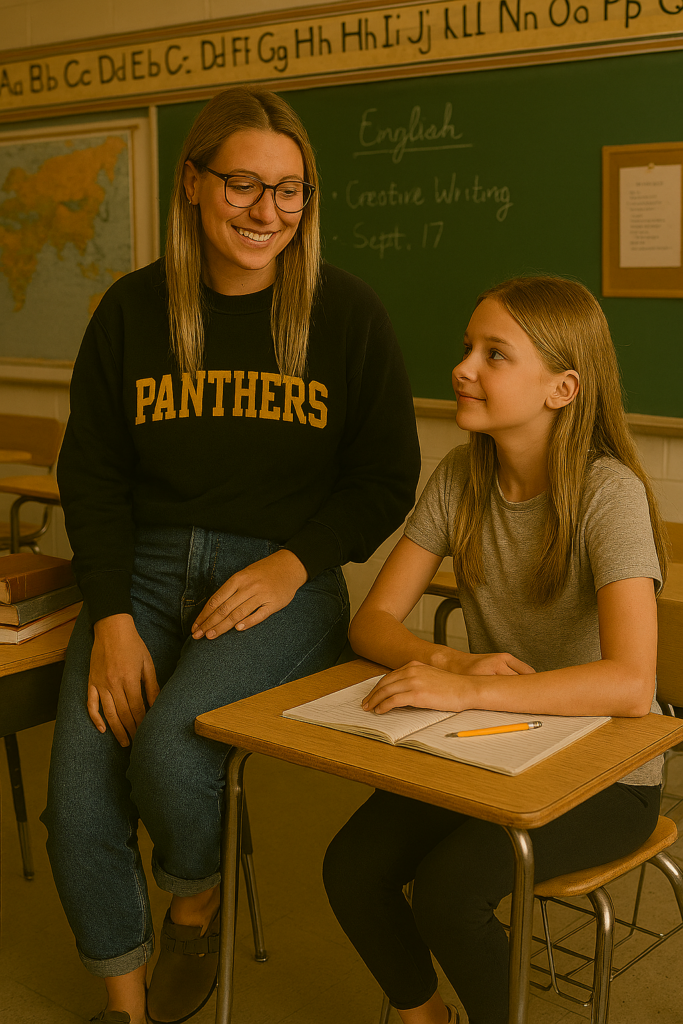
Allison Besonen and new 6th grade student Clara Juntunen, a transfer from Ironwood, share a quiet moment together in class.
After class, as students packed up for science, Clara lingered. Not obviously — just a slight slowness in zipping her backpack, a glance toward the door, then toward Allison.
Allison recognized that too. A child testing whether an adult was safe.
She approached slowly. “How was your first morning?”
Clara shrugged one shoulder. “Okay.”
“Anything confusing? Anything you need?”
Another pause. Then, very quietly: “Do… do you know if the buses ever get delayed going to Ironwood?”
Allison blinked, surprised by the question — not the content, but the emotion behind it. “Sometimes, if the snow is bad,” she said gently. “Why do you ask?”
Clara hesitated. Her fingers tightened on her backpack strap. “My dad… he said he might come to one of my basketball games. But he lives in Ironwood now. And I don’t know if he’ll… if he’ll make it.”
The words were careful, but the worry underneath them was not.
Allison felt something shift inside her — a deep, familiar ache. She crouched slightly so she was at Clara’s eye level.
“That sounds really hard,” she said softly. “Wanting him there and not knowing if he’ll come.”
Clara’s eyes flicked up again — that same searching look, as if she was checking whether Allison meant it.
“My mom says he’ll try,” Clara whispered. “But sometimes he says he will and then… he doesn’t.”
Allison’s heart tightened. Not because she had lived this exact story — she hadn’t — but because she knew the shape of that fear. The fear of hoping too much.
“Clara,” she said, keeping her voice steady, “I’m really glad you told me. And I want you to know something. Whatever happens with the buses, or the weather, or your dad’s schedule… you’re not alone here. I’m in your corner. Okay?”
Clara swallowed. “Okay.”
It wasn’t trust. Not yet. But it was the first step.
After Clara Leaves
When the bell rang, Clara slipped out to science, her shoulders a little less tense than before.
Allison stood alone in the quiet classroom, the winter light slanting across the desks. She felt a warmth in her chest — not just for Clara, but for the realization that she had become the adult she once needed.
Dad, she thought, you taught me how to be steady for someone. How to show up. How to listen.
And then, unexpectedly, her thoughts drifted to Erik.
To the way he had fixed her outlet without fuss. To the way he listened. To the way he steadied her without crowding her. To the way she felt safe letting him into the places she usually guarded.
Helping Clara — being that safe adult — made something click into place. She wanted a life built on that same foundation. That same trust. That same quiet, deep understanding.
She wanted a home where she and Erik could raise children who never had to wonder if someone would show up for them.
The bell rang again, pulling her back to the present. She straightened her stack of papers, took a breath, and smiled.
Clara Juntunen had walked into her classroom today.
And Allison Besonen was exactly the teacher — and the woman — she needed to be.
The sky had already gone dark by the time Allison pulled into her driveway after school that day, the kind of deep winter darkness that settled over the Big Valley area like a blanket. Her porch light glowed softly against the snowbanks, and Erik’s truck was already there, engine off, a faint plume of breath rising from the tailpipe as it cooled.
He stepped out as she parked, hands tucked into his jacket pockets, snow crunching under his boots. “Hey,” he said, voice warm in the cold air. “Thought I’d stop by. Brought you some leftover venison stew.”
She smiled — tired, but genuinely. “That sounds perfect.”
Inside, the house felt instantly warmer with him in it. He set the container on the counter while she hung her coat, then turned toward her with that quiet attentiveness she’d come to rely on.
“You look like you had a day,” he said gently.
Allison exhaled, leaning against the counter. “Yeah. First day back after break. And… we got a new student.”
Erik nodded, waiting — not pushing, not filling the silence, just giving her space.
“Her name is Clara Juntunen,” Allison said. “She’s a sixth grader. She moved here from Ironwood over Christmas. Smart. Really smart. But… guarded.”
Erik’s expression shifted, not dramatic, just a subtle sharpening of focus. “Guarded how?”
Allison hesitated, searching for the right words. “She’s polite but careful. She watches everything. And today she stayed after class to ask me something, but it wasn’t really about buses or weather. It was about her dad.”
Erik leaned his hip against the counter, arms loosely crossed, open and listening. “What’s going on with him?”
“Her parents just divorced,” Allison said softly. “Her dad’s still in Ironwood. She’s worried he won’t show up for her basketball games. She didn’t say it outright, but… I could hear it. That fear of hoping too much.”
Erik nodded slowly. “That’s a heavy thing for a kid.”
“It is.” Allison swallowed. “And she reminds me of… me. Not the family situation, but the way she carries herself. The way she doesn’t want to take up space. The way she tests whether an adult is safe.”
Erik’s eyes softened. “You saw yourself in her.”
“Yeah,” she whispered. “I did.”
He stepped closer, not crowding her, just closing the distance enough that she felt his steadiness. “And how did that feel?”
Allison let out a breath she didn’t realize she’d been holding. “It made me want to show up for her. Really show up. The way my dad did for me. The way… the way I want to show up for the people in my life now.”
Erik didn’t speak right away. He reached out, brushing his fingers lightly along her forearm — a small, grounding touch. “You already do that,” he said quietly. “For your students. For your family. For me.”
Her chest tightened, not with pain, but with something warm and certain.
“I want to be someone she can trust,” Allison said. “Someone steady. Someone who doesn’t disappear.”
“You are,” Erik said. “And she’ll see that. Kids like that… they know who’s real.”
Allison looked up at him, really looked, and saw the truth in his eyes — the calm, the empathy, the quiet understanding that came from years of reading people, of knowing when someone needed gentleness instead of answers.
“I told her she wasn’t alone,” Allison said. “And I meant it.”
“I know you did.” Erik’s voice was low, steady. “And she’ll believe you. Maybe not today. But she will.”
Allison felt something shift again — the same deep, quiet shift she’d felt on the drive to Bessemer, and again when she watched him fix her outlet. A sense of rightness.
“I want a life where this is normal,” she said softly. “Coming home and talking to you about my day. About my students. About the things that matter.”
Erik’s expression warmed — not a smile, exactly, but something deeper. “I want that too.”
He reached for her hand, threading his fingers through hers with a gentleness that made her heart ache in the best way.
“You and me,” he said. “We’re building something. And days like this… they’re part of it.”
Allison squeezed his hand, feeling the truth settle into her bones. “Yeah,” she whispered. “They are.”
And as they stood together in the quiet kitchen, snow falling softly outside, Allison realized that this — the conversation, the connection, the shared understanding — was exactly what she wanted her future to look like.
A life with him. A home with him. A partnership built on the same steadiness she wanted to give Clara.
It was all becoming clear.
Flashback — Negaunee, Besonen Backyard, Allison Age 12
The late‑afternoon sun slanted low across the backyard, catching on the crust of old snow that still clung to the shaded edges of the yard. It was early March in Negaunee — that in‑between season when winter wasn’t ready to leave and spring wasn’t ready to commit. The air smelled faintly of thawing earth and woodsmoke from a neighbor’s chimney.
Allison sat on the back steps, boots swinging, jacket unzipped just enough to show she was testing the limits of the weather. She had a notebook beside her, half‑filled with doodles and half‑finished thoughts. She wasn’t writing. She was thinking — the kind of thinking that made her forehead crease in a way her father recognized instantly.
Art Besonen stepped out onto the porch, letting the screen door ease shut behind him. He carried two mugs of hot chocolate, steam curling into the cold air.
“You look like you’re solving the world’s problems,” he said, handing her one.
“I’m not,” she muttered. “Just… people problems.”
Art eased himself down beside her, boots planted firmly on the step below. He didn’t rush her. He never did.
After a long moment, Allison spoke. “I don’t get people sometimes.”
Art nodded once, as if this were the most reasonable statement in the world. “Most folks don’t.”
“There’s this girl at school,” Allison said. “She’s nice. But she says things that feel… off. Like she’s pretending to be my friend, but she’s not really.”
Art took a slow sip of his hot chocolate. “And what does your gut say?”
“That she’s not genuine,” Allison said quietly. “But I don’t know how I know that.”
Art smiled — small, proud. “That’s because you’re paying attention. Most people don’t. They hear words and stop there. You watch what people do.”
Allison looked down at her boots. “But what if I’m wrong? What if I’m just being… too careful?”
“Being careful isn’t a flaw,” Art said. “It’s a skill. And you’ve got good instincts. Better than most adults.”
She blinked at that — surprised, but warmed.
Art leaned back on his hands, looking out over the yard. “Let me tell you something, kiddo. People show you who they are. Not always right away. Not always loudly. But they show you.”
“How?” she asked.
“Consistency,” he said. “Does what they say match what they do? Do they show up when it matters? Do they treat you the same when no one’s watching?”
Allison absorbed that, her brow furrowed in concentration.
“And here’s the other part,” Art continued. “You can protect your heart without building a wall around it. You don’t have to let everyone in. But the ones who earn it? The ones who are steady, and honest, and real? You let them in. Because those people… they’re rare.”
Allison’s voice was small. “How do you know who’s safe?”
Art looked at her then — really looked — with that steady, quiet love he carried like a second skin. “You’ll feel it. Right here.” He tapped his chest. “It won’t be loud. It’ll be calm. Like standing on solid ground.”
She nodded slowly, letting the words settle.
“And one more thing,” he said. “When you find someone who treats you with respect, who listens, who doesn’t make you shrink yourself… don’t second‑guess it. Trust that you deserve that.”
Allison swallowed hard. “Okay.”
Art nudged her shoulder gently. “You’re going to grow up to be someone who reads people better than they read themselves. Just don’t forget the other half of it.”
“What’s the other half?”
“Let the right ones read you.”
The wind rustled the bare branches overhead. A crow called from somewhere near the alley. Allison tucked that sentence away without realizing she’d carry it for the rest of her life.
Art stood, brushing snow from his jeans. “Come on. Your mom’s making pasties. And you’re on carrot‑peeling duty.”
Allison followed him inside, her heart a little steadier, her instincts a little sharper, and her understanding of herself a little clearer.
Years later — standing in her own kitchen on Hall Road, telling Erik about a guarded sixth‑grader named Clara — she would remember this moment. She would hear her father’s voice in the quiet between her words. And she would realize that the calm she felt with Erik was the very thing Art had taught her to trust.
Solid ground. Steady presence. The right one reading her.
And she would know, with a certainty that felt like coming home, that her father had prepared her for this long before she ever met Erik Heikkila.
Ewen‑Trout Creek — Clara’s Second Day
The second day back from Christmas break had that familiar January hush to it — the kind where the hallways felt a little slower, a little softer, as everyone eased back into routine. Snow tapped lightly against the classroom windows, the sky a pale, wintery gray.
Allison was reviewing vocabulary journals when she noticed Clara hovering near her desk. Not approaching. Not leaving. Just… hovering. Backpack on one shoulder, fingers curled around the strap, eyes fixed on the floor.
Allison looked up with a gentle smile. “Hey, Clara. Everything okay?”
Clara stepped forward, but only by an inch. “Um… I had a question.”
“Sure,” Allison said, keeping her voice warm and steady. “What’s up?”
Clara hesitated, then pulled a folded paper from her pocket. “We’re supposed to write about someone we admire. But I don’t know if I should pick… someone I don’t really know anymore.”
Allison’s breath caught — not visibly, but in that quiet, internal way that meant something had landed.
“Tell me more,” she said softly.
Clara’s eyes flicked up, searching Allison’s face for something — sincerity, maybe. Safety. Permission.
“My dad,” she said finally. “I used to admire him a lot. But now… I don’t know if I should write about him. Because I don’t know if he’s still… the same.”
The words were careful, but the ache underneath them was unmistakable.
And just like that, Allison was twelve again, sitting on the back steps in Negaunee, her dad handing her a mug of hot chocolate, saying in that quiet, Finnish‑American way of his:
“People show you who they are. Not always right away. But they show you.”
She could almost feel the cold March air on her cheeks, hear the creak of the porch boards, see her father’s steady profile as he taught her the kind of lesson no book could hold.
Back in the present, Allison crouched slightly so she was eye‑level with Clara.
“It’s okay not to know,” she said gently. “It’s okay to feel unsure. You get to decide who earns that place in your writing and in your life.”
Clara swallowed. “But what if I pick wrong?”
Allison’s heart tightened. “Then you learn from it,” she said softly. “And you try again. Trust isn’t about being perfect. It’s about paying attention.”
Clara nodded slowly. She was not convinced, but comforted.
“Thank you,” she whispered.
“Anytime,” Allison said.
Clara slipped out to her next class, leaving Allison standing in the quiet room, her father’s words echoing through her mind like a steady heartbeat.
After School — Allison’s SUV
The building was nearly empty when Allison finally stepped outside. The sky had darkened into that deep winter blue, the kind that made headlights glow brighter against the snow. She walked to her Ford Bronco, unlocked it, and slid into the driver’s seat.
But she didn’t start the engine.
She just sat there, hands resting on the steering wheel, breath fogging faintly in the cold air.
Her father’s voice rose again in her memory — calm, grounded, and unmistakably Art Besonen:
“Consistency. That’s how you know. Do their words match their actions?”
She closed her eyes.
Erik’s face came to her instantly — not in a dramatic way, but in the quiet, steady way he always showed up in her life.
• The way he fixed her outlet without making a production of it
• The way he listened when she talked about Clara
• The way he showed up early with venison stew
• The way he softened around her, not because he was trying to impress her, but because he trusted her
Every memory aligned perfectly with her father’s lesson.
Consistency. Steadiness. Words and actions matching every time.
She felt it — that calm her father had described. That sense of standing on solid ground.
Erik wasn’t just someone she loved spending time with. He was someone she could build a life with. Someone she could trust with the deepest parts of herself. Someone who would show up — not just once, but always.
Allison opened her eyes, a small, certain smile forming. Her father had taught her how to read people. Clara had reminded her why it mattered. And Erik… Erik had shown her what it felt like when someone passed every test without even knowing he was taking one.
She turned the key, the engine coming to life. As she pulled out of the school parking lot, and turning east onto M-28 heading toward her quiet house on Hall Road, she felt something settle inside her — a clarity she hadn’t realized she’d been waiting for. She knew exactly where her heart was leading her And this time, she trusted it completely.
Friday Evening at Allison’s House on Hall Road
The snow had settled into a soft, steady fall by the time Erik pulled into Allison’s driveway. His headlights swept across the pines, catching the faint shimmer of ice on the branches. Inside, the house glowed warm against the winter dark — a single lamp in the living room, the kitchen light on, and the faint smell of something simmering drifting out the cracked kitchen window.
Allison opened the door before he could knock, smiling in that quiet, genuine way she reserved for him.
“Come in. Supper’s almost ready.”
Erik stepped inside, stamping snow from his boots. “Smells good.”
“It’s just a simple pasta bake,” she said, brushing a stray hair behind her ear. “Nothing fancy.”
He gave her a look — soft, appreciative. “Anything you make is good.”
She felt that more deeply than she expected.
They ate at her small dining table, the one she’d bought secondhand her first year teaching. The meal was simple, warm, comforting. Their conversation drifted easily — school, the weather, a funny story from one of Erik’s patrols involving a very confused porcupine.
But Allison was quieter than usual. Not withdrawn — just thoughtful. Erik noticed. He always noticed.
After supper, she made coffee, and they moved to the couch. Erik sat at one end, relaxed, one arm draped along the back. Allison curled up at the other end, legs tucked under her, holding her mug with both hands.
The silence between them was comfortable. But there was something she needed to say.
“Erik,” she began softly, “can I tell you something… personal?”
He turned toward her fully, giving her his complete attention. “Of course.”
She took a breath — not nervous, exactly, but aware that she was opening a door she didn’t open often.
“Something happened at school this week. With Clara.”
He nodded, waiting.
“She said something that… brought back a memory. From when I was her age.”
Erik didn’t speak. He didn’t rush her. He just listened — steady, grounded, present.
Allison set her mug down, hands folding in her lap. “When I was twelve, my dad and I had this conversation in our backyard. It wasn’t long. He’s not a talker. But it was… important.”
She looked up at Erik, searching his face. He was still, attentive, encouraging her without a single word.
“He told me how to read people. How to trust my instincts. How to know when someone is genuine. And how to protect my heart without closing it.”
Her voice softened. “I didn’t realize how much that shaped me until this week.”
Erik’s expression didn’t change dramatically — but something in his eyes warmed, deepened.
“What brought it back?” he asked quietly.
“Clara,” Allison said. “She’s guarded. Careful. She watches everything. And she asked me how you know who to trust. And suddenly I was twelve again, sitting on the back steps in Negaunee, hearing my dad say, ‘People show you who they are. Not always right away. But they show you.’”
Erik nodded slowly. “Your dad sounds like a wise man.”
“He is,” she said. “And I realized… I’ve been using that lens my whole life. Especially now.”
She hesitated — the vulnerable part. The part she didn’t share lightly.
“I’ve been watching you,” she said softly. “Not in a suspicious way. Just… paying attention. The way he taught me.”
Erik didn’t flinch. He didn’t joke. He didn’t deflect.
He simply said, “I know.”
Allison blinked. “You do?”
He gave a small, gentle smile. “You’re careful with your heart. I could see that from the beginning. And I never wanted to push you. I just wanted to be… consistent. So you’d know I meant what I said.”
Her breath caught — not dramatically, but deeply.
“That’s the thing,” she whispered. “You are. Consistent. Every time. And I realized this week that… you’re someone I can trust. Completely.”
Erik shifted closer — not touching her yet, but closing the space between them with intention.
“Allison,” he said quietly, “I’m not perfect. But I will always be honest with you. I will always show up. And I will never take your trust lightly.”
She felt tears prick at the corners of her eyes — not from sadness, but from the overwhelming relief of being understood.
“I know,” she said. “That’s why I’m telling you this. Because letting you in… it feels big. And it feels right.”
Erik reached out then, slow and gentle, and took her hand. His thumb brushed lightly across her knuckles — a touch that said more than any speech could.
“You can tell me anything,” he said. “Anytime. I’m here.”
Allison exhaled, a long, steady breath she didn’t realize she’d been holding.
She leaned into him — not dramatically, just enough that her shoulder touched his. He shifted his arm around her, drawing her close in a way that felt natural, inevitable.
For a long moment, they sat like that.
And Allison knew, with absolute clarity, that this was the man she could build a life with. The man who matched her father’s definition of trust without even trying. The man who made her feel seen and understood.
Friday Evening One Week Later
The snow had eased into a fine, glittering dust by the time Erik pulled into Allison’s driveway. It was the kind of January night where the cold felt clean, almost sharp, and the porch light cast a warm circle on the steps like a quiet welcome.
Allison had just finished setting the table when she heard his knock — soft, familiar. She opened the door with a smile that came easily now.
“Hey,” she said. “Come in. You’re right on time.”
Erik stepped inside, brushing snow from his shoulders. He held something in his hand — a small brown paper bag, folded neatly at the top.
“I, uh… brought you something,” he said.
His tone wasn’t nervous, exactly — just thoughtful. Intentional.
Allison raised an eyebrow, amused. “Oh?”
He handed her the bag. “Just… open it.”
She did — carefully, because something about the way he was watching her made her want to savor the moment.
Inside was a jar of Sanders hot fudge — the classic white and blue label, the kind she’d mentioned once, offhandedly, while they were talking about Michigan-made foods. She’d said she loved it but rarely bought it because it felt like a treat for special occasions.
She looked up at him, surprised warmth blooming in her chest. “Erik… how did you even find this? Super One doesn’t carry it.”
He shrugged, a small smile tugging at the corner of his mouth. “I was in Marquette for training earlier this week. I stopped at the Meijer there. I saw it on the shelf and thought of you.”
Allison held the jar in both hands, suddenly aware of how much this meant — not because it was expensive or grand, but because he’d remembered. Erik had gone out of his way for something small that mattered to her.
“That’s… really thoughtful,” she said softly.
Erik stepped a little closer, his voice gentle. “You mentioned it once. And you smiled when you talked about it. I figured that meant something.”
Her breath caught — not dramatically, but in that quiet, internal way that meant something had landed deep.
“Thank you,” she said. “Really.”
He nodded, almost shy. “I just wanted to do something nice for you.”
Allison set the jar on the counter and turned back to him. “You do. All the time.”
He didn’t say anything — he just looked at her with that steady, grounded warmth she’d come to trust more than anything. And something in her softened, opened, leaned in.
She stepped closer, close enough that she could feel the warmth radiating from him after the cold outside. “You listen,” she said quietly. “You remember things. You show up. That means more than you know.”
Erik’s expression shifted — not dramatically, but with a depth that made her heart tighten. “I care about you, Allison. A lot. Remembering things… that’s easy.”
She felt her throat tighten, emotion rising in a way she didn’t try to hide. “It’s not easy for everyone.”
“It is for me,” he said, “with you.”
The room felt warmer suddenly — not from the furnace, but from the closeness between them. Allison reached out, her fingers brushing his hand. He took her hand gently, as if he understood exactly how much this moment meant.
“Stay for dessert?” she asked, voice soft.
He smiled — that quiet, genuine smile she loved. “Only if we open that fudge.”
She laughed, the sound light and warm. “Deal.”
They moved into the kitchen together, side by side, the easy rhythm of two people who were beginning to understand just how deeply they fit.
Allison pulled the Jilbert Dairy half‑gallon from the freezer — vanilla bean, the classic. The red barn logo made her smile; it always reminded her of childhood trips to Marquette, of summer days and small joys. She scooped generous portions into two bowls, the ice cream firm and perfect.
Erik leaned against the counter, watching her with that soft, steady warmth. “You weren’t kidding,” he said. “Jilbert’s is the good stuff.”
“The only stuff,” she corrected, handing him a bowl.
They settled onto the couch again, knees brushing, bowls balanced in their laps. Allison opened the jar of Sanders hot fudge, warmed it just enough, and drizzled it over both servings. The smell alone felt like home.
Erik took his first bite, eyes closing briefly. “Okay,” he said. “You were right. This is incredible.”
Allison laughed, pleased. “Told you.”
Then — without overthinking it — she scooped a small spoonful and held it out toward him. “Here,” she said softly. “Try it with a little more fudge.”
Erik didn’t hesitate. He leaned in, lips brushing the spoon, and the moment was so simple, so natural, that Allison felt her heart warm in a way she couldn’t quite name.
He swallowed, smiled. “That’s dangerous.”
“Good dangerous,” she teased.
“Very good.”
A beat passed — warm, quiet, full of something unspoken — before Erik dipped his spoon into his own bowl and held it out to her.
“Your turn.”
Allison leaned in, tasting the cold sweetness, the warmth of the fudge, and the faint thrill of being cared for in such a gentle, intimate way. When she pulled back, she saw something in Erik’s eyes — not intensity, not pressure, just a deep, steady affection.
The kind her father had taught her to recognize. The kind that didn’t waver. The kind that stayed.
They ate the rest of their dessert side by side, sharing occasional spoonfuls, laughing softly, the house warm around them and the snow falling quietly outside.
And Allison knew — with a certainty that settled deep in her chest — that this was what the beginning of a life together looked like.
Not grand gestures. Not dramatic declarations. Just Jilbert Dairy ice cream, Sanders fudge, and a man who remembered the small things. A man who was hers.
Negaunee — Besonen Backyard, Early February
The cold had settled into that deep, crystalline stillness the U.P. gets in early February — the kind where the snow doesn’t fall so much as hang in the air, suspended, waiting. The Besonen backyard was quiet, the birch trees stark against the pale sky, the woodpile stacked neatly beside the shed.
Art Besonen was outside splitting a few pieces of kindling, working with the slow, deliberate rhythm of a man who never rushed a task that didn’t require rushing. His breath rose in faint clouds, his wool hat pulled low, his posture relaxed but alert — the way he always was.
Erik pulled into the driveway, his truck tires crunching over the packed snow. He stepped out, boots sinking slightly, heart steady but aware of the weight of what he was about to do. He’d called ahead earlier that day — a simple, “Mr. Besonen, could I stop by for a few minutes?” — and Art had answered with a quiet, “Sure.”
Erik walked toward the backyard, hands in his jacket pockets. Art looked up as he approached, set the axe aside, and brushed his gloves together.
“Evening, Erik.”
“Evening, sir.”
Art nodded toward the porch. “Let’s get out of the wind.”
They stepped up onto the porch, the boards creaking softly beneath their boots. The air was cold enough to sting, but not bitter. Just a typical early‑February evening in Negaunee.
Art didn’t speak right away. He simply waited, the way men like him did — giving space, letting the other person find their words.
Erik took a breath. “Thank you for seeing me.”
Art gave a small nod. “Figured it was important.”
“It is,” Erik said. He paused, steadying himself. “I wanted to talk to you about Allison.”
Art’s expression didn’t change, but something in his eyes sharpened — attentive, not suspicious.
“I love her,” Erik said quietly. “Deeply. And I want to spend my life with her. I’m planning to ask her to marry me.”
The words hung in the cold air, simple and sincere.
Art didn’t react immediately. He looked out over the yard — the same yard where he’d taught Allison how to read people, how to trust her instincts, how to protect her heart without closing it. He’d watched her grow into the woman she was. And he’d watched Erik too.
Finally, Art spoke. “You’re a good man.”
The words were quiet, but they landed with the weight of bedrock.
“Thank you,” Erik said, voice low.
Art kept his gaze on the snow‑covered yard. “I’ve seen how you are with her. How you listen. How you show up. That matters.”
“It matters to me too,” Erik said. “She deserves someone steady. Someone honest. Someone who won’t disappear.”
Art’s eyes flicked toward him — a brief, assessing glance that held years of quiet wisdom. “She’s careful with her heart. Always has been.”
“I know,” Erik said. “And I don’t take that lightly.”
Another long moment passed — not tense, just thoughtful.
Then Art gave a single, firm nod. The kind that meant everything.
“You have my blessing.”
Erik felt something settle inside him — a deep, grounded certainty. “Thank you. Truly.”
Art shrugged lightly, as if brushing off the significance even though he knew exactly what it meant. “Just take care of her. Be stable. Be honest. That’s all.”
“I will,” Erik said. “Always.”
Art reached out then — not for a handshake, but for a brief, solid clasp on Erik’s shoulder. A gesture that said more than any speech could.
“Good,” he said simply.
They stood there for a moment, the quiet settling around them like a benediction.
Then Art nodded toward the house. “Lorraine’s got coffee on. Come in before you freeze.”
Erik smiled. “Yes, sir.”
As they walked inside, Erik felt the truth of it settle deeper: Art Besonen didn’t give his blessing easily. He gave it when he meant it. And he meant it now.
Erik was ready — not just to propose, but to build a life with Allison that honored everything her father had taught her to trust.
Valentine’s Day — Lake Superior Shoreline, West of Ontonagon
The sky had settled into that soft, dusky blue that only winter evenings on Lake Superior could hold — a color somewhere between twilight and memory. After dinner in Ontonagon, Erik had suggested a drive, nothing unusual for them, and Allison had agreed without hesitation. She loved these quiet rides with him, the way the world seemed to fall away as the miles slipped by.
They headed west along M‑64, the road hugging the shoreline, the lake stretching out beside them like a frozen, breathing presence. The snowbanks were high, the pines heavy with white, and the sky clear enough that the first stars were beginning to appear.
Erik slowed as they approached one of the small roadside parks — the kind with a simple wooden sign and a narrow path leading down to the beach. He pulled in, turned off the engine, and the sudden quiet felt almost sacred.
Allison looked over at him, curious. “Everything okay?”
He smiled — that soft, steady smile she’d come to trust with her whole heart. “Yeah. Thought we could walk for a minute.”
They stepped out into the crisp air, their boots crunching on the packed snow. The wind off the lake was gentle tonight, almost tender, carrying the faint scent of ice and pine. Erik reached for her hand, and she took it without thinking, their fingers fitting together with the ease of something long understood.
They walked down the short path to the beach, the snow deep but manageable, the lake stretching out before them in a vast, frozen expanse. The moonlight caught the ice in shimmering patches, like scattered silver.
Allison breathed in the cold air, feeling the quiet settle around them. “It’s beautiful,” she whispered.
“It is,” Erik said — but he was looking at her, not the lake.
She turned toward him, and something in his expression made her heart still. Not fear. Not surprise. Just a deep, quiet knowing.
“Allison,” he said softly, taking both her hands now, his gloves brushing hers. “There’s something I’ve been wanting to ask you.”
Her breath caught — not in shock, but in recognition. In clarity. In the sense that everything in her life had been leading gently, steadily, to this moment.
Erik took a slow breath, the kind that came from a place of absolute sincerity. “I love you. I love your steadiness, your heart, the way you care for your students, the way you see people. I love the life we’re building — the simple parts, the quiet parts, the everyday parts.”
Allison felt warmth rise in her chest, spreading through her like a truth she’d always known.
“I want to spend my life with you,” he continued. “All of it. The ordinary days, the hard days, the good ones. I want to be your partner. Your home. Your person.”
He reached into his coat pocket — not dramatic, not rehearsed, just natural — and pulled out a small box. He opened it, revealing a simple, elegant ring that caught the moonlight.
“Allison Besonen,” he said, voice steady, “will you marry me?”
There was no hesitation. No doubt. No fear.
Just clarity.
Just love.
Just the deep, quiet certainty her father had taught her to trust.
“Yes,” she said, her voice soft but sure. “Yes, Erik. Absolutely yes.”
His breath released in a warm cloud, relief and joy mingling in his eyes. He slipped the ring onto her finger — his hands gentle, reverent — and she stepped into him, wrapping her arms around his neck as he held her close.
The lake was silent. The snow was soft beneath their boots. The world felt still, as if holding its breath for them.
Erik pressed his forehead to hers. “I love you,” he murmured.
“I love you too,” she whispered back. “And I’m ready for everything with you.”
They stood there on the frozen shore, two outdoor-loving Yoopers wrapped in winter and moonlight, beginning the next chapter of their life exactly the way they lived it:
Simply. Steadily. Together.
Sparkle Squad FaceTime — Valentine’s Night, 8:15 PM
Allison had barely set her purse down when the group chat lit up like a Christmas tree. She smiled — of course they were already buzzing. She’d texted, “Can we FaceTime tonight? I have news.” and that was basically the Sparkle Squad equivalent of pulling a fire alarm.
She hit “Join,” and one by one, her favorite faces filled the screen.
Lily
Hair in a loose braid, sitting cross‑legged on her couch, eyes already sparkling with suspicion.
Maya
Fully awake, fully illuminated, and fully dramatic. “I put on mascara for this. This better be life‑changing.”
Sophie
Wrapped in a fleece blanket, mug of tea in hand. “If this is about a new Jilbert flavor, I swear—”
Rachel
Already bouncing. “No, no, this is the look. This is the ‘I’m about to scream’ look.”
Marnie
Holding 19‑month‑old Emily on her hip. Emily was wearing footie pajamas with little foxes on them and chewing on a silicone teether shaped like a strawberry. She waved the teether at the camera with great enthusiasm.
“Say hi, Em,” Marnie said, bouncing her gently.
Emily responded with a delighted squeal and a drooly grin.
Allison laughed, cheeks warm. “Okay, okay. I’ll just… show you.”
She held up her left hand.
Five simultaneous shrieks erupted — plus one startled squeak from Emily, who immediately clapped her hands because everyone else was excited.
“OH MY GOSH!” Lily practically levitated. “ALLISON!”
Maya slapped both hands over her mouth. “I KNEW IT. I KNEW IT. I FELT IT IN MY BONES.”
Sophie leaned so close to the camera that only her forehead was visible. “Is that a ring? That’s a ring. That’s a ring.”
Rachel was already crying. “I’m so happy I can’t function.”
Marnie beamed. “Congratulations, sweetheart!” She lifted Emily’s little hand and helped her wave. “Emily says congrats too.”
Emily babbled something that sounded vaguely like “Yay!” and then tried to lick her teether.
Allison’s heart swelled. “He proposed tonight. On the beach. In Silver City.”
Lily gasped. “LAKE SUPERIOR? In FEBRUARY? That’s the most Yooper thing I’ve ever heard.”
“It was perfect,” Allison said softly. “Simple. Quiet. Just us.”
Maya wiped her eyes. “Tell us everything. What did he say? Did you cry? Did he cry? Did the lake freeze in approval?”
Sophie nodded solemnly. “The lake’s blessing is essential.”
Allison laughed. “He was… Erik. Steady. Gentle. He told me he loved the life we’re building. And then he asked.”
Rachel sniffled. “And you said yes.”
“With absolute clarity,” Allison said. “I’ve never been more sure.”
Emily squealed again, then dropped her teether and immediately tried to dive off Marnie’s lap to retrieve it. Marnie caught her with practiced mom reflexes.
“Sorry,” Marnie said, laughing. “She’s very excited.”
Lily wiped her eyes. “Okay, we need details. Wedding timeline. Colors. Location. Do we get to wear cute dresses? Do we get to cry in public?”
“Lily,” Sophie said, “you cry in public constantly.”
“Not the point.”
Allison held up both hands. “One thing at a time. But yes — mid‑June. Outdoors. Small. Very us.”
Maya squealed. “I’m going to be unbearable for months.”
Rachel nodded. “Same. Zero regrets.”
Sophie raised her mug. “To Allison and Erik.”
The others lifted whatever they had — tea, water, emotional support wine, and in Emily’s case, a reclaimed strawberry teether.
“To Allison and Erik,” they echoed.
Allison felt her throat tighten — not with nerves, but with gratitude. These were her people. Her constants. Her chosen family.
And tonight, they were celebrating the beginning of her next chapter.
Marnie smiled softly. “We love you, Allison.”
“I love you all too,” she said. “So much.”
The screen filled with overlapping chatter, laughter, and wildly ambitious wedding ideas — the kind only the Sparkle Squad could dream up.
And as Allison watched them — her ring catching the light, her heart full — she knew she was stepping into her future surrounded by exactly the right people.
Negaunee & Marquette — The Weekend After the Engagement
The drive to Negaunee felt different this time. The roads hadn’t changed – M-28 and US-41 had looked largely the same since the last stretches of the current alignment of those highways between Trout Creek and Negaunee were completed and paved in 1958. Nor because the snowbanks were any higher, though it was a few weeks away from the point where spring would slowly start to eat away at the winter’s snow pack. Instead, Allison kept catching sight of the ring on her hand as the winter sun hit it. Every time it glimmered, she felt a warm flutter in her chest.
Erik noticed her smile and reached over, brushing his thumb across the back of her hand. “Still real,” he said softly.
“I know,” she murmured. “But it still feels like a dream.”
They pulled into the Besonen driveway just as the late‑afternoon light turned golden against the snow. Smoke curled from the chimney, and the familiar warmth of home settled over Allison like a blanket.
Inside, Lorraine greeted them with hugs and the smell of roast chicken and nisu bread. “Come in, come in,” she said, her eyes shining as she looked at Allison’s hand. “Let me see it again.”
Allison held out her hand, and Lorraine clasped it gently. “It’s beautiful,” she said. “Just perfect.”
Erik smiled, a little shy, a little proud.
Art appeared from the hallway, wiping his hands on a dish towel. “Evening,” he said in his quiet way.
“Hi, Dad,” Allison said, stepping forward to hug him.
Art hugged her back — brief, firm, full of meaning. Then he turned to Erik.
And there it was.
The second handshake.
Not the polite one from their first meeting. Not the assessing one from the blessing conversation. But the one that meant something deeper.
Art extended his hand, and when Erik took it, Art gave a subtle double‑pump — a gesture so small most people would miss it.
But Allison didn’t miss it.
She felt it like a chord struck inside her chest.
You’re family now.
Erik seemed to understand too. His expression softened, gratitude flickering across his face. “Thank you,” he said quietly.
Art nodded once. “Welcome.”
Dinner was warm and easy — Lorraine fussing over them, Art listening more than talking, Allison and Erik sharing glances that felt like secrets. Afterward, they lingered at the table with coffee, the kind of slow, comfortable evening that felt like home.
When they finally bundled up to leave, Lorraine pressed leftovers into their hands, and Art walked them to the door.
“Drive safe,” he said.
“We will,” Allison replied.
As they stepped outside, Allison slipped her hand into Erik’s. “That handshake,” she whispered. “It meant everything.”
Erik squeezed her hand gently. “I know.”
Marquette — Jilbert Dairy
The sky was dark by the time they reached Marquette, but Jilly – the mascot at Jilbert Dairy, who stood perched atop the facility – glowed cheerfully against the night from lights shone upon her. The parking lot was quiet — winter wasn’t exactly ice‑cream‑rush season — but the place was open, lights warm inside, and wallpaper in unmistakable cow motif.
They ordered their favorites:
• Allison: vanilla with hot fudge
• Erik: chocolate peanut butter swirl
They sat at a small table by the window, watching snowflakes drift lazily past the streetlights.
Allison took a bite and sighed happily. “This is the perfect way to celebrate.”
Erik grinned. “I figured we should start our engagement with something very… us.”
“Lake Superior and Jilbert Dairy?” she teased.
“Exactly.”
She reached across the table, brushing her fingers against his. “Today was perfect.”
“Your parents are wonderful,” he said. “Your dad… that handshake meant a lot.”
Allison nodded, emotion rising in her chest. “He doesn’t say much. But when he does something like that… it’s everything.”
Erik’s voice softened. “I’m honored he trusts me with you.”
She felt her throat tighten — not with sadness, but with the fullness of being loved by two steady men in her life. “He does,” she whispered. “And so do I.”
They sat there for a long moment, hands intertwined, ice cream melting slowly in their bowls, the world outside quiet and soft.
And Allison felt it — her father’s presence, her mother’s joy, the warmth of home, the steadiness of Erik beside her.
Her past and future meeting in one perfect, simple night.
A beginning wrapped in winter, love, and the glow of a cow two stories high.
Wedding planning
The following weekend, Erik was on patrol all weekend, so Allison headed to Negaunee to begin wedding planning with Mrs. Besonen. Allison was up early and was at her parents’ home by 9:00 a.m. that Saturday. During their visit the prior weekend, they had at least narrowed down some of the most important details:
• They wanted to have the wedding the third Saturday in June, which would be ideal timing with school out for everyone and the exceptionally long daylight hours for those who would be driving any distance, as is common in the Upper Peninsula
• They wanted to be married outdoors at one of the most picturesque Upper Peninsula locations not involving Lake Superior: Sunday Lake in Wakefield, where the city of Wakefield maintains a city park on the north shore of the lake. It is the perfect backdrop for a Saturday in the U.P. that time of year, it has a pavilion for the reception, trees and picnic tables, and plenty of things for kids to do.

The wedding setup on the shore of Sunday Lake in Wakefield, Michigan.
The choice of Wakefield was also more convenient for the Sparkle Squad, who would make up the bridal party. They would be coming from various places in Minnesota and Wisconsin. By having the wedding in Wakefield, as opposed to Ewen or Negaunee, it shortened all of their travel time. The guest list would not be exceptionally large, so that would help with overall costs and make for a more intimate event. The color palette would include a deep fern green for Lily as the maid of honor, soft sage, moss and eucalyptus for the bridesmaids, and dusty olive for Marnie as the bridal attendant.
Silhouettes
• Lily: A-line chiffon with flutter sleeves — romantic, effortless, very “Lily”
• Maya: Sleek V-neck with a slit — she’ll love the drama without overshadowing the bride
• Sophie: Soft wrap dress — comfortable, flattering, gentle
• Rachel: Square neckline midi — sweet, classic, youthful
• Marnie: Cap-sleeve or short-sleeve gown with a defined waist — graceful and mature without looking “matronly”
The kitchen smelled like coffee, cardamom, and something sweet Lorraine had pulled from the oven “just because.” Sunlight streamed through the window over the sink, catching the snowbanks outside and making the whole room glow.
Allison sat at the table with her planner open, a pen tucked behind her ear, and her ring catching the light every time she moved her hand. Lorraine set down two mugs of coffee and slid into the chair beside her.
“Alright,” Lorraine said, smoothing the tablecloth. “Let’s get our ducks in a row.”
Allison smiled. “I feel like we’ve already made so many decisions.”
“You have,” Lorraine agreed, “but weddings have a way of multiplying details like rabbits.”
Allison laughed. “That’s comforting.”
The Guest List
Lorraine pulled out a notepad. “So. Intimate guest list. What does that mean to you?”
“Close family, close friends, and the people who’ve actually been part of our lives,” Allison said. “No obligation invites.”
Lorraine nodded approvingly. “Good. Your dad will appreciate that.”
They worked through names — the Besonen relatives, the Heikkila relatives, the Sparkle Squad, a few Ewen-Trout Creek colleagues, a handful of Erik’s DNR coworkers. Allison paused occasionally, chewing her pen cap.
“I want it to feel like… community,” she said. “Not a crowd.”
“You’ll get that,” Lorraine said. “Wakefield is perfect for that kind of wedding.”
Ceremony Layout at Sunday Lake
Lorraine flipped to a fresh page. “Now, the park. You want the ceremony facing the lake?”
“Yes,” Allison said immediately. “The water behind us, the trees around us… it feels right.”
“And the pavilion for the reception?”
“Exactly. Simple. Outdoorsy. Us.”
Lorraine smiled. “I can already picture it.”
They talked through chair arrangements, where the bridal party would stand, how to keep the aisle stable on grass, and whether to use the natural birch trees as part of the backdrop.
“I don’t want an arch,” Allison said. “Just the lake and the trees.”
Lorraine nodded. “Nature’s already done the decorating.”
Bridal Party Dresses
Lorraine tapped her pen. “Forest palette. That’s beautiful.”
“It feels like home,” Allison said. “And each of the girls gets a shade that fits them.”
She listed them off — Lily in deep fern, Maya in moss, Sophie in sage, Rachel in eucalyptus, Marnie in dusty olive.
Lorraine smiled. “It’s going to look like a June forest in bloom.”
“And we’re all wearing diamond studs,” Allison added. “Simple. Elegant. No hoops for the wedding.”
Lorraine’s eyes softened. “I love that. It’s very you.” Art – who, more than ten years later, still doesn’t quite understand her daughter’s decision to get her nose pierced as a college freshman, wasn’t around for the wedding planning session to hear the details of her daughter’s and friends’ plans for wedding day adornments…he got together that morning for breakfast with some former co-workers from the Tilden Mine, the iron ore mine and pellet processing plant near Ishpeming where he is retired from after 41 years of employment. Lorraine had always been more supportive of Allison’s decision.
Flowers
Allison hesitated. “I don’t want anything too fussy.”
“Wildflowers?” Lorraine suggested.
“Yes,” Allison said, brightening. “Local ones. Lupine if we can get it. Maybe ferns. Something that looks like it was gathered from the woods.”
“And your bouquet?”
“White and green. Maybe a few soft pinks. But mostly natural.”
Lorraine scribbled notes. “We’ll talk to the florist in Ishpeming. She’ll know exactly what to do.”
Food
Lorraine leaned back. “Now, the important part.”
Allison laughed. “Mom.”
“Well, it is.”
They talked through options — a local caterer, simple summer foods, maybe a Yooper twist.
“Pasties?” Lorraine suggested.
“Not for the main meal,” Allison said, “but maybe as a late‑night snack.”
Lorraine grinned. “That’s my girl.”
In the end, pasties would make the menu, along with a few other options.
Music
“Live or playlist?” Lorraine asked.
“Playlist,” Allison said. “Erik and I want to pick songs that mean something to us.”
“And the father‑daughter dance?”
Allison paused, her throat tightening just a little. “Something quiet. Something steady. Something that feels like Dad.”
Lorraine reached over and squeezed her hand. “We’ll find the right one.”
The Dress
Lorraine’s eyes sparkled. “Have you thought about your dress?”
“A little,” Allison admitted. “Simple. Flowing. Nothing poofy. Maybe lace, but not too much. You know I’m more of a sweatshirt-and-jeans type of girl, not fancy.”
“You’ll look beautiful in anything,” Lorraine said. “But simple suits you.”
Allison smiled. “I want to feel like myself.”
A Quiet Moment
They paused, sipping their coffee, the list between them growing longer but somehow feeling manageable.
“You know,” Lorraine said softly, “I always pictured you getting married somewhere outdoors. Somewhere that felt like the U.P.”
Allison nodded. “It’s where I feel grounded.”
“And Erik grounds you too,” Lorraine said. “In the best way.”
Allison looked down at her ring, her heart warm. “He does.”
Lorraine reached over and brushed a strand of hair behind her daughter’s ear. “This is going to be a beautiful wedding, sweetheart. Not because of the details — though those will be lovely — but because it’s true to who you are.”
Allison felt her eyes sting. “Thanks, Mom.”
They leaned over the table and hugged, the kind of hug that held years of love and pride and quiet understanding.
And then Lorraine pulled back, clapped her hands, and said, “Alright. Cake flavors.”
Allison laughed. “Let’s do it.”
The planning continued — warm, steady, full of love — exactly the way Allison’s wedding day would be.
Next Saturday, Lily’s apartment, Pine City, Minnesota
Allison knocked on Lily’s door with a familiar flutter in her chest — not nerves, just that warm anticipation she always felt before seeing the friend who had known her since she was eighteen and terrified and hopeful all at once.
Lily opened the door with her usual brightness. “Get in here,” she said, pulling Allison into a hug that felt like coming home. Lily’s cat, Frodo, wound around their legs, chirping his greeting.
They settled on the couch, coffee mugs in hand. The house smelled like vanilla and laundry detergent — Lily’s signature combination.
For a moment, they just sat. Comfortable silence. The kind only possible between people who have lived entire chapters of life side by side.
Lily glanced over. “Okay,” she said softly. “You’ve got that look.”
“What look?”
“The one you had the day we moved into Ross Hall and you were trying to pretend you weren’t scared out of your mind.”
Allison laughed — a real, unguarded laugh. “I was scared out of my mind.”
“I know,” Lily said. “You walked in with your color‑coded planner and your perfectly folded sweaters, and I thought, ‘Oh no, she’s going to hate me.’”
“I thought you were going to hate me,” Allison said. “And then you offered me half your bag of gummy bears and told me my mom was cute.”
Lily grinned. “She is cute.”
“And that was it,” Allison said. “I wasn’t scared anymore.”
The room softened. Lily’s expression shifted — not sad, not sentimental, just deeply present.
“Allison,” she said quietly, “we grew up together in that room.”
“We did,” Allison agreed. “And we’ve stayed together. Through everything. Even when life pulled us in different directions.”
“Even when we got our noses pierced and I almost passed out,” Lily added.
“You squeezed my hand so hard I thought you’d break it.”
“You squeezed back.”
They both smiled — the kind of smile that holds years.
Allison set her mug down, hands suddenly still. “Lily… I came today because I wanted to ask you something important. And I needed to do it in person.”
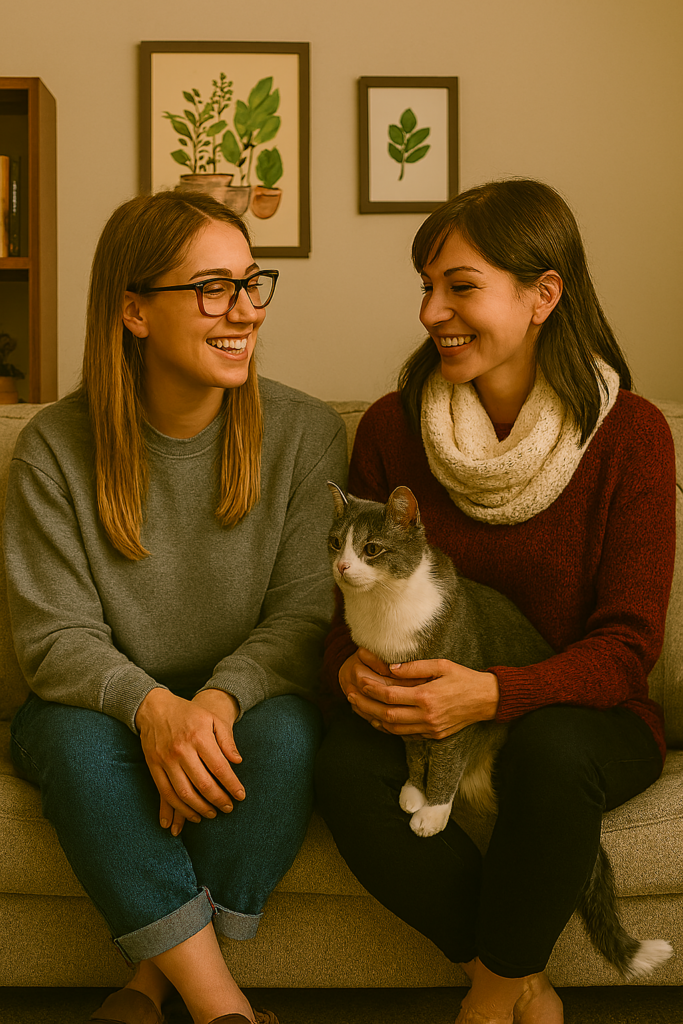
Allison comes to Pine City to ask Lily an important question as Frodo looks on.Lily’s breath caught, just slightly. “Okay.”
Allison turned toward her fully. “Will you be my maid of honor?”
Lily didn’t speak at first. Her eyes filled instantly — not with surprise, but with recognition. As if she’d known this moment was coming, but still needed to feel it land.
“Allison,” she whispered, voice trembling. “Of course I will. Of course.”
Allison felt her own throat tighten. “I can’t imagine standing up there without you. You were the first person who made Superior feel like home. You were the first person I trusted with the real me. You’ve been my constant.”
Lily wiped her cheek, laughing softly through the tears. “You’re my person, Allison. You always have been.”
They leaned into each other, foreheads touching for a moment, the way they used to when finals were crushing them or when one of them had a heartbreak too big for words.
Frodo meowed loudly, jumping onto Lily’s lap as if to break the intensity.
Lily sniffed and scratched his ears. “See? Even Frodo approves.”
Allison laughed, wiping her eyes. “Good. Because I need you there. Not just as a bridesmaid. As my sister.”
Lily’s voice softened to a whisper. “I already am.”
And in that Pine City living room — with coffee cooling, a cat purring, and years of friendship wrapped around them — the moment settled into place. Not dramatic. Not flashy. Just true.
Exactly like them.
Late March — Hall Road, A Quiet Saturday Morning
The snowbanks were finally shrinking, revealing patches of brown grass and the first hints of mud season. Allison was sitting at her small kitchen table with a cup of coffee, grading a stack of essays, when she heard Erik’s truck pull into the driveway earlier than expected.
She glanced at the clock. “He’s home already?”
After Allison and Erik got engaged on Valentine’s Day, among wedding planning, they made another decision. Erik would move in with Allison at her home on Hall Road right away and would give notice to his landlord for the small rental home he had near Trout Creek that he would be leaving by April 1. That would give him time to gradually move into Allison’s home on his off days. While it made for a bit longer drive to the Baraga DNR post – it was nothing by U.P. standards where long drives to anywhere are part of the way of life. So, for the past several weeks, Hall Road and Allison’s house was now home – for the newly engaged couple.
Before she could stand, the door opened and Erik stepped inside, brushing off his boots. He had that look — the one that meant something happened, but not in a bad way. More like he was holding onto a piece of news he couldn’t wait to share.
“Allie?” he called.
“In here!”
He walked into the kitchen, cheeks pink from the cold, eyes bright with something like excitement. He leaned down to kiss her, then pulled out the chair across from her.
“I heard something today,” he said, resting his forearms on the table.
Allison set her pen down. “Good something or bad something?”
“Good,” he said. “Really good.”
She raised an eyebrow. “Okay, now you’re making me curious.”
He took a breath. “There’s a family in Trout Creek. They’ve got a golden retriever — four years old, female. Her name’s Olive.”
Allison’s heart did a little flip. “Olive?”
“Yeah.” He smiled. “They’re moving out of state. Can’t take her with them. They’re looking for a good home.”
Allison’s eyes widened, her breath catching. “A golden retriever?”
“Mm‑hmm.”
“Four years old?”
“Yep.”
“Well-trained?”
“Very.”
She pressed a hand to her chest. “Erik.”
He reached across the table, taking her hand gently. “I thought of you right away. Of us. Of the house. Of… everything we’ve been building.”
Allison felt warmth bloom in her chest — the kind that came from being known so deeply. “I’ve been thinking about a dog,” she admitted. “Especially when you work late shifts. And… I don’t know. It just feels right.”
Erik nodded. “I think so too.”
She squeezed his hand. “Can we meet her?”
“I already called,” he said, grinning. “They’re home this afternoon. Said we’re welcome to come by.”
Allison laughed — a bright, delighted sound. “We’re getting a dog, aren’t we?”
Erik shrugged, but his smile gave him away. “We’ll see how it goes. But… yeah. I think we might be.”
Trout Creek — The First Meeting
The family lived in a modest house tucked among tall pines. When they pulled into the driveway, a golden retriever was already waiting at the window — tail wagging, ears perked, eyes bright.
“That’s Olive,” Erik said softly.
Allison’s heart melted instantly.
The door opened, and Olive bounded out — not wildly, but with that gentle, eager joy goldens are known for. She trotted straight to Allison, sniffed her hand, then leaned her whole body against her leg as if she’d known her forever.
“Oh,” Allison whispered, kneeling to stroke her soft fur. “Hi, sweetheart.”
Olive licked her chin, tail thumping.
Erik crouched beside them. “She likes you.”
“She loves me,” Allison corrected, laughing as Olive pressed closer.
The family explained Olive’s routines, her training, her temperament. Everything they said only confirmed what Allison already felt in her bones: this dog belonged with them.
When they asked if Allison and Erik wanted to take her for a short walk, Olive trotted between them like she’d been doing it for years.
Halfway down the quiet road, Allison looked up at Erik. “She’s ours, isn’t she?”
He nodded. “Yeah. She is.”
Olive looked up at them, tongue lolling, as if agreeing.
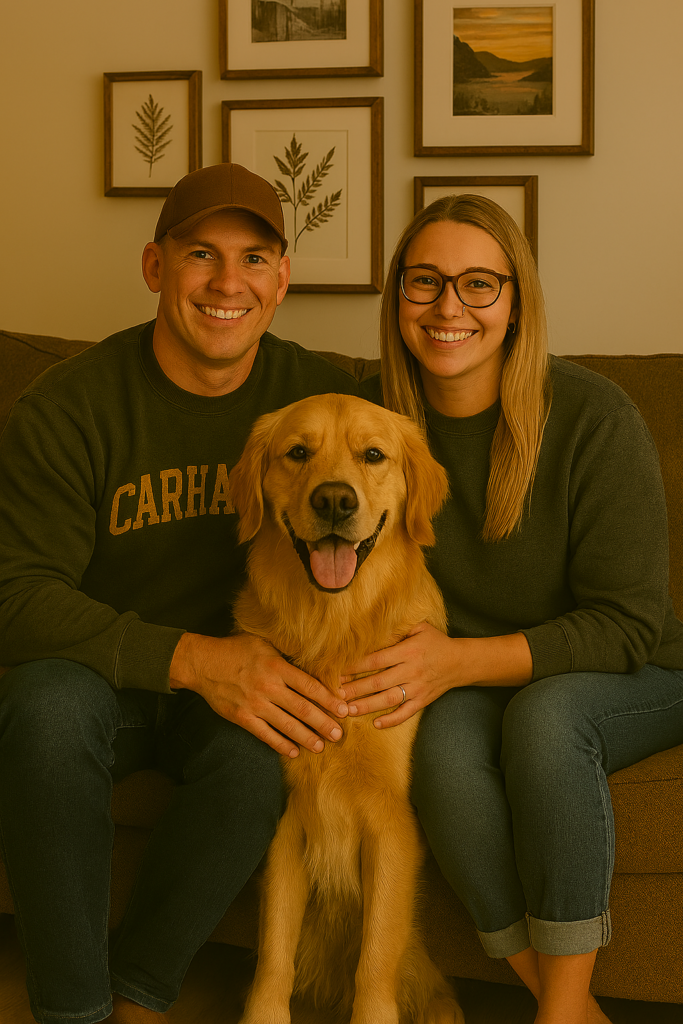
Erik and Allison enjoy Olive’s company at home on Hall Rd. near Ewen.Hall Road — Olive Comes Home
By late afternoon, Olive was curled up in the backseat of Erik’s truck, head resting on Allison’s thigh. When they pulled into the driveway, she hopped out, sniffed the yard, then trotted to the front door like she already knew it was hers.
Inside, she explored calmly — the living room, the kitchen, the hallway — then returned to Allison and sat at her feet, looking up with trusting eyes.
Allison knelt, wrapping her arms around Olive’s neck. “Welcome home, girl.”
Erik stood behind them, resting a hand on Allison’s shoulder. “She’s going to be good for us.”
Allison nodded, tears pricking her eyes. “She already is.”
Olive wagged her tail, nudged Allison’s hand, and let out a soft, contented sigh.
And just like that, their little family grew — not with fanfare, not with spectacle, but with the same quiet, steady love that defined everything Allison and Erik were building together.
Olive was home.
Pine City — The Thurston Farmhouse, A Rainy April Afternoon
The rain came down in soft sheets, tapping against the old farmhouse windows and turning the gravel driveway into a patchwork of puddles. Inside, though, the house glowed with warmth — lamps lit, coffee brewing, the faint scent of lemon bars cooling on the counter.
Lily stood in the entryway, camera already in hand, bouncing on her toes as she waited for Allison to arrive. Maya and Sophie were arranging gifts on the dining room table, Rachel was fussing with a banner that read “Future Mrs. Heikkila!”, and Marnie was in the living room trying to keep Emily from climbing onto the coffee table.
“Sweetheart,” Marnie said gently, scooping Emily up, “we do not stand on furniture.”
Emily giggled, entirely unrepentant, and patted her mother’s cheek.
Ethan walked in from the kitchen, wiping his hands on a towel. “Everything set?”
“Almost,” Lily said. “I need natural light for the perfect shot, but the sky is being rude.”
“It’s April,” Ethan said with a shrug. “It’s supposed to be rude.”
Allison Arrives
A car door slammed outside. Lily squealed. “She’s here!”
Everyone scrambled into position — Maya straightened her hair, Sophie smoothed her dress, Rachel grabbed her phone, and Marnie shifted Emily to her hip.
The front door opened, and Allison stepped inside, shaking off her umbrella. She wore a soft green sweater that matched the forest palette she’d chosen for the wedding, and her cheeks were pink from the cold.
The moment she looked up and saw them — all of them — her face lit up.
“Hi!” she said, breath catching with emotion.
The Sparkle Squad descended on her in a wave of hugs, laughter, and overlapping voices.
“Oh my gosh, you’re engaged!” “Let me see the ring again!” “You look so happy!” “Tell us everything!”
Lily snapped photos the entire time, narrating as she went. “Okay, this is perfect, this is adorable, this is going in the album—Maya, stop blocking the light!”
Maya swatted at her. “I’m trying to hug her!”
“You can hug her after I get the shot!”
Allison laughed, overwhelmed in the best way. “I missed you all so much.”
Ethan’s Moment
When the chaos settled a bit, Ethan stepped forward, hands in his pockets, eyes already suspiciously shiny.
“Allie,” he said softly, “we’re so happy for you.”
She hugged him — a warm, familial hug that spoke of years of friendship and the deep affection between them.
And that was it. Ethan sniffed, blinked hard, and wiped his eyes.
“Oh no,” Maya said, pointing. “He’s crying. He’s actually crying.”
“I’m not crying,” Ethan said, voice cracking. “It’s the rain.”
“It’s not raining inside,” Sophie said gently.
Marnie walked over and kissed his cheek. “It’s okay, honey.”
Emily, sensing emotion, patted Ethan’s leg and said, “Dada sad?”
He scooped her up. “No, sweetheart. Dada’s happy.”
Emily nodded solemnly, then stuck her fingers in his mouth.
The Shower Begins
They moved into the dining room, where Lily had arranged everything with her usual flair — forest‑green table runners, mason jars with ferns, a cake decorated with tiny pinecones made of chocolate.
“It’s perfect,” Allison whispered.
“Of course it is,” Lily said. “I love you, and I’m extra.”
Maya immediately launched into interrogation mode.
“So. Ceremony details. What’s the aisle setup? Are you doing a first look? What’s the menu? Are we doing a bachelorette weekend? Do you want matching pajamas? What about—”
“Maya,” Sophie said, placing a hand on her arm, “breathe.”
“I am breathing,” Maya insisted. “I’m just breathing enthusiastically.”
Allison laughed. “One question at a time.”
Emily Steals the Show
As Allison opened gifts — kitchen towels, a picnic blanket, a set of handmade mugs — Emily toddled around the room, distributing toys from her little basket to anyone who would take one.
She handed Lily a stuffed fox. She handed Sophie a wooden block. She handed Maya a plastic spoon. Maya accepted it with great seriousness. “Thank you, Emily. I will treasure this forever.”
Emily beamed and toddled off to find her next recipient.
At one point, she climbed into Allison’s lap, curling against her like she’d known her forever.
Allison kissed the top of her head. “Hi, sweetheart.”
Marnie watched from across the room, eyes soft. “She likes you.”
“I like her too,” Allison said.
A Quiet Moment Between Friends
Later, as the rain continued to patter against the windows, the Squad gathered in the living room with coffee and dessert. Allison looked around at the faces she loved — Lily radiant with excitement, Maya buzzing with energy, Sophie calm and warm, Rachel glowing with joy, Marnie steady and maternal, Ethan content with Emily asleep on his chest.
“This,” Allison said softly, “is exactly what I hoped today would be.”
Lily leaned her head on her shoulder. “We’re with you every step of the way.”
“Always,” Rachel added.
“Even when we’re annoying,” Maya said.
“Especially then,” Sophie said.
Marnie smiled. “You’re family now. All of you.”
Allison felt her throat tighten — not with sadness, but with gratitude so deep it felt like a second heartbeat.
“I love you all,” she said.
And in the warm, rain‑washed farmhouse, surrounded by the people who had shaped her life, Allison felt the truth settle around her like a blessing:
She wasn’t just planning a wedding. She was stepping into a future held by love.
Duluth — Bella Rose Bridal, A Cool, Bright April Morning
The sky over Duluth had that early‑spring clarity — pale blue, crisp air, the lingering chill of Lake Superior drifting inland. Bella Rose Bridal sat tucked into the busy Miller Hill Mall area, its front windows glowing softly with lace, satin, and warm light.
Allison pulled into the small parking lot, heart fluttering with a mix of nerves and excitement. She, along with Sophie, who she picked up in Ashland, stepped out of her Ford Bronco just as Maya’s Nissan Sentra pulled in beside her, also carrying Lily and Marnie from Pine City. Rachel followed shortly after from New Richmond in her Jeep Compass.
The moment they were all together, the energy shifted — warm, joyful, steady. The Sparkle Squad in full force.
“Okay,” Lily said, bouncing slightly. “This is happening. This is really happening.”
Allison laughed, hugging her. “I know.”
Inside Bella Rose Bridal
The shop smelled faintly of lavender and new fabric. Soft music played in the background, and rows of dresses hung like clouds along the walls. A consultant named Jenna greeted them with a bright smile.
“You must be Allison,” she said. “And this must be your crew.”
“They’re my bridal party,” Allison said simply.
Jenna nodded. “Perfect. Let’s find your dress.”
The consultant led them to a cozy seating area with a large mirror and a small platform. The Squad arranged themselves like they’d done this a hundred times:
• Lily front and center, camera ready
• Maya perched forward, already buzzing with questions
• Rachel soft‑smiling, hands folded neatly
• Sophie calm, grounded, the emotional ballast
• Marnie with that warm, older‑sister presence, quietly observant
“Allison,” Marnie said gently, “take a breath. Enjoy this.”
Allison nodded, exhaling slowly. “I’m ready.”
Dress One — The Safe Choice
A simple A‑line with lace straps.
Allison stepped out of the dressing room, smoothing the skirt nervously.
“It’s pretty,” Rachel said softly.
“It is,” Sophie agreed. “Very you.”
But Lily tilted her head. “It’s good… but it’s not the one.”
Maya nodded vigorously. “Yeah, it’s like… the starter dress. The tutorial level.”
Allison laughed. “Okay, fair.”
Dress Two — The Wild Card
A fitted gown with intricate beading.
Allison stepped out, and the room went quiet.
“Whoa,” Maya whispered.
“It’s stunning,” Lily said, snapping photos. “But… is it you?”
Allison looked in the mirror. It was beautiful — objectively. But it felt like someone else’s wedding.
She shook her head. “No. Not me.”
Marnie smiled. “Good. You’ll know when it’s right.”
Dress Three — The One That Changes the Room
Soft chiffon. A flowing skirt. Delicate lace at the bodice. Sleeves that felt like a whisper. Simple, elegant, grounded — exactly the kind of beauty that matched Allison’s soul.
When she stepped out, the room didn’t go silent.
It softened.
Lily lowered her camera slowly. “Oh… Allie.”
Rachel’s eyes filled instantly. “You look like yourself.”
Sophie nodded, voice warm. “This is the one you walk toward Erik in.”
Maya blinked hard. “I’m not crying. You’re crying. Everyone’s crying.”
Marnie stood, stepping closer. “Turn around, sweetheart.”
Allison did, and the skirt moved like water.
Marnie’s voice caught. “This is you. Simple. Beautiful. True.”
Allison looked at herself in the mirror — really looked — and felt something settle in her chest.
“This is it,” she whispered.
The Moment
Jenna brought out a veil — soft, fingertip length, edged with the faintest lace. She placed it gently in Allison’s hair.
The room exhaled.
Lily snapped a photo, then lowered her camera, eyes shining. “That’s the picture we’ll all remember.”
Allison swallowed hard. “I can see the whole day now.”
Marnie stepped behind her, resting a hand on her shoulder. “You look like a woman who knows exactly where she’s going.”
Allison nodded, tears slipping down her cheeks. “I do.”
Afterward — Canal Park
The Sparkle Squad finished up at the bridal shop, then headed downtown to Canal Park where they had lunch. When they finished eating, they bundled back up and walked the short distance to the lakewalk. The wind was stiff, pushing waves hard against the rocks. The sky had that pale, bright look that comes after a morning of clarity — the kind of light that makes the water look steel‑blue and alive.
They stood together near the canal, watching the whitecaps roll in.
“This is my favorite part of Duluth,” Allison said, pulling her hood tighter. “No matter how many times I come here, it feels like home.”
“It’s the lake,” Lily said. “It’s like a heartbeat.”
Maya pointed suddenly toward the horizon. “Hey — is that a ship?”
They all turned.
A long hull was emerging from the misty line where sky met water. The closer it came, the more distinct the red and white markings became.
Rachel shaded her eyes. “I think that’s a CSL boat.”
Sophie leaned forward. “Which one?”
As the ship approached the canal entrance, the name came into view.
CSL NIAGARA
Allison’s breath caught.
“Oh,” she whispered. “That’s… kind of perfect.”
Marnie smiled knowingly. “Niagara.”
“Niagara Falls,” Lily said, grinning. “Classic honeymoon destination.”
“Symbolism!” Maya declared, throwing her hands up dramatically. “The universe ships you two.”
Sophie groaned. “Maya.”
“What? It does!”
Allison laughed, but there was a softness in her eyes — the kind that comes from feeling seen by something bigger than yourself.
The ship blew its horn — a deep, resonant sound that vibrated through the air and into their chests. The Aerial Bridge responded with a salute of its own. The waves surged harder against the breakwall as the CSL Niagara made its slow, steady approach into the canal.
They watched in silence for a moment, the wind tugging at their jackets, the spray misting their faces.
“It feels like a sign,” Rachel said quietly. “The CSL Niagara used to be the J. W. McGiffin before she was rebuilt and renamed.”
Allison nodded. “It does. But I keep forgetting you’re a Boatnerd.”
Marnie slipped an arm around her shoulders. “You found your dress today. And now a ship named after one of the most iconic honeymoon places in the world sails right past you. I’d say the universe is giving you a little wink.”
Allison leaned into her, smiling. “I’ll take it.”
The CSL Niagara glided through the canal, powerful and graceful, heading toward the harbor. Kaylee, the Lake Superior Maritime Visitor Center park ranger, described the ship and gave pertinent facts over the loudspeaker audible throughout Canal Park. The girls watched until it disappeared behind the lift bridge, the waves calming slightly in its wake.
Lily snapped one last photo — the lake, the canal, the ship’s stern fading into the distance.
“For the album,” she said.
And Allison, standing there with the women who had shaped her life, felt the moment settle into her memory — a quiet blessing carried on wind and water.
A sign of good things ahead.
Wakefield, Michigan — Friday Evening, The Rehearsal at Sunday Lake
The late‑June sun hung low over Sunday Lake, turning the water gold and scattering warm light across the park. The air smelled like pine, fresh‑cut grass, and the faint sweetness of someone grilling a few sites down. A soft breeze rippled the surface of the lake, carrying the sound of laughter from the pavilion.
Allison stood near the birch trees that would frame tomorrow’s ceremony, her hands loosely clasped in front of her, her expression calm and quietly radiant. She wore a simple sundress and sandals, her hair pulled back in a loose braid. She looked like a woman who knew exactly where she was going.
Erik, on the other hand, was trying very hard not to look nervous.
He kept checking the program Lily had printed, flipping it over, flipping it back, glancing at the lake, glancing at Allison, glancing at the pastor, glancing at the bridal party, then back at the program.
“Breathe,” Allison murmured, stepping close enough that only he could hear.
“I am breathing,” he said, though it sounded more like he was trying to convince himself.
She slipped her hand into his. “You’re marrying me tomorrow. That’s the easy part.”
He exhaled, shoulders dropping. “Yeah. That part I’m not nervous about.”
The Pastor Arrives
Reverend Mark Henderson — a warm‑voiced, steady Methodist pastor from Ironwood — approached with a friendly smile and a well‑worn binder. He had the calm presence of someone who had officiated more weddings than he could count and still found joy in each one.
“Evening, everyone,” he said. “Let’s walk through this so tomorrow feels smooth.”
Erik nodded vigorously. “Yes. Smooth. Smooth is good.”
Allison squeezed his hand again. “You’re adorable.”
Bridal Party Chaos (The Good Kind)
The Sparkle Squad gathered near the makeshift aisle:
• Lily, squealing when Allison and Erik practice their walk down the aisle
• Maya, buzzing with excitement and asking questions faster than anyone could answer
• Sophie, grounding the group with her calm presence
• Rachel, soft‑smiling, soaking in the moment
• Marnie, serene and maternal, clipboard in hand, keeping everyone on track without ever raising her voice
Emily toddled around in the grass, clutching a stuffed fox and occasionally shouting “Hi!” at the lake.
“Okay!” Lily called out. “Places, everyone! Let’s run it from the top.”
Maya raised her hand. “Do we walk on the left or the right of the aisle?”
“Left,” Lily said.
“Are we sure?”
“Yes.”
“Positive?”
“Maya,” Sophie said gently, “just follow me.”
Walking the Aisle
The first run‑through was… enthusiastic.
Maya walked too fast. Rachel walked too slow. Sophie walked perfectly, of course. Emily tried to follow them down the aisle until Ethan scooped her up. Lily kept adjusting the angle of the chairs. Marnie kept adjusting Lily. Erik kept adjusting his tie even though he wasn’t wearing one.
And Allison? She stood there smiling, serene, watching the people she loved most in the world be exactly who they were.
When it was her turn to walk, she took a slow breath and stepped forward, imagining tomorrow — the music, the lake, the trees, the man waiting for her.
Erik’s eyes softened the moment he saw her.
Even in rehearsal, it hit him.
This is happening. This is real. This is the woman I get to spend my life with.
Reverend Henderson watched them with a knowing smile. “You two are going to be just fine.”
Practicing the Vows
They didn’t speak the real vows — saving those for tomorrow — but they practiced the rhythm, the timing, the hand‑holding.
Erik’s hands were warm but trembling slightly.
Allison brushed her thumb over his knuckles. “Hey.”
He looked at her.
“You’re doing great.”
He let out a breath that sounded like relief and love all tangled together. “I just… want it to be perfect for you.”
“It already is,” she said. “Because it’s us.”
After the Run‑Through
The rehearsal ended with applause, laughter, and a few tears (mostly Ethan’s, though he blamed “the sun in his eyes”). The group drifted toward the pavilion for the casual rehearsal dinner — pasties, salads, lemonade, and a sheet cake Lily insisted on ordering.
As the others walked ahead, Allison and Erik lingered by the water.
The lake was calm now, the breeze gentler, the sky streaked with pink and lavender.
Erik slipped an arm around her waist. “You’re really calm about all this.”
Allison leaned into him. “Because I’m sure.”
“About me?”
“About us,” she said. “About the life we’re building. About tomorrow. About everything.”
He kissed her forehead, his nerves finally settling. “I love you.”
“I love you too,” she whispered.
They stood there for a moment, watching the ripples on the lake, the birch leaves fluttering, the sun dipping lower.
Tomorrow, she would walk toward him. Tomorrow, he would take her hand. Tomorrow, they would begin the rest of their lives.
But tonight — tonight was perfect in its own quiet way.
A rehearsal. A pretty lake. A beautiful small town. A man and a woman ready for forever.
Saturday Morning — Wakefield, Michigan
The sun rose early over Sunday Lake, casting a soft gold shimmer across the nearly still water. A few ripples drifted toward the shore, stirred by nothing more than a gentle breeze. It was the kind of morning that felt like a blessing — quiet, bright, and full of promise.
Allison woke before her alarm, the light already filtering through her curtains. She lay still for a moment, listening to the birds outside, feeling the soft weight of certainty settle in her chest.
She wasn’t nervous. She wasn’t overwhelmed. She wasn’t second‑guessing a thing.
She felt… steady. Like her heart had finally found its rhythm.
She made coffee in her kitchen at home on Hall Road near Ewen, Olive padding behind her with a soft tail wag. She fed the golden retriever, scratched her ears, and whispered, “Today’s the day, girl.”
Olive leaned into her, sensing the significance the way dogs do — quietly, without fuss.
Allison showered, moisturized, braided her hair loosely to keep it out of the way, and packed her small bag for the Wakefield city park pavilion. Having the pavilion available serves multiple purposes – a staging area for the bridal party before the ceremony, a backup venue in case of rain – which, while forecast for late Saturday night, was not an issue for the ceremony – and to function as a serving area for the reception, the music, and the first dance. Every movement was unhurried, intentional. She felt like she was walking through a sacred morning.
The city park pavilion had been transformed into a simple, elegant bridal space. White curtains hung along the open sides to give a sense of privacy while still letting in the lake breeze. Folding tables were covered with forest‑green linens, bouquets rested in mason jars, and the scent of peonies and pine mingled in the air.
Allison stepped inside with Olive trotting at her heels, tail swishing happily. The golden retriever wore a green floral collar that matched the wedding palette — simple, sweet, and very much “Allison.”
The Sparkle Squad was already there:
• Lily, camera in hand, eyes shining
• Maya, buzzing with excitement
• Rachel, serene and soft‑smiling
• Sophie, grounding the room with her calm
• Marnie, clipboard in hand, the quiet conductor of the day
“Allie,” Lily breathed, “you look so peaceful.”
“I feel peaceful,” Allison said, and she meant it. “I’m ready.”
Maya blinked. “How are you not freaking out? I’m freaking out and I’m not even the one getting married.”
Sophie laughed softly. “She knows she’s marrying the right man.”
Allison smiled. “Exactly.”
Getting Ready
The Squad helped her into her dress — the soft chiffon, the lace bodice, the sleeves that felt like a whisper. The pavilion’s filtered sunlight made the fabric glow.
When she stepped in front of the full‑length mirror propped against one of the pavilion posts, the room fell quiet.
“Allison,” Marnie said gently, “you look like yourself. Just… luminous.”
Olive gave a soft “woof,” as if in agreement.
Lily snapped a photo, then lowered her phone, eyes misty. “This is the moment I’m going to remember forever.”
Allison took a slow breath, feeling the calm settle deeper. “I’m ready to walk toward him.”
Meanwhile — Erik at the Far Side of the Park
Erik and his groomsmen were gathered near the tree line on the opposite side of the park, out of sight from the pavilion. The men were dressed and ready, but Erik kept wiping his palms on his pants and checking his watch.
Ethan clapped him on the shoulder. “You good?”
“I’m fine,” Erik said, voice cracking. “Totally fine.”
“You’re crying.”
“It’s allergies.”
“It’s June.”
“Pollen,” Erik insisted, wiping his eyes again.
But the truth was simple: He loved her. He couldn’t believe this day had arrived. And the joy of it all was leaking out of him in quiet, uncharacteristic tears.
When he finally stood still long enough to breathe, he whispered to himself, “She’s the one. She’s always been the one.”
And for a moment, the nerves eased.
The Ceremony — Under the Birch Trees by the Lake
Chairs were set up facing the water, the birch trees forming a natural archway. The lake shimmered behind the ceremony space, calm and bright. Guests murmured softly as they settled in, the breeze carrying the scent of summer.
Reverend Mark Henderson — warm‑voiced, steady, and deeply kind — stood at the front with his binder.
Erik took his place beside him, Ethan at his side. His heart thudded, but when he looked out at the lake, he felt steadier.
The Processional
The music began — simple, acoustic, perfect for the setting.
• Rachel walked first, serene.
• Maya followed, beaming.
• Sophie walked with quiet grace.
• Lily dabbed her eyes the whole way.
• Marnie walked last, steady and sure.
Then Olive trotted down the aisle, carrying a small symbolic pouch tied to her collar. The guests melted.
Erik laughed through his tears. “Good girl, Olive.”
The Walk Through the Trees
The music shifted.
Allison stepped into view between the birch trees, her father at her side. Sunlight filtered through the leaves, catching the lace of her dress, making her look almost ethereal.
Erik’s breath caught. His eyes filled instantly. He didn’t bother hiding it.
Ethan whispered, “Let it happen, man.”
Allison saw him — really saw him — and her smile softened into something deep and certain.
She walked slowly, the skirt of her dress moving like water, the trees framing her like a natural cathedral. Every step felt like a promise.
When she reached him, Erik whispered, “You’re beautiful.”
“And you’re crying,” she whispered back, smiling.
“Yeah,” he said, voice thick. “I am.”
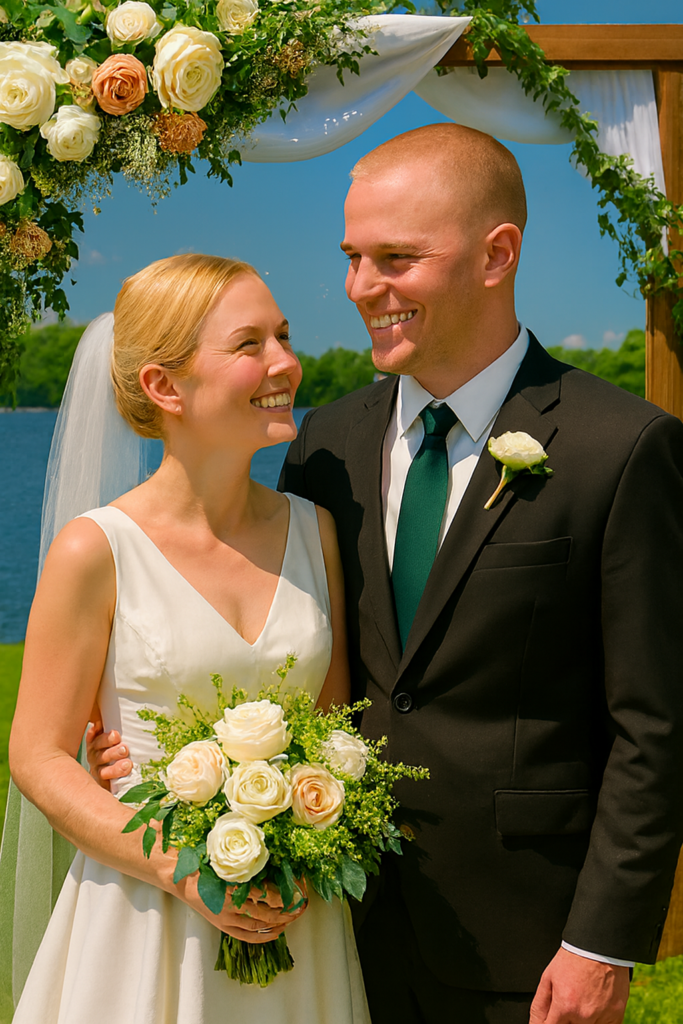
The Vows
Reverend Henderson guided them through the ceremony with warmth and gentle humor. Their vows — simple, heartfelt, steady — felt like an extension of who they were.
Allison’s voice was calm, unwavering. Erik’s voice shook, but in the most honest way.
When they exchanged rings, Olive gave a soft bark, as if offering her approval.
The Kiss & The Walk Back
“You may kiss the bride,” Reverend Henderson said.
They kissed — soft, sure, full of promise.
As they walked back up the aisle, hand in hand, Olive trotted beside them, tail wagging, the lake sparkling behind them.
The world felt bright. The future felt steady. And both of them knew — without a single doubt — that they had chosen exactly right.
Reception — Wakefield City Park, Saturday Evening
The sun hung warm and bright over Sunday Lake as the ceremony guests drifted toward the pavilion. The birch leaves shimmered in the breeze, and the lake reflected the late‑June sky like a sheet of glass. The pavilion, now opened up on all sides, had transformed seamlessly from bridal suite to reception space — tables set with simple greenery, white linens, and soft touches of forest‑green ribbon.
The smell of catered pasties, salads, and grilled chicken drifted through the air. Laughter rose in pockets. Children chased each other across the grass. Olive trotted around greeting guests, her floral collar slightly askew from enthusiastic pats.
It was the kind of reception that fit Allison and Erik perfectly — warm, intimate, grounded, and full of the people who mattered most.
Dinner & Mingling
Allison and Erik moved from table to table, receiving hugs, congratulations, and the occasional tearful squeeze from older relatives. The guest list was small but meaningful — family, close friends, a few colleagues, and a handful of community members who had quietly supported them along the way.
At one table, one of Allison’s coworkers, Mary Jean Olson, the 1st grade teacher at Ewen-Trout Creek School, leaned in and whispered, “He cried when you walked down the aisle.”
Allison smiled. “I know.”
Across the pavilion, Erik was telling Ethan, “I swear I wasn’t going to cry. And then she stepped out from the trees and… well… there it was.”
Ethan clapped him on the back. “It was a good cry. A manly cry.”
As dinner plates were cleared, Marnie tapped her glass gently. “If everyone could find their seats, we’ll begin the toasts.”
The pavilion quieted. The lake breeze rustled the curtains. The last of the golden sunlight slanted across the tables.
Mr. Besonen’s Speech
Art Besonen stood slowly, clearing his throat. He was a man of few words, and everyone knew it. The room instinctively leaned in.
He looked at Allison first, then at Erik.
“Well,” he said, voice steady, “I don’t say much. But I’ll say this.”
A pause. A breath.
“You two are good together. Real good. And I’m proud of you both.”
He nodded once, sat down, and the pavilion erupted in warm applause — the kind that meant people understood exactly how much weight those few words carried.
Allison blinked back tears. Erik squeezed her hand.
Other Toasts
• Lily gave a heartfelt, slightly teary speech about friendship and the way Allison had always been the steady center of the Sparkle Squad.
• Maya made everyone laugh with a story about Allison’s early days of dating Erik and how she “knew before Allison did.”
• Rachel spoke softly but beautifully about watching Allison grow into herself.
• Sophie offered a blessing that felt like a warm blanket.
• Ethan teased Erik just enough to keep things light, then ended with, “You picked the right woman, buddy.”
Each toast felt like a thread woven into the tapestry of the day.
The First Dance
As twilight settled in, the DJ cued up the playlist Allison and Erik had chosen — simple, meaningful songs that felt like them.
“Ladies and gentlemen,” the DJ announced, “our bride and groom.”
Allison and Erik stepped onto the small dance floor under the pavilion lights. Fireflies had begun to flicker at the edges of the park. The lake glowed with the last of the sun.
Erik took her hand, already laughing nervously. “I warned you,” he whispered. “I’m not a dancer.”
“I know,” she said, smiling. “That’s why I love this.”
The music started — slow, warm, familiar.
Because this dance wasn’t about skill. It wasn’t about elegance. It was about everything they had learned together — trust, joy, steadiness, choosing each other again and again.
Erik’s hands were warm on her waist. Her head rested against his chest. The world felt small and safe.
When the song ended, he kissed her forehead. “I love you.”
“I love you too,” she whispered.
Dancing, Laughter, and Sunset
The dance floor filled — kids spinning in circles, older couples swaying, the Sparkle Squad forming a joyful cluster around Allison.
After dancing with Adrian, Maya dragged Sophie into a fast song. Lily filmed everything. Rachel danced with Soren, smiling softly. Marnie swayed with Ethan, content and glowing.
Erik danced with Olive at one point — or rather, Olive danced around him — and the pavilion erupted in laughter.
As the evening deepened, the sky shifted to lavender, then pink, then a soft, dusky blue. White tops of tall thunderstorm clouds towered to the southwest over Wisconsin, but any rain would hold off until after everyone had left for home. Twilight remained well after 9:00 p.m., leaving a warm afterglow across Sunday Lake.
Guests lingered, not wanting the night to end. The air was full of laughter, clinking glasses, and the soft hum of summer.
It was a reception people would talk about for years — not because it was extravagant, but because it was real. Joyful. Grounded. Full of love.
And as the last light faded, Allison and Erik stood at the edge of the lake, hand in hand, watching the ripples shimmer in the twilight.
A perfect ending to a perfect day.
The Morning After — Hall Road, Early Sunday Morning
Sunlight filtered softly through the curtains of the Hall Road house, the kind of gentle, golden light that only late June in the western U.P. can manage. The air was cool, fresh, and impossibly still — the world holding its breath after the joy of the night before.
Inside, the house felt different now. Not because anything had changed physically, but because they had.
Allison stirred first, blinking awake to the quiet hum of morning. Erik was still asleep beside her, one arm draped over her waist, breathing slow and even. Olive lay curled at the foot of the bed, her tail giving a soft thump when she sensed movement.
For a moment, Allison simply lay there, letting the peace settle in.
She smiled.
Coffee, Quiet, and the First Morning as Mr. and Mrs. Heikkila
Allison slipped out of bed, pulled on a soft sweatshirt, and padded barefoot into the kitchen. She started the coffee maker, the familiar scent filling the house. Outside, the early sun lit up the fields along Hall Road, and a few birds chattered from the trees.
Erik appeared a few minutes later, hair tousled, eyes still sleepy. He wrapped his arms around her from behind.
“Morning, Mrs. Heikkila,” he murmured into her shoulder.
She leaned back into him. “Morning, husband.”
He kissed her cheek, then reached for a mug. “I still can’t believe yesterday happened.”
“It did,” she said softly. “And it was perfect.”
They stood together at the kitchen window, sipping coffee, watching Olive trot around the yard with her nose to the ground. The quiet between them wasn’t empty — it was full, warm, steady.
Packing for the Gunflint Trail
By mid‑morning, the house had shifted into gentle motion.
Allison folded clothes into a duffel bag — hiking layers, comfortable jeans, a couple of nicer outfits for dinners in Grand Marais. Erik packed fishing gear, a pair of binoculars, and the well‑worn field guide he always brought on trips.
“Do we have the reservation info?” Allison asked, zipping her bag.
“Printed and in the glove box,” Erik said. “Trout Lake Resort, cabin number four.”
“Perfect.”
Olive watched them with bright eyes, tail wagging hopefully.
“You’re staying with my parents, girl,” Allison said, kneeling to scratch behind her ears. “Just for a few days.”
Olive gave a soft whine, then licked Allison’s cheek in acceptance.
A Moment Before Leaving
With the bags by the door and the house tidied, they paused in the living room — the same room where they’d shared countless quiet evenings, where Erik had fixed the old outlet for her, where they’d talked about the future long before rings and vows.
Erik took her hand.
“You ready?” he asked.
Allison nodded. “More than ready.”
He brushed a thumb over her knuckles. “I know it’s just a few days, but… this feels like the start of something big.”
“It is,” she said. “It’s the start of us.”
On the Road — Heading North
They loaded the truck, hugged Olive goodbye, and pulled out onto Hall Road. The sky was bright, the air warm, and the world felt wide open.
M‑28 carried them west toward Bergland, then US-2 through Wisconsin, into Minnesota, and at Duluth, Minnesota Highway 61 hugging Lake Superior. The closer they got to the lake, the more the air shifted — cooler, fresher, tinged with the scent of water and pine.
In Grand Marais, they turned onto the Gunflint Trail, the road winding into deep forest. Sunlight flickered through the trees, dappling the dashboard.
Allison rested her hand on Erik’s arm. “This feels right.”
“It does,” he said. “It really does.”
Sixteen miles later, and four miles off the Gunflint Trail, the sign for Trout Lake Resort appeared — rustic, welcoming, tucked into the quiet wilderness.
Their cabin waited. The lake shimmered. The world slowed.
And together, they stepped into the first days of their married life — rooted, steady, and exactly where they were meant to be.
Trout Lake Resort — First Evening of the Honeymoon
The gravel under the tires crackled softly as Allison and Erik pulled into the quiet clearing that marked the entrance to Trout Lake Resort. The late‑afternoon sun slanted through the pines, casting long, warm beams across the cabins and the still water beyond. It smelled like pine needles, lake air, and the faint sweetness of summer.
Cabin Four sat a little apart from the others — tucked into the trees, with a small porch overlooking the water. A rowboat was tied to a simple wooden dock, bobbing gently. A loon called somewhere across the lake, its voice echoing in the stillness.
“This is perfect,” Allison said, stepping out of the car and taking in the scene.
Erik nodded, his shoulders relaxing in a way they hadn’t since the wedding whirlwind began. “Feels like we’re the only people on earth.”
They unloaded their bags, carried them inside, and found the cabin exactly as promised — rustic, clean, cozy. Knotty pine walls. A stone fireplace. A small kitchenette. A bed with a handmade quilt. A screened‑in porch with two rocking chairs facing the lake.
Allison ran her hand along the back of one chair. “I could sit here for hours.”
“You will,” Erik said, smiling.
Settling In
They unpacked just enough to feel at home — clothes in drawers, toiletries in the bathroom, fishing gear by the door. Allison placed her journal on the nightstand. Erik tucked the binoculars into a corner of the porch.
Then they stepped outside, letting the screen door creak shut behind them.
The lake was nearly still, touched only by the faintest ripple from a passing breeze. The sun hovered low, turning the water gold.
Allison leaned into Erik’s side. “This feels like the right beginning.”
“It does,” he said quietly. “It really does.”
A Simple Dinner
They cooked something easy — pasta with jarred sauce, garlic bread warmed in the oven, a salad they’d picked up in Grand Marais. They ate on the porch, plates balanced on their laps, watching the light shift from gold to amber to soft rose.
A pair of ducks paddled by. A fish jumped near the dock. Somewhere in the distance, someone laughed — faint, friendly, far away.
“This is exactly what I hoped for,” Allison said.
Erik reached for her hand. “Me too.”
Evening on the Water
After dinner, they walked down to the dock. The rowboat rocked gently, inviting.
“Want to go out?” Erik asked.
Allison nodded. “Yes.”
He steadied the boat while she climbed in, then pushed off and took the oars. The water parted quietly around them, smooth as glass. The air was cool now, carrying the scent of cedar and lakewater.
They drifted toward the center of Trout Lake, the resort shrinking behind them until it felt like they were alone in the wilderness.
Allison trailed her fingers in the water. “I could stay here forever.”
Erik paused rowing, letting the boat glide. “We’ll come back,” he said. “Not just once.”
She smiled at him — that soft, certain smile she’d worn at the altar.
Sunset
They reached the middle of the lake just as the sun touched the treeline. The sky flared in shades of orange, pink, and lavender. The reflection on the water doubled the beauty, turning the lake into a mirror of color.
A loon called again — long, haunting, beautiful.
Allison rested her head on Erik’s shoulder. “This feels like a blessing.”
“It is,” he said. “Everything about this is.”
They stayed until the last light faded, then rowed back slowly, the oars dipping rhythmically into the darkening water.
Back inside, they lit a few small lamps, giving the cabin a warm, golden glow. The night outside was deep and quiet, the kind of quiet that settles into your bones.
Allison curled up beside Erik on the couch, her head on his chest, his arm around her. They didn’t talk much — they didn’t need to. The silence was full of meaning.
Eventually, they slipped into bed beneath the quilt, listening to the soft rustle of wind in the pines and the distant call of another loon.
Their first night as husband and wife ended not with fireworks or spectacle, but with peace — the kind of peace that comes from knowing you are exactly where you’re meant to be, with exactly the right person beside you.
A perfect beginning to their life together.
Day Trip to Thunder Bay — A Honeymoon Adventure
The morning at Trout Lake Resort began cool and bright, the kind of crisp northern air that wakes you up before the coffee does. Allison and Erik stepped out of Cabin Four with travel mugs in hand, ready for their Canadian adventure. The lake was still, the pines whispering, and the whole day felt wide open.
They climbed into the truck, rolled down the windows, and headed back toward Grand Marais, the Gunflint Trail winding behind them like a ribbon through the forest.
Ryden’s — The Ritual Stop Before Canada
By late morning, they pulled into Ryden’s Border Store in Grand Portage — the classic pre‑border stop for anyone heading into Ontario. The parking lot was a mix of Minnesota plates, Ontario plates, and the occasional RV.
Inside, they exchanged a small amount of U.S. cash for Canadian bills — crisp, colorful, and slightly slick textured compared to the greenbacks they were used to.
Erik held up a purple $10 note. “Feels like Monopoly money.”
Allison laughed. “Don’t let the Canadians hear you say that.”
They grabbed a couple of snacks, stretched their legs, and then made the short drive to the border.
Pigeon River Port of Entry — A Lucky Break
Crossing into Canada is always a toss‑up. You can sail through in thirty seconds… or spend half an hour in secondary while someone inspects your trunk with a flashlight.
Today, luck was on their side.
The CBSA border services officer, a young woman with a friendly smile and a calm presence, leaned out of the booth.
“Good morning. Citizenship?”
“U.S.,” Erik said.
“Where are you headed today?”
“Thunder Bay. Just a day trip.”
“Any alcohol, firearms, or pepper spray?”
“No,” they answered in unison.
“Any fruits or vegetables?”
“No.”
She nodded, typed something briefly, and handed back their passports.
“Alright, enjoy your visit. Welcome to Canada.”
And that was it.
Allison exhaled. “That was the easiest crossing of my life.”
Erik grinned. “Let’s not question it.”
Ontario Travel Information Centre — Maps, Brochures, and Coupons
Just past the border, they pulled into the Ontario Travel Information Centre, a bright, welcoming building with huge windows and a view of the river.
Inside, they found:
• maps of Thunder Bay
• brochures for local attractions
• a coupon for the Prince Arthur Hotel’s restaurant
• and a cheerful staff member who circled the best viewpoints along the waterfront
Allison tucked the brochures into her bag. “I love places like this. It feels like the start of something.”
Lunch at the Prince Arthur Hotel — Portside Restaurant
Thunder Bay greeted them with sunshine, a sparkling harbor, and the unmistakable silhouette of the Prince Arthur Hotel, standing proudly since 1911. Inside the Portside Restaurant, they were seated by a window overlooking the marina. The atmosphere was relaxed, historic, and quietly elegant. Erik ordered fish and chips. Allison chose the wild rice salad. They clinked glasses of iced tea.
“To our first international trip as a married couple,” Allison said.
Erik smiled. “And to not getting pulled into secondary.”
Sailing on the Frodo — A Perfect Coincidence
After lunch, they walked down to the waterfront to meet their vessel for the afternoon: the Frodo, a graceful sailing ship operated by Sail Superior. Allison stopped short when she saw the name painted on the hull.
“You’re kidding,” she said. “Frodo?”
Erik laughed. “Lily is going to lose her mind.”
The captain welcomed them aboard, and soon they were gliding out into Thunder Bay Harbour, the wind filling the sails, the city skyline behind them, and the Sleeping Giant rising in the distance.
The water sparkled. The breeze was cool. The world felt enormous and peaceful at the same time.
The CSL Niagara — A Full‑Circle Moment
As the Frodo approached one of the massive grain elevators, the captain pointed toward a ship tied up at the loading spouts.
“That’s the CSL Niagara,” he said. “She’s taking on grain today.”
Allison’s breath caught.
“The Niagara?” she whispered. “The same one that came into Duluth when I was dress shopping.”
Erik turned to her, eyebrows raised. “You’re right. Same ship.”
They watched as the grain poured into the holds, the machinery humming, the red hull towering above them. It felt like a quiet echo from earlier in their story — a thread tying their wedding journey together in a way neither could have planned.
Allison squeezed Erik’s hand. “It feels like a sign.”
He nodded. “A good one.”
Heading Home — A Smooth Return
After the excursion, they wandered the waterfront for a bit, then began the drive back toward the border. The late‑afternoon sun slanted across Ontario Highway 61, the forest glowing. The signs in metric reminded them they were not in the United States:
DULUTH 302
followed shortly by
MAXIMUM
90
km/h
At the U.S. Port of Entry, about a half mile northeast of Ryden’s, a young CBP officer leaned out of the booth, relaxed and friendly.
“Welcome back. Where are you coming from today?”
“Thunder Bay,” Erik said.
“Anything to declare?”
“Only the brochures from the travel information center.”
“Alright, have a good night.”
And just like that, they were back in Minnesota.
Supper in Grand Marais
They stopped in Grand Marais for dinner — burgers and fries at a casual lakeside spot, the harbor calm and blue in the evening light.
Allison leaned back in her chair. “This was perfect.”
Erik nodded. “A little adventure, a little serendipity, and a ship named after Lily’s cat.”
“And the CSL Niagara,” she added softly. “I still can’t believe that.”
They lingered over their meal, watching the boats bob in the harbor.
Back to Trout Lake Resort
By the time they returned to the cabin, the sky was deepening into twilight. The lake was quiet, the pines dark silhouettes against the fading light.
They walked down to the dock, hand in hand, letting the cool air settle around them.
A loon called across the water. The stars began to appear. And the day — full of small wonders and gentle surprises — settled into memory.
A perfect Canadian side trip on a perfect honeymoon.
A Perfect Last Day — Trout Lake Resort
The morning broke warm and bright over Trout Lake, the surface rippling gently under a light breeze. Allison and Erik stepped onto the dock with coffee in hand, the rowboat tied and waiting. A loon called across the water — a soft, familiar greeting.
“Last full day,” Allison said, settling into the boat.
“Let’s make it a good one,” Erik replied, pushing off with the oars.
The lake was quiet, the kind of stillness that makes every sound feel amplified — the dip of an oar, the click of a reel, the soft splash of a lure hitting the water.
They drifted near a stand of reeds where the water deepened. Within minutes, Erik felt a tug.
“Got one,” he whispered, as if the fish could hear him.
Allison grinned. “Bring it in!”
He reeled in a gleaming walleye, not huge but respectable. They released it, laughing like kids.
Allison caught the next one — a feisty smallmouth bass that fought harder than its size suggested.
“Look at you,” Erik teased. “Natural.”
“Beginner’s luck,” she said, but her smile said otherwise.
By midday, they’d caught and released several fish, the sun warm on their shoulders, the lake sparkling around them. It was the kind of simple, perfect day that would stay with them long after the honeymoon ended.
One More Night in the Cabin
Back at Cabin Four, they cooked a simple dinner — grilled chicken, vegetables, and a shared slice of pie from the resort store. The evening light slanted through the pines, turning everything gold.
They ate on the porch, feet propped on the railing, watching the lake settle into evening calm.
“This place feels like a blessing,” Allison said softly.
“It does,” Erik agreed. “We’ll come back.”
Later, they walked down to the dock one last time. The sky glowed lavender and rose. A loon called again — the same haunting, beautiful sound that had marked their first night.
They stood together, arms around each other, letting the quiet sink in.
The Drive Home — A North Shore Farewell
They checked out late the next morning, the car packed, the cabin door locked behind them. The drive back toward Grand Marais felt peaceful, unhurried. Their first stop once they were back on Highway 61 was Split Rock Lighthouse, perched proudly above the lake. They walked the overlook trail, hand in hand, the wind cool and steady off Lake Superior.
“It feels like the lake is saying goodbye,” Allison murmured.
“Or see you soon,” Erik said.
Next came Gooseberry Falls, roaring with early‑summer water. They wandered the paths, pausing at the middle falls to watch the spray catch the sunlight.
Allison snapped a photo of Erik on the bridge.
“That one’s going in a frame,” she said.
By late afternoon, they reached Canal Park. The lake stretched wide and blue, ships anchored offshore – the ocean going ships Redhead, waiting to load wheat, and the Maxima, waiting to load beet pulp pellets, with gulls circling overhead.
They walked the pier, watched the Aerial Lift Bridge rise for an excursion boat, and shared ice cream from a lakeside stand.
“It feels like we’ve come full circle,” Allison said.
Erik nodded. “From Duluth to the Gunflint to Thunder Bay and back.”
“And the CSL Niagara,” she added with a smile. Rachel would have loved it.”
“That too.”
Home — Hall Road, Ewen
They reached Ewen just before dusk. The Hall Road house looked warm and familiar, the yard quiet without Olive’s usual greeting. Inside, everything felt the same — yet different. They were married now. Allison set her bag down and exhaled. “It’s good to be home.” Erik wrapped an arm around her. “It really is.”
They spent the rest of the evening unpacking, doing laundry, and easing back into their space. The house felt fuller somehow — like it had been waiting for them.
The Next Morning — Olive Comes Home
Around mid‑morning, a familiar truck pulled into the driveway. Olive’s excited bark echoed before the doors even opened.
Mrs. Besonen laughed. “She knew exactly where we were.”
Olive bounded out, tail wagging wildly, ears flopping, making a beeline for Allison and Erik.
Allison knelt, arms open. “Hi, girl!”
Olive practically tackled her, whining with joy, then turned to Erik, pressing her head into his chest.
“She missed you,” Art Besonen said with a small smile.
“We missed her too,” Erik replied, scratching behind her ears.
Olive trotted circles around them, tail a blur, as if trying to make up for every minute apart.
The Besonens stayed for coffee, sharing stories from their own weekend. The house felt lively again — warm, familiar, full of love.
Allison Calls Lily — The Frodo Revelation
It was late afternoon, the day after the Besonens brought Olive home. Allison had just finished folding laundry when she glanced at her phone and smiled. There was only one person who needed to hear this story.
She tapped Lily’s name.
“HEY, Mrs. Heikkila!” Lily answered immediately, her voice bright and musical. “How’s married life?”
“Pretty wonderful,” Allison said, settling onto the couch as Olive curled against her leg. “And I have something to tell you. Two things, actually.”
“Oh no,” Lily said dramatically. “Do I need to sit down? Am I going to scream? Should Frodo be present for this?”
“Honestly… maybe.”
“Allison,” Lily said, already laughing, “you’re scaring me.”
“Okay,” Allison said, taking a breath. “So, on our day trip to Thunder Bay, we did a harbor sailing excursion.”
“Cute! Very you two.”
“And the boat we were on…” Allison paused for effect. “Was named the Frodo.”
There was a beat of silence.
Then Lily shrieked.
“NO. YOU ARE LYING. YOU ARE LYING TO ME RIGHT NOW.”
“I swear I’m not,” Allison said, laughing. “It was painted right on the hull. F‑R‑O‑D‑O. Frodo.”
Lily was already yelling for her cat. “FRODO! BABY! YOU’RE FAMOUS! YOU HAVE A BOAT!”
Allison could hear the cat meow in the background, confused but intrigued.
“This is the greatest thing that has ever happened to me,” Lily declared. “I’m putting this in my Christmas letter. I’m telling the other teachers at Pine City. I’m telling my mom. I’m telling strangers at Target.”
“Oh, it gets better,” Allison said. “We also saw the CSL Niagara again.”
“STOP IT.”
“It was loading grain at one of the elevators. Same ship from Duluth. Same red hull. Same name.”
Lily gasped. “Allison. That’s a sign. That’s a cosmic sign. That’s like… the universe giving you a little wedding‑honeymoon wink.”
“That’s exactly how it felt,” Allison said softly.
Lily’s voice softened too. “I love that for you. I love that for both of you.”
There was a pause — warm, full, familiar.
“So,” Lily said, brightening again, “when do I get to see you and hear every detail?”
“Soon,” Allison promised. “Very soon.”
“And bring Olive,” Lily added. “She needs to meet the celebrity cat whose name is now on a Canadian sailboat.”
Allison laughed. “Deal.”
They talked for another half hour — about the wedding, the honeymoon, the cabin, the fishing, the quiet moments that meant the most. And when they finally hung up, Allison felt that familiar glow of being understood by someone who had known her through every chapter.
The Frodo. The CSL Niagara. The Sparkle Squad. Her best friend.
It all fit together perfectly.
A Perfect Return
By afternoon, the house had settled into its new rhythm:
• Allison journaling at the kitchen table
• Erik organizing fishing gear in the mudroom
• Olive asleep at their feet, finally content
The honeymoon had been beautiful — peaceful, adventurous, full of small wonders — but coming home felt just as right.
Their life together had begun. Rooted. Steady. Exactly where they were meant to be.
Mid‑August Visit to the Besonen Home — Negaunee, Michigan
The air had that unmistakable late‑summer feel — warm sun, cool breeze, the first hints of fall hiding in the edges of the birch leaves. Allison and Erik made the familiar drive east on M‑28, Olive’s head occasionally popping up from the backseat as if she knew exactly where they were going. School would start soon. The rhythm of life would shift again. But today was for family — the kind that had opened their arms to Erik without hesitation.
The Besonen home sat in its usual quiet dignity, the yard neat, the garden thriving under Lorraine’s care. As they pulled in, the front door opened and Lorraine stepped out, waving with both hands.
“There they are!” she called.
Art followed behind her, slower, steady, hands in his pockets, expression softening in that subtle way he had when he was pleased.
Olive bounded out of the truck first, tail wagging furiously. Lorraine bent to greet her.
“Well hello, sweetheart,” she said, scratching behind Olive’s ears. “You remember us, don’t you?”
Allison laughed. “She never forgets who feeds her treats.”
Erik stepped forward to shake Art’s hand — a gesture that had become its own quiet ritual. Art’s handshake was firm, warm, and said more than most people’s paragraphs.
“Good to see you, son,” Art said.
Erik never took that lightly.
Inside — Coffee, Conversation, and Comfort
The house smelled like coffee and something sweet baking — Lorraine’s signature welcome. They settled around the kitchen table, sunlight streaming through the window.
“So,” Lorraine said, pouring coffee, “how’s married life treating you two?”
Allison smiled. “Pretty wonderful.”
Erik nodded. “Feels right.”
Art gave a small approving grunt — the Besonen version of a standing ovation.
They talked about the honeymoon, the fishing, the Frodo, the CSL Niagara, and the quiet beauty of Trout Lake. Lorraine listened with delight, and Art’s eyes crinkled at the corners when Erik described rowing across the lake at sunset.
“You two did it right,” Art said simply.
A Quiet Moment — Art and Erik
Later, while Allison helped Lorraine with a few things in the kitchen, Art and Erik stepped outside to the backyard. The late‑afternoon sun cast long shadows across the grass.
Art leaned against the railing of the deck. “You settling in alright? Back home?”
Erik nodded. “Yeah. It feels good. Better than I expected.”
Art studied him for a moment — not prying, just present.
“You know,” he said, “you’re part of this family now. Not just because of the wedding. Because of who you are.”
Erik swallowed, the words landing deeper than he expected.
“I appreciate that,” he said quietly. “More than you know.”
Art nodded once, satisfied. “Good.”
It wasn’t a long conversation. It didn’t need to be.
Dinner — Simple, Warm, Familiar
Lorraine made a classic Yooper summer meal:
• baked chicken
• fresh garden vegetables
• homemade rolls
• blueberry pie for dessert
They ate on the porch, the breeze carrying the sounds of a quiet Negaunee evening. Olive lay at their feet, content.
Allison told stories from her classroom. Erik shared a few lighthearted DNR anecdotes. Lorraine laughed easily. Art listened, adding a comment here and there that always landed just right.
It felt like belonging.
A Conversation on the Drive Home
As they headed west on US-41 and M‑28, the sky turning pink over Teal Lake, Allison reached over and took Erik’s hand.
“You okay?” she asked softly.
He nodded. “Yeah. I just… I really like being there. With them.”
“I know,” she said. “They love you.”
He looked out the window for a moment, thoughtful.
“It’s different,” he said finally. “Growing up in Sagola was like anyone else in the U.P. But going into the Marines… then after my dad died, and then later my mom… it was just me. I got used to that. But with your parents… it feels like I have a place again.”
Allison squeezed his hand. “You do.”
He smiled — small, genuine, grateful.
“And I’m glad Sagola isn’t the place we have to go back to,” he added. “Not because it was bad. Just… that part of my life is done. With you – Ewen, Bruce Crossing, that area – is where I want to be.”
Allison leaned her head against his shoulder. “Me too.”
Back Home — A Quiet Evening on Hall Road
They arrived home just as the last light faded. Olive trotted inside, tail wagging. The house felt warm, lived‑in, ready for the next chapter.
Allison set her school planner on the table. Erik hung his jacket by the door. The crickets hummed outside.
It was the end of summer, the beginning of something steady and beautiful.
And for Erik — for the first time in a long time — family didn’t feel like something he’d lost. It felt like something he’d gained.
Mid‑September — Ewen‑Trout Creek, A New School Year
The mornings had taken on that unmistakable early‑fall crispness — cool enough for a light jacket, warm enough by afternoon to leave it draped over a chair. The maples along M‑28 were just beginning to blush red at the edges. And inside Ewen‑Trout Creek, the hallways hummed with the familiar energy of a new school year.
Allison stood at her classroom door between bells, greeting her 7th graders as they filed in. This group felt different from her other sections — not because of their age, but because she knew them. She’d shepherded them through 6th grade English, watched them grow, watched them settle into themselves.
And among them was Clara Juntunen.
Clara walked in with her backpack slung over one shoulder, her hair pulled back in a neat braid. She gave Allison a small, genuine smile — something that would have been unthinkable last January.
“Morning, Mrs. Heikkila,” she said softly.
“Good morning, Clara,” Allison replied, matching her tone with warmth.
Clara headed to her seat near the window, pulling out her notebook. She looked comfortable. It struck Allison how much had changed in just a few months. Last winter, Clara had been polite but guarded, always watching, always calculating the emotional temperature of the room. She’d been bright, yes, but cautious in a way that made Allison’s heart ache with recognition.
Now, Clara’s shoulders sat lower. Her eyes were steadier. She laughed more easily with the girls at her table. She raised her hand without hesitation.
She was still Clara — observant, thoughtful, a little old‑soul — but she was no longer bracing for impact.
A Small Moment That Says Everything
During independent reading time, Allison made her usual slow circuit around the room. When she reached Clara’s desk, she noticed the book in her hands: The War That Saved My Life.
“That’s a good one,” Allison said quietly.
Clara nodded. “I read it this summer. I’m reading it again.”
“What do you like about it?”
Clara hesitated — not out of fear, but out of wanting to choose her words carefully.
“I like… that Ada finds people who help her. Even though she didn’t expect to.”
Allison felt something warm settle in her chest. “That’s a powerful part of the story.”
Clara looked up at her then — really looked — and there was something in her expression that made Allison’s breath catch. A kind of unspoken understanding. A recognition.
“People can surprise you,” Clara said.
“Yes,” Allison replied softly. “They can.”
It wasn’t a dramatic moment. It didn’t need to be. It was the kind of quiet exchange that meant everything.
7th Grade Lunch Period, Ewen-Trout Creek School
The cafeteria hummed with the usual early‑year noise — trays clattering, seventh graders trying on new versions of themselves, the low roar of conversations bouncing off cinderblock walls. Clara moves through the lunch line with her shoulders slightly tucked, her sketchbook wedged between her arm and her side like a shield.
She scans the room the way she always does: quick, careful, hoping not to be noticed while also hoping not to be alone.
Emma Koskinen is already at the table — the one near the windows, where the light is softer and the noise feels a little farther away. She’s got her lunch spread out neatly, book open beside her tray, a pencil tucked behind her ear. She looks up when she sees Clara, and her face brightens in a quiet, genuine way.
“Hey! I saved you a spot,” Emma called out.
She nudges her backpack off the bench with her foot. It’s not a grand gesture — just thoughtful, practiced, like she’s been doing it for years.
Clara sits, setting her sketchbook down carefully. She doesn’t open it yet. She’s still learning when it’s okay to draw around someone else.
For a moment, they eat in silence. It’s not awkward. It’s the kind of silence that feels like a blanket — soft, familiar, safe.
Emma glances at the sketchbook.
“Did you draw anything new today?”
Clara hesitates. She’s not used to people asking. Not used to people wanting to see.
“Just… shoes,” Clara said.
Emma smiles, not teasing, just curious. “You’re really good at them. The details. The stitching and stuff.”
Clara’s cheeks warmed. Compliments still felt like stepping onto thin ice. “Thanks.”
Emma took a sip of her milk, then added, almost shyly: “I like drawing horses. But they always look like dogs with long legs.”
Clara let out a tiny laugh — the kind she doesn’t usually let slip at school. Emma noticed, and her smile widens just a little. “Maybe sometime you could show me how you do the lines? Like how you make things look real.”
Clara nodded, surprised at how easy the yes felt. “Yeah. I could.”
Outside the window, a gust of wind shook the pine branches. Inside, the cafeteria noise swells and dips like a tide. Emma picked at the corner of her sandwich wrapper.
Emma asked, “Do you… want to sit together every day? You don’t have to. I just… I like sitting with you.”
Clara looked down at her tray. No one has asked her that since Ironwood. Not like this. Not gently. Not without expecting anything in return.
She nodded again, this time with a small, steady smile.
“I’d like that.”
Emma beamed — not big, not loud, but warm enough to melt something in Clara’s chest.
They finished their lunches side by side, not talking much, but not needing to. When the bell rang, they stood at the same time, gathered their things, and walked toward the hallway together — not touching, not announcing anything, just moving in quiet tandem. It was the beginning of something small but steady. It was exactly the kind of friendship Clara needed. She was exactly the kind of friend Emma is.
After School — A Realization
Later that day, after the buses had pulled away and the building had fallen into its late‑afternoon hush, Allison sat at her desk, grading a few early‑year writing samples.
She paused when she reached Clara’s.
It wasn’t the strongest piece in the stack. It wasn’t the neatest. But it was honest. Clear. Thoughtful. And it carried a confidence that hadn’t been there last spring.
Allison leaned back in her chair, letting the realization settle in.
She had become — without fanfare, without even noticing the exact moment — the adult she once needed. The steady presence. The safe place. The person who saw the quiet kid in the back row and understood her without demanding anything in return.
And Clara… Clara was blooming because of it.
Not because Allison had “fixed” anything. Not because she’d pushed. But because she’d shown up. The way someone once had for her.
A Final Thought Before Heading Home
As Allison packed up her bag and turned off the lights, she felt a deep, quiet gratitude — for her students, for the work she got to do, for the way life had come full circle in ways she never expected.
And when she stepped outside into the cool September air, she thought of Erik, of their home on Hall Road, of Olive waiting at the door.
Her life was full. Her heart was steady. And in her classroom, a girl who reminded her of herself was finding her footing.
It was exactly where she was meant to be.
Ewen‑Trout Creek — 7th Grade English, Mid‑September
The bell had just rung, and the room was settling into that familiar hum of seventh‑graders getting out their notebooks, whispering to friends, and pretending they weren’t whispering to friends. Allison — Mrs. Heikkila — stood at the front of the room, flipping through her lesson plan for the day’s discussion on character motivation.
She didn’t notice the conversation brewing in the back corner until she heard a stage‑whisper that was absolutely meant to be overheard.
“Dude, I’m telling you — her husband is the DNR guy. The one with the green truck.”
A few heads snapped up.
Allison looked over her glasses. “Gentle reminder that I have excellent hearing.”
The class giggled, but the whisperer, a boy named Tyler, looked both guilty and thrilled.
“Sorry, Mrs. Heikkila,” he said, not sorry at all. “But… is it true?”
Twenty‑four pairs of eyes turned toward her.
Allison folded her arms, amused. “Is what true?”
“That you’re married to the conservation officer who busts up all the parties in the woods.”
A ripple of laughter moved through the room. Even Clara — quiet, observant Clara — hid a smile behind her book.
Allison kept her expression neutral, though her eyes sparkled. “I’m married to Officer Heikkila, yes. And he does his job very well.”
Tyler leaned forward, fascinated. “So like… if we were having a bonfire and someone brought fireworks—”
“Tyler,” Allison said gently, “I’m going to stop you right there.”
The class erupted.
Another student, Emma, raised her hand. “Does he really have a dog?”
“Yes,” Allison said. “Her name is Olive.”
“Awwww,” half the girls said at once.
“And,” Tyler added dramatically, “does he, like… arrest people?”
Allison shook her head. “He enforces natural resource laws. And he talks to people. A lot of his job is education.”
“So he could arrest people,” Tyler clarified, as if this were the most important detail.
“In certain circumstances, yes.”
The room buzzed with delighted horror.
Clara finally spoke, her voice soft but clear. “So… if someone was doing something dangerous in the woods, he’d help them?”
Allison smiled at her. “Exactly. That’s the heart of his job.”
Clara nodded, satisfied — and Allison felt that familiar warmth, the quiet connection between them.
Tyler raised his hand again. “So if we have a party—”
“Tyler,” Allison said, “I promise you this: if you’re doing something you shouldn’t be doing, my husband is the least of your worries. I will find out first.”
The class howled.
“Okay,” she said, clapping her hands once. “Fun as this is, we’re shifting gears. Open your notebooks. Today we’re talking about why characters make the choices they do.”
Tyler muttered, “Because their teacher’s husband is the DNR guy,” and the room dissolved again.
Allison just shook her head, smiling as she wrote the day’s objective on the board.
Behind her, Clara watched her with a look that was part admiration, part amusement, and part something softer — the recognition that Mrs. Heikkila was confident and exactly the kind of adult she could trust.
And the class, now fully aware of who she was married to, behaved just a little better for the rest of the period.
Early October — A Fall Color Drive, A Return to the Beginning
The western U.P. was on fire with color — maples blazing red, birches shimmering gold, tamaracks just beginning to glow. It was the kind of early‑October Saturday that felt like a gift: warm sun, cool breeze, the scent of leaves and pine drifting through the open truck windows.
Erik and Allison had no schedule, no errands, no obligations. Just a thermos of coffee, Olive in the backseat, and the whole day stretched out before them.
They headed west on M-28 from Ewen, the morning light slanting across the countryside. The traffic was light — a few pickups, a couple of leaf‑peepers from Wisconsin and Minnesota, a logging truck rumbling east.
Allison leaned her head back against the seat, watching the colors blur past.
“This is my favorite time of year,” she said.
Erik glanced over, smiling. “Mine too. Everything feels… settled.”
She reached for his hand. “Us too.”
He squeezed her fingers gently.
They turned south shortly before Bergland, following the winding East Shore Road along Lake Gogebic. The lake was a sheet of deep blue, framed by hills exploding with color. Patches of sunlight danced across the water.
Olive pressed her nose to the window, tail thumping.
“Even she knows this is special,” Allison said.
Erik chuckled. “She’s a Yooper dog. She gets it.”
They stopped at a small pull‑off, stepping out to breathe in the crisp air. The leaves rustled overhead, and the lake lapped gently at the shore.
“This,” Allison said softly, “is why I could never live anywhere else.”
Erik wrapped an arm around her shoulders. “Me neither.”
Where East Shore Road ends at M-64, they turned back north, passing Lake Gogebic State Park, then made the short dog leg with M-28 to Bergland, then the long straight stretch toward White Pine. The trees arched overhead like a cathedral of color.
“Hard to believe this is where we drove the night you proposed,” Allison said.
“Feels like yesterday,” Erik replied. “Feels like forever, too.”
She smiled. “The good kind of forever.”
They passed through Silver City, the air cooling as Lake Superior drew closer. The horizon opened, and the vastness of the lake appeared — an endless sea of blue.
The Roadside Park Where It All Began
Erik pulled into the same turnout where he’d stopped on Valentine’s Day. The same simple place. The same quiet stretch of beach. Only now, instead of snow and moonlight, the world was drenched in autumn color and warm sunlight.
“You know,” she said, turning back to him, “I can still picture that night perfectly.”
“So can I.”
She walked a few steps along the shoreline, the waves brushing her toes. The breeze lifted her hair, carrying the scent of pine and cold water.
“This place feels different now,” she said.
“How so?”
“It feels like ours.”
Erik nodded slowly. “Yeah. It does.”
They stood together at the water’s edge, the lake stretching out before them, the Porcupine Mountains rising in the distance, the leaves glowing behind them like a halo.
“This is home,” Allison said quietly. “Not just the house. Not just the job. All of it. The land. The people. The rhythm of it.”
Erik slipped his arm around her waist. “It’s where we’re meant to be.”
A gull cried overhead. The waves rolled in and out. The sun warmed their faces.
And in that moment they felt it: Not just love. Not just marriage. Not just the memory of a proposal.
But belonging. To each other. To the western U.P. To the life they had chosen — and were still choosing, every day. A life full of promise, waiting just ahead, as steady and beautiful as the lake before them.
Chapter 2: Three Cultures At the Table
The aromas hit first — warm spices blooming in oil, the earthy scent of manoomin toasting in a pan, and something faintly sweet that Adrian can’t quite place. Maya’s apartment in north Minneapolis is small but bright, the kind of place where every object feels chosen: a bookshelf overflowing with novels, a string of lights along the window, a small basil plant trying its best on the sill.
Maya stands at the stove, wooden spoon in hand, her hair pulled into a loose bun that keeps threatening to fall apart. She glances over her shoulder when Adrian steps in from the hallway, holding a cloth bag like it’s something precious.
“You brought it,” she says, smiling.
“Straight from Nokomis Irene,” he replies, lifting the bag. “She sent it with instructions. Very specific instructions.”
Maya laughs softly. “Grandmothers always have specific instructions.”
He sets the bag on the counter and opens it. Inside is a jar of hand‑harvested manoomin, dark and glossy, with a handwritten label: Bad River harvest — cook gently.
Maya touches the jar with reverence. “It smells like the woods,” she murmurs.
“It is the woods,” Adrian says. “Or at least, it’s the closest thing you can eat that still remembers where it came from.”
She nods, understanding more than he expects. “Let’s make it the base for the curry.”
He raises an eyebrow. “Wild rice… with curry?”
“Trust me,” she says, turning back to the stove. “Three cultures at the table tonight.”
The chicken simmers in a sauce of tomatoes, ginger, garlic, and spices that Maya measures by instinct. Adrian rinses the manoomin and adds it to a pot with broth, watching it bloom and curl as it cooks.
“You ever mess up a recipe so badly you almost cried?” Maya asks, stirring the curry.
“Oh yeah,” Adrian says immediately. “Uncle Lenny’s ribs. First time I tried to make them on my own, I burned the sauce so bad the whole house smelled like a crime scene.”
Maya laughs, covering her mouth. “What did he say?”
“He walked in, sniffed the air, and said, ‘Boy, you murdered that sauce. Give it a proper burial and start over.’”
She shakes her head, still smiling. “I want to meet this uncle.”
“You will,” he says, and the certainty in his voice makes her chest warm.
She turns down the heat on the curry. “My worst disaster was chicken curry. I was twelve. I thought I could make it exactly like my mom. I added way too much chili powder. My dad tried to be brave, but he drank an entire glass of milk in one go.”
“Parents deserve medals,” Adrian says.
“They really do.”
Dinner
They sit at her small table — two mismatched chairs, a candle flickering between them. The curry is spooned over the manoomin, the colors rich and warm: deep red sauce, dark wild rice, bright green cilantro.
Adrian takes the first bite and closes his eyes. “Okay. This is incredible.”
Maya exhales, relieved. “Good. I wasn’t sure how the flavors would work together.”
“They work,” he says. “They really work.”
They eat for a while in comfortable silence, the kind that feels earned.
Then Maya sets down her fork. “Can I tell you something? Something I don’t say out loud much?”
He nods.
“Sometimes I feel… between cultures. Like I’m made of pieces that don’t always fit together. Indian at home, Black in some spaces, ambiguous in others. And sometimes people want me to pick one. Or they assume I already have.”
Adrian listens, his expression softening. “Yeah. I get that.”
She looks up. “Do you?”
He leans back slightly, thinking. “Being Ojibwe and Black… it’s like walking with two different histories in your bones. On the rez, people see me as the Black kid. In Black spaces, I’m the Native guy. In white spaces, I’m whatever they decide I am that day.”
Maya’s eyes meet his. “That sounds exhausting.”
“It can be,” he admits. “But it also means I belong to more than one story. More than one place. And I’m learning that doesn’t make me less — it makes me layered.”
She smiles, slow and genuine. “Layered is good.”
“Layered is delicious,” he says, gesturing to the food.
She laughs, and the tension in her shoulders melts.
After Dinner
They wash dishes together, bumping elbows, trading small smiles. The kitchen smells like spices and steam and something new forming between them.
As they finish, Adrian dries his hands and looks at her with a quiet certainty.
“You know,” he says, “this meal… it’s kind of us.”
Maya tilts her head. “How do you mean?”
“Different ingredients. Different histories. But intentional. Thoughtful. And somehow it all fits.”
She feels the truth of it settle in her chest.
“Yeah,” she says softly. “It does.”
He reaches for her hand — not dramatic, not rushed, just steady.
And she takes it.
The candle flickers. The dishes cool. The flavors linger.
Three cultures at the table. Two people finding their way. One relationship beginning to deepen, layered and warm and entirely theirs.
Maya’s Wild Rice Chicken Curry
A three‑culture weeknight dinner for two
This recipe blends:
• Indian home‑kitchen curry (Maya’s childhood)
• Manoomin (wild rice) from Bad River (Adrian’s Ojibwe heritage)
• A hint of Southern/Midwestern comfort (Adrian’s family roots)
It’s meant to be cooked by feel — just like Maya does.
Ingredients
For the manoomin (wild rice)
• 1 cup hand‑harvested wild rice (or any good wild rice)
• 3 cups broth (vegetable or chicken)
• 1 bay leaf (optional)
• Pinch of salt
For the chicken curry
• 1 lb boneless chicken thighs, cut into bite‑size pieces
• 1 medium onion, finely chopped
• 3 cloves garlic, minced
• 1 inch fresh ginger, grated
• 2 medium tomatoes, chopped (or 1 cup canned crushed tomatoes)
• 1–2 tbsp neutral oil
• 1 tsp cumin seeds
• 1 tsp turmeric
1 tsp garam masala
• 1 tsp ground coriander
• ½–1 tsp chili powder (Maya learned the hard way not to overdo it)
• Salt to taste
• Fresh cilantro for garnish
Optional Southern/Midwestern touches
• A splash of maple syrup (a nod to the Northwoods)
• A squeeze of lemon (Maya’s mom’s trick)
• A pat of butter stirred in at the end (Adrian’s uncle Lenny would approve)
Instructions
- Cook the manoomin
- Rinse the wild rice under cold water.
- Combine rice, broth, bay leaf, and salt in a pot.
- Bring to a boil, then reduce to a simmer.
- Cook 35–45 minutes, until the grains split and curl.
- Drain any excess liquid and keep warm.
(Maya likes to toast the rice in a dry pan for 1–2 minutes first — it deepens the aroma.)
- Start the curry base
- Heat oil in a pan over medium heat.
- Add cumin seeds; let them sizzle for 10–15 seconds.
- Add onions and cook until golden.
- Add garlic and ginger; cook until fragrant.
- Build the sauce
- Add tomatoes and cook until they break down.
- Stir in turmeric, coriander, chili powder, and salt.
- Let the mixture thicken into a paste.
- Add the chicken
- Add chicken pieces and stir to coat in the spice mixture.
- Cook until the chicken is no longer pink.
- Add ½–1 cup water to create a sauce.
- Simmer 10–15 minutes, until the chicken is tender.
- Stir in garam masala and adjust seasoning.
(This is where Maya adds a tiny splash of maple syrup — just enough to round the edges.)
- Serve
Spoon the curry over a bed of warm manoomin. Top with fresh cilantro and a squeeze of lemon.
Uncle Lenny’s Low‑and‑Slow Chicago Ribs
The Fourth of July classic that tells you everything about the man who makes them
These ribs are tender, smoky, a little sweet, a little spicy, and full of the kind of depth that only comes from time, care, and a cook who knows exactly what he’s doing.
They’re not fancy. They’re not rushed. They’re Lenny.
Ingredients
For the ribs
• 2 racks pork spare ribs (St. Louis-style cut) or baby back ribs
• Yellow mustard (for coating)
• 2–3 tbsp neutral oil
For Uncle Lenny’s dry rub
• 3 tbsp brown sugar
• 1 tbsp smoked paprika
• 1 tbsp garlic powder
• 1 tbsp onion powder
• 1 tbsp kosher salt
• 1 tsp black pepper
• 1 tsp chili powder
• 1 tsp mustard powder
• ½ tsp cayenne (optional, but Lenny always adds it)
For the mop sauce (used during cooking)
• 1 cup apple juice
• ¼ cup apple cider vinegar
• 2 tbsp Worcestershire sauce
For the finishing glaze
(Lenny’s secret weapon — sweet, tangy, and sticky)
• 1 cup barbecue sauce (your favorite brand or homemade)
• 2 tbsp honey
• 1 tbsp molasses
• 1 tsp hot sauce (Lenny uses just a dash)
Instructions
- Prep the ribs
- Remove the membrane from the back of the ribs (Lenny says this is non‑negotiable).
- Pat dry.
- Rub a thin layer of yellow mustard over both sides — it won’t taste like mustard; it just helps the rub stick.
- Coat generously with the dry rub.
- Let rest at least 30 minutes, or refrigerate up to overnight.
Set up the grill or smoker
Lenny prefers charcoal, but gas works too.
• Heat to 225–250°F — the “low and slow” zone.
• If using charcoal, add a handful of soaked wood chips (hickory or apple).
• If using gas, add a smoker box or foil packet of chips.
Cook the ribs
Place ribs bone‑side down over indirect heat.
Cook for 3 hours, maintaining 225–250°F.
Every 45 minutes, brush lightly with the mop sauce to keep them moist and build flavor.
(This is when Lenny wanders around the yard with a beer, telling stories about Chicago.)
Wrap and tenderize
After 3 hours: - Lay out heavy‑duty foil.
- Place ribs meat‑side down.
- Add a splash of mop sauce.
- Wrap tightly.
Return to the grill/smoker for 2 more hours.
This is where the magic happens — the ribs soften, the fat renders, and the meat starts to pull back from the bones.
Finish with the glaze
Unwrap the ribs carefully.
Brush generously with the finishing glaze.
Return to the grill, uncovered, for 20–30 minutes to set the glaze and caramelize the edges.
Rest and serve
Let the ribs rest 10 minutes before slicing.
They should be tender enough that the bones wiggle but not so soft they fall apart — exactly how Lenny likes them.
Serve with:
• cornbread
• coleslaw
• baked beans
• and a big smile, because Lenny always says food tastes better when you’re happy
Late September, Lake of the Isles in Minneapolis, late on a Saturday morning
The morning has that unmistakable late‑September clarity — cool enough for light jackets, warm enough that the sun feels like a gentle hand on the shoulder. Lake of the Isles lies still except for the faint ripples from an early paddleboarder, and the trees along the path are just beginning to blush with color.
Maya and Adrian fall into step easily, the way they always do. The gravel crunches softly beneath their shoes. A few runners pass, breath visible in the crisp air. Somewhere across the water, a dog barks — the happy kind of bark that belongs to a Saturday morning.
Maya tucks her hands into her jacket pockets. “I love this time of year,” she says. “Everything feels like it’s shifting, but not in a bad way.”
Adrian nods. “Like the world’s taking a deep breath.”
They walk a little farther, watching a pair of ducks skim low over the lake. The path curves, and the sunlight catches the water just right — a shimmer that looks almost unreal.
“So,” Maya says, glancing at him, “you mentioned your sister’s planning a fall gathering in Odanah. Are you going?”
“Yeah,” he says. “I try to go home whenever I can. Even if it’s just for a day.” He pauses, searching for the right words. “I love Minneapolis. I love my work here. But Bad River… it’s not something I ever want to drift away from. It’s where my roots are. My family. My history.”
Maya listens carefully, her expression soft. “You don’t have to choose,” she says. “You can have both.”
“That’s what I’m hoping,” he replies. “A life where I can be here — doing the work I care about — but still stay connected to home. To the land. To my people.”
They walk in silence for a moment, letting the weight of that settle. A pair of kids on bicycles zoom past, laughing, their jackets flapping behind them like capes. A golden retriever bounds toward the water, splashing in with pure joy.
Maya smiles at the scene, then looks down at the path. “I’ve been thinking about the future too,” she says. “Not in a big dramatic way. Just… what I want my work to become.”
Adrian glances at her. “Tell me.”
She exhales, almost shy. “I want to build an English curriculum that actually reflects the students in my classroom. Minneapolis has changed from what it was 50 years ago. I want stories from different cultures. Authors who look like them. Narratives that don’t all come from the same narrow slice of the world.” She kicks a pebble lightly. “I want kids to see themselves in the books they read. I didn’t get that growing up here. That’s still part of the culture today, but it’s not all of it.”
Adrian’s voice is warm. “That sounds incredible. And needed.”
“I don’t know how to start,” she admits. “But I know it’s where I’m heading.”
They reach a bench overlooking the lake and sit. The breeze carries the scent of leaves and water. A couple throws a tennis ball for their dog; the splash echoes across the surface. The world feels unhurried, like it’s giving them space.
Adrian leans back, watching the sunlight dance on the water. “You know,” he says quietly, “I like imagining a life where we’re both doing what matters to us. You building something in your classroom. Me working with the kids at the center. And still having time for mornings like this.”
Maya turns her head toward him. “Yeah,” she says. “Me too.”
He doesn’t think about it — not consciously. His hand just moves, reaching for hers as naturally as breathing.
And she takes it. No hesitation. Just a gentle squeeze, warm and sure.
They sit like that for a long moment, watching the lake shimmer, the dogs play, the kids ride past, the city waking up around them. It feels like belonging — not to a place, but to a possibility.
A life unfolding. Not rushed. Not defined yet. But real.
Maya visits Adrian’s youth program
The community center sits just off Lake Street, tucked between a Somali‑owned café and a mural‑splashed convenience store. On Saturday mornings, the building hums with life — basketballs thudding in the gym, kids laughing in the hallway, the smell of waffles drifting from the kitchen where volunteers serve breakfast.
Maya steps inside with a small flutter in her chest. She’s been in plenty of schools and youth spaces, but this one feels different — not hers, not familiar, but warm. Lived‑in. Loved.
Adrian meets her in the lobby, a stack of folders under one arm.
“You made it,” he says, smiling.
“Wouldn’t miss it,” she replies.
He leads her down the hallway toward a room labeled Youth Leadership Circle. Voices spill out — loud, teasing, energetic. The kind of noise that means kids feel safe.
Inside, a group of about fifteen teens sit in a loose circle. They’re a mix of backgrounds that feels unmistakably Minneapolis. Among them are:
• Amina, a Somali American ninth grader with a bright hijab and a sharper wit
• Jayden, a Black eleventh grader from North Minneapolis who’s always drumming on something
• Luis, a Mexican American sophomore who sketches constantly in the margins of his notebook
• Talia, a Dakota and Ojibwe eighth grader who rarely speaks but misses nothing
• DeShawn, a tenth grader who jokes his way through everything but shows up every week
• Meklit, an Ethiopian American senior with a quiet leadership presence
They look up when Adrian enters.
“Alright, alright,” he says, clapping his hands once. “Let’s get started before Jayden breaks that chair trying to balance on two legs.”
Jayden grins. “It’s a skill, man.”
“A skill that ends with paperwork for me,” Adrian shoots back, and the room laughs.
Maya watches the way he moves — relaxed, confident, completely at ease. He knows every kid’s name, every inside joke, every dynamic. He doesn’t command the room; he belongs to it.
“Today,” Adrian says, “we’re talking about identity and leadership. Not the cheesy poster version. The real version. The version you carry into rooms where people think they already know who you are.”
A few kids nod. Amina leans forward.
“So,” he continues, “I want you to think about a moment when you realized something about yourself — something that made you stronger.”
He gives them time. The room quiets.
Then he shares first.
“For me,” he says, “it was realizing I didn’t have to choose between being Ojibwe and being Black. I could be both. I am both. And that makes me a better leader, not a confused one.”
Maya feels something warm settle in her chest.
The kids begin sharing — haltingly at first, then with growing confidence.
Amina talks about translating for her mom at the doctor’s office. Luis talks about being the first in his family to think about college. Talia talks about learning her language from her aunties. Jayden talks about losing a friend and deciding to be someone younger kids could look up to.
Adrian listens to each one like they’re the only person in the room.
When the conversation shifts to goals, DeShawn raises his hand. “Hey, who’s she?” he asks, nodding toward Maya.
Adrian smiles. “This is Maya. She’s a teacher at North.”Amina tilts her head. “Like… books about people who look like us?”
“Exactly,” Maya says. “And books written by people who look like you. And stories that don’t all come from the same place.”
Jayden grins. “I recognize you. I go to North. You’re that cool teacher.”
Maya laughs. “I try.”
The workshop winds down with a group activity — designing “identity shields” with symbols that represent who they are. Maya watches Adrian move from group to group, offering encouragement, teasing gently, asking thoughtful questions.
A few kids perk up. “For real?” Luis asks. “What do you teach?”
“English,” she says, and something in her lights up — the spark she gets when she talks about her work. “Mostly ninth and tenth grade. I love helping students find stories that feel like theirs.”
He’s in his element. And she can see why the kids trust him.
Afterward
The teens drift out in pairs and clusters, calling goodbyes over their shoulders.
“See you Tuesday, Adrian!” “Bye, Miss Maya!” “Don’t forget my permission slip!” “Jayden, stop stealing the markers!”

Maya, “that cool teacher” from Minneapolis NorthWhen the room finally empties, Adrian exhales, rubbing the back of his neck.
“You okay?” Maya asks.
He nods, then hesitates. “I was… nervous for you to see this.”
She steps closer. “Why?”
“Because this is the part of my life that matters the most,” he says quietly. “And I wanted you to see it the way I see it. The way I feel it.”
Maya’s expression softens. “I did.”
He looks up.
“You’re incredible with them,” she says. “You make them feel seen. You make them feel powerful. And you do it without ever making it about you.”
A slow smile spreads across his face — not the confident one he uses with the kids, but something gentler.
“Thank you,” he says.
She reaches for his hand, and this time he doesn’t hesitate.
They stand in the quiet room, surrounded by half‑finished identity shields and the lingering energy of young voices, and Maya realizes she’s just seen a new layer of him — one that makes her fall a little deeper into whatever they’re building together.
Adrian, the Guest Instructor
The bell rings with its usual metallic buzz, but the energy in Maya’s third‑hour English class is different today — a low hum of curiosity, the kind that comes when someone new is about to step into their world. Sunlight pours through the tall windows of Minneapolis North High, catching dust motes in the air and warming the rows of desks.
Maya stands at the front of the room, smoothing the corner of her lesson plan even though she doesn’t need it. She glances toward the door just as Adrian appears, a canvas messenger bag slung over his shoulder, his expression open and steady.
He gives her a small smile — the kind that says I’m here, and I’m ready — and she feels a quiet swell of pride.
“Good morning, everyone,” Maya says, turning to her students. “Today we have a guest joining us. This is Mr. Nadeau. He works with youth leadership programs here in Minneapolis, and he’s going to talk with us about storytelling, identity, and community — all things we’ve been exploring in The House on Mango Street.”
A few students perk up. Others sit back, arms crossed but curious. The usual mix.
Adrian steps forward, easy and unhurried. “Hey, folks,” he says. “Thanks for letting me hang out with you today.”
He doesn’t launch into a lecture. Instead, he pulls a small notebook from his bag — worn, soft at the edges — and holds it gently.
“My grandmother,” he begins, “used to tell me stories when I was little. Ojibwe stories. Some were funny. Some were warnings. Some were about how the world came to be. But all of them were about who we are — and who we’re becoming.”
The room quiets.
He opens the notebook and reads a short passage — a story about Nanaboozhoo, the trickster, learning humility from the animals. His voice is calm, rhythmic, carrying the cadence of something old and deeply lived.
When he finishes, he looks up. “Now,” he says, “think about the book you’re reading. Think about Esperanza. Think about how she tells her story — not just what happens to her, but what it means.”
Hands start to rise.
A usually silent student, Marisol, speaks first. “Esperanza wants to leave Mango Street,” she says, “but she also wants to come back. Like… she wants to be more, but she doesn’t want to forget where she came from.”
Adrian nods. “Exactly. That’s the tension a lot of us live with. Wanting to grow, but not wanting to lose the people who shaped us.”
Another student, Darius, leans forward. “So… is that like you? With the reservation?”
Adrian doesn’t flinch. “Yeah,” he says. “It is. I live here. I work here. But Bad River is home too. My family, my history — they’re part of me. I don’t have to choose.”
The room is still. Even the students who usually drift are locked in.
He moves through the lesson with a kind of quiet authority — asking questions, listening deeply, weaving connections between Ojibwe stories, the novel, and the students’ own experiences. He never talks down to them. He never rushes. He treats every answer like it matters.
And Maya watches him — the way he stands, the way he listens, the way he makes her students feel seen — and something inside her settles into place. Pride. Admiration. Something warmer, too.
When the bell rings, the students linger longer than usual.
“Thanks, Mr. Nadeau!” “That story was cool.” “You should come back!”
One student, Talia, hangs back. She’s soft‑spoken, thoughtful, the kind of kid who writes more than she says.
She approaches Maya quietly. “Ms. Patel?”
“Yes?”
Talia glances toward the door where Adrian is packing up. “He… he made me think about my family differently,” she says. “Like… maybe the stories my grandma tells are important too.”
Maya’s heart lifts. “They are,” she says gently. “And so are you.”
Talia nods and slips out.
Afterward
The classroom empties, leaving only the scrape of chairs and the soft hum of the radiator. Sunlight slants across the desks, warm and golden.
Adrian stands by Maya’s desk, his bag over his shoulder. “Your students are incredible,” he says.
“They really are,” she replies. “And you were… amazing with them.”
He looks down, almost shy. “I wasn’t sure how it would go.”
“You didn’t see their faces,” she says. “They were with you the whole time.”
He meets her eyes then — steady, warm, a little vulnerable. “Thank you for trusting me with your class.”
“I trust you with a lot of things,” she says softly.
The room feels suspended — quiet, sunlit, full of something unspoken but unmistakably real.
Adrian reaches out, brushing his fingers lightly against hers on the edge of the desk. Not a full handhold. Just a touch. A promise.
Maya doesn’t pull away.
Outside, the hallway buzzes with the noise of passing periods. But inside the classroom, it’s just the two of them — surrounded by desks, sunlight, and the lingering echo of stories that brought them a little closer.
A Visit to the Bad River Reservation
The road into Odanah feels different this time.
Last time, Maya arrived with the Sparkle Squad, swept into the color and rhythm of the pow wow — a guest, an observer, welcomed but still on the outside of something sacred. Today, she sits in the passenger seat of Adrian’s car, watching the familiar pines rise around them, feeling the quiet weight of being invited into his family.
Adrian glances over as they cross the Bad River bridge along US-2, the small community of Odanah just ahead. “You doing okay?”
She nods. “Yeah. Just… taking it in.”
He smiles, soft and reassuring. “They’re going to love you.”
The small houses of Odanah come into view, smoke curling from chimneys, kids bundled in jackets tossing a football in a yard. It’s late September, the air crisp and edged with the promise of fall.
Adrian pulls into the driveway of a modest, well‑kept home with a blue front door and a wind chime shaped like feathers. Before Maya can unbuckle, the front door opens.
Dani Nadeau steps out first — warm eyes, silver‑streaked hair pulled back, a cardigan wrapped around her shoulders. Marcus follows, tall and steady, hands tucked into his pockets. They’re both in their mid-50s. Dani works in the tribal administration offices for the reservation. Marcus, a Chicago native who moved to northwestern Wisconsin when he was 19 and met Dani not long after, works in maintenance for Tamarack Health Ashland Medical Center in Ashland.
And behind them, a woman with soft gray braids and a presence that feels like the quiet center of the world. Nokomis Irene. Maya feels her breath catch. Adrian squeezes her hand once before they step out.
“Mom, Dad,” he says, hugging them both. “This is Maya.”
Dani’s smile is immediate and genuine. “Welcome, sweetheart. We’re so glad you’re here.”
Marcus nods with a quiet warmth. “Good to meet you, Maya.”
Then Nokomis Irene steps forward. She doesn’t rush. She simply looks at Maya — really looks — with eyes that seem to see past nerves and surface impressions, straight into something deeper.
She places a gentle hand on Maya’s cheek.
“Boozhoo, child,” she says softly. “You carry a good heart.”
The words settle into Maya like a blessing. She swallows, touched in a way she can’t quite name.
“Miigwech,” she whispers, hoping she’s said it right.
Nokomis Irene’s smile widens, approving.
Inside, the house smells like simmering stew and fresh bread. The kitchen is warm and bustling — Dani stirring a pot, Marcus chopping vegetables with practiced ease, and Talia leaning against the counter, arms crossed, a mischievous grin already forming.
“So this is Maya,” Talia says, pushing off the counter. “The woman who somehow puts up with my brother.”
Adrian groans. “Talia…”
“What?” she says innocently. “I’m just saying, we all wondered who’d be brave enough.”
Maya laughs, instantly charmed. “I’ve learned to manage him.”
“Oh, she’s perfect,” Talia declares, pulling Maya into a quick hug.
Adrian shakes his head, but there’s affection in every line of his face.
In the Kitchen
Maya offers to help, and Dani accepts with a grateful nod. She hands Maya a bowl of wild rice to rinse — manoomin, harvested by relatives just a few weeks earlier.
“Always rinse it gently,” Dani says. “It’s a gift from the land.”
Maya nods, watching how Dani handles the grains with care. She mirrors the movement, slow and respectful.
Talia leans over her shoulder. “You’re doing great. Adrian’s first time helping, he spilled half the bowl.”
“I was eight,” Adrian protests.
“You were twelve,” Talia corrects, smirking.
Maya laughs, and the kitchen fills with an easy warmth — teasing, stories, the rhythm of a family that knows each other’s edges and soft spots.
Marcus chops vegetables with the same calm precision he brings to his work at Tamarack Health, while Dani moves through the kitchen with the practiced ease of someone who has fed both her family and half the tribal office over the years.
Maya notices small details:
• Dani humming an old song under her breath
• Marcus tasting the stew and adjusting seasoning without a word
• Talia switching between English and Ojibwe effortlessly
• Nokomis Irene sitting at the table, shelling beans with slow, deliberate movements
Every gesture feels like a thread in a tapestry she’s being invited to join.
Later, at the Table
They gather around a meal that feels both simple and sacred — stew with venison, manoomin, roasted squash, fresh bread. Conversation flows easily.
Marcus asks about her family. Dani asks about her students. Talia asks how Adrian behaves when she’s not around.
And Nokomis Irene watches her with that same gentle, knowing smile — as if she’s witnessing something unfolding exactly as it should.
At one point, Maya glances at Adrian.
He’s not talking. He’s not performing. He’s just watching her — the way she listens, the way she laughs, the way she fits into the rhythm of his family like she’s always belonged.
There’s gratitude in his eyes. And something deeper. Something steady and growing.
After Dinner
Maya helps Dani with the dishes, learning how to dry the wooden bowls properly, how to store the manoomin so it stays fresh, how to read the subtle cues of a kitchen shaped by generations.
“You’re welcome here anytime,” Dani says quietly. “I mean that.”
Maya feels her throat tighten. “Thank you. That means a lot.”
When they step outside later, the sky is streaked with stars, the air cool and clean.
Adrian takes her hand as they walk toward the car.
“You okay?” he asks softly.
She nods. “Your family is… wonderful.”
He squeezes her hand. “They think the same about you.”
She looks up at him, the porch light casting a warm glow behind them.
“I can see why this place matters to you,” she says. “And I want to understand it. All of it.”
Adrian’s expression softens into something full and quiet and true.
“You already are,” he says.
And as they drive away, Maya glances back at the house — at the blue door, the wind chime, the silhouette of Nokomis Irene in the window — and feels something settle inside her.
Not certainty. Not destiny. But belonging.
A beginning.
Late October, Twin Cities weekend Squad gathering
The late‑October air has that unmistakable Twin Cities bite — cold enough for scarves, warm enough that no one minds walking from the parking lot to the restaurant with a little bounce in their step. The eastern‑suburbs spot Maya chose is cozy and softly lit, the kind of place with big windows, warm wood, and a hum of conversation that makes everything feel intimate without being quiet.
Maya arrives first with Adrian, checking in at the host stand.
“Reservation for seven,” she says. “Patel.”
The host smiles. “Your table’s ready whenever your group arrives.”
Adrian leans close. “You sure you’re ready for all six of them at once?”
She nudges him. “They love you. You survived Emily’s birthday party. You’ll be fine.”
He laughs. “That was chaos, not love.”
“Same thing with them.”
Before he can respond, the door swings open and the Sparkle Squad pours in like a burst of color and sound.
Lily spots them first. “There they are!” Allison waves, cheeks pink from the cold. Sophie gives Maya a hug that nearly knocks her off balance. Rachel follows with her calm, steady warmth. And Marnie — stylish as always, hair perfect, mom-energy glowing — smiles wide. “We made it!”
The greetings overlap in a happy tangle of hugs, laughter, and “oh my gosh, it’s been too long.”
Adrian gets pulled into it too.
“Good to see you again,” Rachel says. “You clean up nice,” Lily teases. Sophie grins. “You survived Emily’s birthday party, so you’re officially one of us.” Marnie adds, “Ethan says hi — and Emily would too if she could stay awake past 7.”
They settle around the long table, Maya and Adrian in the middle, the Squad fanning out around them.
Dinner
Menus open. Drinks ordered. The chatter begins.
“So,” Sophie says, leaning forward, “Maya tells us you two went to Bad River recently.”
Maya shoots her a look. “I said we visited his family. That’s all.”
Lily grins. “Which is code for ‘it went really well.’”
Adrian laughs. “It did. My family liked her.”
“Of course they did,” Marnie says. “She’s Maya.”
Rachel nods. “How was it for you, Maya?”
“It felt… peaceful,” Maya says. “His grandmother is incredible.”
Adrian’s expression softens. “Nokomis Irene liked her right away.”
“She gave me this look,” Maya says, “like she could see right through me. But in a good way.”
“That’s her gift,” Adrian says.
The Squad melts a little at that.
Dinner arrives — pasta, roasted chicken, salads, a couple of adventurous orders from Sophie and Lily — and the conversation flows easily.
Allison asks Adrian about his youth program. Rachel asks about the stories he shared in Maya’s class. Marnie asks about his sister Talia. Sophie asks if he’s coming to the next holiday gathering.
He answers each question with warmth and humor, and Maya watches her friends watch him — the way they soften, the way they exchange little glances that say we approve.
At one point, Lily leans toward Maya and whispers, “He’s good for you.”
Maya’s cheeks warm. “I know.”
Hotel Rooms — Girls’ Night
After dinner, the Squad checks into two adjoining hotel rooms — leggings, sweatshirts, snacks spread out, the door between rooms propped open. It feels like college, but better. Softer. More earned.
Marnie claims a spot on the bed with a blanket over her legs. “Okay,” she says, “someone catch me up on everything I’ve missed.”
Sophie raises her hand. “I’ll start. Maya and Adrian are adorable.”
“Seconded,” Rachel says.
Maya groans. “Can we not make this the theme of the night?”
“No promises,” Lily says.
But the conversation shifts, as it always does, to the rest of their lives.
Allison stretches out on the floor. “I have a student this year,” she says. “Clara Juntunen. Seventh grader. She reminds me so much of me at that age.”
“Ooh,” Sophie says. “In what way?”
“She’s smart but doesn’t know it yet. Quiet but observant. And she writes these little stories in the margins of her notebook. I see so much potential in her.”
Rachel smiles. “She’s lucky to have you.”
Allison shrugs, but her eyes soften. “I just want her to see what she can be.”
Marnie takes a sip of her tea. “Speaking of school… Pine City gossip time.”
Lily perks up. “Oh no. What happened?”
“Mark Dawson,” Marnie says casually, “is dating Stacy Hendrickson.”
Lily blinks. “Stacy Hendrickson… the nurse from Sandstone?”
“The very one,” Marnie says. “She helped deliver Emily.”
Sophie gasps. “Small world!”
Rachel laughs. “Only in Minnesota.”
Lily sits back, thoughtful. “You know… I’m really happy for him. Mark’s a good guy. We weren’t right for each other, but he deserves someone who fits.”
Marnie nods. “They seem really happy.”
“That makes me smile,” Lily says. “Honestly.”
The room warms with that — the kind of grown‑woman contentment that comes from seeing old chapters close gently.
When the Squad is sprawled across the hotel beds and floor, snacks everywhere, and the conversation turns to work, Rachel updates the group.
“New Richmond is still such a good fit,” she says, tucking her legs under her. “But my third hour this year? They’re… lively.”
Lily laughs. “Define lively.”
Rachel sighs dramatically. “Paper airplanes. Constantly. And yesterday one of my girls asked me how to convince her mom to let her get her nose pierced.”
Sophie snorts. “Oh no. Not the nose ring conversation.”
Maya grins. “Lily had that her first year.”
“I remember,” Lily says, covering her face. “I was not prepared.”
Rachel shakes her head, smiling. “I swear, I love them. They’re just… a lot.”
And the Squad dissolves into laughter because they know exactly what that means.
They talk until nearly midnight — about work, families, Maya’s students, Rachel’s classes’ latest antics, Sophie’s chaotic classroom, Lily’s travel plans, and Marnie’s stories about Emily’s new obsession with stacking blocks.
Sunday Morning Brunch
The next morning, they gather in the hotel restaurant for brunch — pancakes, omelets, fruit bowls, endless coffee.
Allison checks the time. “I should head out by noon if I want to get home before dark.”
“We’ll walk you to your car,” Rachel says.
Maya squeezes her hand. “I’m glad you came. Say hi to Erik from us.”
“I will. And I wouldn’t miss this,” Allison says. “And Maya?”
“Yeah?”
Allison smiles. “I like Adrian. A lot.”
Maya’s heart lifts. “Me too.”
As they say their goodbyes in the parking lot, the cold October wind whipping around them, Maya feels something settle inside her — a sense of rightness, of alignment.
Her friends know Adrian. Adrian knows her friends. And everyone fits.
Not a milestone. Not a declaration. Just a quiet, steady step forward.
Exactly the kind that lasts.
Chapter 3: Deadlines
The Monday after the Sparkle Squad’s Minneapolis weekend has that unmistakable late‑October feel — gray sky, cold air, and a building-wide sense that everyone is already dreaming of Halloween candy and the long weekend in November. But in Room 214, the yearbook staff room, the atmosphere is anything but sleepy.
Lily can feel it the moment she walks in, coming two doors down from her regular classroom, Room 210, where she teaches the rest of her English classes. There was tension in the air.
The staff is already gathered around the big table, laptops open, layout drafts spread everywhere. Tessa sits at the head of the table — not because Lily assigned her that seat, but because she always gravitates there. Her posture is straight, her jaw tight. Carly sits across from her, arms folded, eyes narrowed in a way Lily has never seen from her before.
Lily sets her bag down quietly. “Good afternoon, everyone. Let’s check in on where we’re at with the fall sports spread.”
Tessa jumps in immediately. “We’re behind. We need to finalize the layout today if we want to meet Friday’s deadline.”
Carly mutters, “We’d be on time if you’d actually listen.”
Tessa’s head snaps up. “Excuse me?”
Lily’s internal alarm bells go off.
She steps closer. “Let’s pause. Carly, what’s going on?”
Carly exhales sharply. “I made a layout draft for the cross‑country page. I spent hours on it. And Tessa just… dismissed it. She didn’t even look at it.”
Tessa bristles. “I did look at it. And it doesn’t match the theme we agreed on. The fonts are inconsistent, and the photo placement is—”
“It’s creative,” Carly interrupts. “It’s different. And it actually looks modern.”
Tessa’s voice sharpens. “It looks like a middle school newsletter.”
A few students wince.
Lily steps between them, palms open. “Okay. We’re not doing this. Not like this.”
Tessa crosses her arms. “I’m just trying to keep the book consistent.”
“And I’m trying to make it better,” Carly fires back.
Lily takes a slow breath — the kind she learned to take in her second year of teaching, when she realized that staying calm wasn’t optional, it was survival.
“Everyone,” she says, voice steady, “laptops closed for a minute.”
There’s a shuffle of hesitation, but they obey.
Lily pulls up a chair between Tessa and Carly. “We’re five days from a major deadline. We cannot afford to let this derail us. So let’s talk about what’s really happening.”
Carly looks down at her hands. “I just… I want to contribute. And every time I try, Tessa shoots it down.”
Tessa opens her mouth, but Lily holds up a hand. “Let her finish.”
Carly swallows. “I know I’m only a sophomore. I know I’m new. But I care about this. And I’m good at this. I just want a chance.”
The room is quiet.
Tessa’s expression softens — barely, but enough for Lily to see it.
Lily turns to her. “Tessa?”
Tessa sighs, rubbing her forehead. “I’m not trying to shut her out. I just… I’ve been doing this for four years. I know what works. And I feel responsible for the whole book. If something looks off, it reflects on me.”
Lily nods. “That makes sense. But leadership isn’t about doing everything yourself. It’s about helping others grow.”
Tessa looks away, jaw working.
“And Carly,” Lily continues, “your ideas are strong. Truly. But part of being on a team is being willing to revise, collaborate, and sometimes compromise.”
Carly nods reluctantly.
Lily leans back, letting the silence settle for a moment. “Here’s what we’re going to do. Tessa, you’re going to walk Carly through the theme guidelines again — not as a lecture, but as a conversation. Carly, you’re going to show Tessa your layout draft and explain your choices. Then the three of us will sit down and merge the best parts of both approaches.”
Tessa hesitates. “Both approaches?”
“Yes,” Lily says firmly. “Because you’re both talented. And this book needs both of your strengths.”
Carly glances at Tessa. “I can do that.”
Tessa exhales. “Yeah. Okay.”
Lily smiles. “Good. That’s teamwork.”
The rest of the staff relaxes, the tension easing like a pressure valve releasing. Laptops reopen. Conversations restart. The room returns to its usual productive buzz.
As Tessa and Carly move to a corner table with their drafts, Lily watches them — the senior editor with her sharp edges and high standards, the sophomore with her bright ideas and rising confidence.
They’re going to clash again. Of course they are. That’s part of the process.
But Lily can already see it: This yearbook is going to be one of the best yet.
And she’s becoming the kind of advisor who can guide them through it — not by controlling everything, but by helping them find their way.
She smiles to herself, feeling that quiet, steady pride she’s earned over nine years of teaching.
This is exactly where she’s meant to be.
Mark Dawson stops by
The hallway outside Room 210 is unusually quiet for a Tuesday afternoon. Most students have already cleared out, leaving only the faint echo of lockers closing somewhere down the corridor and the hum of the building settling into its after‑school stillness.
Lily stands at her classroom door, a stack of yearbook layout drafts tucked under one arm. She’s still thinking about Tessa and Carly — the tension, the deadline, the delicate balance she’ll need to maintain all week — when she hears footsteps approaching from down the hall.
She looks up.
Mark Dawson rounds the corner, just having come up the stairway from first floor that roughly bisects the length of the second floor hallway, a folder under his arm, his messenger bag slung over one shoulder. He looks slightly out of place in the academic wing — the music department is on the opposite end of the building — but he smiles when he sees her.
“Hey, Lily,” he says, slowing to a stop. “Didn’t expect to run into you over here.”
She returns the smile. “You’re a long way from the choir room. Everything okay?”
“Yeah,” he says, rubbing the back of his neck. “I was dropping off some forms in the main office and took the scenic route back.”
She laughs softly. “The scenic route. Through the academic wing.”
He shrugs, sheepish. “Old habits.”
There’s a comfortable pause — the kind that comes from two people who once shared something, ended it kindly, and genuinely meant it when they said they’d stay friends.
Lily shifts the papers in her arms. “Actually… I’ve been meaning to say something.”
Mark tilts his head. “Oh?”
“I heard about you and Stacy Hendrickson,” she says gently. “From Marnie, actually. She mentioned it over the weekend.”
Mark’s eyebrows lift, and for a moment he looks almost nervous. “Ah. Yeah. That’s… that’s true.”
“She’s the nurse from Sandstone, right?” Lily asks. “The one who helped deliver Emily?”
He nods. “That’s her. She moved to Pine City over the summer. She started coming to my church. We met at the Wednesday night adult Bible study group.”
There’s a warmth in his voice when he says it — not dramatic, not showy, just steady and real.
Lily feels her smile deepen. “She seems really sweet. And honestly? I’m really happy for you.”
Mark exhales — a long, quiet breath that sounds like relief. “Thank you. That means a lot, Lily.”
“You deserve the best,” she says, and she means it. “Truly. And it sounds like Stacy might be exactly the right person for you.”
He looks down for a moment, then back up at her with a grateful expression. “I wasn’t sure how you’d feel hearing about it.”
She shakes her head. “Mark, we ended things for the right reasons. And I’ve always wanted you to find someone who fits your life and your hopes. I’m glad you have.”
He nods, the tension easing from his shoulders. “I’m glad we can still talk like this.”
“Me too,” she says.
Another quiet moment settles between them — but this one is lighter, easier, like a window has been opened.
Mark adjusts his bag. “Well… I should get back before the madrigal singer kids start wondering where I disappeared to.”
“And I should get back to yearbook chaos,” Lily says with a wry smile. “We’ve got a deadline coming up, and my editor and my rising star are butting heads.”
Mark chuckles. “Ah, the joys of leadership.”
“Something like that.”
They share one last smile — warm, familiar, uncomplicated.
“See you around, Lily,” Mark says.
“See you, Mark.”
He heads down the hall toward the music wing, and Lily watches him go for a moment before turning back into Room 210.
She feels lighter. He does too.
And somewhere in the quiet space between them, a chapter that needed closing finally settles into place — gently, cleanly, without regret.
The Plumber
The late‑October sun is already low when Lily pulls into the parking lot of her apartment building, the kind of pale autumn light that makes everything look a little softer. She’s still dressed from her morning classes — white sweater, burgundy infinity scarf, and plum skirt — because she didn’t have time to change before racing home to meet the plumber.
Her landlord’s text still sits on her phone: “Sorry Lily — something came up. Can you meet the plumber instead?”
She’d sighed, arranged for a sub for her afternoon classes, and driven home. The change in plans wasn’t ideal, but manageable.
At 1:28 p.m., she hears a utility van pull up outside. A moment later, there’s a knock at her door — firm, but not loud.
She opens it. And there he is.
Shane Larson.
He’s taller than she expected, broad‑shouldered under a navy work jacket with the Northwoods Mechanical logo stitched on the chest. His tool bag hangs from one hand, and his expression is open, steady, quietly confident — the look of someone who knows his job and doesn’t need to prove it.
“Hi,” he says, offering a small smile. “You must be Lily. I’m Shane. Your landlord said you’ve got a kitchen leak giving you trouble.”
His voice is warm. Not booming. Not shy. Just… comfortable.
“Yes,” Lily says, stepping aside. “Come on in. It’s under the sink — it started dripping last night, and this morning it was worse.”
“Alright,” he says, setting his bag down gently. “Let’s take a look.”
He kneels under the sink, flashlight in hand. Lily stands nearby, arms loosely folded, watching him work. He moves with practiced efficiency — not rushed, not showy, just competent.
After a moment, he speaks without looking up. “You caught it early. That’s good. Looks like the supply line’s worn out. I’ll replace it, but the shutoff valve’s sticking a bit. Might need to come back next week to swap that out too.”
He slides out from under the sink and sits back on his heels, meeting her eyes.
“I can explain more if you want,” he says. “Some people like the details, some don’t.”
Lily smiles. “I like the details. I’m an English teacher — I live on explanations.”
He chuckles, a low, warm sound. “Alright then. The supply line is the flexible hose that brings water up to your faucet. Yours is old enough that it’s starting to crack. Easy fix. But the shutoff valve — that’s the little knob down there — is sticking. It’s not an emergency, but it’s smart to replace it before it becomes one.”
He explains it clearly, respectfully, without talking down to her. She appreciates that more than she expected.
“That makes sense,” she says. “Thank you.”
“No problem,” he replies. “You’re easy to explain things to. Some people look at me like I’m speaking Martian.”
She laughs. “I get that. Try explaining MLA formatting to ninth graders.”
He grins — a real grin, the kind that reaches his eyes. “Fair point.”
Shane LarsonHe reaches for a wrench, still smiling a little. “You’ve got a great laugh, by the way.”
Lily feels a small, unexpected flutter in her chest. “Thank you,” she says softly.
A few minutes later, he stands, wiping his hands on a cloth. “Alright. The immediate issue’s fixed. You won’t have any more dripping today. But I’ll need to come back early next week to replace that valve. Shouldn’t take long.”
“That’s fine,” Lily says. “Just let me know when.”
“I will,” he says, gathering his tools. “And thanks for being home. It makes my job easier.”
“Thanks for explaining everything,” she replies. “And for… well, being good at what you do.”
He gives her that same steady smile. “I try.”
He heads toward the door, then pauses with his hand on the knob.
“It was nice meeting you, Lily.”
“You too, Shane.”
He nods once, then steps out into the crisp afternoon air.
When the door closes, Lily exhales — a slow, surprised breath she didn’t realize she’d been holding.
She’s impressed. More than she expected to be.
And in his work van outside, Shane sits for a moment before starting the engine, replaying the way she smiled, the way she listened, the way she carried herself with quiet confidence.
He’s impressed too.
More than he expected to be.
And both of them, in their own quiet ways, feel something shift — just a little — as the week moves forward.
The following Monday is a blur of yearbook deadlines, ninth‑grade essays, and the usual swirl of hallway chatter. By Tuesday, Lily has almost convinced herself she imagined the spark from last week — that she read too much into a smile, a comment, a moment.
But Thursday afternoon arrives, and with it, the return visit from Northwoods Mechanical.
She’s home by 1:20 p.m., the October light slanting through her apartment windows in soft gold. She’s still in her school clothes — today it’s a charcoal sweater dress and black leggings.
At 1:32, there’s a knock.
She opens the door.
Shane stands there, tool bag in hand, jacket unzipped, the faintest hint of cold air clinging to him. His smile is immediate and warm.
“Hi, Lily.”
“Hi, Shane. Come on in.”
He steps inside, and something about the way he looks around — not nosy, just taking in the space with quiet appreciation — makes her pulse skip.
“Shouldn’t take long,” he says, setting his bag down near the sink. “Just need to swap out that valve we talked about.”
“Sounds good,” she says, leaning against the counter.
He kneels to get to work, and the conversation starts easily — like they’re picking up a thread they didn’t realize they’d dropped.
“How’s school this week?” he asks, voice muffled slightly as he reaches under the sink.
“Busy,” she says. “Yearbook deadlines. Ninth graders discovering metaphors. The usual chaos.”
He laughs. “Metaphors, huh? I barely survived English class in high school.”
“You seem like someone who did just fine,” she says.
He slides out from under the sink, giving her a look that’s half amused, half curious. “I did okay. But I had to work for it. Math made sense to me. Pipes make sense to me. But symbolism?” He shakes his head. “That’s your world.”
“And plumbing is yours,” she replies. “I’d be lost under there.”
“You’d pick it up,” he says, returning to the valve. “You’re sharp.”
The compliment lands gently, without any agenda. Lily feels it settle in her chest.
A few minutes pass in comfortable silence — the kind that feels like a shared room, not an awkward pause.
When he finishes, he stands and wipes his hands. “All set. You’re good to go.”
“Thank you,” she says. “Really.”
He nods, but he doesn’t reach for his bag right away. Instead, he leans lightly against the counter across from her — not too close, not too far. Just… present.
“You know,” he says, voice a little softer, “I’ve really enjoyed talking with you. Both times.”
Lily feels her breath catch — not in surprise, but in recognition.
“I have too,” she says.
He studies her face for a moment, making sure he’s reading her right. Then:
“If you’d ever want to grab coffee sometime, I’d like that.”
It’s exactly the tone she hoped for — gentle, confident, no pressure. An invitation, not an expectation.
Lily’s answer comes without hesitation.
“Yes,” she says. “I’d like that.”
His smile deepens — not triumphant, just quietly pleased. “Great. I’ll text you? Or call, if you prefer.”
“Text is perfect.”
He gives her one last smile — warm and unmistakably interested — and then he’s gone, the door clicking gently behind him.
Lily stands in the quiet apartment, heart steady but bright, and thinks:
This feels right.
Not dramatic. Not overwhelming. Just… right.
And for the first time in a long time, she feels the beginning of something she didn’t know she was ready for.
Sparkle Squad FaceTime — Thursday Night
The screen opens with the usual chaos: Maya is a cryptid silhouette against a lamp, Sophie is adjusting her ring light for no reason, Rachel is already eating something, Marnie is in her kitchen with a mug the size of her head, and Allison is perfectly framed like she’s filming a documentary.
ALLISON: Okay, everyone’s here. Lily, you said you had news. And you used the word news with punctuation. That’s rare.
SOPHIE: Yeah, spill it. I’ve been waiting all day. I even made popcorn.
RACHEL: You always make popcorn.
SOPHIE: Yes, but tonight it’s themed popcorn. It’s “Lily Has a Crush” popcorn.
LILY: I do not have a crush.
MAYA: (leaning so close her forehead nearly hits the camera) Did he smile at you.
LILY: (already flustered) I— maybe. That’s not the point.
MARNIE: (sips her tea with exaggerated innocence) Did you smile at him, sweetheart?
LILY: (offended gasp) I smile at people!
ALLISON: (deadpan) No, you don’t.
RACHEL: (laughing) You do the polite half‑smile. The “I acknowledge your existence” smile. The “I’m grading papers in my head” smile.
SOPHIE: (leans in) So who is he. Name. Occupation. Height. Vibe. Tattoos. Beard. Give us the dossier.
LILY: (trying to sound casual, failing) His name is Shane. Shane Larson. He’s… a plumber.
SOPHIE: (immediately, loudly) A plumber? That’s hot.
MAYA: (nods solemnly) Tradesmen energy. Strong forearms. Good with tools. Checks out.
MARNIE: (smirking) Do you need something else fixed, Lily?
LILY: (scandalized) Marnie!
RACHEL: (mouth full of popcorn) No but seriously, what did he fix.
LILY: My sink. And he was very professional.
ALLISON: (soft smile, watching her) Lily… you’re blushing.
LILY: (instantly defensive) I’m not!
ALLISON: You absolutely are.
MAYA: (squints at the screen) Zoom in. Enhance.
LILY: Maya, don’t you dare.
SOPHIE: So he came twice in one week. That’s basically fate. Or a rom‑com. Or a Hallmark movie but with better dialogue.
RACHEL: Did he ask you out.
LILY: (quietly, but glowing) …Yes.
The Squad erupts — overlapping squeals, clapping, someone drops their phone, Maya disappears entirely off‑screen.
MARNIE: Where are you going.
MAYA: (from somewhere on the floor) I had to lie down. I’m overwhelmed.
ALLISON: Lily, that’s wonderful. Truly.
SOPHIE: When’s the date. What are you wearing. Do you need us to assemble a wardrobe board.
LILY: It’s just coffee.
RACHEL: Coffee is intimate. Coffee is intentional. Coffee is “I want to see you without distractions.”
MARNIE: Coffee is foreplay.
LILY: MARNIE.
ALLISON: Lily… you look happy.
Lily pauses. She softens. She doesn’t deny it this time.
LILY: I… am. He’s kind. And steady. And easy to talk to. It feels… different.
The Squad quiets — not silent, but warm, present, protective.
SOPHIE: Then we’re in. We like him already.
MAYA: But if he hurts you, I will appear in his vents.
RACHEL: We’ll be normal. Mostly.
MARNIE: I’ll behave. Probably.
ALLISON: We’re happy for you, Lily. Really.
LILY: (smiling, real and unguarded) Thanks, guys.
Lily’s Journal — Thursday Night
I’m writing this while my cheeks are still warm. The girls would say I’m blushing again. They’re probably right.
Tonight was our usual Thursday FaceTime, but it didn’t feel usual at all. I knew they’d ask about my week, and I knew I wouldn’t be able to keep quiet about Shane. I didn’t want to keep quiet. That’s the surprising part.
I told them about the sink. And how he came back so quickly. And how he smiled at me — that soft smile that feels like it’s meant for one person at a time. I didn’t tell them how my stomach flipped when he said my name. Or how I kept thinking about the way he listened, really listened, when I talked.
They didn’t need me to say it. They saw it on my face.
Allison said I was blushing. I denied it. I was lying.
It’s been a long time since someone made me feel… light. Not swept away, not dizzy, not performing. Just light. Like I can breathe a little easier around him. Like I don’t have to be anything other than myself.
He asked me to coffee. I said yes. I said it calmly, but inside I felt something warm and bright open up — something I didn’t realize I’d been missing.
I keep replaying the moment he stood in my doorway before leaving. He hesitated, just for a second, like he wanted to say something more. And then he smiled — that same quiet, genuine smile — and said he hoped he’d see me again soon.
I hope so too. More than I expected.
The Squad is excited. Maybe a little too excited. But underneath the teasing and the chaos, they’re happy for me. I could feel it. And that means more than I can put into words.
I don’t know where this is going. But tonight, for the first time in a long time, I feel… hopeful.
And that feels like enough.
— Lily
Yearbook Room — Tuesday Afternoon
The yearbook room always smelled faintly of printer ink and peppermint gum. Today, it also carried the sharp, metallic edge of tension.
Lily stood at her desk, sorting through proofs from the first deadline. The staff buzzed around her — juniors arguing about fonts, freshmen trying to figure out the camera batteries, someone asking where the tripod went. Normal chaos.
But at the center table, the air was different.
Tessa sat with her laptop open, jaw tight, fingers flying across the trackpad. Carly stood beside her, arms crossed, clutching a folder of sketches to her chest.
Lily noticed the posture before she heard the voices.
We’re not changing the layout for the fall sports spread. It’s already approved,” Tessa ordered.
“I know,” Carly said, “but I think the photos would pop more if we used the diagonal grid instead of the straight columns. It’s more dynamic. I mocked it up — it’s right here.”
She slid the folder onto the table.
Tessa didn’t touch it. A few heads turned. The room quieted by degrees. Carly’s cheeks flushed, but she held her ground.
Lily set down her proofs.
“Okay. Let’s pause,” Lily said.
Tessa didn’t look at her. Carly did — eyes bright with frustration, but also with that sophomore ache of wanting to be taken seriously.
“Ms. Jorgenson, I’m just trying to help. I thought—
Tessa cut in. “You thought you could redo my work without asking.”
“I wasn’t redoing it. I was offering an option.”
“It’s not your call,” Tessa snapped back.
Carly escalated the tension. “You don’t get to decide everything.”
That landed like a dropped textbook. Tessa’s face went cold. Not angry, but rather wounded. The kind of wounded that turns into defensiveness.
“Actually, I do. I’m the editor‑in‑chief,” Tessa stated matter-of-factly.
“That doesn’t mean the rest of us don’t matter,” Carly rebutted.
A few staff members exchanged glances. Someone pretended to reorganize the camera bag just to avoid eye contact.
Lily stepped forward, voice steady.
“Tessa. Carly. With me. Now,” Lily commanded.
She led them to the small conference nook off the main room — a space with two chairs, a whiteboard, and a plant that had somehow survived three years of teenagers forgetting to water it. The door closed behind them.
“I’m going to say this once: you are both valuable to this staff. And you are both making this harder than it needs to be,” Lily said.
Tessa looked away. Carly blinked fast.
“Tessa, you’re a strong leader. You know the workflow, the deadlines, the expectations. But leadership isn’t just protecting the process. It’s making room for other people to grow.”
Tessa’s shoulders tightened, but she didn’t argue.
Lily continued. “Carly, your creativity is a gift. Your ideas are good. But you can’t bulldoze the chain of communication. Bring ideas — yes. But bring them collaboratively.”
Carly nodded, swallowing.
The three of them discussed the spread that Carly proposed, ultimately deciding to adopt it into the book.
“Good. That’s how this works,” Lily said. “You don’t have to agree on everything. But you do have to respect each other.”
Both girls nodded — not fully reconciled, but no longer on the edge of a blow‑up.
As they stood to leave, Lily caught a glimpse of something in both of them — potential. Tessa’s leadership, Carly’s spark. If they could learn to work together, the yearbook would be better for it. But Lily knew this wasn’t the end of the tension. It was only the first real flare. And she’d need to keep a close eye on both of them.
Teacher’s Lounge — Friday Lunch
The teacher’s lounge smelled faintly of reheated soup and burnt coffee. Lily sat at the small round table by the window, poking at her salad while replaying yesterday’s yearbook blow‑up in her mind. She’d barely slept.
Marnie walked in carrying a Tupperware container and a stack of ungraded essays. She took one look at Lily’s face and raised an eyebrow.
That’s your “I’m pretending everything is fine but everything is not fine” expression, Marnie observed astutely.
Lily sighed. “It’s the yearbook staff.’
“Ah. Tessa and Carly again?” Marnie sat down, peeling the lid off her lunch.
Lily continued. “Right. It’s getting worse. Yesterday they had a full‑on standoff in front of the entire staff. I had to pull them into the conference nook like two siblings fighting over the remote.”
“What set it off this time?” Marnie asked.
“Carly redesigned a spread. Tessa took it as a personal attack. Carly took Tessa’s reaction as condescension. And then it spiraled into “you don’t respect me” and “you don’t listen to anyone but yourself.”
Marnie winced. “Teenagers and their egos. It’s like watching two baby deer try to fight — all legs and panic.”
Lily let out a tired laugh. “I just… I don’t want this to become the tone of the whole year. They’re both talented. They both care. But they’re locked in this tit‑for‑tat cycle, and I don’t know how to break it without making one of them feel like I’m taking sides.”
Marnie leaned back, thinking. “Okay. Let’s break this down. Tessa’s a senior. She’s used to being the smartest person in the room. She’s used to being right. And she’s used to people not challenging her.”
“Exactl,” Lily said.
Marnie continued. “And Carly’s a sophomore with big ideas and zero fear. She’s not trying to overthrow Tessa — she just doesn’t understand the unspoken hierarchy.”
Lily answered. “Right. She’s enthusiastic, not rebellious.”
“So what you have is a power struggle neither of them actually wants, but both of them feel trapped in.”
Lily nodded slowly. “That felt true. So how do I get them out of it?”
Marnie pointed her fork at her.
“You give them a shared win,” Marnie explained.
Lily blinked. “A shared win?”
Marnie continued. “Something they have to build together. Something where they both bring their strengths. Something where they can’t succeed unless they collaborate. Right now, they only see each other as obstacles. You need to give them a reason to see each other as assets.”
Lily sat back, letting that sink in. “Like… a special feature? Or a big spread?”
“Exactly,” Marnie said. “Something high‑profile. Something they’ll both want to put their stamp on. And you frame it as: “I trust both of you with this because you complement each other.”
Lily felt a small spark of hope. “That could work. Tessa gets to feel respected. Carly gets to feel included. And they have to talk to each other instead of around each other.”
Marnie added, “And you stay out of the middle unless they start throwing staplers.”
Yearbook Room — After School Meeting
The last bell had rung an hour ago, and the yearbook room was quiet except for the hum of the old desktop computer and the faint clatter of someone stacking chairs in the hallway.
Lily stood by the conference nook, waiting. She’d asked Tessa and Carly to stay after — separately, so neither could claim ambush. Both arrived within seconds of each other, which was its own kind of irony.
Tessa walked in first, posture straight, expression neutral but guarded. Carly followed, clutching her notebook, trying to look confident but clearly bracing herself.
Lily gestured to the small table. “Thanks for staying. Have a seat.”
They sat — not quite facing each other, but not avoiding each other either. It was a small improvement from yesterday. Lily took a breath.
“I want to talk about something important. And I want both of you to hear this the same way: I trust you. Both of you. And I need your help with a project that matters,” Lily explained.
Tessa’s eyes flicked up. Carly straightened a little.
Lily continued. “As you both know, Todd Hanson, our chief engineer, is retiring at the end of the year. He’s spent forty‑two years with the district. Thirty‑three of them have been here at the high school.”
Carly blinked. Tessa’s expression softened just a fraction.
“Most students barely know him. But he’s kept this building running longer than either of you have been alive. He’s fixed everything from boilers to broken bleachers. He’s been here through principals, a roof replacement, storms, and thousands of kids passing through these halls.”
Lily paused, letting the weight of that settle.
“I want to honor him. Properly. With a two‑page feature spread in the yearbook.”
Tessa leaned forward slightly — the “editor brain” kicking in.
Tessa asked, “A retirement feature? We’ve never done one that big.”
Lily answered, “Exactly. That’s why it needs the right team.”
Carly looked between them, unsure where this was going.
Lily added, “This spread will require strong design and strong storytelling. It means interviewing someone who’s quiet, humble, and not used to being in the spotlight. It means digging through archives for old photos. It means capturing a legacy most students don’t even realize exists.” She folded her hands. “And I want the two of you to do it together.”
There was silence.
Tessa blinked. Carly’s mouth opened slightly.
Tessa asked, “Together?”
Carly, almost incredulous, asked, “Both of us?”
Lily answered, “Yes. Because you complement each other. Tessa, you understand structure, theme, and the big picture. Carly, you bring creativity, fresh eyes, and a willingness to try new approaches. This project needs both.”
Tessa looked down at the table, processing. Carly looked hopeful but cautious.
Lily went on. “This isn’t punishment. It’s trust. I’m giving you something important because I believe you can rise to it — if you work with each other instead of against each other.”
Carly glanced at Tessa.
Carly said, “I mean… I’d like to. I think it could be really cool.”
Tessa hesitated. Lily watched her carefully — the senior pride, the instinct to protect her turf, the fear of losing control.
Then Tessa exhaled.
Tessa said, “If we’re doing this… I want it to be good. Really good. Mr. Hanson deserves that.”
Carly nodded quickly. “He does. And I can help with the interview questions. I’m good at getting people to talk.”
Tessa gave her a sideways look — not hostile, just… assessing.Lily felt something unclench in her chest.
“Great. I’ll get you access to the archives and Todd’s schedule. You’ll need to meet with him soon — he’s shy, but he opens up once he trusts you. And I’ll be here if you need guidance.”
Both girls nodded.
For the first time in weeks, they didn’t look like rivals. They looked like a team in the making.
Saturday Morning — Lily & Shane’s First Coffee Date
The December sun was pale but bright, the kind that made the snow look like powdered sugar. Lily arrived at Pine Cone Coffee ten minutes early — not because she was nervous, she told herself, but because she liked having time to settle.
She chose a small table near the window. Her charcoal coat draped over the chair, her hands wrapped around a warm mug of chai. She kept glancing at the door, pretending she wasn’t.
At 10:01, Shane walked in.
He spotted her immediately — that same soft, steady smile spreading across his face. He looked a little windblown, a little shy, and very much like someone who was genuinely happy to see her.
“Hey. Sorry if I’m late — parking lot was a sheet of ice,” Shane said.
‘You’re right on time,” Lily reassured him.
He took off his jacket, shook off a bit of snow, and sat across from her. For a moment, they just smiled at each other — the kind of smile that says, Okay, we’re really doing this.
The Conversation Begins
Shane asked, “So… how’s your Saturday going so far?”
“Peaceful,” Lily answered. “I like slow mornings. How about you?”
“I had a service call at eight. Frozen pipe. December special.”
Lily laughed — a soft, genuine sound that surprised even her. “I suppose that’s job security.”
“Pretty much.,” Shane said. “But I didn’t mind. I was looking forward to this.”
Her heart did a small, unexpected flip.
Once the initial nerves faded, the conversation found its rhythm — easy, warm, unforced.
They talked about:
• her students (“Ninth graders discovering metaphors is… an adventure”)
• his work (“People tell me their whole life stories while I’m fixing their water heaters”)
• their favorite local spots
• the best winter boots
• the worst winter commutes
• the fact that they both secretly love old diners
Every time Lily said something, Shane listened like it mattered. Every time Shane talked, Lily found herself leaning in without realizing it.
A Moment That Changes the Tone
At one point, Lily brushed a strand of hair behind her ear — a small, unconscious gesture. Shane noticed, and his smile softened.
“You look really nice today,” Shane complimented Lily.
Lily froze for half a second — not because she didn’t believe him, but because she wasn’t used to someone saying it so simply, without agenda.
“Thank you,” Lily said quietly. “You do too.”
He ducked his head a little, almost bashful.
The Goodbye Outside
After nearly two hours, Shane and Lily stepped outside together. The air was crisp, their breaths visible. They stood by her car, neither quite ready to leave.
“Would you want to do this again sometime?” Shane asked.
Lily didn’t even have to think.
“Yes. I would.” Lily answered.
His smile deepened, warm and unmistakably pleased.
“Good. I’ll text you.”
They lingered for another moment, the quiet between them comfortable and full of promise. Then they parted, both walking away with a lightness they hadn’t expected when they woke up that morning.
Text Messages Sunday Afternoon
Shane couldn’t stop thinking that weekend about his Saturday morning coffee date with Lily. The feeling was mutual.
Shane: Hey Lily. Hope your Sunday’s going well. I’ve been thinking about yesterday — I had a really good time.
Lily: Hi Shane. I did too. It was… really nice.
Shane: I was wondering if you’d want to get dinner sometime this week. No pressure — just thought it’d be good to see you again.
Lily: I’d like that. A lot, actually.
Shane: (pause — he types, deletes, types again) Great. Does Friday evening work for you?
Lily: Friday works. Do you have a place in mind?
Shane: There’s a little Italian place on 4th Street — warm lighting, good food, quiet enough to talk. Thought it might be your style.
Lily: That sounds perfect.
Shane: I’ll pick you up at 6, if that’s okay.
Lily: That’s more than okay.
Shane: Looking forward to it.
Lily: Me too.
Shane: And… just so you know… I’ve been smiling at my phone for the last five minutes.
Lily: … Same.
Yearbook Interview with Todd Hanson
The boiler room office at Pine City High School was warmer than either girl expected. The room smelled faintly of metal, dust, and the lemon cleaner Todd used on every surface. Tessa and Carly stood just inside the doorway, notebooks in hand, trying to look professional. Todd Hanson sat behind his small desk, hands folded, posture straight. His gray hair was neatly combed, his flannel shirt looked lived in, and his expression politely nervous — the look of a man who could fix a failing furnace in five minutes but had no idea what to do with two teenagers holding clipboards. Tessa and Carly entered the room.
Tessa began the interview. “Mr. Hanson, thank you for meeting with us today. We really appreciate your time.”
Todd answered softly, feeling somewhat out of his element. “Oh. Sure. Happy to help. If I can.”
Carly explained the purpose of their visit, in a tone perhaps a little louder and more enthusiastically than Todd was used to in his conversations as the chief engineer. “We’re doing a feature on your retirement! Forty‑two years! That’s amazing!
Todd blinked, startled by the volume.
Todd answered, “Well… it’s been a while, I guess.”
Tessa continued. “We’d like to ask you some questions about your career, your favorite memories, and your plans for retirement.”
Todd agreed. “Okay. I’ll try to answer. I’m not very… uh… interesting.”
Carly replied, “That’s not true! You’re like… the backbone of the school.”
Todd’s ears turned pink. “Well, I don’t know about that.”
Tessa asked, “What made you want to work in school maintenance?”
Todd paused briefly, thinking, then responded, “I like fixing things. And schools… well, they always need something fixed.”
Carly asked a follow-up question. “What’s the weirdest thing you’ve ever had to repair?”
Todd hesitated, then smiled faintly. “A vending machine someone tried to climb into. They got stuck.”
Carly snorted. Tessa tried not to laugh.
Tessa had the next question. “Do you have a favorite memory from your time here?”
Todd looked down at his hands. “I don’t know if I have a favorite. I just… liked being useful. Helping people.” Quietly, Todd continued. “I liked knowing the building better than anyone.” There was something tender in the way he said it — something that made both girls pause.
Carly added, “We’re also hoping to find old photos of you. Maybe from the ’80s or ’90s?”
Todd’s eyes widened in mild horror.
“Oh. I don’t know about that. I wasn’t much for pictures.”
Tessa said, “We’ll check the archives. Maybe yearbooks from the early years.”
Todd gave a nervous laugh. “If you find any, let me know. I’d like to see what I looked like back then.”
After a few more questions — some good, some awkward, some answered with long pauses — they wrapped up.
“Thank you again, Mr. Hanson. This was really helpful,” Tessa said.
“You’re welcome,” Todd answered, as he stood with his hands in his pockets. “You two… you’re doing a nice thing. Thank you.”
Carly beamed. Tessa softened.
They left the boiler room and stepped into the hallway and immediately started talking over each other.
The Argument, Round Two
Tessa and Carly start making their way along the main first floor hallway from the boiler room and chief engineer’s office near the auditorium, headed in the direction toward the main office, cafeteria, and the academic wing. As they walked, it didn’t take long for each to start finding fault with the other’s interviewing techniques.
“You were so stiff!” Carly accused. “He was nervous enough already!”
“I was being professional,” Tessa defended. “Someone had to keep it structured.”
“You didn’t even smile until the vending machine story!” Carly said.
“Because you kept interrupting my questions!” Tessa countered.
Carly pleaded, “I was trying to make him comfortable!”
“By shouting?” Tessa looked quizzically.
They stopped at the top of the stairwell going to 2nd floor at the end of the academic wing hall closest to Rooms 201 and 202, both flushed with frustration.
“We’re supposed to be a team,” Carly reminded her classmate.
“Then stop making it harder,” Tessa scolded.
Carly threw her hands up.
“Okay, you know what? Let’s just go talk to Ms. Jorgenson. Because clearly we need help.”
Tessa hesitated — pride flaring — then exhaled sharply.
“Fine. Together.” Tessa insisted.
They walked down the hall side by side, not in harmony, but in reluctant alignment.
Seeking Lily
Lily was in Room 210, grading essays. She looked up as the two girls appeared in the doorway, frazzled, flushed, and very much in need of guidance.
“Oh boy,” Lily expressed, as she set down her pen, sensing trouble. “What happened?”
Tessa and Carly exchanged a look which was the first moment of agreement all day.
“We need help,” Tessa and Carly explained simultaneously.
Lily gestured them in, already bracing herself, but also quietly hopeful. This was the moment she’d been waiting for. Lily closed the door behind them and gestured toward the two student desks she’d pulled together. Tessa and Carly sat stiffly, like they were waiting for a verdict. Lily took the chair across from them, calm and steady.
“Okay. Tell me what happened — one at a time,” Lily asked.
Tessa opened her mouth first, but Carly beat her by half a second.
“She was so formal it made him more nervous!” Carly explained.
“And she kept interrupting me!” Tessa countered.
They both stopped, glaring at each other.
Lily held up a hand. “Pause. We’re not doing the blame game. Start with your own part. Tessa?”
Tessa inhaled sharply, then exhaled.
“I… might have been too rigid. I wanted the interview to go smoothly, and when it didn’t, I got tense.”
Lily nodded. “Thank you. Carly?”
Carly shifted in her seat. “I got excited. And loud. And I probably jumped in too fast because I didn’t want him to feel awkward.”
Lily said, “Good. That’s honest.”
Both girls looked down, chastened but listening.
Lily Reframes the Problem
Lily continued the discussion. “Here’s the thing: Todd Hanson is shy. He’s not used to being interviewed. He’s not used to being the center of attention. So he needed both of you today, but he needed you in balance.”
Tessa looked up. “Balance?”
Lily explained. “Yes. Tessa, your structure keeps things on track. Carly, your warmth helps people open up. But when you’re pulling in opposite directions, the person you’re interviewing feels it.”
Carly winced. Tessa’s shoulders softened.
Lily helped guide her young yearbook staff. “You’re not competing. You’re complementing each other. If you let yourselves.”
Lily leaned forward, with her elbows on her knees.
“First — decide who leads which part of the interview. Not everything. Just sections. Tessa, you’re good at the timeline questions. Carly, you’re good at the personal ones.”
Carly perked up. Tessa nodded slowly.
“Second — signal each other. If one of you wants to jump in, make eye contact first. A small nod. A hand gesture. Something subtle.”
Tessa and Carly exchanged a glance. It was awkward, but it was a start.
Lily gave them something to work on for future interviews. “Here’s what I want you to try next time.” She held up one finger.
“Third — debrief afterward. Not to criticize. To adjust. You’re building a rhythm, and that takes practice.”
The Breakthrough Moment
Tessa hesitated, then spoke quietly. “I’m not trying to shut you out, Carly. I just… I’ve been doing this for three years. I’m used to being the one who knows how everything works.”
Carly blinked, surprised by the honesty. “I know. And I’m not trying to take over. I just… I have ideas. And I want to help. And sometimes I get excited and forget to slow down.”
For the first time, they weren’t arguing. They were understanding.
Lily smiled.
“That right there? That’s the beginning of a good team,” Lily offered.
Both girls looked at her, then at each other.
“We can try again,” Tessa said.
“Yeah. We can,” Carly agreed.
“Good,” Lily answered. “Because Todd Hanson deserves a feature that reflects who he is. And you two are the right people to make that happen, but only if you work together.”
Leaving the Room
As they gathered their things, Carly paused.
“Ms. Jorgenson? Thanks. For… helping us not kill each other.”
Tessa snorted. Lily laughed softly.
“You’re welcome, Carly. Now go make something you’re proud of.”
They left the room side by side — still awkward, still figuring it out, but walking in the same direction. Lily felt, for the first time, that this might actually work.
Second Interview with Todd Hanson, Tuesday Afternoon
The boiler room office was warm again, humming with the sound of machinery. Todd looked up from a clipboard as Tessa and Carly approached, this time side by side, notebooks ready, a quiet determination between them.
“Hi, Mr. Hanson. Thanks for meeting with us again,” Tessa began.
“Oh. Sure. No problem,” Todd answered, smiling faintly. “You two came prepared.”
“We did,” Carly said, glancing at Tessa. “We thought we’d start with some timeline questions, then move into stories and memories. If that’s okay with you.”
Todd blinked, pleasantly surprised. “That sounds fine.”
The interview proceeded through a discussion about Todd fixing plumbing leaks, the auditorium updates done in 1997 to install new seats and wiring, and a snowstorm in 2004 where Todd fired up the emergency diesel generator during the middle of a basketball game against rival Hinckley-Finlayson. Both Tessa and Carly were more at ease, their styles complementing each other, and it produced results, as Todd seemed more relaxed and more forthcoming with interesting details when he responded to their questions.
Outside the Boiler Room
They stepped into the hallway, notebooks full, energy lighter.
“That went… really well,” Carly observed.
“Yeah,” Tessa agreed. “You did great with the personal questions.”
Carly blinked, surprised.
“Thanks. And you kept us on track. In a good way,” Carly responded.
They walked a few steps in silence — comfortable silence.
Tessa said, “We should start drafting the spread tomorrow.”
Carly answered, “Yeah. Together.”
And for the first time, they meant it.
After School Archive Session
The school library was quiet in that late‑afternoon way — sun slanting through the tall windows, dust motes drifting lazily, the heater humming in the background. Lily sat with Tessa and Carly at one of the long wooden tables, surrounded by stacks of old yearbooks, file boxes, and a slightly musty binder labeled Facilities Staff — Historical. It was the kind of research session Lily loved: focused, calm, and full of small discoveries.
Carly flipped through a 1998 yearbook and suddenly stopped. “Oh my gosh — look!” she said, holding the book up for the others to see. “Is that him?”
Tessa leaned closer. Todd Hanson stood next to a ladder, wearing a flannel shirt and sporting a truly heroic mustache — the kind that could have won awards in its own right. “That is… incredible,” she said, eyebrows raised.
Lily laughed. “He warned you about the mustache.”
Carly snapped a quick photo of the page with her phone. “We’re absolutely using this.”
They kept digging, moving through the archives with growing excitement. Every few minutes, one of them found something new:
• Todd shoveling snow during the blizzard of 1997
• Todd standing proudly beside the newly installed auditorium lights in 2003
• Todd receiving a staff award in 2010
• Todd fixing the scoreboard in 2014
Each discovery made the girls more animated, leaning in together, sharing pages, pointing out details. Tessa tapped one of the photos thoughtfully. “We have enough for a whole timeline,” she said. “This is going to look amazing.”
Lily watched them work — the easy way they collaborated, the way Carly’s enthusiasm balanced Tessa’s editor‑level focus, the way they were starting to trust each other without even realizing it. It made her smile. Moments like this were why she loved advising yearbook: seeing students grow into their roles, seeing them find their rhythm, seeing them build something together.
And this spread for Todd Hanson was going to be something special.
Drafting the Spread
Back in the yearbook room, Tessa opened a fresh two‑page layout on her laptop, the screen glowing in the dimming afternoon light. Carly spread the photos across the table, sorting them into neat little piles by decade — ’90s, 2000s, 2010s, 2020s.
“What if we put the ’90s and 2000s on the left page,” Carly said, nudging the older photos into place, “and the 2010s and 2020s on the right?”
Tessa considered it, tapping her finger lightly against the trackpad. “That could work. And we can anchor it with the interview quotes in the center.”
Carly brightened. “And maybe a sidebar with ‘Todd’s Top Five Fixes.’”
Tessa looked up, smiling. “That’s actually really good.”
Lily sat nearby, grading papers but keeping an eye on them. Every so often she glanced up and saw the two girls leaning over the same screen, pointing, adjusting, laughing — falling into an easy rhythm that made the room feel warm.
It was working. Really working.
Pizza Break
Around 5:30, Lily stood and stretched, her back popping in that familiar teacher way. “Okay, you two keep going,” she said, grabbing her coat. “I’m making a Pizza Hut run. Pepperoni? Cheese? Breadsticks?”
“Yes,” Carly said immediately.
“All of the above,” Tessa added.
Lily shook her head, amused. “Don’t burn the place down while I’m gone.”
“No promises,” Carly called after her.
When Lily returned twenty minutes later, the room smelled like melted cheese and warm dough. The girls practically cheered when she set the boxes on the table.
They ate around the layout — laughing, talking, wiping pizza grease off their fingers before touching the keyboard. It felt like a little family, the kind that forms quietly around shared work and shared enthusiasm.
The Finished Draft
By seven o’clock, the spread was complete.
A clean, beautiful two‑page tribute:
• A timeline of Todd’s forty‑two years
• Photos from every decade
• Quotes from the interview
• A warm paragraph about his legacy
• A small box titled “What’s Next for Todd Hanson?”
Tessa sat back, proud. Carly grinned. Lily felt a swell of affection for both of them — for their teamwork, their creativity, their genuine care for the project.
“Let’s go show him,” Lily said.
Showing Todd the Spread
They walked down to the boiler room together, the printed draft in Lily’s hands. The hallway was quiet at this hour, just the low rumble of the building settling for the night. When they stepped inside, Todd looked up from a toolbox, wiping his hands on a rag.
“Evening, ladies,” he said. “Everything okay?”
“We wanted to show you something,” Lily replied, offering him the pages.
Todd adjusted his glasses and began reading — slowly, carefully, the way someone reads when they know the words matter. His eyes lingered on each photo, especially the one with the mustache. He let out a quiet huff of laughter at that, then moved on to the quotes, the timeline, the closing paragraph.
When he finally looked up, his eyes were a little shiny.
“I…” He cleared his throat, trying again. “I don’t know what to say.”
Carly stepped forward, her voice gentle. “You don’t have to say anything. We just wanted you to know how much you’ve meant to this place.”
Tessa nodded. “You’ve done more for this school than most people ever see.”
Todd swallowed hard, emotion tightening his voice. “This is… really something. Thank you. All of you.” Lily felt her chest warm. “You deserve it, Todd.”
He folded the pages carefully, like they were something precious. “My wife’s gonna cry when she sees this.” Carly smiled. Tessa did too.
And for the first time, the three of them — Lily, Tessa, and Carly — walked back up the hallway feeling like a team that had done something meaningful together. A real yearbook crew, finding their rhythm.
Main 1st Floor Hallway — Early Evening
The hallway was dim, lit only by the emergency lights and the faint glow from the vending machines in the foyer. Tessa and Carly walked side by side, the printed draft still in Tessa’s hands. The double‑sided Simplex clock outside the main office showed 7:17.
For a few steps, neither of them spoke. They were both still processing Todd’s reaction — the way his voice had caught, the way he folded the pages like they were something precious.
Carly finally let out a breath. “I didn’t expect him to get emotional.”
“Me neither,” Tessa said softly. “It felt… good. Like we actually did something that mattered.”
Carly nodded, hugging her notebook to her chest. “Yeah. It really did.”
They walked a little farther. The silence wasn’t tense this time — it was warm, shared, the kind that settles in after a moment that means something.
“Hey…” Carly glanced over. “You were really good today. With the layout. And the timeline. It all came together because of you.”
Tessa blinked, caught off guard. “Thanks. And you were great with the interview. He opened up because you made him comfortable.”
Carly smiled — small and genuine. “We make a good team, don’t we.”
Tessa hesitated, then nodded. “Yeah,” she said, a little surprised at herself. “We actually do.”
They reached the yearbook room door. Tessa paused with her hand on the handle.
“I know we got off to a rough start,” she said, exhaling. “I’m… not always great at letting people in. Or letting go of control.”
Carly’s expression softened. “And I’m not always great at slowing down. Or… not talking over people.”
They exchanged a look — honest, open, a little vulnerable.
“Maybe we can keep each other balanced,” Tessa said.
“I’d like that,” Carly replied.
Tessa opened the door, and they stepped inside together — not as rivals, not as reluctant partners, but as something new. A team.
Friday Evening — Dinner on 4th Street
The little Italian restaurant on 4th Street glowed like a warm lantern against the January dark. Frost clung to the windows, and every time the door opened, the smell of garlic and fresh bread drifted out into the cold. Lily arrived a few minutes early, brushing snow from her coat as she stepped inside. The hostess recognized her — Pine City was that kind of town — and led her to a small booth near the back where the lighting was soft and the world felt a little quieter.
She had barely settled when she saw Shane walk in.
He spotted her instantly. His smile spread across his face, and Lily felt her heart lift in a way she hadn’t expected.
“Hey,” he said as he reached the booth. “You look… wow.” He sounded a little shy. “Really nice.”
“Thank you,” Lily said. “You do too.”
He slid into the seat across from her, shaking off the cold. For a moment, they just looked at each other — that warm, slightly breathless pause between two people who are genuinely happy to be exactly where they are.
Settling In
They ordered quickly: a shared pizza and a basket of garlic knots that arrived almost immediately. Shane tore one open, steam rising.
“Careful,” he said. “These things are basically lava.”
Lily laughed, and he looked pleased with himself, like he’d earned that sound.
The conversation flowed easily, the kind that didn’t need effort:
• stories from her classroom
• the odd things people say to plumbers
• favorite movies
• winter survival strategies
• the best places to get pie in Pine County
Every time Lily talked, Shane leaned in slightly, listening like her words mattered. Every time Shane spoke, Lily found herself smiling without meaning to.
The Pizza Moment
When the pizza arrived, it was perfect — thin crust, bubbling cheese, basil curling at the edges. They both reached for the same slice at the same time and froze, fingers brushing.
A tiny spark jumped between them — not dramatic, just warm and unmistakable.
Lily gave a soft laugh. “Go ahead.”
“No, you take it,” Shane said.
They each grabbed a different slice, but the moment lingered — a small, sweet thing neither of them wanted to break.
Halfway through dinner, Lily told a story about one of her ninth graders — a kid who tried to convince her that Shakespeare invented emojis — and Shane laughed, really laughed, head tipped back.
When he looked at her again, something in his expression had changed. Softer. More open.
“I’m really glad we’re doing this,” he said.
Lily felt her breath catch. “Me too.”
He didn’t reach across the table. He didn’t rush anything. But the warmth in his eyes was enough to make her pulse flutter.
The Walk Outside
After dinner, they stepped out into the crisp night. Snowflakes drifted lazily under the streetlights, drifting like slow sparks in the cold air. Their breaths mingled as they walked, neither of them in any hurry to reach her car.
“You want to know something?” Shane said after a moment. “I was nervous tonight.”
Lily looked up at him, surprised. “You didn’t seem nervous.”
“That’s because being around you…” He paused, searching for the right words. “It feels easy. In a good way.”
Her heart fluttered again — that warm, bright feeling she was still getting used to.
They reached her car, and Lily turned toward him, hands tucked into her coat pockets. “I had a really good time.”
“Yeah,” Shane said. “Me too.”
A pause settled between them — the kind that feels like a held breath, waiting for whatever comes next.
Shane stepped just a little closer. Not assuming. Not pushing. Just offering.
“Can I—” he began, but he didn’t finish the sentence. He didn’t need to.
Lily nodded.
He leaned in slowly, giving her every chance to pull back. She didn’t. Their lips met — soft, warm, unhurried. A first kiss that felt like a promise rather than a question.
When they parted, Lily’s cheeks were pink from more than the cold.
Shane smiled — that quiet smile she was already starting to love. “I’d really like to see you again.”
“I’d really like that too,” she said.
He touched her hand briefly — a gentle brush of his fingers — then stepped back so she could get into her car.
As she drove away, she caught a glimpse of him in her rearview mirror, standing in the snow with his hands in his pockets, smiling to himself.
And she knew she’d be smiling all the way home too.
Sparkle Squad FaceTime — Saturday Night
Lily barely had time to set her phone on the coffee table before it started buzzing with an incoming group call. Marnie was busy with Emily and missed the call but got the full run down from Lily at school on Monday.
MAYA: (as soon as Lily answers) DID YOU KISS HIM
LILY: (laughing, flustered) Hello to you too.
ALLISON: Don’t dodge the question. We can see the glow on your face from here.
RACHEL: She’s absolutely glowing. Like she just walked out of a Hallmark movie.
SOPHIE: Spill it. Every detail. Start to finish. No skipping.
Lily tucked her legs under her on the couch, cheeks warm. Frodo is beside her on the couch.
LILY: We had dinner. It was really nice. And then… yes. We kissed.
The screen exploded.
MAYA: I KNEW IT I KNEW IT I KNEW IT
ALLISON: Was it good? Tell me it was good.
LILY: It was… Really good.
RACHEL: Like “I want a second date” good or “I’m already planning the wedding” good?
LILY: Rachel.
RACHEL: What? I need to know the scale.
SOPHIE: Let her breathe, you animals. But also, Lily, seriously — how did it feel?
Lily hesitated, searching for the right words.
LILY: It felt… easy. And warm. And like he really meant it. I didn’t realize how much I missed feeling that way.
The Squad collectively softened.
ALLISON: Oh, Lil.
MAYA: Okay, but also — he’s cute. And handy. And he fixes things. And he looks at you like you’re the only person in the room.
RACHEL: And he’s not intimidated by your brain. That’s a big one.
SOPHIE: And he’s steady. You deserve steady.
Lily felt her throat tighten — in the good way.
LILY: You all are ridiculous. But thank you.
MAYA: So when’s date three.
LILY: We… didn’t set anything yet.
ALLISON: He’s going to text you. I can feel it in my bones.
RACHEL: If he doesn’t, I will personally go to his house and fix his pipes wrong.
SOPHIE: Rachel.
RACHEL: What? I’m just saying.
Lily laughed — the kind of laugh that comes from feeling held, supported, known.
LILY: I’ll let you know when he texts.
MAYA: We expect updates. Charts. Graphs. A timeline.
ALLISON: And Lily?
LILY: Yeah?
ALLISON: I’m really happy for you.
The others nodded, each in their own way.
Lily felt her heart swell — with gratitude, with hope, with the quiet joy of being loved by her people.
LILY: I’m happy too.
Chapter 4: Integrity
This chapter dedicated to the memory of the late Perry Rowlison (1938-2016), whose integrity shaped this chapter and inspired the teacher Rachel became.
Evan’s Return – Monday After Thanksgiving
The Monday after Thanksgiving always carried a strange quiet with it — a mix of leftover holiday warmth and the cold reality of winter settling in. Rachel unlocked her classroom door just after seven, the hallway still dim, the building humming awake around her. She set her travel mug on her desk, shrugged off her coat, and opened her gradebook.
The stack of essays sat neatly in a plastic tray, each one marked and scored. All except one.
Evan Brenner — missing.
She exhaled slowly. She’d hoped, irrationally, that he might have emailed something over the weekend. But she knew better. He’d been out sick since Monday, and the due date had been Wednesday — the last day of the marking period. Policy was clear. Fairness was clear. And she had already submitted the incomplete to the office before leaving on Wednesday for the long Thanksgiving weekend.
Still, she felt the weight of it.
At 7:42, the door opened quietly. Evan stepped in, backpack slung over one shoulder, looking pale but determined. His hair was still damp from a rushed shower, and he clutched a folder to his chest like it was the only thing keeping him upright.
“Hi, Mrs. Berglund,” he said, voice thin.
Rachel’s expression softened. “Evan. It’s good to see you back. How are you feeling?”
“Better,” he said, though the shadows under his eyes told a different story. “I, um… I brought my paper.”
He held out the folder with both hands, as if offering something fragile.
Rachel accepted it gently. “Thank you. I’m glad you got it finished.”
He nodded, but his eyes flicked toward her gradebook on the desk. “I know I missed the deadline,” he said quietly. “I didn’t want to. I really tried.”
“I know you did,” Rachel said. And she meant it. Evan was never careless, never late without reason. “Your absences were excused. But because the marking period closed on Wednesday, I had to enter an incomplete.”
He swallowed hard. “So… it’s on my report card?”
“For now,” she said. “Once I grade this, I’ll submit the change. It won’t stay there long.”
Evan nodded, but the disappointment flickered across his face anyway — not anger, just the sting of falling short despite his best effort.
“I’m sorry,” he murmured.
Rachel shook her head. “You don’t need to apologize. You were sick. You did the right thing by staying home and taking care of yourself.”
He shifted his backpack, trying to stand a little straighter. “I just… I didn’t want you to think I didn’t care.”
“I’ve never thought that,” Rachel said softly. “Not for a moment.”
For the first time that morning, he let out a breath that sounded like relief.
The bell rang overhead, echoing down the hallway.
“Go get settled,” Rachel said, giving him a small, encouraging smile. “I’ll read your paper tonight.”
He nodded again, more firmly this time, and slipped into his usual seat near the window. The November light was thin and gray, but it fell across his desk like a quiet promise — that he was back, that he’d catch up, that this wasn’t the end of anything.
Rachel placed his paper on top of her stack, smoothing the edges with her fingertips.
An incomplete wasn’t a punishment. It was a placeholder. And she knew — as surely as she knew her own name — that Evan Brenner would fill it.
Evan’s Follow‑Up — Two Days After Thanksgiving Break
The Wednesday after Thanksgiving had a different energy than Monday. Students were settling back into routine, the hallways a little louder, the winter air a little sharper. In her classroom during homeroom, Mrs. Berglund sat at her desk with a small stack of graded papers beside her — Evan’s on top, neatly clipped, the bright red A circled in the upper corner.
She glanced toward the door just as Evan slipped in, backpack slung over one shoulder, still looking a bit pale but far more himself than earlier in the week.
“Good morning, Evan,” she said, lifting the paper slightly so he could see it.
His eyes widened. “You finished it?”
“I did,” she said, and the warmth in her voice was unmistakable. “Come here a moment.”
He approached her desk, careful, almost reverent. She handed him the paper, and he scanned the first page, then the second, then the margin notes. Relief washed over his face like a tide.
“An A?” he breathed.
“You earned it,” she said. “It’s excellent work. Thoughtful, well‑argued, beautifully written.”
He let out a breath he’d been holding for days. “Thank you. I was worried it wouldn’t be good enough after being sick.”
“It was more than good enough,” she said. “And I’ve already submitted the grade change. Your marking‑period average is right where it should be.”
Evan nodded, but his expression shifted — not quite troubled, but thoughtful. “Mrs. Berglund… I know you had to put the incomplete in. I wasn’t upset. I just… I didn’t want you to think I didn’t care.”
She folded her hands on the desk, meeting his eyes with steady kindness. “Evan, listen to me. I knew you’d do well on this paper. I knew you’d finish it. But I have to uphold the grading policies fairly and with integrity, no matter who the student is. That’s part of my job and part of respecting all of you.”
He absorbed that quietly, nodding. “I get it. Really. And I appreciate that you treated me the same as anyone else.”
“That means a lot to hear,” she said softly.
He gave a small, shy smile. “Well… thank you. For everything. For being fair. And for not assuming the worst.”
“I never do,” she said. “Especially not with you.”
The bell rang, sharp and bright, sending students shuffling into the hallway. Evan tucked the paper carefully into his binder, as if it were something fragile.
“See you in class, Mrs. Berglund.”
“See you then.”
As he walked to his seat, she watched him with a quiet sense of peace. Some students made you proud because of their brilliance. Others because of their character.
Evan Brenner managed both.
And as she turned back to her gradebook, she felt the small, steady satisfaction of knowing she had done right by him — not by bending the rules, but by honoring them with compassion.
Late January — The Discovery
By the time the last bell rang that Thursday afternoon, the sky outside had already begun to dim, the pale winter light fading into the early blue of evening. Mrs. Berglund sat alone in her classroom, a mug of cooling tea beside her, the stack of AP English term papers spread across her desk like a small mountain range.
She reached Megan Rademacher’s paper near the bottom of the pile, neatly formatted, meticulously organized, and exactly what she expected from a student with a 4.0 GPA and a reputation for excellence. But halfway down the second page, something snagged her attention.
There was a paragraph which seemed polished and elegant, but… off. The voice didn’t match Megan’s. It did not have her cadence, did not match her syntax, and was not the way she usually built an argument. Rachel frowned, reread it, then typed a few key phrases into her laptop. The source appeared instantly.
Her stomach sank. It was a paragraph lifted almost verbatim from the source document. She closed her eyes for a moment, steadying herself. This wasn’t a careless mistake. This was a breach of trust, and a serious one.
She printed the source, highlighted the matching section, and set it beside Megan’s paper. Then she sent a brief email asking Megan to stop by after school on Friday.
Friday Afternoon — The Confrontation
The classroom was quiet when Megan stepped in, backpack slung over one shoulder, her expression bright and confident.
“You wanted to see me, Mrs. Berglund?”
“Yes,” Rachel said gently. “Have a seat.”
Megan sat, crossing her legs, smoothing her skirt — poised, polished, every inch the high-achieving senior she was known to be.
Rachel folded her hands. “I’ve been grading your term paper.”
Megan smiled. “Great. I hope it was okay.”
Rachel hesitated only a moment. “There’s a paragraph in your paper that concerns me.”
Megan blinked. “Concerns you? Why?”
Rachel slid the printed source across the desk. “Because it matches this published work almost word for word.”
A flicker — the briefest flash of panic — crossed Megan’s face before she masked it.
“I… I don’t think so,” she said quickly. “I mean, I read a lot of sources. Maybe it just sounds similar?”
Rachel’s voice remained calm, steady. “Megan, I checked. It’s identical. Even the phrasing and transitions.”
Megan’s jaw tightened. “I didn’t copy it. I swear.”
Rachel turned the two pages so they sat side by side — Megan’s paragraph and the highlighted original. The match was undeniable.
Silence stretched between them.
Finally, Megan’s shoulders slumped. Her voice came out small, almost breaking. “Okay. Fine. I copied it. Just that one part. I was behind on scholarship essays and college stuff and… I just needed to get it done.”
Rachel exhaled softly — not in anger, but in sadness. “I appreciate your honesty. But plagiarism is a serious violation of academic integrity.”
Megan stared at the desk, eyes shining with frustration. “It was just one paragraph.”
“One paragraph is enough,” Rachel said gently but firmly. “I have to give you a zero on the paper.”
Megan’s head snapped up. “A zero? But that’s— that’s my whole grade for the marking period.”
“It will result in an F for this grading period,” Rachel said, her voice steady. “And there may be additional consequences once I report the incident.”
Megan’s breath hitched. “Mrs. Berglund, please. This will ruin everything. My scholarship committee— they’re reviewing applications right now. I can’t have this on my record.”
Rachel’s heart ached, but her resolve didn’t waver. “I know this is devastating. I truly do. But I can’t ignore it. I can’t treat you differently than I would any other student.”
Megan’s expression hardened, the panic turning to anger. “So that’s it? You’re just… doing this to me?”
“I’m upholding the policy,” Rachel said quietly. “The same policy I uphold for everyone.”
Megan stood abruptly, her chair scraping against the floor. “This isn’t fair.”
Rachel met her gaze. “What wouldn’t be fair is pretending this didn’t happen.”
For a moment, Megan looked like she might argue again — but then she grabbed her backpack, blinking back furious tears.
“I trusted you,” she whispered. “I thought you were on my side.”
Rachel’s voice softened. “I am on your side. But part of being on your side is holding you to the standards you’re capable of meeting.”
Megan shook her head, jaw clenched, and walked out without another word.
The door clicked shut behind her.
Rachel sat alone in the quiet classroom, the winter light fading completely now, leaving only the hum of the overhead lights and the weight of what had just happened.
Doing the right thing didn’t always feel good. But it was still the right thing.
Tuesday morning – Mrs. Thompson’s office
Megan sat stiffly in the chair across from Principal Karen Thompson’s desk, hands clasped so tightly in her lap that her knuckles had gone pale. She looked tired — not defiant, not angry, just worn down by the weight of the weekend. Rachel sat beside her, calm but steady, offering quiet presence without trying to soften the moment.
Mrs. Thompson closed the door gently before taking her seat. Her expression was firm, but not cold.
“Thank you both for coming in,” she began. “Megan, I know this isn’t easy. But it’s important.”
Megan nodded once, eyes fixed on the corner of the desk.
Rachel spoke softly. “As I told you Friday, you’ll receive a zero on the paper and an F for the marking period. That part is already in place.”
Mrs. Thompson folded her hands. “My role today is to address the school’s academic integrity policy. I want to be clear: this is serious. But it is also something you can recover from.”
Megan’s eyes flickered upward at that — the first sign of hope she’d shown.
“First,” Mrs. Thompson continued, “there will be an academic integrity report placed in your file. This is standard procedure. It documents what happened and how it was addressed.”
Megan swallowed hard but nodded.
“Second, because you are a member of National Honor Society, I’m placing you on a probationary period for the remainder of the semester. NHS requires integrity from its members, and this is a way to acknowledge the breach while still giving you the opportunity to remain part of the organization.”
This one stung. Rachel could see it in the way Megan’s shoulders tightened, but it wasn’t devastating. It was corrective, not punitive.
“Third,” Mrs. Thompson said, her tone gentler, “the scholarship committee you applied to will be notified. They require transparency about academic integrity violations. That doesn’t automatically disqualify you, but they need to be aware.”
Megan blinked rapidly, fighting emotion. “Okay,” she whispered.
“And finally,” Mrs. Thompson said, sliding a single sheet of paper across the desk, “I’m assigning you a reflective essay. I want you to think about what happened, why it happened, and what you’ve learned. This isn’t busywork. It’s meant to help you process this in a healthy way. Your essay is due to me by the end of the day a week from Friday.”
Megan took the paper with trembling hands.
Mrs. Thompson leaned forward slightly. “Megan, listen to me. This is not the end of your academic career. It’s not going to define you unless you let it. Students make mistakes — even very strong students. What matters is how you respond.”
For the first time, Megan’s voice cracked. “I’m… I’m really sorry.”
Rachel felt her heart twist — not with vindication, but with compassion.
Mrs. Thompson nodded. “I believe you. And I believe you can move forward from this.”
She glanced between the two of them. “Do either of you have questions?”
Megan shook her head. Rachel did too.
“Then we’ll leave it there,” Mrs. Thompson said, standing. “Megan, you’re still on track to graduate with a strong record. This is a setback, not a derailment. Use it to grow.”
Megan rose slowly, clutching the reflective assignment. “Thank you,” she murmured — and though her voice was small, it was sincere.
Rachel followed her out into the hallway. For a moment, they walked in silence.
“Are you okay?” Rachel asked gently.
Megan nodded, eyes down. “I… will be.”
And for the first time since Friday, Rachel believed her.
Scholarship Decisions Day
The announcements crackled to life just after second period, the way they always did — a little too loud, a little too sudden. Megan was gathering her books when she heard Mrs. Thompson’s voice come over the speaker.
“And this year’s recipient of the New Richmond Academic Excellence Scholarship is… Emily Sorenson.”
A ripple of applause spread through the hallway. Emily, standing by her locker, flushed bright pink as her friends hugged her. She deserved it — everyone knew that. Emily was brilliant, hardworking, and kind.
Still, Megan felt her stomach dip. She’d known the plagiarism incident would hurt her chances, but hearing Emily’s name read out loud made it real. She forced a small smile and clapped along with everyone else, even though her chest felt tight.
She didn’t cry. She didn’t run off. She just breathed through it.
By lunchtime, the sting had dulled into a quiet ache. She sat with her friends, trying to stay present, when her phone buzzed with a new email notification.
Subject: Scholarship Award Notification
Her heart skipped.
She opened it with trembling fingers.
Dear Megan, We are pleased to inform you that you have been selected as a recipient of the New Richmond Community Scholars Award…
She read the rest twice, barely processing the words until she reached the line that mattered:
This award totals $6,000 and may be applied to tuition at any accredited institution, including the University of Wisconsin system.
Her breath caught.
Six thousand dollars. Enough to make UW–Madison — her quiet favorite all along — actually possible.
She pressed a hand to her mouth, overwhelmed by the sudden shift in her day. It wasn’t the top scholarship. It wasn’t the one that came with prestige and ceremony. But it was real. It was meaningful. And it opened a door she’d feared was closing.
Her friend Jenna leaned over. “Meg? You okay?”
Megan turned the screen toward her, eyes shining. “I… I got one. I actually got one.”
Jenna squealed and threw her arms around her. “Megan! That’s amazing!”
For the first time in weeks, Megan let herself feel something like hope. Not the naïve kind she’d had before the plagiarism incident — but a steadier, humbler kind. A kind that said:
You messed up. You learned. And you still have a future.
That afternoon, she walked into AP English with a lighter step. Rachel noticed, not with surprise, but with quiet relief.
After class, Megan lingered by the door. “Mrs. Berglund?”
Rachel looked up. “Yes, Megan?”
“I, um… I got a scholarship today. Not the big one, but… enough. I can still go to Madison.”
Rachel’s smile was warm and genuine. “Megan, that’s wonderful. Truly.”
Megan nodded, a little shy, a little proud. “Yeah. It feels… good.”
And for the first time since the incident, she believed it.
Scene — Megan’s UW–Madison Acceptance Letter
The envelope was thicker than the others.
Megan found it in the stack of mail on the kitchen counter when she got home from school. The envelope was white, crisp, and bore the red crest of the University of Wisconsin–Madison stamped in the corner. Her breath caught. She didn’t touch it at first. She just stared at it, heart thudding in her chest. Her mom walked in from the living room. “Meg? Everything okay?”
Megan held up the envelope with both hands, almost reverently. “It’s… it’s from Madison.”
Her mom’s eyes widened. “Do you want me to stay?”
Megan nodded. “Yeah. I think so.”
She slid her finger under the flap, hands trembling just enough to make the paper crackle. The letter unfolded in her hands, and she scanned the first line, then the second — and then her breath left her in a soft, stunned laugh.
Congratulations! We are pleased to offer you admission to the University of Wisconsin–Madison for the Fall term…
She pressed a hand to her mouth, eyes filling. “I got in,” she whispered. Then louder, with a shaky, disbelieving joy: “I got in!”
Her mom wrapped her in a hug, laughing through tears. “Megan, that’s incredible! You did it!”
Megan clutched the letter to her chest, feeling something inside her loosen — something that had been tight since the plagiarism incident, since the meeting in Mrs. Thompson’s office, since the scholarship announcements. For the first time in months, she felt not just relief, but possibility.
She read further down the page, her eyes catching on the line she’d been hoping for:
Your intended major: Psychology.
She smiled — a real, bright smile. “They accepted me into the psych program,” she said, almost in awe. “I’m actually going to study psychology at Madison.”
Her mom squeezed her shoulders. “You’re going to thrive there.”
And Megan believed it.
Later that night
She sat on her bed with her laptop open, diving into everything she could find about UW–Madison:
• photos of Bascom Hill glowing in the late afternoon sun
• students lounging by Lake Mendota
• the Memorial Union Terrace with its iconic sunburst chairs
• the bustle of State Street
• the energy of a campus known for activism, research, and academic rigor
She read article after article describing Madison as “the Berkeley of the Midwest” — a place where ideas sparked, where students debated everything from neuroscience to ethics to public policy, where the atmosphere buzzed with curiosity and purpose.
It felt like exactly where she belonged.
She imagined herself walking across campus with a backpack full of psych textbooks, grabbing coffee before a lecture on cognitive development, studying in the library with the lake outside the window, joining clubs, meeting new people, starting fresh.
A fresh start. A real one.
She opened a new document and typed at the top:
UW–Madison Plans
Underneath, she began a list:
• Psychology major
• Intro to Psych, Developmental Psych, and Stats first semester
• Visit the Terrace during Welcome Week
• Join the Psych Club
• Explore State Street
• Find a good study spot near the lake
• Maybe… research assistant by sophomore year?
She paused, smiling at the screen.
For the first time since the plagiarism incident, she wasn’t thinking about what she’d lost.
She was thinking about what she was building.
And it felt good.
Late Spring, A Quiet Thaw Between Megan and Rachel
The last weeks of school always carried a certain hum — windows cracked open, seniors half‑buzzing with anticipation, the hallways filled with the soft rustle of yearbooks and the smell of lilacs drifting in from outside. In AP English, that hum felt gentler this year, steadier, as if the class had finally settled into the rhythm of who they were.
Megan slipped into her usual seat near the middle of the room. She wasn’t the bold, hand‑raising student she’d been in September, but she wasn’t the withdrawn, wounded version from January either. She’d found a middle ground — quieter, more thoughtful, but present.
Rachel noticed the shift every day. Noticing was part of her job, but with Megan, it had become something more tender — a quiet gratitude that the girl was finding her footing again.
“Good morning, everyone,” Rachel said as she set her notebook on the podium. “Let’s start with your reflections on the final chapters.”
As students began discussing in small groups, Megan approached Rachel’s desk with a paper in hand.
“Mrs. Berglund?” she said softly.
Rachel looked up, offering a warm, steady smile. “Hi, Megan. What’s up?”
Megan held out her reflection assignment. “I finished the optional rewrite you mentioned. I… wanted to try again. I think I understand the theme better now.”
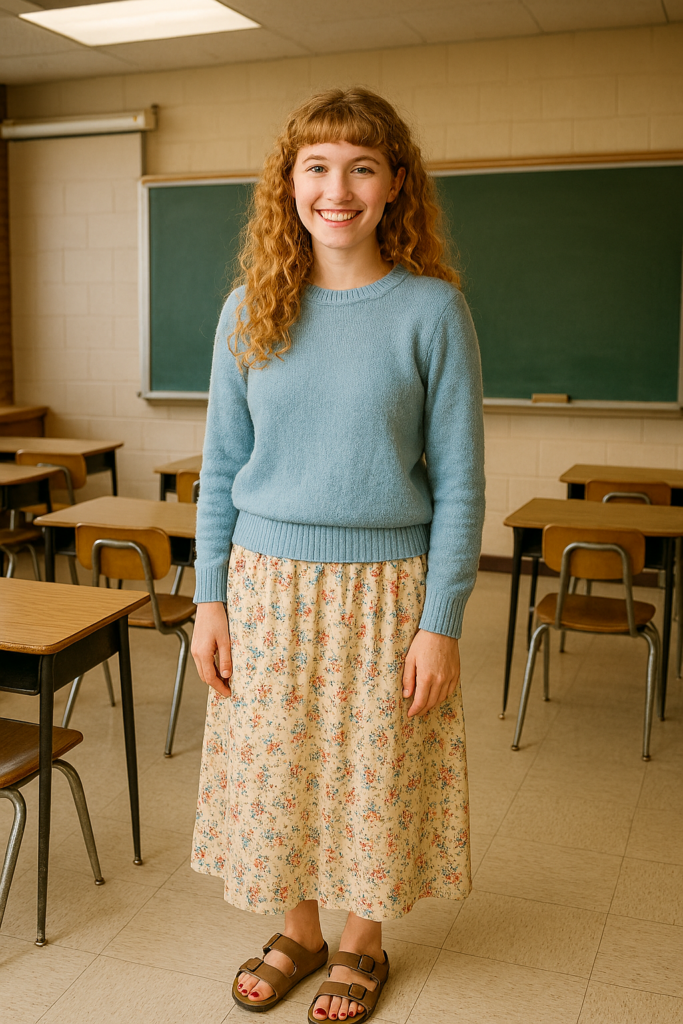
AP English student, senior Megan Rademacher, standing in Rachel’s classroom at New Richmond High School.
Rachel took the paper, scanning the first few lines. Megan’s writing had always been sharp, but this was different — deeper, more introspective, more grounded in lived experience.
“This is excellent work,” Rachel said, genuinely impressed. “You’ve grown a lot as a writer this year.”
Megan’s cheeks flushed with a mix of pride and humility. “Thanks. I’ve been trying.”
“I can tell.”
There was a brief pause — not awkward, just full of things neither of them needed to say out loud.
Then Megan added, “I, um… got my housing assignment for Madison yesterday.”
Rachel’s eyes brightened. “You did? That’s exciting.”
“Yeah. Lakeshore dorms.” Megan smiled, small but real. “I looked up pictures. It’s beautiful. And I registered for my classes. Intro Psych, Stats, and a seminar for first‑years.”
“That sounds like a great start,” Rachel said. “You’re going to thrive there.”
Megan hesitated, then said quietly, “I’m… really grateful things turned out the way they did. I know I messed up. But I feel like I’m heading somewhere good.”
Rachel’s voice softened. “You are. And you earned that.”
Megan nodded, her eyes warm with something like trust — not the same trust she’d had before the incident, but a new, steadier version built on honesty and resilience.
Before she returned to her seat, she added, “I’m glad we’re okay.”
Rachel’s smile was gentle. “Me too.”
Later that week
As the class worked on a final group project, Megan raised her hand to ask a question — the first time she’d done so in months. The class didn’t react dramatically; they simply listened, and Rachel answered with the same thoughtful clarity she always offered.
But Rachel felt something shift inside her — a quiet, private sense of restoration.
And Megan, gathering her books at the end of class, felt something she hadn’t felt since fall:
She felt like herself again.
The Nomination — A Tuesday Morning in February
The announcement came on a morning that felt like any other. Rachel was straightening a stack of essays on her desk, the hum of students settling into homeroom filling the room with its usual soft chaos. She didn’t notice the email notification at first — not until the bell rang and the room quieted.
She clicked it open absently, expecting a reminder about ACT proctoring or a department meeting.
Instead, she froze.
Subject: Teacher of the Year Finalists
Her breath caught. She blinked, reread the first line, then the second.
Congratulations, Mrs. Berglund. You have been selected as one of three finalists for New Richmond’s Teacher of the Year Award…
Her hand went instinctively to her mouth. For a moment she just sat there, stunned, the words blurring slightly as her eyes stung. She scrolled down, seeing the other names:
• Mr. Daniel Johnson — Biology
• Mr. Aaron Clarke — Mathematics
• Mrs. Rachel Berglund — English
Two teachers she respected deeply. Two teachers she never imagined seeing her name beside.
A soft knock pulled her back. Mr. Johnson himself stood in the doorway, grinning.
“You saw it?” he asked.
Rachel nodded, still dazed. “I… I did. I can’t believe—”
“Oh, believe it,” he said warmly. “You’ve earned this.”
A moment later, Mr. Clarke appeared behind him, holding a coffee cup and shaking his head with a laugh. “I told my wife last night that if they didn’t nominate you, the whole committee needed their heads examined.”
Rachel flushed. “You two are ridiculous.”
“No,” Mr. Johnson said gently. “We’re proud of you.”
Their sincerity hit her harder than the email. She felt her throat tighten, the weight of the year — the triumphs, the heartbreaks, the quiet battles no one saw — rising all at once.
“I’m just… doing my job,” she managed.
Mr. Clarke smiled. “Exactly. And that’s why you’re here.”
The bell rang again, sending students spilling into the hallway. The two men stepped back, giving her space, but not before Mr. Johnson added, “Whatever happens, Rachel — this is well deserved.”
When they left, Rachel sat for a moment longer, letting the reality settle in. She wasn’t flashy. She wasn’t loud. She wasn’t the teacher who commanded attention in staff meetings or dazzled with elaborate projects.
She was steady. She was fair. She was kind. She was consistent. She was the teacher students trusted — even when trust cost her something.
And now, somehow, the school saw that too.
She closed the email, took a slow breath, and stood to greet her first class of the day — heart full, humbled, and quietly overwhelmed by the honor she never expected.
The All‑Faculty Meeting (Late April)
The library buzzed with the low hum of teachers settling into their seats, the kind of weary camaraderie that always marked late April. Rachel slipped into a chair near the middle of the room, surrounded by colleagues she’d grown to admire in her quiet, steady way. She didn’t know everyone well yet, but she felt the warmth of the place — the easy greetings, the shared smiles, the sense of belonging she hadn’t realized she’d been craving until she found it here.
When Principal Thompson stepped to the podium, the room gradually fell still.
“Good afternoon, everyone. Thank you for being here. I know this time of year is… intense.”
A ripple of laughter moved through the crowd.
“As you know, each spring we recognize one teacher whose work reflects the heart of New Richmond High School — integrity, mentorship, compassion, and excellence. This year’s finalists were all outstanding.”
Rachel folded her hands in her lap, trying to steady her breathing.
“The committee’s decision was unanimous,” Principal Thompson continued. “This year’s Teacher of the Year is… Mrs. Rachel Berglund.”
For a moment, Rachel didn’t move. The applause rose around her — warm, genuine, overwhelming — and she felt her face flush as she stood. Colleagues reached out to squeeze her arm, pat her shoulder, offer quiet congratulations as she made her way to the front.
Principal Thompson handed her the plaque with a soft smile. “You’ve made a remarkable impact this year.”
Rachel swallowed hard. “Thank you,” she managed, her voice barely above a whisper.
“You’ve earned this,” the principal said simply.
The applause swelled again as Rachel stepped back, humbled and overwhelmed. She wasn’t flashy. She wasn’t loud. She wasn’t the kind of teacher who expected recognition.
But in that moment — surrounded by colleagues who saw her clearly — she felt something she hadn’t felt in a long time.
She felt seen.
The P.A. Announcement in Evan Brenner’s Class
Second period had just settled into its usual rhythm. Rachel moved between desks, handing out fresh copies of The Crucible, the soft shuffle of paper mixing with the low murmur of students settling in. Evan Brenner sat near the window, flipping open his notebook, already halfway through the warm‑up before she’d even written it on the board. He looked healthier these days — steadier — and Rachel felt a quiet swell of pride every time she saw him focused like this.
She had just turned back toward the front of the room when the intercom crackled to life.
“Good morning, New Richmond,” Principal Thompson’s voice rang out, warm and clear. “I have a special announcement to share.”
The room stilled instantly. Even the students who usually ignored the P.A. looked up.
“As many of you know, each spring we honor one teacher who exemplifies the values of our school — integrity, mentorship, compassion, and excellence. I’m pleased to announce that this year’s Teacher of the Year is… Mrs. Rachel Berglund.”
For a heartbeat, the room was silent.
Then it erupted.
“Mrs. B!” “No way!” “YES!” “You deserve it!” “Let’s gooooo!”
Evan grinned so wide his eyes crinkled. “Called it,” he said under his breath, loud enough for the row around him to hear.
Rachel felt her face flush as thirty pairs of eyes turned toward her. She pressed a hand to her chest, overwhelmed by the sudden wave of applause and cheers. A few students actually stood up. One girl fanned her face dramatically. Someone in the back shouted, “We love you, Mrs. B!”
Rachel laughed, blinking hard. “All right, all right — sit down before you make me cry in front of all of you.”
They didn’t sit down right away. They clapped a little longer, grinning at her like they’d just watched their favorite team win a championship.
When the noise finally settled, Rachel took a slow breath, still smiling. “Thank you,” she said softly. “Truly. Now — before you all get me emotional again — let’s talk about Salem and mass hysteria.”
Evan raised his hand. “Mrs. B?”
“Yes, Evan?”
He gave her a small, earnest smile. “We’re really proud of you.”
The room murmured in agreement.
Rachel swallowed, her voice warm and unsteady. “Thank you. That means more than you know.”
And for the rest of the period — and the rest of the day — the glow in the room didn’t fade.
A Subtle Shift — But Not a Cold One
The cheers were still fading when the door opened and Megan Rademacher stepped into the room, late slip in hand. The energy dipped — not dramatically, not awkwardly, just… perceptibly. A soft recalibration. The students who knew the story glanced between her and Rachel, unsure of how this moment would land.
Megan paused, taking in the flushed faces, the scattered applause still dying out, the unmistakable glow around Rachel. For a heartbeat, something unreadable flickered across her expression — surprise, maybe, or something quieter.
She walked to Rachel’s desk, placed the late slip down, and said in a voice that was steady but softer than usual, “Congratulations, Mrs. Berglund.”
It wasn’t warm. It wasn’t effusive. But it was sincere.
Rachel met her eyes — really met them — for the first time in over three months. “Thank you, Megan,” she said gently, with no expectation, no pressure, just gratitude.
Megan nodded once, almost imperceptibly, and slipped into her seat. The moment passed. And the lesson continued.
But for Rachel, that small gesture — that tiny, fragile olive branch — stayed with her long after the bell rang. Not because it erased the past. Not because it signaled forgiveness. But because it showed that even in her hurt, Megan still had grace.
And for a teacher who had carried the ache of that broken relationship all year, it meant more than Megan would ever know.
That Night at Home
Rachel didn’t plan to tell him right away.
She walked through the front door still carrying the soft glow of the day, the plaque tucked safely in her bag, her heart full but fragile in that way big moments can be. The house smelled faintly of garlic and butter — Soren was cooking — and she could hear music playing quietly from the kitchen.
He turned when he heard her keys.
“Hey, babe,” he said, smiling the way he always did when she came home. “Dinner’s almost—”
He stopped mid‑sentence.
Because he saw it. Not the plaque. Not the email. Not the announcement.
He saw her — the way she was holding herself, the shimmer in her eyes, the way she looked like she was trying not to burst.
He wiped his hands on a towel and crossed the room in three long strides.
“What happened?” he asked, voice warm, curious, already proud without knowing why.
Rachel swallowed, suddenly shy. “I… um… something happened at school today.”
Soren’s eyebrows lifted. “Good something or bad something?”
She laughed — a soft, breathy sound. “Good. Really good.”
He waited, patient, steady, giving her space to say it in her own time.
“I won,” she said finally, her voice barely above a whisper. “Teacher of the Year.”
For a heartbeat, Soren just stared at her — not because he was surprised, but because he was overwhelmed.
Then he let out a breath that was half‑laugh, half‑emotion, and pulled her into his arms so tightly her feet almost left the ground.
“Rachel,” he murmured into her hair, “oh my gosh. Oh my gosh. You did it.”
She laughed again, this time with tears in her eyes. “I didn’t think— I mean, I never expected—”
“Of course you didn’t,” he said, pulling back just enough to look at her. “Because you’re you. Because you never see what everyone else sees.”
She blinked, cheeks flushed. “What do you mean?”
Soren cupped her face gently, his thumbs brushing her cheeks. “You think you’re ordinary. You think you’re just doing your job. But Rachel… you change people. You steady people. You make that school better just by walking into it.”
Her breath hitched.
“And they see it,” he continued. “Your colleagues see it. Your students see it. I see it every single day.”
Rachel leaned into him, overwhelmed in the best way.
Soren kissed her forehead. “I’m so proud of you. So, so proud.”
She let out a shaky laugh. “My students cheered. Evan almost cried.”
Soren grinned. “Of course he did. You’ve been his anchor this whole year.”
She rested her head against his chest, letting the moment settle. “It still feels unreal.”
“Well,” he said, wrapping his arms around her again, “get used to it. Because this is who you are. And this is just the beginning.”
The kitchen timer beeped behind them, but neither of them moved.
For a long moment, they just stood there — wrapped in warmth, pride, and the quiet joy of a day that had changed something in Rachel’s heart.
Not because of the award. But because of the way Soren saw her. And the way she was finally starting to believe it.
Last Day of School for Seniors
The building felt different on the last day of senior classes — lighter, louder, threaded with that strange mix of nostalgia and impatience that only eighteen‑year‑olds can generate. Students drifted through the halls with yearbooks tucked under their arms, stopping for hugs, selfies, and signatures. The air smelled faintly of Sharpie ink and spring rain.
In AP English, Rachel had left the windows open. A warm breeze fluttered the stack of final essays on her desk. Seniors filtered in slowly, savoring the moment even as they pretended not to.
Megan arrived a few minutes early.
She paused in the doorway, taking in the room — the posters, the bookshelves, the desks she’d sat in for nine months. Then she stepped inside, her expression soft but steady.
“Morning, Mrs. Berglund,” she said.
Rachel smiled. “Morning, Megan. Big day.”
“Yeah,” Megan said with a quiet laugh. “Feels weird.”
She set her backpack down and approached Rachel’s desk. She held something in her hands — her yearbook, opened to a page already crowded with messages.
“Could you… sign it?” she asked.
Rachel’s smile warmed. “Of course.”
As she wrote, Megan stood nearby, hands clasped loosely in front of her. She wasn’t fidgeting — just thoughtful.
When Rachel finished, she closed the book gently and handed it back. “There you go.”
Megan glanced at the page but didn’t read it yet. Instead, she took a breath.
“I wanted to say something before… you know, everything gets crazy today.”
Rachel gave her full attention. “I’m listening.”
Megan’s voice was quiet but clear. “Thank you. For this year. For… not giving up on me. Even when I made it really hard.”
Rachel’s expression softened. “You worked hard to come back from that moment, Megan. You showed a lot of maturity.”
“I didn’t feel mature,” Megan admitted. “I felt embarrassed. And angry. Mostly at myself. But you were fair. And you didn’t treat me like I was broken or… bad.”
“You weren’t,” Rachel said gently. “You made a mistake. And you learned from it. That’s what matters.”
Megan nodded, eyes bright but steady. “I’m glad we’re okay.”
“So am I.”
There was a pause — not awkward, just full of meaning.
Then Megan added, “I got my Madison orientation packet yesterday. I’m officially registered for Intro Psych. And I joined the Facebook group for Lakeshore dorms.”
Rachel laughed softly. “You’re really doing it.”
“Yeah,” Megan said, smiling. “I’m excited. Nervous, but excited.”
“You’re going to thrive there,” Rachel said. “Truly.”
Megan took that in, the words settling somewhere deep. “Thanks. That means a lot.”
The bell rang, and the room filled with seniors chattering and shuffling to their seats. Megan stepped back, giving Rachel space to start class.
But before she sat down, she turned once more.
“Goodbye, Mrs. Berglund.”
Rachel’s voice was warm, steady, full of pride. “Goodbye, Megan. And good luck. You’re ready.”
Megan smiled — a real, confident smile — and took her seat for the last time.
And for Rachel, watching her settle in among her classmates, it felt like the quiet closing of a chapter that had been painful, complicated, and ultimately full of grace.
Graduation Day
The football field had been transformed overnight — rows of white folding chairs lined up with perfect symmetry, a stage draped in the school colors, and a sea of proud families filling the bleachers. The late‑May sun hung warm and bright over everything, giving the whole morning a soft, golden glow.
Seniors gathered behind the stadium, adjusting caps, straightening gowns, laughing too loudly, hugging too tightly. Megan stood among them, her red gown swaying in the breeze, her honor cords draped neatly around her shoulders. She looked… peaceful. Not triumphant, not anxious — just grounded, ready.
Her friends snapped photos, scribbled last‑minute yearbook messages, and compared how crooked their mortarboards were. Megan joined in, smiling easily, her eyes bright with the kind of excitement that comes from knowing exactly where you’re headed next.
When the processional music began, the seniors filed toward the field. Megan’s heart thudded with each step, but in a good way — the kind of thud that says this is real, this is happening, this is mine.
During the ceremony
Rachel sat with the faculty on the stage, her Teacher of the Year sash tucked neatly over her robe. She scanned the rows of seniors until she found Megan — third row, fifth seat from the left. Megan was listening intently to the speeches, her hands folded in her lap, her posture straight.
When the valedictorian spoke about resilience, Rachel saw Megan’s eyes soften. When the principal spoke about integrity, Megan nodded almost imperceptibly. When the superintendent spoke about new beginnings, Megan smiled.
It was subtle, but Rachel noticed every bit of it.
When Megan’s name was called
“Megan Rademacher.”
Her friends cheered. Her parents stood to clap. Megan walked across the stage with a calm confidence that hadn’t been there in January. Rachel watched her approach, diploma cover in hand, and felt a quiet swell of pride.
As Megan crossed in front of the faculty line, she caught Rachel’s eye. Rachel gave her a small, warm nod. Megan returned it — a gesture full of gratitude, respect, and closure.
It lasted only a second, but it said everything.
After the ceremony
The field erupted into joyful chaos — caps flying, families rushing forward, cameras flashing. Megan found her parents first, hugging them tightly. Then her friends. Then a few teachers.
Eventually, she spotted Rachel near the edge of the field, speaking with another parent. Megan hesitated for a moment, then walked over, diploma cover tucked under her arm.
“Mrs. Berglund?” she said gently.
Rachel turned, her face lighting with recognition. “Megan. Congratulations.”
“Thank you.” Megan shifted her weight, then added, “I just… wanted to say goodbye. And thank you. For everything this year.”
Rachel’s smile was warm and steady. “You earned this day, Megan. I’m proud of you.”
Megan exhaled, a soft, relieved breath. “I’m excited for Madison. I feel ready.”
“You are ready,” Rachel said. “And you’re going to do incredible things there.”
Megan’s eyes shone. “I hope so.”
“I know so.”
For a moment, they simply stood there — teacher and student, closing a chapter that had been harder, deeper, and more meaningful than either expected.
Then Megan stepped forward and gave Rachel a brief, sincere hug. Not long. Not dramatic. Just enough.
“Goodbye, Mrs. Berglund,” she said as she stepped back.
“Goodbye, Megan. Take care of yourself.”
Megan nodded, smiled, and turned to rejoin her friends — her future stretching wide and bright ahead of her.
Rachel watched her go, feeling that quiet, unmistakable sense of fulfillment that comes from seeing a student not just succeed, but grow.
And under the warm graduation sun, it felt like the perfect ending to a complicated, beautiful year.
Rachel and Soren at Home, Early Summer Evening
The windows were open, letting in the soft hum of crickets and the scent of freshly cut grass. Rachel sat curled into the corner of the couch, legs tucked beneath her, a mug of chamomile cooling in her hands. Soren was at the kitchen counter, slicing strawberries into a bowl, the rhythm of the knife steady and familiar.
“Last day of school,” he said, glancing over with a smile. “You survived.”
Rachel laughed softly. “Barely. I think my feet are still vibrating from standing through graduation.”
Soren carried the bowl over and sat beside her, offering a strawberry. She took it, chewing thoughtfully.
After a moment, she said, “It was a good day. A really good day.”
Soren leaned back. “You sound surprised.”
Rachel hesitated, then set her mug down. “I guess I am. I didn’t expect it to feel so… complete. Especially after everything that happened this year.”
Soren nodded, waiting.
Rachel looked out the window, watching the breeze stir the leaves. “The plagiarism incident with Megan — that was one of the hardest things I’ve ever had to navigate as a teacher. Not because of the policy, or the paperwork, or even the fallout. But because it was her. Because I cared about her.”
“You still do,” Soren said gently.
Rachel nodded. “Yeah. I do.”
She paused, then added, “There was a stretch in January where I thought I’d lost her completely. She was so withdrawn. So guarded. And I kept wondering if I’d handled it wrong — if I’d been too firm, or not firm enough, or if I’d missed something.”
“You didn’t,” Soren said. “You were honest. You were fair. And you didn’t abandon her.”
Rachel’s eyes softened. “I tried not to. But it hurt. Watching her pull away. Watching the trust unravel.”
She picked up her mug again, cradling it. “But then she started coming back. Quietly. Thoughtfully. She didn’t ask for forgiveness, but she showed up. She did the work. She rebuilt.”
Soren smiled. “And she got into Madison.”
Rachel’s face lit up. “She did. And she earned a scholarship. Not the top one, but enough to make it happen. She’s majoring in psychology. She’s already talking about dorm life and psych club and lakeside study spots.”
“That’s amazing.”
“It is,” Rachel said, her voice full of quiet pride. “And today, she asked me to sign her yearbook. She thanked me. She said she was glad we were okay.”
Soren reached for her hand. “That’s the kind of ending you hope for.”
Rachel nodded, eyes misting. “It really is. I didn’t need a dramatic apology. I just needed to know she was going to be okay. That she didn’t carry bitterness. That she saw the whole year — not just the worst moment.”
They sat in silence for a while, the kind that feels full rather than empty.
Then Soren said, “You know, I think that’s why you’re getting the Teacher of the Year award.”
Rachel laughed softly. “Not because I gave a kid an F?”
“No,” he said, squeezing her hand. “Because you gave her a future.”
Rachel blinked, then smiled — the kind of smile that comes from deep down, from knowing you did something hard and didn’t lose yourself in the process.
“She’s going to be okay,” she said again, more to herself than to him.
And in the quiet of their home, with the summer evening settling around them, that truth felt like the best possible way to end the year.
Chapter 5: Growth and Development
Mid-August, Rachel and Soren’s Kitchen
The late summer light filtered through the windows in soft gold, casting long shadows across the hardwood floors. The kitchen smelled faintly of basil and lemon — Soren had made pasta earlier, and the remnants still lingered in the air. The house was quiet, settled, the kind of quiet that comes from two people who’ve built something steady together.
Rachel stood by the sink, her fingers curled around the edge of the counter. The test sat on the windowsill beside the little ceramic herb pots — two unmistakable lines, clear and gentle, like the beginning of a new sentence.
Soren was at the stove, rinsing out the pasta pot, humming something under his breath. He looked content — sleeves pushed up, hair a little tousled, the rhythm of domestic life fitting him like a favorite hoodie.
Rachel watched him for a moment, her heart full and quiet.
Then she said, softly, “Hey, babe?”
Soren turned, drying his hands on a dish towel. “Yeah?”
She reached for the test and held it out, not dramatically, just simply. “There’s two lines.”
He blinked, then stepped closer, taking it from her gently. His eyes scanned the result, then lifted to meet hers.
“You’re pregnant?” he asked, voice low, reverent.
Rachel nodded, her eyes shining. “I am.”
Soren didn’t speak right away. He just wrapped his arms around her, pulling her close, resting his forehead against hers. The silence between them was full — of joy, of awe, of the kind of love that doesn’t need words.
They stood like that for a long moment, surrounded by the hum of their home — the 1920s trim, the mismatched mugs, the calendar on the fridge already marked with Rachel’s first teacher workday and Soren’s preseason travel dates.
“This feels… right,” he said finally, voice thick with emotion.
Rachel smiled. “It does.”
“You’re about to start your third year,” he said, brushing a curl from her cheek. “I’m with the Wild. We’re settled. We’re ready.”
Rachel leaned into him, her voice soft. “I didn’t think I’d feel this calm. But I do. I feel grounded. Like this is exactly where we’re supposed to be.”
Soren kissed her temple. “You’re going to be an amazing mom.”
She laughed quietly. “You’re going to be ridiculous. I can already see you buying tiny hockey skates.”
“Only if they come in Berglund blue,” he teased.
They stood there, wrapped in each other, the test still resting on the counter beside the basil. Outside, the cicadas buzzed and the sun dipped lower, casting their kitchen in amber light.
It wasn’t dramatic. It wasn’t loud. It was just them — in the home they’d built, with a new chapter quietly beginning.
And it was perfect.
Sharing the News with Their Parents
The sun had set by the time Rachel and Soren settled onto the couch, the soft glow of a table lamp filling the living room with warm light. Their 1920s home felt especially cozy tonight — like it already knew something sacred was unfolding.
Rachel held her phone in both hands, nerves fluttering in her stomach. “Ready?” she asked.
Soren smiled. “They’re going to be thrilled.”
She nodded, took a breath, and tapped FaceTime: Mom & Dad.
Part 1 — Rachel Tells the Schneiders
Her parents appeared on the screen almost immediately — her mom in her favorite reading chair, her dad leaning in from the side, both smiling as soon as they saw her.
“Hi sweetheart!” her mom said. “You two look cozy.”
“We are,” Rachel said, tucking a curl behind her ear. “I… actually have something to tell you.”
Her parents exchanged a quick glance — the kind that said Is it good? Is it bad? — before her dad asked, “Everything okay?”
Rachel’s smile softened. “Everything’s wonderful.”
She held up the pregnancy test — not dramatically, just gently, letting the two lines speak for themselves.
Her mom gasped, hand flying to her mouth. “Rachel! Oh my goodness!”
Her dad blinked, then broke into the widest grin she’d seen from him in years. “You’re… you’re expecting?”
Rachel nodded, eyes shining. “We are.”
Her mom started crying — the happy, overwhelmed kind — while her dad wiped at his eyes in that subtle, Midwestern way that pretends he’s not emotional even though he absolutely is.
“Oh honey,” her mom said, voice trembling, “we are so happy for you. So happy.”
Her dad leaned closer to the camera. “You’re going to be a wonderful mother, Rachel. And Soren — congratulations, son.”
Soren leaned into the frame. “Thank you. We’re really excited.”
Her mom sniffed. “When are you due?”
“Early April,” Rachel said. “We just found out today.”
Her parents beamed, talking over each other — names, nursery ideas, how proud they were, how they couldn’t wait to visit. Rachel laughed, letting their joy wash over her.
Before hanging up, her mom said softly, “This baby is already so loved.”
Rachel swallowed around the lump in her throat. “I know.”
Part 2 — Soren Calls the Berglunds
After the Schneiders’ call ended, Soren took a breath and dialed his parents. Rachel curled against his side, listening.
Robert and Mary appeared on the screen from their kitchen in Edina — Mary in an apron, Robert with a dish towel over his shoulder.
“Hey bud!” Robert said. “What’s up?”
Soren glanced at Rachel, then back at the screen. “We’ve got some news.”
Mary froze mid‑wipe. “Good news?”
Soren lifted the test into view. “You’re going to be grandparents.”
Mary let out a delighted gasp, pressing both hands to her cheeks. “Soren! Rachel! Oh, that’s wonderful!”
Robert’s face softened into a proud, quiet smile — the Berglund version of emotional fireworks. “Congratulations, you two. That’s… that’s really something.”
Mary leaned closer to the camera. “How far along? How are you feeling? Do you need anything?”
Rachel laughed. “Just a few weeks. And I’m okay — tired, but okay.”
Robert nodded. “You’ll be great parents. And we’re here for whatever you need.”
Mary added, “And you tell us when we can come visit. I want to bring a little something for the baby.”
Soren grinned. “Mom, it’s been like two hours.”
Mary waved him off. “Babies need things.”
They all laughed — the warm, easy kind that comes from family who loves without hesitation.
Before ending the call, Robert said, “This is a blessing. Truly.”
Soren’s voice softened. “We feel that.”
After the Calls
When both screens finally went dark, Rachel leaned her head on Soren’s shoulder.
“That went well,” she murmured.
Soren kissed the top of her head. “They’re all so happy.”
Rachel placed a hand over her stomach — still flat, still quiet, but suddenly full of meaning.
“So am I,” she said.
And in the soft glow of their living room, surrounded by the life they’d built, they let the joy settle in.
Sparkle Squad FaceTime: “Pull the Fire Alarm!”
Rachel set her phone on the kitchen counter, propped against the little ceramic butter dish shaped like a cow. The house was quiet, warm, and full of that soft, glowing sense of something new beginning.
She hit FaceTime → Sparkle Squad.
The screen blinked once… twice…
And then—
Lily appeared first, hair in its usual shoulder length, slightly tousled style, Frodo draped across her shoulder like a furry stole.
“Rach! You pulled the alarm. What’s going on? Frodo is concerned.”
Frodo meowed loudly, as if on cue.
Allison popped in next, sitting on her porch swing in Ewen, iced tea in hand.
“This better be good. I paused my true crime podcast for this.”
Maya joined from her apartment, wrapped in a blanket despite it being August.
“Is this a crisis or a celebration? I need to calibrate.”
Sophie appeared with perfect lighting, as always.
“Rachel Berglund, you look suspiciously serene.”
Marnie Thurston connected last, breathless, hair slightly windblown.
“Sorry! I was folding laundry. What’s happening?”
Rachel looked at all of them — her people — and felt her heart swell.
“Okay,” she said, tucking a curl behind her ear. “I have news.”
The Squad collectively leaned in.
Rachel held up the pregnancy test, two clear lines visible.
For half a second, there was silence.
Then—
The Squad absolutely exploded.
Lily gasped so loudly that Frodo leapt off her shoulder and sprinted out of frame. Allison shrieked and slapped her porch swing so hard it bounced. Maya clapped both hands over her mouth. Sophie screamed into a pillow to avoid waking her neighbors. Marnie’s eyes filled instantly with tears.
“RACHEL!” Lily shouted. “Oh my gosh, oh my gosh, oh my gosh!”
“You’re pregnant?” Maya said, eyes huge.
“You’re going to be a mom!” Sophie squealed.
Allison leaned into the camera. “Soren knows, right? You didn’t tell us first, did you?”
Rachel laughed. “Yes, he knows. I told him earlier.”
Marnie wiped her eyes. “This is the best news. The absolute best.”
The Squad erupted again — overlapping voices, laughter, squeals, questions.
“When are you due?” “How are you feeling?” “Do you need anything?” “Have you told your parents?” “Does Soren already have Wild baby gear picked out?”
Rachel held up her hands, laughing. “One at a time!”
She answered their questions — early April, tired but happy, yes they told their parents, no Soren hasn’t bought skates yet but she’s sure it’s coming.
Then Lily leaned closer to the camera, her voice softening. “Rach… we’re so happy for you.”
The others nodded, the energy settling into something warm and steady.
“You’re going to be such a good mom,” Maya said.
“And that kid is going to be so loved,” Allison added.
“And stylish,” Sophie said. “Because I’m buying them tiny cardigans.”
“And grounded,” Marnie said, smiling. “Because they’ll have you.”
Rachel felt her throat tighten. “I love you guys.”
“We love you too,” they chorused.
The call drifted into gentle chatter — nursery ideas, baby names, how Rachel would handle first trimester nausea during the first week of school, whether the baby would inherit Soren’s hockey obsession or Rachel’s love of books.
Eventually, after the laughter softened and the excitement settled into a warm glow, Lily said:
“Rach… this is the start of something beautiful.”
Rachel smiled, hand resting lightly on her stomach.
“I know.”
And surrounded by the faces of the women who had walked with her through every storm and celebration, she felt it — deeply, quietly, joyfully.
The Sparkle Squad fire alarm had never been pulled for something so perfect.
Rachel’s First Prenatal Appointment
The clinic smelled faintly of lavender and disinfectant — a strangely comforting combination. Rachel sat on the exam table, the crinkly paper beneath her legs rustling every time she shifted. Soren sat in the chair beside her, elbows on his knees, hands clasped, trying to look calm but failing adorably.
He kept glancing at the ultrasound machine like it might suddenly spring to life.
Rachel reached over and squeezed his hand. “You’re more nervous than I am.”
“I’m not nervous,” he said, then immediately added, “Okay, maybe a little.”
She smiled. “It’s sweet.”
Before he could respond, the door opened and Dr. Halvorson stepped in — cheerful, efficient, and exactly the kind of doctor who made you feel like everything was going to be okay.
“Good morning, Berglunds!” she said, washing her hands. “Ready for your first official check-in?”
Rachel nodded, heart fluttering. “Very ready.”
The Ultrasound
A few minutes later, Rachel lay back as the cool gel touched her abdomen. Soren scooted his chair closer, eyes fixed on the monitor.
Dr. Halvorson moved the wand gently, her expression focused but warm.
“There we go…” she murmured. “And… yes. That’s a beautiful early pregnancy.”
Rachel exhaled, relief washing through her.
Soren’s eyes softened. “That’s… our baby?”
“That’s your baby,” Dr. Halvorson said with a smile.
The tiny flicker on the screen — barely more than a spark — felt like the most miraculous thing Rachel had ever seen.
The Due Date
Dr. Halvorson tapped a few keys on the computer. “Based on the measurements and your cycle history, your due date is…”
Rachel held her breath.
“April 10.”
Soren blinked. “April 10?”
Rachel’s mind immediately jumped to the school calendar. “That’s… right before finals. I’ll miss the end of the year.”

Rachel BerglundDr. Halvorson nodded sympathetically. “Most likely, yes. You’ll want to plan for maternity leave starting in early April, maybe late March depending on how you’re feeling.”
Rachel nodded slowly. She’d known it was possible — but hearing the date made it real. Concrete. She felt a strange mix of practicality and awe.
Soren squeezed her hand. “We’ll figure it out.”
She smiled. “I know.”
Then he added, with a half‑laugh, “April 10… that’s right around the start of NHL playoffs.”
Dr. Halvorson chuckled. “Well, if the Wild make a run, you might have a very exciting month.”
Rachel rolled her eyes affectionately. “Great. Baby Berglund could arrive during a first‑round overtime.”
Soren grinned. “I’ll be there. No matter what.”
She believed him.
After the Appointment
They walked out to the parking lot hand in hand, the late‑morning sun warm on their shoulders. Rachel held the little ultrasound printout between her fingers, staring at the tiny flicker captured on glossy paper.
“April 10,” she said softly.
“April 10,” Soren echoed.
“It feels real now.”
“It is real,” he said, wrapping an arm around her. “And we’re ready.”
Rachel leaned into him, the ultrasound pressed to her heart.
She wasn’t thinking about missed school days or sub plans or the chaos of playoff season. She was thinking about the tiny spark on the screen, the life growing quietly inside her, and the steady warmth of the man beside her.
And for the first time since the test showed two lines, she felt the full weight — and full joy — of what was coming.
A new season. A new chapter. A new Berglund.
Soren Is Called Into Bill Guerin’s Office
The offices at TRIA Rink always felt different in late August — quieter, but charged. The calm before the storm. Staff moved with purpose, prepping for camp, finalizing reports, updating depth charts. Soren had been in this rhythm long enough now to feel it in his bones.
He was finishing a development report at his desk when his phone buzzed.
From: B. Guerin Subject: Need you in my office. Now.
Soren blinked. Bill wasn’t dramatic, but he also wasn’t the type to send vague summons unless something mattered.
He grabbed his notebook — the one he always carried, filled with scribbles, arrows, and shorthand only he could decipher — and headed down the hall.
Inside Guerin’s Office
Bill’s door was half‑open. Soren knocked lightly.
“Come in,” Bill said.
The GM was standing by the window, arms crossed, staring out at the rink below where a handful of prospects were skating informal drills. His expression was thoughtful, not tense — but focused.
“Soren,” he said, turning. “Close the door.”
Soren did, heart ticking up a notch.
Bill gestured to the chair across from his desk. “Sit.”
Soren sat, notebook ready.
Bill didn’t sit right away. He paced once behind his desk, then finally lowered himself into his chair with a sigh that carried weight.
“We’ve got a situation,” he said.
Soren nodded, waiting.
Bill tapped a file on his desk — thick, overstuffed, full of scouting reports and analytics printouts. “It’s about Lukas Jansson.”
Soren’s eyebrows lifted. Jansson — the Swedish winger drafted three years ago. Electric skill. Inconsistent results. A player who could look like a future top‑six forward one night and a ghost the next.
Bill continued. “The organization is split. Analytics loves him. Scouts are frustrated with him. Coaches don’t know what to do with him.”
“And you?” Soren asked carefully.
Bill gave a humorless laugh. “I’m invested. I pushed for him at the draft. I still think he can be something. But I’m not blind. I know we’re at a crossroads.”
He slid the file toward Soren.
“I want you to evaluate him.”
Soren blinked. “Me?”
“You,” Bill said firmly. “You’ve got the best blend of eyes, instincts, and numbers in this building. You see players for who they are and who they can be. And you’re not afraid to tell me the truth.”
Soren swallowed. “What’s the timeline?”
“Ten days,” Bill said. “Before camp starts. I want a full report — video breakdown, development trajectory, mental readiness, comparables, the whole thing.”
Soren nodded slowly. “Okay.”
Bill leaned forward, elbows on the desk. “This isn’t just another assignment. What you tell me is going to influence whether we keep pushing with him… or whether we move him.”
Soren felt the weight of that. A prospect’s future. A GM’s pride. A franchise’s long‑term strategy.
Bill continued, voice lower. “I’m not asking you to agree with me. I’m asking you to be honest. If you think he’s a bust, say it. If you think he needs a different development path, tell me. If you think he’s worth the patience, make the case.”
Soren nodded again, more firmly this time. “I’ll give you the truth.”
Bill’s expression softened — just a little. “I know you will. That’s why I picked you.”
He stood, signaling the meeting was over. “Go watch the kid. Talk to the coaches. Dig into the tape. And Soren?”
Soren paused at the door. “Yeah?”
Bill’s voice was steady, but there was something vulnerable beneath it. “Don’t sugarcoat it. I need the real picture.”
Soren nodded once. “You’ll get it.”
He stepped out into the hallway, closing the door behind him. The file felt heavy in his hands — heavier than anything he’d been given before.
But beneath the weight was something else:
A spark of confidence. A sense of purpose. And the quiet thrill of knowing Bill Guerin trusted him with something that mattered.
The season hadn’t even started yet, and already, Soren was in the middle of the storm.
Soren’s Deep Dive Into Lukas Jansson’s Tape
The video room at TRIA Rink was one of Soren’s favorite places in the building — dim, quiet, and lined with monitors that made the whole space feel like a command center. Tonight, it was just him, a thermos of coffee, and the thick file Bill Guerin had handed him earlier.
He settled into the rolling chair, cracked his knuckles, and pulled up the first set of clips: Jansson’s shifts from a late‑season Iowa Wild game.
The screen flickered to life.
Shift 1 — The Flash of Brilliance
Jansson entered the zone with speed, cutting between two defenders like he was slicing through water. His edges were sharp, effortless. He pulled the puck to his backhand, froze the goalie, and slid a perfect pass across the crease.
The winger on the other end whiffed the shot.
Soren paused the clip.
“Not his fault,” he murmured, jotting a note. Creates high‑danger chances. Vision excellent.
He hit play again.
Shift 2 — The Vanish
The next clip was from the same game, ten minutes later. Jansson drifted through the neutral zone, stick low, posture loose. The puck was fifty feet away, but he didn’t adjust. Didn’t anticipate. Didn’t hunt.
The play moved past him, and he was late to the backcheck by a full stride and a half.
Soren sighed, writing: Engagement inconsistent. Motor dips when play moves away from him.
He rewound the clip, watching it again. And again. The talent was there. The instincts were there. But the compete level… it flickered.
Shift 3 — The Wild Card
Another game. Another moment.
Jansson picked up a loose puck in the defensive zone and exploded up ice. His acceleration was elite — the kind of burst you couldn’t teach. He beat a defender wide, cut to the middle, and ripped a shot off the crossbar.
Soren leaned back. “That’s NHL speed.”
But on the very next shift, Jansson lost a board battle he should’ve won. Not because he was smaller — he wasn’t — but because he didn’t commit to it. He reached instead of driving through.
Soren scribbled: Strength fine. Willingness questionable. Needs accountability.
The Analytics Overlay
He pulled up the tracking data next — heat maps, zone entries, retrieval rates.
The numbers were glowing.
• Top‑tier controlled entry percentage
• High expected assists per 60
• Excellent transition metrics
• Above‑average shot creation
But then the red flags:
• Low puck‑battle win rate
• Poor defensive zone retrievals
• High variability shift‑to‑shift
Soren rubbed his forehead. “Analytics aren’t wrong. Scouts aren’t wrong. They’re just looking at different halves of the same player.”
The Moment of Clarity
He clicked into a clip labeled “Practice — Development Camp.”
Jansson was doing a small‑area battle drill. Tight space. High pressure. No room to float.
And he was… good. Really good. Engaged. Competitive. Focused. Winning battles. Making plays. Not disappearing.
Soren froze the frame.
“That’s the real kid,” he whispered.
Not the ghost on the backcheck. Not the highlight‑reel winger. The one in the middle — the one who showed up when the environment demanded it.
He wrote slowly, deliberately:
Needs structure. Needs accountability. Needs a coach who won’t let him drift. Ceiling: top‑six winger. Floor: AHL enigma. Recommendation: keep him — but change his development path.
He sat back, letting the conclusion settle.
This wasn’t a yes or no. This wasn’t a keep or trade. This was a crossroads.
And Bill Guerin had trusted him to see it clearly.
Soren closed the laptop, gathered his notes, and exhaled.
Tomorrow, he’d talk to the analytics team. Then the scouts. Then the coaches.
But tonight, he’d found the thread — the truth in the tape.
And that was the first step toward giving Bill the real picture he’d asked for.
Soren Meets with the Analytics Team, Scouts, and Coaches
The next morning, Soren arrived at TRIA early — coffee in hand, notebook under his arm, and Lukas Jansson’s file tucked into his backpack. Today was the day he’d gather the perspectives that would either reinforce or challenge what he saw on tape.
He started with analytics. The analytics room was bright, cluttered, and humming with quiet intensity. Screens displayed heat maps, shot charts, and player‑tracking models. Evan, the lead analyst, looked up as Soren walked in.
“Morning,” Evan said. “You’re here about Jansson.”
“Yeah,” Soren replied. “I need the full picture.”
Evan pulled up a dashboard. “Then let’s start with the good news.”
He tapped a key, and Jansson’s transition metrics filled the screen.
“Controlled entries per 60? Elite. Zone exits? Excellent. Expected assists? Top tier for his age group.”
Soren nodded. “Matches what I saw.”
“But…” Evan clicked again, and the screen shifted to defensive metrics. “Here’s the problem.”
Red zones lit up across the defensive end.
“Retrievals are low. Puck‑battle win rate is bottom‑third. Defensive engagement is inconsistent.”
Soren leaned forward. “Is it effort or instinct?”
“Effort,” Evan said without hesitation. “When he’s locked in, the numbers spike. When he’s not, they crater.”
Soren scribbled a note. “So the analytics say he’s a high‑ceiling volatility case.”
“Exactly,” Evan said. “If he figures out the compete level, he’s a top‑six winger. If he doesn’t… he’s a career tweener.”
Soren closed his notebook. “Thanks. This helps.”
Evan smirked. “Tell Guerin we’re right.”
Soren laughed. “I’ll tell him you’re confident.”
Meeting with the Scouts
The scouting office was a different world — dark wood, old coffee, and walls covered in prospect photos. Tom, a veteran scout with thirty years in the league, sat with his arms crossed as Soren entered.
“You’re here about the Swede,” Tom said.
Soren nodded. “I want your read.”
Tom grunted. “Kid drives me nuts.”
“How so?”
“He’s got all the tools. Every single one. But he doesn’t use them every night.” Tom leaned back. “Some games he looks like a first‑rounder. Other games he looks like he’d rather be anywhere else.”
Soren flipped open his notebook. “Is it compete? Confidence? Conditioning?”
“Compete,” Tom said immediately. “He floats. He cheats for offense. He avoids contact unless he has no choice.”
“But you still like him,” Soren said.
Tom sighed. “Yeah. Because when he’s on, he’s special. But I don’t trust him yet.”
Soren nodded slowly. “If it were your call, what would you do?”
Tom didn’t hesitate. “Send him to a coach who won’t let him coast. Someone who’ll get in his face when he drifts. He needs structure. Accountability. And maybe a kick in the pants.”
Soren smiled. “That lines up with what I’m seeing.”
Tom pointed a finger at him. “Don’t sugarcoat this for Bill. He needs the truth.”
“I know,” Soren said. “That’s why I’m here.”
Meeting with the Coaches
The Iowa Wild coaching staff was in town for preseason meetings, so Soren found them in a conference room reviewing systems. Coach Rourke, the head coach, waved him in.
“You’re looking at Jansson,” Rourke said. “Sit.”
Soren sat. “I want your perspective.”
Rourke rubbed his temples. “He’s a puzzle. A talented one, but a puzzle.”
“How’s he in practice?” Soren asked.
“Depends on the day,” Rourke said. “Some days he’s the best player on the ice. Other days he’s invisible.”
“Does he respond to coaching?”
“Yes,” Rourke said. “But only when he’s engaged. If he’s locked in, he absorbs everything. If he’s drifting, it’s like talking to a wall.”
Soren nodded. “What do you think he needs?”
“A tighter leash,” Rourke said. “More accountability. More structure. And someone who won’t let him disappear.”
“Do you think he can make the jump?” Soren asked.
Rourke paused, then said, “If he buys in, yes. If he doesn’t, no.”
Soren wrote that down carefully.
Rourke leaned forward. “You’re going to tell Bill the truth, right?”
“I am.”
“Good,” Rourke said. “Because this kid’s future depends on it.”
After the Meetings
Soren walked back to his office, notebook full, mind buzzing.
Analytics said: elite upside, inconsistent engagement Scouts said: special talent, unreliable compete Coaches said: needs structure and accountability
And Soren’s own instincts said the same thing:
Jansson wasn’t a lost cause. He was a mismanaged one.
Now came the hard part — putting it all together into a recommendation Bill Guerin would trust. Bill Guerin’s office always felt a little intimidating, even after two and a half years. The walls were lined with framed jerseys, photos from his playing days, and a whiteboard full of depth charts and cap projections. It was a room built for decisions — big ones. Soren stood outside the door for a moment, steadying his breath. He had his notebook, his laptop, and the thick file he’d assembled over the past ten days. He was ready. He knocked.
“Come in,” Bill called.
Soren stepped inside. Bill was seated at his desk, glasses on, flipping through a scouting packet. He didn’t look up immediately — which was always a sign he expected excellence.
Finally, he closed the packet and gestured to the chair across from him.
“Alright, Soren. What’ve you got?”
Soren sat, opened his laptop, and pulled up his report. “I’ve completed the full evaluation on Lukas Jansson.”
Bill leaned back, arms crossed. “Good. Start talking.”
The Presentation
Soren clicked to the first slide — a simple title: Lukas Jansson — Comprehensive Evaluation.
“Lukas is a high‑variance player,” Soren began. “Elite transition numbers, excellent vision, and top‑tier skating. But his engagement level fluctuates dramatically.”
Bill’s eyes narrowed. “Define ‘fluctuates.’”
Soren didn’t flinch. “Shift to shift. Sometimes within the same period.”
Bill grunted. “Show me.”
Soren played two clips back‑to‑back.
Clip 1 — The Flash
Jansson slicing through defenders, creating a perfect scoring chance.
Bill nodded. “That’s the kid I drafted.”
Clip 2 — The Drift
Jansson coasting on a backcheck, arriving late, giving up a scoring chance.
Bill’s jaw tightened. “And that’s the kid who drives me insane.”
Soren paused the video. “Both versions are real. The question is which one we can get consistently.”
Next, Soren pulled up a chart. “Analytics love him. His controlled entries and expected assists are elite.”
Bill raised an eyebrow. “But?”
“But his puck‑battle win rate and defensive retrievals are bottom‑third.”
Bill tapped his pen. “So the numbers say he’s a star, and the scouts say he’s a headache.”
“Pretty much,” Soren said.
Bill leaned forward. “What do you say?”
Soren took a breath. “He’s not a lost cause. He’s a mismanaged one.”
Bill’s eyes sharpened. “Explain.”
“He thrives in structure. In small‑area drills, he’s fully engaged. When the environment demands compete, he competes. When it doesn’t, he drifts.”
Bill nodded slowly. “So he needs someone riding him.”
“Yes,” Soren said. “He needs accountability. A coach who won’t let him float. A development plan that forces consistency.”
Bill tapped the desk. “And if he doesn’t get that?”
“Then he becomes a career tweener.”
Bill didn’t react — which was somehow more intense than if he had.
The Recommendation
Soren slid a printed summary across the desk.
“I recommend we keep him,” he said. “But change his development path.”
Bill scanned the page. “Specifics.”
“Move him to a coach who will hold him accountable every shift. Increase his battle‑drill reps. Reduce his offensive freedom until he earns it back. And pair him with a veteran who won’t tolerate inconsistency.”
Bill looked up. “You think he’ll respond?”
“Yes,” Soren said without hesitation. “Because when he’s pushed, he’s excellent. When he’s not, he disappears. We’ve been giving him too much rope.”
Bill studied him for a long moment — the kind of stare that tested your conviction.
“You’re sure about this?” he asked.
“I am.”
“You’re not just telling me what you think I want to hear?”
“No,” Soren said. “I’m telling you the truth.”
Guerin’s Verdict
Bill leaned back, exhaled, and finally — finally — let a small, approving smile tug at the corner of his mouth.
“Good,” he said. “Because that’s exactly what I needed.”
He closed the folder.
“You did your homework. You didn’t sugarcoat it. And you didn’t hedge. That’s how you earn trust in this business.”
Soren felt a quiet swell of pride.
Bill stood, signaling the meeting was over. “I’ll take your recommendation. We’ll adjust his development plan.”
Soren rose as well. “Thank you.”
Bill clapped a hand on his shoulder — firm, solid. “Nice work, Soren. This is why you’re here.”
Soren stepped out of the office, heart pounding, but in the best way.
He’d done it. He’d given Bill the truth. And Bill had listened.
The season hadn’t even started yet, and already, Soren had made an impact.
A Quiet Night at Home
The house was dim except for the warm pool of light over the kitchen table. Rachel sat there in one of Soren’s old Wild hoodies, grading a small stack of summer reading reflections she’d promised to look over for a colleague. The windows were open, letting in the late summer breeze and the distant hum of cicadas.
The front door clicked softly.
Rachel looked up. “Hey. You’re home later than usual.”
Soren stepped inside, shoulders a little tight, laptop bag slung over one arm. He set it down gently — the kind of gentle that meant he’d been carrying something heavy all day.
“Yeah,” he said. “Long one.”
She closed her folder and gave him her full attention. “How’d it go?”
He didn’t answer right away. Instead, he walked over, leaned down, and kissed the top of her head. Then he pulled out the chair beside her and sat, exhaling slowly.
“It was intense,” he said.
Rachel reached for his hand. “Tell me.”
Soren rubbed his thumb along her knuckles, grounding himself. “I gave Bill the full report. No hedging. No softening. Just… the truth.”
Rachel nodded, encouraging him.
“He asked hard questions,” Soren continued. “Really hard. Wanted specifics. Wanted to know why I thought Jansson wasn’t a bust, why I thought he needed structure, why I believed he could still be something.”
“And you had answers,” Rachel said softly.
“I did,” he said. “I was ready. I showed him the tape, the analytics, the scout notes, everything. And I told him exactly what I thought — that Jansson isn’t broken, he’s just been handled wrong.”
Rachel’s eyes warmed. “That’s brave, you know. Telling a GM something he might not want to hear.”
Soren gave a small, tired smile. “He asked if I was telling him what he wanted to hear. I told him no. I told him I was telling him the truth.”
“And how did he take it?”
Soren leaned back, letting the moment replay. “He listened. Really listened. And then he said… ‘Good. That’s why you’re here.’”
Rachel’s smile spread slowly, pride blooming across her face. “Soren… that’s huge.”
He shrugged, but the emotion in his eyes betrayed him. “It felt huge. Like he trusted me with something that mattered. And I didn’t screw it up.”
Rachel stood, walked around the table, and wrapped her arms around him from behind, resting her cheek against his hair.
“You didn’t just not screw it up,” she murmured. “You proved yourself. Again.”
He closed his eyes, letting the tension finally drain from his shoulders.
After a moment, he turned in his chair and pulled her into his lap, arms around her waist. She settled easily, her hand instinctively resting on her stomach — a gesture she didn’t even realize she’d started doing.
Soren noticed, and his expression softened even more.
“You know,” he said quietly, “I kept thinking today… I want to be someone our kid can be proud of.”
Rachel brushed a thumb along his cheek. “You already are.”
He rested his forehead against her chest, breathing her in, letting the day finally settle.
They stayed like that for a long time — no noise, no rush, just the two of them in their old house, the night breeze drifting through the windows, and the quiet knowledge that both of their worlds were shifting in big, beautiful ways.
And for the first time all day, Soren felt completely at peace.
Six Weeks Into the Iowa Wild Season
The practice rink in Des Moines was buzzing with the usual mid‑season rhythm — pucks clattering off boards, skates carving into fresh ice, coaches barking instructions over the hum of drills. But there was a different energy around one player in particular.
Lukas Jansson.
Soren stood at the top of the bleachers, notebook in hand, watching the winger weave through a small‑area battle drill. And for the first time in a long time, Jansson wasn’t just surviving the drill.
He was winning it.
Cleanly. Consistently. With purpose.
Coach Rourke blew the whistle. “Good rep, Jansson! Again!”
Jansson nodded — not with the old, half‑checked‑out shrug, but with a sharp, focused acknowledgment. He reset quickly, stick tapping the ice, eyes locked in.
Soren scribbled a note: Engaged. Compete level high. No drifting.
After practice, the players filtered off the ice, laughing, chirping, tossing towels at each other. Jansson skated past Soren with a quick nod — respectful, not performative — before disappearing into the tunnel.
Coach Rourke walked over, helmet tucked under his arm, cheeks still red from the cold.
“You see that?” he asked, jerking his chin toward the ice.
“I did,” Soren said. “He looks different.”
Rourke let out a low whistle. “He is different.”
They walked down toward the boards, the rink quieting behind them.
“Six weeks ago,” Rourke said, “I wasn’t sure what we had. Some nights he was a highlight reel. Other nights he was a ghost. But now?” He shook his head, almost in disbelief. “He’s showing up every game.”
Soren flipped to the stats page in his notebook. “His scoring’s up. He’s got eight goals already.”
“Nine,” Rourke corrected. “He tipped one in last night. And his plus‑minus is finally in the black.”
Soren smiled. “That’s not nothing.”
“No,” Rourke said. “It’s not. But the numbers aren’t even the biggest thing.”
He leaned against the boards, voice lowering.
“It’s his mindset. He’s battling. He’s finishing checks. He’s staying engaged on the backcheck. And he’s not pouting when I get on him. He takes it, nods, and fixes it.”
Soren felt a quiet swell of satisfaction. “That’s exactly what we hoped for.”
Rourke gave him a sideways look. “Your plan worked.”
Soren shook his head. “Our plan. You’re the one pushing him every day.”
Rourke snorted. “Yeah, well, he needed someone in his ear. Someone who wouldn’t let him coast. And he’s responding.”
He paused, then added, “You were right about him. He wasn’t lazy. He was unstructured.”
Soren tucked that away — not as pride, but as confirmation that he’d read the kid correctly.
“Where do you think he goes from here?” Soren asked.
Rourke crossed his arms. “If he keeps this up? He’ll get a call‑up this season. Maybe sooner than people think.”
Soren felt a spark of excitement. “Bill will want to hear that.”
“Oh, he’ll hear it,” Rourke said. “But I wanted you to hear it first.”
They stood there for a moment, watching the Zamboni begin its slow crawl across the ice.
“You know,” Rourke said, “I wasn’t sure about you when you first came in. Young guy, new to the front office, big ideas.”
Soren raised an eyebrow. “Is this going somewhere good?”
Rourke chuckled. “Yeah. It is. You’ve got an eye for this. And the kid’s better because of it.”
Soren didn’t say anything at first. He just let the words settle — the validation, the trust, the sense that he was truly shaping the organization.
Finally, he said, “Thanks, Coach. That means a lot.”
Rourke clapped him on the shoulder. “Keep doing what you’re doing. The Wild need people like you.”
As the Zamboni finished its final pass, Soren closed his notebook, feeling something he hadn’t expected when he walked into the rink that morning: A quiet, steady pride. Not just in Jansson. But in himself.
Chapter 6: Adrian’s Big Plans
The air had shifted — that unmistakable early‑fall crispness that made Minneapolis feel alive again after the heavy heat of August. Adrian felt it in his bones as he walked down Lake Street toward Uncle Lenny’s Smokehouse, the place where every major decision in his life had somehow been made over a plate of ribs.
He pushed open the door, greeted by the familiar scent of hickory smoke and Lenny’s booming voice.
“There he is! My favorite nephew who still can’t grill a brisket to save his life.”
Adrian laughed. “I’m better than I used to be.”
“That’s a low bar,” Lenny said, waving him into the back booth. “Now sit. You look like a man with something on his mind.”
Adrian slid into the booth, suddenly aware of how fast his heart was beating.
“I’m going to ask Maya to marry me.”
Lenny froze mid‑sip of sweet tea. Then he grinned so wide it nearly split his face.
“Well, it’s about time.”
Advice from Uncle Lenny
Lenny leaned forward, elbows on the table. “Alright. Tell me what you’re thinking.”
Adrian exhaled. “I want it to be meaningful. Something that honors her culture and mine. Something that reflects the work we do — the kids we serve. Something that feels like us.”
Lenny nodded slowly. “Good. Because Maya’s not a fancy‑restaurant proposal girl.”
“No,” Adrian said. “She’d hate that.”
“So,” Lenny continued, “where do you two feel most like yourselves?”
Adrian thought for a moment. “Honestly? Community spaces. Schools. The lakes. Places where people gather.”
Lenny snapped his fingers. “Then that’s your answer. Don’t overthink it. Choose a place where your lives overlap — where your stories meet.”
Adrian nodded, feeling the idea begin to take shape.
“And one more thing,” Lenny added. “Make sure she’s not hungry when you propose. Hungry women say no.”
Adrian laughed. “I’ll keep that in mind.”
Advice from Allison
Later that week, Adrian met Allison at a quiet coffee shop in Duluth during one of his leadership workshops with the nearby Fond du Lac Band. She arrived with her usual calm presence, eyes bright with curiosity.
“You said you needed to talk?” she asked, sliding into the seat across from him.
Adrian took a breath. “I’m going to propose to Maya.”
Allison’s face lit up instantly. “Oh, Adrian. That’s wonderful.”
“I need your help,” he said. “You know her better than almost anyone. And you’re the only Squad member I trust to keep this quiet.”
Allison smirked. “You’re right about that. Lily would explode. Sophie would accidentally tell someone. Marnie would cry and then tell everyone she cried.”
Adrian laughed. “Exactly.”
“So what do you want to know?” Allison asked.
“What would make it meaningful for her?”
Allison didn’t hesitate. “She needs it to feel rooted. Not performative. Not flashy. Something that honors her students, her identity, and the way she’s grown these last few years.”
Adrian nodded. “That’s what I want too.”
“And,” Allison added, “she loves when you talk about your heritage. Your connection to Bad River. Your family. If you bring that into the moment, she’ll melt.”
Adrian felt something warm settle in his chest. “Thank you.”
Allison reached across the table and squeezed his hand. “She’s ready, Adrian. She’s been ready.”
Maya Senses Something Shifting
Back in Minneapolis, Maya noticed it almost immediately.
Adrian was… thoughtful. More than usual. Distracted sometimes. Checking his phone. Writing things down in a notebook he wouldn’t let her peek at.
One evening, as they walked around Lake of the Isles, she nudged him gently.
“You’re quiet tonight.”
Adrian smiled. “Just thinking.”
“About what?”
He hesitated — not enough to alarm her, but enough to make her curious.
“About the future,” he said.
Maya’s heart fluttered. “In a good way?”
“In the best way,” he said, kissing her forehead.
She didn’t press further. But she knew something was coming. Something big.
Choosing the Location
A week later, Adrian stood alone at North High School, the building where Maya poured her heart into her students every day. The sun was setting, casting long shadows across the courtyard.
This was where she became the teacher she was meant to be. This was where he’d guest‑taught and seen her brilliance firsthand. This was where their worlds overlapped — education, community, identity, hope.
He walked the courtyard slowly, imagining it:
• The golden fall leaves
• The quiet of a Saturday morning
• The mural painted by Maya’s students
• The place where she had once told him, “This is where I feel most alive.”
He could see it clearly now.
This was the place.
A proposal rooted in community. In culture. In shared purpose. In the life they were building together.
Adrian took a deep breath, feeling the certainty settle in his bones.
“It’s here,” he whispered.
And with that, the plan was set.
Adrian Proposes to Maya (Early Fall, Minneapolis)
The courtyard at North High School was quiet in the early Saturday morning light. The trees along the walkway had just begun to turn — gold at the edges, hints of red creeping in — the kind of fall color that always made Maya feel like the world was shifting into something new.
Adrian stood beneath the mural her students had painted the previous spring, a swirl of color and identity and hope. Adrian’s hands were tucked in his jacket pockets, his heart pounding harder than he expected. He’d arrived early, set everything up, checked it twice, and now all he could do was wait.
He heard her before he saw her — the familiar rhythm of her footsteps, purposeful even on a weekend.
“Adrian?” she called, rounding the corner. “You said you needed help with—”
She stopped.
The courtyard was empty except for him… and the small table he’d set up with two cups of chai, still steaming in the cool air. A woven blanket from his Bad River family lay folded neatly on the bench. A single marigold, her mother’s favorite flower, rested beside the cups.
Maya blinked. “What… what is all this?”
Adrian smiled softly. “Come here.”
She walked toward him slowly, suspicion and curiosity warring on her face. “You’re being weird,” she said. “You’ve been weird for weeks.”
“I know,” he said. “I’m sorry.”
She crossed her arms, but her eyes softened. “Okay. Explain.”
He took her hands gently. “I wanted to bring you somewhere that mattered. Somewhere that feels like you.”
Maya glanced around — the mural, the courtyard, the school she poured her soul into. “This place… this is where I became myself.”
“I know,” he said. “I saw it the first time I visited your classroom. The way you lit up. The way the kids responded to you. The way you made this place feel like home.”
Her breath caught.
“And,” he continued, “I wanted to bring something of me too.”
He gestured to the blanket — the one his aunt had woven by hand, the one he’d grown up seeing at every family gathering.
“My family uses this blanket for blessings,” he said. “For new beginnings. For moments that matter.”
Maya’s eyes shimmered.
“And I brought chai,” he added, lifting one cup with a small smile. “Because your mom always said good things start with chai.”
Maya laughed — a soft, shaky sound. “She did.”
Adrian took a breath, steadying himself. “Maya… when we met at that conference, I knew you were brilliant. But I didn’t know you’d become the person who makes me feel grounded. Seen. Whole.”
Her lips parted, but no words came.
“You challenge me,” he said. “You make me better. You make me want to show up for people — for our kids, for our communities, for us — in ways I didn’t know I could.”
A tear slipped down her cheek.
“And I love you,” he said, voice thickening. “I love you in a way that feels like home. Like heritage. Like purpose.”
He reached into his jacket pocket.
Maya’s breath hitched.
Adrian lowered himself to one knee — not dramatic, not performative, just steady and sure, right there on the pavement where she’d walked a thousand times.
“Maya Patel,” he said, looking up at her with eyes full of quiet certainty, “will you marry me?”
For a moment, she didn’t move.
Then the tears came — not the overwhelmed kind, not the hurt kind, but the kind she’d promised she’d only shed for joy.
She covered her mouth with both hands, shoulders shaking, breath catching on a half‑laugh, half‑sob.
“Yes,” she whispered.
Then louder, firmer, radiant:
“Yes. Yes, Adrian. Of course I will.”
He stood, and she threw her arms around him, burying her face in his shoulder, laughing through tears she didn’t even try to hide.
He wrapped the blanket around both of them — a gesture so instinctive, so rooted, that it made her cry harder.
They stood there in the quiet courtyard — wrapped in his family’s blanket, surrounded by her students’ art, holding cups of chai that had gone lukewarm but didn’t matter at all — and let the moment settle into their bones.
Sparkle Squad FaceTime — Maya’s Engagement Edition
Maya has positioned herself in her living room with the soft lamp on, hair curled just enough to look effortless, makeup fresh, and her brand‑new ring angled just so in the frame. She looks radiant — not cryptid‑adjacent in the slightest.
She hits the “Sparkle Squad Fire Alarm” group call button.
One by one, the screens pop to life.
Lily appears first, wrapped in a cardigan, sitting on her couch with a mug of chamomile. “Hi! Maya, you look beautiful tonight!”
Allison joins next, hair in a neat braid, grading papers but instantly setting them aside. “You’re glowing. What’s going on?”
Sophie pops in third, chaotic energy already present. “Is this a crisis? A celebration? A crisis‑bration?”
Rachel joins with her warm smile, sitting in her reading nook. “Maya, you look like you’re about to burst.”
Marnie was the last to join, gentle and observant, wrapped in a soft blanket. “Oh my goodness… you look so happy.”
Maya takes a breath — dramatic, but controlled — and then lifts her left hand into the frame.
The ring catches the light.
Five simultaneous screams.
Sophie:
“OH MY GOSH OH MY GOSH OH MY GOSH—”
Lily:
“Maya! It’s beautiful! You’re beautiful!”
Allison:
“Wait, wait, wait — when did this happen? How did this happen? Tell us everything.”
Rachel:
“I knew something was coming. I knew it.”
Marnie:
(teary already) “Oh, sweetheart… congratulations.”
Maya beams, absolutely soaking in the moment.
Maya: “Okay, okay, okay — everyone breathe. I wanted to tell you last night, but I looked like a cryptid and I refused to let that be the memory of my engagement announcement.”
Sophie: “You were a cryptid with a fiancé!”
Maya: “Yes, but tonight I am a glamorous cryptid with a fiancé.”
Allison:
“So tell us everything. Where? When? What did he say? What did you say?”
Maya:
“Well… he took me to Minneapolis North. Saturday morning. And he said—”
She pauses, suddenly emotional.
Maya: “He said he loved the way I see the world. And that he wants to spend his life seeing it with me.”
The Squad melts.
Rachel:
“That is the most Adrian thing he could’ve said.”
Lily:
“Did you cry?”
Maya:
“Lily. I sobbed. I was a mess. A beautiful mess.”
Sophie:
“Did he cry?”
Maya:
“He teared up. Which made me cry harder. Which made him laugh. Which made me cry even harder.”
The Squad erupts into laughter.
Marnie:
“I’m so proud of you. You’ve grown so much, Maya. And you deserve every bit of this joy.”
Maya’s eyes soften — because coming from Marnie, that lands deep.
Maya:
“Thank you. All of you. You’ve been with me through every version of myself. And now… you get to be with me through this too.”
Allison:
“Okay, but we need details. Ring close‑up. Now.”
Maya holds her hand to the camera. Five women gasp like they’re watching fireworks.
Sophie:
“It’s so sparkly I’m going blind.”
Rachel:
“It suits you perfectly.”
Lily:
“Adrian did so well.”
Marnie:
“It’s elegant. And bold. Just like you.”
The call continues for over an hour — wedding ideas, timelines, jokes, happy tears, and the kind of laughter that only happens with people who know your whole story.
And through it all, Maya glows.
Not because of the lighting. Not because she planned her angles. Not because she avoided cryptid mode.
But because she’s loved — deeply, fiercely, and by people who have walked with her every step of the way.
Maya’s Journal — Late Saturday Night
The apartment is finally quiet. Adrian fell asleep on the couch an hour ago, still smiling in that soft, sleepy way he does when he’s completely at peace. I keep glancing over at him, and then at the ring on my hand, and then back at him again. It still doesn’t feel real.
It happened this morning. Outside North High.
I don’t think I’ll ever forget the way the building looked in the early light — the brick glowing warm, the flag barely moving in the breeze, the quiet of a Saturday morning settling over everything. I’ve walked past those doors a thousand times, but today they felt different. Sacred, almost.
He said he wanted to stop there “for a minute.” I didn’t think anything of it. I thought he wanted to talk about a student, or a lesson idea, or something about the youth program. That’s what we do — we talk about the work, the kids, the future we want to build.
But then he turned to me. And he took my hands. And he said:
“This place shaped you. And you’ve shaped me. I want our life to be rooted in the things that matter — community, purpose, and the way you love people. I want to build that future with you.”
I didn’t cry right away. I think I forgot how to breathe. And then he reached into his jacket, and everything inside me just… broke open. I cried so hard I couldn’t even get the word “yes” out at first. I just nodded and laughed and cried all at once.
He slipped the ring on my finger right there on the sidewalk, with the school behind us and the whole day ahead of us.
The rest of the day was a blur — brunch, calls, walking around the city like we were floating. And then tonight, the Sparkle Squad call. Seeing their faces made it real in a way nothing else had yet. Their joy felt like an echo of my own.
Now it’s quiet. The ring keeps catching the lamplight. My heart feels full in a way I didn’t know it could.
This morning, I said yes. Tonight, it’s sinking in.
I’m engaged. I’m really, truly engaged.
And the fact that it happened at North — at the place where I found my voice, my purpose, my calling — makes it feel like the beginning of something rooted and right.
I’m ready for whatever comes next.
— M.
Chapter 7: Staking a Claim
Early November, Ewen-Trout Creek, After School
The last of the daylight is fading outside the classroom windows, that soft coppery glow that only happens in the U.P. in November. Allison is finishing up grading a stack of eighth‑grade essays when she hears the familiar creak of the door.
Erik steps in, still in his DNR jacket, smelling faintly of cedar and cold air.
“Thought I’d find you here.”
“Where else would I be at 4:30 in November?”
He smiles, crosses the room, and kisses the top of her head. She leans into it for a moment before setting her pen down.
“Kids ready for deer camp?”
“Oh, they’ve been ready since October. I swear half of them have countdowns in their notebooks.”
He chuckles, glancing at the essays.
“How’d they do?”
“Really well, actually. Especially Clara.”
She says it with that soft, proud tone she only uses when she’s talking about a student who’s found her footing.
“She’s… different this year. More confident. More willing to raise her hand. She and Emma are practically inseparable — in a healthy way. They balance each other out.”
Erik pulls up a student desk and sits backwards on it, arms resting on the backrest.
“You’ve been good for her.”
“She did the hard part. I just gave her a place to land.”
She pauses, looking out the window at the line of pines beyond the football field. “I’m glad the staff kept this group with me. Continuity matters. Especially for kids like Clara who’ve had so much change.”
Erik nods, watching her with that quiet admiration he never says out loud but always shows.
“You’re building something here.”
Allison smiles, a little shyly.
“Speaking of building…”
He raises an eyebrow.
“Oh?”
“I’ve been thinking. If we’re serious about looking for land… we should start soon. Before the snow gets too deep.”
He leans back, surprised but pleased.
“I didn’t want to push. I know you love your little house on Hall Road.”
“I do. It was perfect for who I was then. But now… I want something that’s ours. Something we build together.”
He reaches for her hand across the desk.
“I’d like that.”
She squeezes his fingers.
“And I want to stay here. In the Ewen-Trout Creek district. With these kids. With Clara and Emma’s class moving up next year… I don’t want to miss that. I don’t want to uproot anything.”
“I never wanted to leave. My whole life is here now. My work, my family, you.”
She blushes, just a little — even after a year of marriage, he still catches her off guard.
“So maybe after deer camp, we start looking? Just casually. Driving around. Seeing what feels right.”
“Deal.”
He stands, offering her his hand.
“Come on. Let’s get you home before it gets dark-dark.”
She laughs, gathering her papers.
“Dark-dark. Very scientific.”
“Hey, I’m a conservation officer, not a poet.”
She slips her arm through his as they walk out of the classroom, turning off the lights behind them. The hallway is quiet, lockers reflecting the last of the sunset.
As they step outside, the cold air hits them — sharp, clean, full of the promise of winter.
Allison looks back at the school, thinking of Clara and Emma, of the way Clara’s eyes light up now when she talks about books, of the way she laughs more freely, of the way she’s finally starting to feel like she belongs.
And she thinks: This is home. This is where I’m meant to be.
Erik squeezes her hand, as if he heard the thought.
They walk to the truck together, the sky deepening into indigo, the first stars appearing above the pines.
Parent–Teacher Conferences — Early Evening, Ewen‑Trout Creek
The hallway hums with the soft murmur of parents and teachers, boots squeaking faintly on the polished floor. Outside, the November wind rattles the last of the leaves against the windows.
Allison straightens the student work samples on her table. She’s already met with a handful of families, but this next one matters in a different way.
There’s a gentle knock on the doorframe. Stephanie Juntunen steps in. She’s still in her clinic scrubs, jacket unzipped, hair pulled back in a loose ponytail. She looks tired — but in a lighter way than last year. There’s a softness around her eyes that wasn’t there before.
“Hi, Stephanie. It’s good to see you.”
Stephanie sits down. “You too. I’m glad I could make it. Clara’s been reminding me all week.”
Allison laughs softly. “That sounds like her.”
There’s a comfortable pause, the kind that comes from shared history.
“She’s… doing really well. At home, I mean.”
Allison’s expression brightens, attentive.
Stephanie continued. “She talks more. Not a lot — she’s still Clara — but she tells me things about her day now. About Emma. About your class. She laughs more. She’s… lighter.” Her voice wavers just a little. “I didn’t realize how much she’d been carrying until she started putting it down.”
Allison feels that in her chest — the quiet pride, the relief, the gratitude.
“I’ve seen the same thing here. She’s opening up. She raises her hand more. She volunteers to read. She’s even started helping other students during group work.”
Stephanie’s eyes widen, touched. “She helps Emma with math at home. I hear them giggling in her room. I haven’t heard that sound in a few years.”
Allison nods, smiling.
“She’s found her footing. And having Emma as a friend has been huge for her. They balance each other beautifully.”
Stephanie looks down at her hands, then back up with a small, emotional smile.
“I just… I want to thank you. I know you’ll say it’s Clara doing the work — and it is — but you’ve given her a place where she feels safe. Seen. That matters.”
Allison’s voice softens.
“She’s an incredible kid. Thoughtful. Observant. Kind. She just needed time and consistency. I’m grateful I get to be part of her story.”
Stephanie swallows, blinking back tears she doesn’t want to shed in a classroom.
“She told me the other day that she likes who she is here. That she feels like she belongs. I haven’t heard her say something like that since… before the move.”
Allison feels her own eyes sting. “That’s the best thing she could’ve said.”
There’s a long, quiet moment — full, warm, steady.
“She’s excited for deer camp. She and Emma have been planning snacks.”
“Oh, I’ve heard all about the snacks.”
They both laugh, the tension easing.
“Thank you, Allison. Really.”
“She’s lucky to have you.”
“She’s easy to root for.”
Stephanie leaves with her shoulders a little straighter, her steps a little lighter.
Allison watches her go, thinking of Clara — the quiet girl who arrived mid‑year with guarded eyes and a too‑careful posture, now laughing with a friend, raising her hand, finding her voice.
“You’re welcome. And thank you for trusting me with her.”
Stephanie stands, pulling her jacket tighter around her shoulders.
And she thinks: This is why I’m here. This is the work that matters.
Early December — Land‑Scouting Drive
A thin layer of snow dusts the fields as Allison and Erik head west on M‑28 in Erik’s truck, thermoses of coffee between them. The sky is that pale winter blue that promises more snow by evening.
“Feels strange to be driving without blaze orange in the backseat.”
“I’m still finding pine needles in my laundry from camp.”
He laughs, reaching over to squeeze her hand.
They turn onto Norwich Road — the long, quiet stretch that runs north of Matchwood toward Ontonagon. The trees arch overhead, bare and still.
The Norwich Road Parcel
Erik slows the truck as they approach the first property. There’s a small “For Sale — 10 Acres” sign half‑buried in snow. A narrow two‑track disappears into the woods.
They get out, boots crunching on the frozen gravel.
“It’s peaceful.”
“It is. Good mix of hardwoods and spruce. Looks like decent drainage too.”
They walk a little ways down the two‑track. The woods open into a gentle rise — not a hill, but enough elevation to feel tucked in.
“I could see a house here. Something simple. Big windows. Wood stove.”
“And a garage big enough for the sleds.”
She nudges him with her shoulder.
“Of course.”
They stand quietly for a moment, listening to the wind move through the branches.
“It’s close to school. Five minutes, maybe a little more.”
“And an hour for me to Baraga.”
He says it without complaint — just a fact.
“You’ve been doing that drive for years.”
“Yeah. But if we’re building something long‑term… it’s worth thinking about.”
She nods, thoughtful.
They walk back to the truck, both a little quieter — not in a bad way, but in the way people get when they’re imagining something real.
The Trout Creek Parcel
They head east again, then south toward Trout Creek. The snow is deeper here, the woods denser. The parcel sits off a quiet side road, not far from the village but far enough to feel secluded.
Erik parks, and they step out into the crisp air.
“This feels… different.”
“Yeah. More remote.”
The land here is flatter, with a mix of young pines and older maples. A small creek cuts through the back of the property — they can hear it faintly under the ice.
“It’s beautiful,” Allison said.
“And more expensive,” Erik added.
She laughs softly. “I noticed.”
They walk a little ways in. Erik’s posture shifts — he’s more at ease here, more rooted. This is closer to his childhood woods, closer to the places he patrols, closer to the rhythms he knows.
“You like this one.”
He hesitates, then nods.
“I do. It’s central. I could get to Baraga faster. And Ontonagon if they need backup. She looks around again, taking it in — the quiet, the trees, the sense of being held by the land.
“It’s a longer drive for me.”
“Yeah.”
“But… it’s not unreasonable. And I’d still be close enough to school, maybe 18, 19 miles.”
He studies her face, making sure she’s not just saying it for him.
“I don’t want you to feel like you’re giving something up.”
“I’m not. I’m thinking about what we’re building. Together.”
He exhales, relieved.
They stand side by side, watching a pair of deer move quietly through the trees — a doe and a yearling, stepping lightly across the snow.
“They’re mocking us.”
“Probably.”
The Drive Home
Back in the truck, the heater humming, they head toward Ewen as the sky darkens.
“I liked both. For different reasons.”
“Me too.”
“We don’t have to decide today.”
“No. But it’s a good start.”
She leans her head against the window, watching the pines blur past.
“I can picture our life in both places. That’s the part that feels real.”
He reaches over, resting his hand on her knee.
“Me too.”
They drive the rest of the way in comfortable silence — the kind that only comes from two people who know they’re heading in the same direction, even if they haven’t picked the exact road yet.
Early December — The Night They Decide
Snow tapped softly against the windows of the Hall Road house, the kind of gentle, steady snowfall that made the whole world feel hushed. Allison was curled up on the couch with a blanket over her legs, a mug of tea cooling on the coffee table. Erik sat beside her, boots off, socked feet stretched toward the wood stove. They’d both been quiet for a while — not tense, just thoughtful, the kind of silence that comes when two people are turning over the same idea.
“So… we’ve had a week,” Erik said at last.
Allison smiled faintly. “We have.”
He shifted, turning toward her. “I keep thinking about Trout Creek.”
She exhaled, a soft, knowing sound. “Me too.”
Erik studied her face, making sure she meant it. “Not because it’s the easy choice. It’s not. It’s more expensive. It’s a longer drive for you.”
“But it fits us,” she said.
He nodded, relieved she’d said it first. “It does.”
Allison pulled the blanket a little tighter around her shoulders. “When we were standing there… I could picture it. A house. A garden. You coming home from Baraga without feeling like you’ve driven across the whole U.P. A place that feels like ours, not just mine.”
Erik reached for her hand, his thumb brushing her knuckles. “And closer to your folks. Your mom… she’s been good to me. I like the idea of being a little nearer.”
Allison’s expression softened. “She’d love that. And honestly? I would too.”
Outside, the snow thickened, swirling under the streetlight.
“You sure about the drive?” Erik asked.
“It’s not that much longer,” she said. “And I’m not losing anything. Same school. Same kids. Same community. Just… a little farther home.”
He let out a breath he didn’t realize he’d been holding. “Then I think we should do it.”
She smiled — not a big, dramatic grin, but the warm, settled kind that comes from choosing something right. “I think so too.”
Erik leaned back, head resting against the couch. “Want to call the realtor tomorrow?”
“Tomorrow,” she agreed.
They sat in comfortable silence, watching the snow drift past the window. The wood stove crackled. The house felt small in the best way — cozy, safe, a chapter that had served them well.
But they both felt it now: it was time for the next one.
Erik squeezed her hand. “We’re really doing this.”
“We are,” Allison said.
Outside, the snow kept falling — quiet, steady, full of promise.
The Decision… and Game Night
The December afternoon light was already fading when Allison’s phone buzzed on her desk. She was finishing up after school, the hallway outside quiet except for the distant hum of the custodians’ vacuums. She glanced at the caller ID.
Realtor.
Her heart jumped.
She answered quickly. “Hello?”
There was a brief pause, then a bright, cheerful voice on the other end. “Good news! The sellers accepted your offer on the Trout Creek parcel.”
Allison closed her eyes, a smile blooming across her face. “They did?”
“They did. Congratulations to both of you.”
She thanked them, hung up, and immediately called Erik.
He picked up on the first ring. “Everything okay?”
“They accepted our offer,” Allison said, laughing, breathless with relief.
There was a beat of stunned silence — then a warm exhale. “Well… that’s pretty great.”
“It is.”
“Let’s celebrate tonight,” Erik said. “The girls play Watersmeet at six.”
“Perfect.”
That Evening — Ewen‑Trout Creek Gym
The gym buzzed with the kind of cozy, electric energy only small‑school basketball could generate. The bleachers filled with parents, grandparents, siblings, and neighbors, everyone bundled in winter layers. The smell of popcorn drifted through the air.
Allison and Erik slipped into their usual spot halfway up the bleachers. A few parents waved; a couple of students grinned and whispered to each other.
“Feels like the whole town’s here,” Erik said.
“It usually is,” Allison replied.
The JV game wrapped up, and the varsity girls took the court. The announcer’s voice crackled over the speakers as he read the starting lineup, each name earning a cheer.
Allison spotted Clara on the bench — warm‑ups off, jersey crisp, hair pulled back neatly. She looked small next to the older girls, but she sat tall, alert, soaking in every moment.
“She looks ready,” Erik said.
“She is,” Allison answered.
The game was tight. Watersmeet’s Nimrods were scrappy, fast, and physical, but E‑TC held their own. By the fourth quarter, the Panthers pulled ahead by ten.
With two minutes left, Coach Rantala glanced down the bench. “Clara — you’re in.”
Clara’s eyes widened, but she nodded, steady. She jogged onto the court, the crowd giving her a warm ripple of applause.
Allison felt her chest tighten with pride.
“Look at her go,” Erik murmured.
Clara took her spot on defense, focused and quick on her feet. She didn’t force anything — just played smart, the way she always had. She snagged a clean rebound off a missed Watersmeet shot and made a crisp outlet pass that earned a cheer from the crowd.
With thirty seconds left, E‑TC scored again, sealing the win.
“Final score — Ewen‑Trout Creek 48, Watersmeet 39!” the announcer called.
The gym erupted. The girls high‑fived, laughing, breathless. Clara jogged back to the bench beaming, cheeks flushed, eyes bright.
Allison clapped until her hands stung. “She’s come so far.”
“She really has,” Erik said, slipping his arm around her shoulders and pulling her close. “Pretty good day, huh?”
She leaned into him, smiling. “We got the land. Clara got playing time. E‑TC beat Watersmeet. I’d say it’s perfect.”
They stayed for a few minutes after the game, watching the girls celebrate, parents chatting, little kids dribbling stray basketballs across the court. It was one of those nights that felt ordinary and extraordinary at the same time — the kind that roots itself in memory.
As they walked out into the cold night air, snowflakes drifting down, Allison squeezed Erik’s hand.
“This is our life,” she said. “And it’s good.”
“It really is,” he replied.
They headed to the truck, the gym lights glowing behind them, the future stretching ahead like a quiet, snow‑covered road.
Monday Morning — Ewen‑Trout Creek, Before First Hour
The hallways still smelled faintly of popcorn from Friday night’s game. Snow clung to boots as students shuffled in, shaking off the cold. Allison stood at her classroom door, greeting kids as they arrived, coffee warming her hands.
Clara appeared in the flow of students — backpack snug against her shoulders, hair neatly braided, cheeks pink from the cold. She hesitated for a moment, then stepped closer.
“Um… Mrs. Heikkila?” she asked.
Allison smiled warmly. “Good morning, Clara.”
Clara shifted her weight, fingers tightening on her backpack strap. “Did you… did you see the game on Friday?”
There was a tiny flicker of hope in her eyes — the kind that was easy to miss unless you knew her well.
Allison’s smile widened. “I did. Erik and I were there. We saw the whole thing.”
Clara’s shoulders lifted just a little — not quite a smile yet, but close. “Oh. Okay.”
Allison leaned in slightly, lowering her voice in that gentle, teacherly way that made a kid feel seen without drawing attention. “I saw you get in during the fourth quarter. You played really well. That rebound you grabbed? Beautiful footwork.”
Clara’s eyes widened — surprised, pleased, trying not to show too much. “You… you noticed that?”
“Of course I did,” Allison said. “You looked confident out there.”
Clara ducked her head, but she couldn’t hide the small smile tugging at her mouth. “Coach Rantala said I might get more minutes next time.”
“I’m not surprised,” Allison said. “You earned them.”
A few students brushed past, heading into the classroom. Clara lingered a moment longer, the glow of being seen settling into her posture.
“Thanks,” she said quietly. “For… watching.”
“I wouldn’t have missed it,” Allison replied.
Clara nodded — a little shy, a little proud — and stepped into the classroom. As she walked to her desk, there was a lightness in her step, the kind that comes from knowing someone she admires saw her shine.
Allison watched her go, heart full.
This, she thought, is why continuity matters. This is why she stayed.
First Home‑Building Plans
A soft lake‑effect snow drifted past the windows, falling straight down in slow motion. The Hall Road house was warm, the wood stove crackling, and the kitchen table was covered in what could only be described as organized chaos: a notebook, a couple of pencils, Erik’s tape measure, a mug of tea, and a stack of printouts from the realtor.
Allison sat cross‑legged on one of the chairs, her hair pulled into a loose bun, flipping through a notebook. Erik stood behind her, leaning over her shoulder with his hands braced on the table.
“So… we actually own ten acres of woods now,” she said.
“Feels a little surreal,” Erik replied, grinning.
She tapped her pencil against the page. “Okay. We’re not drawing blueprints tonight. But we can start with the big picture.”
Erik pulled out the chair next to her and sat, stretching his legs out. “Big picture. Easy. Wood stove. Big windows. Mudroom big enough for all my gear.”
Allison laughed. “Your gear? You mean our gear. I’ve seen what happens to my boots when they’re next to yours.”
He nudged her knee gently. “Fair enough.”
She flipped to a clean page and wrote at the top: Heikkila Home — First Ideas.
“Okay,” she said. “What matters most to you?”
Erik thought for a moment, his gaze drifting toward the window where snow was piling up on the porch railing. “Something that fits the land. Nothing too big. Nothing that sticks out. I want it to feel like it belongs there.”
She nodded, writing. “Modest footprint. Natural materials. Maybe a metal roof?”
“Definitely a metal roof,” he said. “Snow slides right off.”
She smiled — practical, predictable Erik.
“And for me,” she continued, “I want light. Lots of it. Big windows facing south. A kitchen that opens into the living room. And a spot for a reading nook.”
“You mean a spot for your stack of books that keeps growing?”
“Exactly.”
Erik reached for the tape measure, pulling it out and letting it snap back in. “What about bedrooms?”
“Two for now. Maybe three. One for us, one for guests, and… one for the future.”
He paused, the meaning settling in. Not pressure. Not expectation. Just possibility. He covered her hand with his.
“I like that,” he said.
She squeezed his fingers, then cleared her throat and moved on. “Porch?”
“Oh yeah,” he said. “Wraparound if we can swing it.”
“And a spot for a garden,” Allison added. “I want raised beds. And maybe a little greenhouse someday.”
“You’ll have the space,” Erik said. “Ten acres is a lot of tomatoes.”
She laughed, leaning back in her chair. “This is starting to feel real.”
“It is real.”
He reached into his jacket pocket and pulled out the folded map of the property — the one they’d walked with the realtor. He spread it on the table, smoothing the creases.
“House here,” he said, tapping a spot near the gentle rise they both loved. “Driveway coming in from the road. Garage tucked behind the house. And the creek stays wild.”
“Perfect,” Allison said.
They sat for a moment, looking at the map, imagining the shape of their life settling into that land.
“You know,” she said softly, “someday we’ll look back at this little table and laugh at how simple our first plans were.”
“Maybe,” Erik said. “But this is the fun part.”
She closed the notebook, resting her hand on top of it. “It’s a good beginning.”
“It’s our beginning,” he said.
Outside, the snow kept falling — quiet, steady, full of promise — just like the life they were building together.
Chapter 8: Movin’ On, Movin’ Up
Christmas Break — Lily Makes Her Calls
Snow drifted past the windows of Lily Jorgenson’s Pine City apartment, soft flakes catching the glow of the streetlight outside. The place was quiet — the kind of quiet that only came during Christmas vacation, when the school hallways were dark and the world seemed to exhale.
Lily sat cross‑legged on her couch, a fleece blanket wrapped around her legs. Frodo, her gray‑and‑white domestic shorthair with the white‑tipped tail, was curled tightly against her hip, purring in a low, steady rumble. His warmth grounded her, his presence familiar and comforting.
She’d been thinking about this for days. Moving in with Shane. It wasn’t a sudden idea. It had been growing quietly, like a seed that finally found the right season. They’d talked about it — gently, without pressure. Shane had said he wanted her there, but only if she felt ready. Only if it felt like home to her too. But she rented. She’d need to give notice. She’d need to pack. She’d need to… well, decide. She took a slow breath and reached for her phone.
Allison would get the first call. Allison always saw her clearly — not the version Lily feared she was, but the one she was becoming.
Lily tapped her contact, and the call connected on the second ring.
“Hey, Lily! Everything okay?” Allison asked, her voice warm and familiar.
Lily smiled at the sound of it. “Yeah. Yeah, everything’s fine. I just… wanted to talk about something.”
She heard a soft rustle on the other end — Allison settling in, giving her full attention. “Alright. I’m listening.”
Lily glanced down at Frodo, who blinked up at her with patient eyes. “So… Shane and I have been talking. About me moving in.”
There was a beat of silence — not surprise, just understanding settling into place.
“That’s a big step,” Allison said.
“I know. And I’ve been thinking about it a lot. I rent, so I’d need to give a month’s notice. And I don’t want to rush anything. But… it feels right. I think it does.”
Allison’s voice softened. “Lily, you sound steady. Not impulsive. Not unsure. Just… thoughtful.”
Relief washed through Lily, loosening something tight in her chest. “I am. I really am. I just wanted to hear what you thought.”
“I think you’ve grown into someone who knows her own heart,” Allison said. “And if your heart is telling you this is the next step, then I trust that. And I’m proud of you.”
Lily blinked hard, her throat tightening. “Thank you.”
“And Shane’s a good man,” Allison added. “He’s steady. He cares about you. He’ll take care of you — and you’ll take care of him too.”
Lily let out a breath she didn’t realize she’d been holding. “Yeah. He does. And I want to be there. With him.”
“Then I think you should do it.”
A small, warm smile spread across Lily’s face. “I think so too.”
They talked a few minutes more — about logistics, about Frodo adjusting, about how she could start packing slowly. When they finally hung up, Lily felt lighter. But there was one more call Lily needed to make.
She tapped Marnie’s name.
“Hey, Lily! What’s up?” Marnie answered, sounding like she was in the middle of three things and delighted about all of them.
Lily laughed softly. “I’ve been thinking about something. And I talked to Allison, but I wanted to talk to you too.”
“Okay,” Marnie said. “Shoot.”
Lily hesitated, then said it plainly. “Shane and I have been talking about me moving in.”
There was a delighted gasp. “Oh my gosh, Lily! That’s huge!”
Lily felt her cheeks warm. “I know. And I’m not rushing. I just… it feels right. And I’d need to give notice anyway, so it wouldn’t be immediate.”
“Do you want to?” Marnie asked.
Lily looked down at Frodo. He thumped his tail once, as if answering for her.
“Yeah,” Lily said. “I do.”
“Then that’s your answer,” Marnie replied. “You’ve been so steady with him. And he’s good for you. You’re calmer. Happier. More… you.”
Lily’s eyes stung unexpectedly. “I didn’t realize it was that obvious.”
“Oh, it’s obvious,” Marnie said. “In the best way.”
Lily laughed, wiping her cheek. “I’m thinking I’ll talk to my landlord after New Year’s. Give notice. Start packing a little.”
“And I will absolutely help you pack,” Marnie said. “And unpack. And organize your new kitchen. And make sure Frodo has a perfect spot for his bed.”
Lily smiled down at her cat, who nudged her hand. “He’ll like that.”
“And Lily?” Marnie added.
“Yeah?”
“I’m proud of you too.”
Lily closed her eyes, letting the words settle. “Thank you.”
They talked a little longer—about Christmas break, about school starting again, about how Marnie suspected Ethan was planning something for New Year’s but wouldn’t say what.
When Lily finally hung up, the apartment felt different. Not smaller—just temporary. A place she’d loved, a place that had held her through some hard years, but no longer the place she belonged.
She looked down at Frodo. “What do you think, buddy? Ready for a new home?”
Frodo stretched, yawned, and curled even closer, purring.
Lily smiled. “Yeah. Me too.”
Outside, snow continued to fall.
Lily Tells Shane She’s Ready
The sun had set early, as it always did in late December, and Shane’s house glowed warm against the cold. Lily parked in the driveway, Frodo’s carrier in the backseat — not because she planned to leave him here tonight, but because she’d brought him over earlier for a little test visit. He was currently inside, curled up on the back of Shane’s recliner like he owned the place.
Lily took a breath, feeling the cold sting her lungs, then headed up the steps.
Shane opened the door before she could knock. “Hey. I was just about to put water on for tea.”
“That sounds perfect,” she said.
She stepped inside, brushing snow from her coat. Frodo lifted his head, blinked at her, and stretched luxuriously before settling back down. Shane smiled at the sight.
“He made himself at home pretty fast.”
“He does that,” Lily said.
They moved into the kitchen, the soft hum of the kettle filling the quiet. Shane leaned against the counter, arms loosely crossed, watching her with that steady, patient expression she’d come to trust.
“You look like you’ve been thinking,” he said.
Lily let out a small breathy laugh. “I have.”
He didn’t push. He never pushed.
She stepped closer, fingers brushing the edge of the counter. “I talked to Allison. And Marnie.”
His eyebrows lifted slightly, but he stayed quiet, letting her lead.
“And I’ve been thinking about what we talked about,” she said. “Me… moving in.”
Shane’s posture shifted — not tense, just attentive. Hopeful, but careful. “Only if you’re ready.”
Lily nodded, her throat tightening with emotion she hadn’t expected. “I am.”
The words came out soft but sure. Solid.
Shane’s breath left him in a quiet exhale, relief and warmth mingling in his eyes. “Yeah?”
“Yeah,” Lily said. “I want to be here. With you. And Frodo seems to have already decided this is his house.”
Shane laughed, glancing toward the living room where the cat was now grooming a paw with regal indifference. “I’ll make sure he has a good window seat.”
Lily smiled and stepped into his arms. He wrapped her in a gentle hug, the kind that made her feel anchored.
“When were you thinking?” he asked.
“I need to give my landlord a month’s notice. So… end of January. But I can start bringing things over slowly.”
He nodded against her hair. “Whatever pace feels right. I’m just glad you’re coming.”
She pulled back enough to look at him. “I am too.”
The kettle whistled softly, but neither of them moved right away. They stood there in the warm kitchen, snow falling outside, Frodo purring in the next room — a small, perfect moment of beginning.
Finally, Shane reached over and turned off the stove. “Tea can wait.”
Lily laughed, leaning into him again. “Yeah. It can.”
Outside, the winter night settled deep and quiet, holding their decision like something precious.
Packing the First Box
Lily’s apartment already looked different. The framed prints on the walls seemed to watch her, the bookshelves suddenly too full, the kitchen counters too lived‑in. Frodo perched on the back of the couch, tail flicking with mild suspicion at the cardboard boxes invading his territory. Marnie stood in the doorway, hands on her hips, taking in the space with a fond smile. “Well… ten years in one place. This is going to be a project.”
“Don’t remind me,” Lily said, laughing softly.
Marnie stepped inside, brushing snow from her boots. “I meant it in a good way. You’ve built a whole life here.”
Lily didn’t answer right away. She knelt beside the first empty box, running her hand along the cardboard edge. Frodo hopped down and rubbed against her arm, purring.
“Yeah,” she said quietly. “I guess I have.”
She opened the box and reached for the top shelf of her bookcase — the shelf she’d filled her first year teaching. A battered copy of To Kill a Mockingbird. A Norton anthology with a cracked spine. A mug from her first yearbook staff that said Yearbook: We Survived. She placed them gently into the box.
“It feels like I’m packing up a whole version of myself,” she murmured.
Marnie crouched beside her, picking up a stack of notebooks. “You are. But you’re not losing her. You’re just… carrying her forward.”
Lily swallowed, blinking back a sudden sting in her eyes. “I didn’t think this would make me emotional.”
“Oh, honey,” Marnie said softly. “You’ve lived here since you were twenty‑two. You’ve grown up here.”
Lily let out a shaky laugh. “Don’t say that. It makes me feel ancient.”
“You’re thirty‑two. That’s not ancient. Trust me — I’m the one who’s ancient.”
Lily nudged her with her shoulder. “You’re not ancient. You’re just… seasoned.”
“Wow. Thanks.”
They both laughed, the tension easing.
Marnie reached for a framed photo on the shelf — Lily with her first group of seniors, all beaming, Lily’s hair shorter and her smile a little more tentative. “You’ve come a long way.”
“I have,” Lily said quietly.
Marnie set the photo gently into the box, then glanced around the apartment. “Your parents are going to have opinions.”
The words were casual, tossed out without malice — but they hit Lily like a pebble dropped into deep water.
She stiffened. “Don’t remind me.”
Marnie froze, eyes widening slightly. “Sorry. I didn’t mean—”
“It’s fine. Really.” But Lily’s voice was too quick, too tight.
She reached for another book, placing it carefully into the box. “They haven’t really… been involved. Not since college.”
“Since you got your nose pierced?” Marnie asked gently.
Lily huffed a humorless laugh. “Yeah. That was the beginning of the end. You’d think I’d gotten a tattoo of a skull on my forehead.”
“They’re only a few miles away.”
“Doesn’t matter. I see them maybe twice a year. Christmas. Easter. Sometimes not even that.” She shrugged, trying to make it sound like it didn’t matter. “It’s just… how it is.”
Marnie didn’t push. She simply placed a hand on Lily’s shoulder. Marnie’s friendship was warm and familiar. “You deserved better.”
Lily swallowed hard. “I know.”
A quiet settled between them — not heavy, just honest.
After a moment, Marnie brightened, shifting the energy gently. “Well. On a happier note… I’m in my last semester.”
Lily blinked. “Of your master’s?”
“Yep. All online. I’ll be done in May.”
Lily’s face lit up. “Marnie, that’s amazing!”
“It’ll be good for us,” Marnie said. “The pay bump will help, and… I don’t know. It feels good to finish something for myself.”
“You deserve that,” Lily said, smiling genuinely.
They kept packing — books, framed photos, a few knickknacks from Lily’s early years. Frodo supervised from the arm of the couch, tail flicking with judgment every time they moved something he liked.
After a while, Lily sat back on her heels, looking at the half‑filled box. “I’m excited, you know. About moving in with Shane.”
“I know you are,” Marnie said.
“It feels… safe. And right. And like I’m choosing something good.”
Marnie smiled, eyes warm. “You are. And he’s choosing you right back.”
Lily felt her throat tighten again — but this time with something soft, hopeful. “I didn’t think I’d ever get here.”
“You did the work,” Marnie said. “You grew. You healed. And now you’re stepping into something beautiful.”
Lily looked around her apartment — the place that had held her through heartbreak, loneliness, growth, and joy. The place she’d become herself.
“I’m ready,” she said.
“I know,” Marnie replied, squeezing her hand.
They returned to packing, the room filled with the rustle of paper, the soft thud of books, and Frodo’s steady purr — the soundtrack of a life shifting gently into its next chapter.
Lily’s Journal — Last Night in the Apartment
December 30
It’s my last night here. I’m sitting on the floor because the couch is covered in half‑packed boxes, and Frodo has claimed the only clear cushion like a tiny, judgmental king. The apartment feels strange — not empty, but unsettled. Like it knows I’m leaving.
I’ve lived here for ten years. Ten. I was twenty‑two when I moved in, fresh out of college, terrified and hopeful and pretending I knew what I was doing. I remember standing in this very room with my first box, thinking, This is mine. My own place. My own life. I didn’t know then how much life would actually happen here.
I grew up here. Maybe not in the way most people mean, but in the ways that matter. I learned how to be alone without being lonely. I learned how to cook more than pasta. I learned how to grade papers on the couch at midnight and how to survive my first year of teaching. I learned how to let myself rest. I learned how to heal. And now I’m leaving.
I thought I’d be more sad. Maybe I will be in the morning. But right now, I feel… steady. Like this is the right step, the next step. Like I’m not running away from anything — I’m moving toward something good.

Lily JorgensonShane.
I still can’t believe I get to say that. That I get to choose him, and he chooses me right back. I’ve never had something feel this safe. I told him I was ready. He didn’t make a big deal out of it — he just held me like he’d been waiting for me to say it in my own time. That’s who he is. That’s why this feels possible.
Frodo has already decided he likes Shane’s house. He found the warmest vent and parked himself there like he pays the mortgage. I think he’ll adjust faster than I will.
I keep thinking about what Marnie said today — that I’ve grown, that I’m carrying myself forward. She’s known me half my life. She’s seen every version of me, even the ones I’d rather forget. If she says I’m ready, I believe her.
She also mentioned my parents, and it hit harder than I expected. It’s ridiculous that a nose piercing could fracture a family, but here we are. They’re only a few miles away, and yet I see them maybe twice a year. I used to think it was my fault. I don’t anymore. But it still stings.
Maybe that’s why this move feels so big. I’m choosing a home that feels like mine. A place where I’m wanted. A place where I don’t have to shrink or apologize for who I am.
I packed my first box today — books from my first year teaching. I cried a little. Not because I’m sad, but because I’m grateful. This apartment held me through some hard years. It gave me space to become someone I actually like.
Tomorrow, I’ll wake up here one last time. I’ll feed Frodo, make coffee, and start loading the car. And then I’ll drive to Shane’s house — our house — and start something new.
I’m ready.
I really am.
— Lily
New Year’s Eve — Move‑In Day
Snow fell in soft, lazy flakes as Lily pulled into Shane’s driveway, her little hatchback packed with the first wave of boxes. Shane was already outside in a flannel jacket, brushing snow off the steps. Marnie’s SUV was parked behind him, and Allison and Erik’s Ford F‑250 sat at the curb, having just arrived after an early start leaving Ewen. It felt real now.
Shane walked over as she stepped out of the car, his breath visible in the cold air. “Morning. You ready?”
Lily smiled, nerves fluttering in her stomach. “I am.”
He kissed her forehead, gentle and grounding. “Let’s get you home.”
The First Load
Inside, the house was warm — the wood stove humming, the faint smell of coffee lingering in the air. Frodo’s carrier sat on the floor, and the cat was already meowing indignantly, demanding release.
“Let the king out,” Marnie said. “He needs to inspect his kingdom.”
Lily opened the carrier. Frodo stepped out cautiously, tail low… then immediately perked up, trotting into the living room like he owned the place.
“He’s adjusting well,” Allison said.
“He’s not subtle,” Lily replied.
They all laughed.
The first load went quickly — boxes of books, kitchen items, a few bags of clothes. Erik carried the heaviest things without complaint, and Shane kept checking in with Lily, making sure she wasn’t overwhelmed.
“You doing okay?” he asked quietly.
“Yeah,” Lily said. “Better than I thought.”
He squeezed her hand.
Back to the Apartment
By late morning, they headed back to Pine City to clean the apartment. The place looked strange — half‑empty, echoing slightly, the familiar corners suddenly sharper without Lily’s things softening them.
She stood in the doorway for a moment, taking it in. “It looks smaller without all my stuff.”
“That’s how you know you’re ready to leave,” Allison said.
They worked together — wiping counters, sweeping floors, scrubbing the bathroom. Marnie hummed under her breath, Erik tackled the oven like it had personally offended him, and Allison kept handing Lily small things she’d missed: a forgotten candle, a lone sock, a magnet that had fallen behind the fridge.
At one point, Lily paused, leaning on the counter. “I lived here for ten years.”
Marnie looked up, her expression softening. “And you’re leaving it better than you found it. That’s a good way to go.”
Lily nodded, swallowing emotion. “Thank you. For being here.”
“Wouldn’t miss it,” Allison said.
“You’re family,” Erik added.
Lily blinked hard at that — surprised, touched.
Back at Shane’s — Frodo’s Grand Tour
When they returned to Shane’s house with the last load of the day, Frodo was nowhere to be seen.
“Frodo?” Lily called.
A faint thump came from the hallway.
Then Frodo appeared, trotting proudly with his tail high, as if giving them a tour of his new domain. He hopped onto the windowsill, chirped at a bird outside, then leapt down and rubbed against Shane’s leg.
Shane looked down, amused. “I think I’ve been accepted.”
“He doesn’t accept just anyone,” Lily said.
“I’ll take the honor.”
Frodo then darted into the bedroom, discovered the heat register, and flopped dramatically on top of it.
“He’s home,” Marnie said.
Lily felt her chest warm. “Yeah. He is.”
A Quiet Moment
By late afternoon, the boxes were stacked neatly in the corner, the apartment was clean, and the house felt… different. Allison and Erik hugged her goodbye, promising to check in on their way back north. Marnie squeezed her tight before heading out.
When the house finally quieted, Lily stood in the living room, taking it all in.
Shane came up behind her, wrapping his arms around her waist. “How’s it feel?”
She leaned back against him, letting out a slow breath. “Like the start of something good.”
He kissed her temple. “It is.”
From the bedroom, Frodo meowed loudly, demanding attention.
Lily laughed. “And apparently someone else agrees.”
Shane chuckled. “Welcome home, Lily.”
She turned in his arms, smiling up at him. “Thank you. For all of this.”
“I’m glad you’re here,” he said.
Outside, snow continued to fall as Lily stepped fully into her new life.
Chapter 9: The Staff Meeting
Pine City High School — Monthly Staff Meeting
Location: Media Center Time: 3:32 p.m. Mood: “We’re tired, but we’re here.”
Cast:
Danielle Savoy, principal, trying her best
• Ethan Thurston, social studies teacher, agent of chaos
• Peter Bouchard, social studies teacher, deadpan accomplice
• Marnie Thurston, English teacher, sitting directly behind Ethan
• Lily Jorgenson, English teacher, already bracing herself
• Assorted faculty, ready to lose it
Scene Begins
Danielle (cheerful, clipboard in hand) Alright everyone, thanks for being here. I promise we’ll keep this to under an hour.
Ethan (leans toward Peter, stage whisper) She says that every time.
Peter (straight-faced, adjusting aviators) Statistically inaccurate.
A few chuckles ripple through the room. Marnie taps Ethan’s shoulder.
Marnie (low, warning) Please. Behave.
Ethan gives her the innocent “Who, me?” shrug.
Agenda Item 1: Hallway Supervision
Danielle So, starting Monday, we’re adjusting the hallway supervision schedule. You’ll find your new assignments in your email—
Ethan’s hand shoots up.
Danielle (sighs, smiling) Yes, Ethan.
Ethan Just to clarify — is this the final version of the schedule, or the “final until next Tuesday” version?
Peter (without looking up) He means the “final until someone forgets they coach basketball” version.
The room erupts. Danielle pinches the bridge of her nose, laughing.
Danielle I walked right into that one.
Marnie (behind Ethan, whispering) I’m not with him.
Agenda Item 2: New Copier Procedures
Danielle Next — the new copier in the workroom. Please remember it now requires your staff code to—

Social studies teachers Peter Bouchard (left) and Ethan Thurston before the monthly Pine City High School staff meeting in the school library.
Ethan raises his hand again.
Danielle: Ethan?
Ethan: Hypothetically… if someone, not me, but someone… accidentally used the wrong code and printed 47 copies of a blank page—
Peter: (still deadpan) It was 52.
Ethan: (turns) Peter.
Peter: I counted.
The staff loses it again. Lily has her head down on the table, shoulders shaking.
Danielle (laughing): Okay, okay — please try to use the correct code. And maybe don’t print 52 blank pages.
Peter: Correcting the record is important.
Marnie, looking at Peter, and gesturing toward Ethan: Peter, don’t encourage him.
Agenda Item 3: Fire Drill Procedures
Danielle: Moving on — fire drill procedures. We’ll be doing a practice drill next Thursday. Please make sure your class roster is—
Ethan’s hand goes up.
Marnie: (whispering urgently) Ethan. No.
Danielle: (resigned but amused) Yes, Ethan.
Ethan: If the drill happens during lunch, do we evacuate with our food, or is that considered a safety hazard?
Peter: (straight-faced) Depends on the food. (pause) Tacos are a tripping risk.
The room explodes. English department head Tim White is wheezing. Danielle is wiping tears from her eyes.

Pine City High School English department head Tim WhiteDanielle: I’m… I’m not answering that.
Ethan: Just trying to be thorough.
Peter: He’s a public servant.
The Peak Moment — The Line That Breaks the Room
Danielle: Okay. Last item — please remember to submit your professional development preferences by Friday.
Ethan (hand up again): Is there an option for “None of the above”?
Peter (still deadpan, still unmoving): I selected “Witness Protection.”
The room falls apart. Actual chaos. People doubled over. Someone claps. Someone else wheezes. Danielle puts her head down on the table, laughing so hard she can’t breathe.
Marnie smacks Ethan’s shoulder.
Marnie: You two are unbelievable.
Ethan (grinning): We’re a public service.
Peter: Community outreach.
Danielle Wraps It Up
After a full minute of laughter, Danielle straightens her papers, still smiling.
Danielle: Well… that was not on the agenda. But I think we all needed it.
The staff applauds. Ethan bows. Peter adjusts his aviators like nothing happened.
POST‑MEETING HALLWAY CHAOS
Location: Main hallway outside the media center Time: 4:18 p.m. Mood: “We survived… and we’re still laughing.”
Teachers spill out of the media center like they’ve just left a comedy show.
Tim White, English department head (still wheezing): Witness Protection. I can’t. I physically cannot.
Lily (wiping her eyes): I’m going to be laughing about that during first hour tomorrow.
Ethan (grinning, hands in pockets): Glad to be of service.
Peter deadpan, adjusting his aviators: I merely provided factual commentary.
Nicole Keller, learning disability teacher, walking past Peter: You broke Danielle. I’ve never seen her cry‑laugh before.
Special ed teacher Nicole Keller still laughing after jokes by Social Studies teacher and straight man humorist Peter Bouchard during the monthly staff meeting that just concluded.
Danielle emerging from the library, still smiling: I’m fine. I’m fine. I just… wasn’t prepared for tacos being a tripping hazard.
Ethan: You have to consider all variables.
Peter: Safety is everyone’s responsibility.
The staff dissolves again.
Marnie from behind Ethan, poking his shoulder: You two are done for the day. No more public speaking.
Ethan: I make no promises.
Peter: I promise nothing.
MARNIE & ETHAN WALK TO THE PARKING LOT
Location: Staff parking lot
Time: 4:26 p.m.
Mood: Married‑people banter with a side of exasperated affection
Ethan and Marnie walk toward their car, the winter sun low and golden.
Marnie: You know… I love you. I do. But I swear, Ethan Thurston, you are going to be the reason I develop stress wrinkles.
Ethan (puts an arm around her shoulders): Wrinkles of joy.
Marnie: Wrinkles of something.
Ethan: Come on. Admit it. You laughed.
Marnie: I did not.
Ethan: You absolutely did.
Marnie: Maybe once.
Ethan: Triumph.
She rolls her eyes but leans into him.
Marnie: Just… maybe warn me next time you and Peter decide to turn a staff meeting into open‑mic night.
Ethan: We didn’t decide anything. It’s a calling.
Peter walking past them toward his car: Public service.
Marnie groans. Ethan beams.
THE RUNNING JOKE IS BORN
Location: Teacher workroom, next morning
Time: 7:42 a.m.
Mood: The legend grows
Teachers filter in for coffee. Someone has taped a sign to the copier:
“PLEASE ENTER YOUR STAFF CODE. DO NOT PRINT 52 BLANK PAGES. — MANAGEMENT”
Underneath, someone else has added:
“Unless you’re entering Witness Protection.”
Ethan walks in, sees it, and bursts out laughing.
Ethan: I feel seen.
Peter entering behind him: I feel targeted.
Lily pouring coffee: You two deserve it.
Danielle walking in with her mug: Just so you know… the superintendent heard about the meeting.
Everyone freezes.
Ethan: Oh no.
Danielle: He said — and I quote — “Glad to hear morale is high.”
The room erupts.
Peter deadpan: We aim to please.
Ethan: We’re a morale‑boosting initiative.
Marnie from the doorway: You’re a hazard.
Peter: Depends on the food.
Everyone loses it again.
Chapter 10: Double The Fun
Pine City High — Teacher’s Lounge, January Lunch Hour
The teacher’s lounge hummed with its usual midday chaos. Microwaves beeped in uneven rhythm, the coffee pot sputtered out its last exhausted drops, and Peter Bouchard loudly insisted again that the Vikings would make the playoffs next year, despite overwhelming evidence to the contrary. Marnie Thurston sat at the round table near the window, unpacking her lunch with the same quiet efficiency she brought to everything. Across from her, Ethan Thurston was locked in mortal combat with a yogurt cup, trying to open it without sacrificing his tie in the process.
The door swung open and Lily Jorgenson slipped inside, cheeks pink from the cold. Her hair carried a faint trace of Shane’s wood‑stove warmth, and a few stubborn strands of Frodo’s fur clung to her sweater. Mark Dawson followed behind her, balancing a Tupperware container and looking unusually buoyant.
Principal Danielle Savoy glanced up from her salad. “Looks like a full house today.”
Peter jabbed his fork toward the ceiling. “Because it’s too cold to eat in our classrooms. My radiator is making a noise that sounds like a dying walrus.”
Special ed teacher Nicole Keller didn’t look up from her sandwich. “Honestly, that’s an improvement over your third‑hour class.”
Peter pointed at her with his fork. “Rude. Accurate, but rude.”
Lily laughed as she settled beside Marnie. Marnie plucked a stray cat hair off her sleeve with a knowing smirk.
“Frodo adjusting well?” she asked.
Lily sighed fondly. “He’s claimed the heat register in the bedroom. Shane says he’s never seen a cat look so smug.”
“That’s because Frodo knows he’s the real man of the house,” Ethan said, finally conquering the yogurt.
Lily rolled her eyes, but she was glowing — unmistakably, undeniably glowing — and everyone in the room saw it.
Mark cleared his throat then, louder than necessary. The room didn’t fall silent, but it softened just enough for him to look suddenly self‑conscious.
“So, uh… I actually have some news.”
Marnie’s eyes widened. “Oh! Is this the thing you hinted at yesterday?”
Mark nodded, cheeks flushing. “Yeah. I, uh… I’m engaged.”
The room erupted.
Danielle’s chair scraped back. “Mark! Congratulations!”
Nicole clapped her hands. “Oh my gosh, that’s amazing!”
Peter pumped a fist. “About time, man!”
Ethan stood and clapped Mark on the back so hard he nearly dropped his fork. “Who’s the lucky woman?”
Mark’s grin stretched wide, unable to contain itself. “Stacy Hendrickson.”
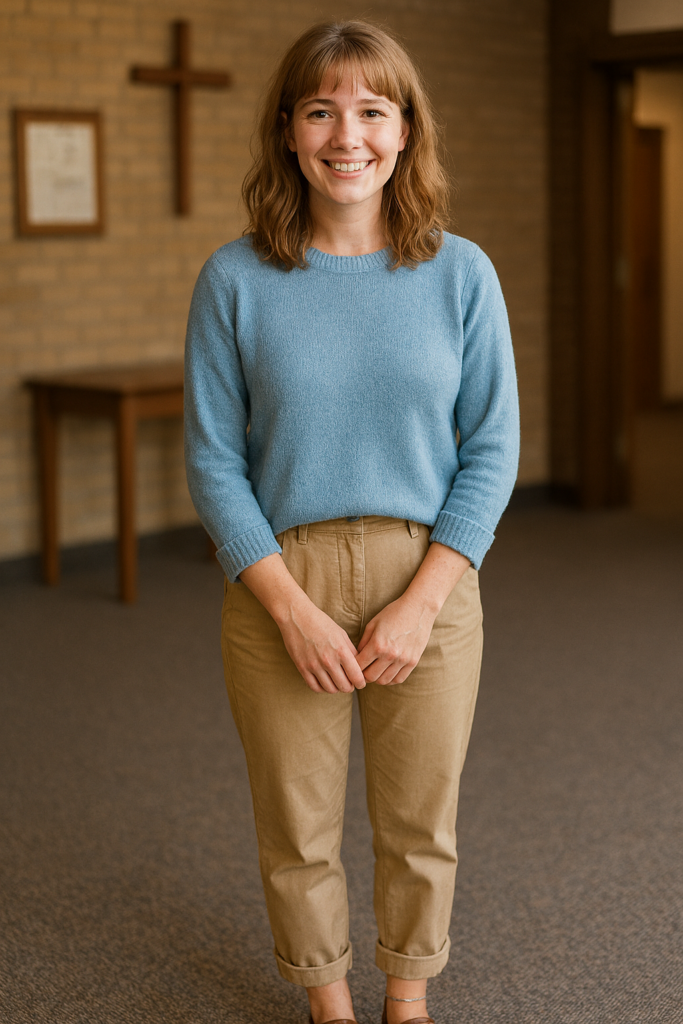
Stacy Hendrickson, the nurse from Essentia Health-Sandstone who helped deliver Ethan and Marnie’s daughter Emily, is engaged to Pine City choir director Mark Dawson after meeting him at Mark’s church, Pine City Evangelical Free Church.
Marnie gasped, her hand flying to her mouth. “Emily’s nurse? Stacy from Essentia?”
Mark nodded, still flushed. “Yeah. We’ve been dating since summer. She moved to Pine City, started coming to my church, and… well. Things just clicked.”
Marnie’s face lit up, her smile warm and immediate. “She was wonderful. So calm. So kind. Oh, Mark, that’s perfect.”
Lily’s smile softened, genuine and full of quiet affection. “I’m really happy for you.”
Mark met her eyes, relief and gratitude flickering there. “Thanks, Lily. That means a lot.”
Principal Danielle Savoy leaned forward, elbows on the table. “So when’s the big day?”
“July,” Mark said. “We wanted something simple. Outdoors. Maybe at her parents’ place in Sandstone.”
Peter perked up. “Do we get to come?”
Mark laughed. “Of course you do.”
“Good. I give excellent wedding toasts.”
Nicole snorted. “No, you give long wedding toasts.”
“Long is a form of excellence,” Peter declared.
The table groaned collectively.
Mark shook his head, still grinning, then turned back to Lily. “And I heard you’ve got some news too.”
Lily blushed, just faintly. “Oh. Yeah. I moved in with Shane over break.”
Mark’s smile widened. “That’s great. He’s a good guy.”
“He really is,” Lily said, and the warmth in her voice made Ethan glance over with a knowing grin.
“Shane’s the kind of guy who’d shovel your driveway before you even wake up,” Ethan said.
Marnie nodded. “He did that for us once.”
“He did it because you were nine months pregnant,” Ethan reminded her.
“And?” Marnie replied, deadpan.
The room burst into laughter again.
Mark leaned back in his chair, looking around at the group — his colleagues, his friends, the people who had seen him through breakups, concerts, late‑night grading sessions, and now this. “I’m just… really happy. And I wanted to share it with all of you.”
Danielle raised her water bottle. “To love in the new year.”
Peter lifted his coffee cup. “To weddings and moving in and whatever Ethan spilled on his tie.”
Ethan looked down and groaned. “Oh come on. Again?”
Without looking up from her lunch, Marnie handed him a napkin. “You’re hopeless.”
“You married me,” Ethan said.
“Don’t remind me.”
But she was smiling.
Lily glanced at Mark, who was still glowing. He caught her eye and gave a small, grateful nod — a quiet acknowledgment of their past, their friendship, and the fact that both of them were stepping into something new and good.
For a moment, the teacher’s lounge felt warm in a way that had nothing to do with the radiator. Love was in the air — messy, funny, unexpected, and exactly right.
Thurston Farmhouse — A January Evening
Snow tapped softly against the windows of the old farmhouse, a steady winter rhythm that wrapped the place in a cocoon of quiet. The wood stove crackled in the corner, sending gentle heat through the living room and casting a warm glow across the rug where Emily Thurston sat cross‑legged, her curls bouncing as she arranged her stuffed animals in a perfect semicircle.
“Okay, class,” she announced in her tiny, serious voice. “Eyes on me.”
From the couch, Ethan peeked over the backrest, trying not to laugh. Marnie sat beside Emily on the rug, her posture patient and amused — the look of a mother who had seen this game a hundred times and loved it every single time.
Ethan leaned closer, whispering, “She’s you.”
“She is not,” Marnie whispered back.
“She literally just said ‘eyes on me.’ That’s your line.”
Marnie attempted a glare, but her smile betrayed her.
Emily picked up a picture book — upside down, though she didn’t seem to notice — and began “reading” to her class of plush students. Her voice rose and fell with dramatic flair, and she paused occasionally to scold the stuffed rabbit for “not paying attention.”
Ethan leaned back, draping his arm around Marnie’s shoulders. “She’s gonna run the world someday.”
“She’s three,” Marnie said.
“Exactly.”
Marnie laughed softly and rested her head against his shoulder. The warmth of the moment settled around them like another blanket — the crackling stove, the soft snow outside, their daughter’s earnest little voice giving instructions to a semicircle of stuffed animals.
It was the kind of evening that made the whole farmhouse feel like its own small universe, safe and bright against the January cold.
Emily Thurston plays “school” with her stuffed animals as Marnie looks on.After a quiet beat, Ethan spoke, his voice low so as not to interrupt Emily’s “lesson.” “I still can’t believe Mark’s getting married.”
Marnie’s smile widened. “To Stacy. I mean… that’s perfect. She was amazing when Emily was born.”
Her voice softened with memory — the delivery room, the fear, the relief, the way Stacy Hendrickson had spoken gently to her through every contraction, grounding her with calm professionalism and genuine care.
“She was such a calming presence,” Marnie said. “And she really cared. You could tell.”
“And she laughed at my jokes,” Ethan added.
Marnie gave him a look, the room’s warm light catching the dry humor in her eyes. “She was medicated on adrenaline and newborn joy. Don’t flatter yourself.”
Ethan grinned, unbothered. “I’m just saying — Mark picked well.”
“He really did,” Marnie agreed. “She’s grounded. Kind. And she’ll understand his heart.”
They watched Emily for a moment as she held up a crayon and declared it “today’s spelling word,” her tiny brow furrowed with the seriousness of a seasoned educator.
“You know who else is growing up fast?” Ethan murmured.
Marnie sighed, a mix of pride and ache threading through her voice. “I know. She’s reading, Ethan. Actually reading. I didn’t start reading until kindergarten.”
“She’s got your brain,” Ethan said.
“And your stubbornness.”
Emily turned around suddenly, hands on her hips. “Mommy, Daddy, no talking in class.”
Ethan slapped a hand over his mouth in exaggerated horror. Marnie bit her lip to keep from laughing. “Sorry, Miss Emily,” she said.
Emily nodded, satisfied, and returned to her lesson.
Ethan lowered his voice again. “She’s gonna be a teacher, you know.”
“Maybe,” Marnie said. “Or a scientist. Or a writer. Or a—”
“—comedian,” Ethan finished. “She’s got my timing.”
“She has your chaos.”
He kissed her temple. “And your heart.”
Marnie’s eyes softened. She watched Emily carefully line up her stuffed animals again, her tiny brow furrowed in concentration, her curls bouncing with each decisive movement.
“I just… I want to do right by her,” Marnie whispered. “I want her to feel supported. Seen. Loved.”
“She does,” Ethan said. “Every day.”
“I hope so.”
“I know so.”
He squeezed her shoulder gently. “And she’s got a whole village. Lily. Allison. Maya. Sophie. Rachel. Mark Dawson. Even Peter Bouchard, God help us.”
Marnie snorted. “Peter’s going to teach her sarcasm.”
“Good. Someone should.”
They fell into a comfortable silence, watching their daughter “teach” her class with all the seriousness in the world.
After a moment, Marnie whispered, “She’s growing so fast.”
Ethan nodded, his voice soft. “Yeah. But we get to grow with her.”
Marnie leaned into him, letting the truth of that settle.
Emily turned again, hands on her hips. “Daddy, you’re still talking.”
Ethan raised both hands in surrender. “Sorry, Miss Emily. I’ll be quiet.”
Emily nodded firmly and resumed her lesson.
Marnie laughed quietly, her heart full. “She really is us.”
“The best parts,” Ethan said.
They sat together on the couch, the farmhouse warm around them, their daughter teaching her stuffed animals with fierce determination — and for a moment, everything felt exactly right.
Pine City High — After School
The hallways of Pine City High were nearly silent, the last students long gone and the winter sun already slipping toward the horizon. The building held that familiar after‑hours stillness — lockers shut, lights dimmed, the heating system humming in the background. In Room 208, Marnie stacked papers into a neat pile. Lily appeared in the doorway, keys dangling from her fingers, coat draped over one arm.
“You headed out?” Marnie asked.
Lily nodded. “Yeah. I’m… turning in my apartment keys tonight.”
Marnie looked up, her expression softening. “Big moment.”
Lily let out a breath that was half laugh, half sigh. “Bigger than I expected.”
Marnie gestured toward the reading nook by the window. “Sit with me.”
Lily crossed the room and sank into the chair, setting her keys on the small table. They glinted in the fading light — the last physical tie to a decade of her life.
“How are you feeling?” Marnie asked.
“Good. Really good. Just… reflective.” Lily traced the edge of the keyring. “That apartment was my first real home. I grew up there.”
“You did,” Marnie said gently. “I watched it happen.”
Lily smiled at that — small, grateful. “And now I’m closing the door for the last time.”
“And opening a new one.”
Lily nodded, her eyes softening. “Shane makes it easy. Being with him feels right. Like we’re building something that fits both of us.”
“He loves you,” Marnie said. “That’s obvious.”
“And I love him. More than I’ve ever loved anyone.”
Marnie’s smile warmed. “I’m really happy for you.”
Lily hesitated. “It’s not the life my parents pictured for me.”
“It’s the life you pictured for you,” Marnie said. “That matters more.”
Emotion flickered across Lily’s face. “Sometimes I wish they could be happy for me. Or even just… present.”
Marnie reached over and squeezed her hand. “You deserve people who show up. Shane does. We do. That’s your family.”
Lily blinked hard, then shifted the conversation. “And speaking of family… Emily is getting so big. I can’t believe she’s three.”
Marnie laughed softly. “She corrected Ethan’s pronunciation of ‘hippopotamus’ yesterday. He’s still recovering.”
“She’s going to run your house by kindergarten,” Lily said.
“She already does.”
They shared a quiet laugh.
Then Lily’s expression softened again. “I love being Aunt Lily. But… I still don’t want kids of my own. And I hope that’s okay.”
“Of course it’s okay,” Marnie said immediately. “You don’t owe anyone a certain kind of life. You get to choose what fits you.”
Relief washed over Lily’s face. “Thank you. I needed that.”
“You’ve always known who you are,” Marnie said. “Even when you didn’t feel like you did.”
Lily smiled shyly. “And you’ve always helped me figure it out.”
“That’s what friends do,” Marnie said. “Especially friends who’ve known each other since one of them was a dramatic sixteen‑year‑old quoting Emily Dickinson in my classroom.”
Lily groaned. “Oh no. Don’t bring that up.”
“I will bring it up forever.”
They laughed again — the kind of laugh built from years of shared history.
Outside, the sky deepened to a dusky blue. The building felt suspended between endings and beginnings.
Lily picked up her keys, turning them over once more. “I’m ready. Really ready.”
“I know you are,” Marnie said.
Lily stood, slipped on her coat, then crossed the small space between them and wrapped Marnie in a tight, grateful hug. Marnie hugged her back just as firmly — holding every version of Lily she’d ever known.
When they stepped apart, Lily’s smile was soft and certain. “Thanks for this. For… everything.”
“Anytime,” Marnie said. “Go turn in those keys. And then go home to Shane.”
“I will.”
Her footsteps echoed down the quiet hallway — walking out of one chapter and into the next, steady and sure.
Marnie watched her go, heart full.
Something Tastes Off
The farmhouse kitchen was warm with the smell of toast. Ethan stood at the counter pouring coffee into two mugs, humming off‑key to whatever country song had lodged itself in his head.
Marnie sat at the table, hair still damp from her shower, flipping through her lesson plans. Emily sat in her booster seat, swinging her legs and eating Cheerios one at a time with intense concentration.
Ethan set a mug in front of Marnie. “Extra cream, just how you like it.”
She smiled, took a sip — and immediately made a face.
“Did you… change the coffee?” she asked.
Ethan blinked. “No? Same beans. Same pot. Same everything.”
She tried another sip, slower this time. The taste hit her wrong again — too bitter, too strong, too something she couldn’t name.
“Huh. It just tastes… off.”
“Maybe the cream’s bad?”
“No, it’s not that.”
She pushed the mug away, puzzled. She wasn’t sick. She wasn’t tired. She just… didn’t want coffee. Which was unheard of.
Emily looked up from her Cheerios, studying her mother with that unnervingly perceptive gaze she’d had since she was a baby. “Mommy tummy hurt?”
“No, sweetie. Just… weird coffee.”
Emily nodded solemnly, as if filing the information away for later.
Emily’s Uncanny Observation
After school, the three of them curled up in the living room. Emily was “reading” a picture book to her stuffed animals, and Marnie sat on the couch rubbing her temples. A dull headache had been lingering all day.
Emily toddled over and climbed into her lap, patting her cheek. “Mommy tired?”
“A little,” Marnie admitted.
Emily tilted her head, studying her mother with the same serious expression she used when deciding which stuffed animal was in trouble during “school.” Then she placed her small hand on Marnie’s stomach.
“Baby in there?”
Marnie froze.
Ethan, sitting on the floor sorting laundry, looked up sharply. “Whoa. Where’d that come from?”
Emily shrugged, as if this were the most obvious thing in the world. “Baby.”
Marnie laughed it off, brushing a curl from Emily’s forehead. “No baby, sweetheart.”
But the comment lodged itself in her mind like a pebble dropped into deep water — small, quiet, and impossible to ignore.
The Calendar Check
The farmhouse was quiet after Emily fell asleep, the only sound the steady ticking of the old wall clock in the hallway. In the bathroom, Marnie stood brushing her teeth, catching her reflection in the mirror — tired, yes, but not sick. Not stressed. Just… off.
She reached for her planner on the counter and flipped to the monthly calendar. Her eyes landed on the date. She counted backward. Then forward. Then checked again. One day late.
Not three. Not enough to panic. But enough to make her heart skip. Enough to make Emily’s comment echo louder. Enough to make the strange‑tasting coffee click into place.
She closed the planner slowly, her breath catching.
“Oh,” she whispered.
The Quiet Confession
Ethan was in bed reading when she came in, the lamp casting a warm glow across the room. He looked up immediately.
“You okay? You’ve been quiet.”
Marnie sat on the edge of the bed, twisting her wedding ring. “I think something might be going on.”
Ethan set his book aside. “What kind of something?”
She took a breath. “I’m late.”
His eyebrows lifted. “Late late?”
“Just one day. But… the coffee tasted wrong this morning. And I’ve felt off all day. And Emily…” She swallowed. “Emily asked if there was a baby in my tummy.”
Ethan blinked, then let out a soft, incredulous laugh. “Of course she did. That kid knows everything.”
Marnie’s voice dropped to barely above a whisper. “I think I might be pregnant.”
Ethan reached for her hand, threading his fingers through hers. “Do you want to take a test?”
She nodded. “Tomorrow morning. First thing.”
He squeezed her hand gently. “Okay. We’ll do it together.”
She leaned into him, letting his steadiness anchor her. “I wasn’t expecting this.”
“Me neither,” he said softly. “But… if it’s true…” His smile warmed. “We’ll be okay. More than okay.”
Marnie rested her head on his shoulder, her heart full of nerves and hope and something she couldn’t quite name yet. “I know.”
Outside, the January wind whispered against the farmhouse windows, quiet but full of possibility.
Early Morning — The Test
The farmhouse was still dark when Marnie slipped out of bed. January cold pressed against the windows, and the floorboards creaked softly under her feet. Ethan stirred but didn’t wake.
She moved quietly down the hallway, careful not to wake Emily, and stepped into the bathroom. The overhead light was harsh in the early morning, but she needed it. Her hands trembled slightly as she reached into the cabinet for the test.
She’d done this before. But somehow, this felt different.
She took the test, set it on the counter, and exhaled slowly. Two minutes. The longest two minutes in the world.
A soft knock sounded on the door.
“Marn? You okay?” Ethan’s voice was sleepy, gentle.
She opened the door, and he stepped inside, hair tousled, eyes heavy with sleep. He didn’t say anything else — just wrapped his arms around her from behind, resting his chin on her shoulder.
“Timer going?” he murmured.
She nodded. “Yeah.”
They stood like that, watching the little white stick on the counter as if it were a live wire.
A minute passed. Then another.
Marnie’s breath hitched. “I wasn’t expecting this. Not at my age. Not now.”
Ethan squeezed her gently. “I know.”
She swallowed, her voice barely above a whisper. “When I realized I was late last night… a line from a psalm popped into my head. Something I haven’t thought about in years.”
Ethan tilted his head. “Which one?”
“‘Children are a blessing.’” She let out a shaky breath. “It just… came back to me. Like a memory. Like something I needed to hear.”
Ethan didn’t answer right away. He just held her a little closer. “Well… whatever happens… we’ll take it as it comes. Together.”
The timer beeped.
Marnie froze. Ethan reached out, his hand steady even though his heart was pounding. He turned the test over.
Two lines.
Positive.
Marnie covered her mouth, tears springing to her eyes — not from fear, not from shock, but from the overwhelming rush of oh.
Ethan let out a soft, stunned laugh. “Well… looks like Emily knew before we did.”
Marnie laughed through her tears, leaning into him. “She really did.”
Ethan cupped her face gently. “You okay?”
She nodded, emotion thick in her voice. “I think so. I think… I’m happy. Scared. But happy.”
He kissed her forehead. “Me too.”
She looked down at the test again, her hand resting instinctively on her stomach. “I didn’t expect this blessing.”
Ethan wrapped his arms around her again, holding her close in the quiet morning light. “Sometimes the best ones are the unexpected ones.”
Outside, the first hint of sunrise touched the snow‑covered fields — soft, pale, full of promise.
And in the small bathroom of the old farmhouse, Marnie and Ethan stood together, letting the reality settle in:
Their family was growing.
After School — Marnie Tells Lily
The end‑of‑day halls at Pine City High were thinning out, students drifting toward buses and cars as the winter light faded. In Room 210, Lily was packing up when a soft knock sounded on her doorframe. Marnie stood there, her coat draped over her arm, her eyes bright in a way that wasn’t her usual after‑school tired.
“You okay?” Lily asked. “You look… different.”
Marnie stepped inside and closed the door behind her. She didn’t sit. She just stood for a moment, hands twisting together.
“I took a test this morning.”
Lily froze, her expression shifting instantly. “A test? Lily blinked once. Twice. Then her eyes widened. “Oh.”
Marnie nodded, tears gathering but not falling. “It was positive.”
Lily’s hand flew to her mouth. In three quick steps she crossed the room and wrapped Marnie in a fierce hug.
“Oh my gosh. Marnie. Oh my gosh.”
Marnie held on tightly, sinking into the comfort of someone who had known her since she was sixteen. “I wasn’t expecting this. Not at forty‑one. But… I think I’m happy. Scared, but happy.”
Lily pulled back just enough to see her face. “You’re going to be amazing. Again. And Ethan is going to lose his mind in the best way.”
Marnie laughed, wiping her eyes. “He already did. Emily too. She… actually guessed before we did.”
“Of course she did,” Lily said. “That child is terrifyingly perceptive.”
The tension eased into soft laughter.
“Do you want to tell the Squad?” Lily asked.
A mischievous smile tugged at Marnie’s mouth. “Oh, I’m absolutely pulling the fire alarm.”
Sparkle Squad Fire Alarm FaceTime
Lily and Marnie sat side‑by‑side at Lily’s desk, the phone propped up against a stack of graded essays. Marnie hit the group FaceTime button – not one of the red Edwards fire alarm pull stations out in the hallway that says “LOCAL FIRE ALARM PULL IN CASE OF FIRE” on the handle.
It rang once.
Twice.
And then—
Allison: “WHAT DID YOU DO?!” She was breathless, hair in a messy bun, clearly having sprinted for her phone.
Maya: “I swear if this is about a new nose ring I’m going to—oh. Hi.” She looked suspiciously put‑together for a weeknight.
Sophie: “I’m in the middle of making dinner but I dropped everything, so this better be good.”
Rachel: “I’m in the parking lot at Target. I left my cart. What’s happening?”
Marnie tried to keep a straight face. She failed.
Marnie: “Okay. So. I have news.”
Allison leaned so close to the camera that only one eye was visible.
Allison: “Are you pregnant?”
Marnie blinked.
Marnie: “…Yes.”
The screen erupted.
Maya: “WHAT?!” Sophie: “OH MY GOSH!” Rachel: “ARE YOU SERIOUS?!” Allison: “I KNEW IT! I KNEW IT! I FELT IT IN MY BONES!”
Marnie laughed, overwhelmed and delighted.
Marnie: “Yes, I’m serious. I took a test this morning. It’s positive.”
Sophie: “How far along?”
Marnie: “No idea yet. I’ll see Dr. Klein soon.”
Maya: “Emily must be thrilled.”
Marnie: “She… actually figured it out before we did.”
Rachel: “That tracks. That child is a prodigy.”
Allison: “Oh my gosh, Marnie, this is amazing. I’m so happy for you.”
Lily leaned into the frame, smiling.
Lily: “She told me first. I got the pre‑alarm scoop.”
Maya: “Of course you did. You’re the emotional support human.”
Lily: “I’ll take that.”
The Squad kept talking over each other — baby name jokes, predictions, squeals, and at least one suggestion from Sophie that they start planning a baby shower immediately.
Marnie pressed a hand to her heart, overwhelmed in the best way.
Marnie: “I love you all. Thank you.”
Allison: “We love you too. And we love Baby Thurston already.”
Rachel: “Keep us updated. Every step.”
Maya: “And tell Ethan congratulations from us.”
Sophie: “And Emily. The real mastermind.”
They all laughed.
The call ended with a chorus of goodbyes, blown kisses, and Allison shouting, “I’M MAKING A SPREADSHEET!” before the screen went dark.
Marnie set the phone down, exhaling.
Lily nudged her shoulder.
Lily: “You’re surrounded, you know.”
Marnie: “I know.”
And she did — by love, by friendship, by a community that held her through every season.
And now, by the tiny new life growing quietly inside her.
Pine City Women’s Health — Familiar Surroundings
The waiting room was quiet in that early‑morning clinic way — soft music drifting from hidden speakers, the hum of the heater working against the January cold, a few expectant parents flipping through outdated magazines. Ethan sat beside Marnie, his knee bouncing, his hand wrapped around hers.
“You okay?” he asked.
“Nervous. Excited. Mostly nervous.”
“Me too.”
He squeezed her hand, and she leaned into him. They had done this before — but somehow, this felt new. Unexpected. Fragile and miraculous all at once.
A nurse opened the door. “Marnie Thurston?”
They followed her down the hallway to a familiar exam room — the same one where they had first seen Emily’s heartbeat flicker on the screen. Marnie’s breath caught at the memory, warm and sharp all at once.
A moment later, Dr. Jessica Klein stepped inside, her warm smile and calm presence exactly as they remembered.
“Well, well,” she said, her voice gentle. “The Thurstons. It’s good to see you both again.”
Marnie returned the smile, her nerves easing just a little. “You too.”

Dr. Jessica Klein makes notes in Marnie Thurston’s chart at her OB-GYN appointment.Dr. Klein’s warm smile deepened as she settled onto her stool. “I hear we might have some exciting news?”
Marnie nodded, her voice soft. “Positive test yesterday.”
“Wonderful. Let’s take a look and see how things are progressing.”
She dimmed the lights and prepared the ultrasound machine. Ethan moved closer, resting a steady hand on Marnie’s shoulder. The gel was cold against her skin. The room fell quiet as the monitor flickered to life.
Dr. Klein’s expression shifted — not alarmed, but surprised.
“Well now… this is unexpected.”
Marnie’s heart jumped. “What? What is it?”
Dr. Klein turned the screen slightly toward them. “Two.”
Ethan blinked. “Two… what?”
“Two babies,” she said gently. “You’re having twins.”
Silence.
Then—
“TWINS?!” Ethan’s voice boomed through the small room, and Dr. Klein laughed.
Marnie stared at the screen, tears filling her eyes as two tiny flickers pulsed steadily. “Oh my gosh… oh my gosh…”
Ethan grabbed her hand, his own eyes shining. “Marnie… we’re having two.”
“I’m forty‑one,” she whispered.
“And healthy,” Dr. Klein said. “And these little ones look perfect.”
Marnie let out a shaky laugh, covering her mouth. “I wasn’t expecting this blessing.”
Ethan kissed her forehead. “Best surprise of my life.”
They watched the screen in awe — two tiny heartbeats, two tiny beginnings, two new lives they never imagined.
Dr. Klein tapped a few notes into the chart, then swiveled toward them with her calm, steady smile. “Okay,” she said, “let’s talk timing.”
Marnie squeezed Ethan’s hand. “We weren’t sure how far along I might be.”
“That’s what today helps us figure out.” Dr. Klein turned the monitor slightly so they could see the frozen ultrasound image — two unmistakable shapes. “Based on the measurements, both babies are right on track.”
Ethan still hadn’t stopped smiling. “Both,” he repeated softly, as if the word itself were a blessing.
“Now,” Dr. Klein continued, “for dating the pregnancy… your last menstrual period was January 11, correct?”
“Yes,” Marnie said.
“That gives us an estimated due date of…” She pressed one final key. “October 18.”
Marnie let out a breath she didn’t realize she’d been holding. “October.”
“That’s the official due date,” Dr. Klein said. “With twins, we often see deliveries a little earlier — sometimes around thirty‑seven or thirty‑eight weeks — but we’ll take it one step at a time.”
Ethan nodded, still holding Marnie’s hand like it was the only thing tethering him to the earth. “October 18,” he said softly. “We can work with that.”
“It’s a good date,” Dr. Klein said. “And everything looks healthy so far. You’re doing beautifully.”
Relief, joy, and disbelief braided together in Marnie’s chest. “Thank you,” she whispered.
“Of course.” Dr. Klein’s voice was gentle. “Now let’s talk about what the next few months will look like.”
Ethan leaned closer to Marnie, their shoulders touching, both of them staring at the screen where two tiny lives had just rewritten their future.
The Drive Home — Old US‑61
The car was quiet as they followed the long stretch of Old US‑61, snow drifting lazily across the open fields. The sky hung low, pale and wintry, the kind of morning that made everything feel suspended.
“Twins,” Ethan said at last.
“I know.”
“Two babies.”
“I know.”
“We’re gonna need a bigger car.”
Marnie laughed, wiping her eyes. “And a bigger coffee maker.”
“And maybe a bigger house.”
“Don’t you dare.”
Their laughter softened the shock, melting it slowly into joy. Marnie watched the landscape blur past, her mind still lingering in Dr. Klein’s office — the calm voice, the steady smile, the words she kept replaying:
Estimated due date: October 18. She whispered it under her breath. “October 18.” Something tugged at her memory.
She hadn’t thought about that date in years. Not really. Not in a way that reached her bones.
Her hand drifted to her nose, brushing the tiny silver stud she’d worn for so long it felt like part of her skin. The metal was cool under her fingertip, familiar. And suddenly, without warning, a memory rose — not loud, not sharp, just a soft ripple from another lifetime.
“I finally said yes. I got my nose pierced. The stud is silver, simple, but it feels like a declaration… Tonight, I feel different. Not louder, not wilder — just more myself.” — Marnie’s Journal, October 18, age 25
The words flickered through her like a lantern being lit.
She blinked, the present settling back around her. Ethan glanced over, catching the shift in her breathing, and reached for her hand without asking anything. His thumb brushed her knuckles, steady and warm.
Marnie looked out the window at the winter fields, bare and waiting.
She had been brave before. Quietly, instinctively, in ways no one else ever fully saw.
And now — this new season, this unexpected yes growing inside her — felt like another small, glinting declaration. Not louder. Not wilder. Just more herself, again.
She closed her fingers around Ethan’s and let the moment settle.
Some things come full circle whether you plan them or not.
Telling Emily
That evening, the farmhouse glowed with warm lamplight. Emily sat at the kitchen table coloring, her curls bouncing as she hummed to herself, completely absorbed in her masterpiece.
Marnie knelt beside her. “Sweetie? Mommy and Daddy have something to tell you.”
Emily looked up, eyes wide and curious. “’Bout the baby?”
Marnie and Ethan exchanged a look — the kind that said of course she already knows.
“Yeah,” Ethan said gently. “About the baby.”
Marnie took a breath. “There isn’t just one baby.”
Emily blinked. “Two babies?”
“Two babies,” Ethan confirmed.
Emily gasped — a dramatic, full‑body gasp — then clapped her hands with explosive joy. “I get TWO babies?!”
Marnie laughed, tears gathering in her eyes. “Yes, sweetheart. You get two babies.”
Emily hopped off her chair and ran in a delighted circle around the kitchen. “I’m a BIG sister! I’m a BIG sister TWO TIMES!”
She stopped suddenly, her expression turning very serious. “I need more stuffed animals.”
Ethan burst out laughing. “We can arrange that.”
Emily ran back to Marnie and threw her arms around her neck. “I love the babies already.”
Marnie held her tight, overwhelmed by the sweetness of it all. “They love you too.”
Emily pulled back and patted Marnie’s stomach with great authority. “Hi babies. I’m your big sister. I’m in charge.”
Ethan groaned. “Oh no.”
Marnie laughed through her tears. “We’re in trouble.”
Emily nodded solemnly. “Yes. Big trouble.”
And the three of them stood there in the warm farmhouse kitchen — a family of three becoming five — wrapped in joy, surprise, and the promise of everything to come.
Evening Call — Marnie and Her Mom
The farmhouse was quiet after dinner, the twins’ ultrasound photo still sitting on the kitchen table like a tiny miracle. Upstairs, Ethan was giving Emily a bath, her giggles echoing faintly through the floorboards.
Marnie stepped into the living room, phone in hand, and sank onto the couch. She hesitated — not out of fear, but because of the enormity of what she was about to say. Then she tapped her mother’s name.
The phone rang twice.
“Well hello, sweetheart,” Lori Gordon said, warm as ever. “Everything okay?”
“Yeah,” Marnie said softly. “Everything’s okay. I just… wanted to talk.”
“You sound like you’ve got something on your mind.”
Marnie let out a slow breath. “I had my first prenatal appointment today.”
There was a beat of silence — not shocked, just processing. “Oh, honey. You’re pregnant?”
“I am.”
Lori’s voice softened instantly. “Oh, sweetheart… congratulations. I’m so happy for you.”
Emotion rose in Marnie’s throat. “Thanks, Mom. I wasn’t expecting it. Not at forty‑one.”
“Life has a way of surprising us,” Lori said gently. “Sometimes in the best ways.”
Marnie laughed quietly. “Yeah. About that.”
“What is it?”
“It’s not just one baby.”
Another pause — longer this time. “…What do you mean?”
“Mom… it’s twins.”
Lori gasped — a soft, breathy sound full of wonder. “Oh my goodness. Twins? Are you serious?”
“I saw both heartbeats today.”
Lori’s voice wavered, thick with emotion. “Oh, Marnie. Oh, sweetheart. That’s… that’s incredible.”
Tears pricked Marnie’s eyes. “I know. I’m still trying to wrap my head around it.”
“How are you feeling?”
“Honestly? A little overwhelmed. A little scared. But… happy. Really happy.”
Lori’s tone shifted into the gentle reassurance she’d given Marnie her whole life. “You’re going to do beautifully. You and Ethan both. And Emily will be the best big sister.”
Marnie laughed softly. “She already thinks she’s in charge.”
“She gets that from you.”
“Mom.”
“Well, it’s true.”
They both laughed, the tension easing.
After a moment, Lori’s voice softened again. “You know… when you were born, I remember thinking, ‘This child is a blessing.’ And when Emily came along, I thought the same thing. And now… two more blessings. Unexpected, maybe. But no less precious.”
Marnie closed her eyes, letting the words settle. “I needed to hear that.”
“I know you did.”
A long, comfortable silence followed — the kind that only exists between a mother and daughter who have weathered decades together.
“You call me anytime, okay?” Lori said. “I want to hear everything. Every appointment. Every update.”
“I will. I promise.”
“And give Ethan and Emily a hug from me.”
“I will.”
“I love you, sweetheart.”
“I love you too, Mom.”
They hung up, and Marnie sat for a moment with the phone resting in her lap, her heart full.
Upstairs, Emily squealed with laughter as Ethan pretended to be a sea monster in the bathtub.
Marnie smiled.
Her family was growing — in ways she never expected, but in ways that felt exactly right.
Sparkle Squad FaceTime — Twin Edition
Marnie sat on the couch with Ethan beside her, the ultrasound photo in her hand. Emily was upstairs “reading” to her stuffed animals, blissfully unaware that her parents were about to unleash a storm of joyful chaos.
Marnie opened the group chat and typed two words:
“Fire alarm.”
Within seconds, her phone exploded with incoming calls.
She accepted.
The screen filled with faces in various states of disarray:
• Allison — hair in a messy bun, breathless, clearly having sprinted
• Maya — holding a mug of tea, eyes wide
• Sophie — wearing an apron, wooden spoon in hand
• Rachel — sitting in her car, Target bags in the backseat
• Lily — already grinning because she knew what was coming
Allison: “WHAT DID YOU DO NOW?!”
Maya: “Is it the baby? Is everything okay?”
Sophie: “I dropped my pasta for this!”
Rachel: “I abandoned a full cart again!”
Lily: “Everyone breathe. It’s good news.”
All eyes snapped to Marnie.
She held up the ultrasound photo.
Marnie: “So… we had our first appointment today.”
Allison: “AND?!”
Marnie took a breath.
Marnie: “It’s twins.”
Silence.
Absolute, stunned silence.
Then—
Allison: “AAAAAAAAAAAAAAAAAAAAAAAHHHHHHHHHHHHHHHHHHHHH!”
Maya: “WHAT?!”
Sophie: “TWINS?!”
Rachel: “YOU’RE HAVING TWO?!”
Lily: “I told you all to sit down.”
Allison was crying and laughing at the same time.
Allison: “MARNIE THURSTON, YOU ARE HAVING TWINS?!”
Marnie: “Yes! Yes, I am!”
Sophie: “Oh my gosh, oh my gosh, oh my gosh—Ethan, are you okay?!”
Ethan leaned into the frame, dazed but smiling.
Ethan: “I’m… processing.”
Rachel: “You look like you got hit by a snowplow.”
Ethan: “That’s accurate.”
Maya: “TWINS. Marnie, this is incredible!”
Sophie: “I’m planning the shower already.”
Allison: “I’m making a spreadsheet!”
Rachel: “I’m buying matching outfits!”
Maya: “I’m buying noise‑canceling headphones for Ethan!”
Ethan groaned.
Ethan: “Thank you. I’ll need them.”
Lily: “And Emily is thrilled. She thinks she’s in charge.”
Allison: “Oh no.”
Rachel: “Oh yes.”
Sophie: “That child is going to run that house.”
Maya: “She already does.”
Marnie wiped her eyes, overwhelmed by the love pouring through the screen.
Marnie: “I wasn’t expecting this. But… I’m really happy. We both are.”
Allison: “We’re happy for you. So, so happy.”
Rachel: “You’re going to be amazing.”
Sophie: “And exhausted.”
Maya: “But amazing.”
Lily: “And we’re here for all of it.”
Marnie pressed a hand to her heart.
Marnie: “I love you all.”
Allison: “We love you too. And we love those babies already!”
The call dissolved into overlapping chatter — name ideas, nursery themes, jokes about Ethan needing a second job, and Sophie insisting she was crocheting two baby blankets immediately.
Marnie leaned into Ethan, smiling through tears.
Her village was loud. Her village was chaotic. Her village was perfect.
And those twins were already so loved.
Chapter 11: At Last
Northern Great Lakes Visitor Center — Early Evening, April
The parking lot still held the warmth of the late‑afternoon sun when Sophie stepped out of her car, tucking her hands into the pockets of her fleece jacket. The air smelled like thawing earth and pine needles — that particular Chequamegon Bay scent that always made her feel like she was exactly where she belonged. Inside, the Visitor Center hummed with quiet conversation. Retirees in hiking vests, college students with notebooks, a few local activists she recognized from watershed meetings. Sophie slipped into a seat near the middle — close enough to see the slides, far enough back to observe the room.
The moderator introduced the evening’s speaker.
Elias Thorsen“Please welcome Elias Thorsen, freelance environmental writer and policy analyst based in Bayfield.”
Sophie had heard the name before — a byline in Great Lakes Now, a thoughtful op‑ed about tribal water rights. But the man who stepped up to the podium wasn’t quite what she expected. Tall, with a calm presence and a voice that carried without strain. Scandinavian features softened by a kind of quiet warmth. He didn’t perform the way some speakers did. He simply… spoke.
His slides weren’t flashy. His arguments were precise. And when he talked about Lake Superior, it wasn’t academic. It was reverent.
Sophie felt herself leaning forward.
He finished with a call for community‑level collaboration — tribes, municipalities, watershed councils, educators. “We protect what we understand,” he said. “And we understand what we take the time to see.”
The room exhaled into applause.
During the Q&A, Sophie hesitated for a moment, then raised her hand.
“Yes?” Elias nodded toward her.
She stood. “You mentioned the tension between local economic pressures and long‑term watershed health. In your research, have you seen models where community education — not just policy — shifted the balance? Especially in rural areas where people feel talked at instead of talked with?”
A few heads turned. It was a Sophie question — layered, precise, and aimed at the heart of the issue rather than the edges.
Elias paused, and something in his expression sharpened — interest, recognition.
“That’s a good question,” he said, and he meant it. “Yes. Actually, some of the strongest examples come from places where educators and scientists partnered with local residents to co‑create the data. When people gather the information themselves — when they’re part of the process — the conversation changes. It becomes shared stewardship instead of outside pressure.”
Sophie nodded, absorbing every word.
“And,” he added, “it only works when someone like you is in the room asking that question.”
A few people chuckled. Sophie felt her cheeks warm, but she didn’t look away.
After the lecture, she lingered near the exhibit on Ojibwe wild rice restoration, pretending to study a map while the crowd thinned. She wasn’t waiting for him. Not exactly. But she wasn’t rushing out either.
Elias approached with a paper cup of coffee in hand.
“I’m glad you asked that question,” he said. “Most people jump straight to policy. You went to the human part.”
Sophie smiled. “I’m a biology instructor. I spend a lot of time thinking about how people learn.”
“That explains it.” He shifted his weight, not awkward, just… present. “I’m Elias.”
“I know,” she said, then immediately regretted it. “I mean — you were introduced. I’m Sophie.”
His smile reached his eyes. “Nice to meet you, Sophie.”
They talked for a few minutes — about watershed education, about Lake Superior’s moods, about the strange joy of living in a place where the lake dictated the weather and sometimes the day’s plans. It wasn’t flirtation. It was something quieter, more grounded. Two minds meeting in the middle of something they both loved.
Eventually, people began stacking chairs. The spell of the evening shifted.
“Well,” Elias said, slipping his notebook into his bag, “I’m glad our paths crossed.”
“Me too.”
He gave a small nod — not a promise, not an ending. Just an acknowledgment that something had begun.
Sophie walked out into the cool evening air feeling unexpectedly light, as if the lake breeze had lifted something inside her.
She didn’t know if she’d see him again.
But she hoped she would.
And that hope felt good.
Maslowski Beach, Ashland — Community Clean‑Up Day
The wind off Chequamegon Bay carried that early‑spring bite — not winter anymore, but not quite warm either. Sophie tightened her grip on the trash bag as she walked along the shoreline, the sand soft and uneven beneath her boots. Volunteers dotted the beach in bright jackets, bending to pick up stray wrappers, tangled fishing line, and the occasional forgotten soda can.
She loved this kind of event. It wasn’t glamorous, but it felt honest. Hands in the dirt, eyes on the water, people doing something small and tangible for a place they loved.
She reached the artesian well and paused to take a sip from her water bottle, listening to the steady trickle of the spring. A few gulls circled overhead, their cries sharp against the quiet morning.
“Didn’t expect to see you here.”
Sophie turned — and there he was.
Elias stood a few feet away, gloves on, a half‑filled trash bag slung over his shoulder. His hair was wind‑tousled, and he looked exactly like someone who belonged on this shoreline.
Sophie smiled. “I could say the same about you.”
He returned the smile — small, warm, unmistakably pleased. “I try to make it to these when I can. Bayfield does their own next weekend, but I figured Ashland could use an extra pair of hands.”
“Always,” she said. “The lake gives us enough. Least we can do is pick up after ourselves.”
“That sounds like something you’d say,” he replied, amused.
She raised an eyebrow. “You’ve known me for five minutes.”
“Five minutes,” he said, “and one very good question at a lecture.”
Sophie felt a flutter she hadn’t expected. Not romantic, exactly — more like recognition. Like someone had seen her clearly and without effort.
They fell into step along the shoreline, picking up bits of debris as they talked.
He asked about her work at Northwood Tech. She asked about his writing and policy projects. They compared notes on watershed education, tribal partnerships, and the strange, stubborn beauty of Lake Superior.
The conversation was easy — not rushed, not performative. Just two people following the same current.
At one point, Sophie crouched to pick up a tangled mess of fishing line. Elias knelt beside her to help, their gloved hands brushing for a moment. Not enough to be a moment, but enough to notice.
When they stood again, he looked out over the bay. “You know,” he said, “I’m glad we both ended up at this stretch of beach.”
“Me too.”
There was a pause — not awkward, just full.
Elias shifted his trash bag to his other hand. “Would you… maybe want to continue this conversation sometime? Over coffee? Or a walk? Something less… trash‑bag‑adjacent?”
Sophie laughed softly. “I’d like that.”
He pulled his phone from his pocket. “Can I get your number?”
She gave it to him, and he typed it in carefully, as if it mattered. When she finished, he offered his in return, and she saved it under Elias — Lake Superior before she could overthink it.
He glanced at her screen and chuckled. “That’s fair.”
“Accurate,” she said.
They stood there for another moment, the lake wind tugging at their jackets, the artesian well bubbling steadily behind them.
“I’ll text you later,” he said. “Maybe we can find a time next week?”
“Sounds good.”
He gave her a small nod — the same one from the lecture, but warmer now, more certain — and headed down the beach to join another group of volunteers.
Sophie watched him go, feeling that quiet click again. Not fireworks. Not a rush. Just… right.
He gets it, she thought.
And for the first time in a long time, the possibility of something new felt not intimidating, but hopeful.
Text Thread: Elias & Sophie
Elias: Hi Sophie — this is Elias from the clean‑up this morning. I’m the one who heroically rescued the fishing line while you handled the actual work.
Sophie: Ha! I remember. And I think we both know you did at least half the untangling.
Elias: I’ll take the compliment. I really enjoyed talking with you today.
Sophie: Same here. It was… easy. In a good way.
Elias: Agreed. Would you want to meet up sometime this week? Maybe continue the conversation without trash bags involved.
Sophie: That sounds nice. Did you have a place in mind?
Elias: How do you feel about Black Cat Coffeehouse? Good coffee, good soup, and it’s quiet enough to actually talk.
Sophie: Black Cat is perfect. I’m usually free after 4 on weekdays.
Elias: Thursday at 4:30?
Sophie: Works for me. I’ll be the one with the notebook and the braid.
Elias: And I’ll be the one pretending I didn’t rehearse what to order. Looking forward to it.
Sophie: Me too.
Black Cat Coffeehouse — Thursday, 4:30 p.m.
The late‑afternoon sun slanted through the big front windows of Black Cat, catching dust motes in the air and giving the whole place a soft, amber glow. The smell of espresso and fresh bread wrapped around Sophie the moment she stepped inside. She spotted Elias almost immediately — seated at a small table near the back, a book open but clearly not being read.
He looked up, saw her braid, and smiled in a way that reached his eyes.
“Sophie. Hi.”
“Hi.” She slipped into the seat across from him, setting her notebook on the table. “Have you been waiting long?”
“Not at all. I got here early on purpose. I like the atmosphere.”
She laughed. “Same.”
They ordered coffee — he went with a dark roast, she chose a lavender latte — and once the mugs were on the table, the conversation began as naturally as breathing.
Northland College
It started with a passing comment about the environmental science books on the shelf behind them.
“You know,” Elias said, tracing the rim of his mug, “I still miss Northland. The whole community felt different when it was open.”
Sophie nodded, her expression softening. “It really did. There was this… energy. Students everywhere. Events. Lectures. You’d run into people who cared about the same things you did without even trying.”
“And now it’s quiet,” he said. “Too quiet.”
“It changed Ashland,” she agreed. “Not in a catastrophic way, but in a way you can feel. Like a missing note in a chord.”
He looked at her, surprised and pleased. “That’s exactly how I’d describe it.”

Elias Thorsen and Sophie Kowalski enjoy coffee, company, and conversation at Black Cat Coffeehouse in Ashland, Wis.
WPR’s “Central Time”
From there, the conversation drifted to Wisconsin Public Radio — a natural jump for two people who lived on a steady diet of local news and thoughtful commentary.
“I still can’t believe they ended Central Time,” Sophie said, shaking her head. “It was such a staple. I used to plan my late‑afternoon grading around it. A two-hour stretch that engaged me and helped me focus.”
“Same,” Elias said. “It was the perfect mix of statewide issues, quirky stories, and actual journalism. Nothing else has filled that gap.”
“It made Wisconsin feel connected,” she said. “Like we were all part of the same conversation.”
He smiled. “You’re good at putting things into words.”
She shrugged, a little shy. “I teach biology. I have to translate things.”
“Still,” he said, “you see the heart of things.”
UW–Madison Memories
They compared notes on Madison next — the campus, the city, the lake breeze that cut through winter like a knife.
“You were there for grad school, right?” he asked.
“Two years,” she said. “I lived near the Arboretum. Walked the trails whenever I needed to think.”
“I was on the east side,” he said. “Five years earlier than you. But I bet we walked some of the same paths.”
“Probably,” she said. “Maybe even passed each other without knowing.”
He chuckled. “I like that idea.”
“Me too.”
The Shift
Somewhere between the second cup of coffee and the shared laughter about the chaos of State Street on game days, something shifted. Not dramatically. Not suddenly. Just a quiet awareness settling between them.
Sophie noticed the way he listened — fully, without rushing her. Elias noticed the way she thought — layered, curious, unpretentious.
There was no pressure. No performance. Just two people discovering how naturally they fit.
At one point, Sophie tucked a loose strand of hair back into her braid, and Elias watched her with a softness he didn’t try to hide.
“This was really nice,” he said finally, when the sun dipped low enough to turn the windows gold.
“It was,” she agreed. “I’m glad we did this.”
“Would you… want to do it again?”
She didn’t hesitate. “Yes. I would.”
His smile was small but certain. “Good.”
They stood, gathering their things. Outside, the air was cool but not cold, the kind of evening that hinted at spring without promising it.
They walked to their cars together, steps unhurried.
“Goodnight, Sophie.”
“Goodnight, Elias.”
She drove home with the windows cracked just enough to let in the lake air, her heart steady and warm.
And he drove back to Bayfield thinking, This could be something.
Not fireworks. Not fate. Just two people choosing to see where this goes.
And that was more than enough.
Sparkle Squad FaceTime — Thursday Night
The familiar ding-ding-ding of an incoming group call lit up Sophie’s screen just as she curled onto her couch with a blanket and a mug of tea. She took a breath — not nervous, exactly, but aware that this was going to be A Moment.
She hit Join.
Immediately, the screen filled with faces.
Rachel — hair in a loose bun, baby bump very visible even through the camera angle. Rachel is now very pregnant, five days overdue.
Maya — still in her work clothes, leaning against her kitchen counter.
Allison — sprawled on her couch, Olive in her lap.
Lily — sitting cross‑legged on her bed, fairy lights glowing behind her.
Marnie — in her favorite oversized sweatshirt, twins doing gymnastics under her ribs.
Rachel: “There she is! Our mysterious Sophie, who has been very quiet today.”
Lily: “Suspiciously quiet.”
Maya: “Alarmingly quiet.”
Allison: “Quiet enough that I assumed you were grading lab reports.”
Sophie: (laughing) “Okay, okay. I deserve that.”
Rachel: “You do. Because you have that look.”
Sophie: “What look?”
Rachel: “The look you get when something happened and you’re trying to decide if you’re ready to tell us.”
Sophie felt her cheeks warm. “Well… something did happen.”
Five faces leaned closer to their screens.
Marnie: “Oh, this is going to be good.”
Sophie: “I… went on a date today.”
The reaction was instantaneous.
Lily: “WHAT.”
Allison: “A DATE?”
Maya: “With who?”
Rachel: (hands in the air) “Finally! I was starting to wonder if it would ever happen!”
Sophie burst out laughing — because Rachel’s tone was exactly right. Teasing, affectionate, celebratory. Not pressure. Not judgment. Just joy.
Sophie: “I know, I know. It’s been a while.”
Rachel: “A while? Sophie, the last time you went on a date, we were still using Snapchat filters unironically.”
Sophie: “Okay, rude but fair.”
Maya: “Details. Now.”
Sophie tucked a strand of hair behind her ear, still smiling. “His name is Elias. I met him at a watershed lecture at the Northern Great Lakes Visitor Center a couple weeks ago.”
Allison: “Of course you did. That is the most Sophie place to meet someone.”
Lily: “Was he cute?”
Sophie: “He was… thoughtful. And grounded. And he actually listened when I asked a question.”
Marnie: “That’s better than cute.”
Rachel: “Agreed. But also — was he cute?”
Sophie rolled her eyes, but she was glowing. “Yes. He’s cute.”
Lily: “Yessss.”
Maya: “So what happened today?”
Sophie: “We ran into each other at the community clean‑up at Maslowski Beach. Talked for a while. And then he asked if I wanted to get coffee.”
Allison: “And you said yes.”
Sophie: “I said yes.”
Rachel: “And?”
Sophie took a breath, letting the warmth of the memory settle. “It was… easy. We talked about Northland College closing, and how much we miss Central Time, and Madison memories. Nothing forced. Nothing awkward. Just… good.”
The Squad collectively melted.
Marnie: “Sophie. That sounds wonderful.”
Lily: “I’m so happy for you.”
Maya: “He sounds like someone who gets your brain.”
Allison: “And your heart.”
Rachel leaned closer, her voice softening. “I’m proud of you. And I’m really, really glad you met someone who sees you.”
Sophie swallowed, touched. “Thanks. I… think I want to see where this goes.”
Rachel: “Oh, we’re already invested. We’re basically in the relationship with you.”
Lily: “We’re the emotional support ensemble.”
Maya: “We’ll try not to scare him.”
Allison: “No promises.”
Marnie: “Absolutely no promises.”
Sophie laughed, feeling lighter than she had in a long time.
Sophie: “I’ll keep you posted.”
Rachel: “You’d better.”
The call dissolved into chatter — wedding updates, baby kicks, school stories — but Sophie sat back for a moment, letting the joy of her friends wash over her.
She’d met someone. Someone who made her feel seen. And the people who loved her most were right there, celebrating with her.
It felt like the beginning of something good.
The Call
It’s a quiet Thursday evening. Sophie’s in her apartment in Ashland, curled up on the couch with her laptop closed and her tea cooling beside her. She’s been thinking about Elias all day — hopeful, yes, but also unsettled. She opens her phone and taps Allison’s name.
Sophie: “Hey… do you have a minute? I know it’s late.”
Allison (gentle): “Of course. What’s going on?”
Sophie: “It’s about Elias. We’ve only met the few times and had the one date, but it feels… different. Good. But also like I’m standing on a cliff edge and I don’t know how deep the water is.”
Allison (soft laugh): “That sounds about right.”
Sophie: “I keep thinking — you always seem so competent. You’ve got your job, your house, Erik… and I feel like I’m just now catching up. But I also know you’ve had moments where it wasn’t easy. I guess I just… needed to talk to someone who’s been there.”
Allison (after a pause): “I’ve had more of those moments than I let on. And you’re not behind, Sophie. You’re just arriving in your own way. Want to come up to Ewen Saturday? Erik and I were going to make soup and stay in. You could join us. We’ll talk. No pressure.”
Sophie (relieved): “I’d love that.”
Saturday in Ewen
The woodstove crackled softly in the corner of the living room, casting a gentle warmth across the braided rug and the mismatched mugs on the coffee table. Outside, the last of the winter’s snow had melted, leaving that early spring mess before things started greening up. Inside, the house smelled of rosemary and lentils — Erik’s soup simmering on the stove — and the kind of comfort that only comes from people who know how to listen.
Sophie sat curled into the corner of the couch, her braid tucked over one shoulder, fingers wrapped around a mug of cider. She looked across at Allison, who had just settled into the armchair with her own mug, legs tucked beneath her. Erik was in the kitchen, humming faintly as he stirred.
“I didn’t expect it to feel like this,” Sophie said quietly. “Meeting someone and suddenly… everything shifts. I’m excited. Elias is thoughtful and grounded and we connect on so many things. But I also feel like I’m losing my footing.”
Allison nodded, her expression soft. “I remember that feeling. When Erik and I started dating seriously, I kept waiting for the other shoe to drop. I was used to being competent — at work, with my house, even with the Squad. But emotionally? Vulnerability wasn’t my strong suit.”
Sophie smiled faintly. “You always seemed so steady to me.”
“I am,” Allison said. “But steadiness doesn’t mean invulnerability. I had to learn that being strong didn’t mean being closed off. And that letting someone in doesn’t erase who you are — it expands it.”
Sophie looked down at her mug, then back up. “That’s what I’m afraid of. That I’ll become someone else. That I’ll lose the independence I’ve worked so hard for.”
Erik stepped into the room, wiping his hands on a dish towel. “You won’t,” he said gently. “You’re not giving anything up. You’re just making room.”
Sophie blinked, surprised by the simplicity of it. “Making room,” she repeated.
Allison leaned forward, resting her elbows on her knees. “You’re the last of us to step into something lasting, maybe. But that doesn’t mean you’re behind. It means you’ve had time to know yourself — and now you get to share that with someone who sees you clearly.”
They sat in silence for a moment, the kind that felt full rather than empty. Sophie glanced toward the window, where snowflakes drifted past the glass.
“I’m glad I came,” she said.
Allison smiled. “Me too.”
Erik raised his mug. “To making room.”
Sophie clinked hers against his, then Allison’s. And for the first time in days, she felt steady again — not because the questions had vanished, but because she wasn’t holding them alone.
The sun was beginning its slow descent as Sophie headed west on M-28, the late‑afternoon April light turning the few lingering patches of snow in ditches into soft, glowing mirrors. The air still held a chill, but the world smelled like thawing earth — like possibility. She cracked her window just enough to let in a ribbon of cool air, the kind that woke her up without making her shiver.
The road was quiet. A few pickups, a logging truck, the occasional house tucked behind stands of birch and pine. Sophie let the silence settle around her, not heavy but spacious, like a room she hadn’t realized she needed.
She replayed the afternoon in her mind — Allison’s steady voice, Erik’s gentle reassurance, the warmth of their home. She hadn’t expected to feel so understood. Not pitied, not advised from a distance, but met exactly where she was.
“You’re not losing anything. You’re expanding.”
Erik’s words lingered, surprising her with their simplicity. She’d always admired Allison’s competence, her ability to navigate life with a kind of quiet precision. But today she’d seen something deeper — the courage it took for Allison to let herself be known, to let someone in. It made Sophie feel less alone in her own uncertainty.
The sky shifted to a soft lavender as she crossed into Wisconsin on US-2, the familiar curve of the road leading her out of Hurley, past the Kimball Inn supper club, and on toward Ashland. She thought about Elias — the way he listened, the way he asked questions that made her feel both challenged and seen. She felt that flutter again, the one she’d been trying to name.
Hope, maybe. Or the beginning of something that didn’t need a name yet.
She passed the sign for Wisconsin Highway 169 and Mellen and let her shoulders relax. She didn’t have to figure everything out tonight. She didn’t have to decide what this was or where it was going. She just had to keep showing up — to herself, to the people who cared about her, to whatever was unfolding with Elias.
As she approached the outskirts of Ashland, the lights of town flickering on one by one, Sophie felt a quiet steadiness settle in her chest. Not certainty — but grounding. A sense that she wasn’t navigating this alone, and that maybe, just maybe, she was ready for whatever came next.
She turned onto her street, the sky now a deepening blue, and parked in front of her apartment. For a moment she sat there, hands resting on the steering wheel, breathing in the stillness.
Then she smiled and stepped out into the cool spring evening.
Sophie’s FaceTime with Marnie and Ethan
Sophie settled onto her couch with a blanket draped over her legs, the soft glow of her living room lamp reflecting off her glasses. She tapped the screen, and within seconds, Marnie’s face appeared — braid over her shoulder, scarf looped comfortably around her neck. Ethan leaned into the frame a moment later, still in his Pine City faculty hoodie, hair slightly tousled from wrangling Emily into bed.
Marnie: “There she is. Hi, Soph.”
Sophie (smiling): “Hey. Thanks for picking up. I know it’s late.”
Ethan: “Late is relative. Emily just declared her stuffed animals needed a bedtime story, so we’re still in wind‑down mode.”
Marnie nudged him with her shoulder, then focused on Sophie with that warm, attentive expression that always made people feel safe.
Marnie: “You sounded like you had something on your mind.”
Sophie hesitated, then exhaled. “I talked to Allison and Erik today. It helped. A lot. But I realized I wanted… another perspective. Yours.”
Ethan raised his eyebrows, pleasantly surprised. “Well, we’re honored.”
Sophie tucked a strand of hair behind her ear. “So… I met someone. His name is Elias. And it’s good — really good — but it’s also stirring up things I didn’t expect. I feel excited and hopeful, but also unsteady. Like I’m stepping into a part of life everyone else figured out before me.”
Marnie’s expression softened even further. “Oh, Sophie. That feeling is so normal. And it doesn’t mean you’re behind. It means you’re opening up.”
Sophie: “That’s what Allison said. But I guess I wanted to hear it from someone who’s been… settled for a while.”
Ethan chuckled. “Settled is a generous word for us.”
Marnie elbowed him again, but she was smiling. “What he means is: even when you’re married, even when you’ve built a life together, vulnerability still shows up in new ways. You don’t outgrow it. You just learn to walk with it.”
Sophie let that sink in. “I think I’m afraid of losing myself. I’ve been independent for so long. I don’t want to disappear into someone else’s life.”
Ethan leaned closer to the camera, his voice gentle. “You won’t. The right person doesn’t take up your space — they make more of it.”
Marnie nodded. “And from what you’ve said about Elias, it sounds like he sees you. Really sees you. That’s rare. And it’s worth exploring, even if it feels a little scary.”
Sophie felt her throat tighten, not with sadness but with relief. “I didn’t realize how much I needed to hear that.”
Marnie: “You’re not doing this alone. You’ve got us. You’ve got Allison. You’ve got the whole Squad. And you’ve got your own instincts — which are better than you give yourself credit for.”
Ethan added, “And if this Elias guy ever hurts you, I’ll drive to Ashland and give him a very stern talking‑to.”
Sophie laughed, the tension in her shoulders easing. “Thank you. Both of you. I just… needed to check in with people who know me.”
Marnie: “Always. Call anytime.”
Ethan: “And keep us posted. We’re invested now.”
Sophie smiled, warm and steady. “I will.”
They said their goodnights, and as the screen went dark, Sophie felt something she hadn’t felt all week — grounded. Not because the uncertainty was gone, but because she knew she had people who would walk with her through it.
Sophie’s Journal — Sunday Morning
I’m sitting at my kitchen table with a mug of lavender tea, and the apartment is so still I can hear the radiator ticking. It feels like the right kind of quiet for sorting through everything that’s happened this week.
I didn’t realize how much I needed to talk to people who know me — really know me — until I did. Yesterday with Allison and Erik helped more than I expected. There’s something grounding about being in their home. Maybe it’s the woodstove or the way they move around each other so naturally, but I felt safe there. Safe enough to say out loud that I’m scared.
Allison surprised me. I’ve always seen her as the one who has everything figured out — the job, the house, the marriage, the calm competence. But hearing her talk about her own insecurities, the ones she still bumps into even now, made me feel less alone. She didn’t try to fix anything. She just listened. And then she said something I keep turning over in my mind: “You’re not behind. You’re just arriving in your own way.” I didn’t know how much I needed to hear that until she said it.
And then last night’s call with Marnie and Ethan… I’m still thinking about that too. They have such a gentle way of offering wisdom without making it feel like advice. Marnie’s voice always softens when she’s talking about vulnerability, like she knows exactly how fragile it can feel. And Ethan — I don’t think he realizes how reassuring he is. “The right person doesn’t take up your space — they make more of it.” I keep coming back to that line. It feels true in a way I can’t quite explain yet.
I guess what I’m realizing is that I’m not actually afraid of Elias. I’m afraid of what he represents — the possibility of something lasting, something that asks me to open doors I’ve kept closed for a long time. But the people who know me best don’t seem worried. They see something good here. Something worth exploring.
And maybe I do too.
I don’t have answers yet. I don’t need them. But I feel steadier today than I did earlier this week. Not because the uncertainty is gone, but because I’m not carrying it alone.
I think that’s what growth feels like — not dramatic or sudden, just a quiet shift toward openness.
I’m going to take a walk by the lake this afternoon. Let the wind clear my head. And maybe — maybe — I’ll text Elias later.
Just to say hi.
Chapter 12: A Son and a Spotlight
Westfields Hospital Birth Center — April 20
The automatic doors whooshed open as Rachel and Soren stepped into the quiet, softly lit lobby of the Birth Center. It was early, just after 6:30 a.m., and the world outside was still wrapped in that pale spring light that made everything feel possible.
Rachel paused for a breath, one hand on her very overdue belly. “Okay,” she murmured. “We’re doing this.”
Soren shifted the hospital bag on his shoulder and offered his free hand. “We’re doing this,” he echoed, his voice warm and steady.
They checked in at the desk, and within minutes a nurse named Kendra led them down the hallway to a birthing suite.
The room was spacious and calm, with soft lighting, a recliner, a rocking chair, and a big window overlooking the budding trees outside. A monitor beeped quietly in the corner.
“Let’s get you settled,” Kendra said, helping Rachel onto the bed. “Dr. Halvorson will be in shortly. We’ll start with a cervical check and get your induction plan going.”
Rachel nodded, exhaling slowly. “Okay.”
Soren set the bag down and moved to her side, brushing a strand of hair behind her ear. “You doing alright?”
She gave him a look that was half amusement, half exhaustion. “I’m ten days overdue. I’m… very ready.”
He kissed her forehead. “I know.”
A few minutes later, Dr. Halvorson stepped in — the same calm, reassuring presence from their first prenatal appointment months earlier.
“Good morning, Berglunds,” she said warmly. “Ready to meet your baby?”
Rachel’s eyes softened. “More than ready.”
Dr. Halvorson reviewed the chart, then gently examined her. “You’re about two centimeters and nicely effaced. We’ll start with Pitocin and see how your body responds. You’ve done everything right.”
Rachel let out a breath of relief. “Okay.”
As the nurse started the IV, Soren pulled the rocking chair close to the bed and took her hand. The monitor began tracing the baby’s heartbeat.
Rachel watched the lines rise and fall. “That sound… I’m going to miss hearing it.”
Soren squeezed her hand. “We’ll hear a new sound soon.”
She smiled, eyes shining. “Yeah. We will.”
The contractions started slowly, gentle waves at first. Rachel breathed through them, leaning into Soren’s hand, his voice, his presence. Hours passed in that strange, suspended time that only labor creates. Nurses came and went. The sun climbed higher. The contractions grew stronger, closer, and deeper.
At one point, Rachel gripped Soren’s hand and whispered, “I don’t know if I can do this.”
He leaned close, forehead touching hers. “You already are.”
She closed her eyes, letting his words settle into her bones.
By early afternoon, she was six centimeters. By late afternoon, eight. The room grew quieter, more focused. The world narrowed to breath, pressure, and the steady rhythm of the baby’s heartbeat.
Finally, just after 5 p.m., Dr. Halvorson returned, checked her, and smiled.
“Rachel… it’s time.”
Tears filled her eyes — relief, fear, joy all braided together. “Okay,” she whispered. “Okay.”
Soren kissed her hand, then her forehead. “I’m right here.”
The nurses moved with practiced calm. The room shifted into purposeful motion. Rachel took a deep breath, bracing herself for the final stretch.
And as the first push began, she felt it — the moment her world tilted, opening into something new and holy.
The moment she and Soren stepped across the threshold into parenthood.
The moment Baby Berglund was finally on the way.
Westfields Hospital Birth Center — 5:42 p.m.
The room had shifted into that focused stillness that comes right before a birth. The nurses moved with calm precision, Dr. Halvorson’s voice encouraging.
“Okay, Rachel… deep breath. When the next contraction comes, give me a long, steady push.”
Rachel nodded, jaw tight, sweat dampening her hairline. Soren held her hand with both of his, his forehead nearly touching hers.
“You’re doing so well,” he murmured. “I’m right here.”
The contraction built.
Rachel bore down, gripping Soren’s hand, her breath catching in a low, determined sound. The room narrowed to pressure, breath, and the rhythmic beeping of the monitor.
“That’s it,” Dr. Halvorson said, her voice warm. “You’re bringing your baby into the world. You’re doing beautifully.”
Another push.
And then—
“Rachel,” Dr. Halvorson said, smiling behind her mask, “reach down. Your baby’s almost here.”
Rachel let out a trembling breath. “Okay… okay.”
“One more,” the doctor said gently. “You’ve got this.”
Rachel pushed — a sound escaping her that was half effort, half surrender.
And then the pressure released.
A beat of silence.
Then—
A cry.
Rachel’s eyes flew open, tears spilling instantly. “Oh—oh my gosh—”
“It’s a boy,” Dr. Halvorson announced, lifting the tiny, vernix‑dusted newborn into the air for just a moment before placing him on Rachel’s chest. “You have a son.”
Rachel let out a sob as her hands came up instinctively, protectively, around the tiny body now resting against her.
“A boy,” she whispered, voice breaking. “Soren… he’s a boy.”
Soren’s face crumpled — joy, disbelief, love all hitting him at once. He leaned over them both, one hand on Rachel’s shoulder, the other gently cupping the back of his son’s head.
“Hi, buddy,” he whispered, voice thick. “Hi there. Oh my goodness…”
The baby let out another cry, rooting instinctively against Rachel’s skin. She laughed through tears, smoothing a trembling hand over his damp hair.
“He’s perfect,” she whispered. “He’s so perfect.”
Soren kissed her forehead, then her temple, then the top of their son’s head. “You did it,” he murmured. “Rachel, you did it.”
She looked up at him, eyes shining. “We did.”
The nurses moved quietly around them, adjusting blankets, checking vitals, dimming the lights. But the world had already shrunk to the three of them — a tiny family in a warm, quiet room in New Richmond, wrapped in the first moments of a new life.
Rachel held her son closer, her voice barely above a breath.
“Welcome to the world, little one.”
And Soren, still touching both of them, whispered the only thing he could manage.
“I love you. Both of you.”
Westfields Hospital Birth Center — Early Evening, April 20
The room had settled into a hush after the flurry of birth. The lights were dimmed now, the monitors steady and calm. Rachel lay propped against her pillows, her son curled on her chest, his tiny breaths warm against her skin.
Soren sat on the edge of the bed, one hand resting lightly on the baby’s back, the other wrapped around Rachel’s fingers. He couldn’t stop looking at them — at him — as if his heart were trying to memorize every detail at once.
A nurse stepped in quietly with a clipboard. “Whenever you’re ready,” she said gently, “I can take his name for the birth certificate.”
Rachel and Soren exchanged a look — the kind that held sixteen hours of labor, ten days overdue, and a lifetime of love.
Rachel brushed her thumb over the baby’s cheek. “I think we’re ready.”
Soren nodded, his voice soft. “Yeah. We are.”
The nurse smiled and waited.
Rachel looked down at her son again, studying the tiny features, the soft curve of his nose, the way his fist curled against her collarbone. “He looks like a Henrik,” she whispered.
Soren’s breath caught — not in surprise, but in recognition. “He does,” he said.
Rachel’s eyes lifted to his. “And… I want his middle name to be Soren.”
Soren blinked, startled. “Rach…”
“It’s not a junior,” she said quickly, her voice warm and sure. “It’s just… a way of giving him a piece of you. The best piece.”
Emotion washed over him. He leaned forward, pressing his forehead to hers, his voice barely a breath. “I’d be honored.”
The nurse waited, smiling softly.
Rachel looked down at her son again, her voice full.
“His name is Henrik Soren Berglund.”
The nurse wrote it down with a nod. “Beautiful name.”
Soren kissed Rachel’s temple, then the top of Henrik’s tiny head. “Welcome to the world, Henrik,” he murmured. “We’re so glad you’re here.”
Rachel exhaled, her eyes shining. “Our boy.”
Their boy.
Henrik shifted against her, letting out a small, contented sigh — as if he already knew his name, already knew he belonged.
And in that quiet hospital room in New Richmond, the Berglund family became three.
Westfields Hospital Birth Center — Early Evening, April 20
The room felt full in the best possible way — soft lamplight, the faint beeping of monitors, and the low hum of four grandparents trying (and failing) to keep their emotions in check.
Rachel sat propped up in bed, Henrik tucked against her chest, swaddled and sleeping with the peaceful confidence of a baby who had taken his sweet time entering the world. Soren sat beside her, one arm around her shoulders, the other resting lightly on Henrik’s back.
Tom and Diane Schneider stood closest to the bed, still in their jackets from the drive from Green Bay. Diane’s eyes were already glassy, one hand pressed to her mouth.
“Oh, Rachel…” she whispered, voice trembling. “He’s beautiful.”
Tom cleared his throat — the kind of throat‑clear that meant he was feeling more than he could say. “Strong little guy,” he managed. “Looks like he’s got a good grip already.”
Rachel smiled, exhausted and glowing. “He made us wait,” she said softly. “Ten days overdue.”
Soren grinned. “Yeah. First delay of game penalty of his career.”
Robert Berglund let out a warm laugh from the foot of the bed. “Well, he is a Berglund. We’re not known for rushing.”
Mary swatted her husband’s arm lightly, though she was smiling through tears. “Oh, hush. He came exactly when he was supposed to.”
She stepped closer, her voice softening as she looked at her grandson. “May I…?”
Rachel nodded, shifting Henrik just enough for Mary to see his tiny face. “Of course.”
Mary leaned in, her breath catching. “Oh, Soren… he has your nose.”
Soren blinked hard, emotion rising fast. “Yeah,” he whispered. “I think he does.”
Diane stepped closer too, her hand brushing Rachel’s arm. “And he has your mouth,” she said gently. “Just like when you were born.”
Rachel’s eyes filled. “Mom…”
Tom put an arm around Diane’s shoulders, steadying her as she wiped her eyes. “What’s his name?” he asked, voice thick.
Soren looked at Rachel, and she nodded — the quiet, certain kind of nod that said this is right.
Soren turned back to their parents. “We’d like you to meet your grandson,” he said softly. “Henrik Soren Berglund.”
A hush fell, the kind that comes when a name lands exactly where it belongs.
Diane pressed a hand to her heart. “Oh, Rachel… that’s beautiful.”
Robert smiled, pride shining in his eyes. “Strong name for a strong boy.”
Mary reached out and gently touched Henrik’s tiny hand. “Hello, Henrik,” she whispered. “Welcome to the world, sweetheart.”
Henrik stirred, scrunching his face before settling again. The grandparents all laughed softly — the kind of laugh that comes from pure joy.
Soren tightened his arm around Rachel. “He’s got a whole cheering section already.”
Rachel leaned into him, her voice warm and full. “He’s ours,” she whispered. “All of ours.”
And in that cozy hospital room in New Richmond, surrounded by two families who had just become one, Henrik Soren Berglund slept on — blissfully unaware that he had already earned his first delay‑of‑game penalty and four devoted grandparents in the span of a single evening.
Sparkle Squad FaceTime — April 20, 8:15 p.m.
Soren held the phone at just the right angle so the screen framed Rachel in her hospital bed, Henrik swaddled and sleeping against her chest. The room was dim and peaceful.
The moment the call connected, peace evaporated.
Five faces burst onto the screen at once — all talking, all emotional, all Sparkle Squad.
Maya: “IS HE HERE?! RACHEL, IS HE—”
Allison: “OH MY WORD, YOU DID IT, YOU DID IT—”
Lily: “Show him! Show him right now!”
Sophie: “Wait, is he sleeping? Should we be quiet? Should we—”
Marnie: “I’m already crying and I haven’t even seen him yet.”
Rachel laughed, exhausted and glowing. “Hi, guys.”
The Squad collectively melted.
Allison: “Rach… you look so happy.”
Lily: “You look like a mom.”
Rachel’s breath caught. “I am.”
Soren shifted the phone so they could see the tiny bundle on her chest.
The Squad erupted again.
Maya: “STOP. HE’S PERFECT.”
Sophie: “Look at his little face—oh my gosh—”
Lily: “I’m crying. I’m actually crying.”
Marnie: “Rachel, he’s beautiful. Absolutely beautiful.”
Allison: “He looks so peaceful. Like he already knows he’s loved.”
Rachel brushed a finger over Henrik’s cheek. “He’s been so calm. He’s just… perfect.”
Maya: “Okay, okay, what’s his name? You cannot keep us waiting.”
Soren grinned. “We’d like you to meet—”
Rachel finished softly, “Henrik Soren Berglund.”
The Squad froze for a beat.
Then chaos.
Lily: “THAT IS THE MOST ADORABLE NAME.”
Allison: “Henrik! Oh my gosh, that fits him so well.”
Maya: “That is a hockey name. That child is destined for greatness.”
Sophie: “He’s going to be the cutest little defenseman in the entire state.”
Marnie: “He already sounds like he belongs on a roster.”
Soren laughed. “He was ten days overdue, so he’s already earned his first delay-of-game penalty.”
The Squad howled.
Maya: “BENCHED. Straight to the penalty box.”
Lily: “Two minutes for excessive cuteness.”
Sophie: “No, major penalty. Five minutes.”
Marnie: “Delay of game, served in the nursery.”
Rachel shook her head, smiling. “You guys…”
Allison: “How are you feeling, Rach?”
Rachel exhaled, emotion rising. “Tired. Sore. Happy. Really, really happy.”
The Squad softened instantly.
Lily: “We’re so proud of you.”
Maya: “You did something incredible today.”
Sophie: “And he’s perfect. Absolutely perfect.”
Marnie: “We love you so much.”
Rachel blinked back tears. “I love you guys too.”
Henrik stirred, letting out a tiny squeak. The Squad gasped in unison.
Lily: “He made a noise!”
Allison: “He knows his aunties are here.”
Maya: “He’s already dramatic. I love him.”
Soren leaned closer to the screen. “We’ll let you all meet him in person soon. But we wanted you to be the first call.”
Sophie: “We wouldn’t have it any other way.”
Marnie: “Welcome to the world, Henrik.”
Lily: “We love you already, little guy.”
Allison: “And Rachel? Rest. Let us know what you need.”
Rachel nodded, eyes shining. “I will.”
The call ended with five blown kisses, five teary smiles, and five women already planning meals, visits, and who gets to hold Henrik first.
Rachel leaned into Soren afterward. “They’re going to spoil him.”
Soren kissed her forehead. “He’s got the best aunties in the world.”
And Henrik, blissfully unaware of the love he’d just been welcomed into, slept on.
Berglund Home — Memorial Day Weekend
The late‑May sun slanted across the Berglund backyard, warm and golden, the kind of evening that made New Richmond feel like the center of the Midwest universe. The screen door creaked open as Allison and Erik stepped inside first — Allison carrying a bouquet of early‑summer flowers, Erik holding a hot dish with the careful precision of a man who had been warned not to spill.
“Hi, you two,” Rachel called from the couch, Henrik asleep in her arms.
Allison’s face softened instantly. “Oh, Rachel… look at him.”
Erik smiled, quiet and warm. “He’s even smaller than I imagined.”
Before Rachel could answer, the door opened again — this time with considerably more volume.
Maya and Adrian stepped in, Maya announcing, “THE PARTY HAS ARRIVED,” while Adrian followed with a bag of groceries and a patient smile.
“Maya,” Soren said, laughing, “the baby is sleeping.”
She froze mid‑stride. “Right. Quiet party. Whisper party. I can do that.”
Adrian kissed the top of her head. “You absolutely cannot, but we’ll try.”
Next came Lily and Shane, hand in hand, Lily carrying a pitcher of lemonade and Shane balancing a tray of burgers he’d promised to grill.
“Hi, Mama Rachel,” Lily said softly, her voice instantly dropping to a reverent hush as she spotted Henrik. “Oh my goodness…”
Shane leaned in, eyes widening. “He’s tiny. And perfect.”
Then Marnie and Ethan slipped in, Marnie holding a tiny Wild‑themed gift bag and Ethan already scanning the room like a man on a mission.
“Where’s my nephew?” Ethan asked.
“Ethan,” Marnie murmured, elbowing him gently, “let them say hello first.”
Finally, Sophie arrived — solo, glowing, and carrying a container of homemade lemonade bars.
“I brought dessert,” she said. “And myself.”
“Perfect,” Rachel said. “Come in.”
The moment everyone gathered around the couch, the room shifted — warm, full, buzzing with the kind of love that only happens when the whole Sparkle Squad is finally in the same place.
Maya gasped first. “Oh my gosh. He’s even cuter in person.”
Lily leaned in. “Look at his little hands.”
Sophie whispered, “He’s beautiful, Rachel.”
Marnie’s eyes softened. “He looks so peaceful.”
Allison added, “He looks like he already knows he’s adored.”
Rachel brushed a finger over Henrik’s cheek. “He’s been such a good baby.”
“Okay,” she said, shifting Henrik gently. “Who wants to hold him first?”
Five hands shot up.
Soren held up both palms. “We need a system.”
Adrian raised an eyebrow. “A draft?”
Maya gasped. “YES. BABY HOLDING DRAFT.”
Allison groaned. “We are not drafting the baby.”
Marnie: “We absolutely are.”
Sophie: “Snake draft?”
Shane: “Obviously.”
Rachel shook her head, smiling. “You’re all ridiculous.”
But she was glowing — truly glowing — watching her friends fall in love with her son.
In the end, they didn’t draft. They just took turns, one by one:
• Allison cried first.
• Lily whispered, “Hi, little buddy,” like she’d known him forever.
• Maya declared him “the future of Minnesota hockey.”
• Sophie kissed the top of his head.
• Marnie rocked him like she’d been doing it her whole life.
• Ethan held him like he was made of glass.
• Adrian surprised everyone by being a total natural.
• Erik smiled quietly, imagining a future.
• Shane held him with a protective gentleness.
Rachel and Soren watched it all, hands intertwined, hearts full, as their son was welcomed into the circle that had carried them through so much.
By the time the grill fired up outside and the sun dipped low, the Berglund home felt like the warmest place in Wisconsin.
Henrik slept on, blissfully unaware that he had just been claimed by the Sparkle Squad — and all the love, chaos, and lifelong auntie‑and‑uncle energy that came with it.
Berglund Home — Wrap‑Around Porch, Memorial Day Weekend
The porch boards creaked under the weight of five pairs of shoes as the guys settled into a loose circle — Soren on the porch swing, Erik leaning against the railing, Adrian in a rocking chair, Shane perched on the steps, and Ethan sprawled in an Adirondack chair like he owned the place.
A soft breeze drifted through, carrying the scent of lilacs and the distant laughter of the women inside.
Ethan took a sip of his lemonade and sighed dramatically. “Well, boys… another one of us has officially entered the Dad Era.”
Soren smirked. “Feels pretty good so far.”
Shane grinned. “You look good, man. Like… calmer. Happier.”
Soren shrugged, but the smile gave him away. “He’s a good baby. And Rachel… she’s incredible.”
Erik nodded. “She looked so at peace holding him. Like she was made for it.”
Adrian rocked back in his chair. “You both were. Henrik’s lucky.”
Soren looked down at his hands, a little overwhelmed. “Thanks. It still feels surreal sometimes.”
Ethan leaned forward. “Okay, but real talk — how many diapers have you changed so far?”
Soren laughed. “Plenty.”
“Define plenty,” Ethan pressed.
“Enough to know I’m getting faster.”
Shane snorted. “That’s the most dad answer I’ve ever heard.”
Adrian pointed at him. “Just wait. You’ll be next.”
Shane held up both hands. “Hey now. Lily and I are good. We’re… pacing ourselves.”
Ethan wiggled his eyebrows. “Uh‑huh. Sure.”
Shane rolled his eyes, but he was smiling.
Erik, quiet as always, finally spoke. “It’s strange, isn’t it? Seeing one of us with a baby. Makes everything feel… real.”
Soren nodded. “Yeah. It does.”
Adrian added, “It also makes me realize how unprepared I am for fatherhood.”
Ethan clapped him on the shoulder. “Buddy, none of us are prepared. Soren just makes it look easy.”
Soren shook his head. “Trust me, I’m winging it.”
Shane grinned. “Well, you’re doing a good job. Henrik’s perfect.”
A comfortable silence settled in — the kind that only happens among people who trust each other.
Then Ethan broke it, of course.
“So… when does he start skating?”
Soren laughed. “He’s five weeks old.”
“Okay, so… six weeks?”
Adrian groaned. “Ethan.”
“What? I’m just saying — the kid’s got Berglund genetics. He’s destined for the blue line.”
Shane nodded. “And he was ten days overdue. That’s classic defenseman energy.”
Erik smirked. “Delay of game.”
All five men cracked up.
Soren shook his head, smiling. “You guys are ridiculous.”
Ethan raised his glass. “To Henrik Soren Berglund — future Norris Trophy winner.”
Adrian lifted his. “To Soren and Rachel — for making a pretty amazing kid.”
Shane added, “To the Sparkle Squad — who are probably inside arguing over who gets the next turn holding him.”
Erik smiled. “And to all of us — because somehow, we’re becoming real adults.”
The Berglund family: Soren, Rachel, and HenrikSoren looked around at the men who had become his brothers. “To all of us.”
They clinked their glasses — lemonade, tea, whatever they’d grabbed — and let the moment settle.
Inside, a burst of laughter erupted from the living room.
Ethan grinned. “Sounds like Henrik woke up.”
Soren stood, stretching. “Time to go rescue him from his aunties.”
Shane laughed. “Good luck with that.”
Soren opened the screen door, pausing just long enough to look back at the porch — at the friends who’d shown up for him, for Rachel, for Henrik.
“Thanks, guys,” he said quietly.
Adrian nodded. “Anytime.”
And with that, Soren stepped inside, the screen door closing behind him with a soft thump — the sound of a new chapter settling into place.
Minnesota Wild Headquarters — Internal Awards Reception
Early June
The event wasn’t large — maybe forty people gathered in the Wild’s executive conference space — but it felt important. The room was dressed in understated elegance: framed photos of the season lining the walls, a small stage with a podium, and tables set with simple floral arrangements in Wild green and wheat‑gold.
Rachel stood beside Soren near the back of the room, her hand tucked into the crook of his arm. He looked sharp in a navy sport coat, the kind he only wore for special occasions. She could feel the energy humming through him and it made her heart swell.
A few staffers stopped to greet them.
“Hey, Soren — congrats again,” said one of the analytics guys, clapping him on the shoulder.
“You earned this,” added a development coach.
Soren smiled, humble as always. “Thanks. Really appreciate it.”
Rachel watched him — the way he interacted with his colleagues, the way they respected him, the way he belonged here. It reminded her of the first time she saw him at the Gamblers game years ago, headset on, stats clipboard in hand, completely in his element. Except now… this was bigger. The NHL. His dream.
A familiar voice cut through the room.
“Alright, folks — let’s get started.”
Bill Guerin stepped up to the podium, reading glasses in hand, radiating the easy authority of a man who had seen everything hockey could offer and still loved the game.
Rachel felt Soren straighten beside her.
Bill scanned the room. “Tonight we’re recognizing a few people who made a significant impact on our organization this season — on the ice, off the ice, and everywhere in between.”
He paused, smiling.
“And our first award is the Excellence in Organizational Impact.”
A ripple of applause moved through the room.
Bill continued. “This year’s recipient is someone who has quickly become one of the most trusted voices in our development pipeline. Someone who sees the game with clarity, who bridges analytics and instinct, and who isn’t afraid to tell me what he really thinks.”
The room broke out in laughter.
Rachel felt her throat tighten.
Bill lifted the card in his hand. “For his work in player development — including early‑season recommendations that helped reshape Lukas Jansson’s trajectory and ultimately earned him a call‑up — this year’s award goes to… Soren Berglund.”
The applause was warm, genuine, immediate.
Soren exhaled, stunned for a moment, then squeezed Rachel’s hand before stepping forward. She watched him walk to the front and her heart felt too full for her chest.
Bill shook his hand firmly. “Proud of you, kid.”
“Thank you,” Soren said, voice soft but sure.
He accepted the plaque — simple, elegant, and engraved with his name — and stepped to the microphone.
“I… wow,” he began, cheeks flushing. “I didn’t expect this.”
A few people chuckled knowingly.
“I’m grateful,” he continued. “For the trust, for the mentorship, for the chance to do what I love every day. Working with our prospects, seeing them grow, helping them find their game — it’s the best job in the world.”
His eyes flicked to Rachel for half a second, just long enough for her to feel it.
“And I couldn’t do any of it without the support I have at home,” he added. “So… thank you.”
Rachel blinked hard, swallowing emotion.
When the applause faded and the mingling resumed, Bill Guerin made his way over to them.
“You must be Rachel,” he said warmly, extending a hand.
Rachel shook it, steady but glowing. “It’s great to meet you, Mr. Guerin.”
“Bill,” he corrected with a grin. “And I’ve heard a lot about you. All good things.”
Soren blushed. “Bill…”
Bill waved him off. “Hey, when a guy’s this proud of his wife, you hear about it.”
Rachel laughed, touched.
Bill turned to her more seriously. “He’s the real deal, you know. Smart. Sees the game the right way. We’re lucky to have him.”
Rachel felt something settle inside her, a quiet, powerful certainty.
“I know,” she said softly. “I’m lucky too.”
Bill clapped Soren on the back. “Keep doing what you’re doing. This is just the beginning.”
As he walked away, Rachel stepped closer to Soren, slipping her hand into his.
“You were amazing,” she whispered.
Soren looked at her, eyes shining. “I just… I love this. All of it.”
“I know,” she said. “And I love watching you do what you were made to do.”
He exhaled, emotion catching him off guard. “Rach…”
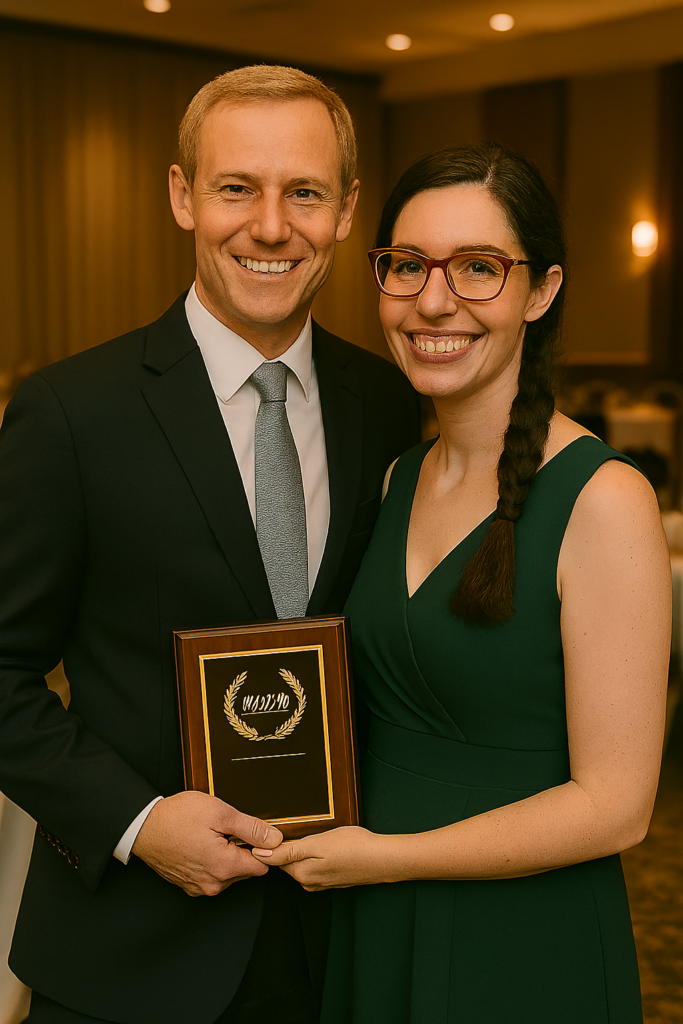
Soren and Rachel Berglund at the Minnesota Wild organization awards banquetShe leaned her head against his shoulder. “This is your dream,” she murmured. “And I get to be part of it.”
He wrapped an arm around her, pulling her close.
“And you’re living yours,” he said. “Two callings. Two careers. One team.”
Rachel smiled — the same smile she wore the night she won Teacher of the Year, the same smile she wore when she first saw him at the Gamblers game, the same smile she wore when Henrik was placed in her arms.
A life unfolding. Two paths running side by side. Growing. Becoming. Together.
And as the reception buzzed around them — colleagues laughing, glasses clinking, Bill Guerin telling a story in the corner — Rachel held onto Soren’s hand and felt it fully:
They were exactly where they were meant to be.
Chapter 13: The Long Light of June
Pine City High School — First Week of June
Finals Week & Graduation Prep
The building felt different in June — lighter, warmer, and humming with anticipation. Pine City High’s old casement windows were cranked open as far as they would go, letting in the soft breeze that carried the unmistakable scent of lilac and honeysuckle from the courtyard bushes. It was the smell of endings and beginnings braided together.
Students moved through the halls with a mix of exhaustion and giddy relief. Teachers leaned in doorways with coffee cups, trading knowing looks. The 1958 vintage building had no air conditioning, but no one minded — not when summer was this close.
Room 210 — Lily’s Classroom
Stacks of yearbooks lined the counter, glossy and fresh. Lily stood behind her desk, handing them out as students trickled in for her final exam.
“Don’t open them until after the test,” she warned, smiling because she knew they absolutely would.
A senior boy grinned. “Ms. Jorgenson, that’s cruel.”
“You’ll survive,” she said, handing him his copy.
The breeze lifted the edge of a poster on her wall — a quote about stories and belonging — and Lily felt that familiar tug of nostalgia. This room had been hers for years now, but it still carried echoes of Marnie’s era. And now, she was the one signing yearbooks, the one students came back to visit.
She glanced out the open door just in time to see Marnie walking toward the office, hand resting on her belly, moving with that gentle, careful grace she’d adopted in recent weeks.
Lily smiled. Everything was changing — in the best ways.
Principal’s Office — Marnie Thurston & Danielle Savoy
Danielle Savoy’s office was bright with morning sun, the window open wide enough to let in the breeze and the faint sound of seniors rehearsing graduation speeches in the gym.
Marnie eased into the chair across from her, smoothing her dress over her growing bump.
“Thanks for meeting with me,” she said.
“Of course,” Danielle replied warmly. “I figured we should talk before the summer rush hits.”
Marnie nodded. “I wanted to give you a clear picture of next year. I’ll be here for the start of the school year — no problem there. But with the twins due October 18, I’ll likely need to step out early- to mid‑October. And with twins… well, I’m planning on taking leave through the end of first semester.”
Danielle nodded, already jotting notes. “That gives us plenty of time to line up a long‑term sub. And honestly? Thank you for being proactive. The timing isn’t ideal, but we’ll make it work.”
Marnie exhaled, relieved. “I just want to make sure the kids have stability.”
“They will,” Danielle assured her. “And you’ll come back in January ready to finish the year strong. We’ll support you every step of the way.”
A breeze drifted through the window, carrying that sweet early‑summer scent. Marnie closed her eyes for a moment, letting it wash over her.
“This time of year always makes me emotional,” she admitted.
Danielle laughed. “You’re pregnant with twins. You get a free pass.”
Marnie laughed too — a soft, warm sound. “Fair.”
Hallway — Between Classes
Lily caught up with Marnie as she came back up to 2nd floor from the office and her meeting with Danielle Savoy. Marnie was approaching Room 208, her room, from the set of stairs at the south end of the long hallway in the academic wing where she had just come up.
“How’d it go?” Lily asked.
“Good,” Marnie said, smiling. “We have a plan. I’ll be here until October, then back in January.”
Lily squeezed her arm. “That’s perfect.”
They walked together down the hallway, the breeze following them, carrying the scent of summer and the faint sound of seniors practicing “Pomp and Circumstance.”
“You ready for graduation?” Marnie asked.
Lily grinned. “Almost. Yearbooks are out, which means I’ll be signing them nonstop for the next forty‑eight hours.”
“Occupational hazard,” Marnie teased.
“Hey, you started it,” Lily shot back.
They both laughed — the kind of laugh that comes from years of shared history, shared hallways, shared seasons of life.
Auditorium — Graduation Rehearsal
The seniors were lined up in rows, practicing their walk across the stage. The auditorium was warm, the fans humming, the doors propped open to let in the breeze.
Lily stood with the other teachers along the wall, watching her students — some confident, some nervous, all on the edge of something new.
Marnie stood beside her, hand on her belly, eyes soft.
“Every year,” she whispered, “I think I’m ready. And every year, I’m not.”
Lily nodded. “It hits different now that I’m the one teaching in your old room.”
Marnie smiled. “You’ve made it your own.”
A senior girl waved at them from across the auditorium. Lily waved back, heart full.
Danielle Savoy tapped the microphone. “Alright, seniors — one more run‑through.”
The music started again. The breeze drifted in. The scent of lilac and honeysuckle wrapped around them like a blessing.
And in that moment — with finals nearly done, graduation days away, and summer stretching out before them — Pine City High felt like the center of a world that was growing, shifting, and blooming in all the right ways.
Summer’s Beginning
The gravel driveway to the Thurston farmhouse shimmered in the late‑afternoon sun, the heat rising in soft waves above the fields. The yard was already alive with voices and laughter, the kind that carried easily across the open space between Pine City and Beroun. The scent of charcoal drifted from the grill near the porch, unmistakable and comforting — the smell of summer’s true beginning.
Marnie stood on the front lawn, one hand resting on her belly, the other steadying Emily as she chased bubbles drifting lazily in the warm air. Ethan hovered nearby, pretending not to hover, his eyes flicking between his daughter and his pregnant wife with the protective instinct of a man who knew his life was about to expand in ways he couldn’t yet imagine.
“Daddy, look!” Emily squealed, popping a bubble with her nose.
Ethan laughed. “That’s my girl.”
From the driveway, Olive bounded toward them, tail wagging wildly. Allison and Erik followed at a slower pace, carrying a bowl of potato salad and a bag of buns. Olive made a beeline for Emily, who shrieked with delight and wrapped her arms around the golden retriever’s neck.
“Sorry!” Allison called, though she was smiling. “She saw her favorite toddler.”
“She’s fine,” Marnie said, brushing a strand of hair from her face. “Emily loves it.”
Across the yard, Maya and Adrian were arranging folding chairs in a loose circle, pausing every few minutes to debate something wedding‑related — colors, music, whether Adrian’s brother could be trusted with microphones. Their laughter floated on the breeze, light and easy.
Sophie and Elias arrived next, hand in hand, moving with the quiet comfort of a couple still discovering each other but already fitting together with surprising ease. Sophie carried a tray of lemon bars; Elias followed with a large bowl of pasta salad he’d insisted on making himself.
“Thank you,” Rachel said as she approached them, baby monitor tucked under her arm. Henrik was asleep in his carrier under the maple tree, the shade dappling softly across his tiny face.
“You’re welcome,” Elias said, setting the bowl on the picnic table. “And I promise the pasta salad is edible. Possibly even good.”
Sophie nudged him. “It’s great. He’s just modest.”
Rachel laughed. “Well, we’ll be the judge of that.”
Soren settled beside her, brushing a thumb across Henrik’s cheek. “He’s out cold.”
“Long day of being adored,” Rachel said softly.
Soren smiled — that quiet, full smile he’d worn more often since Henrik’s birth and the award ceremony that followed. A man stepping into his calling, into fatherhood, into a life that fit him like a well‑worn jersey.
Shane and Lily arrived last, carrying a cooler between them. Lily’s hair was pulled back in a loose braid, her cheeks still faintly sun‑kissed from graduation week. Shane set the cooler down and kissed her temple before heading toward the grill to join Ethan and Erik.
“School’s out,” Lily said, exhaling as she sank onto the blanket beside Rachel. “I swear I can still smell the yearbooks.”
Rachel laughed. “You survived another finals week.”
“Barely,” Lily said, but her smile was bright. “It’s summer now. Everything feels lighter.”
Rachel nodded, looking around the yard — at the couples scattered in small clusters, at the kids playing, at the golden retriever weaving between legs, at the grill smoking gently in the warm air. “It really does.”
The sun dipped lower, casting long golden rays across the farmhouse and the fields beyond. Fireflies began to blink in the tall grass. The grill hissed as Ethan flipped burgers, sending up a fresh wave of charcoal‑and‑beef aroma that drifted across the yard.
“Food’s almost ready!” he called.
The group gathered instinctively — chairs pulled closer, blankets spread out, plates passed around. The easy rhythm of people who had become family.
Maya leaned into Adrian’s side. “We found a venue,” she announced, eyes sparkling.
A chorus of cheers rose around her.
“When’s the date?” Lily asked.
“Next June,” Maya said. “We wanted a full year to plan.”
“Perfect,” Marnie said, her hand resting on her belly. “The twins will be eight months old. They’ll steal the show.”
Ethan groaned. “Please don’t give them ideas.”
Laughter rippled through the group.
Allison pulled out a folded sheet of paper — a rough sketch of a house. “We met with a builder,” she said. “This is the first draft.”
Erik leaned over her shoulder, pride softening his features. “It’s starting to feel real.”
“It is real,” Sophie said gently. “All of this is.”
Rachel looked around the circle — at the couples, the dreams, the beginnings. At Henrik sleeping in her arms. At Soren watching her with that quiet, steady love that had carried them through so much.
She felt it then — the fullness of this moment. The sweetness of early summer. The promise of what was coming. The deep, abiding gratitude for the people gathered here.
Soren reached for her free hand. “You okay?”
She nodded, eyes shining. “More than okay.”
The fireflies glowed brighter. The grill hissed again. Someone turned on soft music from a speaker on the porch. The air was warm, the sky endless, the night stretching ahead like a gift.
And as the Sparkle Squad settled into their circle — laughing, talking, dreaming forward — Rachel felt the truth settle deep in her chest:
They were stepping into a new season. A season of beginnings. A season of growth. A season of joy.
Summer had arrived. And with it, the quiet certainty that whatever came next, they would walk into it together.
The night settled soft and golden around them, and the Sparkle Squad — twelve hearts, six stories, one family — stepped into summer with the quiet certainty that the year ahead would be full of new life, new promises, and the kind of joy that only grows when shared.