Chapter 1 – The First Bell
Pine City High School Library Tuesday, Late August
The library hummed with the soft, familiar noise of teachers returning from summer: chairs scraping, quiet laughter, the rustle of new planners being opened for the first time. The scent of fresh floor wax drifted in from the 1958-vintage tiled hallways, ready for another year of teacher and student traffic, mixing with the aroma of the coffee someone had brewed too strong on purpose.
Marnie Thurston eased into a seat near the front, one hand resting on her very pregnant belly. Ethan sat beside her, posture unusually perfect — the posture of a man determined to behave. Fellow Social Studies teacher Peter Bouchard dropped into the chair on Ethan’s other side, surprisingly quiet, as if he’d made the same vow.
Principal Danielle Savoy stepped to the front of the room, her binder tucked under one arm, her smile warm and bright.
“Good morning, everyone,” she said, and the room settled instantly. “Welcome back to another year at Pine City High. I hope you all had a restful summer — or at least a summer that didn’t involve too many home improvement projects gone wrong.”
A ripple of laughter moved through the room.
Danielle continued, “We’ll keep this meeting efficient so you can get into your classrooms. I know some of you are itching to rearrange furniture and alphabetize your bookshelves.”
Peter raised a hand. “I alphabetized mine in July.”
Ethan elbowed him. “Of course you did.”
Danielle shook her head fondly. “And that, Peter, is why we love you.”
She moved through the agenda with her usual clarity — updates on curriculum pacing, reminders about advisory, a note about the new copier that everyone silently prayed would actually work this year. Ethan and Peter remained remarkably well‑behaved, exchanging only the occasional smirk.
Near the end, Danielle closed her binder and softened her voice.
“Before we wrap up, I want to take a moment to talk about something important.”
Every head turned toward Marnie instinctively.
“As most of you know,” Danielle said, “Marnie and Ethan are expecting twins — due October eighteenth.”
A warm wave of applause filled the library. Marnie flushed, smiling shyly as Ethan squeezed her hand.
Danielle continued, “Because of the timing, Marnie will be going on maternity leave in early October. And I’m very pleased to announce that we have secured an exceptional long‑term substitute.”
She paused, letting the anticipation build.
“Claire Halvorsen will be joining us for the fall.”
Several teachers murmured in approval. Lily Jorgenson grinned broadly.
“Oh, she’s fantastic,” Lily said. “She subbed for me a couple of days last spring. My sophomores adored her.”
“Same here,” said geography and civics teacher Roger Jacobson. “She’s the real deal.”
Danielle nodded. “Claire taught full‑time in Mora for twelve years before stepping back to substitute so she could have more flexibility for her kids. She’s been working in Mora, Hinckley, and Pine City for the last four years, and every single review I’ve heard from staff has been glowing.”
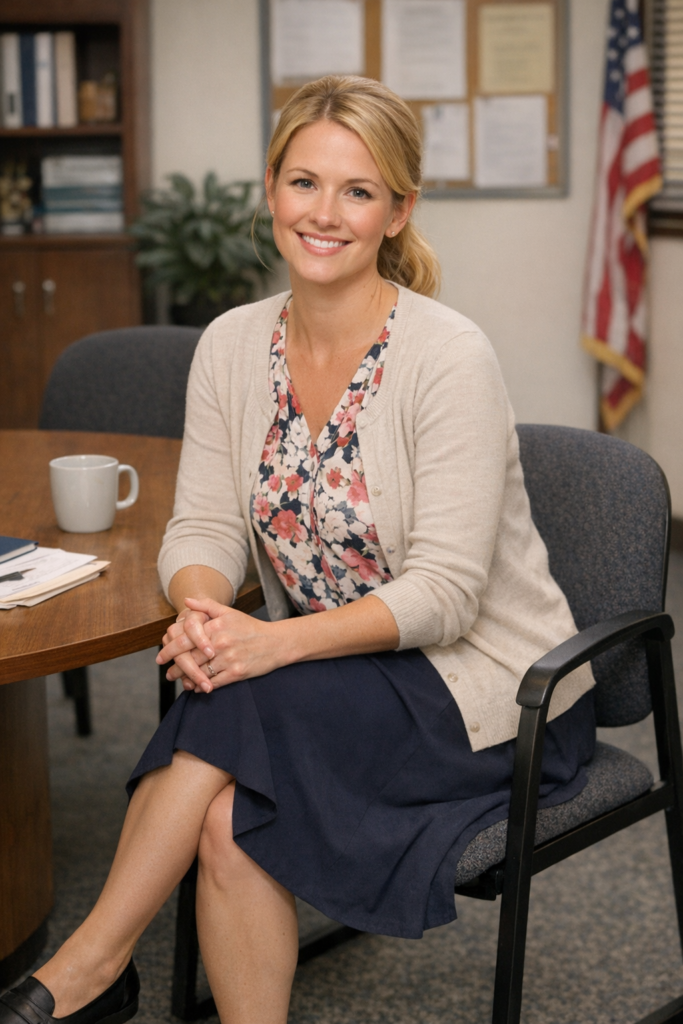
Long-term substitute teacher Claire Halvorsen will be taking Marnie Thurston’s American Literature classes for several months during Marnie’s maternity leave.
Peter raised a hand. “She covered my eighth graders during that flu outbreak two years ago. Anyone who survives that deserves a medal.”
More laughter.
Danielle smiled. “Exactly. She’s experienced, steady, and a perfect fit for Marnie’s classroom. She and Marnie have already met, and I know the transition will be smooth.”
Marnie blinked rapidly, emotion rising in her chest. “Thank you,” she said softly. “Really. I… I appreciate all of you so much.”
Danielle stepped closer, her voice warm. “We’re here for you, Marnie. All of us. And because we want to celebrate these babies properly, we’ll be hosting a little staff baby sprinkle two weeks from Thursday after school in the cafeteria.”
A delighted murmur swept the room.
“I’ll have a sign‑up sheet in the office by lunch,” Danielle added. “Snacks, decorations, whatever you’d like to contribute. And Peter—”
He sat up straighter. “Yes?”
“No cakes shaped like babies.”
The room erupted.
Peter threw his hands up. “It was one time!”
Ethan leaned over. “And it haunts us still.”
Marnie laughed, wiping a tear from her cheek. “You’re all ridiculous,” she said, voice thick with emotion. “And I mean that in the best possible way. Thank you. Truly. I couldn’t ask for better coworkers… or better friends.”
The faculty applauded again — warm, genuine, full of affection.
Danielle gave her a soft smile. “We’re glad you’re here, Marnie. Now let’s go make this a great year.”
Chairs scraped back, conversations bubbled up, and the Pine City staff dispersed into the hallways — a cheerful, bustling community ready to begin again.
And Marnie, surrounded by people who loved her, felt the year beginning in exactly the right way.
Tuesday Afternoon — Classroom Prep Day
Rooms 207, 208, and 210
The second floor of Pine City High shimmered with late‑August heat, the kind that settled into the old brick walls and refused to leave. With no air conditioning in the building, every classroom door stood propped open, and box fans roared like jet engines in the hall.
Marnie Thurston stood in the middle of Room 208, hands on her hips, surveying the stacks of novels, the bulletin board half‑covered in butcher paper, and the rows of desks she’d already rearranged twice. A sheen of sweat glistened on her forehead.
“This building is trying to kill me,” she muttered.
From across the hall, Ethan leaned in his doorway, arms crossed, grinning. “It’s eighty‑five degrees and you’re carrying two tiny humans. I think you get to complain.”
“Thank you,” she said, fanning herself with a syllabus. “I will.”
He stepped into her room, dodging a pile of composition notebooks. “Need help moving anything?”
“Everything,” she said. “But start with that fan. Aim it directly at me.”
Ethan adjusted the fan obediently. “Better?”
“Blessed relief,” she sighed.
Down the hall, Lily Jorgenson poked her head out of Room 210. “Is that the sound of the Thurstons melting?”
“Slowly,” Marnie called back.
Lily walked toward them, her hair pulled into a messy bun, a stack of posters under one arm. “I swear this building gets hotter every year. My room feels like a greenhouse.”
“That’s because you have twenty‑seven plants in there,” Ethan said.
“They’re thriving,” Lily replied, unbothered. “Unlike the rest of us.”
She stepped into Marnie’s room and looked around. “Ooh, I like the desk layout. Very open. Very collaborative.”
“It’s the only arrangement where I can still walk between the rows without bumping into things,” Marnie said. “My center of gravity is… not what it used to be.”
Lily laughed. “You’re doing great. And your room looks amazing already.”
Marnie gestured to the half‑finished bulletin board. “Tell that to the paper that keeps peeling off the wall.”
“I’ve got better tape,” Lily said, already heading back to her room. “Be right back.”
Ethan watched her go. “She’s like a classroom‑setup superhero.”
“She really is,” Marnie agreed.
A moment later, Lily returned with a roll of industrial‑strength tape and a stapler. “Okay, let’s fix this before it drives you crazy.”
The three of them worked together, the easy rhythm of long friendship settling over them. Lily smoothed the paper while Ethan held it in place, and Marnie supervised from her chair, sipping water and offering commentary.
“Higher on the left,” she said. “No, your other left.” “Perfect. Don’t move.”
Ethan stepped back. “There. Bulletin board conquered.”
“Thank you,” Marnie said. “Both of you.”
From the hallway came the sound of Roger Jacobson greeting someone loudly, followed by Peter Bouchard’s unmistakable laugh echoing off the lockers. The building felt alive again.
Lily leaned against a desk. “So… how are you feeling after this morning?”
Marnie’s expression softened. “Overwhelmed. In a good way. I wasn’t expecting Danielle to announce the sprinkle today.”
“She loves you,” Lily said simply. “We all do.”
“And Claire seems great,” Ethan added. “I liked her.”
Marnie nodded. “I did too. I feel… relieved. Like everything’s going to be okay.”
“It is,” Lily said. “And you’re going to have the cutest twins in Pine County.”
Ethan grinned. “Biased, but true.”
A burst of warm air drifted through the hallway, carrying the scent of floor wax and old books. The fan hummed.
Marnie looked around her classroom — the posters, the bookshelves, the desks waiting for students — and felt a familiar flutter of anticipation.
“Okay,” she said, pushing herself up from the chair. “Let’s finish this. School starts in a week.”
Ethan saluted. “Yes, ma’am.”
Lily raised her stapler like a battle flag. “To Room 208!”
“To Room 208,” Marnie echoed, smiling.
And together, in the sweltering heat, they got to work — readying their rooms, their hearts, and their year.
Friday Morning — Labor Day Weekend
Principal’s Office Conference Room
The building was unusually still for a Friday morning. Most teachers had taken the day to enjoy the long weekend, but the soft hum of the copier and the faint scent of coffee drifted through the main office as Marnie Thurston stepped inside, one hand resting on her belly.
Danielle Savoy waved her in from the small conference room, next door to her office down the narrow corridor off the main office. “Good morning, Marnie. Come on in — Claire’s just getting settled.”
Claire Halvorsen stood as Marnie entered, offering a warm smile and an easy handshake. Claire wore a simple cardigan over a floral blouse with a flowy skirt, her hair pulled back in a way that made her look both professional and approachable.
“Marnie, it’s so nice to finally meet you properly,” Claire said. “I’ve heard wonderful things.”
“Same here,” Marnie replied, genuinely. “I’m really glad you’re stepping in this fall.”
They sat around the small table — Danielle with her binder open, Claire with a notebook, and Marnie with a water bottle she’d already half‑finished.
Danielle began, “I wanted the three of us to meet before the year starts in earnest. Just to talk through the transition, expectations, pacing — and to give you two a chance to connect.”
Claire nodded. “I appreciate that. I’ve subbed in Pine City plenty. Though I’ve never had the chance to sub for Marnie until now, but stepping into someone’s classroom long‑term is different. I want to make sure I’m honoring what you’ve built.”
Marnie smiled. “Thank you. That means a lot. And honestly, I think we’re going to work really well together.”
Claire’s eyes lit with recognition. “You’re an English teacher who actually likes Dickinson, right?”
Marnie laughed. “Love her. I know that’s not everyone’s thing.”
“Oh, it’s mine,” Claire said. “I used to do a whole mini‑unit on her shorter poems — the ones that sneak up on students.”
“‘Tell all the truth but tell it slant’?” Marnie asked.
Claire grinned. “Exactly.”
Danielle leaned back, satisfied. “See? I knew you two would click.”
They spent a few minutes talking about classroom management — the routines Marnie used, the tone she set, the way she handled late work and group projects. Claire took notes, nodding thoughtfully.
“I like your bell work structure,” Claire said. “It’s consistent without being rigid. I can keep that going.”
“That would be great,” Marnie said. “The kids respond well to it.”
“And your seating charts?” Claire asked.
“I’ll have them ready before I go on leave,” Marnie said. “But feel free to adjust once you get to know them.”
Claire smiled. “I’ll ease into it. I don’t want to change too much too fast.”
Danielle chimed in, “That’s one of the reasons I wanted Claire. She’s experienced enough to step in confidently, but she’s not the type to bulldoze.”
Claire shrugged modestly. “I’ve learned over the years that students need stability more than novelty.”
Marnie nodded. “Exactly.”
They moved on to curriculum pacing. Marnie pulled out a folder of printed plans.
“So,” she said, “I’ve been thinking about the first several weeks. I’m planning to start the year with poems and short stories — things that are flexible and won’t leave you in the middle of a novel when I go on leave.”
Claire’s face brightened. “That’s perfect. I can take the first novel unit once I’m in the classroom full‑time. And when you come back, you can pick up with the next one.”
“Exactly,” Marnie said. “And I’ll leave notes for where I expect the writing unit to start. You can adjust as needed.”
Claire tapped her pen thoughtfully. “I love that. And honestly, I enjoy teaching novels — it’ll be a nice stretch of consistency for the kids.”
Danielle added, “And it gives you both clear bookends. Marnie starts the year with shorter texts, Claire takes the novel unit, and Marnie returns for the writing and term papers. Clean, simple, and predictable.”
Marnie exhaled, relieved. “This feels really good. I was worried about leaving things messy.”
Claire shook her head. “You won’t. And I’ll keep your routines intact. I promise.”
There was a quiet moment — warm, steady, full of mutual respect.
Then Claire added with a soft laugh, “And as a mom, I get it. You don’t need extra stress right now.”
Marnie smiled. “How old are your kids again?”
“Eight and eleven,” Claire said. “Busy ages. Lots of activities. Lots of… everything.”
Marnie laughed knowingly. “I can imagine.”
“Oh, you’ll be in the thick of it soon enough,” Claire said gently. “But it’s wonderful. Exhausting, but wonderful.”
Danielle closed her binder. “Well, I think we’ve got a solid plan. Claire, you’ll shadow Marnie one day in late September. We’ll finalize the exact date next week.”
“Sounds great,” Claire said.
Marnie stood slowly, hand on her belly. “Thank you both. I feel so much better about everything.”
Claire touched her arm lightly. “You’re going to have a great start to the year. And I’ll take good care of your students.”
“I know you will,” Marnie said, smiling.
As they walked out into the quiet hallway, the building still warm with late‑summer air, Marnie felt something she hadn’t expected — not just relief, but gratitude. The year ahead was going to be full, unpredictable, and beautiful.
And with Claire stepping in, she knew her students would be in the best possible hands.
Tuesday After Labor Day — First Day of School
The hallways of Pine City High buzzed with the unmistakable electricity of the first day of school. Backpacks thumped against lockers, friends reunited with shrieks and hugs, and the scent of new notebooks and floor wax mingled in the late‑summer air. Teachers stood in doorways greeting students, and the building felt alive in a way it hadn’t since June.
At 8:10 sharp, the intercom crackled to life.
“Good morning, Pine City High School,” Danielle Savoy’s voice rang out, warm and steady. “Welcome back. Please make your way to the auditorium for our opening assembly.” A cheer rose from somewhere near the science rooms on the 2nd floor of the academic wing.
The auditorium filled quickly, students spilling into rows with the chaotic enthusiasm only the first day could bring. Danielle stood at the podium, smiling as she watched the last stragglers slip in.
“Good morning, Pine City Dragons,” she began, and the room erupted in applause. “It’s wonderful to see all of you again. We have an exciting year ahead — new classes, new opportunities, and yes, new challenges. But I know this community, and I know we’re ready.”
She moved through the usual announcements — clubs, sports, expectations — with her trademark blend of humor and clarity. When she finished, she sent students off to their modified schedule with a final, “Let’s make it a great year.”
The hallways surged to life again.
Marnie’s American Literature Class — Room 208
Marnie stood at the front of her classroom, the fan humming in the corner, her juniors settling into their seats with the jittery energy of the first day. She smiled as she took attendance, then launched into her introduction.
“Welcome to American Literature. I’m Mrs. Thurston, and I’m excited to spend this year exploring stories, poems, and voices that shaped our country.”
A hand shot up. “Are we reading The Great Gatsby?”
“Yes,” Marnie said. “But not until later in the year. We’ll start with shorter texts.”
She paused, resting a hand on her belly. “And before we get too far, I want to share something important. Some of you may already know, but… I’m expecting twins.”
The reaction was instant.
A chorus of “Aww!” rose from the girls in the front row.
One girl, Holly, clasped her hands dramatically. “Oh, for cute!”
The whole class applauded, warm and genuine. Marnie laughed, cheeks flushing.
“Thank you. I’ll be here through early October, and then you’ll have a wonderful long‑term substitute, Mrs. Halvorsen. She’s fantastic — you’ll love her.”
A boy in the back raised his hand. “Will she give less homework?”
“No,” Marnie said, smiling. “Nice try.”
The class laughed, and the year officially began.
Ethan’s American Government Class — Room 207
Across the hall, Ethan Thurston sat at his desk, ready to begin his senior American Government class. He reached for his chair — and froze.
Squeak.
He sat down slowly.
Squeak. Squeak. Squeeeeeak.
He closed his eyes. “Oh no.”
The students snickered.
One boy in the second row grinned. “Rough morning, Mr. T?”
Ethan pointed at him. “Don’t start with me, Carter.”
Carter raised his hands innocently. “Hey, I didn’t do anything. Yet.”
Ethan sighed dramatically. “This chair was swapped out. Someone replaced it with a squeaky look‑alike.”
The class leaned in, amused.
“And I,” Ethan continued, “have a very strong suspicion about who did it.”
“Mr. Bouchard?” several students said at once.
Ethan nodded solemnly. “Mr. Bouchard.”
The room erupted in laughter.
Carter added, “You should keep it. It adds character.”
Ethan gave him a look. “If it squeaks during my lecture on the Constitution, I’m blaming you.”
“Fair,” Carter said.
And just like that, Ethan’s seniors were fully engaged.
Lily’s 10th Grade English Class — Room 210
Down the hall, Lily Jorgenson stood at the front of Room 210, her plants thriving in the windows and her posters crisp and bright. Her sophomores settled in, chattering excitedly.
“Welcome to English 10,” Lily said, handing out syllabi. “We’ll go over expectations, get your literature books, and start our first story today.”
As she passed out textbooks, a girl named Grace raised her hand.
“Ms. Jorgenson? Can I ask you something?”
“Sure, Grace” Lily said.
“So… I want to get my nose pierced. How do I convince my parents?”
A few students snickered. Lily smiled — the kind of smile only an experienced teacher could manage.
“Great question,” she said calmly. “But not a topic for class. Let’s stay focused on our story.”
Grace nodded, slightly embarrassed but not upset.
Lily continued smoothly, “Today we’re reading ‘Leiningen Versus the Ants.’ It’s an adventure story about determination, problem‑solving, and—”
“Ants,” a boy named Gavin supplied helpfully.
“Yes, Gavin” Lily said. “Lots of ants. Open to page 42.”
And just like that, the class was back on track — no derailment, no chaos, just a teacher who knew exactly how to steer the ship.
End of the Day — Second Floor Academic Wing
The final bell rang, echoing down the hallway. Students poured out, buzzing about their first day. When the noise finally faded, Marnie, Ethan, and Lily gathered near their classrooms, leaning against doorframes, tired but smiling.
Danielle Savoy appeared at the end of the hall closest to Rooms 201 and 202, Mr. Tarnowski’s and Mr. White’s rooms, respectively, coming up the stairs from 1st floor, clipboard in hand. She walked down the hall to where Marnie, Ethan, and Lily were standing, outside of Room 208.
“Well?” she asked. “How’d the first day treat you?”
“Great,” Lily said. “My sophomores are chatty, but manageable.”
Danielle gave her a knowing smile. “And you handled them beautifully. Remember your first year of teaching?”
Lily laughed, shaking her head. “Oh, don’t remind me.”
“I will remind you,” Danielle said warmly. “Because the teacher I saw today? Confident. Steady. Completely in control. You’ve come a long way, Lily.”
Lily’s cheeks flushed with quiet pride. “Thanks, Danielle. That means a lot.”
“Mine tried to sabotage me with a squeaky chair,” Ethan said. “I know it was Peter.”
Danielle laughed. “I’ll talk to him.”
“No, don’t,” Ethan said. “I’m plotting revenge.”
Marnie rubbed her belly. “My juniors applauded when I told them about the twins.” Holly even said, ‘Oh, for cute!’”
Danielle’s face softened. “Of course they did. They adore you.”
Marnie smiled. “It was a good day. A really good day.”
The four of them stood together for a moment, the late‑afternoon sun slanting through the windows, the building finally quiet.
A new year had begun — full of promise, full of warmth, full of life.
And Pine City High felt exactly as it should.
Sparkle Squad FaceTime — Planning the Baby Sprinkle
Lily Jorgenson balanced her phone against a stack of cookbooks on her kitchen counter, adjusting the angle until her face wasn’t at a weird upward tilt. Shane walked by, gave her a thumbs‑up, and whispered, “Good luck,” before disappearing down the hall.
She hit FaceTime → Sparkle Squad.
The screen blinked once… twice…
And then the familiar cascade of faces appeared.
Allison popped in first, sitting cross‑legged on her couch with a mug of tea.
“Lily! Okay, I’m ready. I’ve got notes.”
Maya joined next, hair in a messy bun, wearing her “I Survived Parent-Teacher Conferences” sweatshirt.
“Tell me this is a fun meeting. I need fun.”
Sophie appeared with perfect lighting and a glass of sparkling water.
“I brought color palettes. Don’t judge me.”
Rachel connected last, baby monitor glowing behind her.
“Sorry! I had to get Henrik to sleep.”
And then—
Marnie Thurston joined, smiling tiredly but warmly.
“Hi, everyone.”
The Squad erupted in greetings.
“Hi, Mama!” “How are you feeling?” “You look great!” “Are the twins kicking?” “Do you need anything?”
Marnie laughed. “One at a time!”
Lily clapped her hands. “Okay, okay — let’s get started. We’re planning your baby sprinkle, Marnie. The Sparkle Squad version. Small, cozy, and full of love.”
Marnie’s eyes softened. “You guys… you don’t have to—”
“We absolutely do,” Allison said. “It’s twins. That’s like… double the sprinkle.”
“Double the chaos,” Maya added.
“Double the cuteness,” Sophie countered.
Rachel nodded. “Double the diapers.”
Marnie groaned. “Don’t remind me.”
Planning Begins
Lily pulled out her notebook. “So here’s what I’m thinking. We host it at my place — Saturday, two weeks from now. Late afternoon. I’ll invite your mom, Lori, and your sisters, Amber and Kellie.”
Marnie smiled. “They’d love that.”
“And it’ll be smaller than the school sprinkle,” Lily continued. “Just us, your family, and maybe a couple of your closest Pine City friends if you want.”
“That sounds perfect,” Marnie said.
“Okay,” Allison said, flipping a page. “Food. What are we thinking?”
“Comfort food,” Maya said immediately. “It’s fall. We need cozy.”
“Soup and sandwiches?” Rachel suggested.
“Or a baked potato bar,” Sophie said. “People love those.”
Lily nodded. “I can do a big pot of chili. Shane can grill something if we want.”
Marnie laughed. “Shane will grill something whether you want him to or not.”
“True,” Lily admitted.
Gifts & Activities
“All right,” Allison said. “Gifts. Since this isn’t your first baby, we don’t need the big stuff.”
“No,” Sophie said, “but twins means double the basics. Diapers, wipes, burp cloths, onesies…”
“Matching onesies,” Maya corrected. “Obviously.”
Rachel leaned closer to the camera. “I’m making you a freezer meal stash. You’ll thank me later.”
“I already thank you,” Marnie said.
“And activities?” Lily asked.
“Nothing cheesy,” Marnie begged. “Please.”
“No guessing the belly size,” Sophie said. “That’s banned.”
“No melted chocolate in diapers,” Maya added. “Trauma.”
Allison snapped her fingers. “What about a ‘name the baby item’ speed round? Like… who can list the most things you need for twins in sixty seconds?”
“That’s actually cute,” Lily said.
“And practical,” Rachel added. “We can give her the list afterward.”
Marnie laughed. “You guys are ridiculous.”
“And you love us,” Maya said.
“I do,” Marnie admitted.
The Emotional Moment
Lily softened. “Marnie… we want this to be special. You’ve been through a lot this year. And these babies — they’re such a gift.”
Marnie blinked rapidly. “You’re going to make me cry.”
Sophie fanned her face dramatically. “No crying! I didn’t waterproof my mascara.”
Rachel smiled gently. “We’re just excited for you. And we want you to feel supported.”
Marnie wiped her eyes. “I do. I really do.”
“All right,” Lily said, clapping once. “I’ll send out a group text with details. I’ll coordinate with Lori, Amber, and Kellie. You all bring whatever you want — food, gifts, chaos.”
“Chaos is my specialty,” Maya said.
“Mine too,” Allison added.
Sophie raised her glass. “To Marnie. And to the twins.”
Rachel lifted her mug. “To the sprinkle.”
Lily smiled at her screen, heart full. “To the Sparkle Squad.”
Marnie placed a hand on her belly. “To family — the one you’re born into and the one you choose.”
The call dissolved into laughter, chatter, and the usual overlapping goodbyes that took a full minute to complete.
And when the screen finally went dark, Marnie sat back, feeling held, supported, and deeply loved — exactly as the Sparkle Squad intended.
Pine City Faculty Baby Sprinkle
Thursday, Second Week of School — Cafeteria
The final bell had rung nearly fifteen minutes earlier, and the cafeteria was already transformed into something softer, warmer, and unmistakably Pine City. A long table near the windows held a sheet cake decorated with pastel frosting, a stack of paper plates, and two large carafes of coffee. A few vases of late‑summer flowers — courtesy of Ann Nylund from the art room — added a cheerful touch.
Teachers drifted in, still wearing their end‑of‑day expressions: tired, rumpled, but happy to be together.
Marnie Thurston stepped inside with Ethan at her side, one hand resting on her belly. She was immediately greeted by a chorus of voices.
“There she is!” “Hi, Mama!” “You look beautiful!” “Sit down — don’t stand too long!”
Danielle Savoy approached with a warm smile. “Welcome to your sprinkle, Marnie. Nothing fancy, but we wanted to celebrate you.”
“It’s perfect,” Marnie said, genuinely touched.
The Gathering Begins
Lily Jorgenson hurried over, carrying a small gift bag. “Okay, I know we’re keeping this simple, but I couldn’t resist. It’s not much — just something cute.”
Marnie laughed. “Lily, you always say that, and then it’s adorable.”
Special ed teacher Nicole Keller waved from the refreshment table. “Cake’s ready! And I made sure we got the corner pieces for anyone who likes extra frosting.”
“That’s me,” Peter Bouchard said, appearing behind her. “I need the sugar to maintain my personality.”
Ethan groaned. “Please don’t.”
Peter grinned. “Too late.”
He handed Marnie a neatly wrapped gift. “This is from me and my wife. She picked it out. I wrapped it. Poorly.”
Marnie smiled as she accepted it. “Thank you, Peter. Tell her I said thank you.”
“Oh, she adores you,” Peter said. “She said, and I quote, ‘Get something nice. Not one of your joke gifts.’”
Ethan raised an eyebrow. “So no baby‑shaped cake?”
Peter held up his hands. “I behaved. See? Growth.”
Danielle laughed. “We’re all very proud.”
Gifts and Good Wishes
Teachers gathered around as Marnie opened a few small gifts — soft blankets, matching onesies, a pack of diapers with a bow on top.
Ann Nylund handed her a beautifully wrapped box. “This is from the art department. We pooled together.”
Inside was a pair of hand‑painted nursery prints — watercolor animals in soft colors.
Marnie gasped. “Ann… these are gorgeous.”
Ann blushed. “I had help from the kids in Advanced Art. They wanted to contribute.”
Marnie wiped her eyes. “I love them. Thank you.”
Nicole Keller stepped forward next. “Mine’s practical,” she said. “But you’ll need it.”
Marnie opened the bag to find a double‑pack of baby carriers — one for each twin.
“Oh my goodness,” she said. “Nicole, this is amazing.”
Nicole shrugged. “I figured you’d want your hands free at some point.”
“Someday,” Ethan said. “In like… five years.”
Laughter rippled through the group.
Conversations and Cake
As people mingled, Lily and Danielle stood with Marnie near the refreshment table.
“How are you feeling?” Danielle asked.
“Good,” Marnie said. “Tired. But good.”
“You’re doing great,” Lily said. “Your juniors adore you already.”
“They applauded when she told them about the twins,” Ethan added from behind them, grabbing a piece of cake.
Danielle smiled. “Of course they did. You’re a favorite.”
Marnie shook her head. “I’m just… grateful. For all of you.”
Peter wandered over, coffee in hand. “So, Marnie, I have a question.”
Ethan groaned. “Oh no.”
Peter ignored him. “If the twins are identical, how will we tell them apart? Should we get them tiny name tags? Color‑coded socks? Matching tattoos?”
“Peter!” Danielle said, half laughing, half scolding.
“What?” Peter said. “I’m being helpful.”
Marnie laughed so hard she had to hold her belly. “We’ll figure it out.”
“Fine,” Peter said. “But if one of them grows up to be a prankster, I want it on record that I called it.”
“You’re not allowed to mentor them,” Ethan said.
“No promises.”
Winding Down
By 4:45, the crowd had thinned. Teachers headed home to families, lesson plans, and the promise of a quiet evening. The cafeteria lights glowed softly as the last few lingered.
Danielle approached Marnie one more time. “Thank you for letting us celebrate you.”
“Thank you for doing this,” Marnie said. “It means more than you know.”
Lily hugged her gently. “And don’t forget — Sparkle Squad sprinkle is next Saturday. Smaller group, but we’re going all out.”
Marnie smiled. “I can’t wait.”
Ethan gathered the gifts. “All right, Mama. Let’s get you home before you fall asleep standing up.”
“I’m not that tired,” Marnie protested — then yawned.
Peter pointed. “Lies.”
Everyone laughed.
As they walked out of the cafeteria, the late‑afternoon sun slanting through the windows, Marnie felt wrapped in warmth — the kind that only comes from a community that truly loves you.
And Pine City High, once again, had shown exactly who they were.
Sparkle Squad Baby Sprinkle Saturday Afternoon
Lily & Shane’s House
The late‑September sun filtered through the maple trees in Lily Jorgenson and Shane Larson’s backyard, casting warm patches of light across the patio. A long table was set up with food — Shane’s pride and joy — including a steaming pot of chili, a tray of grilled chicken sliders, a baked potato bar with every topping imaginable, and a spread of fresh fruit and veggies. Inside, the kitchen counter held desserts: cookies, bars, and a small cake decorated with pastel dots.
Emily and four‑year‑old Ava, her best friend from day care, darted between the adults, giggling as they chased each other with plastic wands Lily had set out “to keep them busy.”
Marnie Thurston arrived with Ethan, one hand on her belly, the other holding Emily’s backpack full of emergency snacks and coloring books. Lori, Amber, and Kellie followed close behind, carrying gifts and wearing the unmistakable smiles of excited grandmother and aunties.
Lily hurried over, arms open. “You made it! Come in, come in — food’s ready, drinks are inside, and the kids have already taken over the backyard.”
Marnie laughed. “I can see that.”
Shane waved from the grill. “Hey, Mama Thurston! I saved you the good sliders.”
“Thank you,” Marnie said. “I’m starving.”
“You’re always starving,” Ethan teased.
“Growing two humans,” she replied. “I’m allowed.”
The Gathering Begins
Inside the living room, Allison, Maya, Sophie, and Rachel were already settled on the couches, chatting with Jill — Marnie’s friend from high school — and Samantha, Ava’s mom.
“Marnie!” Jill jumped up to hug her. “Look at you! You’re glowing.”
“I’m sweating,” Marnie corrected. “But thank you.”
Samantha hugged her next. “Ava’s been talking about this all week. She told me she’s going to help Emily be a big sister.”
Emily, overhearing, ran over. “I am a big sister!”
Ava nodded solemnly. “I’m helping.”
Everyone melted a little.
Once plates were filled and drinks poured, the group settled around the patio table. Conversation flowed easily.
“This chili is amazing,” Amber said, spoon in hand.
“Shane takes it personally,” Lily said. “He’s been tweaking the recipe for years.”
Shane called from the grill, “It’s a craft!”
Kellie laughed. “Well, your craft is delicious.”
Maya leaned back in her chair. “Okay, I’m calling it now — this is the perfect fall afternoon.”
Sophie nodded. “Warm sun, good food, cute kids, pregnant glow… it’s very aesthetic.”
Rachel raised her glass of lemonade. “To Marnie. And to the twins.”
Everyone echoed the toast.
The Activity — Sparkle Squad Style
After the food, Lily clapped her hands. “Okay! Time for our one activity. Nothing cheesy, nothing weird, nothing involving melted chocolate.”
“Thank goodness,” Marnie said.
Allison pulled out a stack of index cards and a timer. “We’re doing a sixty‑second challenge: list as many baby items as you can think of that Marnie will need for twins.”
Maya cracked her knuckles. “Oh, I was born for this.”
“Ready?” Allison said. “Go!”
The patio erupted in frantic scribbling.
“Do snacks count?” Sophie asked.
“For the babies or for Marnie?” Rachel replied.
“Both!”
Amber shouted, “Do we write diapers twice?”
“Yes!” Kellie yelled.
Jill added, “What about matching hats? That’s important.”
Samantha scribbled furiously. “I’m writing down everything Ava needed at that age.”
Emily leaned over Marnie’s shoulder. “Write down toys!”
Ava nodded. “And snacks!”
When the timer beeped, Allison collected the cards.
“Okay,” she said, scanning them. “The winner is… Maya, with thirty‑two items!”
Maya pumped her fist. “Victory!”
“What do I win?” she asked.
“Bragging rights,” Lily said.
“And my eternal gratitude,” Marnie added.
Gifts and Sweet Moments
After the game, the group moved inside to open gifts. The atmosphere was warm and unhurried.
Lori handed Marnie a soft blanket set. “These are handmade. One for each baby.”
Marnie’s eyes filled. “Mom… they’re beautiful.”
Amber and Kellie gave her matching footie pajamas — one with tiny stars, one with tiny moons.
“So they coordinate,” Kellie said proudly.
Jill’s gift was a set of board books. “Start the library early.”
Samantha handed over a diaper bag stocked with essentials. “Trust me. You’ll need backups for your backups.”
Emily and Ava presented a crayon‑decorated envelope. Inside were two hand‑drawn pictures of babies with big smiles.
“These are for the twins,” Emily said.
Ava nodded. “We made them cute.”
Marnie hugged them both. “They’re perfect.”
The Sparkle Squad gifts were equally thoughtful — cozy blankets, matching onesies, a gift card for takeout nights, and a framed print that read “Twice the love.”
As the afternoon faded into early evening, the group lingered on the patio, talking and laughing while the kids played in the grass.
Lori watched her daughter with a soft smile. “You’re surrounded by good people, Marnie.”
“I know,” Marnie said quietly. “I’m really lucky.”
Ethan slipped an arm around her shoulders. “We both are.”
Lily joined them. “This was perfect. Exactly what we wanted it to be.”
“It really was,” Marnie said. “Thank you. All of you.”
The Sparkle Squad gathered for a final group photo — chaotic, warm, full of love — with Emily and Ava front and center, wiggling with excitement.
As everyone packed up to leave, Marnie felt a deep, steady warmth settle in her chest. Between her family, her friends, and her Pine City community, she knew she and the twins were held in more love than she could ever have imagined.
And that was the best gift of all.
Claire’s Shadow Day
Late September — Pine City High
The morning sun slanted through the second‑floor windows as Marnie Thurston unlocked Room 208. The building still held the coolness of early fall, and the hum of the hallway was soft — teachers greeting each other, students shuffling in with backpacks and half‑awake expressions.
Claire Halvorsen arrived right on time, a notebook tucked under her arm and a warm smile on her face.
“Good morning,” she said. “Ready for a full day?”
Marnie laughed. “As ready as I ever am. Come on in.”
Claire stepped into the room, taking in the posters, the tidy bookshelves, the soft lighting. “It feels peaceful in here.”
“That’s the goal,” Marnie said. “Controlled chaos, but with a calm center.”
Claire nodded. “I like that.”
First Hour — American Literature (Juniors)
The bell rang, and students filtered in, some waving at Claire, others whispering, Is that the sub? Marnie introduced her right away.
“Everyone, this is Mrs. Halvorsen. She’ll be taking over for me when I go on maternity leave in October.”
A chorus of greetings followed.
Holly, the girl who had exclaimed “Oh, for cute!” on the first day, raised her hand. “Are you going to keep the same bell work? I like it.”
Claire smiled. “Yes, I plan to. Mrs. Thurston has a great system.”
Marnie added, “See? She’s already winning you over.”
The class laughed.
They spent the period discussing a short story, and Claire observed how Marnie guided the conversation — gentle prompts, open‑ended questions, a calm presence that encouraged even the quieter students to speak.
During group work, Claire leaned over to Marnie. “Your rapport with them is incredible.”
“It took time,” Marnie said. “But they’re a good group.”
Second Hour — Prep Time
Marnie and Claire sat at the round table in the corner of the room, sipping coffee.
“So,” Marnie said, “what questions do you have so far?”
Claire flipped open her notebook. “Mostly about pacing. I want to make sure I pick up exactly where you leave off.”
“I’ll finish the poetry and short story unit before I go,” Marnie said. “You’ll start the first novel. I’ll leave notes, but feel free to adjust.”
Claire nodded. “I appreciate that. And your classroom routines — I love them. They’re structured but not rigid.”
“That’s the sweet spot,” Marnie said. “Kids need consistency, but they also need humanity.”
Claire smiled. “You and I are going to get along just fine.”
Third Hour — American Literature (Another Junior Section)
This class was livelier — more chatter, more energy — but Marnie handled them with the same steady warmth.
A boy raised his hand. “Mrs. Thurston, are the twins identical?”
“We don’t know yet,” Marnie said.
Claire added, “Either way, they’re going to be adorable.”
The class collectively melted.
“Mrs. Halvorsen,” another student asked, “are you strict?”
Claire laughed. “I’m fair. And I like to keep things moving. But I promise I don’t bite.”
Marnie whispered, “They’re testing you.”
“I know,” Claire whispered back. “It’s kind of cute.”
Lunch — The Faculty Lounge
Lunch periods at Pine City fall during 4th hour. The 4th period classes are split up into periods labeled 4A, 4B, and 4C; the A and C periods are each 30 minutes long, with the B period 20 minutes long. During this block, someone either has lunch during 4A and a class during 4B and 4C, or has class during 4A and 4B and lunch during 4C. In Marnie’s case, she eats first, during 4A, and class meets during 4B and 4C. A few classes, such as the top choir, band, and orchestra classes, meet during 4th period, and will vary lunch and class meeting times at the director’s discretion from day to day based on sectional rehearsal needs. For instance, in choir, Mark Dawson might have one day where the sopranos and altos eat first while the tenors and basses sing first, then it goes the other way around the next day…or other days where the entire choir sings first or eats first.
The faculty lounge buzzed with conversation. Lily waved them over.
“Come sit with us! Claire, you’re officially part of the crew now.”
Claire smiled. “Thanks. Everyone’s been so welcoming.”
Peter Bouchard appeared with a sandwich the size of his head. “So you’re the brave soul taking over for Marnie.”
Claire laughed. “I prefer the term ‘honored.’”
Peter nodded approvingly. “Good answer.”
Ethan joined them, leaning against the counter. “How’s the shadow day going?”
“Great,” Claire said. “Your wife is a master at classroom management.”
“I know,” Ethan said. “I married up.”
Lily snorted. “We all know.”
Marnie rolled her eyes affectionately. “You’re all ridiculous.”
Fourth Hour — American Literature (Juniors)
Fourth hour, which met immediately after lunch, brought in a quieter, more reflective group of juniors — the kind who entered the room already flipping through their notebooks or finishing the last bites of lunch. Marnie introduced Claire again, and this class responded with polite smiles and a few curious glances. As they settled into a discussion of a short story, Claire noticed how this group leaned into analysis more readily, offering thoughtful observations without much prompting. One student raised her hand and asked, “Will you keep doing the Friday free‑writes when you take over?” Claire nodded. “Absolutely. I love seeing what students come up with when they’re given space to explore.” Marnie shot her an approving look. During independent work time, Claire moved quietly between desks, chatting with students about their interpretations, while Marnie observed with a small, contented smile. It was clear this class, too, would transition smoothly.
Fifth Hour — Sophomore English with Lily (A Quick Visit)
Lily had invited Claire to stop by briefly to see another classroom style. Her sophomores were in the middle of a discussion about symbolism.
Grace — the girl who had asked about a nose piercing — waved. “Hi, Mrs. Thurston! Hi, Mrs. Halvorsen!”
Lily raised an eyebrow. “Grace, focus.”
Grace grinned. “Sorry.”
Claire whispered to Marnie, “She’s adorable.”
“She keeps Lily on her toes,” Marnie whispered back.
Sixth Hour — American Literature (Final Junior Section)
By the last class, Claire was comfortable enough to jump in.
When a student asked, “Will you teach the same way Mrs. Thurston does?” Claire answered honestly.
“I’ll keep the routines the same, and I’ll honor the structure you’re used to. But I’ll also bring my own style. You’ll get the best of both worlds.”
Marnie nodded approvingly.
During independent reading time, Claire walked the room, chatting quietly with students about their book choices. Marnie watched her with a sense of peace.
She’s going to be perfect.
Seventh Hour — Study Hall (A Calm Ending)
Marnie supervised a quiet study hall, with students from grades 7 through 12, and Claire used the time to ask final questions.
“Your students are wonderful,” Claire said. “Truly.”
“They are,” Marnie agreed. “And they’ll love you.”
Claire hesitated. “Are you nervous about stepping away?”
Marnie thought for a moment. “A little. But mostly I’m grateful. I know they’ll be in good hands.”
Claire’s eyes softened. “Thank you. That means a lot.”
After School — A Quiet Hallway Moment
The final bell rang, and the hallway emptied. Marnie and Claire headed downstairs to 1st floor and walked together toward the main office.
Danielle Savoy stepped out of her doorway into the little hallway off the main office. “Well? How’d it go?”
Claire smiled. “Wonderful. I feel ready.”
Marnie added, “She’s going to be fantastic.”
Danielle nodded. “I knew you two would click.”
Claire turned to Marnie. “Thank you for today. Truly.”
“Thank you for being here,” Marnie said. “I feel… relieved. And excited.”
Claire laughed. “Me too.”
As they parted ways, Marnie felt a deep sense of calm settle over her. The transition was coming — soon — but after today, she knew her students would be cared for, challenged, and loved.
And that made all the difference.
The “Unannounced” Fire Drill
Friday, Late September — 10:45 a.m.
The morning at Pine City High had been mild and bright, the kind of early‑fall Friday that made students restless and teachers quietly hopeful for a smooth day. Third period was in full swing when the Simplex clock in Room 208 ticked toward 10:45.
Marnie Thurston glanced at it, then at Claire Halvorsen, who sat beside her observing the class. Claire gave a tiny nod — she remembered the staff email from Danielle Savoy that morning:
“Surprise fire drill at 10:45. Please do not announce it to students.”
The juniors in Marnie’s American Literature class were deep into a discussion about symbolism when—
BWAAAAAAMP.
The vibratory horns blared through the building, sharp and continuous — unmistakably the same sound as the strike buzzer on Family Feud.
A few students jumped. One boy muttered, “Oh man, I forgot we even had fire drills.”
Another whispered, “Is this real?”
Marnie stood, steady and calm. “All right, everyone. You know the routine. Leave everything on your desks and head down the stairs past Room 201 to first floor, and out the south exit.”
Claire moved to the door, holding it open as the students filed out. Marnie followed, a little slower than usual, one hand bracing her lower back.
“Mrs. Thurston, do you need help?” a girl asked.
“I’m good,” Marnie said with a smile. “Just moving at twin speed.”
The Hallway & Exit
The hallway was already full of students from nearby rooms, moving quickly but calmly. Teachers stood at doorways directing traffic. The horns continued their steady, vibrating drone.
As Marnie and Claire reached the bottom of the stairwell, they merged with the flow of students from the first floor in the commons area near the foyer. Peter Bouchard appeared behind them with his American Government class, his voice carrying easily above the noise.
“Make way, folks! Pregnant teacher coming through!”
Marnie shot him a look over her shoulder. “Peter, I’m fine.”
Peter grinned. “I can carry you, you know. Fireman’s carry. Very heroic.”
Before Marnie could respond, Ethan — coming down the stairwell with his seniors — called out, “You’d be in trouble if you drop her.”
Peter pointed at him. “I have never dropped anyone.”
Ethan raised an eyebrow. “You dropped a stack of tests last week.”
“That was different,” Peter said. “Those were slippery.”
Claire tried not to laugh as she stayed close to Marnie, making sure she had space to move.
Outside at the Assembly Area
The classes spilled out onto the lawn across the school parking lot, the early‑autumn air crisp and pleasant. Teachers held up class signs, students clustered in loose groups, and Danielle Savoy stood near the sidewalk with her clipboard, checking off each class as they arrived.
“Room 208 accounted for,” Marnie said as she reached her spot.
Danielle smiled. “Perfect. How are you feeling?”
“Good,” Marnie said. “Just slow.”
Peter, still hovering nearby, added, “I offered to carry her.”
Danielle didn’t miss a beat. “And she wisely declined.”
Ethan snorted. “See? Even Danielle agrees.”
Danielle shook her head, amused. “All right, everyone — stay with your classes. We’ll be just a few minutes.”
Across the lawn, Nicole Keller was shepherding a group of freshmen who seemed determined to wander. “Nope, stay with me. Yes, all of you. No, you can’t go look at the fire truck that isn’t here.”
Ann Nylund stood with her art students, sketchbook in hand. “This lighting is fantastic,” she murmured. “Don’t move — I want to capture this.”
One of her students whispered, “Is she drawing us during a fire drill?”
“Yes,” another replied. “Of course she is.”
The All Clear
After a few minutes, the horns finally stopped. A moment later, the passing bell rang — a single, clear tone that echoed across the lawn.
“That’s Nathan,” Danielle said, glancing toward the building. “All clear.”
Nathan Beckstrom, the new chief engineer, stood just inside the doorway, giving a thumbs‑up to the staff outside. He had taken over after Todd Hanson’s retirement and had already earned a reputation for being calm, competent, and unflappable.
“Back inside, everyone,” Danielle called. “Return to your third‑hour classes.”
The students filed back toward the building, buzzing with post‑drill chatter.
“That wasn’t bad,” one junior said.
“Better than a quiz,” another replied.
Back in Room 208
As the class settled back into their seats, Claire leaned toward Marnie.
“That was… impressively smooth.”
Marnie smiled. “Danielle runs a tight ship. And the kids know the routine.”
A boy raised his hand. “Mrs. Thurston, do we still have to finish the symbolism discussion?”
“Yes,” Marnie said. “The fire drill didn’t save you.”
Groans filled the room.
Claire laughed quietly. “I think I’m getting the full Pine City experience today.”
“You are,” Marnie said warmly. “And this is exactly what it’s like — a little chaos, a lot of routine, and people who take care of each other.”
Outside, the last echo of the passing bell faded, and the school settled back into its familiar rhythm — steady, warm, and unmistakably Pine City.
Marnie’s Last Day Before Leave
Friday, First Week of October
The first Friday of October dawned crisp and bright, the kind of fall morning that made the maple trees outside Pine City High glow like embers. Inside Room 208, Marnie Thurston stood for a moment before the bell rang, taking in the familiar space — the posters, the bookshelves, the soft lamp in the corner. She rested a hand on her belly.
“Last day,” she murmured.
Claire Halvorsen arrived a moment later, notebook in hand. “Ready?”
“As ready as I can be,” Marnie said with a tired smile. “I’m excited. And exhausted. And a little emotional.”
“That’s allowed,” Claire said warmly. “You’ve earned every feeling.”
First Hour — American Literature
The juniors filed in with unusual energy, whispering and carrying suspiciously large backpacks. When the bell rang, Holly stood up.
“Mrs. Thurston, we have… um… a thing.”
Marnie blinked. “A thing?”
The class parted like a curtain, revealing a table they had pushed to the front of the room. On it sat a spread of treats: muffins, cookies, a small cake, and a bowl of fruit.
“We wanted to celebrate your last day before the babies come,” Holly said. “We know you’re not due yet, but… we didn’t want to miss it.”
Marnie pressed a hand to her heart. “You guys… this is so sweet.”
A boy added, “We even got decaf coffee because we know you can’t have the real stuff.”
“That,” Marnie said, “is love.”
The class laughed, and for the rest of the hour, they alternated between discussing their short story and enjoying the treats. Claire watched from the side, touched by how naturally the students gravitated toward Marnie.
Second Hour — Prep Time
Marnie and Claire sat together at the round table.
“You’re really ready,” Marnie said. “I feel completely at peace handing things over.”
Claire shook her head. “That means more than you know. And I promise — I’ll take good care of them.”
“I know you will.”
They went over a few last‑minute notes: seating charts, a couple of students who needed gentle nudges, the pacing for the novel unit.
“And if you need anything,” Marnie said, “text me. I’ll be home. Probably napping.”
Claire laughed. “Deal.”
Third Hour — American Literature
This class had clearly coordinated with First Hour.
“Mrs. Thurston!” a student called as she walked in. “We brought stuff too!”
This time it was donuts, a bag of clementines, and a card signed by the entire class.
“We’re gonna miss you,” one girl said. “But we’re excited for the babies.”
Marnie swallowed hard. “I’m going to miss you too. But you’re in good hands.”
She gestured to Claire, who waved shyly.
A boy whispered loudly, “She seems nice.”
Claire grinned. “I promise I am.”
Fourth Hour — Lunch & Class
During 4A, Marnie sat in the faculty lounge with Lily, Ethan, and Nicole Keller.
“How are you holding up?” Lily asked.
“Running on fumes,” Marnie admitted. “But it’s a good day.”
Ethan squeezed her hand. “You’re doing great.”
Nicole added, “And you’re making the right call. Better to rest now than push too far.”
When 4B and 4C began, her fourth‑hour class surprised her with a small banner they had made in art class with art teacher Ann Nylund’s help: Good luck, Mrs. Thurston! We’ll miss you!
Marnie laughed. “You guys are going to make me cry.”
“You’re allowed,” one student said. “You’re pregnant.”
Fifth Hour — American Literature
Her fifth‑hour juniors were waiting for her with barely contained excitement. As soon as she walked in, they burst into applause.
“Oh no,” Marnie said, laughing. “Not you too.”
“Yes, us too,” a girl said proudly. “We brought bars. And fruit. And a card.”
The card was enormous — a poster board folded in half, covered in signatures, doodles, and messages like Good luck, Mrs. T! and We’ll miss you!
Claire stood near the back, smiling at the scene.
“You guys are the sweetest,” Marnie said. “Thank you.”
A boy raised his hand. “Mrs. Thurston, will Mrs. Halvorsen keep doing Friday free‑writes?”
“Yes,” Claire said. “Absolutely.”
“Okay, good,” he said. “Those are my favorite.”
The class settled into a gentle, celebratory rhythm — a little discussion, a little snacking, a lot of warmth. Marnie felt the tug of emotion again, but in the best way.
Sixth Hour — American Literature
By sixth hour, word had clearly spread.
As soon as Marnie stepped inside, the class shouted, “SURPRISE!”
A table near the windows held brownies, pretzels, and a small vase of flowers someone had brought from home.
“You guys…” Marnie said, pressing a hand to her chest. “This is too much.”
One student grinned. “We wanted to send you off right.”
Another added, “And we promise to behave for Mrs. Halvorsen.”
Claire raised an eyebrow. “Promise?”
A ripple of laughter went through the room.
The last ten minutes of class turned into a mini Q&A about the twins.
“Do you know their names yet?” “Will they look the same?” “Will you bring them to visit?” “Can we vote on middle names?”
“No,” Marnie said to the last one. “Absolutely not.”
The class groaned dramatically.
When the bell rang, several students lingered to give her hugs or wish her luck. One girl whispered, “We’re going to miss you so much.”
“I’ll miss you too,” Marnie said softly.
Seventh Hour — Study Hall
Study hall was unusually calm. A few students worked quietly; others came up one by one to sign the giant card that had been circulating all day.
A boy approached her desk. “Mrs. Thurston, my mom had twins. She said sleep now while you can.”
“I’ve heard that,” Marnie said. “Repeatedly.”
He nodded solemnly. “She was right.”
Marnie laughed. “Thanks for the warning.”
As the period wound down, Claire stopped by the doorway.
“Last class of the day,” she said. “How are you feeling?”
“Emotional,” Marnie admitted. “But good. Really good.”
“You’ve built something special here,” Claire said. “I’m honored to step into it.”
After School — Goodbyes
When the final bell rang, teachers drifted into Room 208 to hug Marnie, offer encouragement, and promise to check in.
Danielle Savoy appeared in the doorway. “You made it.”
“Barely,” Marnie said with a tired laugh.
Danielle hugged her. “Go home. Rest. We’ve got everything covered.”
Ethan arrived with her bag. “Ready?”
“So ready.”
Claire hugged her too. “I’ll text you Sunday night with any questions.”
“Anytime,” Marnie said. “You’re going to be amazing.”
Saturday Evening — The Phone Call
Marnie sat curled on the couch under a blanket, feet propped up, a mug of tea on the coffee table. Ethan was in the kitchen rinsing dishes when her phone buzzed.
“Hi, Claire,” she said, putting the call on speaker.
“Hi! I promise I won’t keep you long. I just wanted to double‑check a couple things before Monday.”
“Go for it.”
“Sixth hour — row three, seat two. He’s the one who talks a lot, right?”
“Yes,” Marnie said. “Pair him with someone grounded. He’ll stay on task better.”
“Got it. And the juniors really do love Friday free‑writes?”
“They do,” Marnie said. “It’s their favorite routine.”
Claire exhaled. “Okay. I think I’m set. And… thank you. For trusting me with your classes.”
“I really do trust you,” Marnie said. “And I’m so grateful you’re stepping in.”
“You just focus on resting,” Claire said. “I’ve got the classroom.”
After they hung up, Ethan came over and sat beside her.
“How are you feeling?”
“Relieved,” she said. “And tired. And grateful.”
He kissed her forehead. “You did good, Mama.”
Marnie leaned into him, letting the weight of the week settle. Her classroom was in good hands. Her students were cared for. And now, she could rest — and wait for the twins who would soon change everything.
The Twins Arrive
Saturday, October 18 — 4:00 a.m.
The house was dark and still when Marnie Thurston woke with a sharp, unmistakable tightening low in her abdomen. She lay there for a moment, breathing through it, one hand on her belly, the other gripping the edge of the mattress.
Another contraction followed, stronger.
She whispered into the dim room, “Ethan… Ethan, wake up.”
He stirred, groggy. “Hmm? You okay?”
“I think… it’s time.”
That woke him fully. He sat up, eyes wide. “Time time?”
“Time time,” she said, exhaling as another contraction rolled through.
Ethan swung his legs out of bed. “Okay. Okay. We’ve practiced this. Bags are ready. I’ll get Emily’s overnight stuff.”
“She’s not going to wake up,” Marnie said, already easing herself upright. “She sleeps like a rock.”
But as if on cue, a small voice drifted from down the hall. “Mommy?”
Ethan sighed. “Of course.”
Emily appeared in the doorway, hair tousled, clutching her stuffed bunny. “Is it baby day?”
Marnie smiled through the discomfort. “It might be, sweetheart.”
Emily’s eyes widened. “I’ll go get my shoes.”
“No, honey,” Ethan said gently. “You’re going to Lily and Shane’s for a little while.”
Emily brightened. “Oh! Frodo!”
“Yes,” Marnie said, laughing softly. “You can see Frodo.”
Ethan grabbed his phone and dialed Shane’s number. It rang once.
A groggy voice answered. “Hello?”
“Shane? It’s Ethan. Sorry — really sorry — but we need help. It’s time.”
There was a rustling sound, then Shane’s voice sharpened. “Time time?”
“Time time,” Ethan said.
In the background, Lily’s voice: “Tell them yes, of course. We’re up. We’re coming.”
Shane relayed, “We’ll be there in five minutes.”
And they were. Lily arrived in leggings and an oversized sweatshirt, hair in a messy ponytail, eyes alert despite the hour. Shane followed, pulling on a jacket.
Lily crouched to Emily’s level. “Hey, kiddo. Want to come hang out with us for a bit?”
Emily nodded. “Can I pet Frodo?”
“You can pet Frodo as much as you want,” Lily said.
Emily slipped her hand into Lily’s without hesitation.
Marnie exhaled in relief. “Thank you. Really.”
Lily hugged her carefully. “Go have those babies. We’ve got Emily.”
Shane added, “Drive safe. Text when you can.”
Arrival at Essentia Health – Sandstone
The drive was quiet except for Marnie’s steady breathing and Ethan’s occasional, “You okay?”
“I’m okay,” she said. “They’re just… enthusiastic.”
The automatic doors whooshed open as they entered the quiet hospital. A nurse at the desk looked up, immediately recognizing the situation.
“Good morning,” she said warmly. “Looks like we’ve got a birthday or two coming.”
“Two,” Ethan said. “Definitely two.”
They were taken to a room quickly. Marnie changed into a gown, settled into the bed, and breathed through another contraction.
“Let’s get Dr. Klein on the line,” the nurse said. “She told us she was on alert for today.”
Within minutes, Dr. Jessica Klein arrived, hair pulled back, expression calm and unsurprised.
“I had a feeling,” she said as she entered. “October 18. Right on schedule.”
Marnie managed a tired smile. “We aim for punctuality.”
Dr. Klein checked her, nodded, and said, “Things are moving quickly. You’re doing beautifully.”
Ethan took Marnie’s hand. “You’ve got this.”
The Birth
The next hour passed in a blur of focused breathing, steady coaching, and the quiet efficiency of the medical team. The sky outside shifted from deep blue to pale gray as dawn approached. At 6:39 a.m., with one final push, a cry filled the room.
“A boy!” Dr. Klein announced, lifting a tiny, squirming newborn into view.
Marnie’s breath caught. Ethan’s eyes filled instantly.
“He’s perfect,” Ethan whispered.
Five minutes later — 6:44 a.m. — another cry joined the first.
“And a girl,” Dr. Klein said, her voice warm. “Healthy and strong.”
The twins were placed on Marnie’s chest, one on each side, their cries softening as they settled against her.
“Oh,” she breathed, tears slipping down her cheeks. “Hi, babies.”
Ethan leaned over them, brushing a hand over each tiny head. “They’re here,” he whispered. “They’re really here.”
The room felt suspended in time — quiet, glowing, full of the soft hum of new life.
Once the babies were cleaned, weighed, and swaddled, the nurse placed them in Marnie’s arms again.
“They’re perfect,” she said. “Absolutely perfect.”
Dr. Klein smiled. “You did wonderfully. Both babies are healthy, and you’re doing great. I’ll check in again soon.”
When she left, Ethan sat on the edge of the bed, one arm around Marnie, the other gently touching the tiny hand of his son.
“What do you think?” Marnie asked softly.
“I think,” Ethan said, voice thick with emotion, “that this is the best day of my life.”
Marnie leaned her head against his shoulder. “Mine too.”
The twins slept peacefully, their breaths small and steady, the early‑morning light spilling across the room as the world outside slowly woke.
Inside, everything had changed — beautifully, irrevocably, and exactly on time.
First Visitors, First Moments
Saturday, October 18 — Late Morning & Afternoon
The room at Essentia Health – Sandstone was quiet except for the soft newborn breaths of the twins sleeping in their bassinets. Marnie rested against her pillows, exhausted but glowing, while Ethan sat beside her, one hand on her arm, the other gently rocking the boy’s bassinet with his foot.
A soft knock sounded.
“That’s them,” Ethan said, standing.
He opened the door to find Lily Jorgenson holding Emily’s hand, with Shane Larson behind them carrying Emily’s little backpack. Emily’s face lit up the moment she saw her parents.
“Hi, Mommy!” she said, running to the bed.
“Hi, sweetheart,” Marnie said, opening her arms. “Come meet your brother and sister.”
Emily climbed carefully onto the chair beside the bed, eyes wide as she looked at the two tiny bundles.
“They’re so little,” she whispered.
“They are,” Ethan said. “And they’re perfect.”
Lily stepped closer. “How are you feeling?”
“Tired,” Marnie said honestly. “But happy.”
Shane nodded. “You look like you did something pretty impressive this morning.”
Marnie laughed. “I did.”
Emily leaned over the bassinets, studying each baby with the seriousness of a scientist.
“Which one is the boy?”
Ethan pointed. “This one.”
Emily reached out and gently touched his tiny hand. “Hi, baby brother.”
The baby’s fingers curled around hers, and Emily gasped. “He grabbed me!”
“He likes you already,” Marnie said.
Emily turned to the other bassinet. “And this is my sister?”
“Yes,” Marnie said. “Your baby sister.”
Emily touched the girl’s cheek with one careful finger. “She’s soft.”
Lily’s eyes filled. “Oh, Em. You’re a natural.”
Emily sat up straighter. “I’m a big sister now.”
“You are,” Ethan said. “And you’re going to be a great one.”
Emily nodded solemnly. “I will teach them things.”
Shane grinned. “I believe it.”
After a while, Lily and Shane stepped back.
“We’ll let you have some family time,” Lily said. “Call if you need anything. We’re around all day.”
“Thank you,” Marnie said. “For everything.”
Shane gave a small salute. “Happy to help.”
They left quietly, and the room settled into a peaceful hush.
Becoming a Family of Five
For the next couple of hours, the world shrank to the size of the hospital room.
Emily sat on the bed beside Marnie, watching the twins sleep, occasionally whispering observations:
“His nose is tiny.” “She has hair!” “They smell like baby.”
Ethan took turns holding each twin, his face soft with awe.
At one point, Emily leaned against him and said, “Daddy, I love them.”
“I know,” he said, kissing the top of her head. “Me too.”
Marnie watched them, her heart full. “This is perfect,” she whispered.
Around mid‑afternoon, another knock sounded.
“Come in,” Ethan called.
Marnie’s parents, Lori and Tim Gordon entered first, followed by Marnie’s sisters, Amber and Kellie, each carrying bags of snacks, flowers, and gifts. Both sisters looked radiant — Amber in her scrubs, clearly having come straight from a shift at the Twin Cities hospital where she works, and Kellie in a neat sweater, the kind she wore for meetings with franchise owners.
“Oh, sweetheart,” Lori said, hurrying to Marnie’s side. “Look at you.”
Tim hugged Ethan, then leaned over the bassinets. “Well, would you look at that. Two perfect little peanuts.”
Amber squealed softly. “They’re so cute I can’t stand it.”
Kellie wiped her eyes. “I’m not crying. You’re crying.”
Emily stood proudly. “These are my babies.”
Amber laughed. “Oh, are they?”
“Yes,” Emily said. “I’m the big sister.”
Kellie knelt beside her. “And you’re going to be amazing at it.”
After everyone had taken turns holding each baby, Lori asked gently, “Have you decided on names?”
Marnie and Ethan exchanged a look.
“We have ideas,” Ethan said. “But we wanted to talk with all of you.”
Tim nodded. “We’re listening.”
Ethan picked up the baby boy, swaddled in a soft blue blanket.
“For him,” Ethan said, “we’d like to name him Ethan Allen Thurston II.”
Lori smiled. “Carrying on the name.”
Tim nodded approvingly. “A fine choice.”
Emily clapped. “Baby Ethan!”
Marnie laughed. “We’ll call him something different at home so it’s not confusing.”
“Maybe ‘Allen’?” Amber suggested.
“We’ll see,” Ethan said. “We’ll let his personality decide.”
Then Marnie picked up the baby girl, wrapped in a pale pink blanket.
“And for her,” she said, “we were thinking of naming her after both of you.”
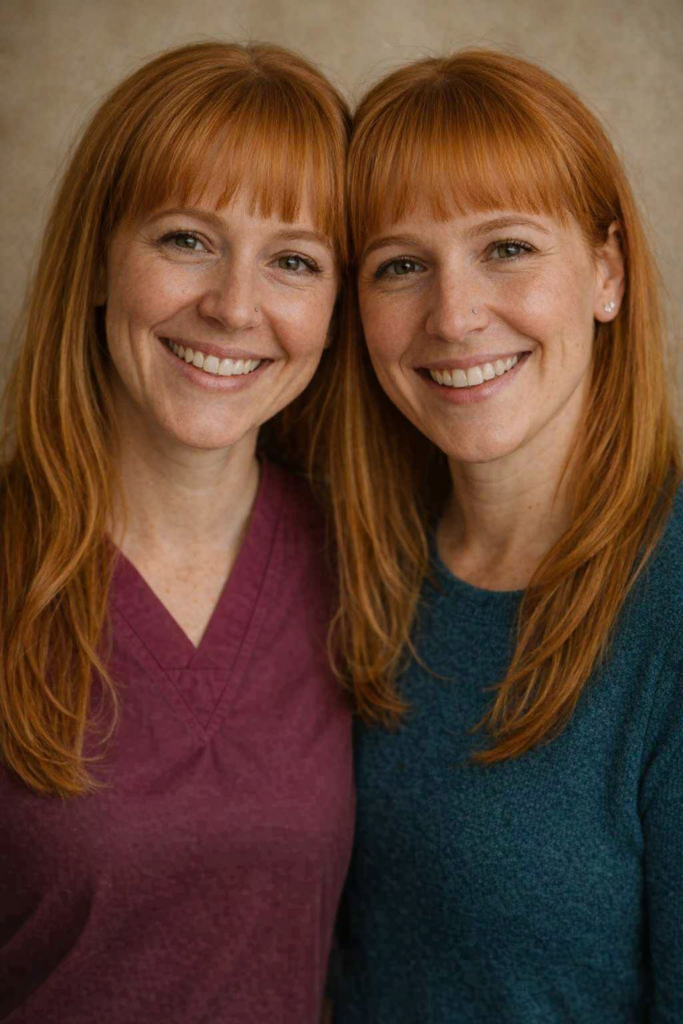
Marnie’s two younger sisters, Amber (left), 39, and Kellie, 38.
Amber’s eyes widened. “Us?”
Kellie blinked. “Wait—really?”
“Yes,” Marnie said. “We want her name to be Amber Kellie Thurston.”
Amber put a hand over her mouth. “Oh my gosh.”
Kellie grinned. “Well… we could go with Kellie Amber. You know, in honor of the coolest aunt.”
Amber snorted. “You are not the coolest aunt.”
“I absolutely am,” Kellie said. “But—” she looked at the baby girl, her expression softening “—Amber Kellie sounds perfect. You’re the older sister. It should be your name first.”
Amber’s eyes filled. “Kellie…”
“I mean it,” Kellie said. “I love it.”
Tim nodded. “It fits.”
Lori smiled through tears. “It really does.”
Emily leaned over the baby girl. “Hi, Amber Kellie. I’m your big sister.”
The baby stirred, stretching one tiny hand toward her.
Emily gasped. “She waved at me!”
Everyone laughed softly.
The Moment Settles
As the Gordons visited, the room filled with warmth — laughter, soft tears, gentle teasing, and the quiet awe that comes with welcoming new life.
When they finally left to give the new family time to rest, the room grew peaceful again.
Ethan sat beside Marnie, one arm around her, the twins sleeping in their bassinets, Emily curled at the foot of the bed with her bunny.
“We’re really a family of five now,” he said quietly.
Marnie leaned her head on his shoulder. “We are.”
Emily looked up sleepily. “I love our family.”
Marnie reached out and stroked her hair. “Me too, sweetheart.”
Outside, the October sun dipped lower in the sky, casting warm light across the room.
Inside, everything felt full — of love, of promise, of the beginning of a new chapter.
The Quiet Kind of Brave, Again
Saturday, October 18 — Evening
The hospital room had settled into a warm hush by early evening. The lights were dimmed, the October dusk filtering softly through the blinds. Both twins slept in their bassinets — tiny chests rising and falling in perfect rhythm — and Emily was curled up in the recliner, her bunny tucked under her chin, fast asleep after a long and exciting day.
Ethan sat on the edge of Marnie’s bed, one hand resting lightly on her leg, the other holding the tiny pink hospital hat their daughter had worn earlier. Marnie leaned back against her pillows, her hair loose around her shoulders, her face tired but peaceful.
For a long moment, neither of them spoke. They didn’t need to. The room itself seemed to breathe with them.
Finally, Ethan said softly, “You know what today is.”
Marnie smiled, eyes drifting toward the bassinets. “I do.”
He reached for her hand. “You thought about it earlier, didn’t you?”
“Of course I did,” she whispered. “How could I not?”
She touched her nose ring – her “pearl of wisdom,” the same one she was wearing the day Emily was born – feeling the small stud beneath her fingertip.
“October 18,” she said quietly. “The day I walked into that piercing studio with shaking hands and walked out feeling… different. Braver. More myself.”
Ethan nodded. “And now it’s the day our twins were born.”
Marnie’s eyes softened. “I still can’t believe Dr. Klein’s prediction was perfect. I mean… exactly perfect.”
“She’s good at her job,” Ethan said with a small smile. “But this? This feels like more than timing.”
Marnie exhaled, her voice barely above a whisper. “It feels like… a circle closing. Or maybe opening.”
Ethan shifted closer, brushing a strand of hair from her face. “Tell me.”
She looked at the twins — their tiny faces relaxed in sleep, their hands curled into soft fists.
“When I was twenty‑five,” she said, “I didn’t know what bravery looked like. I thought it had to be loud. Dramatic. Something other people noticed.” She touched the side of her nose gently. “But that day… it was just me choosing to be a little more myself. Quietly.”
Ethan squeezed her hand. “And today?”
“Today,” she said, her voice thickening, “I did something brave again. Not loud. Not dramatic. Just… bringing two new lives into the world. At forty‑one. With all the risks and fears and hopes that come with that.”
She blinked back tears. “And they came on the same day. The exact same day.”
Ethan leaned his forehead against hers. “Because you’re still that woman. The one who chooses courage quietly. Steadily. Every time.”
Marnie let out a soft, shaky laugh. “I don’t always feel brave.”
“You don’t have to feel it,” Ethan said. “You live it.”
They sat like that for a moment — foreheads touching, breaths mingling, the room wrapped in the soft hum of newborn sleep.
After a while, Marnie whispered, “They’ll always remind me.”
“Of what?” Ethan asked gently.
“That I’ve been brave before,” she said. “And I can be brave again.”
Ethan kissed her forehead. “You already are.”
She looked at the twins again — Ethan Allen II and Amber Kellie — sleeping peacefully under the soft glow of the room’s single lamp.
“They’re our quiet kind of brave,” she said.
Ethan smiled. “Just like their mom.”
Emily stirred in the recliner, mumbling something about “baby brother” and “baby sister,” then settled again.
Marnie reached for Ethan’s hand once more, threading her fingers through his.
“Thank you,” she whispered.
“For what?”
“For being here. For believing in me. For… all of this.”
Ethan looked at her with that steady, gentle love he’d carried since the beginning. “There’s nowhere else I’d ever be.”
Outside, the October night deepened, cool and calm.
Inside, the Thurstons rested — a family of five, wrapped in warmth, in meaning, and in the quiet kind of brave that had carried them all the way here.
Chapter 2 – The Season of Beginnings
Friday, November 14
Ewen-Trout Creek School
The last period of the day always had a certain restless hum, but on the Friday before deer season, it was practically vibrating. The hallways of Ewen‑Trout Creek School had been buzzing since morning — blaze-orange jackets stuffed into lockers, whispered plans about camp breakfasts, and the unmistakable scent of cold air clinging to students who’d slipped outside during lunch.
In Allison Heikkila’s ninth‑grade English classroom, the energy was no different.
She tried to keep the discussion on The Outsiders moving, but half the class was already mentally in the woods. A few boys in the back were comparing the merits of different scopes under their breath; two girls near the windows kept glancing outside as if snow might suddenly appear. Even the fluorescent lights seemed to hum with anticipation.“All right,” Allison said, clapping her hands lightly as the bell rang. “Have a good weekend. Be safe out there. And remember — Monday we’re back to essays, not deer stories.” A few groans rose, but they were good‑natured. Backpacks zipped. Boots thudded. Students spilled into the hallway, voices echoing off the cinderblock walls. Clara Juntunen lingered near her desk, tucking a strand of hair behind her ear. Emma Koskinen hovered beside her, hands wrapped around the straps of her backpack.
“Mrs. Heikkila?” Clara asked. “Do you have a minute?”
“Of course.” Allison smiled, leaning against her desk. “What’s up?”
Clara’s eyes were bright — the kind of bright that meant she was trying not to look too excited. “Basketball tryouts start Monday.”
“I know,” Allison said. “I’ve already heard Coach Rantala pacing the halls like a caged animal.”
Clara laughed. “I’m really looking forward to it. I mean… varsity. It still feels unreal.”
“You’ve earned it,” Allison said. “You’ve worked hard since sixth grade.”
Clara’s smile widened, but she nudged Emma gently with her elbow. “And Emma’s thinking about trying out too.”
Emma’s cheeks flushed pink. “I… might. Maybe. I don’t know yet.”
Allison softened her voice. “You don’t have to decide right this second.”
Emma nodded, eyes on the floor. “I just… I’ve never played before. Not really. I don’t want to look stupid.”
“You won’t,” Clara said immediately, her voice firm in that quiet way she had. “You’re fast. And you’re good at reading people. That matters.”
Allison watched the exchange with a warmth that settled deep in her chest. “Emma,” she said gently, “if you want to try, Coach Rantala will teach you. And Clara will be there. You won’t be alone.”
Emma looked up, meeting Allison’s eyes. “You really think I could do it?”
“I do,” Allison said. “But what matters is whether you want to.”
Emma didn’t answer, but the small, hopeful curve of her mouth said enough.
Allison’s phone buzzed in her pocket. She glanced at the screen.
Erik: Patrol all day tomorrow. Should be able to swing by camp mid‑afternoon. Save me some coffee?
She smiled, thumbs tapping a quick reply.
Allison: Always. Dad and Jerry will be there by 7. I’ll head out early.
Another buzz.
Erik: Be safe. M-28 is slick. See you in the woods.
She slipped the phone away, still smiling.
“Erik?” Clara asked, perceptive as always.
“Yep,” Allison said. “He’ll be on patrol for opening day, but he thinks he can stop by camp for a bit.”
“Nice,” Clara said. “My mom says half the county disappears into the woods tomorrow.”
“She’s not wrong,” Allison said. “It’s practically a holiday.”
The girls gathered their things. Clara gave a small wave; Emma offered a shy smile. “Have a good weekend, Mrs. Heikkila.”
“You too,” Allison said. “And Emma? Think about it. That’s all.”
Emma nodded once, more confidently this time. “I will.”
When they left, the room fell into a rare, peaceful quiet. Desks sat slightly askew, a few papers fluttered on the bulletin board, and the faint smell of pencil shavings lingered in the air.
Allison gathered her bag, turned off the lights, and locked the classroom door. The hallway was nearly empty now, the earlier buzz fading into the soft echo of distant footsteps.
She stepped outside into the sharp November air. The sky was a pale, washed‑out blue, the kind that promised colder nights ahead. Her breath puffed in front of her, and somewhere in the distance, she could almost imagine the crack of a rifle echoing through the woods.
It was deer season mode. It settled over her like a familiar coat — the rhythm of the region, the pulse of home.
She pulled her jacket tighter and headed toward her truck, ready for the weekend to begin.
Saturday, November 15
Besonen Deer Camp, Calderwood Road
The woods were still waking up when Allison pulled her truck onto the narrow two‑track leading to the Besonen family deer camp. Frost clung to the tamaracks and the last stubborn leaves of the popples, and the air held that unmistakable November bite — the kind that seeped through gloves and made every breath feel sharp and clean.
Her dad’s old Ford was already parked beside the cabin, alongside Uncle Jerry’s truck. Smoke curled from the stovepipe, thin and blue against the pale morning sky.
She stepped out, boots crunching on the frosted ground.
Inside, the cabin was warm, smelling of coffee, woodsmoke, and the faint metallic tang of gun oil. Art Besonen stood at the counter pouring himself a second cup, his blaze‑orange hat already on his head. Jerry sat at the table, lacing his boots with the slow, practiced motions of someone who’d done this every November for fifty years.
“Well, look who finally decided to show up,” Jerry said, grinning.
“It’s 7:05,” Allison said, hanging her coat. “I’m practically early.”
Art snorted. “Early is when the coffee’s still boiling, not when it’s ready to drink.”
Allison kissed his cheek anyway. “Morning, Dad.”
“Morning, kiddo.”
They headed out to their stands not long after, the woods quiet except for the occasional distant crack of a rifle. The sun climbed slowly, turning the frost to glitter. It was a good morning.
Around 10:30, the sound of tires on the gravel road drifted through the trees. Allison looked up from her thermos just as a DNR truck eased into the clearing.
Erik stepped out, brushing pine needles from his uniform pants. His cheeks were red from the cold, and his breath puffed in front of him as he walked toward them.
“Morning,” he said, lifting a hand.
“’Bout time you got here,” Jerry called from the porch. “We were starting to think you’d forgotten us.”
“Forgotten you?” Erik said. “I’ve been checking camps since before sunrise. You’re lucky I made it before lunch.”
Art clapped him on the shoulder. “Good morning for it?”
“Pretty good,” Erik said. “Everyone’s been squared away so far. No issues. Checked a few camps off Golden Glow Road, a couple on Gardner Road. Quiet morning.”
“That’s how we like it,” Art said.
They all headed inside, grateful for the warmth. Jerry poured Erik a cup of coffee without asking — a sign of acceptance as clear as any handshake.
Erik took a sip and sighed. “That’s the good stuff.”
“Better than that gas station swill you drink on patrol,” Jerry said.
“Hey,” Erik replied, “when it’s five a.m. and twenty degrees, you take what you can get.”
Allison watched them with a soft smile. This was the rhythm she’d grown up with — the easy teasing, the shared stories, the quiet respect. But this year felt different. Fuller. Warmer. Like Erik wasn’t just visiting camp — he belonged here.
Art leaned back in his chair, studying Erik with that thoughtful, measuring look he sometimes had. “You staying long?”
“Just a bit,” Erik said. “I’ve got to get back out before noon. But I wanted to stop in.”
Art nodded slowly. “Glad you did.”
It was simple, understated — but Allison felt the weight of it. Her dad didn’t hand out approval lightly. And Erik received it with the same quiet steadiness he brought to everything.
Jerry launched into a story about the time he and Art got stuck on a logging road in ’78, and Erik listened with genuine interest, laughing at all the right moments. Allison leaned against the counter, watching the three of them — her dad, her uncle, her husband — and felt something settle deep inside her.
This deer season wasn’t like the others. This one was the beginning of something new.
She thought of the land near Trout Creek, the parcel they’d walked together, the way Erik had stood with his hands in his pockets, imagining where the house might sit. She thought of the spring ahead, the clearing, the building, the life they were shaping.
Outside, a gust of wind rattled the cabin windows. Inside, the coffee was hot, the laughter easy, and the future felt close enough to touch.
Monday, November 17
Ewen‑Trout Creek Gymnasium, After School
The gym smelled like floor polish, old leather, and the faintest trace of popcorn from Friday’s boys’ scrimmage. The squeak of sneakers echoed off the high rafters as girls trickled in, dropping backpacks on the bleachers and pulling on practice jerseys.
Coach Rantala stood at center court, arms crossed, whistle hanging from a lanyard around his neck. He was already in full mid‑season mode — clipboard in hand, expression somewhere between stern and amused.
“Combined practice today,” he called out as the girls gathered. “JV and varsity. Numbers are small, so we’re all working together. Let’s get moving.”
Clara Juntunen jogged onto the court with the easy confidence of someone who’d been waiting for this day since the last buzzer of eighth grade. Her ponytail bounced behind her, and she dribbled a ball with practiced rhythm, warming up her wrists.
Emma Koskinen slipped in a moment later, clutching her water bottle like a lifeline. She looked around the gym as if expecting someone to tell her she didn’t belong — until she spotted Clara.
Clara waved her over. “You made it.”
Emma exhaled, a nervous smile flickering. “Yeah. I… figured I should at least try.”
“You’re going to be fine,” Clara said. “Just stick with me.”
Coach blew his whistle. “Line drills! Let’s see what kind of shape you’re all in.”
The girls groaned, but they lined up. Clara took off with long, efficient strides, her form clean and controlled. Emma followed, not as fast, but steady — and more determined than she’d expected to feel.
By the third sprint, her lungs burned, but Clara jogged back beside her, matching her pace.
“You’re doing great,” Clara said between breaths. “Just keep moving.”
Emma nodded, pushing through.
Next came passing drills. Coach paired them together — partly because of numbers, partly because he’d already noticed the way they gravitated toward each other.
“Chest passes,” he barked. “Quick hands. Eyes up.”
Clara fired the ball to Emma with a crisp snap. Emma caught it cleanly, surprised by her own reflexes, and sent it back with more confidence than she’d had a minute earlier.
“Nice,” Clara said.
They moved into bounce passes, then overheads. Something unspoken clicked — a rhythm, a trust, a sense of where the other would be before she got there. Coach Rantala paused mid‑stride, watching them with a raised eyebrow.
“Juntunen. Koskinen.” He pointed his whistle at them. “You two played together before?”
“No,” Clara said.
Emma shook her head.
“Huh.” He scribbled something on his clipboard. “Keep it up.”
They shared a quick, shy grin.
Scrimmage time came next. Clara was placed with the varsity group, Emma with the JV, but the teams blended on the court. Clara moved like she belonged there — quick cuts, sharp passes, a soft layup off the glass. Emma hung back at first, unsure, but when Clara signaled for her to cut toward the basket, she did — and Clara threaded a perfect pass through two defenders.
Emma caught it, startled, and tossed up a shot. It hit the rim, bounced once, and dropped in.
Her face lit up.
Clara pumped a fist. “Yes! See? You’ve got this.”
Coach Rantala blew his whistle again. “Koski—” He paused, correcting himself. “Koskinen. Nice hustle.”
Emma’s cheeks flushed pink, but this time it wasn’t from exertion.
Practice wound down with free throws. The gym grew quieter, the rhythmic thump of balls echoing in the cavernous space. Clara sank shot after shot, her form smooth and practiced. Emma missed her first two, then her third, but on the fourth, Clara stepped beside her.
“Bend your knees a little more,” Clara said softly. “And follow through.”
Emma tried again. Swish.
She stared at the net, stunned. “I… did it.”
“Told you,” Clara said, bumping her shoulder lightly.
When Coach finally dismissed them, the girls gathered their things, breathless and flushed. Emma looked tired, but in a good way — the kind of tired that came from doing something she didn’t think she could.
As they walked toward the locker room, Emma glanced at Clara. “Thanks for… you know. Not letting me chicken out.”
Clara shrugged, but her smile was warm. “I’m glad you came.”
Emma hesitated, then added, “I think I want to keep coming.”
Clara grinned. “Good. I’d miss you if you didn’t.”
The gym lights hummed overhead as the girls disappeared down the hallway, their footsteps echoing off the tile. Outside, the November sky was already dimming, the cold settling in for the long season ahead.
But inside the school, something new had begun — a friendship deepening, a team forming, and a quiet, unmistakable chemistry taking root on the court.
Thursday, November 20 & Friday, November 21
The gym smelled faintly of floor wax and adrenaline. The lists had gone up on the bulletin board outside the locker room—two sheets of paper taped side by side, varsity and JV. Clara stood with her backpack slung over one shoulder, scanning the names. Her own appeared halfway down the varsity column: Juntunen, C. She blinked once, then smiled, small and sure.
Emma found hers on the JV list, just below:
Koskinen, E.
She exhaled, the tension leaving her shoulders. “We did it,” she said softly.
Clara grinned. “You did it. I just got lucky.”
“Luck doesn’t box out like you do,” Emma teased, bumping her arm. Their laughter was quiet, the kind that stayed between friends who didn’t need to make a scene.
Inside the gym, practice was already underway. Sneakers squeaked, the ball thudded against the hardwood, and Coach Rantala’s whistle cut through the noise. Clara and Emma moved easily together—passes crisp, timing instinctive. They weren’t showy, just fluid, reading each other like they’d been doing it for years.
From the doorway, Erik Heikkila watched for a few minutes, still in his DNR uniform, the scent of pine and cold air clinging to him. Allison had texted him the news; he’d swung by on his way home. He leaned against the wall, unnoticed, until the drill ended.
When the girls came off the court, he stepped forward. “You two make a good team,” he said. “I could see it from the hallway—how you read each other for passes. That’s rare.”
Emma blushed. “Thanks, Officer Heikkila.”
Clara smiled, tugging at her ponytail. “We just… kind of know where the other’s going.”
“That’s what makes a team work,” Erik said. “Keep that up.”
Allison caught his eye from across the gym, pride written all over her face. She mouthed, They’re good, and he nodded.
Friday was the start of another deer camp weekend, and school was closed. By Thursday evening, Allison and Erik were on Calderwood Road, headlights cutting through the dark forest. The Besonen cabin glowed ahead, smoke curling from the chimney. Inside, Art and Jerry were already settled—coffee mugs on the table, rifles cleaned, the rhythm of camp steady and familiar.
Erik hung his jacket by the door, still half in patrol mode. “Quiet week,” he said, pouring himself coffee. “Only one stop worth mentioning.”
Art looked up. “What happened?”
“Couple of guys parked too close to the road, rifles out before daylight. I reminded them about the safety zone. They were polite—just careless. But one had his kid with him, maybe twelve. I told him, ‘You’re teaching him every time you step out of that truck.’ He nodded. I think it stuck.”
Art smiled, slow and approving. “That’s the kind of talk that makes a difference.”
Jerry chuckled. “You sound like Dad.”
Erik shrugged. “Maybe that’s not a bad thing.”
Allison watched the exchange, warmth settling in her chest. The respect between them was quiet, earned.
Friday morning broke cold, 13 degrees, and clear. Frost rimmed the leaves, and the woods held their breath. Art’s shot came first—9:45 a.m.—a clean, steady crack echoing through the timber. Erik heard it from his stand a few hundred yards away and smiled. When he reached Art, the older man was already kneeling beside an eight‑point buck, hand resting on its shoulder.
“Nice one,” Erik said.
“Been watching him all week,” Art replied. “Finally stepped out broadside.”
They worked together, methodical and respectful. Art drew his knife, made the careful incision from sternum to pelvis, avoiding the stomach, steam rising in the cold air. Erik held the legs steady, passing paper towels and a length of rope. When the field dressing was done, they loaded the deer onto the sled and hauled it back to camp, muscles burning, breath visible in the crisp air.
By early afternoon, Erik’s turn came. A rustle in the brush, a flash of antlers—then the clean shot at 12:58 p.m. His own eight‑point dropped just inside the clearing. He approached slowly, hand on his rifle, then knelt. “Thank you,” he murmured, the way Art had taught him.
He field‑dressed the deer with the same precision—steady hands, practiced movements. When he finished, he tied the legs, dragged the sled back toward camp, and found Art waiting with a grin.
“Looks like we’re both eating well this winter,” Art said.
“Guess so,” Erik replied, smiling.
They hung both deer from the gambrel behind the cabin, the blaze orange jackets bright against the gray November woods. By late afternoon, the truck was loaded for the trip to the processor in Bruce Crossing—venison steaks, roasts, and sausage to come. The day had been good, honest, and full.
Inside, Allison poured coffee for everyone, the cabin warm with laughter and the smell of wood smoke. Erik caught her eye across the table, and she smiled—the kind of smile that said this is home.
Friday Evening, November 21
The light was fading fast by the time the four of them settled inside the Besonen camp. The cabin glowed with the soft amber of propane lanterns, the woodstove ticking as it worked to push back the November chill. Outside, the two eight‑point bucks hung from the gambrel, silhouettes against the last blue of the sky. They’d planned to haul the deer to the processor that afternoon, but after the long drag and the cold settling in, they decided to wait until morning. It just made more sense anyway, as it was better for the deer to wait overnight, and for Art, it was more convenient, since he and Jerry were heading out in the morning. Plus – Allison’s coffee was too good to pass up.
Inside, the air smelled of coffee, woodsmoke, and the faint metallic tang of cold air clinging to jackets hung by the door.
Allison poured steaming mugs for everyone, handing them around before settling beside Erik at the small kitchen table. Art and Jerry sat across from them, both still wearing their flannel shirts, sleeves rolled up, faces ruddy from the long day.
Art took a slow sip. “Been a good week,” he said, voice low and content. “Quiet. Cold enough to keep the deer moving. And now we’ve got two nice bucks hanging out there.”
Jerry nodded. “Not bad for a couple of old guys and a conservation officer,” he teased.
Erik chuckled. “I’ll take that as a compliment.”
“It is,” Jerry said. “You shoot clean. You hunt clean. Dad would’ve liked that.”
Erik glanced down at his mug, humbled. “I try to do things right. Learned from good people.”
Allison nudged him gently with her knee under the table. Art noticed, and a small smile tugged at the corner of his mouth.
Art leaned back in his chair. “You know, this week… it’s been good for me and Jer. We don’t get as many years at camp as we used to. Life gets busy. But being out here—same woods, same trails—it reminds you what matters.”
Jerry nodded. “Yeah. And having you two come up tonight… feels like the next generation’s stepping in.”
Allison’s cheeks warmed. “We love it here. Always have. This place is part of who we are.”
Erik looked around the cabin—the old knotty‑pine walls, the faded deer‑camp photos, the coffee pot that looked older than he was. “I get why you love it,” he said. “There’s something about this place. It’s honest.”
Art’s eyes softened. “That’s the U.P. for you. Hard winters, long drives, small towns… but good people. Good land. You take care of it, it takes care of you.”
Jerry raised his mug. “Amen to that.”
They clinked their cups lightly, the sound small but meaningful.
After a moment, Jerry added, “Mike and Josh’ll be up tomorrow. They’re itching to get their turn. Told ’em we’d leave the place warmed up for ’em.”
Art chuckled. “They’ll hunt hard. Those boys don’t mess around.”
Allison smiled. “They’re good guys. It’ll be fun for them to have the camp to themselves for a few days.”
“Yeah,” Jerry said. “They’ll stay till Wednesday, then head back to Marquette for Thanksgiving. Tradition.”
The word hung in the air, warm and familiar.
Erik set his mug down. “Speaking of tradition… I had a moment today that reminded me why I do this job.” He looked at Art and Jerry. “When I was out on patrol earlier this week, I stopped a couple hunters who were too close to the road and out before legal shooting light. They weren’t trying to break rules—just excited. But the dad had his kid with him. And I told him, ‘Every time you step out of that truck, you’re teaching him something.’”
Art nodded slowly. “That’s exactly right.”
Jerry added, “Kids watch everything. More than we think.”
Erik continued, “The dad took it seriously. You could see it hit him. And that’s what I want—people to hunt safe, hunt right. Not because they’re scared of a ticket, but because they respect the land and the tradition.”
Art’s voice was quiet. “You’re the kind of officer we need up here.”
Erik swallowed, the compliment landing deeper than he expected. “Thank you.”
Allison reached for his hand under the table, giving it a gentle squeeze. He squeezed back.
Outside, a gust of wind rattled the cabin siding. Inside, the warmth held steady.
Jerry stretched, joints popping. “Well, I’d say today was a success. Two bucks down, good company, and coffee that doesn’t taste half bad.”
Allison laughed. “That’s because I made it.”
“That explains it,” Jerry said with a wink.
Art looked around the table, his expression softening. “I’m glad you’re here,” he said simply. “Both of you.”
Erik met his eyes. “We wouldn’t want to be anywhere else.”
The four of them sat in comfortable silence for a moment, listening to the crackle of the stove and the wind in the trees. It was the kind of quiet that only comes when people feel completely at home.
Finally, Allison spoke. “This… this is what I love about the U.P. The land, the people, the traditions. It’s not fancy. But it’s real.”
Art nodded. “That’s all we ever wanted to pass down.”
Erik looked at her, then at the two men who had shaped her life. “You did,” he said. “And we’ll keep it going.”
Jerry raised his mug one more time. “To family. To the U.P. And to a good day.”
They toasted again, the warmth of the moment settling deep into the walls of the old cabin—another memory added to decades of them, another story that would be told in years to come.
Thanksgiving Week
Wednesday’s half‑day always felt a little lighter, a little brighter. Students spilled out of Ewen‑Trout Creek by noon, chattering about deer camp, cousins, and pumpkin pie. By 1:00, Allison was home, still carrying the faint scent of dry‑erase markers. Erik had already packed the truck: overnight bags, a cooler, and a small tote of pies Allison had baked the night before.
“Ready?” he asked, leaning against the doorframe.
Allison smiled, slipping her hand into his. “Let’s go see my folks.”
The drive east toward Negaunee was quiet in the best way—late‑November woods, patches of snow in the shaded ditches, the sky a pale, wintry blue. They talked about school, about Clara and Emma’s excitement for the season, about the deer camp weekend that still lingered warmly in their minds.
By the time they pulled into Art and Lorraine’s driveway, the Besonen house was already alive with Thanksgiving preparations. The windows glowed, and the smell of roasting turkey drifted out as soon as they stepped inside.
“Allie!” Lorraine hurried from the kitchen, wiping her hands on a towel before pulling her daughter into a hug. “And Erik—come in, come in. You must be starving.”
Erik laughed. “I won’t say no to whatever you’ve got going.”
“Oh, I’ve got plenty,” Lorraine said, ushering them toward the kitchen. “Turkey’s in the oven, pies are cooling, and Art’s been sneaking the rolls when he thinks I’m not looking.”
From the recliner in the living room, Art called out, “I only took one!”
Lorraine shot him a look that said she knew better.
Allison leaned over the back of the recliner and kissed her dad’s cheek. “Hi, Dad.”
Art’s eyes softened. “Good to have you home, sweetheart.”
Erik shook his hand, and Art held on a moment longer than usual. “Glad you’re here,” he said quietly.
Erik nodded. “Wouldn’t miss it.”
A Quiet Thanksgiving Eve
Later, after dinner and after Lorraine insisted they all “sit and relax for once,” the four of them gathered in the living room with coffee. The house felt warm and lived‑in. Family photos lined the walls, the hum of the furnace provided background sound, and Lorraine washed dishes in the kitchen. Art settled back in his chair. “Been a good week,” he said. “Got the deer processed Saturday. They did a fine job with the cuts.”
Erik nodded. “I’m looking forward to the sausage. Bill’s already jealous. He wants some when I come up to Baraga next.”
Jerry wasn’t there—he’d headed home Saturday with Art—but his presence lingered in the stories they told. Art chuckled as he recounted the week at camp, the cold mornings, the quiet woods, the way the coffee tasted better out there than anywhere else.
Lorraine joined them with her own mug. “I’m glad you boys had a good hunt,” she said. “And I’m glad you’re all home safe.”
Art looked at Erik over the rim of his cup. “You know… you handled yourself well out there. Not just the shot. The whole thing. You hunt with respect.”
Erik felt the compliment settle deep. “I learned from good people,” he said. “And I’m grateful for that.”
Allison smiled softly. She could see the bond forming. It was one that was slow and steady, built on shared values rather than words.
Dreaming Forward
Later that night, after Lorraine went to finish a pie crust and Art dozed lightly in his chair, Allison and Erik sat at the kitchen table with her laptop open between them.
“Okay,” Allison said, pulling up a bookmarked folder. “Contractors. We should start narrowing this down.”
Erik leaned in. “Feels real now, doesn’t it?”
She nodded. “It does. We’ve talked about it for months, but… now that we’ve got the land, and the season’s slowing down… I can picture it.”
“Me too,” he said. “Waking up out there. Coffee on the porch. Woods all around.”
Allison smiled. “A mudroom big enough for all your gear.”
“And a kitchen big enough for all your baking,” he countered.
They clicked through websites—local builders with suggested choices all the way from St. Ignace to the east to Superior to the west, custom home designers, floor plans. They compared notes, debated siding colors, talked about the number of bedrooms, the layout, the windows that would face the woods.
At one point, Allison rested her head on his shoulder. “This is really happening,” she whispered.
Erik kissed the top of her hair. “Yeah. It is.”
From the doorway, Art watched them for a moment before speaking. “You two planning your future home?”
Allison looked up. “We are.”
Art nodded slowly, pride softening his features. “Good. Build something that lasts. Something that feels like you.”
Erik met his gaze. “That’s the plan.”
Art gave a small, approving grunt. “You’ll do it right.”
Thanksgiving Day
Thursday was full—laughter, food, stories, the familiar chaos of a Besonen holiday. Lorraine’s table overflowed: turkey, mashed potatoes, rutabaga, rolls, cranberry sauce, pies. Art carved the turkey with the same steady hands he used in the woods. Erik helped with dishes. Allison and Lorraine talked in the kitchen about school, about the girls’ basketball season, about the house plans.
At one point, Lorraine touched Allison’s arm. “I’m proud of you,” she said softly. “And I’m glad Erik’s part of the family.”
Allison’s eyes warmed. “Me too.”
By late Friday afternoon, the sky had turned gray with the promise of snow. Erik loaded their bags into the truck while Allison hugged her mother tightly.
“Drive safe,” Lorraine said. “And come back soon.”
“We will,” Allison promised.
Art shook Erik’s hand firmly. “You’ve got patrol this weekend?”
“Yeah,” Erik said. “Bill’s taking Monday and Tuesday, and he took yesterday and today, so I’m covering Saturday and Sunday.”
Art nodded. “Good man. Tell him I said hello.”
“I will.”
As they pulled out of the driveway, Allison looked back at the house—warm lights glowing in the windows, her parents waving from the porch.
Erik reached over and took her hand. “Good visit.”
“The best,” she said.
Erik’s Ford F-350 rolled onto US-41, the U.P. stretching out before them.
Monday, December 1
The first Monday after deer season always felt a little strange at Ewen‑Trout Creek School—like the whole building was waking up from a long nap. The hallways buzzed with leftover stories from camp, the kind that spilled out in half‑whispered excitement: “My uncle got a ten‑point,” “We saw wolves near the swamp,” “Grandpa fell asleep in the blind again.”
Allison Heikkila smiled as she stepped into her 9th‑grade classroom, coffee in hand, scarf still dusted with snowflakes. She knew better than to fight the energy. Instead, she leaned into it.
“Bell‑ringer,” she said as students settled in. “Write about your deer camp or your Thanksgiving. One page. Doesn’t have to be polished—just get your thoughts down.”
Clara and Emma exchanged a look—half amusement, half relief. They both liked the gentle landing Allison always gave them after long weekends.
Clara wrote about the quiet of the woods, the way the frost clung to the branches, and how she’d spent Thanksgiving helping her mom bake. Emma wrote about her family’s loud, chaotic dinner and the way her little cousins kept stealing rolls off the table.
Allison walked the aisles, reading over shoulders, offering a nod here, a soft “nice detail” there. She paused behind Clara, noticing the careful handwriting, the way Clara captured the stillness of the woods with surprising maturity.
“You’ve got a poet’s eye,” Allison murmured.
Clara blushed. “Thanks.”
After School Practice
By 3:30, the gym was alive again—basketballs echoing, sneakers squeaking, Coach Rantala’s whistle slicing through the air. Varsity and JV practiced together, numbers still small enough that the two squads blended into one.
Clara moved with quiet confidence. She wasn’t loud, but she was everywhere—cutting to the basket, boxing out, making crisp passes that seemed to find teammates before they even called for the ball.
Emma, meanwhile, had found her rhythm. She wasn’t flashy, but she was steady—good footwork, good instincts, always in the right place. And when she and Clara were on the floor together, something clicked.
During a scrimmage, Clara drove toward the lane, drawing two defenders. Without looking, she kicked the ball out to the wing—right where Emma had slid into position. Emma caught it cleanly and sank a mid‑range jumper.
A few teammates whistled. Someone muttered, “Those two, man…”
Coach Rantala blew the whistle. “Nice read, both of you.”
Emma grinned, cheeks flushed. Clara just nodded, but her eyes sparkled.
A Quiet Word
After practice, as the girls grabbed their bags and waited for the activity bus, Coach Rantala called out, “Clara? Got a minute?”

(left to right) 9th graders Emma Koskinen and Clara Juntunen play basketball for Ewen-Trout Creek.
Emma gave her a quick thumbs‑up and headed toward the hallway.
Clara walked over, heart thumping. Coach Rantala leaned against the bleachers, arms crossed, expression thoughtful.
“You’re doing good work,” she said. “Really good. You see the floor better than most upperclassmen.”
Clara swallowed. “Thank you.”
“And you don’t force things. You make the right play, even if it’s not the flashy one. That’s leadership, Clara. Quiet leadership, but leadership all the same.”
Clara blinked, unsure what to say.
Coach softened her tone. “Don’t be afraid to use your voice a little more. The team listens to you, even when you don’t realize it.”
Clara nodded slowly. “I’ll try.”
“I know you will.”
Waiting for the Bus
Clara found Emma by the trophy case, backpack slung over one shoulder.
“What’d he say?” Emma asked.
Clara shrugged, but her smile gave her away. “Just… that I’m doing okay.”
Emma bumped her shoulder. “You’re doing more than okay.”
Clara looked at her friend, encouraging and always ready with a quiet confidence of her own. “You too,” she said. “That shot you made? Perfect timing.”
Emma’s cheeks warmed. “It’s easier when you’re the one passing to me.”
They stepped outside into the cold December air, breath puffing in small clouds, the sky already darkening. The activity bus pulled up, headlights cutting through the early winter dusk.
As they climbed aboard, Clara glanced back at the school with its windows glowing and the gym lights still on. Something inside her settled. Basketball season was just beginning, but already she felt the shape of it: challenge, growth, friendship, and the steady rhythm of a team finding its heartbeat.
Monday Evening, December 1
Snow had begun to drift across Hall Road by the time Allison pulled into the driveway, the sky already dimming into that deep blue that only early December could make. The house glowed softly from the kitchen window, the porch light catching the flakes as they fell.
Inside, Olive greeted her first—tail thumping, whole body wiggling—before trotting back toward the kitchen as if to say, Come on, Mom, you’ve got work to do.
Allison laughed, hung up her coat, and set to making supper. Spaghetti with meatballs was simple, comforting, and exactly what a Monday needed. By the time the sauce was simmering, the headlights of Erik’s truck swept across the front yard.
He stepped inside, stamping snow from his boots, cheeks flushed from the cold. “Smells amazing,” he said, leaning in to kiss her cheek.
“You picked a good night to work an extra shift,” she teased. “I made enough for an army.”
Erik chuckled. “Bill’s taking a long weekend with his family. Figured I’d cover today so he could have it.”
“That’s very you,” she said, handing him a plate. “Always making sure everyone else gets time with their family.”
He shrugged, but the compliment warmed him. “I like the work. And it’s quiet now that deer season’s over. Mostly checking camps, making sure folks cleaned up after themselves.”
They sat down at the small kitchen table, Olive lying at their feet, hopeful for a dropped noodle. The meal was simple, warm, grounding—exactly the kind of evening that made their little house feel like home.
Monday Night Football
After dishes were washed and leftovers tucked away, Erik settled onto the couch, remote in hand. “Packers and Vikings tonight,” he said. “Should be a good one.”
Allison brought her laptop to the armchair at first, finishing a bit of lesson planning—grading bell‑ringer writing, sketching out the week’s literature discussions. Olive hopped onto the couch beside Erik, head on his thigh, already half-asleep.
“You know,” Allison said after a while, closing her laptop, “I think I’m done for the night.”
Erik patted the cushion beside him. “Come watch with us.”
She curled up next to him, tucking her legs under a blanket. The game played on—green and gold against purple and white, the familiar rivalry filling the room with a comfortable background hum.
During a commercial break, Allison rested her head on Erik’s shoulder. “Feels like winter’s really here now.”
“Yeah,” he said. “We’ll get snow that sticks soon. Makes patrol different. Slower in some ways, harder in others.”
“You like it, though.”
He nodded. “I do. I like being out there. I like knowing the woods, the roads, the people. It’s the job I always wanted.”
She smiled softly. “And the place you always wanted.”
Erik looked toward the window, where snowflakes drifted past the glass. “Yeah. This is home.”
A quiet settled between them—warm, content, the kind that didn’t need filling.
After a few minutes, Allison spoke again. “I’ve been thinking about the Trout Creek land.”
“Me too,” Erik said. “Feels more real now that we’ve talked with your folks. And after Thanksgiving… I don’t know. I can picture it better.”
“What do you picture?” she asked.
He took a breath. “A house that fits us. Nothing huge. Just… solid. Warm. A place where we can come home after long days and feel like the world slows down.”
Allison’s eyes softened. “I want big windows. Facing the woods.”
“And a mudroom,” he added, grinning. “A real one. Not the tiny one we’ve got now.”
She laughed. “Deal.”
“And a porch,” he said. “Where we can drink coffee in the mornings.”
“And watch Olive chase squirrels,” she added.
Olive thumped her tail in her sleep, as if agreeing.
The game faded into the background again as they leaned into each other. Erik brushed a strand of hair behind Allison’s ear, his touch gentle, unhurried.
“You know,” he said quietly, “I didn’t think life could feel this steady. This… right.”
Allison’s breath caught—not from surprise, but from the depth of it. “Me neither.”
He rested his forehead against hers. “I trust you,” he said. “More than I’ve ever trusted anyone.”
She closed her eyes, letting the truth of it settle deep. “I trust you too. Completely.”
The moment wasn’t dramatic. It didn’t need to be. It was soft, warm, and rooted—two people who had found exactly where they were meant to be, in a small house on Hall Road, with snow falling outside and a golden retriever snoring between them.
The Packers scored. The crowd on TV roared. Olive shifted in her sleep.
And Allison and Erik stayed right where they were, wrapped in the quiet certainty of the life they were building together.
Friday, December 5
The first home game of the season always carried a special kind of electricity at Ewen‑Trout Creek. By the time the JV girls took the floor, the bleachers were already half‑full—parents, grandparents, hunters fresh out of the woods, and kids still wearing snow‑damp boots. The gym smelled of popcorn and winter coats, and the pep band warmed up in the corner with a few tentative notes.
Emma stood near the bench, bouncing lightly on her toes. She wasn’t nervous—not exactly—but she felt the flutter of anticipation in her stomach. Clara, already dressed in her varsity warm‑ups, leaned over and whispered, “You’ve got this.”
Emma smiled. “Thanks.”
JV Game
The JV game was scrappy, fast, and full of early‑season jitters. Emma didn’t score much, but she didn’t need to. She played smart defense, made clean passes, and grabbed a couple of rebounds that earned nods from the older girls watching from the sideline.
Coach Rantala, who oversaw both squads, clapped for her as she came off the floor. “Good instincts, Emma. Keep trusting them.”
She beamed.
In the stands, Allison nudged Erik. “She’s really coming into her own.”
Erik nodded. “She’s steady. Coaches love that.”
Olive wasn’t allowed in the gym, of course, but Allison still laughed imagining her golden retriever trying to chase the basketball across the court.
Varsity Game — Ewen‑Trout Creek vs. Watersmeet
By the time varsity warmed up, the gym was packed. Watersmeet always brought a crowd, and the rivalry had decades of history behind it.
Clara jogged onto the court with the starters, ponytail swaying, eyes focused. She didn’t look like a freshman—not in the way she carried herself, not in the way her teammates glanced toward her during warm‑ups.
From the opening tip, the game was tight. Watersmeet pressed hard, forcing quick decisions. Clara handled it with a calm that surprised even some of the seniors. She broke the press with sharp passes, found open teammates, and sank a clean mid‑range jumper late in the second quarter that brought the crowd to its feet.
Allison clapped so hard her hands stung. “That’s our girl!”
Erik grinned. “She’s seeing the floor like a senior.”
The game stayed close—possession by possession—until the final minute. Ewen‑Trout Creek led 46–44 when Clara intercepted a pass at half‑court, drove, and dished to a teammate for a layup that sealed the win. The final score: 50–44, Ewen‑Trout Creek.
As the buzzer sounded, the gym erupted. Clara’s teammates swarmed her, shouting and laughing. She didn’t bask in it—she just smiled, cheeks flushed, and hugged Emma when she came down from the bleachers.
“You were amazing,” Emma said.
“So were you,” Clara replied. “We’re just getting started.”
Allison and Erik in the Stands
As the crowd thinned, Allison and Erik made their way down to congratulate the girls. Clara’s face lit up when she saw them.
“You played with so much confidence,” Allison said, pulling her into a quick hug.
Erik added, “You made the right play every time. That’s leadership.”
Before Clara could respond, another familiar voice chimed in.
“Clara, sweetheart — that was incredible.”
Stephanie Juntunen, Clara’s mom, stepped forward, cheeks flushed from cheering, her winter coat still unzipped. She wrapped Clara in a tight hug, pride radiating from her.
“I’m so proud of you,” she said softly. “You looked like you belonged out there.”
Clara hugged her back. “Thanks, Mom.”
Emma joined them, followed closely by her parents Mark and Janelle Koskinen. Mark was still wearing his work jacket from the mill, and Janelle had a camera slung around her neck, the strap decorated with little blue flowers.
“You girls were fun to watch tonight,” Mark said, giving Emma’s shoulder a squeeze. “And that shot you hit in JV? Smooth as butter.”
Emma blushed. “Thanks, Dad.”
Janelle smiled warmly at both girls. “You two have such good chemistry. It’s like you always know where the other one is.”
Allison nodded. “They really do. It’s special.”
Erik added, “If they keep this up, Watersmeet’s not the only team that’s going to have trouble with them.”
Clara and Emma exchanged a shy but proud look — the kind that said we’re doing something real here.
The adults fell into easy conversation — Stephanie thanking Allison for being such a steady presence at school, Mark joking with Erik about the Packers game coming up on Sunday, Janelle showing a couple of photos she’d snapped during the varsity game.
For a few minutes, it felt like a small circle of warmth in the middle of a cold December night — parents, teachers, and two girls who were just beginning to understand what they were capable of.
As they all stepped out into the snowy parking lot, Clara and Emma walked side by side, their breath rising in clouds, their parents trailing behind in friendly chatter. The gym lights glowed behind them, and the season felt wide open.
The Weekend — Trout Creek Land
Saturday morning brought a quiet snowfall—soft flakes drifting down like feathers. Allison and Erik drove out to the Trout Creek parcel, boots crunching through the fresh layer as they walked the property line.
The woods were hushed, peaceful. The snow softened everything—the branches, the ground, even the air.
Erik stopped near a gentle rise overlooking a stand of tall pines. “I keep coming back to this spot,” he said. “Feels like where the house should sit.”
Allison slipped her gloved hand into his. “I can picture it. Big windows here. Morning light coming through the trees.”
“And the porch,” he added. “Right there.”
They stood together, imagining the shape of their future—walls, rooms, laughter, coffee, quiet mornings, and the life they were building one step at a time.
Olive bounded through the snow, nose dusted white, tail wagging wildly. She approved of the land wholeheartedly.
Early the Next Week — First Calls
On Monday evening, after school and patrol, Allison sat at the kitchen table with her laptop while Erik leaned over her shoulder.
“Okay,” she said. “Marquette contractor first?”
Erik nodded. “Let’s get a sense of timelines. And cost ranges.”
They made two calls—one to a builder in Marquette, one to another in Ironwood. Both were friendly, both gave rough estimates, both offered to schedule site visits after the holidays.
When they hung up, Allison exhaled. “This is really happening.”
Erik smiled, warm and certain. “Yeah. It is.”
Chapter 3 – The First Thaw
Monday, December 1
Pine City, Minnesota
The first day back after Thanksgiving always felt a little heavier, a little slower, as if the whole school was still digesting turkey and mashed potatoes. By the time Lily and Shane got home that evening, the sky had already gone dark, the house warm and softly lit, and Frodo had claimed his usual throne: the glider rocker in the living room, where he sat like a gray‑and‑white sentinel overseeing his kingdom.
Lily kicked off her shoes by the door and let out a long breath. “My sophomores were wired today. I swear, they came back with more energy than they left with.”
Shane chuckled from the kitchen as he set his tool bag down. “Must be nice. My water heater install this afternoon was in a basement that felt like a meat locker. I think my fingers are still thawing.”
Frodo offered a single, authoritative mrrrp from the rocker, as if weighing in on the hardships of both professions.
Lily smiled and walked over to scratch behind his ears. “Frodo says he had a very productive day supervising the couch.”
Another meow, this one more self‑satisfied.
Shane came into the living room, loosening the collar of his work shirt. “You know,” he said, settling onto the couch beside her, “I keep thinking about Thanksgiving with the Thurstons. That was a good day.”
“It really was.” Lily leaned back, letting her head rest on the cushion. “Emily was so excited to show us her new books. And The Deuce—oh my gosh, that kid is going to be climbing furniture by Christmas.”
Shane laughed. “He’s got Ethan’s energy. And Amber… she’s so tiny. I still can’t believe they have three kids now.”
“Neither can Marnie,” Lily said with a grin. “But she’s so good with them. They both are.”
They sat in a comfortable silence for a moment, the kind that only comes when two people have lived together long enough to share quiet without needing to fill it. Frodo shifted, curling his paws under himself like a loaf of bread.
Shane glanced over at Lily, his tone casual. “You know… in the year we’ve been together, I’ve noticed you don’t talk much about your parents.”
Lily’s breath caught for half a second—just enough for her to feel it, not enough for him to see. She kept her voice light. “There’s not much to talk about. We’re… not super close.”
Shane nodded, not pushing. “Fair enough.”
But the moment lingered in the air, soft but noticeable, like the faint scent of something warming on the stove. Lily reached for Frodo again, letting her fingers run through his fur as if grounding herself.
He purred, loud and steady.
Shane shifted closer, draping an arm along the back of the couch. “Didn’t mean anything by it,” he added gently. “Just… curious.”
“I know.” Lily offered him a small smile. “It’s okay.”
And it was. Frodo blinked slowly at her from his rocker, and the house hummed with the quiet of an early December night.
Wednesday, December 3
The house was warm after supper, the kind of cozy heat that settled into the walls and made the early‑December darkness feel less sharp. Shane was rinsing dishes in the kitchen, humming something tuneless, while Lily sat on the couch with Frodo curled like a gray‑and‑white comma against her thigh.
Her phone buzzed on the coffee table.
She glanced at the screen.
Mom.
Her stomach tightened—not dread, exactly, but something close. Her mom rarely called on weeknights.
She answered. “Hi, Mom.”
“Hi, Lily.” Her mother’s voice was softer than usual, thinner around the edges. “Do you have a minute?”
Lily straightened. “Yeah. What’s going on?”
There was a small inhale on the other end, the kind that carried more weight than words. “Your dad had a little episode yesterday.”
Lily’s heart thudded once, hard. “What kind of episode?”
“He had some chest pain,” her mom said. “It wasn’t severe, but it scared him. Scared me too. We went to urgent care, and they sent us to the ER just to be safe.”
Lily pressed a hand to her forehead. Frodo lifted his head, sensing the shift, and gave a soft, questioning mrrrp.
“Is he okay?” she asked, her voice tighter than she meant it to be.
“He’s fine,” her mom said quickly. “Really. They kept him overnight for observation in the cardiac unit. Ran all the tests—EKG, bloodwork, X‑ray. Everything came back normal.”
Lily let out a breath she didn’t realize she’d been holding. “Okay. Okay… that’s good.”
“He was discharged this afternoon,” her mom continued. “They gave him nitroglycerin tablets, just in case it happens again. And he has a stress test scheduled for Monday.”
Lily closed her eyes. She could picture it all too clearly—her dad in a hospital gown, wires taped to his chest, her mom sitting in a plastic chair beside the bed. It wasn’t life‑threatening. It wasn’t catastrophic. But it was real.
And it mattered.
“Thanks for calling,” Lily said quietly. “I’m glad you told me.”
“I thought you should know.” Her mom hesitated. “He didn’t want to worry you, but… well. I wanted to hear your voice.”
That landed somewhere deep, somewhere Lily hadn’t let herself feel in a long time.
“How’s he doing now?” she asked.
“Resting. A little embarrassed by the whole thing.” A small, shaky laugh. “You know your father.”
Lily smiled faintly. “Yeah. I do.”
Another pause—gentle, tentative.
“We’re okay,” her mom said. “Really. But it was a scare.”
“I’m glad he’s alright,” Lily said. “Tell him I said that. And… keep me posted about the stress test.”
“I will,” her mom said. “Thank you, Lily.”
They exchanged goodbyes, and Lily ended the call.
She sat there for a moment, phone still in her hand, Frodo nudging her arm with his head. Her chest felt tight—not with fear, but with something more complicated. Something she hadn’t let herself feel in years. Shane stepped out of the kitchen, drying his hands on a towel. “Everything okay?”
Lily nodded, then shook her head, then let out a breath that was somewhere in between. “My dad had some chest pain yesterday. They kept him overnight. He’s fine, but… it shook them up.”
Shane came to sit beside her, his presence steady and warm. “I’m sorry. That’s scary, even if it turned out okay.”
“Yeah.” Lily leaned into him, letting her head rest against his shoulder. “I didn’t expect to feel… this much.”
“Of course you did,” Shane said softly. “They’re your parents.”
Frodo climbed into her lap, purring like a small engine, as if trying to anchor her.
Lily stroked his fur, her voice barely above a whisper. “I guess I thought I’d built more distance than that.”
Shane kissed the top of her head. “Some things get through anyway.”
She didn’t answer, but she didn’t need to. The house was quiet except for Frodo’s purr and the hum of the furnace, and in that quiet, something inside her shifted—small, subtle, but unmistakable.
Something in her chest shifted, small but undeniable, as if a door she’d kept shut for years had eased open a fraction.
Saturday, December 6
The cold had settled in overnight, the kind that made the windows hum and the air feel sharp even inside the house. When Lily woke that morning, the thermometer outside the kitchen window showed a chilly -6°F, and the world beyond the glass was still blanketed in the four inches of snow that had fallen the day before. By afternoon, the sun had pushed the temperature into the low teens, but the cold still clung to everything like a second skin. Shane was out in the garage tinkering with something on his workbench, and Frodo was stationed on the back of the couch, tail flicking lazily as he watched a squirrel make questionable life choices on the bird feeder.
Lily pulled on boots and a coat to check the mail. The air bit at her cheeks as she stepped outside, the snow squeaking under her feet. The mailbox was stiff with cold, and when she opened it, a small padded envelope sat on top of the usual stack of flyers and bills.
The return address made her pause: Stephen and Margaret Jorgenson.
Her breath clouded in front of her as she stood there for a moment, the envelope light in her hands, almost weightless. She carried everything inside, shaking off snow before stepping into the warmth.
Frodo hopped down immediately, inspecting the mail with the seriousness of a federal agent.
Lily set the envelope on the kitchen table and stared at it for a long moment before opening it.
Inside was a small cardboard box wrapped in tissue paper. When she lifted the lid, she found a Christmas tree ornament—a lopsided felt mitten with uneven stitching and a faded glitter “L” on the front. The kind of thing only a first‑grader could make with absolute sincerity.
Her handwriting—tiny, crooked—was still on the back.
Lily, Grade 1.
Beneath it were two packets of her favorite hot chocolate, the brand her parents used to buy every winter.
Her throat tightened.
It wasn’t sentimental enough to be overwhelming. But it wasn’t nothing. It was something.
She sat down, the ornament resting in her palm, and let herself feel the complicated warmth of it.
After a minute, she pulled out her phone.
Her thumbs hovered over the screen before she typed:
Thank you for the ornament and the cocoa. That was thoughtful. I appreciate it.
She read it twice. It was warm, but not too warm. Kind, but not open-ended. Safe.
She hit send.
The reply came less than a minute later.
A single heart emoji.
Lily stared at it, surprised by how hard it landed. Not heavy in a bad way—just… unexpectedly deep. Like a ripple touching something she hadn’t realized was still there. Frodo jumped into her lap, purring loudly, as if sensing the shift. She stroked his fur, the ornament still on the table beside her, and let out a slow breath. Something was happening. And she wasn’t sure what to do with it yet. But she didn’t push it away. Not this time.
Monday, December 8
Pine City High School — Room 127
Room 127 was humming long before the bell rang for fourth period. The choir room always felt alive in December — folders snapping open, risers creaking under winter boots, the faint scent of peppermint mochas smuggled in from the student commons. But today, with the Christmas program exactly one week away, the energy had shifted from ordinary rehearsal buzz to controlled holiday chaos.
Mark Dawson stood at the front of the room, baton in hand, scanning the semicircle of students settling into their places on the built‑in risers. Concert Choir — mostly juniors and seniors — had eaten lunch first, as they always did this time of year, so they could rehearse straight through fourth period.
“Alright, everyone,” Mark called over the chatter. “Folders open to O Holy Night. We’re tightening the phrasing in the second verse today.”
A collective groan rose from the altos.
Mark grinned. “Yes, I heard that. And no, I’m not changing my mind.”
The rustling of sheet music filled the room as students flipped pages. The Madrigal Singers — the elite ensemble nested within the choir — sat interspersed among the sections, already mentally juggling the week ahead: a nursing home performance that afternoon, Pine City Elementary on Tuesday, a senior apartment building in North Branch on Wednesday, and a church cantata on Sunday.
Mark felt the weight of it too. December always stretched him thin, but this year, the exhaustion came with a quiet joy. This was his first Christmas season as a married man. It would be his first Christmas program with Stacy in the audience.
He lifted his baton. “From measure thirty‑two. Sopranos, watch the pitch on that high A. And… breathe.”
They sang, and the room filled with the soaring, shimmering lines of O Holy Night. It wasn’t perfect, but it was close, and Mark felt that familiar swell of pride.
After running the piece twice, he moved them on.
“Next up: Do You Hear What I Hear. We’re adjusting the dynamics in the bridge.”
More groans. More laughter. More music.
Then The Little Drummer Boy, where the basses tried — and failed — to out‑rival the tenors on the “pa‑rum‑pa‑pum‑pum.”
And finally, the crowd‑pleaser.
Mark clapped his hands once. “Alright, folks. Let’s finish with Fruitcake.”
The room erupted. Even the too‑cool seniors couldn’t hide their grins. Fruitcake was a high‑school choir staple — fast, funny, chaotic, and beloved.
They launched into it with gusto, the rhythmic patter filling the room like musical confetti.
Near the end of the period, as Mark was giving notes on diction, the door to Room 127 opened quietly.
Stacy Dawson stepped inside, holding two steaming cups of coffee. She was dressed with purple ear muffs, a lavender North Face jacket over a white pullover sweater, Levi’s jeans cuffed at the ankles, and a thick pair of slouch socks tucked into her Nike sneakers. It was a day off from her nurse job at Essentia Health-Sandstone, so she wasn’t in scrubs.
Mark blinked in surprise, then smiled so wide the sopranos giggled.
“Hi,” Stacy mouthed.
He lowered his baton. “Alright, choir — five‑minute break. Don’t go far.”
The students scattered into clusters, buzzing with energy. Mark crossed the room to Stacy, who handed him a cup.
“Thought you could use this,” she said, her voice warm, eyes soft.
“You’re an angel,” he murmured, leaning in to kiss her cheek. The students pretended not to watch, but several exchanged knowing smiles.
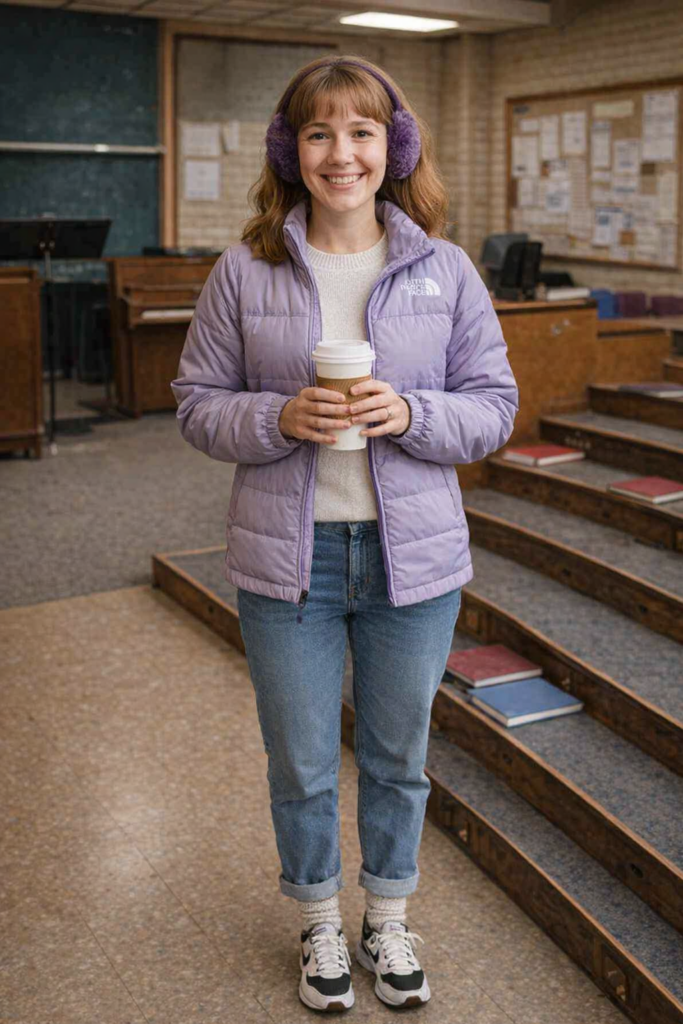
Stacy Dawson, Mark’s wife, brings coffee to Pine City High School at lunch on her day off as a nurse.
“How’s your day going?” Stacy asked.
“Busy. Chaotic. Wonderful.” Mark took a sip. “And now significantly better.”
She laughed. “I figured. I know this week is… a lot.”
“It is,” he admitted. “But it’s good. And I’m excited. First Christmas program married.” He bumped her shoulder lightly. “You’ll be in the audience.”
“Wouldn’t miss it.”
The bell rang, signaling the end of fourth period. Students began packing up, still humming bits of Fruitcake.
Mark walked Stacy toward the door. “I hope Lily and Shane can make it,” he said quietly. “It’d be good to see them.”
Stacy’s smile softened. “I’m sure they will. And it’ll mean something to Lily. You two have a good history.”
Mark nodded, warmed by her understanding. Stacy always seemed to know exactly what to say — and exactly when to say it.
“Thanks for stopping by,” he said, squeezing her hand.
“Always,” she replied. “Go conquer the rest of your day, Maestro.” She placed a kiss on Mark’s cheek.
“I should be home between 5:30 and 6,” Mark said, “after our performance at the nursing home.”
She slipped out into the hallway that ran between the music rooms on one side and the auditorium on the other side, making for a handy shortcut back out to the school parking lot, leaving behind the faint scent of winter air and coffee.
Mark watched her go, heart full, before turning back to the risers. Fifth period was his prep hour — a rare pocket of quiet in a week that would be anything but.
But for the moment, with Stacy’s visit still lingering like a warm chord, the chaos felt manageable. Even joyful.
Monday, December 8
Pine City High School to Lily & Shane’s Home
The last of the daylight was fading when Lily finally looked up from the stack of essays spread across her desk in Room 210. The hallway outside had gone quiet — that particular after‑school hush where only the hum of the building remained. She rubbed her eyes, reached for her water bottle, and clicked open her email out of habit.
A new message sat at the top of the inbox:
Reminder: Pine City High School Choirs — Christmas Program Monday, December 15, 7:00 PM — Auditorium
Lily smiled faintly. Mark always sent these reminders early, but this one felt different — maybe because the season felt softer this year. Maybe because she was simply more open than she’d been in a long time.
She shut down her computer, gathered her things, and headed home through the crisp December air.
Supper was simple — leftover chicken and roasted vegetables — but the kitchen felt warm, the kind of warmth that came from routine and comfort. Frodo had taken his usual place beside Lily’s chair, sitting upright with the posture of a tiny, judgmental prince. His green eyes were locked on her plate with laser‑focused hope.
“Don’t even think about it,” Lily murmured, nudging him gently with her elbow.
Frodo blinked slowly, as if to say I would never, then inched half an inch closer.
Shane chuckled from across the table. “He’s got you wrapped around his paw.”
“He absolutely does not,” Lily said, even as she tore off a microscopic piece of chicken and set it on the edge of her plate. Frodo pounced like a lion.
Shane raised an eyebrow. “Case in point.”
Lily rolled her eyes, smiling despite herself. “Anyway… I got a staff email today. Mark’s Christmas program is next Monday.”
“Oh yeah?” Shane took a sip of water. “You thinking about going?”
She hesitated. “I don’t know. It’s a busy week. And with everything going on lately…” Her voice trailed off, the ornament and the heart emoji still lingering somewhere in her chest.
Shane set down his fork. “I think we should go.”
She looked up.
“It would be fun,” he said simply. “And Mark would like seeing you there.”
There was no tension in his voice, no insecurity. Just steady warmth. Shane had always been comfortable with the history she and Mark shared — the brief relationship, the easy friendship that followed, the way life had taken them in different directions. He respected it. He respected her.
“And,” he added with a grin, “I’ve never actually seen a Pine City Christmas program. I hear they’re legendary.”
“They’re… something,” Lily said, laughing softly. “Fruitcake alone is worth the price of admission.”
“Then it’s settled.” Shane leaned back in his chair. “We’ll go. Support Mark. Enjoy the music. Make a night of it.”
Lily felt something loosen inside her — a small, quiet yes. Maybe it was the ornament. Maybe it was the heart emoji. Maybe it was just the season.
“Yeah,” she said. “Let’s go.”
Frodo, having finished his tiny piece of chicken, head‑butted her arm as if adding his vote.
Lily scratched behind his ears. “Fine. You can come too.”
Shane snorted. “Absolutely not.”
Lily laughed, the sound warm and easy. “Okay, okay. Just us.”
And for the first time in a long time, the idea of sitting in that auditorium — surrounded by music, by community, by people she cared about — felt right.
She didn’t know her parents would be there too. Not yet.
But the thaw had already begun.
Monday, December 15
Late Afternoon — Lily & Shane’s Home
The house was warm when Lily stepped inside, the kind of warmth that came from a furnace working steadily against a mid‑December sky already dimming toward evening – though with a high temperature of 39 degrees that afternoon, it had felt pleasant outside and some of the snow that fell about ten days earlier had started to melt. She set her school bag down by the door, kicked off her boots for the comfort of bare feet, and breathed in the familiar scent of onions and garlic sautéing in a pan.
Shane was at the stove, stirring something with the easy rhythm of someone who’d been home for a while. His hair was still damp from a quick shower after his last plumbing call, and he wore one of his soft flannel shirts — the green one Lily liked.
“You’re home early,” she said, hanging her coat.
“Wrapped up my last job around two‑thirty,” he said, glancing over his shoulder with a smile. “Figured I’d get supper going.”
Frodo trotted in from the living room, tail high, chirping his greeting as if Lily had been gone for days instead of hours. He rubbed against her leg insistently.
“Hi, buddy,” Lily murmured, scooping him up for a moment before setting him down. He immediately resumed his campaign to be underfoot.
She washed her hands and joined Shane at the counter, chopping vegetables while he browned the chicken. It was an ordinary evening — the kind that felt safe, predictable, steady.
At 4:15, Lily’s phone buzzed on the counter.
She wiped her hands on a towel and picked it up.
A text from her mom.
We’re thinking of going to the Pine City Christmas program tonight. We heard it’s wonderful.
Lily froze.
The kitchen sounds — the sizzle of the pan, the hum of the refrigerator, Frodo’s soft meow — all seemed to fade into a kind of suspended quiet.
Shane noticed immediately. “Everything okay?”
She handed him the phone.
He read the message, then looked at her with gentle understanding. “Ah.”
Lily swallowed. “I… wasn’t expecting that.”
“No,” he said softly. “I don’t think anyone would be.”
She set the phone down, pressing her palms against the counter to steady herself. “I mean… we were already planning to go. But now—”
“It feels different,” Shane finished for her.
She nodded, throat tight. “Yeah.”
Shane turned off the burner, letting the pan rest. He stepped closer, leaning his hip against the counter beside her. “Hey,” he said quietly. “It’s a public event. Low pressure. You don’t have to talk long. You don’t have to talk at all if you’re not ready.”
Lily stared at the message again, the words blurring slightly. “I don’t want to avoid them. Not after… everything. But I’m nervous.”
“Of course you are.” Shane’s voice was warm, steady. “But you’re not going alone.”
Frodo, sensing the shift in mood, hopped onto a dining chair and peered at her with wide, concerned eyes — or as concerned as a cat could look. His tail curled neatly around his paws.
Lily let out a shaky breath. “We should still go.”
Shane nodded. “We should.”
She picked up her phone again, not to respond — not yet — but to acknowledge the moment. The thaw she’d felt over the past week was real, but so was the fear. The uncertainty. The ache of old wounds meeting new hope.
“Okay,” she said finally, more to herself than to Shane. “Let’s go to the program.”
Shane squeezed her hand. “We’ll take it one step at a time.”
Frodo chirped in agreement, or hunger, or both.
And as the winter evening settled outside their windows, Lily felt the quiet tremor of something shifting — not a reunion, not yet, but the unmistakable beginning of one.
Monday, December 15
Pine City High School Auditorium — 7:00 p.m.
By the time the Simplex clock on its back wall struck 6:30, the Pine City High School auditorium was already buzzing. The mild December day had given way to a crisp, festive evening, and the town had turned out in force. Families, teachers, retirees, and proud parents filled the rows, shedding coats and greeting neighbors as they found their seats.
At Mark Dawson’s request, chief engineer Nathan Beckstrom had transformed the auditorium into something out of a Christmas card. Two towering Christmas trees flanked the stage, their branches heavy with ornaments and warm white lights. More lights traced the edge of the stage, casting a soft glow across the risers. The air hummed with anticipation and the faint scent of pine.
Lily and Shane found seats near the middle of the auditorium, close enough to see the expressions on the singers’ faces but far enough back to blend into the crowd. Frodo, of course, was at home — likely asleep on the couch, blissfully unaware of the emotional minefield his humans were navigating.
Stacy Dawson arrived a few minutes later, slipping into a seat on the left side of the auditorium. She wore a lighter winter jacket over a red sweater, paired with a tartan-patterned skirt and loafers. A delicate anklet — one of Mark’s favorite features of her dressier outfits — glinted softly when she crossed her legs. She looked both festive and effortlessly herself, her smile bright as she scanned the stage.
On the far right side of the auditorium, halfway to the front, Stephen and Margaret Jorgenson took their seats. They chatted quietly, unaware that their daughter was somewhere across the room — and unaware of the tremor their presence would soon send through her.

Lily’s parents, Stephen and Margaret Jorgenson, at the Pine City High School Christmas program
At exactly 7:00, the house lights dimmed. A hush fell.
Mark Dawson stepped onto the stage in a tuxedo, looking every bit the seasoned choir director — confident, warm, and deeply proud.
“Good evening, everyone,” he said, his voice carrying easily. “Welcome to the Pine City High School Christmas Program. We’re so glad you’re here. Tonight, we hope to share with you the joy, beauty, and fun of the season. Let’s begin with our 7th and 8th grade choir and that 1957 Bobby Helms hit, “Jingle Bell Rock.”
Applause rippled through the auditorium as the youngest singers filed onto the risers. They performed three songs — bright, earnest, and full of that unmistakable middle-school charm. The audience loved them.
Next came the Madrigal Singers for their first set. Dressed in their traditional attire, they filled the room with rich harmonies, their voices blending in a way that made the auditorium feel smaller, more intimate.
Lily and Shane listened, hands loosely intertwined. Lily felt herself relaxing into the music — until, during the applause, she glanced across the auditorium.
Her breath caught.
There, on the far right side, sat her parents.
Stephen. Margaret. Side by side. Watching the stage.
A flicker of surprise shot through her — sharp, immediate — followed by something softer, something she wasn’t ready to name. She didn’t look away right away. She let herself see them. Let herself feel the complicated warmth rising in her chest.
Shane squeezed her hand gently. No words. Just presence.
The program continued, its emotional tone shifting into something deeper. The 9th and 10th grade choir performed a candlelight version of “Silent Night,” the stage lights dimmed except for the soft glow of battery candles in each student’s hand. The room felt hushed, reverent, as if the whole town were breathing in unison.
More familiar carols followed — some secular, some sacred — the kind everyone knew well enough to hum along. The atmosphere softened. Guards lowered. Hearts opened.
The Madrigal Singers returned for another set, their voices weaving through the auditorium like threads of gold.
Then it was time for the concert choir — the crown jewel of the program. Mostly juniors and seniors, with a few exceptional sophomores who had earned their spots by audition, they took the stage with quiet confidence.
They began with “The Little Drummer Boy,” the steady rhythm of the “pa-rum-pum-pum-pum” pulsing through the room.
Next came “Do You Hear What I Hear,” which Mark Dawson introduced with a brief background of the song, written in October 1962 during the Cuban Missile Crisis as a song intended for the upcoming Thanksgiving holiday but that also represented the hopes for peace during an uncertain time. The harmonies swelled beautifully on the line “A song, a song, high above the trees…”
Then “What Child Is This,” haunting and elegant.
And finally — the moment Pine City had been waiting for — “Fruitcake.”
“Choirs around the country do this song, including a few of my colleagues in other schools here in our area,” Mark explained, “and I’ve made it a tradition during my years here at Pine City. We hope you enjoy it.”
The audience perked up immediately. This was tradition. This was joy.
The choir launched into the opening lines with theatrical flair:
“…it would be, positively, Absolutely, must be made with fruit! (rest) FRUITCAKE!”
Laughter rippled through the auditorium.
Then came the lines that always brought the house down, sung by the low bass voices:
“Pecans, and, walnuts and ha-zel-nuts. Almonds, and, all other cra-zel-nuts!”
The students leaned into the choreography — exaggerated stirring motions, goofy expressions, perfectly timed pauses. Even Mark, conducting with professional precision, couldn’t hide the grin tugging at the corner of his mouth.
By the end, the audience was roaring with laughter and applause.
Stacy beamed, her eyes shining with pride as she watched her husband bring the choir through the final comedic flourish. She clapped enthusiastically, her anklet catching the stage lights again.
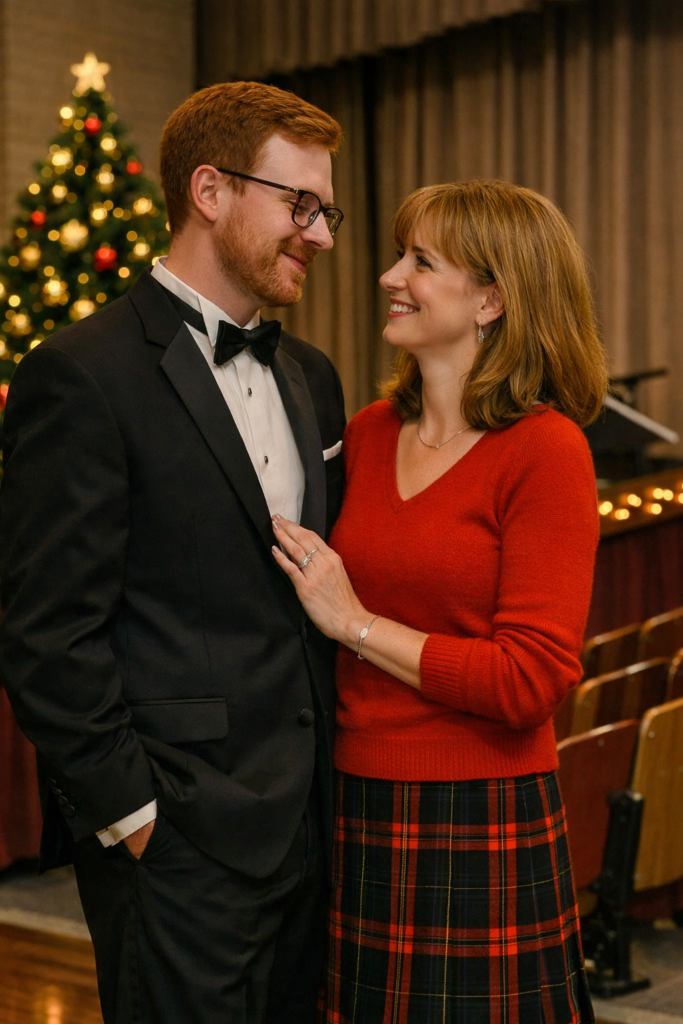
Mark and Stacy Dawson at the Pine City High School Christmas program
The finale brought all the choirs back onstage for “O Holy Night.” The opening notes rose like a prayer, the combined voices filling the auditorium with a sound that was both powerful and tender. When the sopranos soared on “Fall on your knees…” a hush fell so deep it felt sacred.
When the final chord faded, the applause was thunderous.
Mark stepped forward once more. “Thank you all for joining us tonight. We invite you to the cafeteria for refreshments. Please enjoy the rest of your evening, and Merry Christmas.”
The audience rose, buzzing with warmth and holiday spirit. Stacy stood, still glowing. Lily remained seated for a moment, gathering herself, her eyes drifting once more toward the far right side of the auditorium.
Her parents were standing too.
And for the first time in years, the sight didn’t make her pull away.
It made her breathe.
Monday, December 15
Hallway Outside the Auditorium — After the Concert
The final applause still echoed faintly as the audience began to rise, gathering coats and programs, chatting about favorite songs and laughing over the “Fruitcake” choreography. The auditorium doors opened wide, and a cheerful stream of people flowed into the hallway, heading toward the cafeteria where tables of cookies, hot cider, coffee, and punch waited.
Lily and Shane stepped into the current of movement, walking side by side. The warmth of the concert still lingered in Lily’s chest — the candlelight, the harmonies, the laughter. She felt steadier than she expected.
They were halfway down the hall when it happened.
No staging. No buildup. Just the natural flow of people shifting around each other.
Stephen and Margaret Jorgenson emerged from the crowd at the same moment Lily and Shane passed by.
Lily stopped. So did her parents.
For a heartbeat, no one spoke.
Then Margaret smiled — warm, genuine, a little tentative. “Lily. Hi.”
Lily felt her breath catch, but not in the old, tight way. More like surprise softening into something gentler. “Hi, Mom.”
Stephen’s shoulders eased visibly. “It was a great program,” he said, voice steady but touched with relief. “Really well done.”
“Yeah,” Lily said, nodding. “Mark’s choirs always sound good.”
Shane offered a polite smile, extending a hand. “Good to see you both.”
Margaret shook his hand lightly. “You too, Shane. You two look well.”
“We’re doing okay,” Shane said, his tone calm and supportive, the kind of presence Lily could lean into without even thinking.
Margaret glanced toward the cafeteria. “We’re glad we came tonight. It was… really beautiful.”
Lily swallowed, but the knot she expected wasn’t there. “I’m glad you came too.”
Stephen nodded, his expression softening. “Well… we won’t keep you. Enjoy the refreshments.”
“You too,” Lily said.
A small pause — not awkward, just hopeful.
Then her parents stepped aside, merging back into the flow of people heading down the hall. Lily and Shane continued forward, walking slowly.
After a few steps, Shane brushed his hand against hers. “You did great.”
Lily let out a breath she hadn’t realized she’d been holding. “It was… easy.”
“Yeah,” he said. “That’s the breakthrough.”
She didn’t say anything for a moment. She just let the truth of that settle like the last chord of O Holy Night still humming somewhere inside her.
And together, they walked toward the cafeteria lights, the scent of cookies, and the soft murmur of Pine City gathering to celebrate the season.
Monday, December 15
Pine City High School Cafeteria — After the Concert
The cafeteria was alive with sound — the rustle of paper plates and cups, the hum of conversation, the soft thump of winter boots on linoleum. Long tables were lined with platters of cookies, bowls of punch, urns of hot cider, and two large coffee dispensers that were already half‑empty. The scent of cinnamon and sugar hung in the air.
Mark Dawson stood near the entrance, still in his tuxedo, cheeks flushed with the glow of a successful program. Stacy was beside him, her tartan skirt swishing lightly as she shifted her weight, her anklet catching the fluorescent lights with each movement.
When Lily and Shane entered, Mark spotted them immediately.
“Hey! You made it!” he said, stepping forward with a grin that hadn’t faded since the final chord of O Holy Night.
“We wouldn’t miss it,” Shane said, shaking his hand.
Lily smiled. “It was beautiful, Mark. Really.”
Stacy beamed. “Wasn’t it? I swear, every year he says he’s nervous, and then he pulls off something like that.”
Mark laughed. “Well, the mild weather didn’t hurt. People actually wanted to leave their houses tonight. I took a peek backstage after the finale — the free‑will offering was way up from last year. I think folks were feeling generous. Or maybe they just really liked ‘Fruitcake.’”
Shane grinned. “You sure put on a show with that one.”
Mark held up a hand. “Okay, okay — I’ll admit it. I actually do like that song. It’s ridiculous, but it’s fun. And the kids love it.”
Stacy nudged him. “He loves it more than he claims.”
“I do not—” Mark began, then sighed. “Fine. I do. It’s a good time.”
They all laughed, the kind of easy laughter that comes when everyone is warm and full of cookies and still riding the glow of good music.
They chatted for a few minutes — about the program, about the turnout, about how the 7th and 8th graders had nearly missed their cue but recovered like pros. Stacy complimented Lily’s scarf; Lily complimented Stacy’s skirt. It was easy, warm, familiar.
As they talked, Lily’s gaze drifted across the cafeteria.
Her parents were there.
Stephen and Margaret stood near the coffee table, chatting animatedly with two local business owners Lily recognized from town events. Her dad laughed at something, his shoulders relaxed, his posture open. Her mom touched someone’s arm lightly as she spoke — the same warm gesture Lily remembered from childhood.
They weren’t strangers here. They belonged. They always had.
And for the first time in a long time, Lily felt that truth without the old ache.
Stacy followed Lily’s line of sight. “Your parents?” she asked gently.
Lily nodded. “Yeah.”
Mark’s expression softened. “It’s good they came.”
“It is,” Lily said quietly.
Shane slipped an arm around her waist — subtle, supportive, grounding. “You want to say hi again?” he asked.
Lily considered it. The room was warm, full of laughter and music and the lingering glow of community. Her parents were smiling, relaxed, talking to people who clearly knew them well.
She didn’t feel pressure. She didn’t feel dread. She felt… like something was possible.
“Maybe in a bit,” she said. “Right now I’m just taking it in.”
Mark nodded. “Take your time. Tonight’s a good night for that.”
Stacy added, “And if you want to hide behind the cookie table for a minute, I fully support that.”
Lily laughed — a real laugh, light and unguarded. “I’ll keep that in mind.”
A group of Madrigal Singers approached to congratulate Mark, and he excused himself with a quick squeeze of Stacy’s hand. Stacy followed, waving at Lily and Shane as she went.
Left in the warm bustle of the cafeteria, Lily leaned into Shane’s side.
“You okay?” he asked.
She looked again at her parents — laughing, talking, part of the world she’d built her life in.
“Yeah,” she said softly. “I think I am.”
And for the first time in fifteen years, the distance between them didn’t feel like a wall.
It felt like a hallway.
One she could walk down when she was ready.
Monday, December 15
Pine City High School Cafeteria — Later in the Evening
The crowd had thinned. The cookie platters were half‑empty, the cider urns nearly drained, and the hum of conversation had softened into smaller clusters of people lingering before heading out into the mild December night.
Lily and Shane stood near the far end of the cafeteria, finishing their cider, when Lily noticed her parents drifting closer. Not intentionally — just the natural flow of people shifting as the room emptied.
Stephen saw her first. He gave a small, warm nod. Margaret followed his gaze and smiled.
This time, Lily didn’t freeze.
“Hi again,” Margaret said, her voice gentle.
“Hi,” Lily replied, steady.
Stephen slipped his hands into his coat pockets. “We really enjoyed the program. It was… uplifting.”
“It was,” Lily agreed. “Mark’s choirs always do a great job.”
Shane offered a polite smile. “Good to see you both again.”
“You too, Shane,” Stephen said. “Glad you two came tonight.”
There was a brief pause — not tense, just the kind of pause that comes when people are choosing their words carefully.
Margaret broke it softly. “We didn’t want to overwhelm you earlier. But… we’re really glad we ran into you.”
Lily nodded, her throat tightening just a little. “I’m glad too.”
Stephen cleared his throat. “I suppose you heard about my… episode.”
“A little,” Lily said. “Mom told me some. How are you doing?”
He exhaled, not dramatically, just honestly. “It wasn’t a heart attack. Angina pectoris, they called it. Chest discomfort from reduced blood flow. Scared me more than it hurt, I think.”
Margaret touched his arm. “He’s on a couple of medications now.”
“And I’ve been strongly encouraged to start exercising regularly,” Stephen added with a wry smile. “Apparently walking from my office to the bank lobby doesn’t count.”
Lily let out a soft laugh — the first one in her parents’ presence in years. “Probably not.”
“I’ll get there,” he said. “One step at a time.”
Something in Lily eased. Not everything. But something.
Margaret glanced between Lily and Shane. “We were thinking… if you’re free… maybe you could come over for Christmas dinner next week. Nothing fancy. Just… family.”
Lily felt Shane’s hand brush hers — not pushing, not guiding, just present.
She took a breath. “Yeah. I think we can do that.”
Margaret’s smile warmed. “Good. We’d love that.”
Stephen nodded, relief flickering across his face. “We’ll text you the details.”
“Okay,” Lily said. “Sounds good.”
It wasn’t emotional. It wasn’t dramatic. It was simple. And it was enough.
After a few more gentle words — “Drive safe,” “Good night,” “See you soon” — they parted ways, each couple heading toward the exit.
Perspectives on the Drive Home
Lily & Shane — Quiet Roads, Warm Hearts
The car was warm, the heater humming softly as they pulled out of the parking lot. Pine City’s streets were calm, Christmas lights glowing in windows and along porches.
Shane reached over and took Lily’s hand. “You handled that beautifully.”
Lily stared out at the passing lights, her fingers tightening around his. “It felt… different tonight.”
“Different good?” he asked.
She nodded. “Yeah. Good.”
For the first time in years, she felt hope without the sharp edge of fear. A door had opened — not wide, but enough.
Mark & Stacy — A Director’s Glow
In their car, Stacy rested her head lightly against the seat, still smiling. “You were wonderful tonight.”
Mark laughed, loosening his bow tie. “The kids were wonderful. I just waved my arms.”
“You waved them very well,” she teased.
He glanced at her, warmth in his eyes. “It was a good night. One of the best.”
“And Lily was here,” Stacy added softly. “That felt… important.”
Mark nodded. “Yeah. It did.”
Stephen & Margaret — A Long-Awaited Exhale
Driving home through familiar streets, Stephen kept one hand on the wheel, the other resting on his knee.
“That went better than I expected,” he said quietly.
Margaret smiled out the window. “She looked well.”
“She did,” he agreed. “And she didn’t seem… distant.”
“No,” Margaret said. “She didn’t.”
They shared a small, hopeful silence.
“Christmas dinner,” Stephen murmured. “I’m glad she said yes.”
“So am I,” Margaret whispered.
Home — Later That Night
When Lily and Shane stepped through their front door, Frodo was waiting — tail high, chirping indignantly as if they’d been gone for days.
Shane scooped him up. “We were gone two hours, buddy.”
Frodo disagreed loudly.
Lily laughed — a soft, real laugh — and hung up her coat. The house felt warm, familiar, safe.
She stood in the entryway for a moment, letting the night settle around her.
Hope. Without fear. She hadn’t felt that in a long time.
Shane came up beside her, Frodo draped over his arm like a floppy scarf. “You okay?”
Lily leaned into him, her voice quiet but sure. “Yeah. I think I really am.”
And with that, the chapter closed — not with a grand gesture, but with the gentle, steady warmth of a life opening back up.
Chapter 4 – Beginnings in Every Direction
The Christmas tree was still up in the corner of Maya’s apartment, its lights glowing softly in the late‑afternoon dimness. Outside, the world was a quiet post‑holiday gray, the kind that made staying inside with tea and blankets feel like the only reasonable choice. Maya sat cross‑legged on the couch, a mug of chai warming her hands, while Adrian settled beside her with the thick, spiral‑bound wedding organizer book balanced on his knee.
“Okay,” he said, flipping open the cover. “We are officially six months out. Time to get serious.”
Maya raised an eyebrow. “You say that like we haven’t been serious. We picked a date. And a location. That’s huge.”
“True,” Adrian admitted. “But according to this book, we’re supposed to have… let’s see…” He scanned the page. “A preliminary guest list, a budget worksheet, a ceremony outline, and a list of ‘non‑negotiable traditions.’”
Maya snorted. “Non‑negotiable traditions? That sounds like a fight waiting to happen.”
“Right?” Adrian flipped the page toward her. “Look at this. It literally says, ‘Decide which cultural or religious traditions must be included.’ And then it gives examples like ‘unity candle,’ ‘father‑daughter dance,’ and ‘garter toss.’”
Maya made a face. “We’re not doing a garter toss.”
“Absolutely not,” Adrian said. “My aunties would riot.”
“And my mother would faint,” Maya added.
They both laughed, leaning into each other for a moment before Adrian turned the page again.
“Okay, here’s the ceremony section,” he said. “It wants us to choose between ‘traditional Christian,’ ‘non‑denominational,’ or ‘civil.’”
Maya blinked. “That’s it?”
“That’s it.”
“Where’s the option for ‘South Asian–Ojibwe fusion with a dash of modern practicality’?”
“Apparently not a standard template,” Adrian said dryly.
Maya reached over and tapped the blank lines beneath the headings. “Well, good thing they left space. We’ll just write our own.”
Adrian grinned. “That’s kind of our whole vibe, isn’t it?”
She smiled back. “Pretty much.”
He flipped to the next page. “Ooh, here’s a fun one: ‘Choose your wedding colors.’”
Maya leaned over to look. “They give us swatches. How cute.”
Adrian held up a pastel pink square. “This one looks like something from a baby shower.”
Maya held up a deep marigold. “This one looks like my mom’s favorite sari.”
Adrian’s eyes lit. “Actually… that’s not bad.”
Maya softened. “You like it?”
“I do. It feels like you.”
She reached for a deep forest green swatch. “And this feels like you.”
He took it from her fingers, rubbing the textured paper between his thumb and forefinger. “Green and marigold. That’s… actually gorgeous.”
“See?” Maya said. “We’re naturals at this.”
Adrian flipped a few more pages. “Okay, here’s the ‘family traditions’ section. It wants us to list what each side expects.”
Maya laughed. “Oh boy. How many pages do they give us?”
“Two.”
“Two?” She stared at him. “My family alone needs at least four.”
“And mine needs a whole appendix,” Adrian said.
They both dissolved into laughter again, the kind that came easily between them — warm, familiar, rooted in the shared understanding that their families were big, loving, and occasionally overwhelming.
When the laughter faded, Maya rested her head on Adrian’s shoulder. “We’ll figure it out,” she said softly.
“I know,” he murmured, kissing the top of her head. “We always do.”
He turned another page. “Okay, here’s something we can fill out: ‘Venue.’”
Maya smiled. “That one’s easy. Bad River Reservation. Odanah.”
Adrian wrote it down in neat, careful handwriting. “Done.”
“And under ‘Why this venue?’” Maya said, leaning closer, “write: ‘Because it’s your home.’”
Adrian paused, then wrote exactly that.
They sat quietly for a moment, the weight of that truth settling between them — not heavy, but grounding. Their wedding wouldn’t be a generic template. It would be theirs. Rooted in who they were, where they came from, and the life they were building together.
Finally, Adrian cleared his throat. “Okay. Next question: ‘Who will officiate?’”
Maya blinked. “Oh. Wow. That’s… actually a big one.”
“Yeah,” Adrian said. “We might need more than one person.”
“Or someone who understands both sides,” Maya said thoughtfully.
“Or,” Adrian added, “we create a ceremony where different people take different parts.”
Maya smiled slowly. “I like that.”
He wrote a note in the margin: Ask families about shared officiating roles.
Maya nudged him. “See? We’re doing great.”
Adrian nudged her back. “We’re doing us. And that’s even better.”
They turned the page together, ready for whatever the next blank line asked of them.
The Chuppah Page
Adrian flipped another page in the wedding organizer, humming under his breath. “Okay, next section… ‘Ceremony Structures and Symbolic Elements.’ That sounds promising.”
Maya took a sip of her chai. “Promising or terrifying?”
“Could go either way,” he admitted.
He scanned the page, then frowned. “Uh… Maya?”
She looked up. “Hmm?”
“What’s a… chuppah?” He pronounced it carefully, like he wasn’t sure if the ch was supposed to be soft or the throat‑clearing kind.
Maya blinked, then leaned over to see the page. “Oh! A chuppah.”
“So you do know what it is.”
“Of course I know what it is,” she said, crossing her arms with exaggerated authority. “I went to grad school. I’ve been to weddings. I’ve watched Fiddler on the Roof.”
Adrian raised an eyebrow. “Okay, but what is it?”
“It’s a canopy used in Jewish weddings,” Maya explained. “Beautiful tradition. Symbolizes the home the couple will build together.”
Adrian nodded thoughtfully. “That’s actually lovely.”
“It is,” Maya agreed. Then she tapped the page with one finger. “But for as many cultures as we’re blending into this ceremony, a chuppah is one thing we definitely don’t need.”
Adrian grinned. “You sure? We’re already mixing South Asian and Ojibwe traditions. Why not throw in a third?”
Maya gave him a look — the one that said she adored him but also that he was being ridiculous. “Because, my love, at some point we have to stop before our ceremony turns into a world cultures unit.”
He laughed. “Fair.”
“And also,” she added, “I refuse to be the person who appropriates someone else’s sacred tradition just because a wedding book told me it was an option.”
Adrian held up his hands. “Point taken. No chuppah.”
“Correct,” Maya said, flipping the page decisively. “We have enough to juggle without borrowing from cultures that aren’t ours.”
Adrian leaned over and scribbled in the margin: Respectfully not applicable.
Maya snorted. “Perfect. That’s exactly the tone we need.”
He looked at her with a soft smile. “You know… I love that we’re doing this our way.”
She nudged his shoulder. “I love that you’re doing it with me.”
They turned the page together, ready for whatever the binder threw at them next.
Shared Values and Vision
Adrian turned another page in the planner, and this one was titled “Shared Values & Vision.” The layout was simple: a few prompts, wide blank spaces, and a soft watercolor border of eucalyptus leaves.
Maya exhaled. “Oh boy. This is the page where they want us to get deep.”
Adrian smiled. “We’re good at deep.”
“Yeah, but this is the kind of deep where they expect you to write in complete sentences,” she said, nudging him with her knee. “I’m not grading it, but still.”
He laughed, then read aloud: “‘What do you want your marriage to stand for?’”
Maya leaned back against the couch cushions, her expression softening. “That’s… actually a good question.”
Adrian set the planner on the coffee table, turning toward her. “Okay. Let’s try it.”
She tucked her legs under herself, thinking. “I want our marriage to be… grounded. Like, rooted in who we are and where we come from. Not pretending we’re the same, but celebrating the fact that we’re not.”
Adrian nodded slowly. “I like that. And I want it to be steady. Not perfect, not dramatic — just… steady. Like something we can always come home to.”
Maya smiled, a small, warm thing. “That’s very you.”
He shrugged. “I’m a simple man.”
“You’re not simple,” she said, touching his arm. “You’re thoughtful.”
He looked down, a little shy. “Well. You bring that out in me.”
Maya reached for the planner and wrote a few words in her looping handwriting: Grounded. Steady. Celebratory of difference.
Adrian watched her write, then said quietly, “You know… this reminds me of something you said once. About your master’s program.”
Maya blinked. “What did I say?”
“That class you took last year — the one about culturally responsive pedagogy. You told me the professor said something like, ‘A shared life isn’t about blending identities into one. It’s about holding space for each other’s whole selves.’”
Maya’s breath caught for a moment. She remembered that day — sitting in a seminar room with mismatched chairs, listening to her professor talk about identity, community, and belonging. She hadn’t realized how much it had stayed with her.
“Yeah,” she said softly. “I remember.”
Adrian reached for her hand. “I think that’s us.”
She swallowed, her eyes warming. “I think so too.”
He squeezed her fingers. “Write that down.”
She did — slowly, deliberately: Hold space for each other’s whole selves.
When she finished, she rested the pen on the page and leaned her head against Adrian’s shoulder. The room was quiet except for the soft hum of the heater and the faint rustle of the Christmas tree lights.
After a moment, Adrian said, “Next question?”
Maya laughed, wiping at the corner of her eye. “Sure. Hit me.”
He flipped the page. “‘What do you want your wedding day to feel like?’”
Maya didn’t hesitate. “Like us. Not like a template.”
Adrian grinned. “Good thing we’re already ignoring half this book.”
She nudged him again. “We’re customizing. There’s a difference.”
He kissed the top of her head. “There always is with you.”
And together, they bent over the planner again, ready to write the next line of the life they were building.
The Snag
They had just finished the “Shared Values & Vision” page when Adrian flipped ahead to the next tab: Vendors & Logistics.
“Okay,” he said, “this is where we get practical.”
Maya stretched her legs out and took another sip of chai. “Practical is good. Practical means we’re making progress.”
Adrian scanned the first page. “It says we should book our officiant, photographer, caterer, and florist by… uh…” He squinted. “Three to six months before the wedding.”
Maya blinked. “We’re at six months.”
“Yep.”
“And we haven’t booked any of those.”
“Nope.”
They stared at each other for a beat.
Then Maya groaned and flopped backward onto the couch cushions. “Oh no. We’re behind. We’re officially behind.”
Adrian set the planner down. “Okay, okay, don’t panic.”
“I’m not panicking,” Maya said, absolutely panicking. “I’m just… expressing concern at a high volume.”
Adrian bit back a smile. “We knew this part would be tricky. Bad River isn’t exactly overflowing with wedding vendors.”
“I know,” she said, sitting up again. “But I thought we’d at least have a photographer by now. Or a caterer. Or… something.”
Adrian flipped the page. “Let’s see what the book suggests.”
He read aloud: “‘Start by researching local vendors in your ceremony area.’”
Maya snorted. “Local vendors? In Odanah? What, the book thinks we’re getting married in downtown Minneapolis?”
“Apparently,” Adrian said.
She leaned over and looked at the page. “This is so unhelpful. It’s like the book assumes every wedding happens within ten miles of a Whole Foods.”
Adrian laughed. “We can adapt. We always adapt.”
Maya sighed, rubbing her forehead. “I know. It’s just… I’m thinking about my master’s program, and how my advisor keeps talking about ‘anticipatory planning.’ And here we are, not anticipating anything.”
Adrian nudged her knee. “Hey. You anticipated the date. And the venue. And the colors. And the ceremony structure. And the values. That’s a lot.”
She gave him a look. “You’re trying to soothe me with logic.”
“Yes,” he said. “Is it working?”
“A little.”
He flipped another page. “Okay, here’s a list of suggested questions to ask potential vendors.”
Maya scanned it. “‘Do you offer multiple package tiers?’ ‘What is your cancellation policy?’ ‘Do you have experience with large indoor venues?’” She rolled her eyes. “We’re getting married outdoors on tribal land. None of this applies.”
Adrian nodded. “We’re going to have to build our own list.”
Maya exhaled slowly. “Okay. Okay. We can do that.”
But then she froze.
“Adrian.”
“Yeah?”
She pointed to a line halfway down the page. “‘Confirm that your venue allows outside vendors.’”
Adrian blinked. “Well… they do. Right?”
Maya’s eyes widened. “Do they?”
Adrian opened his mouth. Closed it. “I… assumed.”
Maya stared at him. “You assumed?”
“I mean—my family’s had ceremonies there. And community events. And feasts. And—”
“But weddings?” Maya pressed.
Adrian hesitated. “I… don’t know.”
They both sat in stunned silence for a moment.
Then Maya whispered, “Oh no.”
Adrian grabbed his phone. “I’ll text my mom.”
Maya grabbed a throw pillow and hugged it to her chest. “Please tell me we didn’t choose a venue where we can’t bring in a caterer.”
Adrian typed furiously. “She’ll know. She always knows.”
They waited.
Maya’s foot bounced anxiously. “If we can’t bring in outside vendors, we’re going to have to—”
His phone buzzed.
He read the message.
Then he exhaled.
“Well?”
“She says,” Adrian read, “‘Yes, you can bring in outside vendors, but they need to be approved ahead of time, and some types of vendors require a tribal permit.’”
Maya blinked. “A permit?”
“Apparently.”
“For what?”
Adrian scrolled. “Caterers, photographers, and anyone who sets up equipment on tribal land.”
Maya stared at him. “So… everything.”
“Pretty much.”
She let out a long, slow breath. “Okay. Okay. That’s not terrible. It’s just… one more thing.”
Adrian put his arm around her shoulders. “We can handle one more thing.”
She leaned into him. “I know. It’s just… I wanted this part to be easy.”
“I know,” he said softly. “But we’re doing something unique. Unique things take a little extra work.”
Maya rested her head against his shoulder. “You’re right.”
He kissed her hair. “We’ll figure it out. Together.”
She smiled faintly. “We always do.”
And with that, they turned back to the planner — a little overwhelmed, a little behind, but still very much in it together.
Dani’s Follow‑Up Text
Adrian’s phone buzzed again just as Maya was rereading the “Vendor Checklist” page for the fifth time, her brow furrowed like she was preparing to defend a thesis.
Adrian glanced at the screen. “It’s my mom again.”
Maya straightened. “Please tell me she has good news.”
He opened the message.
Mom: Sweetie, don’t worry. It’s not complicated. I’ll explain. Vendors just need to send their info to the tribal office ahead of time. Most get approved. We just don’t want people coming in who don’t respect the land or the community. Tell Maya it’s all very normal. ❤️
Maya exhaled, shoulders dropping. “Okay. Okay, that’s… actually reassuring.”
“There’s more,” Adrian said, scrolling.
Mom: Also, if you want recommendations, I know a few people. We have a couple of photographers who’ve done events here before. And for food, you can bring someone from outside, but they need to follow our guidelines. I’ll send you the contact info for the tribal office. They’re very nice.
Maya pressed a hand to her chest. “I love your mom.”
“She loves you too,” Adrian said, smiling. “She’s basically vibrating with excitement about this wedding.”
Maya laughed softly. “That makes one of us right now.”
Adrian nudged her knee. “Hey. We’re okay. We just needed information.”
“And your mom delivered,” Maya said. “As always.”
His phone buzzed again.
Mom: Also, don’t forget: if you want traditional elements, talk to Auntie Marlene. She’ll help you blend things respectfully. She’s already planning to make you both a blanket.
Maya’s eyes softened. “A blanket?”
Adrian nodded. “It’s a big deal. She doesn’t make them for just anyone.”
Maya swallowed. “Okay, now I’m going to cry.”
Adrian wrapped an arm around her. “Good tears?”
“The best tears,” she said, wiping her eyes. “Your family is… incredible.”
“They think the same about you.”
Maya took a deep breath, grounding herself. “All right. Let’s start brainstorming vendors who would actually work.”
Adrian flipped the planner to a blank notes page. “Okay. Categories: photographer, caterer, florist, maybe someone for decorations.”
Maya nodded. “And we need people who either have experience on tribal land or are willing to follow the process.”
Adrian wrote that down. “Mom said she knows photographers. Let’s start there.”
Maya leaned in. “Yes. And for food… I’m thinking we should look for someone who’s done multicultural weddings before. Someone who won’t blink at the idea of blending South Asian flavors with Ojibwe traditions.”
Adrian grinned. “So… not the barbecue truck I suggested last month.”
Maya gave him a look. “Adrian. I love you. But we are not serving ribs at our wedding.”
“Worth a shot.”
She laughed, tension easing. “Okay. Let’s list possibilities.”
Adrian tapped his pen. “What about that Minneapolis fusion place you love? The one with the turmeric‑ginger salmon?”
Maya’s eyes lit. “Oh! They cater. And they’re used to working with cultural guidelines.”
“Perfect,” Adrian said, writing it down. “We can ask if they’re open to the permit process.”
“And for dessert,” Maya added, “maybe we can find someone who does both traditional cakes and something like… I don’t know… cardamom‑rose cupcakes?”
Adrian looked at her with mock seriousness. “You’re speaking my love language.”
She nudged him. “Food is everyone’s love language.”
He laughed. “Okay, so: photographer from Mom’s list. Fusion caterer. Dessert options. And we’ll reach out to the tribal office this week.”
Maya nodded, calmer now. “This feels doable.”
“It is doable,” Adrian said. “We just needed the right information.”
She leaned her head on his shoulder. “And your mom saved the day.”
“She usually does.”
Maya smiled. “Okay. Let’s keep going.”
And together, they bent over the planner again — this time not overwhelmed, but energized, ready to shape a wedding that honored every part of who they were.
Marnie Brings the Twins to School
First Day of School After Christmas Vacation
The January air bit at Marnie’s cheeks as she stepped out of the car, one infant carrier hooked over each arm like she was training for a very specific, very adorable weightlifting competition. The snowbanks along the Pine City High parking lot were piled high from last week’s storm, glittering under the pale morning sun.
“Okay, my little winter babies,” she murmured, adjusting Amber’s blanket. “Let’s go meet Mommy’s students.”
Amber blinked up at her with wide, solemn eyes. Ethan “The Deuce,” on the other hand, was already making soft grunting noises that suggested he had opinions about the cold.
Inside, the school was warm and humming with the familiar sounds of the first day back after break — lockers slamming, kids greeting each other, the faint smell of floor wax and cafeteria pancakes.
Marnie felt a tug of nostalgia. She’d only been gone a few weeks, but it felt longer. She missed her classroom. She missed her students. She missed the rhythm of teaching.
She did not miss waking up at 5:30 a.m., but that was beside the point.
As she approached Room 208, she saw Claire Halvorsen through the window — sleeves rolled up, hair in a loose bun, animatedly explaining something to a circle of juniors who were actually listening. Claire had a natural presence: calm, warm, quietly confident. Marnie smiled. She’d known Claire would be good, but seeing her like this made her proud.
She knocked lightly with her elbow.
Claire turned, her face lighting up. “Marnie!”
The class turned too — and then the room erupted.
“AWW, THE BABIES!”
“Miss Thurston, they’re so tiny!”
“Is that The Deuce?”
“Wait, which one is which?”
“Can we see them?
Can we hold them? Can we—”
Claire moved quickly to help, clearing a space at the front of the room. “Here, set them down. They’re perfect.”
Marnie eased the carriers onto a table. “Everyone, this is Amber. And this—” she tapped the other carrier “—is Ethan Thurston II. Also known as The Deuce.”
The class collectively melted.
“He looks just like Mr. Thurston!” “He has the same eyebrows!” “Amber’s so cute I’m gonna cry.”
Marnie grinned. “Trust me, I cry about them daily. Mostly from exhaustion, but still.”
Claire laughed, then addressed the class. “Okay, everyone, let’s give Mrs. Thurston a minute. And remember — gentle voices. They’re only a few weeks old.”
Marnie shot her a grateful look. “You’re a natural.”
The door across the hall swung open.
Ethan Thurston — the elder — poked his head out, mid‑sentence to his own class. “—and that’s why the Electoral College is the most misunderstood—oh my, are my children here?”
His students immediately abandoned whatever civics point he’d been making.
“MR. THURSTON, GO SEE YOUR BABIES!”
“We can finish the notes!”
“Bring them over here!”
“Is The Deuce really here?!”
Ethan jogged across the hall, tie slightly crooked, eyes bright. “Hi, beautiful,” he said to Marnie, kissing her cheek before peering into the carriers. “Hi, beautifuls,” he added to the twins.
The Deuce made a happy grunt.
“That’s my boy,” Ethan whispered proudly.
Marnie rolled her eyes affectionately. “He grunts at everything. You’re not special.”
Ethan placed a hand over his heart. “Wounded.”
Claire snorted.
Marnie turned to her. “How’s it going? Really.”
Claire’s expression softened. “Good. Better than I expected. Your kids are amazing — and they miss you.”
Marnie’s throat tightened. “I miss them too.”
Ethan squeezed her shoulder. “They’ll be thrilled to see you. And they’re going to lose their minds over the twins.”
As if on cue, a few of Marnie’s juniors edged closer, hands clasped behind their backs like they were approaching sacred artifacts.
“Mrs. Thurston,” Holly whispered, “Amber just smiled at me.”
“She has that effect,” Marnie said.
“And The Deuce is… like… so chill,” another student added reverently.
Ethan puffed up. “He gets that from me.”
Marnie elbowed him. “He gets that from sleep deprivation.”
The class laughed.
Claire stepped forward. “Okay, everyone, let’s give the Thurstons a little space. We’ll take a few minutes to meet the babies, then we’re diving back into our unit.”
Marnie smiled at her. “You’re doing great, Claire.”
Claire’s eyes shone. “Thanks. It means a lot coming from you.”
Marnie looked around the room — at her students, at Claire, at Ethan leaning over the twins with a goofy grin — and felt something warm settle in her chest.
She wasn’t quite ready to come back. But she was ready to miss being here.
And that was a start.
Questions for (and about) the Twins
The moment Claire gently guided the class into a loose semicircle, the hands shot up like popcorn. Marnie laughed under her breath — she’d forgotten how eager juniors could be when something actually interesting happened.
“Okay,” she said, settling Amber’s blanket and checking The Deuce’s pacifier. “One at a time. Holly, go ahead.”
Holly — bright‑eyed, earnest, and already leaning forward — clasped her hands. “Mrs. Thurston, how long do newborns usually stay awake at a time? Amber was looking right at me, and I didn’t know if I should talk to her or let her rest.”
Marnie’s heart warmed. Holly had adored her from day one, and her love for babies was genuine, not performative.
“That’s a great question,” Marnie said. “Right now, they’re awake in little bursts — ten, fifteen minutes at a time. If they’re alert and looking around, talking to them is perfect. They love voices.”
Holly beamed like she’d just been handed a scholarship.
Piper’s hand shot up next — practically vibrating. “Mrs. Thurston, if you ever need a babysitter, I’m totally available. I’ve taken care of my cousins since they were tiny, and I’m CPR certified, and I don’t mind diapers, and—”
Marnie held up a hand, smiling. “Piper, that’s very sweet. We’re not quite ready for babysitters yet, but I’ll keep you in mind.”
Piper nodded vigorously, as if she’d just been offered a job interview.
Ryan raised his hand halfway, then dropped it, then raised it again. “Uh… which one cries the most?”
Ethan snorted. “That’d be The Deuce.”
Marnie elbowed him lightly. “It depends on the day. Amber’s more dramatic, but The Deuce has a louder siren.”
The class laughed.
A boy in the back — Tyler, who usually saved his energy for basketball — asked, “Do they sleep at the same time? Or do they, like… take shifts?”
Marnie groaned theatrically. “Oh, they take shifts. They have a whole system worked out to make sure we never sleep more than ninety minutes at a time.”
Ethan nodded solemnly. “It’s very organized. They’re tiny masterminds.”
Another girl, Lila, raised her hand. “Do they have personalities yet? Or is it too early?”
Marnie smiled down at the carriers. “It’s early, but yes. Amber’s observant — she watches everything. And The Deuce is… well, he’s a Thurston. He’s chill until he’s not.”
Ethan puffed up proudly. “That’s my boy.”
“Don’t encourage him,” Marnie muttered.
A student near the front, Mateo, leaned forward. “Do they recognize you? Like, do they know you’re their mom?”
Marnie softened. “They know our voices. And they calm down when we hold them. That’s enough for now.”
The room went quiet for a moment — the kind of quiet that wasn’t awkward, just full.
Then Holly whispered, “They’re really lucky.”
Marnie blinked, caught off guard. “Why’s that?”
“Because they get you and Mr. Thurston,” Holly said simply.
Ethan’s hand found Marnie’s shoulder. She didn’t look at him, but she felt the warmth of it.
Claire cleared her throat gently. “All right, everyone — a few more questions, then we need to get back to our unit.”
Piper raised her hand again. “Can we take a class picture with them?”
Marnie laughed. “Maybe when they’re a little older and not on a two‑hour feeding schedule.”
Ryan pointed at The Deuce. “Does he always make that face?”
The Deuce, as if on cue, scrunched his eyebrows and let out a tiny grunt.
“Yes,” Ethan said proudly. “It’s his signature move.”
Marnie rolled her eyes, but she was smiling.
The questions kept coming — soft, curious, full of affection — and Marnie answered each one with the ease of someone who loved both her babies and her students.
For the first time since the twins were born, she felt the two worlds overlap in a way that didn’t overwhelm her.
It felt… right.
Across the Hall to Room 207
The questions were still coming when Ethan cleared his throat softly beside Marnie.
“Hey,” he murmured, “my class is about to mutiny if they don’t get their turn.”
Marnie laughed. “Do you want to bring them over?”
Ethan’s eyes lit up. “Absolutely.”
Claire caught the exchange instantly — teacher intuition at its finest. She clapped her hands once, gently but with authority. “Okay, everyone, let’s give the Thurstons a chance to visit Mr. Thurston’s class. We’ll pick up our discussion where we left off.”
A chorus of soft groans rose, but the students obeyed, drifting back to their desks.
Claire stepped closer to Marnie. “Thank you for stopping in. This made their whole week.”
Marnie squeezed her arm. “I’ll come by during my second‑hour prep. We can catch up properly.”
“I’d love that,” Claire said, and she meant it.
Ethan was already lifting the carriers with practiced ease — one in each hand, like he’d been born for this. “All right, little ones,” he said, “time to meet Daddy’s students.”
Marnie followed him into the hallway, and together they crossed into Room 207.
The moment Ethan stepped inside, the room erupted.
“THE DEUCE!”
“MR. THURSTON, BRING THEM UP HERE!”
“Are those your babies?!”
“Sir, we paused the video like you said, but we can’t focus!”
Ethan set the carriers on the front table with a flourish. “Class,” he announced proudly, “these are my children. Amber Thurston and Ethan Thurston II.”
A boy in the second row whispered, awestruck, “He really named him The Deuce.”
Ethan grinned. “I sure did.”
Marnie rolled her eyes affectionately. “It’s a nickname. A temporary one.”
“No it’s not,” Ethan said under his breath.
The students leaned in, but they were gentler than their volume suggested — respectful, curious, and clearly smitten.
A girl near the front, Kayla, raised her hand. “Mr. Thurston, do they sleep through the night yet?”
Ethan barked a laugh. “Absolutely not.”
Marnie added, “We’re lucky if we get two hours in a row.”
Another student, Brianna, leaned forward. “Mr. Thurston, does The Deuce grunt like that all the time?”
As if on cue, The Deuce made a tiny, determined grunt.
“Yes,” Ethan said proudly. “He communicates with purpose.”
Marnie muttered, “He communicates with gas.”
The class burst into laughter.
A boy near the windows, Lucas, raised his hand. “Which one’s older?”
“Ethan,” Marnie said. “By five minutes.”
Lucas nodded thoughtfully. “So he’s the boss.”
Ethan pointed at him. “Exactly.”
Amber blinked up at the room, solemn and observant, as if she were taking attendance.
A girl in the front row, Tessa, asked, “Do they like music? Because my baby cousin only stops crying when we play Taylor Swift.”
Ethan shrugged. “They like whatever’s playing at 3 a.m. when we’re desperate.”
Marnie added, “They seem to like the sound of the shower. And the vacuum. And Ethan singing off‑key.”
“Hey,” Ethan protested, “my singing is soothing.”
“To who?” Marnie teased.
The class laughed again.
Then one student — quiet, thoughtful Ben — raised his hand. “Mr. Thurston… are you happy?”
The room stilled.
Ethan looked at his son, then at his daughter, then at Marnie.
“Yeah,” he said softly. “I really am.”
Marnie felt her throat tighten.
The class seemed to feel it too — a hush settling over them, warm and real.
Then The Deuce let out a loud, indignant grunt, breaking the moment.
Ethan clapped his hands. “All right! Back to civics. You’ve got five minutes to ask baby questions, then we’re returning to the Electoral College.”
Groans filled the room.
Marnie laughed. “I’ll leave you to it.”
Ethan kissed her cheek. “Come back before you go. They’ll want to say goodbye.”
“I will,” she said, and slipped out into the hallway — heart full, hands free for the first time all morning, and already looking forward to her second‑hour chat with Claire.
A Visit to the Office
With Ethan’s class happily occupied and first hour still in session, Marnie decided to make one more stop before her prep period.
“The office is going to riot if they find out I was here and didn’t bring the twins,” she said, adjusting the carriers.
Ethan grinned. “Danielle will put me on lunch duty for a month if she misses them.”
“Exactly,” Marnie said. “I’m preventing administrative retaliation.”
She headed down the hall to the stairs at the south end, down the stairs to the commons area, and down the main 1st floor east-west hall to the office, the twins swaying gently with each step. The main office door was propped open, and the familiar hum of printers, phones, and quiet chatter wrapped around her like a warm blanket.
The moment she stepped inside, secretary Linda, age 56, looked up from her computer — and her face lit up like a Christmas tree.
“Oh my goodness, Mrs. Thurston!” Linda exclaimed, standing so fast her chair rolled backward. “Are these the babies?!”
Marnie laughed. “These are the babies.”
Linda hurried around the counter, hands clasped. “Let me see them. Oh, look at their little faces. Which one is which?”
“This is The Deuce,” Marnie said, touching the carrier on her right. “And this is Amber.”
Linda leaned in, eyes soft. “They’re perfect. Absolutely perfect.”
From the back of the office, secretary Marlene, age 63, called out, “Did I hear the word ‘babies’?”
“You sure did,” Linda said.
Marlene appeared in the doorway, wiping her hands on a stack of attendance slips. “Oh, for cute,” she breathed. “Look at them. Look at their little noses.”
Marnie smiled. “They get those from Ethan.”
“Of course they do,” Marlene said. “That man’s nose could be its own department.”
Before Marnie could respond, a soft whimper rose from Amber’s carrier — then a louder cry. Marnie glanced down and saw the problem immediately: Amber’s bottle had rolled just out of reach, having slipped from the side pocket of the carrier.
“Oh, sweetheart,” Marnie murmured, bending to retrieve it—
But someone else got there first.
A tall senior in a Pine City Dragons sweatshirt stepped forward from the sign‑in counter, picking up the bottle with practiced ease.
“Here you go, Mrs. Thurston,” Kendall said, offering it to her with a gentle smile. “She dropped it.”
Marnie blinked in pleasant surprise. “Kendall! I didn’t even see you there.”
Kendall shrugged. “I’m late. Again.” She gestured toward the sign‑in sheet. “But I saw Amber starting to fuss.”
Marnie took the bottle and gave it back to Amber, who latched on instantly and quieted. “Thank you. That was quick thinking.”
Kendall’s cheeks warmed. “I remember from last year — you always said babies have opinions. She looked like she was about to share hers.”
Marnie laughed. “She definitely was.”
Just then, the door to the principal’s suite opened.
Danielle Savoy stepped out, mid‑sentence into her phone. “Yes, I understand, but the district policy clearly states—” She stopped short when she saw the carriers. Her eyes widened. “Oh. My. Word.”
She ended the call with a quick, “I’ll email you shortly,” then crossed the room in three strides.
“Marnie Thurston,” she said, placing a hand over her heart. “You brought them.”
“I did,” Marnie said, smiling. “I figured you’d want to meet your newest honorary Dragons.”
Danielle leaned over the carriers, her expression softening into something maternal and reverent. “Hello, little ones,” she whispered. “Welcome to Pine City High.”
Amber blinked up at her, still content with her bottle. The Deuce made a small grunt, which Danielle accepted as a greeting.
“Oh, he sounds just like his father,” she said.
“Don’t encourage him,” Marnie replied.
Danielle straightened, her eyes warm. “They’re beautiful. Truly. And you look wonderful.”
“I look like I haven’t slept since December,” Marnie said.
“Which is exactly what wonderful looks like for a new mom,” Danielle countered.
Linda chimed in, “We told her the same thing.”
Danielle turned to Kendall. “And thank you for helping Amber.”
Kendall shrugged again, shy but proud. “Just doing what needed to be done.”
Danielle smiled. “That’s what makes you a leader.”
Kendall’s ears turned pink.
Marnie adjusted the carriers. “I should let you all get back to work. I’m going to stop by Claire’s room during second hour.”
Danielle nodded. “Of course. And bring them by anytime. The office is always open to the Thurstons.”
As Marnie headed back into the hallway, Amber content and The Deuce dozing, she felt a familiar warmth settle in her chest.
This place — these people — were home.
Second‑Hour Conversation with Claire
By the time second hour rolled around, the hallways had settled into that soft mid‑morning quiet — the kind that always made Marnie feel like the school was taking a breath. She slipped back into Room 208, the twins’ carriers swaying gently at her sides.
Claire looked up from her desk, her face brightening. “You made it.”
“Of course,” Marnie said, easing the carriers onto a table. “I promised.”
Claire stood, smoothing her cardigan. “How are they doing?”
“Amber’s full. The Deuce is asleep. So we’re in the golden window,” Marnie said with a grin.
Claire laughed softly. “Perfect timing.”
They sat — Marnie in her old chair, Claire on the edge of a student desk — and for a moment, they just breathed in the quiet.
Then Marnie said, “I wanted to tell you — I was really impressed this morning. You had such good command of the class. They were excited, but you brought them right back.”
Claire’s cheeks warmed. “Thank you. I… wasn’t sure you’d see it that way.”
“I did,” Marnie said. “And I meant it. You’ve done beautifully with them.”
Claire exhaled, a long, slow breath that seemed to release something she’d been holding for weeks. “It’s been… a lot. In a good way. But a lot.”
Marnie nodded. “Tell me.”
Claire folded her hands in her lap. “These last three months have been a mix of emotions. On one hand, I’ve loved having a long stretch with the same group of kids again. I forgot how much I missed the rhythm of it — the inside jokes, the progress, the way they settle in once they trust you.”
Marnie smiled. “They do trust you.”
“I know,” Claire said softly. “And that’s the part that surprised me. I thought I’d feel like a placeholder. But they let me in.”
“You earned that,” Marnie said.
Claire swallowed, eyes shining. “It’s made me… remember why I loved teaching full‑time. Why I did it for so long.”
Marnie waited, sensing there was more.
“But,” Claire continued, “it also reminded me why I stepped back. The early mornings. The grading. The constant planning. And with my kids’ schedules…” She shook her head gently. “I’ve gotten used to the flexibility of subbing. The occasional off day. Being able to go to a school concert without rearranging everything.”
“That makes sense,” Marnie said. “It’s a lot to juggle.”
Claire nodded. “So I’m in this strange place where I’m grateful for the experience, and I’ve loved these kids… but I also know I’m not ready to come back full‑time. Not yet.”
Marnie reached over and squeezed her hand. “That’s not strange at all. That’s honest.”
Claire blinked quickly, brushing away a tear. “Thank you.”
Marnie leaned back, letting her own truth surface. “I get it more than you know. These last few months… I’ve been exhausted. The twins, Emily being four and full of energy, turning forty‑two in the middle of all of it — it’s been a lot.”
Claire’s eyes softened. “You’ve handled it with so much grace.”
Marnie snorted. “Grace is a generous word. Some days it’s more like survival.”
They both laughed.
“But,” Marnie continued, “I’ve missed my classes. I’ve missed this room. I’ve missed the routine. And I think… I’m ready to come back.”
Claire straightened. “When?”
“The first day of second semester,” Marnie said. “Last Monday of January.”
Claire nodded slowly, absorbing it. “That feels right.”
“It does,” Marnie said. “And I want you to know — you’ve made this transition so much easier. For me. For the kids. For everyone.”
Claire’s eyes filled again. “Thank you. Really.”
Marnie smiled. “And I hope you know you’re welcome here anytime. If you ever want to guest‑teach a lesson or just stop by, this room is always open to you.”
Claire laughed softly. “Careful. I might take you up on that.”
“I hope you do.”
They sat in comfortable silence for a moment, the twins breathing softly in their carriers, the hum of the school settling around them.
Then Claire said, “You’re going to be great when you come back.”
Marnie looked at her, warmth blooming in her chest. “So are you — wherever you decide to be.”
And for the first time since the school year began, both women felt something settle into place — not an ending, not a beginning, but a shared understanding of where they were and where they were going.
Third Hour & 4A in the Teacher’s Lounge
The teacher’s lounge was quiet when Marnie slipped inside at the start of third hour, the twins’ carriers bumping gently against her legs. The coffee pot gurgled in the corner, and the faint smell of someone’s reheated soup lingered in the air.
She set the carriers on the low table near the couch and exhaled. “Okay, little ones. Mommy’s going to sit for five minutes. Maybe even six.”
Amber blinked up at her. The Deuce snored softly.
“Mrs. Thurston!” Bailey Murphy — age 27, bright‑eyed, curly‑haired, and perpetually carrying a stack of eighth‑grade essays — froze mid‑step. “Oh my gosh. You brought them.”
Marnie smiled. “I did. Come meet them.”
Bailey practically floated across the room. “They’re so tiny. And so perfect. And so tiny.” She crouched beside the carriers. “Hi, Amber. Hi, Deuce. I’m Bailey. I teach eighth graders, but I promise I’m safe.”
Marnie laughed. “They’ll take your word for it.”
Bailey sat on the couch, leaning in with the kind of awe only someone without children — but with a big heart — could muster. “I can’t believe you made two humans. At once.”
“Trust me,” Marnie said, sinking into the chair opposite her, “neither can I.”
Bailey spent most of her prep hour there — asking questions, cooing at Amber, marveling at The Deuce’s expressive eyebrows, and telling Marnie about her eighth graders’ latest creative writing assignment.
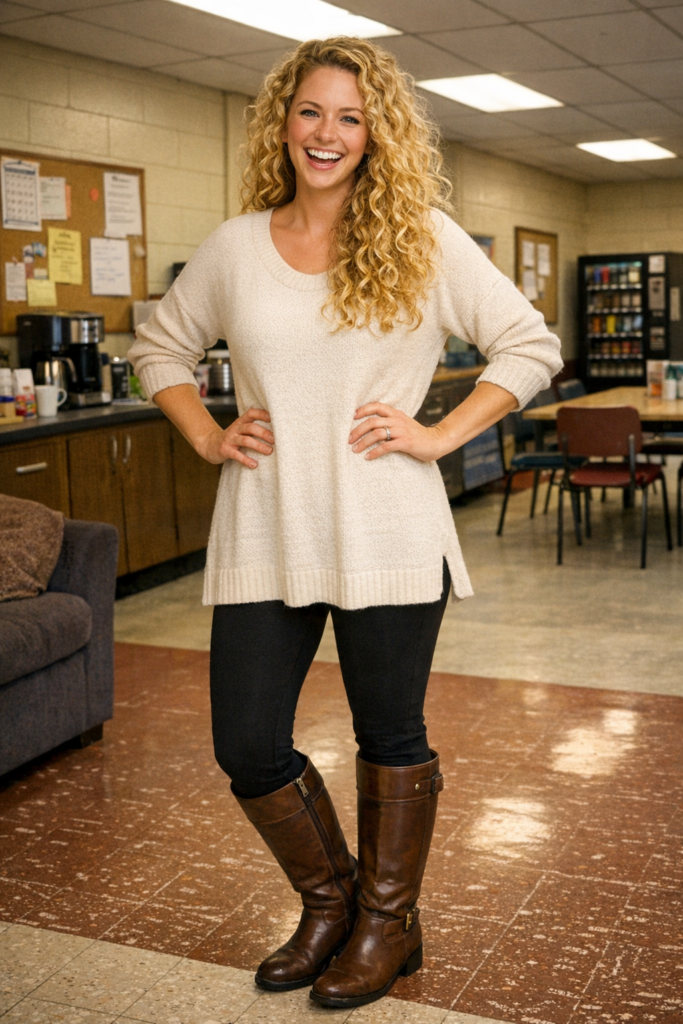
8th grade English and creative writing teacher Bailey Murphy
“They wrote horror stories,” Bailey said, wide‑eyed. “One kid wrote about a haunted Chromebook. I’m still recovering.”
Marnie snorted. “Middle schoolers are a different species.”
“They really are,” Bailey said. “But I love them. And I love these two.” She gently tapped the edge of Amber’s carrier. “If you ever need someone to hold them while you drink a cup of coffee, I volunteer as tribute.”
“I’ll remember that,” Marnie said warmly.
Bailey stayed until the bell rang, then reluctantly gathered her papers. “Okay. I have to go teach eighth graders about symbolism. Wish me luck.”
“Good luck,” Marnie said. “May the haunted Chromebook spare you.”
Bailey laughed all the way out the door as she returned to her classroom, Room 105, the room next door to the teacher’s lounge.
4A Lunch — The Lounge Fills Up
It didn’t stay quiet for long.
At exactly 11:10, the door swung open again and Ethan stepped in, followed by Lily, social studies teacher Peter Bouchard, art teacher Ann Nylund, special ed teacher Nicole Keller, English department head Tim White, choir director Mark Dawson, and 9th grade English teacher Carol Barthel — a full Pine City faculty parade.
“There she is!” Peter announced. “And there they are — the stars of the district.”
Ann clasped her hands. “Oh, Marnie, they’re beautiful.”
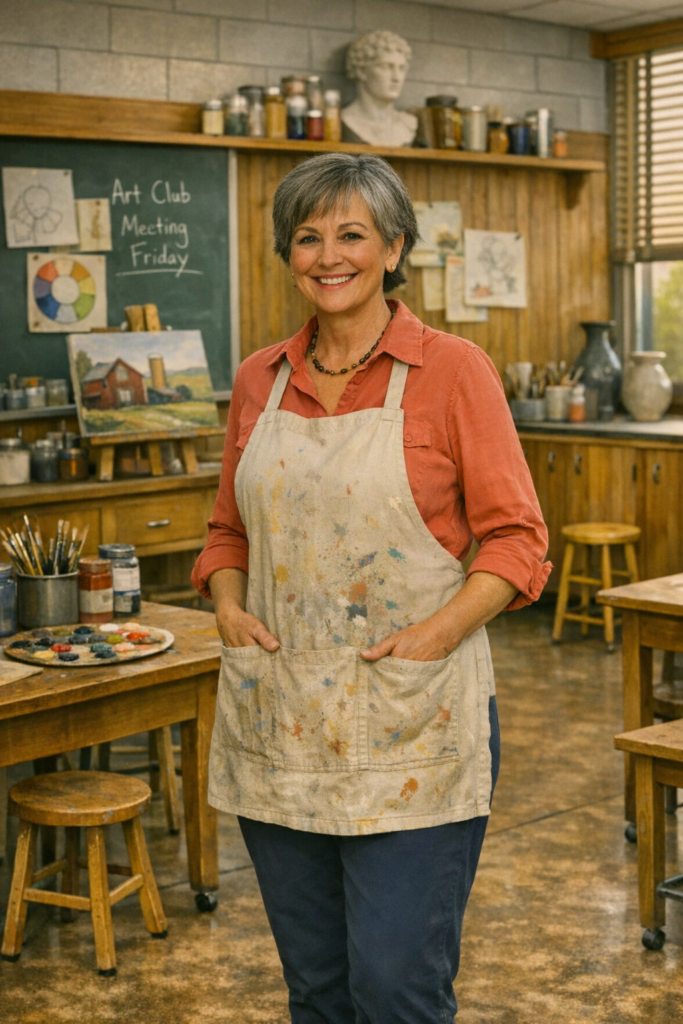
Pine City High School art teacher Ann Nylund
Nicole leaned over the carriers. “Look at their little cheeks. I could cry.”
Tim White, English department head and resident dry wit, peered down at The Deuce. “He has the Thurston brow. That’s going to serve him well in debate someday.”
Mark Dawson, choir director, hummed a soft note. “Amber has perfect pitch. I can tell.”
Carol Barthel laughed. “Mark, she’s three months old.”
“Exactly,” Mark said.
Ethan set his lunch down and kissed Marnie’s temple. “How’s your morning been?”
“Wonderful,” she said. “Busy. Emotional. But wonderful.”
Peter leaned in. “So which one’s the troublemaker?”
Marnie pointed at The Deuce. “This one.”
Ethan pointed at Amber. “This one.”
Marnie and Ethan glared at each other.
Ann laughed. “Parenthood looks good on you two.”
Nicole pulled up a chair. “So how’s Emily doing with being a big sister?”
Marnie smiled. “She loves them. She sings to them. She tries to help with diapers. She also thinks they should be able to play Candy Land already.”
Carol nodded. “That tracks.”
Tim unwrapped his sandwich. “So, Marnie, when are we getting you back?”
“Last Monday of January,” she said. “First day of second semester.”
A cheer went up around the table.
“I’ve missed you being here,” Lily said. “We’ve seen each other at least once a week when I’ve been over to babysit Emily or all three when you and Ethan have needed a quiet evening to yourselves, and I’ve enjoyed working with Claire, but you’re irreplaceable.”
Marnie blushed.
“Thank goodness,” Peter said. “Claire’s great, but we miss you.”
“I miss you too,” Marnie said.
Mark leaned over Amber’s carrier. “Can I sing to her?”
Ethan groaned. “Mark—”
But Amber blinked up at him, wide‑eyed.
Mark sang a soft, warm line of a lullaby — just a gentle melody — and Amber’s eyelids fluttered.
“She likes it,” Mark whispered triumphantly.
Nicole elbowed him. “Everyone likes lullabies.”
Peter pointed at The Deuce. “Does he grunt like that all the time?”
As if on cue, The Deuce let out a determined grunt.
“Yes,” Ethan said proudly. “He communicates with purpose.”
“He communicates with gas,” Marnie corrected.
The room erupted in laughter.
Lunch passed in a warm blur — stories, jokes, gentle teasing, colleagues taking turns leaning over the carriers to admire the twins. Marnie ate half her sandwich, talked twice as much, and felt more like herself than she had in weeks.
When the bell rang for 4B, the room slowly emptied.
Ethan gathered his things. “Ready to head home?”
Marnie looked down at Amber and The Deuce — both asleep, both peaceful — and nodded. “Yeah. It’s time.”
Ann squeezed her arm. “Come back anytime. We love seeing you.”
“We love being seen,” Marnie said.
And as she carried the twins out of the lounge, surrounded by the warmth of her colleagues’ voices and the familiar hum of Pine City High, she felt something settle deep inside her.
She wasn’t just coming back to work in a few weeks.
She was coming home.
Chapter 5 – The Weight and the Welcome
The Berglund Home, Mid‑January
Henrik woke before the sun did, as usual.
Rachel heard him first — that soft, rhythmic babbling that meant he was awake but not upset, just narrating his own private sunrise. She rolled over and nudged Soren gently.
“He’s up,” she murmured.
Soren blinked, groaned, and then smiled. “I’ll get him.”
He padded down the hall, hair sticking up in every direction, and pushed open the nursery door. Henrik was standing in his crib — standing — gripping the rail with both hands, wobbling but proud, his pajamas twisted around one chubby ankle.
“Well, look at you,” Soren whispered. “When did you figure that out?”
Henrik squealed, bounced once, and promptly fell back onto his diapered bottom. Then he laughed at himself.
Soren scooped him up. “Mama’s gonna love this.”
Back in the kitchen, Rachel was already making coffee, still in her robe. She turned when she heard Soren’s voice.
“He pulled himself up,” Soren said, breathless with dad‑pride.
Rachel’s face lit up. “He did? Oh, buddy!” She kissed Henrik’s cheek. “You’re getting too big too fast.”
Henrik grabbed a fistful of her hair in response.
“Ow—okay, yes, I love you too,” she said, gently prying his fingers loose.
The morning routine unfolded in its usual mix of efficiency and chaos. Rachel tried to spoon oatmeal into Henrik’s mouth while he attempted to grab the spoon, the bowl, and the bib all at once. Half the oatmeal ended up on his pajamas. The other half ended up on the dog, who didn’t seem to mind.
“Why do we even bother with bibs?” Rachel sighed.
“Decoration,” Soren said. “Purely decorative.”
They traded off tasks — Rachel packing her lunch, Soren finding Henrik’s missing sock, Rachel brushing her hair, Soren wiping oatmeal off the dog — until finally, miraculously, everyone was dressed, fed, and ready for daycare drop‑off.
As Soren zipped Henrik into his puffy winter coat, the baby let out a delighted shriek and kicked his legs.
“You’re excited for daycare?” Soren asked.
Henrik blew a raspberry.
“I’ll take that as a yes.”
Saturday arrived with a rare gift: no early practice for Soren, no grading pile for Rachel, and a Wild home game on TV. Henrik sat on Soren’s lap in the living room, clutching a soft plush moose and kicking his feet against Soren’s thigh.
“You ready for the game, little man?” Soren asked, bouncing him gently.
Henrik babbled something that sounded vaguely like “da-da-da,” which Soren chose to interpret as enthusiastic agreement.
Rachel settled onto the couch with a mug of tea. “If he grows up thinking the Wild goal horn is the pinnacle of musical achievement, that’s on you.”
“It’s a cultural education,” Soren said.
The game started. Henrik watched the screen with wide eyes, mesmerized by the movement and color. Every time the crowd noise swelled, he bounced a little, sensing the excitement.
Midway through the first period, the Wild scored.
The horn blared.
Henrik froze for half a second — then broke into the biggest grin of his life. He clapped, squealed, and kicked his legs so hard he nearly launched himself off Soren’s lap.
Soren laughed, loud and joyful. “That’s my boy!”
Rachel shook her head, smiling. “He’s going to be impossible when he’s old enough to understand what’s happening.”
Henrik clapped again, as if demanding an encore.
Soren kissed the top of his head. “Don’t worry, buddy. They’ll score again.”
And for a moment — just a moment — the whole world was the three of them on a quiet January afternoon, wrapped in warmth and light and the simple joy of a baby discovering something new.
New Richmond High School — Senior English
The bell rang with its usual flat, metallic buzz, and Rachel watched her seniors drift into Room 214 with the practiced sluggishness of mid‑January. Backpacks thumped to the floor. Hoodies went up. A few students clutched iced coffees like life support.
“Good morning,” Rachel said, cheerful but not overly so. She’d learned the balance.
A few murmured greetings came back. One student, Eli, gave her a sleepy salute.
“Today,” she continued, “we’re diving into Chapters 4 and 5 of Brave New World. I want to start with a question: What struck you most about the way the World State handles relationships?”
A hand shot up immediately — Aubree, always ready.
“They don’t have relationships,” she said. “Not real ones. It’s all… recreational. Like, no one is allowed to care about anyone.”
Rachel nodded. “Good. And why do you think Huxley designed it that way?”
“So people don’t get attached,” Aubree said. “Because attachment leads to… I don’t know. Problems?”
“Conflict,” added Eli from the back. “If you don’t care about anyone, you can’t get hurt.”
“Or rebel,” said another student, Maya, twirling a pen between her fingers. “If you don’t have deep connections, you don’t have anything to fight for.”
Rachel smiled. “Excellent. So what does that tell us about the society’s priorities?”
A pause. Then Maya again: “Control. Stability. Predictability.”
“Exactly.” Rachel moved toward the whiteboard and wrote the three words in neat block letters. “The World State values stability above all else. And to maintain that stability, they eliminate anything unpredictable — including human emotion.”
A hand rose slowly near the window. It was Jonah, quiet but thoughtful.
“Isn’t that kind of like… trading happiness for safety?” he asked. “Like, they’re safe, but they’re not really alive.”
Rachel turned toward him, impressed. “That’s a powerful way to put it. Do you think the characters realize that?”
Jonah shook his head. “No. They’re conditioned not to. They think they’re happy.”
“Manufactured happiness,” Eli muttered. “Like… fake joy.”
“Like soma,” Aubree added.
Rachel nodded again. “So here’s the big question: If you were living in the World State, do you think you’d recognize that something was missing?”
A ripple of reactions moved through the room — groans, thoughtful frowns, a few raised eyebrows.
“That’s not fair,” Maya said. “We know what real emotions are. They don’t.”
“Right,” Rachel said. “So would you even know to question it?”
Silence settled for a moment — the good kind, the thinking kind.
Finally, Eli spoke. “I think… if you never felt anything real, you wouldn’t know what you were missing. But if you ever got even a tiny taste of it? You’d never be able to go back.”
Rachel felt a small thrill — that moment when a student articulated something with clarity and depth.
“That,” she said softly, “is exactly the tension Huxley wants us to wrestle with.”
The class shifted, leaning in just a little more.
She continued, “So for Monday, I want you to track one character’s emotional responses — or lack of them — and think about what that reveals about the society. It can be Lenina, Bernard, Helmholtz… whoever you find most interesting.”
Aubree raised her hand again. “Can we pick John? Or is that too early?”
“You can pick John,” Rachel said, smiling. “Just be careful not to jump ahead too far.”
The bell rang, releasing the seniors into the hallway with the usual explosion of noise. As they packed up, several students lingered to ask quick questions or share thoughts.
Maya paused at the door. “Mrs. Berglund? I really like this book. I didn’t think I would.”
Rachel’s smile softened. “I’m glad. It’s one of my favorites to teach.”
When the room finally emptied, she exhaled — that quiet, satisfied breath that came after a good class. She glanced at the clock, then at the photo of Henrik taped to her desk.
“Okay, little man,” she whispered. “Mama’s doing her best.”
She straightened the stack of papers on her desk, already thinking ahead to her next class — her 9th graders, who would bring a completely different kind of energy.
But for now, she let herself enjoy the moment. She was exactly where she belonged.
TRIA Rink, St. Paul & Iowa Wild, Des Moines — Mid‑January
Soren stood at the glass at TRIA Rink, arms folded, watching the young forward skate another drill with the development coaches. The kid — Landon Price, twenty years old, second‑round pick, all raw talent and no traction — cut tight turns around the cones, but his edges were sloppy, his timing off. Again.
One of the coaches blew the whistle. “Reset! Let’s go again.”
Landon nodded, but the frustration was written all over him. He skated back to the starting line, shoulders tight, jaw clenched.
Soren exhaled slowly. He’d been working with Landon for weeks now — video sessions, on‑ice drills, off‑ice conversations — and nothing was sticking. Last year, he’d helped turn a struggling prospect around. This year… this year felt different.
Bill Guerin stepped up beside him, hands in his pockets, eyes on the ice.
“How’s he looking today?” Guerin asked.
Soren hesitated. “Better effort. But the same issues. He’s not reading the play fast enough. And when he gets frustrated, everything falls apart.”
Guerin grunted. “We need him to take a step. Soon.”
“I know,” Soren said quietly.
Guerin glanced at him. “You’ve put a lot of time into him.”
“I’m trying,” Soren said. “He’s got the tools. He just… can’t put them together.”
Guerin didn’t respond right away. He watched Landon stumble through another rep, then shook his head.
“Maybe he needs more time in Iowa,” he said. “Go down there this week. Watch him in a couple games. Talk to the coaches. See what they’re seeing.”
Soren nodded, though his stomach tightened. “Yeah. I can do that.”
Guerin clapped him on the shoulder. “You’re good at this, Soren. Don’t overthink it.”
But as Guerin walked away, Soren wasn’t sure he believed that.
Two days later, he was in Des Moines.
The hotel room was quiet in that lonely, impersonal way that all hockey‑travel hotel rooms were. His suitcase sat half‑unpacked on the chair. His laptop glowed on the desk, paused on a clip of Landon losing a board battle he should’ve won.
Soren rubbed his eyes. He missed home. He missed Rachel’s voice drifting through the kitchen. He missed Henrik’s babbling. He missed the weight of his son’s small body falling asleep on his chest.
His phone buzzed.
A video from Rachel.
He opened it, and there was Henrik — sitting on the living room rug, banging two plastic blocks together with intense concentration. Then he looked up at the camera, grinned, and said something that sounded suspiciously like “Da!”
Soren felt his throat tighten.
Rachel’s voice came through the video. “He’s been doing that all day. I think he misses you.”
Soren replayed the clip twice before calling her.
She answered immediately. “Hey, you.”
“Hey,” he said, sinking onto the edge of the bed. “I got your video.”
She smiled softly. “He’s been looking at the door every time he hears a noise.”
That didn’t help the ache in his chest.
“How’s Iowa?” she asked.
“Long,” he admitted. “I watched practice this morning. I’ll be at the game tonight. Landon’s… struggling.”
Rachel nodded, her expression warm and steady. “You’ll figure it out. You always do.”
Soren didn’t feel like he was figuring anything out. Not with Landon. Not with the travel. Not with the balance between the job he loved and the family he loved even more.
But hearing her voice helped.
“Give Henrik a kiss for me,” he said.
“I will. And Soren?”
“Yeah?”
“You’re doing a good job.”
He closed his eyes for a moment, letting the words settle.
“Thanks,” he whispered.
After they hung up, he sat in the quiet room, listening to the hum of the heater and the distant traffic outside. He opened his laptop again, watching Landon’s clip one more time.
He wasn’t giving up on the kid. But for the first time since joining the Wild, he felt the weight of a season pressing down on him from two sides — the rink and the nursery.
And he wasn’t sure which one he was more afraid of failing.
Wells Fargo Arena — Des Moines
The Iowa Wild practice had started strong.
For the first fifteen minutes, Landon Price looked like the player everyone hoped he would become — fast, sharp, decisive. He snapped a shot past the goalie that made one of the assistant coaches whistle in approval.
“That’s the kid we drafted,” the coach muttered.
Soren allowed himself a flicker of hope.
But then the wheels came off.
A simple breakout drill turned into a mess. Landon misread a pass, then overcorrected, then lost an edge and slammed into the boards. He popped up quickly, but his face was tight with frustration.
“Reset!” the coach barked.
Landon skated back to the line, shaking his head.
The next rep was worse. He hesitated, second‑guessed himself, and got stripped of the puck by a teammate who wasn’t even trying that hard.
“Come on, Price!” another coach shouted. “You’re thinking too much!”
Landon slammed his stick against the ice. “I know!”
Soren winced. He’d seen this spiral before — the frustration, the tightening, the collapse. But last year, he’d known how to reach the struggling player. This year… he felt like he was shouting into a void.
After practice, Soren caught up with Landon in the hallway outside the locker room.
“Hey,” Soren said gently. “Rough day. Let’s talk through it.”
Landon didn’t look at him. “What’s the point? I’m doing everything you guys tell me, and it’s still not enough.”
“It’s not about effort,” Soren said. “It’s about—”
“Execution,” Landon snapped. “I know. Everyone keeps saying that.”
Soren paused. “Then let’s figure out what’s getting in the way.”
Landon finally met his eyes, and the frustration there was raw. “I don’t know. I don’t know what’s wrong with me.”
Soren opened his mouth to respond, but Landon shook his head and walked into the locker room, letting the door swing shut behind him.
Soren stood alone in the hallway, feeling the weight settle on his shoulders.
That afternoon, back in his hotel room, his phone buzzed. It was Bill Guerin.
Soren answered immediately. “Hey, Bill.”
“How’s it going down there?” Guerin asked, voice clipped.
Soren hesitated. “He’s… inconsistent.”
“I saw the practice report,” Guerin said. “Inconsistent is generous.”
Soren swallowed. “He’s trying. He really is. But he’s not putting the pieces together.”
“We need him to,” Guerin said. “Soon.”
“I know.”
“You’ve been working with him for weeks.”
“I know.”
“So what’s the problem?”
Soren closed his eyes. “If I knew, I’d fix it.”
There was a long silence on the line — the kind that made Soren’s stomach twist.
Finally, Guerin spoke. “Look, Soren. I trust you. But my patience is running thin. We need answers. We need progress. I’m not seeing either.”
The words hit harder than Soren expected. “I’ll keep working,” he said quietly.
“You do that,” Guerin replied. “Call me tomorrow with an update.”
The line went dead.
Soren set the phone down on the desk and stared at it. He felt the sting of Guerin’s disappointment, the frustration of not knowing how to help Landon, the ache of missing Rachel and Henrik — all of it pressing in at once.
He opened his laptop, pulled up the game footage, and watched Landon’s shifts from the night before.
He watched the hesitation. The flashes of brilliance. The moments where everything fell apart.
He watched it again. And again. And again.
But no matter how many times he replayed the clips, he couldn’t find the thread he needed — the insight, the angle, the key that would unlock the player’s potential.
For the first time since joining the Wild, Soren felt truly stumped.
He loved the game. He understood it deeply. He’d built a reputation on seeing things others missed.
But tonight, staring at the screen in a quiet hotel room hundreds of miles from home, he felt like even the smartest and best sometimes hit a wall.
And he had no idea how to climb it.
The Next Afternoon
Soren sat in the Iowa Wild offices with his laptop open, Landon’s game footage paused on a frame where the kid looked lost — eyes darting, posture tight, stick half‑raised in hesitation. It was a moment Soren had watched a dozen times already, hoping for clarity that never came.
His phone buzzed. It was Bill Guerin again, looking for an update.
Soren inhaled slowly, bracing himself, and answered.
“Hey, Bill.”
“Talk to me,” Guerin said. His tone wasn’t angry — just firm, clipped, the voice of a man who’d been waiting for answers.
Soren stared at the frozen image on his laptop. “I’ve been reviewing everything. Practice, games, video sessions. I’ve talked to the coaches here. I’ve talked to Landon. And…” He swallowed. “I don’t have the solution.”
There was a pause on the line — not long, but long enough for Soren to feel it in his chest.
“Go on,” Guerin said.
Soren forced himself to keep going. “I’ve tried every angle I know. I’ve done what worked with other players. I’ve tried new approaches. I’ve tried backing off. I’ve tried pushing harder. And he’s still… stuck.”
Another pause. Soren could hear the faint hum of the TRIA offices behind Guerin — printers, voices, footsteps. Normal life. Meanwhile, Soren felt like he was standing on a cliff edge.
“I came up short,” he said quietly. “I couldn’t figure him out.”
Guerin exhaled — not sharply, not with frustration, but with something closer to acceptance.
“Soren,” he said, “look at me.”
Soren blinked. “I… can’t. You’re on the phone.”
“You know what I mean,” Guerin said, a hint of dry humor slipping in. “Listen. Not every player can be fixed. Not every development plan works. That’s not on you.”
“It feels like it is.”
“That’s because you care,” Guerin said. “And that’s good. But caring doesn’t mean you’re responsible for everything.”
Soren leaned back in his chair, letting the words sink in.
Guerin continued, “We’re going to reassign Landon’s development plan. Fresh eyes, different approach. Sometimes that’s what a kid needs.”
Soren nodded, even though Guerin couldn’t see him. “Okay.”
“And Soren?”
“Yeah.”
“This doesn’t change how I see you. You’re good at your job. But part of being good is knowing when you’ve hit the limit of what you can do.”
Soren felt something loosen in his chest — not relief exactly, but something close.
“I appreciate that,” he said.
“I know you do,” Guerin replied. “Now get home. You’ve been down there long enough.”
Soren let out a breath he didn’t realize he’d been holding. “Yeah. I’ll head back tonight.”
“Good,” Guerin said. “And Soren?”
“Yeah?”
“You did right by the kid. Even if it didn’t work.”
The line clicked off.
Soren closed his laptop slowly. The frozen image of Landon disappeared as the screen went dark. He sat there for a long moment, letting the quiet settle around him. He wasn’t used to failing. He wasn’t used to not having answers. He wasn’t used to admitting he’d reached the end of what he could do. But maybe this — this honesty, this humility, this willingness to say I don’t know — was part of becoming the kind of coach, the kind of evaluator, the kind of man he wanted to be. He packed his bag, slung it over his shoulder, and headed for the door. He was going home — to Rachel, to Henrik, to the life that grounded him.
And as he stepped out into the cold Iowa air, he felt something shift inside him.
Not defeat. Not failure.
Instead, Soren recognized growth.
The Berglund Home — 7:30 p.m.
The garage door rumbled open, and Rachel’s head snapped up from the couch. She’d been half‑watching a show, half‑listening for that sound all evening. Henrik was on the floor beside her, chewing on a silicone stacking ring and babbling to himself.
“Daddy’s home,” she whispered, already smiling.
Henrik didn’t understand the words, but he understood the tone. He looked up, eyes wide, and then — as if on instinct — he twisted toward the entryway, waiting.
The door opened.
Soren stepped inside, shoulders slumped under the weight of travel and tough conversations, duffel bag hanging from one hand. His hair was mussed from the cold. His eyes were tired.
But the moment he saw them — Rachel on the couch, Henrik on the rug — something in him softened.
“Hey,” he said quietly.
Rachel stood and crossed the room in a few quick steps, wrapping her arms around him before he even set the bag down. He held her tightly, burying his face in her shoulder for a moment longer than usual.
“Welcome home,” she murmured.
He exhaled. “It’s good to be home.”
A delighted squeal cut through the moment.
Henrik had launched himself forward in an enthusiastic crawl, arms windmilling, legs kicking, face lit up like a sunrise. He reached Soren and slapped both hands against his shin, babbling triumphantly.
Soren laughed — a real laugh, the first in days — and crouched down to scoop him up.
“Hey, buddy,” he said, lifting Henrik into his arms. “Did you miss me?”
Henrik grabbed his beard with both hands and squealed again.
“I’ll take that as a yes,” Soren said, wincing and grinning at the same time.
Rachel watched them, her heart full. “He’s been looking at the door all day.”
Soren kissed the top of Henrik’s head. “I’ve been looking forward to this all day.”
They moved into the living room, settling into their familiar places — Rachel curled into the corner of the couch, Soren beside her with Henrik perched on his lap, still patting his chest as if to confirm he was real.
“How was the trip?” Rachel asked gently.
Soren hesitated. Not because he didn’t want to tell her, but because he wanted to choose the right words.
“It was… hard,” he said finally. “Landon’s still struggling. And I had a tough conversation with Bill today.”
Rachel’s expression softened. “I’m sorry.”
Soren shook his head. “It needed to happen. I told him I didn’t have the answers. That I’d done everything I could.”
“And how did he take it?”
“He respected it,” Soren said. “We’re reassigning Landon’s development plan. Fresh eyes. Different approach.”
Rachel reached over and took his hand. “That’s good. That’s healthy.”
“Yeah,” he said quietly. “I know it is. It just… wasn’t easy to say.”
Henrik, oblivious to the weight of adult conversations, slapped his hands together and let out a delighted shriek. Soren chuckled and bounced him gently.
“See?” Rachel said softly. “Some things you can fix.”
Soren looked at his son — bright‑eyed, joyful, reaching for his face — and felt something settle inside him. Not relief exactly, but a sense of perspective.
“I missed this,” he said.
“We missed you,” Rachel replied.
They sat like that for a long moment — the three of them tucked together on a quiet January night, the house warm around them, the world outside fading into the background.
Soren leaned back against the couch, Henrik curled against his chest, Rachel’s hand still in his.
The job was hard. The travel was harder. The conversations were sometimes brutal.
But this — this home, this family, this small boy who lit up when he walked through the door — made all of it worth it.
And for the first time in days, Soren felt steady again.
A Quiet Night at Home
By the time the dishes were washed and the toys gathered into a loose approximation of order, the house had settled into that soft, late‑evening hush that only comes in winter. Outside, the January wind pressed against the windows. Inside, the Berglund home glowed with lamplight and the faint scent of baby shampoo.
Rachel carried Henrik down the hall, his head resting heavily on her shoulder, his eyelids drooping in that slow, fluttering way that meant he was minutes from sleep. Soren followed behind them, one hand on the small of Rachel’s back, the other holding the bottle they’d just finished.
In the nursery, they moved through the bedtime routine with practiced ease. Rachel zipped Henrik into his fleece sleep sack while Soren hummed softly — not a real tune, just the low, steady sound that always calmed their son. Henrik blinked up at them, his eyes glassy with sleep, his fingers curling and uncurling.
“Hey, buddy,” Soren whispered, brushing a thumb across Henrik’s cheek. “I’m home now.”
Henrik made a tiny sound — half sigh, half contented hum — and nestled deeper into Rachel’s arms.
They laid him in the crib together. He rolled onto his side immediately, clutching the small plush moose Soren had brought back from his last road trip. Within seconds, his breathing evened out.
Rachel lingered for a moment, watching him. “He missed you,” she said softly.
“I missed him too,” Soren replied.
They stepped out of the nursery and eased the door shut. The hallway light cast a warm glow across the hardwood floor as they walked back toward the living room.
Soren sank onto the couch with a long exhale, the kind that released more than just physical tiredness. Rachel curled beside him, tucking her legs under a blanket. For a moment, neither spoke.
Then Rachel rested her head on his shoulder. “You did the right thing today.”
Soren let the words settle. “It didn’t feel like it.”
“Hard things rarely do,” she said. “But you were honest. You owned what you could and couldn’t do. That matters.”
He nodded slowly. “I just… I want to be good at this. At all of it.”
“You are,” she said. “You’re learning. Growing. That’s what good looks like.”
Soren slipped an arm around her, pulling her closer. The house was quiet except for the hum of the furnace and the faint rustle of branches outside. He felt the weight of the week — the travel, the frustration, the tough conversation — begin to ease.
“Thank you,” he murmured.
“For what?”
“For holding everything together while I was gone. For believing in me. For… this.” He gestured around them — the home, the warmth, the life they were building.
Rachel smiled against his shoulder. “We’re a team. That’s how this works.”
They sat like that for a long time, wrapped in the soft glow of the living room lamp, the quiet of a winter night settling around them. Soren closed his eyes, letting the stillness seep in.
He loved the game. He loved the work. But this quiet, ordinary moment was the center of everything.
Rachel shifted slightly, her hand finding his. “Ready for bed?”
“In a minute,” he said. “I just want to sit here with you.”
She squeezed his hand. “Okay.”
And so they stayed — two tired parents, one sleeping baby down the hall, and a home full of warmth after a long, hard week — letting the quiet hold them as the chapter came to a gentle close.
Chapter 6 – Winter Crossroads
The Duluth Day Trip Begins
Elias pulled out of Bayfield just before eight, the January morning still dim and blue‑gray over the lake. His Subaru Outback hummed steadily along Highway 13, the heater working hard against the cold. A pair of snowshoes rattled softly in the back, bumping against a canvas daypack. It was the kind of winter morning he liked best.
He reached Sophie’s place in Ashland right on time. She stepped out onto the porch as he pulled into the driveway, locking the door behind her. Her outfit made him smile. She looked practical, warm, and unmistakably Sophie. Sophie was wearing a heavy winter jacket over a thick sweater, lavender earmuffs, leggings tucked neatly into wool socks, and sturdy winter boots. She looked ready for anything the day might bring.
“Morning,” he said as she climbed in.
“Morning,” she echoed, cheeks pink from the cold. “Thanks for driving.”
“Happy to,” he said, and meant it.
They merged onto US‑2 heading west, the sky slowly brightening over the frozen expanse of Chequamegon Bay. The world felt hushed, as if winter itself were listening. Sophie settled into her seat, adjusting her earmuffs and tucking a strand of hair behind her ear.
“Weekend Edition?” Elias asked, already reaching for the dial to turn to 91.3, KUWS, the Wisconsin Public Radio station from Superior.
“Of course,” she said, smiling.
The familiar voices filled the car—news, human‑interest stories, a soft undercurrent of music. It was the kind of background sound that made conversation optional, not required. They listened, occasionally exchanging a comment or a quiet laugh, but mostly they just shared the space, comfortable in the rhythm of the road.
As they approached Duluth, the hills rose around them, dotted with pines heavy with snow. The city unfolded ahead—Lake Superior stretching out to the horizon, the lift bridge faint in the distance, the morning light catching on the ice.
Hartley Nature Center was quiet when they arrived, the parking lot dusted with fresh snow. They strapped on their snowshoes, breath puffing in the cold air, and headed toward the trail head.
The woods welcomed them with a soft, muffled stillness. Snow clung to every branch, turning the forest into a cathedral of white. Their snowshoes crunched in steady rhythm, the only sound besides the occasional flutter of a chickadee.
Elias pointed to a set of tracks crossing the trail. “Red fox,” he said. “Probably from early this morning.”
Sophie crouched to look more closely. “How do you always know?”
He shrugged. “You start to recognize patterns. Winter makes everything honest.”
She smiled at that, rising to her feet. “I like that.”
They continued on, weaving through the quiet woods. At one point Sophie slipped on a hidden patch of ice, and Elias reached out instinctively, steadying her with a hand on her elbow. She laughed, breath fogging in the cold.

Elias Thorsen and Sophie Kowalski on snowshoes at Hartley Nature Center in Duluth.
“Graceful,” she said.
“Very,” he replied, deadpan.
Two and a half hours passed without either of them noticing. The trails looped through stands of birch and pine, past frozen ponds and gentle hills. They stopped once to drink from a thermos of hot chocolate Elias had packed, standing side by side as the steam curled into the cold air.
By the time they returned to the parking lot, it was just before 12:30. Their cheeks were flushed, their legs pleasantly tired, and the world felt a little softer around the edges.
They brushed the snow off their boots and climbed back into the Outback. Sophie pulled out the sandwiches they’d packed—simple, hearty, perfect after a morning in the cold.
“Turkey and cheddar?” she asked.
“Always,” Elias said.
They ate in the quiet warmth of the car, watching a few families and solo hikers come and go. The windows fogged slightly, the heater humming, the smell of cold air and pine still clinging to their jackets.
“That was really nice,” Sophie said between bites. “I didn’t realize how much I needed a morning like that.”
Elias nodded, taking a sip from his water bottle. “Me too.”
They sat for a moment, letting the stillness settle around them. Outside, the snow continued to fall in soft, steady flakes.
It was only midday, but the day already felt full—quiet, peaceful, and exactly right.
Bookstores, Bakeries, and a Cozy Supper
By the time they pulled out of the Hartley parking lot, the snow had eased into a soft, steady drift—just enough to make the city feel wrapped in its own quiet. Elias turned the Outback toward West Duluth, the heater humming, Sophie brushing a bit of trail snow from her leggings.
“Zenith first?” he asked.
“Absolutely,” she said. “I’ve been looking forward to this all week.”
Zenith Bookstore sat in a bright, colorful stretch of West Duluth, its windows glowing with warm light and hand‑lettered signs. Inside, the air smelled like old paper, new paper, and the faintest hint of cedar from the wooden shelves. A tabby cat lounged near the front counter, blinking slowly at customers.
“Welcome in,” called a bookseller with a knit hat and a friendly smile. “Let us know if you’re looking for anything.”
“We’re just browsing,” Sophie said, returning the smile.
They wandered through the aisles, occasionally holding up a book for the other to see. Sophie lingered in the poetry section, fingers brushing the spines. Elias drifted toward nature writing and regional history.
“Oh—this one,” Sophie said softly, pulling out a slim volume. “I read it in college. It’s beautiful.”
Elias stepped beside her. “What’s it about?”
“Winter. And quiet. And… noticing things.” She laughed lightly. “So basically your entire personality.”
He grinned. “I’ll take that as a compliment.”
The bookseller overheard and chuckled. “You two sound like you belong here.”
They chatted briefly about favorite authors, local writers, and the joy of small bookstores. When they left, Sophie carried a small paper bag with the poetry book tucked inside.
“Impulse buy?” Elias teased as they stepped back into the cold.
“Necessary buy,” she corrected.
Chester Creek Bookstore in East Hillside had a different vibe—cozier, more eclectic, with mismatched chairs and a bulletin board full of community events. A barista from the adjoining coffee counter waved as they entered.
“Welcome! We just put out some new local titles if you’re interested.”
“We’re always interested,” Elias said.
They browsed again, this time together, shoulders brushing occasionally as they leaned in to read back covers. Sophie picked up a children’s book illustrated by a local artist.
“This is adorable,” she said. “Emily Thurston would love it.”
“Get it,” Elias said. “Support local art.”
She did.
At the counter, the bookseller—a woman with silver hair and bright eyes—asked, “You two from around here?”
“Ashland,” Sophie said. “Day trip.”
“Good choice,” the woman said warmly. “Duluth’s at its best in winter. Everything slows down enough to see it.”
Sophie and Elias exchanged a look—because that was exactly how the day felt.
Their next stop was Positively 3rd Street Bakery, its windows fogged from the warmth inside. The smell hit them immediately—fresh bread, cinnamon, honey, and something nutty and comforting.
A young man behind the counter greeted them. “Hey there! What can I get you? We’ve got fresh cardamom rolls today.”
Sophie’s eyes widened. “Cardamom rolls?”
“Still warm,” he said proudly.
“We’ll take two,” Elias said without hesitation.
They chatted with the staff about the bakery’s worker‑owned model, sustainable practices, and the joys of baking in winter. Sophie found herself nodding along, energized by the shared values.
“This place is wonderful,” she said as they stepped back outside, pastries in hand.
“It really is,” Elias agreed. “Feels like the kind of place that should exist everywhere.”
They ate their cardamom rolls in the car, laughing as the powdered sugar dusted their gloves.
By late afternoon, they made their way to At Sara’s Table / Chester Creek Café. The restaurant glowed warmly against the early‑evening sky, its windows filled with plants and soft light. Inside, the air smelled like roasted vegetables, herbs, and fresh bread.
A host greeted them with a smile. “Table for two?”
“Yes, please,” Sophie said.
They were seated near a window overlooking the snowy street. The menu was full of locally sourced dishes—comforting, hearty, and thoughtful.
“This place feels like a hug,” Sophie said, scanning the options.
“Agreed,” Elias said. “I’m thinking the wild rice bowl.”
“Of course you are,” she teased. “Very on‑brand.”
He raised an eyebrow. “And you’re getting the roasted vegetable plate.”
She laughed. “You know me too well.”
Their server—a cheerful woman with a Pineapple‑print apron—chatted with them about the farm partnerships and seasonal ingredients. Sophie asked questions, genuinely curious; Elias listened with quiet appreciation.
When their food arrived, it was colorful and fragrant, steam rising in soft curls.
“This looks amazing,” Sophie said.
“It really does,” Elias agreed.
They ate slowly, talking about books, the trails they’d explored that morning, and the little bakery they’d discovered. The conversation flowed easily, warm and unhurried.
At one point, Sophie paused, looking out the window at the falling snow. “This has been… really lovely,” she said softly.
Elias followed her gaze. “Yeah. It has.”
There was no rush, no pressure—just two people sharing a winter evening, content in each other’s company.
Almost, Maine at UMD
By the time they left At Sara’s Table, the sky had deepened into that soft, indigo winter twilight that comes early in Duluth. Snowflakes drifted lazily under the streetlights as Elias steered the Outback toward the University of Minnesota–Duluth campus. The roads were quiet, the city settling into its Saturday evening calm.
He pulled into one of the east‑end parking lots, the kind where the light poles hum faintly in the cold. Sophie zipped her jacket up to her chin and pulled her lavender earmuffs back into place.
“Ready?” Elias asked, locking the car.
“Ready,” she said, tucking her hands into her mittens.
They crossed the lot and stepped into the first campus building, the engineering building, grateful for the blast of warm air. The hallways were bright and clean, lined with student posters advertising club meetings, research opportunities, and upcoming concerts. Their boots squeaked faintly on the polished floors. A few students were quietly engrossed in laptops, studying for upcoming exams or working on projects.
“UMD always feels bigger on the inside than it looks from the road,” Sophie said as they walked.
“Yeah,” Elias agreed. “It’s like a little city under one roof.”
They passed through a series of connected buildings—Voss-Kovach Hall, the Labovitz School of Business, then Bohannon Hall and the long corridor that led toward the arts complex. Students in scarves and backpacks moved past them, some heading to the library, others to the dining hall, a few clearly on their way to the same show.
When they reached the Marshall Performing Arts Center, the lobby was already buzzing. Posters for Almost, Maine lined the walls—snowy silhouettes, northern lights, soft blues and greens. A student volunteer at the ticket table greeted them with a bright smile.
“Hi! Welcome. Last name?”
“Thorsen,” Elias said.
The student checked the list. “Got you right here. Enjoy the show!”
They stepped into the auditorium, warm and dimly lit, the stage set with simple wooden benches and a backdrop painted like a winter night sky. Soft instrumental music played over the speakers—gentle, hopeful, a little wistful.
“This is perfect,” Sophie whispered as they found their seats halfway down the left side.
“It really is,” Elias said, settling in beside her.
The house lights dimmed. A hush fell over the audience. The first vignette began—two characters sitting on a bench under the northern lights, talking around their feelings, missing each other by inches.
Sophie felt something in her chest shift. The play was funny, tender, and achingly earnest in the way only student productions can be. The actors leaned into the awkwardness, the sweetness, the small-town winter magic.
At one point, during a vignette about two friends realizing they might be something more, Sophie glanced sideways. Elias was watching intently, his expression soft, thoughtful. Their shoulders were close enough that she could feel the warmth radiating from him.
During intermission, they stayed in their seats, talking quietly.
“I love how simple it is,” Sophie said. “Just… people trying to figure out what they mean to each other.”
Elias nodded. “It feels real. Like conversations you’ve actually heard.”
“Or had,” she said before she could stop herself.
He looked at her then—really looked—but not in a way that made her uncomfortable. More like he was acknowledging something quietly, without pushing it.
The lights dimmed again before either of them said more.
The second half of the play was even more tender—moments of missed timing, moments of connection, moments of hope. Sophie found herself leaning forward, drawn in. Elias sat steady beside her, hands folded loosely, completely present.
When the final vignette ended and the cast took their bows, the audience applauded warmly. Sophie clapped until her hands tingled.
“That was wonderful,” she said as the lights came up.
“It really was,” Elias agreed. “I’m glad we came.”
They walked out into the lobby, joining the slow stream of people heading back into the cold. The snow had picked up again, soft flakes swirling under the campus lights.
As they stepped outside, Sophie pulled her jacket tighter. “It feels like the play is still happening out here,” she said. “Like the whole city is part of it.”
Elias smiled. “Duluth does have that effect.”
They began the walk back through the connected buildings, boots squeaking again on the floors, the warmth of the evening lingering between them like something fragile and bright.
It wasn’t a night of declarations or turning points.
It was something quieter. Something steady. Something real.
And neither of them wanted it to end.
The Drive Back to Ashland
By the time they stepped out of the Marshall Performing Arts Center, the night had settled deep and still over Duluth. Snow drifted in slow spirals under the campus lights, softening the edges of buildings and muffling the world. Sophie pulled her jacket close, breath rising in pale clouds.
“That was… really lovely,” she said as they started the walk back through the connected buildings.
“It was,” Elias agreed. “I always forget how earnest student productions can be. In a good way.”
“In the best way,” she said.
Their footsteps echoed lightly in the empty hallways. Most of campus had gone quiet for the night—just a few students lingering in study lounges, the hum of vending machines, the distant sound of a snowblower somewhere outside. It felt like they were walking through a memory.
When they reached the east‑end parking lot, the Outback sat under a thin layer of fresh snow. Elias brushed off the windshield while Sophie cleared the passenger window with her mittened hands.
“Teamwork,” she said, smiling.
“Always,” he replied.
They climbed in, the heater kicking on with a low whoosh. The clock on the dashboard read 10:07 p.m.
“Ready for the drive?” Elias asked.
Sophie nodded, settling into her seat. “I’m warm and full and happy. So yes.”
They pulled out of the lot and wound their way through the quiet streets of Duluth, past the darkened storefronts of East Hillside, past the glowing windows of late‑night diners, past the long curve where the city meets the lake. Once they reached US‑2, the world opened into darkness and snow and the long, straight stretch toward home.
The road was nearly empty. Just the steady sweep of headlights across the snowbanks and the soft hiss of tires on packed powder.
Sophie watched the snowflakes drift toward the windshield, hypnotic in the beam of the headlights. The warmth of the car, the rhythm of the road, the fullness of the day—they all wrapped around her like a blanket.
At some point, she leaned her head against the window, eyelids growing heavy.
“You can sleep if you want,” Elias said quietly, not looking away from the road.
“I’m not—” she began, but her voice was already softening.
A few minutes later, she was asleep.
Elias glanced over once, just long enough to see her breathing slow and even, her lavender earmuffs resting slightly askew, her hands tucked into her jacket sleeves. She looked peaceful. Completely at ease.
He turned the radio down a little, letting the quiet settle in.
The miles slipped by—Iron River, Ino. A lake effect snow band thickened, then thinned again. The world felt suspended, held in the hush of a winter night.
When they reached Ashland, the streetlights cast warm halos on the snow. Elias turned onto Sophie’s street, pulling into her driveway with a gentle crunch of tires.
He let the engine idle for a moment before speaking softly.
“Sophie,” he said. “We’re here.”
She stirred, blinking slowly. “Oh—sorry,” she murmured, sitting up. “I didn’t mean to fall asleep.”
“It’s okay,” he said. “Long day.”
“A good day,” she corrected, smiling sleepily.
“Yeah,” he said. “A really good one.”
She unbuckled her seatbelt, pausing with her hand on the door handle. “Thank you for today. All of it.”
“Thank you,” he said. “I’m glad we did this.”
They lingered for a moment—not awkward, not expectant, just… present. The kind of pause that holds possibility without demanding anything from it.
“Good night, Elias,” she said softly.
“Good night, Sophie.”
She stepped out into the cold, waving once before heading up the walkway. Elias waited until she was inside, the porch light catching the snow in a soft glow, before backing out of the driveway and heading home.
The day had been long. And full. And quietly, unmistakably meaningful.
Sophie’s Journal — January 24
I didn’t realize how much I needed a day like this.
Snowshoeing, bookstores, cardamom rolls, a cozy supper, and Almost, Maine—all with someone who makes everything feel calm and easy. I fell asleep in the car on the way home. I never do that. Not unless I feel completely safe.
There’s something about Elias. Something steady. Something kind.
Today felt like the beginning of something, even if I don’t know what yet.
I’m looking forward to the next time.
Elias’s Journal — January 24
I can’t remember the last time a day felt this simple and good.
Sophie is… thoughtful. Curious. Quiet in the same way I am, but not withdrawn. She notices things. She listens. She laughs easily. She fell asleep on the drive back, and I didn’t want to wake her. It felt like a kind of trust I don’t take lightly.
No big moments today. Nothing dramatic. Just a day that felt right from start to finish.
I hope she wants to do something again soon.
I know I do.
Claire Halvorsen’s Last Day — Thursday, January 22
Claire Halvorsen arrived at Pine City High School a few minutes earlier than usual, the winter sky still a deep blue outside the frosted windows. She paused in the doorway of Room 208, taking in the posters, the tidy rows of desks, the faint scent of dry‑erase markers and old books. For almost four months, this room had been hers. Today, it would begin to shift back to Marnie.
She set her bag down, smoothed her cardigan, and whispered to herself, “One more day. Make it a good one.”
At the start of the 1st period American Literature class, the bell rang, and students filtered in with an unusual level of excitement. Claire noticed the first clue immediately: a plastic grocery bag tucked under Ethan Carlson’s arm.
“Morning, Mrs. Halvorsen!” he said brightly. “We, uh… brought stuff.”
“Stuff?” Claire raised an eyebrow.
“Treats!” called out Maya from the back. “It’s your last day, so we wanted to do something.”
Within seconds, the desks became a makeshift buffet — cookies, brownies, a box of donut holes, even a container of cut fruit that looked suspiciously like someone’s parent had stepped in.
Claire pressed a hand to her chest. “You all… this is so kind.”
“We wanted to say thanks,” Maya said. “You made this class fun. Even when we were reading The Crucible.”
“That’s high praise,” Claire laughed. “Arthur Miller would be relieved.”
Ethan, another student, handed her a small card. “We all signed it. Don’t read it now or you’ll cry.”
“I make no promises,” she said softly.
As they ate, students drifted up one by one.
“Thanks for helping me with my essays,” said Jordan.
“You explained symbolism in a way that actually made sense,” added Piper.
Period 3 — American Literature
By third hour, word had clearly spread.
“Mrs. Halvorsen, we brought muffins!” announced a student as soon as she walked in.
“And Capri Suns!” another added triumphantly.
Claire laughed. “This is starting to feel like a progressive brunch.”
A student named Kendra approached her shyly. “I just wanted to say… I was nervous when Mrs. Thurston left. But you made it okay.”
Claire’s throat tightened. “Thank you, Kendra. That means more than you know.”
They spent the hour sharing memories — the day the fire alarm interrupted their quiz, the heated debate over whether Huck Finn was funny or infuriating, the time someone accidentally stapled their sleeve to their essay.
“You’re, like… really calm,” said another student. “In a good way.”
Claire smiled at each of them, storing their words like small treasures.
“You’re going to be a great teacher wherever you go next,” said one boy as the bell rang.
Claire blinked rapidly. “You all made me a better one.”
Period 4A — Lunch in the Teacher’s Lounge
Claire slipped into the lounge, still holding the card from first hour. The room buzzed with mid‑day chatter, the hum of the vending machine, and the smell of reheated leftovers.
Principal Danielle Savoy stood near the counter, arranging two pink boxes.
“Claire!” Danielle called out. “Perfect timing. Donuts for your last day.”
Claire laughed. “You didn’t have to do that.”
“Oh, please,” Danielle said, waving a hand. “You stepped in during a chaotic time, kept everything running smoothly, and didn’t let the juniors mutiny during The Scarlet Letter. You earned a donut.”
Several teachers chimed in.
“You did a fantastic job, Claire,” said Peter Bouchard.
“The kids really like you,” added math teacher Doug Sandstrom. “That’s not easy with American Lit.”
“You brought such calm energy to the department,” said Bailey Murphy, grabbing a chocolate donut. “We’re going to miss you.”
Samantha Becker nodded. “Seriously. You fit right in.”
Carol Barthel gave her a warm, knowing smile. “You handled the mid‑semester slump better than some veterans I know.”
Claire felt her cheeks warm. “Thank you. All of you. This place… it’s special.”
Danielle stepped closer. “And you’re welcome back anytime. Subbing, long‑term, full‑time — whatever your path becomes.”
Claire swallowed. “That means a lot.”
“Now eat a donut,” Danielle said. “It’s an order.”
Period 5 — American Literature
Fifth hour burst into the room with the chaotic energy only early‑afternoon classes possess.
“We brought chips!” someone shouted.
“And cupcakes!”
“And… uh… pretzels,” said a boy, holding up a half‑full bag.
Claire grinned. “A well‑balanced meal.”
Students gathered around her desk.
“You were really patient with us,” said one girl.
“You didn’t get mad when we talked too much,” added another.
Claire raised an eyebrow. “I got a little mad.”
“Yeah, but like… in a nice way,” the boy said.
They all laughed.
Period 6 — American Literature
By sixth hour, Claire felt full — not from the treats, but from the steady stream of kindness.
This class had brought a small cake with “THANK YOU MRS. HALVORSEN” written in slightly crooked frosting.
“We tried,” said the girl who carried it in.
“It’s perfect,” Claire said.
As they ate, a student named Marcus approached her.
“You’re the first teacher who didn’t make me feel dumb for asking questions,” he said quietly.
Claire’s heart squeezed. “Marcus… you’re not dumb. You’re thoughtful. And you care about understanding things deeply. That’s a strength.”
He nodded, looking relieved.
When the bell rang, the class lingered.
“Good luck, Mrs. Halvorsen!”
“Tell Mrs. Thurston we miss her!”
“Come back and visit!”
Claire waved as they filed out. “I will. I promise.”
Room 208 — After School, Thursday, January 22
The final bell of the day rang with its usual metallic echo, followed by the familiar rush of seventh‑period study hall students gathering their things, scraping chairs, and calling quick goodbyes. Claire stood by the door as they left, offering her own warm farewells, watching the last few drift down the hallway.
Then the door clicked shut.
Silence settled over Room 208 — a different kind of silence than the early morning kind. This one was full, lived‑in, carrying the weight of four months of lessons, laughter, questions, and small victories.
Claire walked slowly back to the center of the room. The desks were slightly askew from the day’s activity, a few crumbs from farewell treats still on the counter, a stray pencil left behind. The winter afternoon had settled into a muted gray, the kind of soft, indirect light that made the room feel quieter than usual. The posters on the walls seemed to fade gently into the dimness — familiar now, almost comforting — as Claire stood alone in the stillness.
She ran her fingertips along the edge of Marnie’s desk, then her own temporary one. The contrast made her smile — Marnie’s desk neat and intentional, Claire’s with a few lingering papers and a pen she kept forgetting to take home.
She exhaled, a long, steady breath.
“This was good,” she whispered to the empty room. “Really good.”
She sat at Marnie’s desk — just for a moment — and pulled a sheet of lined paper from the drawer. She smoothed it flat, uncapped a pen, and let herself write without overthinking.
When she finished, she read it once, quietly, then folded it in half and placed it neatly in the center of Marnie’s desk, right where she would see it first thing Monday morning.
Here is the note Claire left:
Marnie,
Thank you for trusting me with your classes these past months. It has been an honor to step into your room and to work with students who clearly reflect the care and consistency you’ve built here. They welcomed me with kindness, challenged me in all the best ways, and reminded me daily why I love this work.
Your students are thoughtful, funny, and resilient — a testament to the teacher guiding them. I’m grateful for the chance to be part of their year, even for a short time.
Wishing you a smooth and joyful return, a strong finish to the school year, and all the best for you, Ethan, Emily, and the twins. You have a wonderful family and a wonderful classroom waiting for you.
Thank you again for everything.
— Claire
Claire stood, taking one last slow look around Room 208. She touched the light switch, hesitated for a heartbeat, then flipped it off. The room dimmed into the soft blue of late afternoon.
She closed the door gently behind her.
And with that, her time in Marnie Thurston’s classroom came to a quiet, meaningful end.
Saturday Afternoon — Claire’s Call to Marnie
Claire sat at her kitchen table, a mug of tea cooling beside her. The house was quiet — her kids were at a friend’s, her husband out running errands — and she finally had the space to make the call she’d been thinking about since Thursday.
She dialed Marnie’s number. It rang twice.
“Claire!” Marnie answered, sounding pleasantly surprised. “Hi! I was hoping we’d get a chance to talk this weekend.”
“Hi, Marnie. I didn’t want to interrupt family time, but I thought a quick debrief might help before Monday.”
“Oh, absolutely,” Marnie said. “I’ve been curious how everything wrapped up. And… thank you again for everything. Truly.”
Claire smiled. “It was a good last day. The kids were sweet. But I wanted to go over a few things so you’re not walking in blind.”
“Perfect. I’ve got my notebook,” Marnie said. “Go ahead.”
“So first,” Claire began, “all five American Lit sections are in the same place. I kept them aligned so Monday will be smooth for you.”
“Thank you,” Marnie said. “That helps so much.”
“They finished The Great Gatsby on Thursday,” Claire continued. “We wrapped up discussion and did a short reflection activity. They’re ready for you to start Of Mice and Men whenever you want.”
“That’s perfect,” Marnie said. “I was hoping to begin it right away.”
“They’ll be in a good mindset for it,” Claire said. “They handled the last novel well — lots of strong opinions, which you’ll appreciate.”
“There are a few students I want to flag,” Claire continued. “Nothing alarming — just things to be aware of.”
“Okay,” Marnie said, pen ready.
“First, Kendra. She’s been doing better with participation, but she still hesitates. She responds well to gentle check‑ins.”
“Got it. I’ll keep an eye on her.”
“Marcus too,” Claire added. “He’s bright, but he doubts himself. He asked more questions this week than he did in December, which is a good sign. He’ll thrive with your structure.”
Marnie exhaled softly. “I’ve missed those kids.”
“They’ve missed you too,” Claire said. “They talked about you a lot this week — in a good way.”
“Any behavior issues?” Marnie asked.
“Nothing major. The usual January restlessness. Fifth hour is still your most talkative group, but they settle quickly if you redirect them.”
“That sounds about right,” Marnie said with a laugh.
“Oh — and third hour has a new seating arrangement. I moved a couple of kids who were feeding off each other’s energy. It helped.”
“Thank you,” Marnie said. “I appreciate that.”
“Supplies are in good shape,” Claire continued. “I restocked the paper and markers. The copier jammed on Tuesday, but Peter fixed it.”
“Of course he did,” Marnie said. “He’s a hero.”
“And your desk is exactly how you left it,” Claire added. “I didn’t touch anything except the top drawer for paper.”
“Thank you,” Marnie said warmly. “I know that sounds silly, but it means a lot.”
“It’s your space,” Claire replied. “I wanted it to feel like home when you walk back in.”
There was a small pause — not awkward, just thoughtful.
“How are you feeling about coming back?” Claire asked gently.
“Excited,” Marnie said. “A little nervous, honestly. It’s been a long stretch with the twins and Emily. I’m ready, though. And knowing the kids had you… that made this so much easier.”
Claire felt her throat tighten. “They’re a wonderful group. You’ve built something special with them.”
“And you kept it going,” Marnie said. “That’s not nothing.”
“Well,” Claire said, “that’s the main stuff. I’ll email you a short summary too, just so you have it in writing.”
“Thank you,” Marnie said. “I really appreciate you taking the time to walk me through everything. I’ll look for your email.”
Claire smiled. “I hope it gives you a good start to the day.”
“I’m sure it will.”
There was a warmth in Marnie’s voice that made Claire feel the weight of the moment — not heavy, but meaningful.
“Enjoy the rest of your weekend,” Claire said. “And good luck Monday. You’re going to slide right back in.”
“And you enjoy yours,” Marnie replied. “And don’t be a stranger, okay? You’re part of our department now, whether you like it or not.”
Claire laughed. “I’ll take that as a compliment.”
“It is,” Marnie said. “Talk soon.”
“Talk soon.”
Claire ended the call, feeling a quiet sense of closure — and gratitude.
Sunday Evening — The Thurston Home, 9:00 p.m.
The house was finally still.
Emily had gone to bed after insisting on choosing her own pajamas — the purple ones with stars — and the twins were down after their usual bedtime chaos: one needing rocking, the other needing a fresh sleeper, both needing the kind of patience only a parent of three could summon at the end of a long weekend.
Now, in the soft quiet of the kitchen, Marnie stood at the counter packing her lunch for Monday. She moved with the muscle memory of a teacher who had done this thousands of times, even if it had been months since the last one.
Leftover chicken and rice into a container. A yogurt cup. A small bag of baby carrots. And, almost without thinking, she reached for the little plastic cup and filled it with raisins — her old mid‑morning snack, the one she’d eaten during passing time for years.
She snapped the lid on and smiled to herself. “Back to it,” she murmured.
She placed everything neatly into her lunch bag, zipped it, and set it by the fridge so she wouldn’t forget it in the morning. Then she wiped down the counter, turned off the kitchen light, and walked quietly to the living room where her journal waited on the end table.
She curled up on the couch, pulled a blanket over her legs, and opened to a fresh page. The lamplight was warm, steady. She uncapped her pen and let herself breathe before writing.
After a moment, the words began to come.
Marnie’s Journal — Sunday, January 25
Tomorrow I go back.
It feels strange to write that. These past months have been some of the hardest and most beautiful of my life. The twins have stretched me in ways I didn’t expect — physically, emotionally, spiritually. And Emily… she has grown so much. She’s proud to be a big sister, even when she’s exhausted by it. I see myself in her more than I ever have.
I’m grateful for this time. I’m grateful for the chance to slow down, to be present, to hold my babies close in these early months. But I’ve missed teaching. I’ve missed my students. I’ve missed the rhythm of the school day, the hum of the hallways, the feeling of standing in front of a room and watching something click for someone.
I’m nervous, too. Three kids is a lot. I’m tired in a way I wasn’t before. But I know myself — once I’m back in Room 208, something in me will settle. Teaching has always been a kind of home.
I’m thankful for Claire. She stepped in with grace and steadiness, and I know the kids were in good hands. I hope I can pick up where she left off without missing a beat.
Here’s to tomorrow. To returning. To finding the balance again. To trusting that I can be both the mother my children need and the teacher my students deserve.
One day at a time.
— M.
Marnie closed the journal gently, resting her hand on the cover for a moment. The house was still quiet. The kind of quiet that felt like a pause before something begins again.
She stood, turned off the lamp, and headed toward the stairs — ready, in her own steady way, for Monday.
Monday Morning — January 26
Pine City High School, 7:28 a.m.
The parking lot was still mostly empty when Ethan pulled into their usual spot. The sky was a pale winter blue, the kind that promised cold but not bitterness. Marnie took a breath, steadying herself as she gathered her lunch bag and her tote.
“You ready?” Ethan asked, locking the car.
“I think so,” she said. “Ask me again in an hour.”
He smiled and squeezed her hand as they walked toward the building. The familiar scent of floor polish and the old Herman-Nelson radiators greeted them as they stepped inside. A few early‑bird teachers were already in the hallway, but it was quiet — the kind of quiet that only existed before 7:45.
They reached Room 208. Ethan kissed Marnie.
Marnie paused, key in hand, feeling the weight of the moment. Then she unlocked the door, pushed it open, and flicked on the lights.
The room glowed softly to life.
Everything was exactly as she remembered — the posters, the desk arrangement, the bookshelf with its slightly crooked middle shelf. Her desk sat waiting for her, neat and orderly, just as she’d left it.
And there, centered on the blotter, was a folded piece of lined paper.
Her breath caught.
She crossed the room slowly, sat down in her chair, and opened the note. As she read Claire’s handwriting — the gratitude, the praise for her students, the well‑wishes for her family, including Emily — a warmth rose in her chest.
A tear slipped down her cheek before she could stop it.
Ethan, leaning in the doorway, saw it. “Good note?”
Marnie nodded, wiping her cheek. “A beautiful one.”
He gave her a soft smile. “You’re home.”
She nodded again — because she was.
Ethan headed across the hall to Room 207 and got ready for his school day.
7:50 a.m.
The hallway noise began to swell as students arrived. A few minutes later, the first of her homeroom kids trickled in, offering shy smiles, waves, and a couple of whispered “Welcome back, Mrs. Thurston.” By 8:10, the official start of homeroom, everyone was there.
It was a quick ten minutes — attendance, announcements, a few questions about the twins — and then they were off to first period.
Marnie took one more steadying breath.
Then the door opened again.
8:25 – 1st Period — American Literature
Her juniors filed in with a kind of excited energy she hadn’t expected. Backpacks thumped, chairs scraped, and several students hovered near her desk before taking their seats.
Holly — front row, center, bright‑eyed as ever — practically bounced into the room.
“Mrs. Thurston!” she said, beaming. “I’m so glad you’re back! And tell Amber I said hi. She smiled at me when you brought the twins — remember? She totally did.”
Marnie laughed, warmth blooming in her chest. “I remember. She liked you.”
Holly glowed. “I knew it.”
From the second row, Piper leaned forward, chin on her hand. “And just so you know,” she said with mock seriousness, “my offer to babysit is still open. Anytime. Seriously. I’m CPR certified and everything.”
A ripple of laughter moved through the room.
Marnie smiled at her. “I’ll keep that in mind, Piper.”
“You better,” Piper said, pointing at her playfully. “I’m not kidding.”
The bell rang, but the energy didn’t settle — it brightened.
Marnie stepped to the front of the room, feeling the familiar weight of her lanyard, the familiar hum of anticipation.
“Good morning, everyone,” she said.
“Good morning!” several voices echoed back.
“It’s really good to see you,” she added — and she meant it.
Holly whispered, not quietly at all, “It’s good to see you.”
Piper nodded vigorously. “Yeah, we missed you.”
Marnie felt her throat tighten again, but this time she steadied it with a smile.
“All right,” she said, opening her binder. “Let’s get started.”
And just like that, Room 208 came fully alive again.
Monday Morning — After 1st Period
Room 208, 9:15 a.m.
The bell rang, and Marnie’s first‑period class filtered out with a mix of chatter and lingering smiles. Holly waved one more time before disappearing into the hallway. Piper gave a dramatic two‑finger salute and mouthed, Babysitting. Anytime.
When the room finally quieted, Marnie exhaled — a long, steady breath she hadn’t realized she’d been holding.
Second period was her prep.
She crossed to her desk, opened her binder, and pulled out the unit materials for Of Mice and Men. Claire had left everything organized in a neat stack: copies of the novel, pacing notes, a few sticky‑note reminders about which students might need extra support with Steinbeck’s themes.
Marnie smiled. “Thank you, Claire,” she murmured.
She spent the next half hour sketching out her first week back — chapter pacing, discussion questions, a short anticipatory activity for tomorrow. The familiar rhythm of planning settled her nerves, grounding her in the work she loved.
Passing Time — 2nd to 3rd Period
Hallway Outside Room 208
At 10:10, the bell rang, and Marnie stepped into the hallway as students began to move between classes. Lockers clanged, laughter echoed, and the usual Monday shuffle filled the corridor.
She stepped into the hallway just as Danielle Savoy approached, her heels clicking lightly on the tile.
“Is that my returning English teacher?” Principal Danielle Savoy called as she reached the landing.
Marnie turned, smiling. “Good morning, Danielle.”
Danielle opened her arms and gave her a quick, warm hug. “Welcome back. I wanted to come up and see you before the day got away from me.”
“That means a lot,” Marnie said.
“How’s the morning been so far?”
“Good. Better than I expected, honestly.”
Danielle nodded knowingly. “They were excited. I heard from three different kids before eight o’clock that you were back.”
Marnie laughed. “That sounds about right.”
“And Claire spoke very highly of how things wrapped up,” Danielle added. “You’re stepping back into a well‑tended classroom.”
“I’m grateful for her,” Marnie said. “She did an incredible job.”
“She did,” Danielle agreed. “And now it’s your turn again. If you need anything — anything at all — you let me know.”
“I will. Thank you.”
Danielle squeezed her arm. “Have a great first day back.”
She headed down the hallway.
Quick Check‑In with Ethan
Room 207
Marnie crossed the hall and poked her head into Ethan’s room. He was erasing the board, prepping for his 3rd‑period U.S. History class.
“Hey,” she said softly.
He turned, smiling. “How’s it going so far?”
“Good. Really good. I just wanted to say — let’s head down to the lounge together for 4A, okay?”
“Absolutely,” he said. “I’ll meet you right after 3rd.”
“Perfect.”
The final bell rang, and students began pouring into both rooms.
“Have a good class,” Ethan said.
“You too.”
Marnie slipped back into Room 208 as her 3rd‑period students arrived.
4A Lunch — Teacher’s Lounge
11:15 a.m.
The moment Marnie stepped into the lounge with Ethan, a wave of warmth met her.
Peter Bouchard looked up from his sandwich. “There she is!” he said, grinning. “Welcome back, Marnie. The hallways have been too quiet without you.”
Mark Dawson, the choir director, gave her a cheerful nod. “We missed your energy. And your handwriting on the sign‑up sheets. Mine looks like a raccoon wrote it.”
Ann Nylund, art teacher and resident calm presence, reached out to squeeze Marnie’s hand. “It’s so good to see you. How are the twins?”
“Growing fast,” Marnie said. “And Emily’s loving being a big sister.”
Roger Jacobson, social studies teacher and longtime Pine City fixture, leaned back in his chair. “Well, the building feels right again. Glad to have you back in the rotation.”
Marnie felt her throat tighten — not with nerves this time, but with gratitude.
“Thank you,” she said. “It’s really good to be back.”
Peter raised his coffee cup. “To Marnie’s return — and to the fact that my copier‑fixing services will now be needed slightly less.”
Laughter rippled around the table.
Ethan nudged her gently. “Told you they missed you.”
Marnie smiled, settling into her seat, her lunch bag beside her, the familiar hum of staff conversation filling the room.
She was home — in every sense that mattered.
Monday Evening — The Thurston Home
The house had finally gone still.
Emily was asleep in her room, curled around her stuffed fox. The twins were down after their usual bedtime relay — one bottle, one diaper, one last round of rocking — and the baby monitor hummed softly on the end table.
Marnie and Ethan sat together on the couch, legs tucked under a shared blanket. The only light came from the lamp beside them, warm and low, casting a soft glow across the room.
Marnie leaned back, letting her head rest against the cushion. “I’m tired,” she said quietly. “But it’s a good tired.”
Ethan shifted closer, draping his arm around her shoulders. “You made it through your first day back,” he said. “And you didn’t even look nervous this morning.”
“Oh, I was,” she said with a small laugh. “I just hid it well.”
He smiled. “You always do.”
She let herself sink into him, her body finally relaxing after a long day of adrenaline and emotion. “The kids were so sweet,” she said. “Holly practically vibrated out of her chair. And Piper reminded me — again — that she’s available to babysit anytime.”
Ethan chuckled. “She’s persistent. I like her.”
“I do too,” Marnie said. “They all made me feel… missed. Really missed.”
“You were,” he said simply.
She was quiet for a moment, tracing the edge of the blanket with her fingers. “I didn’t know how it would feel,” she admitted. “Going back. Leaving the twins for the whole day. Walking into my classroom again. I thought I’d feel torn in half.”
“And did you?” he asked gently.
She shook her head. “No. I felt… whole. Like both parts of my life finally lined up again.”
Ethan didn’t say anything right away. He just leaned in and pressed a soft kiss to the top of her head.
Marnie froze for half a second — not because it was unusual, but because it hit her differently tonight. She felt heat rise in her cheeks.
“You can’t just do that,” she murmured, her voice soft and flustered — not protesting, just overwhelmed in the sweetest way.
Ethan grinned. “Pretty sure I can.”
She nudged him gently, still blushing. “You know what I mean.” They sat in silence for a moment, the kind that felt like a blanket all its own — warm, familiar, earned. Finally, Marnie exhaled. “Tomorrow will be easier.”
“It will,” Ethan said. “And the day after that. And the day after that.”
She leaned her head against his shoulder. “Thank you for being steady.”
“Always,” he said.
The baby monitor stayed quiet. The house stayed still. And for the first time all day, Marnie felt completely at peace.
Chapter 7 Plans Taking Shape
Valentine’s Day Evening — Minneapolis
They had just come back from dinner — coats hung by the door, the February cold still clinging faintly to their sleeves. Outside, the February night pressed cold against the windows, but the kitchen was warm — lit by the soft glow of the pendant lamp above the table.
Maya and Adrian sat side by side, laptops open, calendars spread out, and a growing stack of notes between them. In the middle of it all sat the wedding planning binder they’d bought months ago — pastel tabs, fill‑in‑the‑blank worksheets, and a smiling couple on the cover who looked like they’d never once had to navigate tribal sovereignty.
Maya flipped it open anyway, out of habit more than hope.
“Okay,” she said, scanning a page titled ‘Finalize Your Ceremony Elements.’ “It says we should be picking out our unity candle.”
Adrian snorted. “Pretty sure the tribal council doesn’t have a form for that.”
“Pretty sure your mom would laugh herself into next week if we asked.”
He leaned over to look at the page. “Look at this — ‘Confirm your officiant’s script.’ As if we’re not working with three different cultural protocols and a tribal elder.”
Maya closed the binder gently. “It’s cute,” she said. “But it’s not… us.”
“No,” Adrian agreed, brushing his hand against hers. “But we keep it anyway. It reminds us how not‑normal we are.”
“Not normal in the best way,” she said, smiling.
They pushed the binder aside — not discarded, just… retired — and turned back to the real work.
Adrian opened an email from his mom. “Okay, so she talked to the council again. They’re good with the ceremony outline we sent. They just need the final vendor list before March.”
Maya nodded, pulling up their spreadsheet. “Which means we need to narrow down photographers this week. And caterers. And the tent rental.”
“And make sure everyone’s willing to go through the approval process,” Adrian added. “Mom said she can help walk them through it, but they need to be respectful and flexible.”
Maya’s expression softened. “Your mom has been incredible.”
“She’s excited,” Adrian said. “She wants this to be done right.”
“I know,” Maya said quietly. “And I trust her. I trust all of them. I just… I want to make sure I’m honoring everything the way I should.”
Adrian reached over and squeezed her hand. “You are. You always do.”
She exhaled, tension easing from her shoulders. “Okay. So — vendors. The photographer from Duluth emailed back. She’s worked on tribal land before.”
“That’s a good sign,” Adrian said. “Put her in the ‘likely’ column.”
Maya typed it in. “And the caterer from Ashland said they’re open to it, but they want to know more about the approval timeline.”
“I’ll call Mom tomorrow,” Adrian said. “She can explain it better than we can.”
Maya smiled. “Your family is basically our wedding planning team at this point.”
“Hey, we’re a package deal,” he said, nudging her gently.
She nudged him back. “I’m not complaining.”
They worked for another half hour — cross‑checking dates, drafting emails, comparing vendor notes. The binder sat quietly at the edge of the table, its pastel optimism no match for the complexity and beauty of what they were building.
Finally, Maya closed her laptop and leaned back. “We’re really doing this,” she said softly. “It’s actually taking shape.”
Adrian reached for her hand again. “Yeah,” he said. “And it’s going to be ours. Not the binder’s version. Not the default version. Ours.”
Maya felt warmth bloom in her chest — not just from the planning, but from the trust, the partnership, the sense of belonging she felt with his family and the land they would stand on in June.
“Happy Valentine’s Day,” she murmured.
Adrian smiled. “Happy Valentine’s Day, future Mrs. Nadeau.”
She laughed, leaning her head against his shoulder. “We’ve got a lot to do.”
“Yeah,” he said. “But we’re doing it together.”
And for the first time that night, the planning felt less like a mountain and more like a path — one they were walking side by side.
Phone Call with Adrian’s Mom — Odanah, Wisconsin
The call came just as Maya and Adrian were finishing their Valentine’s Day planning session. Adrian’s phone buzzed on the table, and he glanced at the screen.
“Mom,” he said, smiling. “Perfect timing.”
He put the call on speaker and set the phone between them.
“Boozhoo, you two,” came Dani Nadeau’s warm voice. “I figured you might still be up.”
“We are,” Maya said. “We were just going over vendors.”
“Oh good,” Dani said. “I’ve got updates for you.”
Maya straightened a little, ready to take notes. Adrian opened the shared document on his laptop.
“So,” Dani began, “I talked with the council again this afternoon. They’re happy with the ceremony outline you sent. They said it shows respect for the land and the traditions, and they appreciate that you’re checking in at every step.”
Maya felt a small swell of relief. “That means a lot,” she said softly.
“It should,” Dani replied. “You’re doing this the right way.”
Adrian shot Maya a proud look.
“Now,” Dani continued, “about vendors. I checked with a few people here who’ve worked weddings on the reservation before. The photographer from Ashland — the one you mentioned — she’s done events here twice. No issues. She knows the approval process.”
Maya typed quickly. “That’s great. She seemed really open to it.”
“She is,” Dani said. “And the council likes her work. So she’s a strong option.”
“What about caterers?” Adrian asked.
“That’s where you might need a little extra communication,” Dani said. “The place in Washburn is willing, but they’ve never done anything on tribal land. They’ll need the guidelines explained clearly. I can help with that if you want.”
Maya smiled. “We’d appreciate that so much.”
“Of course,” Dani said. “And the tent rental company in Ashland has worked with us before. They know the drill. They’ll just need your date confirmed.”
Adrian jotted that down. “We’re getting closer.”
“You are,” Dani agreed. “You’re not ready to make final selections yet, but you’re narrowing it down. That’s exactly where you should be in February.”
Maya hesitated, then asked, “Is there anything we should be doing differently? Anything we’re missing?”
There was a brief pause — not hesitation, but consideration.
“No,” Dani said gently. “You’re doing everything right. You’re asking questions. You’re listening. You’re honoring the process. That’s all anyone could ask.”
Maya felt her throat tighten a little. “Thank you,” she said. “I just want to make sure I’m respecting everything — your family, the land, the traditions.”
“Oh, sweetheart,” Dani said, her voice warm and certain, “you already are. And you’re part of this family now. We’re all in this together.”
Adrian reached for Maya’s hand under the table, giving it a soft squeeze.
“Thanks, Mom,” he said quietly.
“You’re welcome,” Dani replied. “Now go enjoy the rest of your Valentine’s Day. We’ll talk more this week.”
They said their goodbyes, and the call ended.
Maya sat back, letting out a slow breath. “Your mom is amazing.”
“She thinks the same about you,” Adrian said.
Maya smiled, feeling the truth of it settle warmly in her chest. She wasn’t just marrying Adrian, she was joining a family.
And for the first time, the wedding didn’t feel like a puzzle. It felt like something taking shape with guidance, care, and love.
Vendor Outreach — Minneapolis
By the time they finished their call with Dani, the kitchen table looked like a command center: laptops open, tabs everywhere, sticky notes multiplying like spring shoots. Maya took a sip of her tea, squared her shoulders, and clicked open the first email draft.
“Photographer first?” she asked.
“Photographer first,” Adrian confirmed. “She’s our strongest lead.”
Maya hit Call.
The line rang twice before a cheerful voice answered. “Hi! This is Kelsey.”
“Hi, Kelsey,” Maya said. “This is Maya and Adrian — we emailed earlier about our June wedding on the Bad River Reservation?”
“Oh yes! I remember,” Kelsey said brightly. “I’ve done two events there — both beautiful. Are you still looking at June 27th?”
“We are,” Adrian said.
There was a brief pause as she checked her calendar. “I’m available. And I’d love to work with you two.”
Maya grinned at Adrian, who gave her a triumphant thumbs‑up.
“That’s wonderful,” Maya said. “We’d like to book you.”
“Perfect,” Kelsey replied. “I’ll send over the contract tonight. And just let me know when the council needs my info — I’m familiar with the approval process.”
After they hung up, Maya leaned back, smiling. “One down.”
“Feels good, doesn’t it?” Adrian said.
“It really does.”
Caterer #1 — Washburn
Maya dialed the next number, glancing at her notes. “Okay, Washburn Catering. They haven’t done events on tribal land before, but they seemed open.”
A woman answered. “Washburn Catering, this is Denise.”
“Hi Denise, this is Maya. My fiancé and I are planning a wedding on the Bad River Reservation in June, and we wanted to ask about availability and logistics.”
“Oh! Yes, I remember your email,” Denise said. “We’re available that weekend. We’ve never done an event on the reservation, but we’re definitely willing to learn what’s required.”
Maya felt a small wave of relief. “That’s great. The tribal council has an approval process for outside vendors. Adrian’s mom can help walk you through it.”
“That would be wonderful,” Denise said. “We’re flexible — just let us know what we need to do.”
After the call, Adrian nodded. “Promising.”
“Very,” Maya agreed.
Caterer #2 — Minneapolis
Next up was the Minneapolis caterer — the one with the eclectic menu and glowing reviews.
A man answered. “Hello, this is Marco.”
“Hi Marco,” Maya said. “We’re calling about a wedding in June on the Bad River Reservation in Wisconsin.”
“Oh! Yes, I saw your inquiry,” he said. “We can absolutely do multicultural menus. But… where exactly is the reservation located?”
Maya pulled up the map. “About three hours from Minneapolis.”
There was a thoughtful pause. “Three hours… doable, but we’d need to factor in transport, refrigeration, staff travel, and lodging. I’m not saying no — just that it would increase the cost.”
Maya glanced at Adrian, who mouthed, Yikes.
“We understand,” she said. “We’ll keep that in mind.”
After they hung up, Adrian exhaled. “He’s great, but that’s a lot.”
“Yeah,” Maya said. “Let’s keep him in the ‘maybe’ column.”
Caterer #3 — Superior
The Superior caterer answered on the second ring.
“Superior Events, this is Ron.”
“Hi Ron,” Maya began. “We’re planning a wedding on the Bad River Reservation—”
“Oh,” he interrupted. “On tribal land?”
“Yes,” Maya said carefully.
Another pause. “We’ve never done that. And we have a very specific setup process. We’d need full control of the layout, the timing, the menu, the equipment placement…”
Adrian raised an eyebrow.
“And the tribal council would need to approve your participation,” Maya added.
Ron exhaled sharply. “Approval? As in… paperwork?”
“Yes,” Maya said. “It’s standard.”
“I’m not sure that’s something we can accommodate,” he said. “We prefer venues where we can operate without restrictions.”
Maya thanked him politely and ended the call.
Adrian shook his head. “That’s a no.”
“That’s a very firm no,” Maya agreed, marking it on the spreadsheet.
Florists — A Familiar Pattern
They tried two florists next.
The first, in Duluth, was enthusiastic — until Maya mentioned the reservation.
“Oh… that’s a bit far,” the florist said. “We don’t usually travel that distance.”
The second, in Ashland, was friendly but hesitant.
“We’ve never worked with the tribal council,” she said. “I’m not opposed, but I’d need to understand the process before committing.”
Maya added her to the “maybe” list.
“This is harder than I thought,” she admitted.
“It’s okay,” Adrian said. “We’re still early.”
Tent & Chair Rental — Ashland
Finally, Maya dialed the tent rental company.
“Ashland Event Rentals, this is Tyler.”
“Hi Tyler,” Maya said. “We’re planning a wedding on the Bad River Reservation in June and wanted to check availability for a tent and chairs.”
“Oh yeah, we’ve worked with the tribe before,” Tyler said. “No problem there. What’s the date?”
“June 27th.”
“Let me check… actually, I don’t have the schedule in front of me. Can I call you back tomorrow?”
“Of course,” Maya said. “We’ll look forward to it.”
She hung up and smiled. “That one felt easy.”
“Finally,” Adrian said. “A win.”
They sat back, surveying their notes — the “yes,” the “maybe,” the “no,” and the “we’ll call you back.”
“It’s coming together,” Maya said softly.
“It is,” Adrian agreed. “Piece by piece.”
Maya looked at the spreadsheet, then at Adrian, then at the binder sitting quietly at the edge of the table — pastel tabs and all.
“This feels real,” she said.
“It is real,” Adrian said, reaching for her hand. “And it’s going to be beautiful.”
Maya squeezed his fingers, feeling the truth of it settle in her chest.
Their wedding wasn’t a template. It wasn’t a default. It was theirs — and it was taking shape.
A Quiet Moment of Reassurance
By the time they closed out the last tab and updated the spreadsheet, the apartment had settled into a soft hush. The glow from their laptops cast gentle pools of light across the table, and outside, the February night pressed quietly against the windows.
Maya rubbed her forehead, leaning back in her chair. “I didn’t realize how much goes into this,” she murmured. “Every decision feels big.”
Adrian watched her for a moment, then reached across the table and took her hand. “Hey,” he said softly. “Look at me.”
She did.
“We’re doing this together,” he said. “That’s what matters.”
Maya’s shoulders loosened, the tension easing just a little. “I know. I just… I want it to be right. For your family. For the tribe. For us.”
“And it will be,” Adrian said. “Because we’re not rushing it. We’re not forcing it. We’re listening. We’re asking questions. We’re doing it the way it should be done.”
Maya let out a slow breath. “You make it sound so simple.”
“It is simple,” he said with a small smile. “Not easy. But simple.”
She laughed quietly, the sound soft and tired but genuine. “Okay. Simple.”
They sat like that for a moment — hands linked across the table, the binder pushed off to the side like a relic from a different kind of wedding, the spreadsheet glowing with the beginnings of a plan that felt real.
Adrian finally closed his laptop with a gentle click. “Let’s call it for tonight.”
Maya nodded and closed hers too. The sudden quiet felt like an exhale.
“Do you realize,” she said, “that we actually booked a photographer today?”
“And narrowed down caterers,” Adrian added. “And confirmed the tent rental is at least not a disaster.”
Maya smiled. “It’s happening.”
“It is,” he said. “Piece by piece.”
She stood and walked around the table, settling into his arms. He wrapped her up without hesitation, resting his chin lightly on her head.
“This is really our wedding,” she whispered. “Not a template. Not a checklist. Ours.”
“Ours,” he echoed.
And in that moment — in the quiet of their apartment, laptops closed, plans beginning to take shape — Maya felt the shift. The wedding wasn’t just a dream anymore. It wasn’t an idea or a someday.
It was becoming real. A plan. A future they were building together.
She closed her eyes, letting herself rest in that truth, in his arms, in the warmth of the moment.
“Thank you,” she murmured.
“For what?” he asked.
“For making this feel possible.”
Adrian kissed the top of her head. “It is possible. And it’s going to be beautiful.”
Maya believed him.
Districts — Ewen‑Trout Creek vs. Wakefield‑Marenisco
The Ewen‑Trout Creek gym had never felt louder.
Every seat was filled. There were parents, grandparents, little kids in Panther white, black, and gold, and old‑timers who hadn’t missed a game in decades. The bleachers rattled with every defensive stop, every made shot, every whistle. It was Districts, at home, and the Lady Panthers were playing like they belonged there.
Clara had been electric all night — slashing to the basket, hitting mid‑range jumpers, fighting for rebounds against girls three inches taller. She scored eleven points, matching her season average for a game. Clara made a couple of steals. She showed confidence that had grown all season and now burned bright.
Emma Koskinen had carved out a few varsity minutes late in the season. Whenever she took the court, she always seemed to click instantly with Clara. Emma was dressed again tonight for her first postseason game. She had gotten her minutes too — a few shifts in the second quarter, another in the fourth. She didn’t score, but she didn’t need to. She played defense like she always did: steady, smart, in the right place at the right time. And when she and Clara were on the floor together, the ball seemed to find them both, as if pulled by some invisible thread.
But in the end, it wasn’t enough.
Wakefield‑Marenisco hit a contested jumper with twelve seconds left. E‑TC’s last shot, a clean look from the wing, rimmed out at the buzzer.
51–49, in favor of Wakefield-Marenisco, was the final. The Panthers’ season was over.
The gym fell into that strange hush that only comes after a heartbreak — not silence, exactly, but a soft, stunned quiet. It was the kind where you hear the squeak of shoes and the sniffles of younger siblings and the low murmur of parents trying to find the right words.
Clara and Emma walked out of the locker room together, hair still damp from quick showers, uniforms stuffed into their bags. The hallway lights buzzed faintly overhead.
Clara exhaled. “I can’t believe it’s over.”
Emma nodded, hugging her bag to her chest. “It doesn’t feel real yet.”
They stepped outside into the cold March night. The air was sharp, the kind that stung your lungs a little. Snowbanks still lined the parking lot, glowing under the yellow lights.
For a moment, neither spoke.
Then Clara said quietly, “You played great tonight.”
Emma blinked. “I barely played.”
“You played when it mattered,” Clara said. “And you were solid. You always are.”
Emma’s cheeks flushed pink — from the cold, from the compliment, from the truth of it. “Thanks. I just… I’m glad Coach trusted me enough to put me in.”
“She trusted you because you earned it,” Clara said. “You’ve gotten so much better since November.”
Emma laughed softly. “Remember the first practice? When I tripped over my own feet during layup lines?”
Clara grinned. “And I pretended not to see it.”
“You absolutely saw it.”
“I absolutely did,” Clara admitted, laughing. “But look at you now.”
Emma looked down at her shoes, then back up at Clara. “I’m really glad I tried out. I almost didn’t.”
Clara stopped walking. “What? Why?”
“I didn’t think I’d make it,” Emma said. “Or that I’d fit in. Or that I’d be… good enough.”
Clara shook her head. “Emma. You belong on this team. You belong here. And you’re only going to get better.”
Emma’s eyes softened. “You helped with that. You made it easier.”
Clara felt something warm settle in her chest. “You made it easier for me too.”
They started walking again, their breath rising in little clouds.
“You know what’s weird?” Clara said. “Even with the loss… I’m proud of us. Of the whole team. We won six games last year. This year we finished above .500. That’s huge.”
“It is,” Emma agreed. “And you were a big part of that.”
Clara shrugged, but she couldn’t hide the small smile. “I finally feel like I belong. Not just on the team — at school. With everyone.”
“You do,” Emma said simply.
They reached the edge of the parking lot, where their parents’ cars waited with warm interiors and fogged windows.
Emma looked at Clara. “Next year?”
Clara nodded. “Next year.”
“More minutes?”
“More everything.”
“More wins?”
“Definitely more wins.”
Emma grinned. “And more of our weird telepathic passing thing?”
Clara laughed. “Oh, that’s not going anywhere.”
They bumped shoulders — a small, familiar gesture — then headed toward their rides.
The season was over. But something else was just beginning.
And both girls felt the spark of it, the promise of it, glowing warm against the cold U.P. night.
After School in Allison’s Room
The last bell had rung nearly twenty minutes ago, and the hallways of Ewen‑Trout Creek School had settled into that familiar late‑afternoon quiet — lockers closed, lights dimmed, the hum of the building soft in the background. In her classroom, Allison sat at her desk, finishing the last of her grading. The low March sun slanted through the windows, casting long rectangles of light across the floor.
She heard footsteps in the hallway, and a moment later, Clara appeared in the doorway, backpack slung over one shoulder.
“Hi, Mrs. Heikkila,” she said, her voice soft but steady.
Allison looked up and smiled. “Hey, Clara. Come on in.”
Clara stepped inside, closing the door halfway behind her. She didn’t sit — she rarely did during these little after‑school check‑ins — but she hovered near the front row of desks, fingers brushing the edge of one.
“You headed home soon?” Allison asked.
“Yeah. Mom’s picking me up in a few minutes.” Clara hesitated, then added, “I just… wanted to say hi.”
Allison nodded, recognizing the subtext. Clara didn’t need anything. She just needed this — a moment of grounding after a long day, after a long night.
“I’m really proud of you,” Allison said gently. “Last night’s game… you played with so much heart.”
Clara’s eyes flickered, the compliment landing somewhere deep. “Thanks. It was a tough one.”
“It was,” Allison agreed. “But you held your own. More than that — you led. As a freshman.”
Clara looked down at her shoes, a small smile tugging at her mouth. “I didn’t feel like a leader. I just… tried to do what I could.”
“That’s what leaders do,” Allison said. “They show up. They work hard. They make the people around them better. And you’ve been doing that all season.”
Clara’s throat bobbed as she swallowed. “I never thought I’d be… that kind of player.”
“I did,” Allison said softly.
Clara looked up, surprised.
“I’ve watched you grow since the day you walked into my sixth‑grade classroom,” Allison continued. “You were so quiet. So careful. But even then, you were observant. You saw everything. You listened. You worked hard. And little by little, you started trusting yourself.”
Clara’s eyes softened. “You helped with that.”
Allison felt that familiar warmth — the quiet reward that made the long days worth it. “I’m glad if I did. But you’re the one who did the work. You’re the one who stepped onto that court and played like you belonged.”
Clara shifted her backpack strap. “It still feels weird sometimes. Like… I’m not supposed to be good at this.”
“You are good at this,” Allison said. “And you’re allowed to be.”
Clara let out a small breath — almost a laugh, almost a sigh. “Emma said something like that today.”
“She’s a good friend,” Allison said.
“She is.” Clara paused. “We talked about next season already.”
Allison smiled. “Of course you did.”
Clara’s smile grew, shy but real. “I think… I think I’m excited.”
“You should be,” Allison said. “You’ve come so far. And you’re just getting started.”
For a moment, they stood in the soft afternoon light — teacher and student, mentor and mentee, two people who understood each other in a way that didn’t need many words.
Clara finally said, “Thanks for coming to the game last night.”
“I wouldn’t have missed it,” Allison replied.
Clara nodded, her eyes bright. “Okay. I should go. Mom’s probably waiting.”
“All right,” Allison said. “Have a good night, Clara.”
“You too, Mrs. Heikkila.”
Clara slipped out of the room, her footsteps fading down the hallway. Allison watched the doorway for a moment, then leaned back in her chair, letting the quiet settle around her.
Three years ago, Clara had been a timid sixth‑grader with guarded eyes and a careful voice. Now she was a confident ninth‑grader, a varsity athlete, a leader in the making. And Allison felt it again — that quiet reward of teaching. The privilege of watching someone grow.
She smiled to herself, closed her gradebook, and turned off the lights.
Supper and Blueprints
Allison pulled into the driveway just after 4:30. The house felt still when she stepped inside — the kind of quiet that came only on weekdays before Erik got home. She hung her coat, set her school bag down, and moved into the kitchen, rolling up her sleeves.
Venison burgers tonight. From Erik’s November buck — the one he’d dragged out of the woods at the Besonen family deer camp with that proud, sheepish grin she loved.
She mixed the meat with onion, salt, pepper, and a little Worcestershire, shaping the patties as the skillet warmed. The familiar scent filled the kitchen, comforting and earthy. At 5:07, she heard the crunch of tires on the driveway. A moment later, the back door opened.
“Hey, Allie,” Erik called, stepping inside and stamping snow from his boots.
“Hey,” she said, smiling as he leaned in to kiss her cheek. “How was patrol?”
“Cold,” he said, shrugging off his jacket. “Saw wolf tracks out by the Sturgeon River. And a guy trying to ice fish with a license from 2019.”
Allison laughed. “Let me guess — he claimed he didn’t know.”
“Of course he did.” Erik washed his hands at the sink, then peeked at the skillet. “Smells good.”
“Supper’s almost ready.”
They ate at the small dining table, the one Allison bought secondhand when she first bought the house. The venison burgers were juicy, the conversation easy — a little about school, a little about patrol, a little about the District game the night before.
“Clara played her heart out,” Erik said between bites. “Kid’s got grit.”
“She really does,” Allison said softly. “I talked with her after school today. She’s grown so much.”
Erik nodded. “You’ve been good for her.”
Allison didn’t answer right away, but the warmth in her chest said enough.
When the dishes were done, they cleared the table and spread out the blueprints and contractor brochures — the same ones they’d been poring over for weeks. The dream of their Trout Creek home was no longer abstract. It was lines on paper, measurements, materials, choices.
“Okay,” Erik said, tapping the three brochures. “Superior, Ironwood, Marquette.”
Allison pulled the Superior one closer. “They do beautiful work. But the distance…”
“Three hours one way,” Erik said. “Crews would need lodging. They’d be heading home every weekend. That’s a lot of lost time.”
“And cost,” Allison added. “Even if they’ve done a few projects up here, it’s not practical.”
They set that one aside.
Next was Ironwood.
“The low bid,” Erik said. “But…”
“But hard to reach,” Allison finished. “And when we did, the answers were vague.”
Erik exhaled. “I don’t want to chase someone down every time we need an update.”
“Neither do I.”
They both looked at the Marquette brochure. They were the middle bid. They impressed Erik and Allison with quick responses. They seemed to have good relationships with local suppliers. They were always professional.
And then there was her dad’s opinion.
Allison picked up her phone and scrolled to Dad. “Let’s just call him,” she said. “He’ll know.”
Erik nodded. “Good idea.”
She hit Call. After two rings, Art Besonen answered.
“Yeah. Art here.”
“Hi, Dad,” Allison said, smiling at the familiar tone. “Got a minute?”
“Always,” he said. “What’s up?”
“We’re looking at contractors for the house,” Allison said. “Koskela Builders & Contracting from Marquette, Huhtamaki & Sons from Ironwood, and Armstrong Construction from Superior. Wondering if you’ve heard anything about them.”
There was a short pause — not hesitation, just Art thinking.
“Well,” he said, “I don’t know the Superior outfit. We’re too far east for them. Might be fine, but I got nothin’ on ’em.”
“Okay,” Allison said. “What about Huhtamaki & Sons?”
Another pause. A quiet exhale.
“I’ve heard of ’em,” Art said. “Couple folks said their projects take twice as long as quoted. And cost runs over. Not real impressed with their follow‑through.”
Erik raised his eyebrows. Allison mouthed, That tracks.
“All right,” Allison said. “And Koskela?”
This time, Art didn’t pause.
“That’s an A‑1 outfit,” he said, matter‑of‑fact. “Only uses union labor, so you know they’ll do it right.”
Allison smiled. “That’s good to hear.”
“Mike and Josh’ve worked with ’em,” Art added. “Both of ’em talk real highly. Say they’re straight shooters. No nonsense. If they tell you June, they mean June.”
Erik nodded slowly, impressed.
“That’s exactly what we needed to know,” Allison said. “Thanks, Dad.”
“Yup,” Art said. “You two go with Koskela. You’ll be glad you did.”
“We will,” Allison said. “Thanks again.”
“Anytime,” he said. “Tell Erik I said hi.”
“I will. Love you, Dad.”
“Love you too.”
Allison hung up and set the phone down. Erik let out a low whistle.
“Well,” he said, “that settles it.”
“Yeah,” Allison said, smiling. “It really does.”
Erik chuckled. “Your dad doesn’t hand out compliments lightly.”
“No, he doesn’t. And if Mike and Josh like working with them? That says a lot.”
“Plus,” Erik added, “your dad’s warning about the Ironwood contractor…”
“Projects taking twice as long and costing twice as much,” Allison said. “Yeah. That settled it for me.”
They exchanged a look — the kind that said the decision had already been made.
“Koskela Builders & Contracting?” Erik asked.
“Koskela,” Allison confirmed.
He leaned back in his chair, letting out a breath that sounded like relief and excitement all at once. “Feels good to finally choose.”
“It does,” Allison agreed. “Now we can start talking timeline.”
Erik pulled the blueprint closer. “If we want to break ground the last week of May, we need to get the final plans to them by mid‑April.”
“That gives us time,” Allison said. “And we should talk budget. We want to be reasonable, but…”
“But we’re not cutting corners where it matters,” Erik finished. “Roof, insulation, windows — we do those right.”
“And the kitchen,” Allison added with a grin, as she rubbed up against Erik’s shoulder.
“And the kitchen,” Erik agreed, laughing.
They bent over the blueprint together, tracing the outline of the house — the mudroom, the south‑facing windows, the wraparound porch they both loved.
Then Erik tapped the edge of the drawing where the house sat near the trout stream.
“We need to make sure we’re far enough back,” he said. “Flooding’s not common, but spring melt can get high.”
“I was thinking the same thing,” Allison said. “Close enough to hear the water, but not so close we’re worrying every April.”
“Maybe fifty yards back,” Erik suggested. “We can walk it again this weekend.”
Allison nodded, picturing the land — the snow‑covered clearing, the dark ribbon of the stream, the way the sunlight had filtered through the pines when they’d walked it last month.
“It’s really happening,” she said quietly.
Erik reached for her hand. “Yeah. It is.”
They sat there for a long moment — the blueprints spread out before them, the future taking shape in pencil lines and measurements and shared dreams.
The house wasn’t built yet. The ground wasn’t even broken. But it was real now. It seemed tangible. The beginning of the life they were building together.
And in the warm light of their dining room, with the scent of venison still lingering in the air, it felt exactly right.
Walking the Land
By Saturday afternoon, the sky over Trout Creek had settled into a pale, late‑March gray — the kind that promised spring but still clung stubbornly to winter. Snow covered the ground in a thick, uneven blanket, crusted on top from the freeze‑thaw cycle. The pines stood dark and tall, their branches heavy with the last of the season’s snow.
Allison and Erik parked at the edge of the clearing off Gardner Road and stepped out, boots crunching loudly in the cold stillness.
“Still a lot of snow,” Erik said, locking the truck.
“It’s March,” Allison replied with a small smile. “We’ll be lucky if it’s gone by mid‑April.”
They started down the narrow path they’d walked in January, the one that wound between the pines toward the open area where the house would someday stand. The air smelled clean — pine, cold earth, and the faint metallic scent of melting snow.
Erik held out a hand to help her over a drift. “Careful. It’s deeper here.”
She took his hand, laughing as her boot sank nearly to the top. “I should’ve worn the taller ones.”
“You say that every time,” he teased.
They reached the clearing, a wide, gentle rise that overlooked the trout stream. Even under snow, the land felt open and welcoming — a place that wanted to be lived on.
Allison stopped, taking it in. “This is it,” she said softly. “Right here.”
Erik nodded. “Koskela said this spot makes the most sense. Good drainage. Solid ground. And the view…”
He turned with her toward the south, where the trees thinned just enough to let the light spill through. Even on a gray day, the clearing felt bright.
“I can picture the kitchen window right there,” Allison said, pointing. “Looking out at that line of pines.”
“And the porch wrapping around this side,” Erik added. “Morning coffee out here. Fall colors. First snow.”
Allison closed her eyes for a moment, imagining it — the house warm behind her, the porch boards creaking under her feet, the smell of pine and wood smoke drifting through the air.
“It feels real now,” she said.
“It does,” Erik agreed.
They walked farther into the clearing, stepping carefully through the snow. Erik stopped near a small rise and tapped his boot against the ground.
“Bedrooms along this side,” he said. “Ours at the back corner. Two more down the hall.”
Allison smiled. “I like that. Quiet. Private.”
“And the living room here,” Erik continued, gesturing to the center of the clearing. “Big windows. Wood stove. Plenty of space.”
She could see it — the glow of the stove, the soft light on winter evenings, the way the house would feel full even when it was just the two of them.
They moved toward the stream, following the faint sound of running water beneath the snow. The banks were still covered, but the dark ribbon of the creek showed through in places, moving steadily toward the woods.
“We need to make sure we’re far enough back,” Erik said, scanning the slope. “Spring melt can get high.”
Allison nodded. “I was thinking fifty yards. Maybe a little more.”
“That’s what Koskela recommended too,” Erik said. “Close enough to hear it, far enough not to worry.”
They stood there for a moment, listening — the soft rush of water under ice, the distant call of a chickadee, the quiet of the woods settling around them.
“This place feels like us,” Allison said quietly.
Erik slipped an arm around her shoulders. “It does.”
They walked the perimeter of the clearing, marking out rough lines in the snow with their boots — where the porch would sit, where the driveway would curve in, where the garden might go someday.
Every step felt like a promise.
By the time they circled back to the truck, the sky had shifted to a soft, muted gold, the sun dipping low behind the trees.
“Last week of May,” Erik said, opening the door for her. “That’s when it starts.”
Allison looked back at the clearing — their clearing — and felt a warmth spread through her chest.
“Our home,” she said.
“Yeah,” Erik replied. “Our home.”
They climbed into the truck, the engine rumbling to life, and drove back toward the road — leaving behind the snow‑covered land that would soon become the place where their future took root.
Lunchroom Plans
The cafeteria at Ewen‑Trout Creek buzzed with the low hum of Monday lunchtime — trays clattering, chairs scraping, the familiar smell of cheeseburgers drifting through the air. Clara and Emma sat at their usual table near the windows, where the late‑March sun slanted in pale and cold across the linoleum.
Clara unwrapped her cheeseburger, the bun slightly squished from the cafeteria line. Emma tore open her bag of potato chips with her teeth, then grinned at Clara as if they were already mid‑conversation.
“So,” Emma said, leaning forward, “I’m still not over that Wakefield‑Marenisco game.”
Clara let out a breath that was half laugh, half sigh. “Me neither. I keep thinking about that third quarter. If we’d just—”
“—boxed out better,” Emma finished.
“Yeah.”
They both fell quiet for a moment, the sting still fresh. But underneath it was something else — a spark, a pull toward next year, toward what could be.
Emma nudged her chocolate milk carton against Clara’s. “Okay. So we get better. Starting now.”
Clara smiled, small but certain. “Yeah. Now.”
They leaned in, voices low but excited.
“What if we stay after school a couple days a week?” Emma said. “Just to shoot. Work on form, free throws, whatever.” Emma added, “We can stay until the activity bus leaves. It drops me off in Trout Creek anyway.”
Clara added, “Yeah — it’s perfect. My stop is first, yours is last.”
It felt suddenly real — the gym, the echo of the ball, the two of them side by side, getting better together.
“And then there’s Coach Rantala’s camp in June,” Clara added. “He said he wants all of us there.”
“I’m definitely going,” Emma said. “It’s only a few days, but it’ll help.”
Clara nodded. “And then… the big one.”
Emma’s grin widened. “Gogebic.”
Just saying the name made Clara’s stomach flutter — excitement, nerves, possibility all tangled together.
“It’s a whole week,” Clara said. “Full days. And it’s in Ironwood. I don’t know how I’d get there.”
Emma waved a hand like she was brushing away a small, solvable problem. “Easy. You come with me. My dad can drive us. And you can stay at my house that week.”
Clara blinked. “Stay at your house? All week?”
“Yeah!” Emma said, as if it were the most obvious thing in the world. “It’d be fun. We’d go to camp together, come home exhausted, eat everything in sight, sleep, repeat.”
Clara laughed — a real, warm laugh that reached her eyes. “I… I’d love that. If my mom says yes.”
“She will,” Emma said confidently. “We’ll talk to her together.”
The idea settled between them like a shared secret — a week of basketball, a week of friendship, a week of stepping into something bigger than either of them had ever done before. They finished their lunch with a kind of quiet excitement humming under their words, the future unfolding in small, bright pieces.
The Next Day — English Class
Allison Heikkila tood at the front of her ninth‑grade English classroom, the last few students drifting in as the bell rang. Clara and Emma took their usual seats near the middle, exchanging a quick smile before pulling out their notebooks.
After class, as students packed up, Allison stepped toward them.
“Clara? Emma? Can I talk to you for a minute?”
They both froze for a heartbeat — the universal student reflex — then walked up to her desk.
Allison’s expression was warm, proud. “I wanted to ask if you’d be willing to help with the elementary reading program. Both of you have a study hall in your schedule, and the first‑grade teachers are looking for strong readers who can work one‑on‑one with students who need a little extra support.”
Clara’s eyebrows lifted. “Us?”
“Yes, you,” Allison said, smiling. “You’re both excellent students. And you’re leaders in the school — whether you realize it or not.”
Emma’s cheeks flushed pink. “We’d love to.” Clara nodded. “Yeah. Absolutely.”
“Great,” Allison said. “You’ll start next week. Once a week during study hall. I think you’ll be wonderful.”
As they walked out into the hallway, Emma bumped Clara’s shoulder lightly. “Leaders,” she said, grinning.
Clara shook her head, but she couldn’t stop smiling.
Later That Week — Another Lunch
The cafeteria was louder today, but Clara and Emma had carved out their little corner of calm. Emma took a bite of her sandwich, then said, “So… track.”
Clara nearly choked on her chocolate milk. “Track?”
“Yeah. Some of the girls were talking about joining. I thought maybe… I don’t know. Should we?”
Clara hesitated, then shook her head slowly. “E‑TC combines with Ontonagon for track. Practices are over there. I don’t have a ride. And honestly…” She looked at Emma, her voice soft but sure. “Basketball is what I want. That’s what I care about.”
Emma exhaled, relieved. “Good. Me too. I was only thinking about it because everyone else was. But I’d rather stay here and shoot with you.”
Clara felt something warm settle in her chest — a sense of being chosen, of being understood.
“Then that’s what we’ll do,” she said. “Basketball. And the reading program.”
“And next year,” Emma added, “we’re going to be so much better.”
Clara nodded, her smile steady and full of quiet fire. “Yeah. We are.”
They clinked their chocolate milk cartons together like a promise. Clara and Emma were ninth‑grade girls in a tiny U.P. school, dreaming bigger than their world yet rooted deeply in it — ready to grow, ready to work, ready to step into whatever came next.
Friday Evening at Home
The house was warm against the early‑spring chill, the kind of cold that still clung to the western U.P. even in late March. Allison and Erik had finished dinner an hour earlier, the dishes drying in the rack, the last of the daylight fading behind the spruce trees beyond their backyard. A soft lamp glowed in the living room, casting a golden circle over the couch where they sat, legs stretched out, shoulders touching.
Allison leaned her head lightly against Erik’s shoulder, her voice quiet and thoughtful. “It was a good week,” she said. “Busy, but good.”
Erik smiled, brushing his thumb along the back of her hand. “Tell me about it.”
She exhaled, the kind of breath that carried both fatigue and contentment. “My ninth graders wrote personal essays. You remember Tyler Jacobson?”
Allison’s 9th grade English student, Tyler Jacobson, standing in front of his older brother’s 1995 Ford F-150 that he helped replace the transmission in, at home near Bruce Crossing, Michigan.
Erik chuckled. “The fireworks kid.”
“That’s the one,” Allison said, laughing softly. “He wrote this incredible piece about helping his older brother replace a transmission in their truck. Detailed, reflective… honestly one of the best essays I’ve seen from him.”
“Good for him,” Erik said. “He’s a smart kid. Just needed something real to grab onto.”
“That’s exactly it,” she said. “He wrote about wanting to work at Big Valley Ford Chrysler when he gets older. And I believe him. He’s got the hands for it, and now he’s starting to find the words too.”
She shifted slightly, her tone warming. “And Clara and Emma… they’re going to help with the elementary reading program. I talked to them after class. They were so proud. And they should be.”
Erik nodded. “Those two seem like good kids.”
“They are,” Allison said, her voice softening. “Clara especially… I’ve had her since she transferred in sixth grade. She was so quiet then. Timid. Unsure of herself. And now…” She paused, searching for the right words. “She’s becoming a leader. Not loud, not flashy — just reliable. The kind of kid the others look to without even realizing it.”
Erik smiled. “Sounds like someone I know.”
She nudged him gently with her elbow. “I’m serious. Watching her grow… it’s one of those things that reminds me why I do this.”
They sat in a comfortable silence for a moment, the house settling around them, the wind brushing softly against the windows.
Then Allison spoke again, her voice thoughtful. “And the girls are already talking about next basketball season. Staying after school to shoot. Going to Coach Rantala’s camp in June. And Emma wants Clara to go with her to the Gogebic camp in July. She even offered to have Clara stay with them for the week.”
“That’s good,” Erik said. “Gives Clara something to work toward.”
“It gives both of them something,” Allison said. “A sense of direction. A sense of belonging.”
Erik squeezed her hand. “Sounds like they’ve got a good role model.”
She smiled, leaning into him again. “I just… I love seeing them find their place. It feels like everything is moving forward. For them. For us.”
Erik squeezed her hand. “Speaking of moving forward,” he said quietly, “Koskela emailed me this afternoon.”
Allison looked up, interest sparking. “Oh? About what?”
“A couple of things,” Erik said. “They’re putting together the preliminary schedule and wanted to confirm our preferences on a few components. First, they already ordered the trusses from Skandia Truss.”
Allison’s face lit with recognition. “Skandia Truss? They’re still around?”
“Yep,” Erik said, smiling. “Koskela said they’re the best in the region for snow load. Apparently they still use that old slogan — ‘Think Snow Load.’”
Allison laughed softly, shaking her head. “I remember those billboards. I must’ve driven past them a thousand times growing up.”
“Well,” Erik said, “those are the trusses that’ll be holding up our roof.”
She leaned into him a little, the reality of it settling warmly in her chest.
“And,” Erik continued, “Koskela wanted to confirm our choices for subcontractors. They said they’re more than happy to work with Mike for electrical and Josh for plumbing. They’ve worked with both of them before on other projects in the U.P.”
Allison’s smile softened into something deeper. “That means a lot. Having family involved… it makes it feel even more like ours.”
“Exactly,” Erik said. “Koskela said they’ll loop Mike and Josh into the planning emails this week. And they want to meet with us next weekend to stake out the exact house position — assuming the frost is out enough.”
Allison let out a breath that was almost a laugh — quiet, full of relief and anticipation. “It’s really happening.”
“It is,” he said. “Piece by piece.”
She let out a soft, hopeful breath. “Walking that land last weekend… I could see it, you know? The house. The porch. The light in the mornings.”
“I could too,” Erik said. “It’s coming together.”
Allison rested her head on his shoulder again, her voice barely above a whisper. “It feels like everything is settling into place. My students… our home… us.”
Erik kissed the top of her head. “We’re right where we’re supposed to be.”
Outside, the last traces of daylight slipped behind the trees. Inside, the warmth of the room wrapped around them — two lives intertwined, steady and hopeful, moving forward in their own quiet rhythm.
Chapter 8 Mud Season
The Thurston Farmhouse, early April
A light April rain tapped against the old farmhouse windows, the kind that smelled like thawed earth and last year’s leaves. The snow was finally gone, but the mud had claimed everything in its place. Boots crowded the back door in a sloppy line, each pair wearing a different shade of brown. Two towels lay permanently stationed on the floor for wiping paws — and wiping the stroller wheels, which were currently caked in a thick layer of Beroun‑side clay.
It was Saturday morning. The twins were on the living‑room rug, rolling and babbling in that happy, gummy way that made the whole house feel younger. Amber had discovered her toes and was determined to keep them in her hands. The Deuce had discovered Amber’s toes and was equally determined to grab them. Neither seemed bothered by the rain or the mud or the towels or the boots. Life was good.
Marnie poured coffee into her favorite mug — the chipped one with the faded pine trees — and glanced toward the kitchen table where Emily sat swinging her legs, curls slightly damp from the dash in from the car earlier. She was coloring a picture of a robin, tongue poking out in concentration.
Ethan slid scrambled eggs onto plates, moving with the practiced rhythm of a dad who had cooked breakfast with a baby on his hip more times than he could count. “Alright, kiddo,” he said, setting a plate in front of Emily. “Fuel up. Big day of… what was it you said you were doing today? Teaching Frodo the stuffed dog how to read road signs?”
Emily grinned. “He needs practice.”
“I’m sure he does,” Ethan said, kissing the top of her head before sitting down.
They’d barely started eating when Emily straightened in her chair, eyes bright. “Guess what,” she announced, as if she’d been waiting all morning for the right moment. “I’m going to kindergarten roundup next week.”
Marnie froze mid‑sip. Ethan paused with his fork halfway to his mouth. Their eyes met over the table — that silent, shared look that said everything at once.
How is she almost five. How did this happen so fast. Wasn’t she just learning to walk. Wasn’t she just born.
Marnie set her mug down slowly. “Yes, you are,” she said, smiling even as her heart tugged. “Next Thursday.”
Emily nodded proudly, swinging her legs again. “I get to see the school. And meet the teachers. And maybe see the gym!”
Ethan laughed. “The gym is pretty cool. I think you’ll like it.”
“And the library,” Emily added, as if remembering something important. “I hope we get to see the library.”
“Oh, sweetheart,” Marnie said, smiling. “You and the library are going to be very good friends.”
The twins squealed from the rug, as if offering their own commentary. The Deuce rolled onto his stomach and thumped his hands against the floor, delighted with the sound. Amber responded by blowing a raspberry so enthusiastic it startled herself.
Emily giggled. “They’re silly.”
“They get it from their father,” Marnie said.
“Hey now,” Ethan replied, pointing his fork at her. “I’ll have you know I was a very serious baby.”
“You were a menace,” Marnie said, leaning over to kiss his cheek.
Outside, the rain softened to a mist. Inside, the farmhouse felt warm and lived‑in — boots by the door, towels on the floor, babies babbling, coffee steaming, and a little girl who was somehow, impossibly, almost five.
Emily took another bite of eggs, then looked up with that earnest, wide‑open expression that always undid them both. “Mama? Daddy?”
“Yeah, Em?” they said together.
“I think I’m ready.”
And Marnie felt her throat tighten, because she knew — in the way mothers know — that Emily wasn’t talking about roundup.
She was talking about growing up.
Kindergarten Roundup – Pine City Elementary School
Thursday morning arrived gray and cool, the kind of April day that smelled like wet pavement and thawing fields. Marnie had taken the day off, and she and Emily drove into Pine City with the wipers brushing away a soft drizzle. Emily wore her favorite purple dress with the tiny flowers, her curls pinned back with a barrette shaped like a star.
Pine City Elementary looked big from the parking lot, but Emily hopped out of the car with the confidence of someone who had been waiting her whole life to be a “big kid.” Inside, the hallways buzzed with families. Clipboards, sign‑in sheets, cheerful posters, and the faint smell of crayons filled the air. Marnie checked Emily in, then crouched to smooth a wrinkle in her dress.
“You’re going to do great, sweetheart.” Emily nodded solemnly, then brightened when she spotted a basket of stickers on a nearby table.
A few minutes later, a friendly voice called from the doorway of a small room. “Emily Thurston?”
Emily stood immediately. “That’s me!”
Marnie squeezed her hand once, then let her go. “I’ll be right out here, okay?”
Emily nodded and followed the woman inside.
The screener, Deborah Carlson, had been doing kindergarten roundup for twenty‑nine years. She had seen shy kids, bold kids, talkative kids, kids who hid behind their parents’ legs, kids who cried, kids who marched in like they owned the place. She had seen everything.
Or so she thought.
“Hi, Emily,” Deborah said warmly. “I’m Mrs. Carlson. You can call me Deborah if you want.”
“Hi, Deborah,” Emily replied, polite and steady.
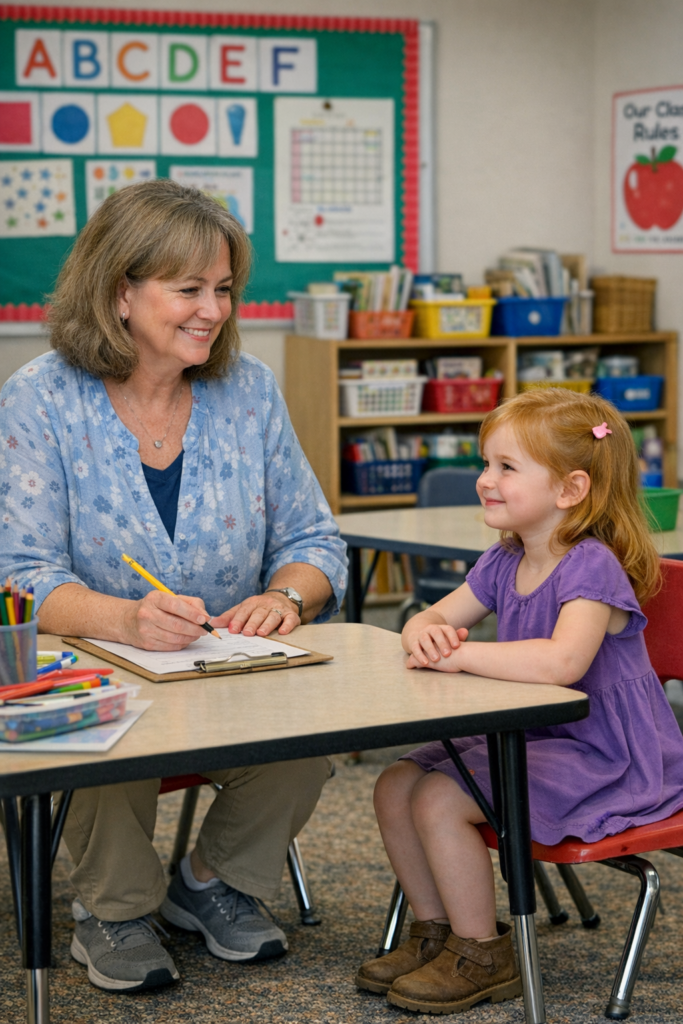
Pine City Elementary School kindergarten roundup screener Deborah Carlson with Emily Thurston
The door stayed open — standard practice — and Marnie stepped just a few feet down the hall, where she spotted Mrs. Lindholm, one of the second‑grade teachers. They began chatting, catching up on spring break stories and the latest staff‑room news.
Inside the room, Deborah began the routine: colors, shapes, simple counting, a few questions about Emily’s name and age. Emily answered easily, cheerfully, without hesitation.
Then Deborah reached for the deck of alphabet flash cards.
“Alright, Emily,” she said, holding up the first card in the pile. “What letter is this?”
It was the B card — with a big block letter, a cheerful cartoon bee, and in the lower right corner, the tiny lithographer’s union imprint logo that no one ever noticed.
Emily looked at the card, then said clearly:
“B. Lithographer Union Local Number 4, Minneapolis, Minnesota.”
Deborah blinked.
“I’m sorry, what was that?”
Emily pointed politely to the corner. “That logo. It says who made the card.”
Deborah squinted, bringing the card closer to her face. The print was so small she had to tilt it toward the light.
And there it was. Lithographer Union Local Number 4 Minneapolis, Minnesota.
“Oh… my,” she whispered.
Out in the hall, Sandra, the school social worker, heard the tone in Deborah’s voice — the tone of a veteran educator encountering something unusual. She stepped toward the doorway.
“Everything okay in here?”
Deborah didn’t look up. She was still staring at the card, then at Emily, then back at the card.
“Sandra,” she said quietly, “come look at this.”
Sandra stepped in. “What’s going on?”
“This child,” Deborah said, still stunned, “just read the union imprint on the flash card. And explained what it was.”
Sandra’s eyebrows shot up. “She read the… imprint?”
“Yes,” Deborah said. “And she knew what it meant.”
At that moment, Marnie, who had caught the shift in tone from the hallway, stepped back into the doorway, concern and curiosity mixing on her face.
“Is everything alright?” she asked.
Deborah turned toward her, eyes wide with a mixture of disbelief and delight. “Mrs. Thurston… your daughter just read the tiny print on this card. The union imprint. And she explained what it meant. I’ve been doing this for twenty‑nine years, and I have never — not once — had a child read that.”
Marnie blinked. “She… what?”
Emily looked up from her chair, cheerful and oblivious to the commotion. “Mommy, it says who made the card.”
Sandra and Deborah exchanged a look — the kind of look that said we’re witnessing something rare.
Sandra spoke first. “We’ll definitely want to follow up with some formal assessments. She’s showing skills well beyond kindergarten readiness.”
Deborah nodded, still holding the card like it might explain itself. “Emily is the strongest early reader I’ve ever screened. By far.”
Marnie felt her breath catch — pride, awe, and that bittersweet tug all at once. Her baby. Her almost‑five‑year‑old. Reading micro‑print and explaining it.
Emily swung her legs happily. “Can we do another one?”
Deborah laughed — a warm, astonished sound. “Oh, sweetheart… yes. Yes, we can.”
And out in the hallway, a few parents glanced over, wondering what on earth had just happened.
It was a moment Pine City Elementary would be talking about for years.
Heading home
The rain had stopped by the time Marnie buckled Emily into her booster seat. The clouds were thinning, letting a soft, silvery light spill across the highway as they headed north toward home. The fields were still wet, the ditches full of meltwater, and the air smelled like spring trying its best.
Emily kicked her feet gently, humming to herself. She had a sticker on her dress — a bright yellow star — and she kept touching it like it was a medal.
“Mommy?” she said as they turned onto the road to their house. “I liked it.”
Marnie glanced at her in the rearview mirror. “You did?”
Emily nodded. “Deborah was nice. And Sandra. And the room had books. And I got to sit in a little chair.”
Marnie smiled, though her throat tightened again. “I’m glad you liked it, sweetheart.”
“I want to go back,” Emily said. “I want to start school now.”
“Soon,” Marnie said softly. “A few more months.”
Emily sighed dramatically, as if this were an unreasonable amount of time. “But I’m ready.”
Marnie swallowed. “I know you are.”
The words came out quieter than she meant them to. Because she did know. And knowing was its own kind of ache.
They drove the rest of the way in a comfortable quiet, Emily watching the trees blur past, Marnie replaying the moment in the screening room — the tiny logo, the way Deborah’s face had changed, the way Sandra had stepped in, the way her own heart had leapt and twisted at the same time.
Her baby. Her almost‑five‑year‑old. Reading micro‑print and explaining it.
When they pulled into the driveway, the mud was worse than ever. Marnie carried Emily over the worst of it, laughing as Emily clung to her like a koala.
Inside, the twins were napping, the house warm and peaceful. Marnie set Emily up with crayons at the kitchen table and started a pot of coffee, needing the grounding ritual of it.
By the time Ethan got home — jacket damp from the mist, messenger bag slung over his shoulder — Emily was waiting at the door.
“Daddy! Daddy! I went to roundup!”
Ethan scooped her up immediately. “You did? How’d it go, Em?”
“It was fun! I got a sticker! And I met Deborah! And I sat in a little chair!”
Ethan laughed. “Sounds like a big day.”
Marnie stepped into the entryway, wiping her hands on a dish towel. “Ethan… you’re not going to believe what she did.”
He raised an eyebrow. “Oh? Did she charm the entire staff? Organize the other kids? Teach a mini‑lesson?”
“No,” Marnie said, shaking her head. “She read the union imprint on the flash card.”
Ethan blinked. “The what?”
“The tiny print,” Marnie said. “In the corner. Lithographer Union Local Number 4, Minneapolis, Minnesota. She read it. And explained what it meant.”
Ethan stared at her, then at Emily, then back at her.
“You’re kidding.”
“I’m not,” Marnie said. “Deborah said she’s the strongest early reader she’s had in twenty‑nine years.”
Emily beamed. “It was right there on the card, Daddy.”
Ethan let out a low whistle. “Well… I guess that’s one way to make an impression.”
Marnie laughed — a soft, overwhelmed sound — and leaned into him. “She’s ready, Ethan. More than ready.”
He wrapped an arm around her shoulders, still holding Emily with the other. “Yeah,” he said quietly. “She really is.”
Emily rested her head on his shoulder, content and proud. “Can I go to school tomorrow?”
Ethan kissed the top of her head. “Not tomorrow, kiddo. But soon.”
And as the three of them stood there in the entryway — muddy boots by the door, rain still dripping from Ethan’s jacket, the house warm and full of sleeping babies — Marnie felt that familiar tug again.
Her little girl was growing up. And the world was already noticing.
Pine City Elementary School teachers’ lounge, late afternoon
The staff room at Pine City Elementary always smelled faintly of coffee, copier toner, and whatever someone had microwaved for lunch and then regretted. By late afternoon, the building had settled into its usual end‑of‑day quiet — except for the low hum of conversation drifting from the round table near the windows.
Deborah Carlson set her tote bag down and sank into a chair, still looking a little dazed. Sandra, the social worker, poured herself the last of the lukewarm coffee and joined her.
“You look like you’ve seen a ghost,” said Mr. Halvorson, a fifth‑grade teacher, grabbing a granola bar from the communal basket.
Deborah shook her head slowly. “Not a ghost. A four‑year‑old.”
That got everyone’s attention.
Mrs. Lindholm, still in her jacket, paused on her way out. “Is this about the Thurston’s girl?”
Sandra nodded. “Word travels fast.”
“It’s a small school,” Mrs. Lindholm said, pulling up a chair. “What happened?”
Deborah exhaled, still half‑laughing at the absurdity of it. “I held up the B card. You know — big letter, picture of a bee. Same set we’ve used for years.”
“Sure,” Mr. Halvorson said. “The ones with the tiny union logo in the corner.”
“Exactly,” Deborah said. “Except I’ve never actually read the logo. It’s microscopic.”
Sandra leaned forward. “Emily read it. Out loud. And then explained what it meant.”
There was a beat of silence.
“You’re kidding,” Mrs. Lindholm said.
“I’m not,” Deborah replied. “Lithographer Union Local Number 4, Minneapolis, Minnesota. Clear as day. Like she was reading a cereal box.”
Mr. Halvorson let out a low whistle. “That’s… not normal.”
“No,” Deborah said. “It’s not. I’ve been doing roundup for twenty‑nine years. I’ve had early readers. I’ve had kids who could read simple books. But I have never had a child read micro‑print functional text and understand it.”
Sandra folded her arms, thoughtful. “She wasn’t showing off. She wasn’t performing. She just… read it because it was there.”
“That’s what got me,” Deborah said. “She wasn’t trying to impress anyone. She was just being herself.”
Across the room, the school nurse poked her head in. “Are you all talking about the little Thurston girl? I heard something about a flash card.”
Mrs. Lindholm laughed. “Oh, you’re going to hear about it. Everyone is.”
Deborah rubbed her forehead, still smiling. “We’ll do formal assessments, of course. But I’m telling you — that child is operating on a different level.”
Sandra nodded. “And she’s socially ready, too. Polite. Confident. No anxiety. That’s rare.”
Mr. Halvorson leaned back in his chair. “Well, Ethan and Marnie are both teachers. I guess it runs in the family.”
“Maybe,” Deborah said. “But this is more than that.”
The room fell quiet for a moment — the kind of quiet that comes when seasoned educators recognize they’ve just met a child they’ll remember for the rest of their careers.
Finally, Mrs. Lindholm stood, pulling her bag over her shoulder. “I’m calling it now. Ten years from today, we’re all going to say, ‘Remember when Emily Thurston read the union imprint at roundup?’”
Deborah chuckled. “Oh, we’ll be saying it long before that.”
And as the staff drifted out into the hallway, the story followed them — spreading from room to room, teacher to teacher, the way only a truly remarkable moment can.
Back at the Thurston Farmhouse
By early evening, the rain had faded into a soft mist drifting across the fields. The Thurston farmhouse glowed with lamplight, the kind that made the windows look golden from the outside. Inside, the house hummed with the familiar sounds of family: the twins babbling in their bouncy seats, the dishwasher running, the faint clatter of toys being rearranged in the living room.
Emily stood proudly in the middle of the kitchen, her “I’m going to be a kindergartner!” sticker displayed like a badge of honor. She kept smoothing it with her hand, making sure it stayed perfectly flat.
“Daddy, look!” she said for the tenth time, spinning so the sticker caught the light. “I’m going to be a kindergartner!”
Ethan grinned from where he was chopping vegetables for dinner. “I see it, Em. Hard to miss. That’s a very official sticker.”
“It means I’m almost five,” Emily said, as if this were a revelation.
In their bouncy seats, the twins erupted into delighted squeals. Amber kicked her legs so hard her socks flew off. The Deuce laughed in that breathy, hiccuping way that made his whole body bounce.
“They think you’re pretty funny,” Marnie said, leaning against the counter with a soft smile.
“I am funny,” Emily declared, marching over to the twins and making a silly face. They shrieked with laughter again, Amber’s hands flapping, The Deuce’s eyes wide with adoration.
Ethan paused his chopping, watching the three of them. “They’re going to miss you when you’re at school all day.”
Emily gasped. “But I’ll come home! And I’ll tell them everything! And I’ll teach them stuff!”
Marnie exchanged a look with Ethan — that same look from the morning, the one that held pride and disbelief and a little ache all at once.
“Emily,” Marnie said gently, “you were amazing today.”
Emily beamed. “Deborah liked me. And Sandra. And I got to sit in a little chair. And I read the card. And—”
She stopped suddenly, brow furrowing. “Mommy? Why did everyone look surprised when I read the little words?”
Marnie crouched beside her. “Because not many kids your age can read words that tiny. You noticed something most people don’t.”
Emily considered this, then nodded. “It was just there. So I read it.”
Ethan laughed softly. “That’s our girl.”
Emily climbed into his lap without asking, settling in like she’d been doing it her whole life. “Daddy? When do I get to go to school again?”
“In the fall,” he said, brushing a curl behind her ear. “But you’ve got a whole summer first.”
“A whole summer,” she repeated, as if weighing the length of it. “Okay. I can wait.”
The twins squealed again, as if cheering her on. Emily hopped down and ran to them, crouching so they could grab her hands. Amber squeaked with joy. The Deuce tried to pull her hair, missed, and giggled anyway.
Marnie watched them — all three of her children in one frame — and felt that familiar tug deep in her chest. The kind that said this is happening fast. The kind that said they’re all growing. The kind that said don’t blink.
Ethan came to stand beside her, sliding an arm around her waist. “Big day,” he murmured.
She leaned into him. “Huge.”
“You okay?”
She nodded, eyes still on the kids. “Just… proud. And a little overwhelmed.”
“Same,” he said quietly.
Emily looked up from the twins. “Mommy? Daddy? When I’m in kindergarten, can I still play with them?”
Marnie smiled. “Of course you can.”
“And teach them stuff?”
“Always,” Ethan said.
Emily seemed satisfied with that. She returned to making the twins laugh, her sticker shining proudly on her dress.
And in the warm, muddy, lived‑in farmhouse between Pine City and Beroun, the Thurstons stood together in the soft glow of evening — a family of five, each growing in their own way, each changing the shape of the house just a little.
It was quiet-ish. It was chaotic-ish. It was perfect.
Friday Night Date Night for Marnie and Ethan
Friday afternoon sunlight slanted across the Pine City High parking lot as teachers streamed out after seventh period. It was 3:15 sharp — the earliest most of them had left in weeks — and both Marnie and Ethan were among them, moving with the purposeful energy of parents who had a plan.
A rare evening out. Just the two of them. Dinner in Duluth. Maybe even a walk along the lake before the concert if the weather held.
They picked up Emily and the twins from daycare, loaded everyone into the car, and headed north toward Lily and Shane’s house. Emily chattered the whole way, still wearing her “I’m going to be a kindergartner!” sticker from the day before.
“Mommy, do you think Frodo will remember me?” she asked.
“He always remembers you,” Marnie said. “You’re one of his favorite people.”
Emily beamed.
By the time they pulled into Lily and Shane’s driveway, it was just after 3:45. Lily had beaten them home by only a few minutes — she’d left Pine City High School the moment seventh period ended and had driven home with the same urgency Marnie and Ethan had.
She opened the front door before they even knocked. “Hi! Come on in!”
Emily barreled past her with a delighted squeal. “Frodo!”
The gray‑and‑white cat trotted into the entryway, tail high, chirping in greeting. He immediately rubbed against Emily’s legs, then circled the twins’ car seats, sniffing them like he was conducting an inspection.
“He’s been waiting,” Lily said with a laugh.
Marnie carried Amber inside while Ethan lifted The Deuce. Emily was already on the floor, showing Frodo her sticker. “Look, Frodo! I’m going to be a kindergartner!”
Frodo responded by head‑butting her shoulder and then flopping dramatically onto his side, as if overwhelmed by pride.
Lily shook her head fondly. “He’s ridiculous.”
“He’s perfect,” Emily corrected.
Marnie and Ethan exchanged a grateful look. This was exactly the kind of home they felt good leaving their kids in.
Shane arrived just before 4:00, stepping inside with a gust of cool air and the smell of sawdust from the job site he’d been at earlier, completing the rough-in for the plumbing. “Hey, everyone,” he said, smiling as he took in the scene. “Looks like the party started without me.”
The twins lit up at the sound of his voice. The Deuce kicked his legs. Amber squealed.
Shane crouched beside them. “Hi, buddies.”
Marnie touched his arm. “Thank you both again. We really appreciate this.”
“Are you kidding?” Shane said. “We love having them.”
Lily nodded. “Go. Have fun. We’ve got everything under control.”
And she meant it — her voice steady, her posture relaxed, her presence warm and confident. There was no trace of the tension she’d carried earlier in the year. Just Lily, grounded and sure.
By 4:10, the Thurstons were out the door, waving as they backed down the driveway. Emily stood in the window with Frodo pressed against her hip, both of them waving wildly.
Once the car disappeared, Lily clapped her hands. “Alright. Who’s hungry?”
“Me!” Emily said.
“Us!” the twins said, or at least that’s how their squeals sounded.
Shane grabbed his keys. “I’ll run into town and pick up pizza. Pineapple on half, right?”
“Right,” Lily said. “Drive safe.”
While he was gone, Lily settled the twins into their bouncy seats and set Emily up with crayons at the coffee table. Frodo supervised all of it, weaving between them like a furry foreman.
Emily drew a picture of a school bus. Amber kicked her feet in rhythm. The Deuce tried to grab Frodo’s tail, missed, and laughed anyway. Frodo tolerated all of it with saintly patience.
“You’re very good with them,” Lily said softly, brushing a curl from Emily’s forehead.
Emily shrugged. “They’re my brother and sister.”
Lily smiled. “They’re lucky to have you.”
Shane returned with pizza just as the twins were starting to fuss. The smell alone calmed them. They ate together at the kitchen table — Lily cutting tiny bites for the twins, Shane helping Emily with her crust, Frodo stationed under the table hoping for dropped cheese.
After supper, the house filled with laughter. Shane bounced the twins on his knees. Lily helped Emily build a block tower taller than Frodo. Frodo knocked it over. Emily shrieked with delight. The twins shrieked in solidarity.
By 7:30, the energy began to ebb. Lily dimmed the lights. Shane rocked The Deuce while Lily held Amber against her shoulder. Emily curled up on the couch with Frodo, who purred like a small engine.
“Are they asleep?” Emily whispered.
“Almost,” Lily whispered back.
By 7:50, all three Thurston children were sleeping — the twins in their portable cribs, Emily on the couch with Frodo curled protectively at her feet.
Lily and Shane stood in the doorway, watching the quiet scene.
“They’re good kids,” Shane murmured.
“They really are,” Lily said.
And in the soft lamplight, with the house warm and peaceful, Lily felt something settle inside her — a sense of belonging, a steadiness she hadn’t always had.
And tonight, it felt like exactly the right pace.
Picking up the kids
The drive back from Duluth was peaceful, the highway mostly empty, the sky a deep spring blue‑black. Marnie and Ethan rode in comfortable silence, the kind that only comes after a good meal, a good concert, and a few hours of remembering who they were before diapers and daycare and three car seats across the back of a sedan.
They pulled into Lily and Shane’s driveway just before 11:00 p.m. The house glowed softly from the living‑room lamp, and the porch light clicked on as they walked up the steps.
Lily opened the door before they knocked. She was barefoot, hair pulled into a loose braid, wearing a Pine City Dragons sweatshirt that looked like it had been washed a hundred times. She smiled — a small, warm smile that reached her eyes.
“Hey. You’re back.”
“How’d it go?” Shane called from the couch, where he was sitting with Frodo sprawled across his lap like a furry throw pillow.
“Wonderful,” Marnie said, stepping inside and shrugging off her jacket. “Dinner at Va Bene, then the concert at the DECC. It felt… really good.”
Ethan nodded. “It was nice to be adults for a few hours.”
Shane arrived just as they stepped inside, Frodo sprawled across his lap like a furry throw pillow. He looked up with a grin.
“Hey, everyone. Looks like we survived.”
Frodo chirped loudly, as if confirming this.
Lily rolled her eyes affectionately. “He was… involved.”
Shane snorted. “He tracked mud everywhere. And stole a burp cloth. Twice.”
Frodo meowed in protest and flopped dramatically onto his back.
Marnie laughed. “That sounds like him.”
“Yeah,” Shane said, scratching Frodo’s chin. “He had a big night.”
Lily gestured toward the hallway. “They’re all asleep. Emily’s on the futon in the guest room. The twins are in the portable cribs. They went down pretty easily.”
“Eventually,” Shane added, but his tone was fond.
Lily gave him a look. “They were fine.”
He held up his hands. “I didn’t say they weren’t.”
Marnie peeked down the hall, just far enough to see the soft glow of a night‑light. “Thank you. Really.”
Lily shrugged, but there was a quiet pride in her posture. “They’re good kids. And they like being here.”
Shane nodded. “The twins took their bottles around six. Emily helped. Frodo supervised.”
“Supervised,” Lily repeated, rolling her eyes. “He stole one of the burp cloths and dragged it under the table.”
Frodo meowed loudly, as if defending his honor.
Ethan laughed. “Sounds about right.”
Lily continued, “After supper, we played in the living room. Emily built a block tower. The twins knocked it over. Frodo knocked it over again. Everyone thought it was hilarious.”
“It was,” Shane said. “Even I laughed.”
Marnie watched Lily as she spoke — the calm way she described the evening, the gentle confidence in her voice, the ease with which she’d handled three small children and a chaotic cat. There was no tension, no hesitation, no shadow of the girl who had once carried so much weight.
“You’re really good with them,” Marnie said softly.
Lily blinked, surprised. “Thanks. They make it easy.”
Shane stood and stretched. “Let’s get them loaded up so you two can get home before midnight.”
Together, they gathered the kids — Emily limp with sleep, her curls stuck to her cheek; Amber warm and heavy in Marnie’s arms; The Deuce snuffling against Ethan’s shoulder. Frodo followed them to the door, chirping his goodbyes.
“Thank you again,” Ethan said as he buckled Emily into her booster seat.
“Anytime,” Lily said. And she meant it.
The short drive home was quiet. The sedan’s heater hummed softly. Emily’s head lolled to the side. The twins slept without stirring.
When they pulled into their driveway, the farmhouse looked peaceful, the porch light casting a warm circle on the steps. Inside, the house was calm — toys put away, dishes clean, the faint smell of lavender from the twins’ lotion lingering in the air.
Ethan carried Emily to her bed. Marnie settled the twins into their cribs. The house felt full and soft and right.
When they finally stood together in the dim hallway, Marnie leaned her head against Ethan’s shoulder.
“Good night,” she whispered.
“Good night,” he murmured back.
And in the quiet of their home, they felt it again. Everyone was growing, in their own ways. And tonight, it felt like exactly enough.
Saturday morning – Eide Chrysler Dodge Jeep Ram in Pine City
Saturday morning dawned bright and cool, the kind of April day that hinted at spring but still carried a bite in the wind. After a late night and a surprisingly solid stretch of sleep, the Thurstons moved through the house with a rare sense of ease. The twins were cheerful, Emily was still wearing her kindergarten sticker from two days ago, and the coffee was strong.
By late morning, they were loading everyone into the Chrysler 300 — a process that had become a choreographed routine.
Emily climbed into her booster on the passenger side. Amber went into the middle rear‑facing seat. The Deuce went behind the driver’s seat.
Ethan buckled straps. Marnie hunted for the missing pacifier. Emily narrated everything.
“It’s squishy in here,” she announced as Ethan closed her door.
“That’s one word for it,” he muttered.
Marnie laughed. “This is why we’re going.”
They drove into Pine City and pulled into the lot at Eide CDJR, the rows of vehicles gleaming in the sun. A salesman in a crisp jacket spotted them immediately and walked over with a practiced smile.
“Morning! I’m Al. What can I help you folks with today?”
Ethan gestured toward the sedan. “We’re… outgrowing this.”
Al peered into the backseat, where three small faces stared back at him. “Ah. Yes. That’ll do it.”
Emily waved. The twins blinked in unison.
“Well,” Al said, clapping his hands together, “let’s take a look at some options.”
He led them across the lot to a row of late‑model used vehicles.
The Chrysler Pacifica
“This one’s a Chrysler Pacifica,” Al said, opening the sliding door with a flourish. “Stow‑n‑Go seating, great safety ratings, tons of room.”
Marnie stepped inside and exhaled. “Oh… this feels nice.”
Ethan lifted The Deuce into the second row. “He fits without me folding myself in half. That’s a plus.”
Emily climbed in after him. “There’s so much space! I could do cartwheels!”
“No cartwheels,” Marnie said automatically.
Al chuckled. “It’s a popular model with families.”
The Dodge Durango
Next, he walked them over to a dark blue Durango.
“Now this,” Al said, “is for folks who want space and power.”
Ethan opened the back. “It’s roomy.”
Marnie frowned thoughtfully. “But the third row feels… tighter.”
Emily climbed in and sat in the back. “It’s like a cave.”
“Not necessarily a bad thing,” Ethan said.
“But a cave,” Emily repeated.
The twins babbled their agreement.
The Toyota Sienna
Finally, Al showed them a silver Sienna.
“This has the famous Toyota reliability, built in Indiana. Smooth ride. Great for long trips. And it’s a hybrid so it’s great on gas mileage.”
Marnie slid the door open and nodded. “I like this one too.”
Ethan lifted Amber inside. “Feels solid.”
Emily tested the cup holders. “This one has the best cup holders.”
Al grinned. “Cup holders are very important.”
“They are,” Emily said seriously.
The Four‑Square
After the test‑drives, Al ushered them into his small office. He pulled out a laminated four‑square sheet and a dry‑erase marker.
“Alright,” he said, “let’s talk numbers.”
Marnie and Ethan exchanged a look — the look of two teachers who knew exactly what a four‑square meant.
Al wrote down monthly payments, trade‑in values, interest rates, and circled a few numbers with the confidence of a man who had done this a thousand times.
“So,” he said brightly, “if we can get you into one of these today, what are you thinking?”
Ethan leaned back. “Honestly? We’re… thinking.”
Marnie nodded. “We weren’t planning to buy today. We just wanted to see what’s out there.”
Al nodded, unfazed. “Totally understandable. Big decision. Three kids, lots of moving parts.”
Emily, sitting on Marnie’s lap, whispered, “I like the cup holders.”
The twins babbled in agreement.
Ethan laughed. “We’ll need to talk it over.”
Al capped his marker. “No pressure. Take your time. I’ll print out the numbers for each option so you can look them over at home.”
He handed them a folder. “And if you decide you’re ready — today, next week, next month — come see me.”
The Drive Home
Back in the Chrysler 300, the kids were already fading. Amber sucked her pacifier sleepily. The Deuce blinked slow, heavy blinks. Emily hummed to herself, still thinking about cup holders.
Ethan pulled onto the highway. “So… what do you think?”
Marnie exhaled. “I think… not today.”
“Same.”
“We’re close, though.”
“Yeah,” he said. “We’re getting there.”
Emily piped up from the back. “I liked the first one. And the last one. And the cave one.”
Marnie laughed. “Good to know.”
The sedan hummed along the road, the kids drifting toward sleep, the folder of numbers resting in Marnie’s lap.
They weren’t ready to say deal.
But they weren’t saying no deal, either.
They were somewhere in the middle — the place where families grow, decisions simmer, and life shifts one small step at a time.
Trout Creek, Mid‑April
The last of the snow clung to the shaded edges of the woods like scraps of forgotten laundry, thin and gray and stubborn. Everywhere else, the ground had given up. The earth was soft, dark, and waking, and each step Allison and Erik took sank an inch or two into the thaw.
Their boots made that unmistakable mud‑season sound — a wet, sticky pull, like the land was reluctant to let them go.
Erik held the rolled‑up site map under one arm, but they weren’t really using it. Not today. Today was about walking the land with their own eyes, their own instincts, their own sense of what felt right.
Allison pushed a strand of hair behind her ear as she stepped around a puddle that reflected the pale April sky. “It looks different without the snow,” she said. “Bigger, somehow.”
“Yeah,” Erik said, glancing toward the gentle rise where the trees opened into a clearing. “Like it’s finally showing us what it actually is.”
They followed the faint path they’d made on earlier visits, though now it was more mud than path. The air smelled like thawing earth and wet leaves — that unmistakable western U.P. scent that meant winter was losing its grip, even if it might still throw a tantrum or two before May.
When they reached the clearing, they stopped without speaking. They always did. It was becoming a ritual.
Allison turned slowly, taking in the space. “Okay,” she said softly. “Kitchen window.”
Erik smiled. “Kitchen window.”
She walked a few steps forward, boots squelching, and stood where she imagined the sink might be. She faced south‑southwest, toward the line of trees that dipped just enough to let the late‑day sun pour through in long, golden beams.
“I can see it,” she said. “Morning light coming in from the east, right over there. And in the evenings…” She lifted her chin toward the west, where the sky was already beginning to warm with the promise of sunset. “Those long summer sunsets. The ones that last forever.”
Erik stepped beside her, close enough that their shoulders brushed. “We’ll sit on the porch and watch them,” he said. “Kids running around. Or chickens. Or both.”
She laughed. “Chickens are more predictable.”
“Debatable.”
They walked the perimeter of the imagined house, marking out rooms with gestures and instinct. Here, the living room. There, the mudroom — essential in the U.P., non‑negotiable. The bedrooms tucked toward the quieter side of the property. The porch wrapping around just enough to catch the evening breeze.
When they reached the spot where the driveway would curve in, Erik paused and squinted toward the road. “I’m thinking it comes in from that angle,” he said. “Not straight. A little bend. Makes it feel more private.”
“And prettier in winter,” Allison added. “Snow on the pines, the curve leading up to the house… I can picture it.”
They stood there for a moment, boots sinking slowly into the soft ground, imagining the crunch of gravel under tires, the glow of porch lights on a dark December afternoon, the way the house would look from the road.
A breeze moved through the trees, carrying the smell of damp bark and the faintest hint of spring.
Allison slipped her hand into Erik’s. “It’s really happening,” she said quietly.
“Yeah,” he answered, giving her hand a gentle squeeze. “It is.”
They walked the rest of the property in companionable silence, letting the land speak in its slow, thawing way. Every step left a print behind them but pointing toward something lasting, something that would one day be home.
Hall Road, Mid‑April
By the time the sun dipped behind the trees, the Hall Road house smelled faintly of wet boots and thawing earth — the scent of a long mud‑season day. Allison set her laptop on the kitchen table, nudging aside a stack of siding samples that had arrived in the mail that afternoon. Erik followed with two mugs of tea and a folder thick with printouts from Koskela Builders.
Olive, their golden retriever, thumped her tail against the floorboards and settled beside the table like she’d been assigned supervisory duty.
“All right,” Allison said, pulling her chair closer. “Window packages first?”
Erik nodded, flipping open the folder. “Koskela sent over the updated specs. They want our final choices before they lock in the order.”
The table was a patchwork of color swatches, brochures, and sample boards — cedar‑tone siding, slate gray, a soft green that reminded Allison of the pines on their Trout Creek land. Window diagrams were spread between them, each labeled with dimensions and energy ratings.
Allison traced a finger along one of the diagrams. “I still like the idea of the bigger kitchen window. The one that faces southwest.”
“Me too,” Erik said. “Especially after walking the land again. That view is going to be incredible.”
They paused, both picturing it — the clearing, the long summer light, the way the sun would linger over the treetops until nearly ten o’clock in June.
Olive gave a soft huff, as if approving the choice.
Next came the siding samples. Allison held up the cedar‑tone board, tilting it under the kitchen light. “This one feels warm. Homey.”
Erik lifted the slate gray. “This one feels… sturdy.”
“Sturdy is good,” she said, smiling. “But I don’t want the house to look like a storm shelter.”
He laughed. “Fair point.”
They set the samples aside for the moment and moved on to the subcontractor calls. Allison dialed her cousin Mike first. He picked up on the second ring.
“Hey, cuz,” Mike said. “You two ready to talk electrical?”
Erik put the phone on speaker. “We’ve got the layout in front of us.”
They walked through outlet placement, lighting preferences, and the all‑important question of where the breaker panel should go. Mike had opinions — strong ones — but they were the kind of opinions that came from a decade of wiring houses in the U.P., so Allison and Erik listened carefully.
When they hung up, Allison shook her head fondly. “He’s going to treat this like it’s his own house.”
“Good,” Erik said. “That’s exactly what we want.”
Next was Josh, the plumber. He was cheerful as always, and immediately launched into a discussion about bathroom layouts, water heater placement, and the pros and cons of a utility sink in the mudroom.
“Trust me,” Josh said, “you’ll thank me the first time you come home covered in mud or fish guts.”
Erik grinned. “He’s not wrong.”
After the calls, the kitchen felt quieter — the kind of quiet that comes after productive conversation, when the pieces of a plan start clicking into place.
Allison’s phone buzzed with a new email. She opened it, scanned the first few lines, and her breath caught.
“It’s from Koskela,” she said. “Updates.”
Erik leaned in. “Good news?”
She read aloud. “Trusses have been ordered from Skandia Truss. Excavation tentatively scheduled for the week of Memorial Day. Foundation crew available that same week.”
For a moment, neither of them spoke.
It was happening. Not someday. Not eventually. Not in the abstract.
Soon.
Erik let out a slow breath. “That’s… real.”
“Yeah,” Allison whispered. “It is.”
They looked at the table — the window diagrams, the siding samples, the notes from Mike and Josh. All the little decisions that had felt theoretical only weeks ago now carried weight.
Olive nudged her head under Allison’s hand, sensing the shift in the room. Allison scratched behind her ears, smiling.
“We’re really doing this,” she said.
Erik reached across the table and took her hand. “Piece by piece.”
Outside, the April wind rattled the last patches of ice in the ditch. Inside, the kitchen glowed warm with lamplight, the future taking shape one decision at a time.
Hall Road, Late Evening
By the time the last of the siding samples was stacked neatly on the counter and the kitchen lights were dimmed, the house had settled into that deep, late‑evening quiet that only comes after a long, productive day. The April wind tapped gently at the windows. Somewhere down the hall, Olive had already curled up in her usual spot, sighing into sleep.
Allison and Erik sat together on the old love seat in the living room, a blanket draped over their legs, the soft hum of the furnace filling the silence between them. The laptop with the Koskela email still sat open on the coffee table, its glow casting a faint light across the room.
Erik leaned his head back against the cushion. “It feels different now,” he said quietly. “Like we crossed some kind of line.”
Allison nodded, pulling the blanket a little higher. “Yeah. Before tonight, it was all planning. Ideas. Sketches. Talking in circles.” She glanced toward the laptop. “But trusses ordered… excavation dates… foundation crew lined up… that’s real.”
He reached for her hand, threading his fingers through hers. “We’re actually going to break ground.”
“Memorial Day week,” she said, almost in a whisper, as if saying it too loudly might break the spell. “That’s barely a month away.”
They sat with that thought for a moment — the weight of it, the excitement, the quiet awe of watching something long imagined begin to take shape.
Erik gave her hand a gentle squeeze. “Do you remember the first time we walked that land? Snow up to our knees. Couldn’t even see half of it.”
“And we still knew,” Allison said. “We knew it was ours.”
He smiled. “We did.”
Outside, a gust of wind rattled the branches of the big maple in the yard. Inside, the warmth of the room wrapped around them like a promise.
Allison rested her head on his shoulder. “It’s funny,” she murmured. “I thought I’d feel nervous when things started moving. But I don’t. I just feel… ready.”
“Me too,” Erik said. “It’s like everything’s been pointing to this.”
She closed her eyes, picturing the clearing in Trout Creek — the soft rise of the land, the way the light had stretched across it in the evenings, the place where their kitchen window would face the long summer sunsets. She could almost smell the pine needles warming in July heat.
“We’re going to build a good life there,” she said.
“We already are,” he answered. “This is just the next step.”
The house creaked softly as the temperature dropped outside. Olive shifted in her sleep. The world felt still, held, suspended in that tender moment between what had been planned and what was about to begin.
Allison lifted her head just enough to look at him. “It’s happening, isn’t it?”
Erik brushed a thumb across her knuckles. “Yeah,” he said. “It really is.”
And in the quiet of that late April night, with the mud of the U.P. thawing and the future inching closer, they sat together — hopeful, steady, and ready for the ground to open and the foundation of their life to take shape.
Chapter 9 – Foundations and Celebrations
Saturday Morning, May 23
Maya woke before her alarm, the soft gray light of early morning filtering through her curtains. Her apartment was quiet except for the faint hum of the refrigerator and the occasional car rolling down the street. She lay there for a moment, heart already fluttering with anticipation. Today was her wedding shower.
She slipped out of bed, pulled on leggings and a soft sweatshirt, and padded into the living room—where she found her mother already in full motion.
“Good morning, beta,” Anjali Patel said without turning around, her hands busy arranging a small box of decorations on the coffee table. “You’re up early.”
“So are you,” Maya said, smiling as she leaned down to kiss her mother’s cheek. “You didn’t have to come this early.”
“I wanted to,” Anjali replied, smoothing a wrinkle in a pastel banner. “Besides, you would have been pacing alone.”
Maya opened her mouth to protest, then closed it. Her mother wasn’t wrong.
A soft knock sounded at the door. Before Maya could reach it, Anjali called, “That will be Dani.”
Sure enough, when Maya opened the door, Dani Nadeau stood there with a neatly wrapped gift in her arms and that warm, steady presence that always made Maya feel like everything was going to be okay.
“Good morning, sweetheart,” Dani said, stepping inside and giving Maya a gentle hug. “Big day.”
“I know,” Maya breathed. “I keep checking the time like it’s going to move faster.”
Dani laughed softly. “It won’t. But that’s alright. Days like this deserve to unfold slowly.”
She set the gift on the dining table—wrapped in soft teal paper with a white ribbon, elegant and understated, very Dani—and joined Anjali in looking over the decorations.
“You brought flowers?” Dani asked, admiring the small bouquet of pale pink peonies.
“Of course,” Anjali said. “They’re Maya’s favorite.”
Maya felt her throat tighten. “You two didn’t have to do all this.”
“We wanted to,” they said in unison, then exchanged a smile that made Maya’s heart swell. Two moms, both hers, moving in sync.
She drifted toward the window, pulling the curtain aside. “Allison and Sophie should be on the road by now. And Rachel. And Lily and Marnie left Pine City early, I think.”
“You’ll see them soon enough,” Dani said. “Let them drive safely.”
Maya nodded, though her foot tapped restlessly against the floor.
Another knock—this one quicker, familiar.
Maya opened the door to find Adrian, hair still damp from a shower, wearing jeans and a soft flannel. He stepped inside, smiling in that way that always made her shoulders drop a little.
“Hey,” he said quietly.
“Hey,” she echoed, stepping into his arms.
He held her for a long moment, grounding her instantly. “You’re buzzing,” he murmured into her hair.
“I know,” she said. “I can’t help it.”
He pulled back just enough to look at her. “You’re going to have an amazing day. And I’ll be thinking about you the whole time.”
“You’re going to Duluth,” she reminded him, though her voice was soft, not scolding.
“Yeah, but I can think about you in Duluth,” he said, brushing a thumb across her cheek. “Mom, Anjali—she’s vibrating like a tuning fork.”
Both moms laughed.
“She gets that from you,” Anjali said.
“Absolutely not,” Adrian replied, grinning. “I’m calm. I’m serenity itself.”
Dani snorted. “You were a tornado as a child.”
“Traitor,” he said, but he was laughing.
He kissed Maya’s forehead, lingering for a heartbeat. “I’ll text when I get to my brother’s. Have fun. Let yourself enjoy it.”
“I will,” she whispered.
He squeezed her hands, nodded to both moms, and slipped out the door.
The apartment felt suddenly quieter.
Maya exhaled, long and slow, then moved back to the window. Outside, the street was still, the morning just beginning to brighten. Somewhere out there, her friends were driving toward her—toward this day, toward this moment.
She pressed her palm lightly to the glass.
“Alright,” she said softly, more to herself than anyone else. “Let’s do this.”
Behind her, Anjali and Dani exchanged a knowing look and went back to their preparations.
Maya stayed at the window, watching for the first car to appear, heart full and rising.
Ewen → Ashland → New Richmond → Minneapolis
Allison locked her front door just before six, the sky still a pale, early‑morning blue. The air held that crisp, late‑May coolness that promised a warm day ahead. She climbed into her Ford F‑150, the seat familiar beneath her, and started the engine. The dashboard clock glowed 5:58 a.m. EDT.
“Alright,” she murmured to herself. “Let’s go get Sophie.”
M‑28 was empty—utterly, beautifully empty. The kind of quiet highway that made her feel like she had the whole Upper Peninsula to herself. The sun crept up behind her as she headed west, the light stretching long across the pavement. She made excellent time, the miles slipping by in a steady rhythm.
At the Gogebic County line, 11.6 miles east of Wakefield on M-28, she gained an hour, crossing into the Central Time Zone.
Sophie’s little house in Ashland came into view just as the church bells downtown chimed the half hour. It was 6:30 a.m. Central Daylight Time. Sophie was already outside, overnight bag at her feet, travel mug in hand, bouncing lightly on her toes.
Allison barely had the truck in park before Sophie hurried over.
“Allie!” she said, pulling her into a hug. “You made amazing time.”
“Highway was deserted,” Allison said. “And the time change helped.”
They loaded Sophie’s bag into the back seat, and Sophie climbed into the passenger seat, buckling in with a contented sigh.
“Okay,” Sophie said, settling her travel mug into the cup holder. “Tell me everything. How was Olive last night?”
“Thrilled,” Allison said, pulling away from the curb. “My dad sent me a picture of her asleep on their couch before I even got back to Ewen.”
Sophie laughed. “Of course he did. She’s basically their grand‑dog.”
“Pretty much.”
They headed south on US‑63, the morning brightening around them. The conversation flowed easily—Maya’s shower, the wedding, the quick trip to Negaunee the night before, the upcoming groundbreaking on Tuesday.
“And Elias?” Allison asked gently, glancing over.
Sophie’s cheeks warmed. “He texted me good luck for the weekend. And…he said he hopes I have fun.”
“That’s something,” Allison said.
“It is,” Sophie admitted, smiling into her mug. “I’m trying not to overthink it.”
“You’re doing great,” Allison said. “Really.”
The miles rolled by, the two of them slipping back into the easy rhythm they’d always had.
Just over three hours later, they turned onto a quiet street in New Richmond. Rachel’s house was already awake, with curtains open, and Rachel herself standing in the driveway, waving both arms like she was signaling a plane.
“Allison Heikkila!” she shouted as the truck approached. “And Sophie Kowalski! My morning is MADE.”
Allison parked, and Rachel practically launched herself at them, hugging Sophie first, then Allison.
“I get bonus time with you two,” Rachel said, beaming. “This is the best day ever.”
She held up a reusable grocery bag. “Snacks for after the shower. And maybe during. I’m not above sneaking a granola bar.”
Sophie laughed. “You haven’t changed at all.”
“Thank you,” Rachel said, sliding into the back seat with a grin. “I take that as the highest compliment.”
They pulled away from the curb, heading west on Wisconsin Highway 64, then onto Minnesota Highway 36, the three of them talking over one another, laughing, reminiscing about UWS, old professors, late‑night study sessions, and the ridiculous things they used to worry about.
It felt like being twenty again—carefree, connected, the world wide open.
By the time they reached north Minneapolis, the clock read 10:28 a.m. The apartment building came into view, and Maya was already at the window, hands pressed to the glass.
“There she is,” Sophie said softly.
Allison eased the truck into a parking spot. The moment the engine shut off, Maya burst out the front door.
She didn’t even wait for them to close the doors before she wrapped all three of them in a hug—Sophie squeaking, Rachel laughing, Allison steadying them all.
“You’re here,” Maya said, breathless and glowing. “You’re really here.”
“And we brought snacks,” Rachel added, holding up her bag.
Maya laughed, wiping at her eyes. “Of course you did.”
The four of them stood there for a moment—sun warm on their shoulders, the day unfolding ahead of them, the joy of reunion settling in like sunlight.
“Come on,” Maya said, stepping back. “Everyone else will be here soon. Then we convoy to 50’s Grill.”
And with that, the Minneapolis thread of the day truly began.
Pine City → Minneapolis
The Thurston farmhouse was quiet when Marnie slipped out the front door at 9:15 a.m. The twins were down for their morning nap, Emily was happily building a block tower with Ethan, and the soft hum of family life followed her to the car like a warm echo.
She backed out of the driveway, waved once toward the living room window—Ethan lifted Emily’s hand to wave back—and headed down the familiar road toward Pine City proper.
Ten minutes later, she pulled into Lily and Shane’s driveway. Lily was already outside, overnight bag slung over her shoulder, Frodo watching from the window with his nose pressed to the glass.
“You’re right on time,” Lily said, opening the passenger door and tossing her bag into the back seat.
“You look ready,” Marnie said.
“I’ve been ready since six,” Lily replied, buckling in. “I’m so excited for Maya.”
Marnie smiled. “Me too.”
They pulled away from the house, chatting easily as they headed south on I‑35. The morning was bright, the traffic light, and the day felt full of promise.
“Coffee?” Lily asked as they approached North Branch.
“Absolutely,” Marnie said.
They swung into the Caribou Coffee drive‑thru, both ordering their usuals—Marnie a medium latte, Lily a mocha with extra whip. When the drinks arrived, Lily held hers up.
“To Maya,” she said.
“To Maya,” Marnie echoed, tapping her cup lightly against Lily’s.
Back on the highway, the conversation flowed—about school, about the kids, about Maya’s shower, about how surreal it felt that the wedding was so close.
“She’s going to be glowing today,” Lily said.
“She already was when I talked with her last week,” Marnie replied. “And she’ll be even more so when everyone gets there.”
They made good time, the drive familiar and easy. As they neared Minneapolis, Lily checked the time.
“Allison’s probably already there,” she said.
“Yeah,” Marnie agreed. “She had the longest drive.”
They turned onto Maya’s street just after 10:35 a.m., pulling in behind a familiar Ford F‑150 with the Big Valley Ford Chrysler dealer plate on the front and a Michigan “Water-Winter Wonderland” license plate on the back.
Maya was already outside again—this time practically bouncing.
“Marnie! Lily!” she called, hurrying toward them.
The moment they stepped out of the car, Maya wrapped them both in a hug, squeezing tightly.
“You’re here,” she said, breathless with excitement.
“We made it,” Lily laughed, hugging her back.
Inside the apartment, the energy was warm and bright. Allison, Sophie, Rachel, Anjali, and Dani were already gathered in the living room, chatting easily.
More hugs followed—Marnie with Allison, Sophie, and Rachel; Lily with everyone; introductions between the moms and the Pine City pair.
“Lily, I’ve heard so much about you,” Dani said warmly.
“All good things, I hope,” Lily replied with a grin.
“Of course,” Dani said.
Anjali stepped forward next. “Marnie, it’s so nice to finally meet you.”
“You too,” Marnie said, shaking her hand. “Maya talks about you all the time.”
The room filled quickly with conversation—catching up, laughing, admiring the decorations Anjali had prepared, and sharing the excitement of the day.
By 11:15, Maya clapped her hands lightly.
“Okay, everyone—let’s head out. We’re meeting Rashida and Sheauna at 50’s Grill.”
The group gathered their bags and gifts, filed out of the apartment, and made their way to the cars. The convoy formed easily—Maya riding with her moms in front, Marnie’s car behind, Allison’s truck bringing up the rear.
As they pulled away from the curb, the day felt officially underway—bright, joyful, and full of celebration.
The Wedding Shower at 50’s Grill, Brooklyn Center
The convoy pulled into the parking lot of 50’s Grill at 11:45 a.m., Maya’s car leading the way with the confidence of someone who had navigated these frontage roads since childhood—even if she only came here every few years. Marnie and Lily followed, then Allison’s F‑150 with Sophie and Rachel.
The bright red-and-white sign gleamed in the late‑morning sun, and through the windows they could already see waitresses in poodle skirts weaving between tables, the pie case glowing like a jewel box.
Inside, the air smelled of burgers, fresh‑baked pies, and nostalgia. A song by Perry Como was playing on the speaker.
Anjali stepped forward immediately, her voice warm but organized. “Hello, we have a reservation for a bridal shower—Patel party.”
The hostess, a cheerful young woman with a high ponytail and a clipboard, smiled. “Of course! Right this way. We’ve got the west dining area set up for you.”
She led them past the bakery counter—where Sophie audibly gasped at the sight of the lemon meringue—and into a semi‑private section with long tables pushed together, pastel decorations already laid out just as Anjali had arranged.
Maya’s breath caught. “Mom…this is perfect.”
Anjali squeezed her hand. “It’s your day, beta.”
They settled into their seats—Maya in the center, flanked by her moms, the Squad filling in around them. The room buzzed with chatter and the soft clink of silverware.
A few minutes later, two more women approached the table.
Rashida Shahin, stylish in a deep green blouse, smiled warmly. “Hi! We made it.”
Sheauna Harris, wearing a denim jacket and bright earrings, waved. “Sorry if we’re late—traffic on 94 was a mess.”
“You’re right on time,” Maya said, standing to hug them both. “Everyone, these are my colleagues from North—Rashida, our social worker, and Sheauna, who teaches social studies.”
Introductions flowed easily—handshakes, hugs, warm welcomes. Rashida and Sheauna fit into the group instantly, their energy bright and open.
Just then, their waitress arrived—Brittany, blonde ponytail bouncing, poodle skirt swishing.
“Hi ladies! I’m Brittany, and I’ll be taking care of you today. Can I start you off with drinks?”
Orders flew around the table—iced teas, Diet Cokes, lemonades, a couple of coffees for the moms.
When Brittany returned for lunch orders, she grinned. “We’ve got everything from burgers to salads to pot roast. And don’t forget the pies.”
Rachel whispered loudly, “I’m not forgetting the pies.”
Laughter rippled around the table.
Marnie looks around the room at the décor, with 1950s record albums, neon and pastel colors, and the ambiance, between Brittany’s outfit and and the music playing, which at that moment was “At The Hop” by Danny and the Juniors. “Ethan would love this,” Marnie quipped.
Lunch — Stories, Laughter, and a Few Tears
As plates arrived—burgers, chicken salads, grilled cheese, fries—the conversation blossomed.
Rashida leaned toward Maya. “Your friends are wonderful.”
“They’re my heart,” Maya said softly.
Across the table, Allison was telling a story about her first year teaching in Ewen, complete with a dramatic reenactment of a 6th grader who tried to smuggle a frog into class.
Sophie nearly choked on her lemonade from laughing.
Marnie shared a sweet story about Emily insisting on wearing her “fancy dress” today because “Miss Maya is having a princess party.”
“She’s not wrong,” Lily said, raising her glass.
Dani dabbed her eyes. “I’m just so happy for you, Maya.”
Anjali squeezed her hand. “Me too.”
Maya’s eyes shimmered. “I’m really lucky.”
Games — Bridal Shower Chaos, 50’s Grill Style
After the plates were cleared, Anjali stood. “Alright, everyone—time for games!”
Groans and cheers mixed together.
Game 1: “How Well Do You Know the Bride?”
Rachel read the questions with theatrical flair.
“What is Maya’s favorite comfort food?”
“Mac and cheese!” half the table shouted.
“Specifically,” Sophie added, “the kind she makes at 11 p.m. during grading season.”
Maya covered her face. “I feel attacked.”
Game 2: “Wedding Emoji Pictionary”
Sheauna turned out to be unexpectedly competitive.
“That’s clearly ‘tie the knot,’” she insisted.
“That’s a pretzel and a rope,” Lily countered.
“It’s metaphorical!”
Maya laughed so hard she had to wipe her eyes.
Game 3: “Advice for the Bride”
Everyone wrote down a piece of advice—some heartfelt, some hilarious.
Marnie: “Never go to bed angry. But snacks help too.” Rachel: “Always keep a spare granola bar in your purse.” Allison: “Communicate. And don’t forget date nights.” Sophie: “Laugh often. Especially at the small stuff.” Lily: “Choose each other, every day.”
Maya read Lily’s last, her eyes softening. “Thank you.”
Lily smiled, quiet but steady.
Gifts — Love Wrapped in Paper and Ribbon
Maya opened each gift with care:
• A beautiful set of mixing bowls from Allison
• A cozy throw blanket from Sophie
• A framed print of Duluth’s skyline from Rachel
• A spa gift set from Marnie
• A Target gift card from Lily (“Because you’ll need it during wedding week”)
• A handmade recipe book from Rashida and Sheauna, filled with Minneapolis North staff favorites
• A delicate necklace from Anjali and Dani, chosen together
When Maya opened the necklace—a simple gold pendant—she pressed a hand to her heart.
“It’s perfect,” she whispered.
Dani hugged her. “We wanted you to have something from both of us.”
Maya’s eyes shone. “I love you both so much.”
Lily’s Quiet Moment
As the others chatted, laughed, and passed around slices of pie, Lily sat back for a moment, letting the warmth wash over her.
She watched Maya—radiant, joyful, surrounded by love.
And she felt something settle gently inside her.
Not sadness. Not regret. Just…peace.
She thought of her parents—how the first steps toward reconciliation had been tentative but real. She thought of the old wound between her and Maya from several years ago—the joke that had landed wrong, the hurt that had spiraled, the night in Superior when everything felt like it might break.
But it hadn’t. They hadn’t.
They had forgiven. They had grown. They had come back stronger.
Lily didn’t bring it up. She didn’t need to.
The proof of their healing was right here—Maya’s hand brushing hers as she passed a plate, the easy laughter between them, the way Maya leaned into her shoulder during a joke.
Love had endured. Friendship had endured. They had endured.
And Lily felt full—quietly, deeply full.
The Afternoon Winds Down
By the time the last gifts were opened and the last crumbs of pie were gone, the group was glowing with contentment.
Brittany returned with the check, still smiling. “You ladies were so much fun.”
“We try,” Rachel said.
As they gathered their things, Maya looked around the table—at her moms, her friends, her colleagues—and felt her heart swell.
“I can’t thank you all enough,” she said. “This was…everything.”
Anjali kissed her cheek. “You deserve all of it.”
The group filed out into the warm afternoon, full of laughter, leftovers, and love—ready for the rest of the weekend, and for everything still ahead.
Maple Grove — The Girls’ Weekend Begins
After the last hugs outside 50’s Grill, the group split into two directions. Maya drove Anjali and Dani back to her apartment to drop them off and so she could grab her overnight bag. The others—Marnie, Lily, Allison, Sophie, and Rachel—headed straight to Maple Grove, chattering the whole way about the shower, the games, and the pie.
By the time Maya pulled into the hotel parking lot, the rest of the Squad was already waiting in the lobby, gathered around a cluster of soft chairs beneath a chandelier that looked like it belonged in a Pinterest board titled “Suburban Chic.”
Maya stepped inside, overnight bag slung over her shoulder.
“There she is!” Rachel called, waving both arms like she was signaling a rescue helicopter.
Maya laughed. “You act like it’s been days.”
“It’s been forty minutes,” Sophie said. “We missed you.”
The six women checked in. The hotel was exactly the kind of place that made sense for them—clean, modern, safe, with a pool and hot tub and a lobby that smelled faintly of citrus and fresh laundry.
They dropped their bags in three adjoining rooms, took a collective breath, and then Lily clapped her hands.
“Okay. Dinner. I’m starving.”
“Olive Garden?” Allison suggested.
Six heads nodded in unison.
Olive Garden — Breadsticks, Laughter, and the Start of Something Soft
The restaurant was busy but not chaotic, filled with families and couples and the comforting hum of weekend energy. The Squad slid into a large booth, menus barely glanced at before everyone defaulted to their favorites.
“Unlimited breadsticks should be illegal,” Rachel said as she tore into one. “I have no self‑control.”
“You never have,” Sophie teased.
“Correct,” Rachel replied proudly.
Marnie leaned back, letting the warmth of the moment settle into her bones. No kids tugging at her sleeve. No Ethan asking where the diaper bag was. No lesson plans waiting on her desk. Just her friends. Her people.
“This feels so good,” she said quietly.
Lily nudged her. “You deserve a night off.”
“More like a month,” Rachel added.
Maya laughed. “We’ll start with tonight.”
They talked about everything—wedding plans, school stories, the ridiculousness of adulthood, the chaos of May for teachers, the absurdity of trying to keep houseplants alive.
At one point, Sophie said, “Okay, but seriously—why does every plant die in my house?”
“Because you forget to water them,” Allison said.
“That’s slander.”
“It’s literally the truth,” Rachel said.
Maya wiped tears from her eyes from laughing. “I missed this.”
“We all did,” Lily said softly.
Back at the Hotel — Pool Time
After dinner, they returned to the hotel, changed into swimsuits, and headed to the pool area. The water was warm, the lights soft, and the hot tub bubbled invitingly.
“This is great,” Marnie said as she sank into the hot tub.
“Honestly, same,” Maya agreed, leaning back against the tile.
Sophie floated lazily in the pool. “I feel like we’re in a commercial for ‘Girls’ Weekend: Midwestern Edition.’”
“Sponsored by Target,” Rachel added.
“And Caribou Coffee,” Lily said.
“And the Minnesota Department of Transportation,” Allison chimed in. “Because we all drove here.”
They dissolved into laughter again.
For a while, they didn’t talk at all—just soaked, floated, breathed. Six women who had lived so much life since college, who had weathered storms and celebrated milestones, who had grown up together and grown into themselves.
Late Night — Comfy Clothes, Snacks, and Heart‑Talk
By the time they returned to their rooms, hair damp and skin warm, the night had settled into that perfect space where time feels soft and slow.
They changed into leggings and hoodie sweatshirts and gathered in one room. Rachel unzipped a tote bag with a flourish.
“Ladies,” she announced, “I present to you: snacks.”
Gasps filled the room.
She laid out:
• gummy bears
• popcorn
• chocolate-covered pretzels
• chips and salsa
• a family‑size bag of M&Ms
• and, inexplicably, a bag of baby carrots
“Balance,” Rachel said.
They sprawled across the beds and floor, talking for hours.
About Maya and Adrian.
About Lily’s slow, steady reconciliation with her parents.
About Marnie’s kids and how Emily had declared herself “in charge of the house” last week.
About Allison’s students, particularly Clara Juntunen and Emma Koskinen, and the plans for the new house in Trout Creek.
About Sophie teaching at the college level and her budding relationship with Elias.
About Rachel’s chaotic teaching stories from both Green Bay and New Richmond.
At one point, Maya looked around the room, eyes shining. “I don’t know what I did to deserve all of you.”
“You existed,” Lily said simply.
“And you loved us,” Marnie added.
“And we loved you back,” Sophie said.
“And we’re never letting you go,” Rachel declared dramatically.
Allison raised her plastic cup of Diet Coke. “To the Sparkle Squad.”
Six cups clinked.
“To the Sparkle Squad,” they echoed.
1:30 a.m. — Finally, Sleep
At some point, someone glanced at the clock.
“Is it really 1:30?” Allison asked.
“No,” Sophie said. “That’s illegal.”
“We should sleep,” Maya said, though she didn’t sound convinced.
They cleaned up the snack wrappers, turned off the lights, and drifted into their respective beds.
“Goodnight, ladies,” Marnie said softly.
“Goodnight,” came the chorus.
Marnie and Maya shared a room. Just like at UWS years ago, Lily and Allison shared another room, and Sophie and Rachel shared the third room. Just like old times.
The rooms fell quiet, the soft hum of the hotel AC the only sound.
It had been a perfect night. A grown‑up girls’ night. A reminder of everything they were, everything they had been, and everything they still were to each other.
And tomorrow, the weekend would continue.
Sunday, May 24
Brunch, Goodbyes, and the Quiet Turning Toward What Comes Next
Sunlight filtered through the hotel curtains in Maple Grove, warm and soft, the kind of light that made everything feel slower and gentler. One by one, the Sparkle Squad stirred awake — some stretching, some groaning, some blinking at the clock in disbelief.
“Why does 8:30 feel like 5 a.m.?” Rachel mumbled from under a blanket.
“Because we’re not 22 anymore,” Sophie said, brushing hair out of her face.
Marnie sat up, rubbing her eyes. “Speak for yourselves. I slept better than I have in months.”
“That’s because no one woke you up asking for cereal,” Lily teased.
Marnie grinned. “Exactly.”
They packed up their bags, checked out of the hotel, and stood for a moment in the lobby, reluctant to let the weekend slip away.
“Brunch?” Allison suggested.
“Perkins?” Maya said.
Six heads nodded. The Perkins off University Avenue in Fridley was busy but familiar, the kind of place where the coffee never stopped flowing and the menu hadn’t changed in twenty years. They slid into a large booth, still carrying the glow of the night before.
“Okay, I’m getting the Tremendous Twelve,” Rachel announced. “Don’t judge me.”
“No judgment,” Sophie said. “I’m getting the Everything Omelet.”
“I want pancakes,” Lily said. “And bacon. And hash browns.”
“You want the whole left side of the menu,” Allison said.
“Correct.”
Maya smiled, soaking in the chatter, the laughter, the easy rhythm of her people. She felt full — not just from the food, but from the weekend itself.
When the waitress left with their orders, Marnie leaned back, sighing contentedly. “I needed this. All of it.”
“We all did,” Maya said.
Lily reached over and squeezed her hand. “You’re glowing, you know.”
“Am I?”
“Yeah,” Rachel said. “It’s very annoying. Stop being so pretty.”
Maya laughed. “I’ll try.”
They lingered long after the plates were cleared, unwilling to break the spell. But eventually, the moment came.
The goodbye moment.
The Parking Lot — Reluctant Goodbyes
Outside, the air was warm, the sky bright, the day stretching ahead of them. They stood in a loose circle, bags slung over shoulders, keys in hand.
“Well,” Allison said, “I guess this is it.”
“For now,” Sophie added quickly.
“We’ll see each other in a few weeks,” Rachel said. “Wedding week is basically Sparkle Squad Summer Camp.”
“That’s true,” Maya said, smiling.
Marnie hugged her first, long and tight. “I’m so proud of you.”
Lily hugged her next. “Five weeks,” she whispered. “You’re ready.”
Sophie squeezed her. “We’ll be here for anything you need.”
Rachel wrapped her arms around her dramatically. “Don’t forget us when you’re a married woman.”
“I could never,” Maya said.
Allison hugged her last. “Drive safe. Text when you get home.”
“You too.”
They hugged each other again — because one round wasn’t enough — and then the group split.
Marnie and Lily headed north toward Pine City. Allison’s truck rumbled to life, Rachel and Sophie climbing in for the long ride back to Wisconsin and the U.P. And Maya slid into her car for the short drive down University Avenue, back to Minneapolis.
Maya’s Apartment — Quiet After the Storm
Her apartment felt still when she walked in — the kind of quiet that follows a weekend full of voices and laughter. She set her overnight bag down, then paused, taking in the sight of the gifts arranged neatly on her dining table.
Mixing bowls. A cozy throw. A framed Duluth skyline. The necklace from her moms. Cards filled with love and advice.
She touched the edge of one gift bag, her breath catching.
Five weeks.
Five weeks until everything changed.
The door opened behind her.
“Hey,” Adrian said softly.
She turned, smiling. “You’re back.”
He crossed the room in a few steps, wrapping her in a hug that felt like home. “How was the shower?”
“Perfect,” she said into his shoulder. “Absolutely perfect.”
He pulled back just enough to look at her. “And the girls’ night?”
“Even better.”
He brushed a strand of hair from her face. “I missed you.”
“I missed you too.”
They stood there for a moment, the weekend settling around them like dust in sunlight.
“Five weeks,” he said quietly.
“I know.”
“You ready?”
She looked at him — really looked — and felt the answer rise from somewhere deep and steady.
“Yeah,” she said. “I am.”
He kissed her forehead, then stepped back. “I’ll let you unpack. I’m going to run home and shower, but I’ll be back later.”
“Okay.”
When the door closed behind him, Maya stood alone in the soft afternoon light, surrounded by gifts and memories and the quiet hum of her apartment.
The celebration was over. The countdown had begun.
She exhaled slowly, letting the weight of it settle.
Five weeks to go.
And she was ready.
Tuesday, May 26
6:05 a.m. — The Convoy
The sky over Baraga County was still a deep, inky blue when the four‑vehicle convoy rolled west on US‑41 and M-28. Dawn hovered somewhere below the horizon, not yet ready to break. The highway was empty, quiet, the kind of quiet that only exists in the Upper Peninsula before sunrise.
At the front of the line, the semi with the lowboy trailer rumbled steadily, amber lights pulsing against the dark. The excavator sat chained down on the trailer, silhouetted like a sleeping giant.
Behind it, the dump truck followed with a low growl, headlights cutting through the mist rising off the trees.
Next came the 1‑ton Ford pickup hauling the skid steer, the trailer rattling softly over the pavement.
And at the rear, the ¾‑ton pickup belonging to the site supervisor for Koskela Builders & Contracting kept a steady pace. Inside, the supervisor sipped coffee from a stainless‑steel thermos while “Green Onions” by Booker T. & The MGs played on SiriusXM — that unmistakable organ riff giving the whole convoy a quiet swagger as they rolled through the dark.
They long ago passed the last streetlights of Negaunee, then Ishpeming, then the long, lonely stretch toward Covington. The world was still asleep. The road belonged to them.
As they approached the junction where US‑41, US‑141, and M‑28 split, the directional sign loomed out of the dim light:
WAKEFIELD
DULUTH MN
One by one, the convoy signaled left, amber blinkers flashing in the darkness. The semi eased into the turn, the others following in perfect formation. It felt almost choreographed — a working‑class ballet of diesel and steel.
The sky began to lighten at the edges.
The day was coming.
And so was the beginning of something real.
6:35 a.m. — Trout Creek
About half an hour later, the convoy crested a small rise, and there it was — the Trout Creek water tower, unmistakable even in the early light. Built in 1990, painted like a giant fishing bobber, it stood above the trees like a cheerful landmark announcing, You’re here. This is Trout Creek.
The supervisor smiled to himself. You couldn’t mistake that tower for anything else.
A few minutes later, the convoy turned north onto Gardner Road as they made their way toward the Heikkila property. Allison and Erik were already there.
Erik’s Ford F‑350 was parked off to the side, the hood still warm from the drive from Ewen. They stood together near the staked‑out footprint of the house, coffee cups in hand, breath visible in the cool morning air.
Allison’s heart thudded in her chest. Erik’s wasn’t far behind.
They heard the convoy before they saw it — the low rumble of diesel engines echoing through the trees, growing louder, closer, more real by the second.
And then the first vehicle appeared around the bend.
The semi. Then the dump truck. Then the skid steer trailer. Then the supervisor’s pickup.
Four vehicles. Four engines. Four pieces of a dream arriving in formation.
Allison swallowed hard. “Oh my gosh… it’s really happening.”
Erik slipped an arm around her shoulders. “Yeah. It is.”
The semi eased to a stop on the cleared pad, the excavator gleaming faintly in the early morning light. The dump truck idled behind it, the pickup with the skid steer pulling off to the side. The supervisor stepped out of his truck, clipboard in hand, giving them a warm nod. He was a man in his late forties or early fifties, sturdy build, clean‑shaven, wearing a Koskela Builders jacket and a ballcap with the Tilden Mine logo faded from years of sun. He carried a clipboard in one hand and a thermos in the other.
He walked toward Allison and Erik with the easy confidence of someone who had started hundreds of job sites just like this one.
“Morning,” he called, voice warm but no‑nonsense. “You must be the Heikkilas.”
Erik stepped forward, shaking his hand. “That’s us. Erik and Allison.”
The man nodded. “Mark Lehtinen. Site supervisor for Koskela. I’ll be your main contact from here on out.”
Allison shook his hand next — and the moment she said her name, something flickered across Mark’s face.
“Hold on,” he said, tilting his head. “Heikkila now, but… you said Allison?”
“Yes,” she said. “I was Allison Besonen before I got married.”
Mark’s eyebrows lifted. “Besonen? From Negaunee?”
Allison blinked. “Yes. My dad’s Art Besonen.”
Mark let out a short laugh — the kind that comes from genuine recognition. “Well I’ll be. I know Art. Worked with him at Tilden back in the day. My dad and his dad were in the pit together for years.”
Allison’s face lit up. “Seriously?”
“Oh yeah,” Mark said, smiling now. “Art’s a good man. Hard worker. Quiet, but dependable. Haven’t seen him in a while, but I remember him well.”
Erik grinned. “Only in the U.P. could we hire a contractor from Marquette and still end up with someone who knows her dad.”
Mark chuckled. “This place isn’t as big as it looks on a map.”
The excavator operator climbed into the cab, fired up the engine, and the machine roared to life. The sound filled the clearing, echoing through the trees.
Mark gestured toward the equipment. “We’ll get the foundation hole dug today. Should have the whole footprint visible by this afternoon. You picked a good spot — high ground, good drainage. This’ll be a solid build.”
Allison swallowed hard, emotion rising in her chest. “Thank you. This… this means a lot.”
Mark nodded, softer now. “It always does. First day’s a big one.”
The excavator swung into position, the bucket lowering toward the earth.
Erik reached for Allison’s hand.
Mark stepped back, giving them space.
The engine growled. The bucket bit into the soil. And with a deep, powerful scoop, the first cut of their future home lifted into the morning air.
The sun broke over the treeline, spilling gold across the clearing.
Mark folded his arms, watching the machine work. “Well,” he said, “there it is. Day One.”
Allison squeezed Erik’s hand, eyes shining.
The beginning of something real.
Wednesday — Footings
By mid‑morning Wednesday, Erik swung the Michigan DNR patrol truck onto the edge of the clearing, gravel crunching under the tires. The air was warm for late May, the kind of day where the sun already had bite and the blackflies hadn’t quite figured out their season yet. It was expected to be close to 80 that afternoon. The excavation crew was gone, but the concrete subcontractors were there, moving with the practiced rhythm of people who had done this a thousand times.
The footing trenches were clean and squared, rebar laid neatly in place. A ready‑mix truck backed toward the excavation, its drum turning slowly.
Erik stepped out, hands on his hips, taking it in. He snapped a photo and sent it to Allison.
Erik: Footings going in. Looks good. You’ll see it after school.
Her reply came seconds later.
Allison: I’m in the middle of 3rd hour but I don’t care — I’m smiling like an idiot.
He grinned, pocketed his phone, and walked down to talk with Mark Lehtinen, who was checking elevations with a laser level.
“Morning, Erik,” Mark said without looking up. “Footings’ll be poured by noon. Good soil here. Better than I expected.”
“Music to my ears,” Erik said.
“Tell Allison it’s a clean pour,” Mark added. “She’ll like that.”
Erik did.
After school, Allison’s truck pulled in behind Erik’s truck. She stepped out still wearing her school lanyard, hair pulled back, the end‑of‑May teacher fatigue softened by excitement.
“Oh my gosh,” she breathed, walking to the edge of the excavation. “It’s so… precise.”
The footings were smooth, pale ribbons of concrete outlining the shape of the basement. Rebar stuck up like metal stems waiting for something to grow.
Erik slipped an arm around her shoulders. “Day Two,” he said. “We’re rolling.”
She took photos from every angle, then sent one to her parents.
Allison: Footings are in! It’s happening!
Her mom responded with a string of exclamation points. Her dad’s reply came a minute later.
Art: Looks solid. Koskela does good work.
Allison smiled. Her dad didn’t gush — but that was his version of it.
She sent another photo to the Sparkle Squad group chat.
Allison: Day 2. Footings poured. I’m losing my mind.
Maya replied instantly.
Maya: THIS IS SO REAL
Lily followed.
Lily: I’m screaming in my car.
Sophie added a heart emoji. Rachel sent an animated GIF of someone fainting.
Allison laughed, pocketed her phone, and leaned into Erik as they looked out over the site.
Thursday — Wall Forms
Erik stopped by late morning between patrol calls. The wall forms were already going up — tall steel panels locked together, braced from the outside, turning the excavation into a metal‑lined rectangle.
He took a video and sent it to Allison.
Erik: You won’t believe this. The walls are going up.
Her reply came during her prep hour.
Allison: I’m coming straight there after school. Don’t let them finish without me.
He chuckled and texted back.
Erik: I’ll tell them to slow down.
When Allison arrived that afternoon, the forms towered above the footings, eight feet high, crisp and geometric. She walked to the edge and stopped, breath catching.
“Erik… it’s huge.”
“It’s the same size it was yesterday,” he teased.
“It feels different,” she said softly. “It feels like a house.”
Mark walked over, wiping his hands on his jeans. “Forms are set. If the truck gets here on time, we’ll pour this afternoon.”
Allison’s eyes widened. “Today?”
“Yup. Weather’s good. No sense waiting.”
She looked at Erik, and he saw the emotion in her face — awe, disbelief, joy.
He squeezed her hand. “Day Three.”
She took more photos, sending one to her parents.
Allison: Look at the walls! Pouring this afternoon!
Her mom replied with: We’re so proud of you two.
Her dad wrote: Tell them to vibrate the concrete properly.
She laughed. “Dad’s in full Tilden mode.”
Erik grinned. “He and Mark are going to get along great.”
Friday — Cure Time, Waterproofing Prep, and Olive’s Visit
Erik stopped by mid‑morning again. The walls had been poured late Thursday, and the forms were still in place, the concrete curing inside. The site was quiet except for a couple of workers staging waterproofing materials — rolls of membrane, stacks of rigid foam, coils of drain tile.
He sent Allison a picture of the forms in the morning sun.
Erik: Walls are curing. Waterproofing starts today.
Allison: I’m counting the minutes until 3:15.
That afternoon, they brought Olive.
The golden retriever bounded out of the truck the moment the door opened, tail wagging furiously, nose to the ground as she trotted around the perimeter of the site. She sniffed the gravel, inspected the skid steer, and circled the foundation with the seriousness of a foreman and the enthusiasm of a puppy.
Mark spotted her and chuckled. “Looks like she approves.”
“She’s doing her inspection,” Erik said.
Olive paused at the edge of the excavation, ears perked, tail sweeping back and forth. Then she barked once — a bright, happy sound — and trotted back to Allison, leaning against her legs.
Allison scratched behind her ears. “She loves it,” she said softly. “She really does.”
They stood together, looking at the forms, the gravel, the waterproofing materials staged neatly nearby. The site felt different now — not just a project, but the beginning of a life they were building with their own hands.
Erik slipped his arm around her waist. “End of Week One,” he said. “Look how far it’s come.”
Allison leaned into him, Olive pressed against her other side.
“It’s really happening,” she whispered.
And it was.
The foundation of their future — literal and otherwise — was taking shape right in front of them.

Mark Lehtinen, site supervisor for Koskela Builders, at Allison & Erik’s property on Gardner Road north of Trout Creek, Michigan.
Friday Evening, May 29
Minneapolis — Maya and Adrian
The late‑May light lingered the way it only did this time of year — warm, honey‑gold, stretching across the living room of Maya’s apartment as if it didn’t want to leave. The windows were cracked open, letting in the soft hum of the city and the faint scent of lilacs from the courtyard below.
Maya sat cross‑legged on the couch, laptop open, a spreadsheet glowing in front of her. Adrian sat beside her, shoulder pressed against hers, flipping through the wedding binder they’d been living out of for months.
“Okay,” Maya said, tapping a cell on the screen. “Final headcount is due Monday. We’re at 142 confirmed.”
Adrian nodded. “Catering wants the entrée numbers by the end of next week.”
“I know.” She exhaled, not stressed — just aware. “Four weeks.”
He leaned back, letting his hand rest on her knee. “Four weeks,” he echoed, softer.
They worked through the last few items — the seating chart draft, the timeline for the ceremony, the music cues. Nothing dramatic, nothing overwhelming. Just the final pieces clicking into place.
When they finished, Maya closed the laptop and let it rest on the coffee table. The room felt suddenly quiet, the kind of quiet that wasn’t empty but full.
Adrian slid an arm around her shoulders. “You okay?”
She nodded, eyes drifting toward the window where the sky was turning a soft watercolor blue. “It’s just… it’s close. I can feel it.”
He kissed the top of her head. “Me too.”
They sat like that for a long moment, the city humming gently around them, the glow of late spring settling over everything. The wedding wasn’t a plan anymore. It was a horizon they could see clearly now.
“It’s happening,” Maya whispered.
Adrian tightened his arm around her. “Yeah,” he said. “It really is.”
Ewen — Allison and Erik
The U.P. evening was picture‑perfect — the kind of late‑May Friday that felt like a promise. Warm air, soft breeze, the sun sinking behind the pines in a slow, unhurried descent. The gravel driveway at the Hall Road house still held the warmth of the day, and the scent of fresh earth clung to their clothes from their earlier stop at the Trout Creek property.
Allison sat on the back steps, boots off, toes in the cool grass. Erik joined her with two glasses of iced tea, handing one over before settling beside her. Olive lay stretched out at their feet, tail thumping lazily every time one of them reached down to scratch her.
“Last day of school is Wednesday,” Allison said, leaning her head on Erik’s shoulder. “I can’t believe it.”
“You made it,” he said. “One more stretch.”
She smiled. “And then summer. And the house.”
He glanced toward the tree line, where the sky was turning a soft pink. “Walls are curing. Waterproofing starts Monday. Mark said framing could start by the end of next week if the weather holds.”
Allison let out a slow breath — not overwhelmed, just full. “It’s going fast.”
“Yeah,” he said. “Feels like everything is.”
They sat in the quiet for a while, listening to the evening birds, the distant hum of a truck on M‑28, Olive’s soft dog‑sighs. The world felt steady, grounded, like the earth itself was settling into place around them.
Allison reached for his hand. “Erik?”
“Yeah?”
She looked out toward the darkening sky. “It’s happening.”
He squeezed her hand, thumb brushing her knuckles. “I know,” he said. “I feel it too.”
Olive lifted her head, tail wagging once as if in agreement.
The evening deepened around them — warm, quiet, full of promise — and for the first time, both of them could see the shape of the future not as a dream, but as something solid, rising from the ground.
Chapter 10 – Maya and Adrian’s Wedding
Saturday, June 27 — Morning
Bad River Reservation — Odanah, Wisconsin
The early morning light drifted over Odanah in a soft, golden wash, the kind that made everything feel touched by blessing. Cool air rolled in from Lake Superior, carrying the faint scent of cedar and river water. The day was beginning slowly, reverently, as if the land itself understood what was about to unfold.
In a small house near the river, Adrian stood with his father, Marcus, and his older sister, Talia. Nokomis Irene moved quietly around the room, her presence steady and grounding. She lit a braid of sweetgrass, the smoke curling upward in thin, fragrant ribbons.
“Boozhoo, nindaanis,” she murmured, greeting her grandson with a soft smile. “Today is a good day.”
Adrian bowed his head as she smudged him, brushing the smoke gently over his shoulders, his chest, his hands. Marcus and Talia followed, each receiving the same quiet blessing. Nokomis Irene spoke a few words in Ojibwemowin, her voice low and melodic, the language older than any ceremony they could plan.
“Gichi-manidoo bimaadiziwin miinawaa zaagi’idiwin,” she said. Great Spirit, bless this life and this love.
Adrian felt the words settle into him like warmth.
Across the clearing, in a guesthouse prepared for her family, Maya stood before a small mirror while her mother, Anjali, fastened a delicate gold earring to her left ear. The room smelled faintly of jasmine and marigold — scents Anjali had brought from Minneapolis, insisting that Maya’s wedding morning should feel like home.
“You look beautiful,” Anjali whispered, smoothing a hand over Maya’s hair. She tucked a small marigold hairpiece into place, its bright orange petals glowing against Maya’s dark curls.
On the bed lay the sari‑inspired wrap they had chosen together — soft cream fabric with gold embroidery, a subtle nod to Maya’s Indian upbringing woven seamlessly into her bridal attire. Anjali helped her drape it over her shoulder, adjusting the folds with practiced hands.
Maya slipped on her bangles, the soft clink of metal a familiar comfort. Anklets followed, delicate and musical. She caught her reflection and felt a sudden swell of emotion — not nerves, but a deep, steady certainty.
Her father, Rajesh Patel, stepped into the doorway, eyes shining. “Beta,” he said softly, “you are radiant.”
Maya smiled, her throat tightening. “Thank you, Dad.”
Outside, the morning brightened.
Wakefield, Michigan — The Lahti Home
Allison and Erik had pulled into the gravel driveway of a modest home just off US‑2, about two miles west of Wakefield. The yard was fenced, the porch wide, and the screen door already open as Trooper Ryan Lahti stepped out to greet them.
He wore jeans and a faded MSP T‑shirt, off duty but unmistakably himself. “Morning!” he called, waving. “And there’s the famous Olive.”
Olive’s tail thumped wildly against the back seat of Allison’s Ford F‑150. The moment Erik opened the door, she bounded out, nose to the ground, tail sweeping the air in happy arcs.
Ryan laughed. “She’s perfect. My kids are going to lose their minds.”
Erik shook his hand — a firm, familiar grip between two men who had worked winter crashes, search calls, and late‑night assists together. “Thanks again, Ryan. We really appreciate it.”
“Are you kidding?” Ryan said. “We’re thrilled. She’ll have a great day.”
Allison knelt to hug Olive, pressing her face into the golden fur. “Be good, sweetheart. We’ll be back tonight.”
Olive licked her cheek, then trotted toward the porch where a water bowl and a basket of dog toys were already waiting. Ryan’s wife, Amanda, waved from the doorway, smiling warmly.
“Go,” Ryan said. “You’ve got a wedding to get to.”
And so they did.
Odanah — Arrival
About forty minutes later, Allison and Erik turned off US‑2 and into the community center of the Bad River Reservation where the wedding would be held.. The morning light had grown brighter, the air still cool, the scent of cedar stronger as they approached the community center and the outdoor clearing where the ceremony would take place.
They parked beside Sophie Kowalski and Elias Thorsen’s car — Sophie already outside, taking in the landscape with a soft, emotional smile. “It’s beautiful,” she said as they walked over. “Just… beautiful.”
Erik nodded. “Perfect day for it.”
Allison smoothed her dress, feeling the quiet reverence of the place settle around her. The land felt alive, welcoming.
A few minutes later, more cars pulled in:
• Lily Jorgenson and Shane Larson, hand in hand
• Marnie and Ethan Thurston with Emily, Ethan II, and Amber all excited
• Rachel and Soren Berglund, with little Henrik perched on Soren’s hip, pointing at everything with wide eyes
Each arrival added to the soft hum of anticipation.
The Sparkle Squad gathered near the edge of the clearing, dressed respectfully, voices low, taking in the beauty of the morning — the tall pines, the river’s distant murmur, the sense of something sacred unfolding.
Somewhere nearby, Maya and Adrian were preparing in their separate spaces, surrounded by family, tradition, and love.
The day had begun.
And everything was moving toward the moment they had all been waiting for.
Pre‑Ceremony Gathering
The late‑morning sun filtered through the tall pines surrounding the tribal community center, casting shifting patterns of gold and green across the clearing. The air carried the cool breath of Lake Superior, threaded with the scent of cedar and sweetgrass. It felt like a place where time slowed down, where the land itself asked for quiet respect.
Near the entrance, a long table had been arranged with care. Bundles of cedar, sweetgrass, and sage lay beside bright marigolds, their orange petals vivid against the natural greens and browns. A small display honored ancestors from both families — framed photos, a few handwritten notes, a folded piece of cloth from Maya’s grandmother, a beadwork medallion from Adrian’s grandfather. At the center stood a sign:
This ceremony is held on the sovereign land of the Bad River Band of Lake Superior Chippewa. Miigwech for honoring this place with us.
Guests moved through the space with a kind of reverent curiosity, voices low, steps unhurried.
Anjali and Rajesh Patel stood near the table, greeting guests as they arrived. When Dani and Marcus Nadeau approached, Anjali stepped forward with a warm smile.
“Dani,” she said, taking her hands. “Your home is beautiful.”
Dani’s eyes softened. “We’re honored to have Maya’s family here.” She glanced toward the marigolds. “She chose well — these look like home for you.”
“They do,” Anjali said, her voice catching just slightly. “Thank you for welcoming us.”
The two women shared a quiet moment — not dramatic, but full of mutual respect, two mothers recognizing the weight and joy of the day.
A few yards away, the Sparkle Squad began to gather.
Lily Jorgenson stepped into the clearing and stopped in her tracks. Her eyes widened, shimmering with emotion. “Oh,” she whispered, hand pressed to her chest. “This is… this is incredible.”
Shane slipped an arm around her waist, smiling at her reaction.
Allison lifted her phone, taking a slow panoramic photo of the landscape — the pines, the river glinting through the trees, the ceremonial space being prepared. “I want to remember this exactly as it is,” she murmured.
Sophie Kowalski and Rachel Berglund were already in motion, corralling the younger kids with practiced ease. Emily Thurston darted toward the marigold table before Sophie gently redirected her. Henrik pointed at everything — the trees, the flowers, the cedar bundles — babbling happily as Rachel shifted him to her other hip.
Marnie stood a little apart from the bustle, hands clasped loosely in front of her. She took in the scene with quiet reverence — the land, the families, the traditions woven together. Her eyes glistened, though she didn’t say a word. Ethan stepped beside her, brushing his hand against hers in silent understanding.
The atmosphere was warm, communal, anticipatory — a gathering of people who had traveled from different places, different histories, all converging here for Maya and Adrian.
A soft breeze moved through the clearing, carrying the scent of sweetgrass and lake air. Conversations blended into a gentle hum. Children laughed. Elders greeted one another. The land held it all with steady patience.
Somewhere nearby, Maya and Adrian were finishing their preparations. The ceremony was drawing near.
The Ceremony Begins
The clearing had transformed.
Where earlier there had been quiet preparation, now there was a gentle, expectant hush. The pines stood tall around the space, their branches stirring in the soft breeze off Lake Superior. Sunlight filtered through in warm, shifting beams, illuminating the cedar bough laid at the front — a grounding symbol, simple and sacred.
Guests settled into their seats, conversations fading into murmurs. The air held the scent of sweetgrass and lake wind. Everything felt suspended, as if the land itself was holding its breath.
A tribal elder stepped forward, his presence calm and steady. He lifted a braid of sweetgrass, letting the smoke curl upward.
“Boozhoo,” he said, voice resonant. “We gather today in a good way, on the land of the Bad River Band of Lake Superior Chippewa. We honor the ancestors who walked before us, and we honor the love that brings these families together.”
The smoke drifted across the clearing, soft and fragrant, blessing the space.
Then the music began — a gentle blend of drum and flute, traditional and contemporary woven together.
And the procession started.
Adrian’s Entrance
Adrian stepped forward first, walking between Marcus and Dani Nadeau, with Nokomis Irene just behind them. His ribbon shirt glowed in the morning light — deep blues and greens, colors chosen to honor his family and the waters of Lake Superior.
He carried himself with quiet strength, but his eyes shone with emotion. When he reached the front, he touched the cedar bough lightly, grounding himself.
Nokomis Irene whispered something in Ojibwemowin, and he nodded, breath steadying.
Maya’s Entrance
The music shifted — still soft, but threaded with a subtle Indian melody, a gentle echo of sitar woven into the air.
Then Maya appeared.
She walked between Anjali and Rajesh Patel, each holding one of her hands. Her dress shimmered with Indian embroidery, delicate gold beadwork catching the light. Draped over her shoulder was the sari‑inspired wrap, its cream and gold fabric moving like water with each step. A small marigold hairpiece glowed against her curls.
She looked radiant — not in a showy way, but in a way that felt deeply, unmistakably her.
As she approached, Adrian’s breath caught. Maya saw it, and her smile softened.
When she reached him, her parents placed her hands in his. Rajesh squeezed Adrian’s shoulder; Anjali brushed Maya’s cheek with her thumb before stepping back.
Opening Blessing
The tribal elder raised his hands.
“Before we begin, we honor those who came before.”
A moment of silence settled over the clearing — deep, still, reverent. The breeze quieted. Even the children seemed to sense the weight of it.
Then the elder spoke a blessing in Ojibwemowin, the words flowing like water, ancient and grounding.
Readings
Anjali stepped forward first, holding a small card.
“This is a verse from Rabindranath Tagore,” she said softly. “A poet of our homeland.”
She read a brief passage — a reflection on love as a meeting of souls, gentle and timeless.
Then Rajesh followed with a short excerpt from African‑American literature — a piece about resilience, joy, and the strength of choosing each other.
The two readings, side by side, felt like a bridge between worlds.
The Sparkle Squad
From their seats, the Sparkle Squad watched with full hearts.
Lily dabbed at her eyes, overwhelmed. Allison reached for Erik’s hand, her camera forgotten in her lap. Sophie leaned into Elias, smiling through tears. Rachel held Henrik close, swaying gently with him. Marnie sat very still, absorbing every detail, her expression soft and luminous. Ethan, Shane, Soren, and Erik watched with quiet pride.
Nearly fifteen years of friendship — late‑night study sessions, heartbreaks, triumphs, weddings, babies, moves, and miles — had led to this moment. Seeing Maya and Adrian standing together, framed by cedar and sunlight, felt like witnessing the culmination of everything they had walked through as a chosen family.
The elder stepped forward again, voice warm.
“Today, we join not only two people, but two families, two histories, two paths that now walk together.”
The ceremony was beginning in earnest.
And the clearing felt luminous — as if the land, the ancestors, and every person gathered there were blessing Maya and Adrian with their presence.
Vows & Rituals
The clearing felt transformed again — not by decoration, but by presence. The sunlight had shifted to a warm, steady glow, filtering through the pines in soft beams. The cedar bough at the front lay still, its scent grounding the space. The small ceremonial flame — a contained, symbolic fire — flickered gently in a copper bowl, its light dancing across the faces of those gathered.
Maya and Adrian stood hand in hand, framed by their families, their communities, and the land that held them.
The tribal elder stepped forward first, lifting a braid of sweetgrass. “We begin in a good way,” he said, voice low and resonant. “With the blessings of this land, and with the ancestors who walk with us.”
Ojibwe Rituals
Marcus and Dani stepped forward with a woven blanket, its colors deep and earthy. Together, they wrapped it around Maya and Adrian’s shoulders — a blanket ceremony, symbolizing protection, unity, and the warmth of family.
Nokomis Irene approached next, carrying a small wooden bowl filled with water and wild rice. She offered each of them a sip of water, then a pinch of rice.
“Life and sustenance,” she said softly. “Shared now, shared always.”
Adrian’s eyes shone. Maya squeezed his hand.
India Rituals
Anjali and Rajesh stepped forward, each holding a garland of marigolds and jasmine. They placed them gently around Maya’s and Adrian’s necks, the flowers bright against their clothing.

(left to right) Rajesh and Anjali Patel of Minneapolis, Maya’s parents, who adopted her at six months old.
Then, guided by a soft melody — a blend of flute and a faint echo of sitar — Maya and Adrian circled the small ceremonial flame four times, a simplified, symbolic echo of the pheras. Each circle was slow, intentional, their steps in rhythm with each other.
On the final turn, Maya looked up at Adrian, her eyes luminous. He smiled back, steady and full of love.
African‑American Heritage Ritual
Marcus stepped forward again, this time with a small framed card. His voice was quiet but strong.
“We honor the ancestors who endured, who persevered, who made joy possible for us.”
A brief musical moment followed — a soft, soulful melody played on violin and drum, honoring resilience, honoring joy, honoring the long arc of history that brought Adrian’s family to this moment.
The air felt full — layered, reverent, alive.
The Vows
The elder stepped back, giving the couple space.
“Now,” he said, “you speak your truth to each other.”
Maya
She took a breath, steadying herself. Her voice trembled only at the start.
“Adrian… I grew up in Minneapolis, surrounded by color and noise and the rhythm of my parents’ world. Then I went to Superior, thinking I was just going to college. But that’s where I found my people. And, after returning to Minneapolis, eventually… I found you.”
Her eyes softened.
“You are the calm in my storms. You are the steady voice when I doubt myself. You are the one who taught me that love can be rooted and expansive at the same time. I promise to walk with you — from Minneapolis to Odanah, from our families’ traditions to the ones we build together. I promise to honor your heritage, your heart, and the land that shaped you. And I promise to choose you, every day.”
Adrian blinked hard, swallowing emotion.
Adrian
He took her hands, his voice low and warm.
“Maya… I grew up here, on this land, with the river and the pines and the stories of my family. I never imagined my path would take me to Minneapolis. But it did. And that’s where I found you.”
He paused, breath catching.
“You are the fire that keeps me moving. You are the laughter that fills the quiet spaces. You are the one who showed me that love can cross miles, cultures, and histories — and still feel like home. I promise to honor your family, your traditions, and the journey that brought you to me. I promise to stand with you — in Minneapolis, in Odanah, and everywhere in between. And I promise to choose you, every day.”
Maya’s eyes glistened. Adrian’s voice wavered. The clearing held its breath.
Recessional & Family Moments
The final blessing lingered in the air like a soft echo, and then the drums began — a steady, rhythmic heartbeat that blended seamlessly with a light melodic thread from the sitar and the warm hum of violin. It was a musical tapestry of all the cultures that had just woven themselves into the ceremony.
Maya and Adrian turned toward the guests, hands clasped, faces glowing.
They were married.
The clearing erupted in applause — warm, joyful, unrestrained. Laughter bubbled up. A few tears shimmered. Children clapped with wide‑eyed excitement.
The couple walked down the aisle between the rows of chairs, the drums guiding their steps. Maya’s marigold garland swayed gently; Adrian’s ribbon shirt caught the sunlight in flashes of blue and green. They looked at each other as if the world had narrowed to just the two of them — and widened to include everyone they loved.
At the end of the aisle, their families surged forward.
Family Hugs & Joy
Dani wrapped Maya in a fierce hug. “Boozhoo, nindaanis,” she whispered, voice thick. “Welcome home.”
Anjali embraced Adrian with equal warmth. “You take care of her,” she said, though her smile made it clear she already trusted him completely.
Rajesh shook Marcus’s hand, then pulled him into a brief, heartfelt embrace. “Our families are one now,” he said.
Marcus nodded. “They always were headed that way.”
Nokomis Irene cupped Maya’s face gently. “You shine today,” she murmured. “Gichi‑manidoo is smiling.”
Maya blinked back tears. “Miigwech, Nokomis.”
The Sparkle Squad Constellation Photo
“Okay!” Shane called out, lifting his phone. “Sparkle Squad, get over here. First photo with Maya as a married woman.”
Soren laughed and shifted Henrik onto his hip. “We’ll sit this one out, buddy. Let the aunties have their moment.”
Henrik babbled happily, patting Soren’s shoulder as the six women gathered.
Maya stepped into the middle, her marigold garland glowing against her dress. Lily looped her arm through Maya’s with a teary grin. Allison smoothed her dress and nudged Sophie into place. Rachel tucked a loose strand of hair behind her ear, smiling warmly. Marnie stood at the end, serene and luminous, the quiet anchor she had always been.
They leaned in close — six women, fifteen years of friendship, one constellation.
“Ready?” Shane said.
“Wait,” Lily sniffed. “I’m already crying again.”
“You’ve been crying since we parked,” Sophie teased.
“Exactly,” Lily said.
Everyone laughed — the kind of laughter that comes from years of shared history.
Shane snapped the photo. Then another. Then one more for good measure.
“Perfect,” he said. “You all look incredible.”
The six women stayed linked for a moment longer, soaking it in — the first Sparkle Squad photo with Maya as a married woman, their nose rings catching the sunlight like tiny stars.
Marnie & Ethan
Marnie stepped forward, her smile soft and full. “Maya… that was one of the most beautiful ceremonies I’ve ever seen.”
Maya hugged her tightly. “You’ve been with me since the beginning.”
“Always,” Marnie whispered.
Ethan shook Adrian’s hand, then pulled him into a brief, brotherly hug. “Welcome to the married club,” he said with a grin.
Behind them, Emily Thurston waved enthusiastically.
“Congratulations!” Emily called. She held up a marigold she’d found on the ground. “This is for you!”
Maya knelt to accept it, touched.
Henrik’s Grand Entrance
Just as the group began to shift toward the reception area, a delighted squeal cut through the chatter.
Henrik — determined, wobbly, and full of toddler purpose — toddled straight toward Maya, arms outstretched.
“Ma‑yaaaa!”
Rachel gasped. “Henrik, wait—”
But it was too late. He barreled into Maya’s legs with all the force a small child could muster.
Maya burst into laughter and scooped him up. “Well hello, little man!”
Henrik patted her cheek, utterly pleased with himself.
The entire clearing erupted in laughter — the kind that lifts the heart and seals the moment in memory.
The drums continued softly in the background. Families mingled. Friends embraced. The air shimmered with joy.
Maya and Adrian stood at the center of it all — wrapped in love, surrounded by their constellation, and stepping into their future with full hearts.
The celebration had begun.
The Reception
The reception area had been set up beneath a canopy of tall pines, their branches swaying gently in the Lake Superior breeze. Long tables were arranged in a horseshoe shape, covered in simple linen cloths and decorated with marigolds, cedar sprigs, and beadwork accents. The air was alive with the scent of food — rich, layered, unmistakably multicultural.
Platters of wild rice pilaf, fry bread, spiced Indian vegetables, butter chicken, barbecue ribs, collard greens, and freshly caught Lake Superior whitefish filled the tables. Guests moved through the buffet line with delighted murmurs, piling their plates high.
Children darted between adults, laughter echoing through the clearing.
At the head table, Maya and Adrian sat side by side, hands intertwined, faces glowing with the kind of joy that radiates outward.
Toasts Begin
Rajesh Patel stood first, adjusting his glasses. The crowd quieted.
“My daughter,” he began, voice soft but steady, “has always walked between worlds — ours, and the one she built for herself. Today, I saw those worlds come together in a way I could never have imagined.”
He looked at Maya, eyes shining.
“You honor us, beta. And Adrian… you honor her. We are proud to welcome you into our family.”
Maya wiped her eyes. Adrian squeezed her hand.
Next came Dani and Marcus. Marcus cleared his throat.
“When Adrian was little,” he said, “he used to run straight into the river every summer, no matter how cold it was. We’d yell, ‘Wait! Think first!’ But he never did. He just went.”
Laughter rippled through the crowd.
“And then,” Dani added, smiling at Maya, “he met someone who runs toward life just as boldly. Someone who matches him step for step.”
Adrian blushed. Maya laughed, leaning into him.
The Sparkle Squad Toasts
Shane tapped his glass. “All right, ladies. Your turn.”
The Sparkle Squad rose as a group, but Lily stepped forward first.
Lily smiled through her tears as she stepped forward.
“Maya, I didn’t meet you on day one — Allison got stuck with me first. But when you came into our lives, something shifted. You were the glue. The connector. The one who made five very different girls feel like we were meant to be a unit.”
She gestured toward the Sparkle Squad, her voice softening.
“You’re the reason this group became what it is. You’re the one who checked in, who remembered birthdays, who dragged us out of our rooms when we were sad, who made sure none of us ever felt alone.”
Her eyes shone.
“You helped build this chosen family. And I’m so grateful I get to stand here and watch you start yours.”
Allison went next.
“You were the one who taught me how to cook something besides mac and cheese,” Allison said, grinning. “And you taught me how to stand up for myself. I’m so grateful for you.”
Then it was Sophie’s turn.
“You’ve always been the heart of our group,” Sophie said. “The one who listens, the one who shows up, the one who makes us feel seen.”
Rachel made her way to the microphone.
“You’re the reason I stayed in Superior that first year,” Rachel said quietly. “You made it home.”
Marnie stepped forward last, her voice soft but sure.
“Maya… I didn’t meet you until later. But I watched you grow into yourself through the eyes of the women who love you. And now, seeing you here — grounded, radiant, loved — I’m honored to be part of your story.”
Maya covered her face, laughing through tears. “You’re all trying to destroy me.”
The crowd laughed with her.
As the toasts ended, the music shifted — a blend of Ojibwe drumming, Indian melodies, Motown, hip‑hop, and modern pop. The beat was irresistible.
Near the buffet table, Henrik made his move. With the stealth of a toddler on a mission, he reached up, grabbed a piece of fry bread, and toddled away triumphantly.
“Henrik!” Rachel called, half laughing, half exasperated. “We talked about this!”
He stuffed a bite into his mouth and beamed.
Soren shrugged. “He’s living his best life.”
Dancing & Community
Maya and Adrian stepped onto the dance floor as the drums blended into a soulful Motown groove. Guests joined them — families, friends, elders, children — all moving together in a joyful, swirling celebration.
Lily danced barefoot in the grass. Allison spun with Erik, laughing. Sophie and Elias swayed together, content. Rachel danced with Henrik on her hip, his fry bread still clutched in one hand. Marnie and Ethan moved slowly, smiling at the chaos around them.
The clearing glowed with lantern light and laughter, the music rising into the warm summer air.
It was a reception full of life — full of cultures, full of community, full of the kind of joy that comes from knowing you are exactly where you’re meant to be.
And at the center of it all, Maya and Adrian held each other close, surrounded by the constellation that had guided them here.
The celebration was everything they had hoped for — and more.
A Quiet Clearing
The music from the reception drifted faintly through the trees — a blend of drumbeat, Motown bassline, and children’s laughter. Lanterns glowed warm against the dusk, but Maya and Adrian had slipped away from the crowd, following a narrow path that led to a small clearing overlooking the river.
The air was cool, touched with cedar and lake wind. Fireflies blinked in the shadows.
Maya let out a long breath. “I didn’t realize how much I needed a minute.”
Adrian chuckled softly. “Me too. I love everyone out there, but… wow.”

Mr. & Mrs. Adrian Nadeau inside the Bad River Indian Reservation Tribal Community Center, decorated for the multicultural wedding ceremony, in Odanah, Wisconsin. Adrian’s ribbon shirt is an Ojibwe tradition with blue and green ribbons to honor Lake Superior and the wooded Bad River tribal lands. Maya’s wedding dress and jewelry honors both India and African-American cultural influences.
They stood side by side, fingers intertwined, watching the water move in slow, silver ripples.
After a moment, Maya leaned her head against his shoulder. “Did you ever imagine this? Any of it?”
“Not like this,” Adrian said. “Not this exact moment. Not this mix of people and cultures and… everything.” He paused, searching for the right words. “But I always hoped I’d end up with someone who understood all the pieces of me.”
Maya smiled. “You did.”
He turned to her. “And you? Did you picture this?”
She laughed softly. “I pictured getting married someday. But I never pictured a ceremony with sweetgrass and marigolds and Motown and wild rice and curry and fry bread all on the same table.”
“That was a good table,” Adrian said.
“A very good table.”
They fell quiet again, listening to the distant thump of drums and the squeal of a child — probably Henrik — being chased by someone who had finally noticed he’d stolen another piece of fry bread.
Maya squeezed Adrian’s hand. “I keep thinking about our families. How different they are. How beautifully they fit together today.”
Adrian nodded. “My mom kept saying how much she loved your parents’ reading. And your dad… I’ve never seen him look that proud.”
“He was,” Maya said softly. “He really was.”
“And my grandma,” Adrian added, smiling. “She told me she felt the ancestors close. She said the land was happy.”
Maya’s eyes softened. “That means everything.”
He brushed a strand of hair from her cheek. “You know… this blending of our families, our cultures — it didn’t feel forced. It felt like… like it was always meant to be.”
Maya looked up at him, her voice barely above a whisper. “So did we.”
Adrian leaned his forehead against hers. “We made it here, Maya. From Minneapolis to Superior to Minneapolis again… from Odanah to the Cities… all those miles, all those years.”
“And now we’re here,” she said. “Married.”
“Married,” he echoed, smiling.
They stood like that for a long moment — the river moving, the music drifting, the fireflies blinking around them like tiny blessings.
Finally, Maya tugged gently at his hand. “We should go back. They’ll come looking for us.”
“Probably Lily first,” Adrian said.
“Definitely Lily.”
They laughed, soft and warm, and began walking back toward the glow of lanterns and the sound of their families celebrating.
Behind them, the clearing settled into quiet again — holding the echo of their words, the softness of their breath, and the beginning of everything that came next.
The Constellation at Dusk
The lanterns had dimmed to a soft amber glow, and the music had settled into a gentle mix of Motown and low drumbeats. Most of the guests were drifting toward their cars or lingering in small clusters, reluctant to let the night end.
But the Sparkle Squad — plus their partners — instinctively gravitated toward Maya and Adrian as the evening cooled. It wasn’t planned. It never had to be. They simply found each other.
Maya leaned into Adrian’s side, her marigold garland now slightly wilted but still fragrant. She looked at her friends gathering around her — the familiar faces, the familiar warmth — and felt her heart swell.
Allison was the first to speak, brushing a stray curl from her forehead. “Okay, I’m just going to say it. That was the most beautiful wedding I’ve ever been to.”
Erik nodded. “And the food. I’m still thinking about that whitefish.”
“You had three servings,” Sophie teased.
“Exactly,” Erik said.
Lily looped her arm through Shane’s. “I’m still emotional. I’m going to be emotional for days.”
“You’re always emotional,” Shane said, kissing the top of her head.
“Correct,” Lily replied.
Rachel shifted Henrik on her hip — he was half-asleep, still clutching the last crumbs of fry bread. Soren stood beside her, looking content. “He’s going to wake up tomorrow and ask for more bread.”
“He already tried to steal mine,” Elias said, laughing.
Marnie stepped closer, her expression soft. “You two created something really special today,” she said to Maya and Adrian. “Not just the ceremony — the whole day. It felt like… all the pieces of your lives finally came together.”
Adrian smiled. “It felt that way to us too.”
Sophie nudged Maya gently. “And now you’re married. How does it feel?”
Maya looked around — at her husband, at her friends, at the families mingling in the background, at the lanterns swaying in the breeze.
“It feels…” She paused, searching for the right words. “It feels like everything we’ve been building toward is here.”
Lily squeezed her hand. “And everything ahead is wide open.”
Allison nodded. “We’ve got a house to finish.”
“And a future to figure out,” Shane added.
“And a toddler who thinks fry bread is a food group,” Rachel said, glancing at Henrik.
“And a baby who’s going to start crawling any day now,” Sophie said, touching Elias’s arm.
“And twins who are going to keep us on our toes forever,” Ethan said, grinning at Marnie.
Marnie laughed softly. “Forever is right.”
Adrian looked at the group — this constellation of people who had shaped Maya’s life and now his. “Whatever comes next,” he said, “we’re all in it together.”
There was a quiet murmur of agreement — warm, certain, unforced.
The group stood there for a long moment, wrapped in the soft glow of lantern light, the hum of distant music, and the comfort of knowing that even as their lives expanded — marriages, houses, babies, careers — the core bond remained unshaken.
Maya leaned her head on Adrian’s shoulder, her voice barely above a whisper.
“This is everything.”
Adrian kissed her temple. “It really is.”
The night settled around them — gentle, full, and full of promise.